
A Generator Operating Alone EE 341 Energy Conversion
- Slides: 21
A Generator Operating Alone EE 341 Energy Conversion Ali Keyhani Synchronous Machines lecture #2 1
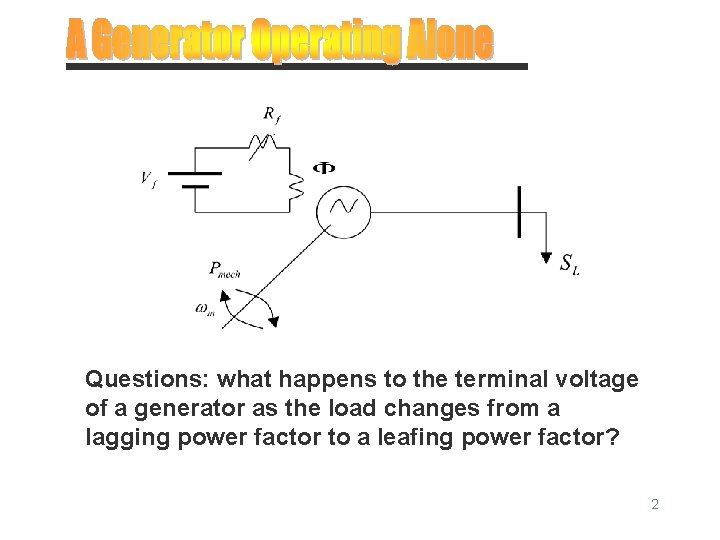
Questions: what happens to the terminal voltage of a generator as the load changes from a lagging power factor to a leafing power factor? 2
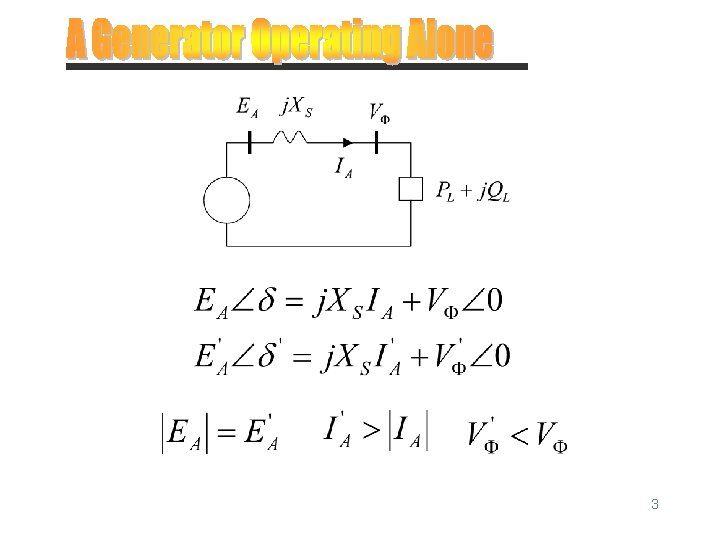
3
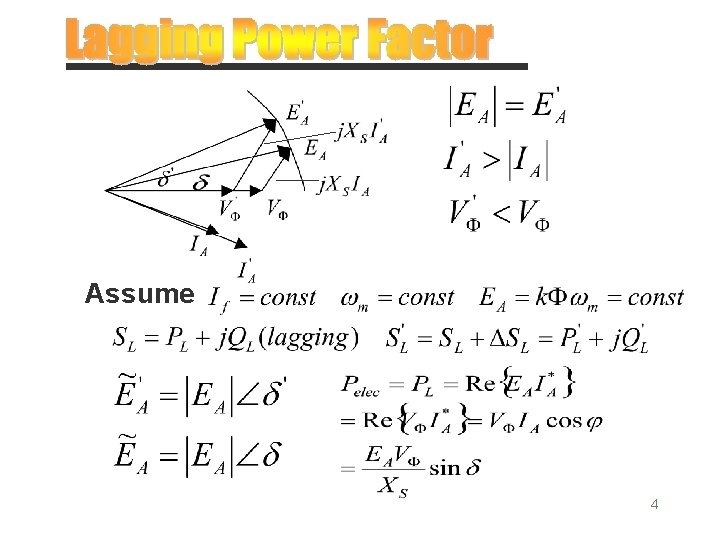
Assume 4
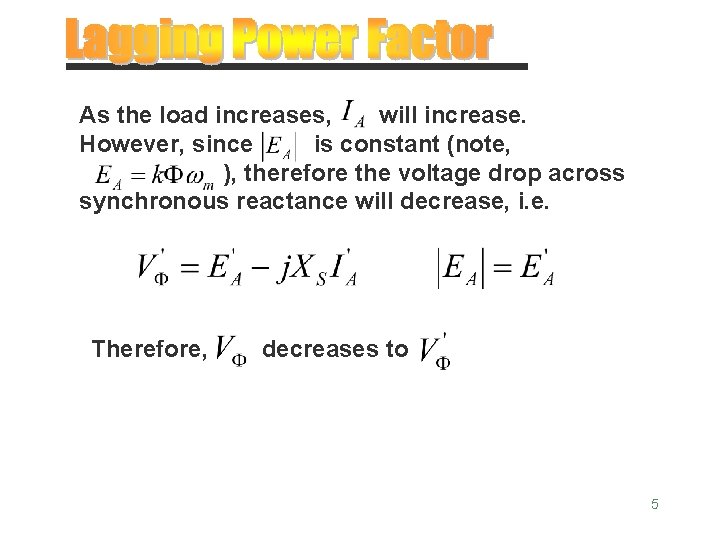
As the load increases, will increase. However, since is constant (note, ), therefore the voltage drop across synchronous reactance will decrease, i. e. Therefore, decreases to 5
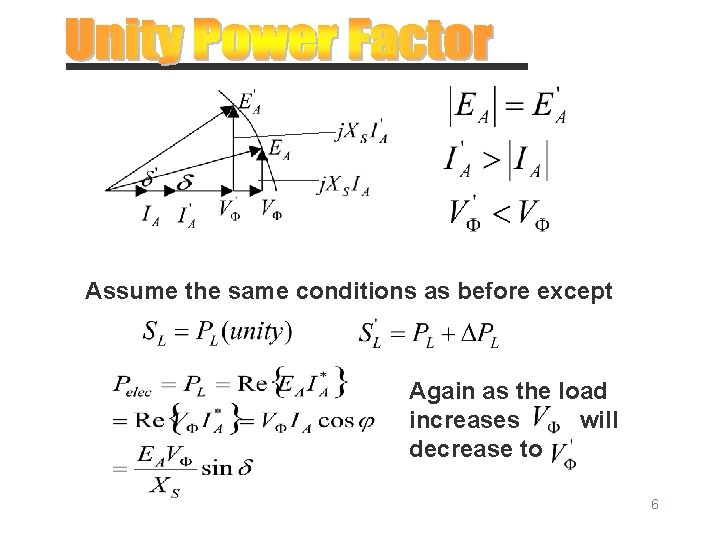
Assume the same conditions as before except Again as the load increases will decrease to 6
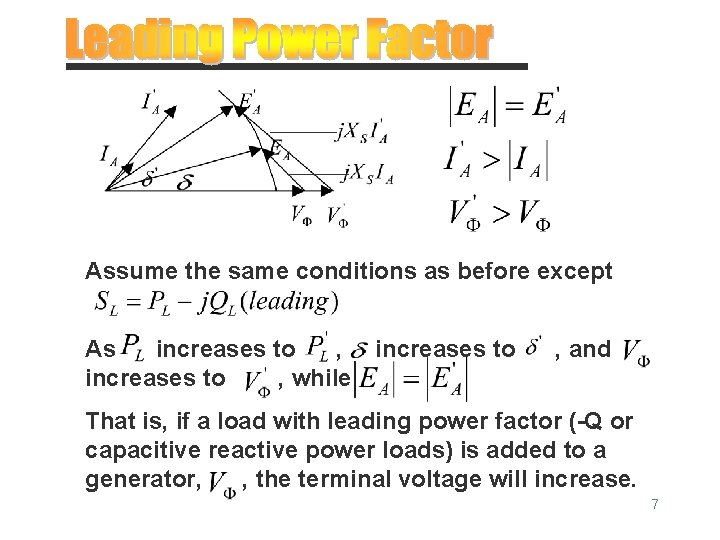
Assume the same conditions as before except As increases to , while , and That is, if a load with leading power factor (-Q or capacitive reactive power loads) is added to a generator, , the terminal voltage will increase. 7
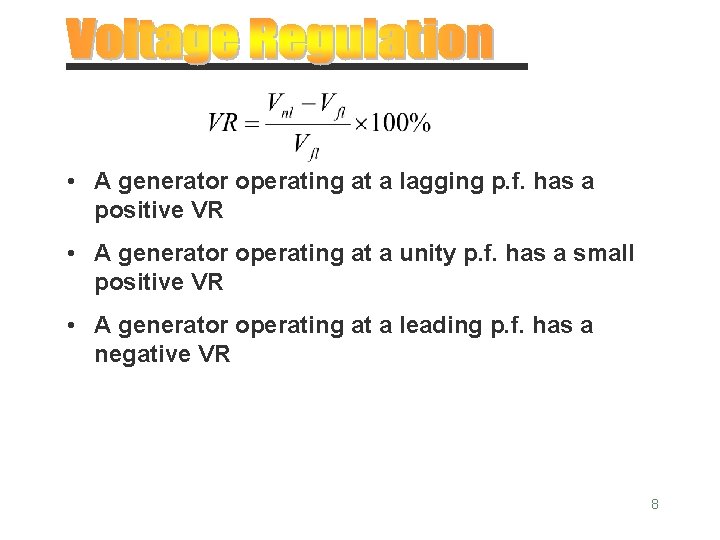
• A generator operating at a lagging p. f. has a positive VR • A generator operating at a unity p. f. has a small positive VR • A generator operating at a leading p. f. has a negative VR 8
Q 1: How must a generator’s field current be adjusted to keep VT constant as the load changes? Q 2: If the load changes and the field left alone, what happens to the terminal voltage? 9
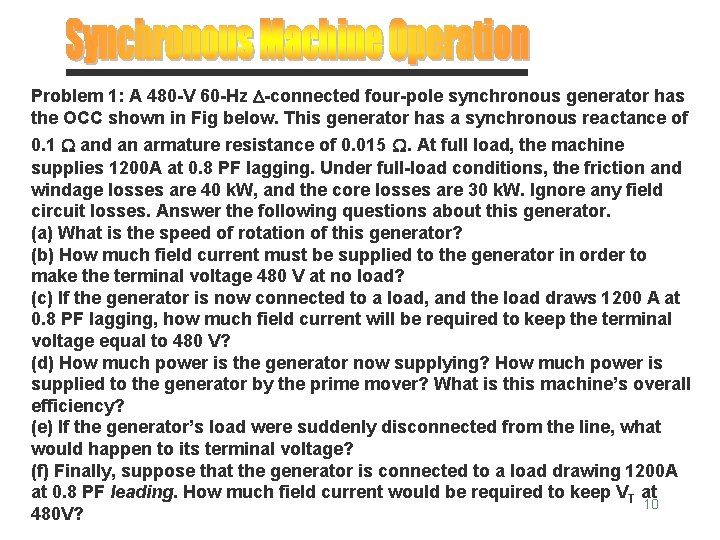
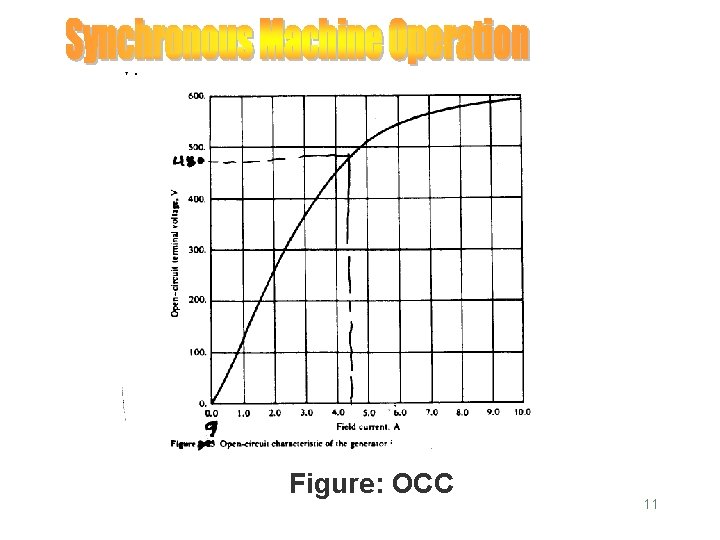
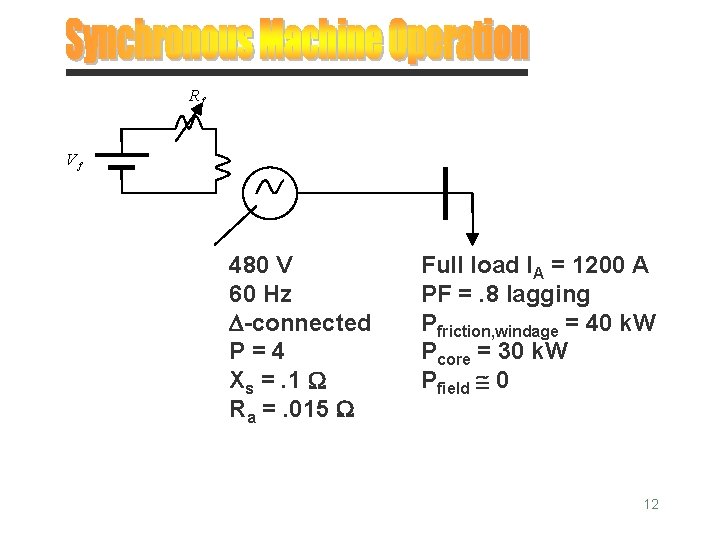
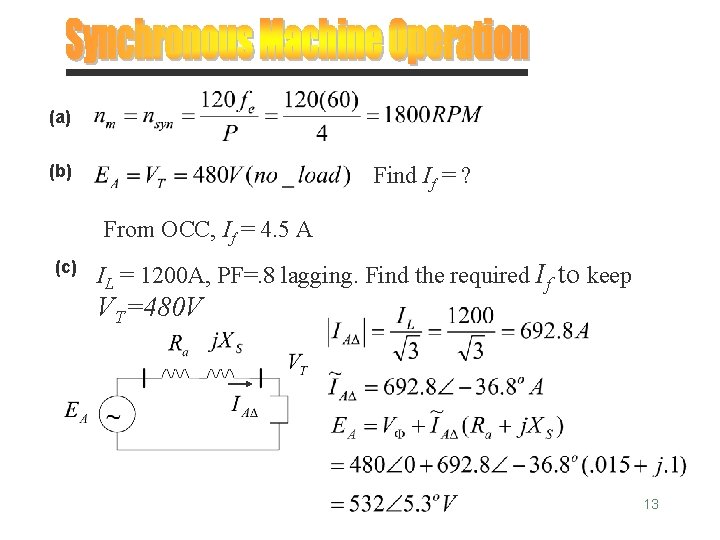
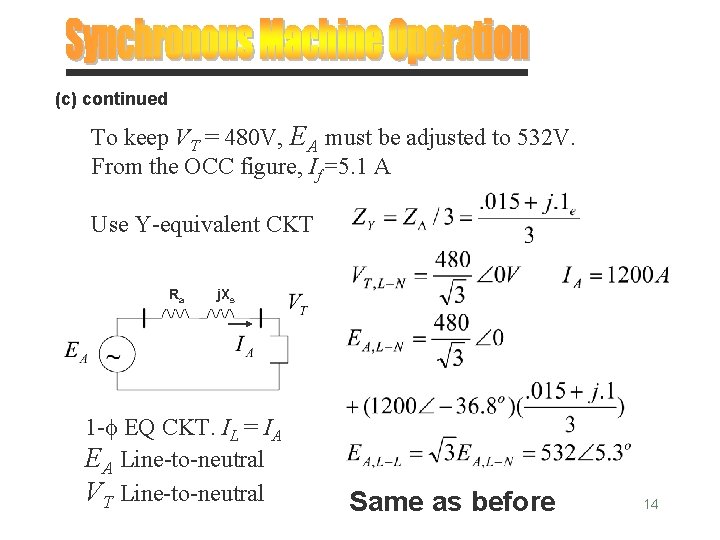
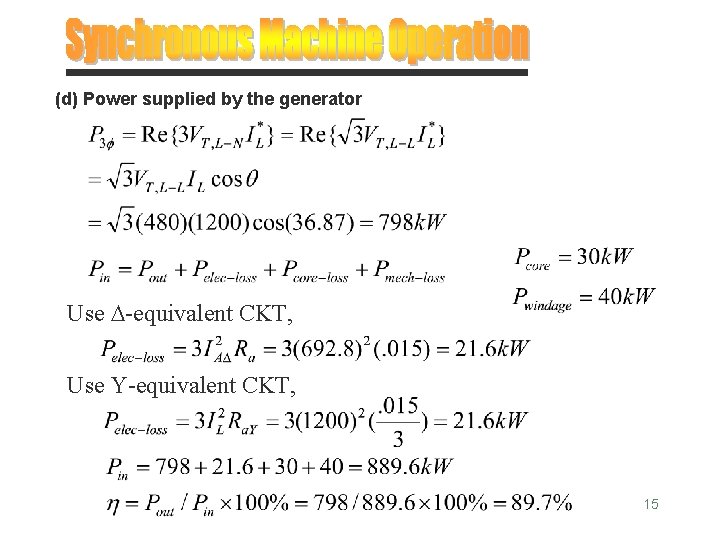
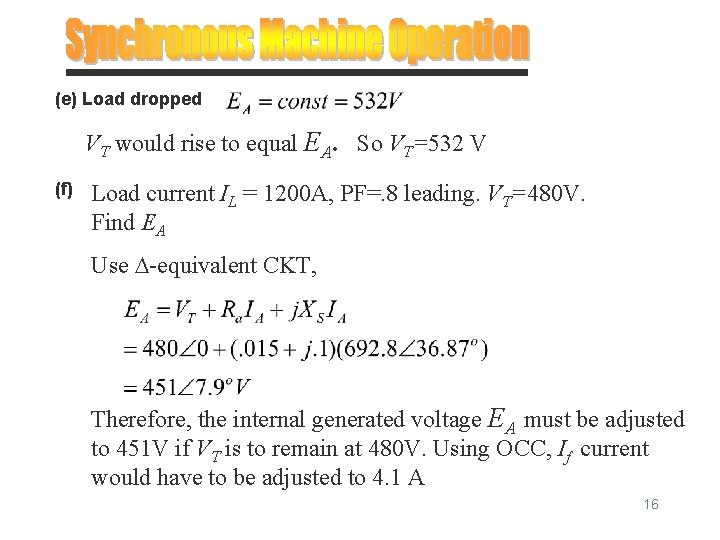
Problem 1: A 480 -V 60 -Hz -connected four-pole synchronous generator has the OCC shown in Fig below. This generator has a synchronous reactance of 0. 1 and an armature resistance of 0. 015 . At full load, the machine supplies 1200 A at 0. 8 PF lagging. Under full-load conditions, the friction and windage losses are 40 k. W, and the core losses are 30 k. W. Ignore any field circuit losses. Answer the following questions about this generator. (a) What is the speed of rotation of this generator? (b) How much field current must be supplied to the generator in order to make the terminal voltage 480 V at no load? (c) If the generator is now connected to a load, and the load draws 1200 A at 0. 8 PF lagging, how much field current will be required to keep the terminal voltage equal to 480 V? (d) How much power is the generator now supplying? How much power is supplied to the generator by the prime mover? What is this machine’s overall efficiency? (e) If the generator’s load were suddenly disconnected from the line, what would happen to its terminal voltage? (f) Finally, suppose that the generator is connected to a load drawing 1200 A at 0. 8 PF leading. How much field current would be required to keep V T at 10 480 V?
Figure: OCC 11
Rf Vf 480 V 60 Hz -connected P=4 Xs =. 1 Ra =. 015 Full load IA = 1200 A PF =. 8 lagging Pfriction, windage = 40 k. W Pcore = 30 k. W Pfield 0 12
(a) (b) Find If = ? From OCC, If = 4. 5 A (c) IL = 1200 A, PF=. 8 lagging. Find the required If to keep VT=480 V 13
(c) continued To keep VT = 480 V, EA must be adjusted to 532 V. From the OCC figure, If=5. 1 A Use Y-equivalent CKT Ra j. Xs 1 - EQ CKT. IL = IA EA Line-to-neutral VT Line-to-neutral Same as before 14
(d) Power supplied by the generator Use -equivalent CKT, Use Y-equivalent CKT, 15
(e) Load dropped VT would rise to equal EA. So VT=532 V (f) Load current IL = 1200 A, PF=. 8 leading. VT=480 V. Find EA Use -equivalent CKT, Therefore, the internal generated voltage EA must be adjusted to 451 V if VT is to remain at 480 V. Using OCC, If current would have to be adjusted to 4. 1 A 16
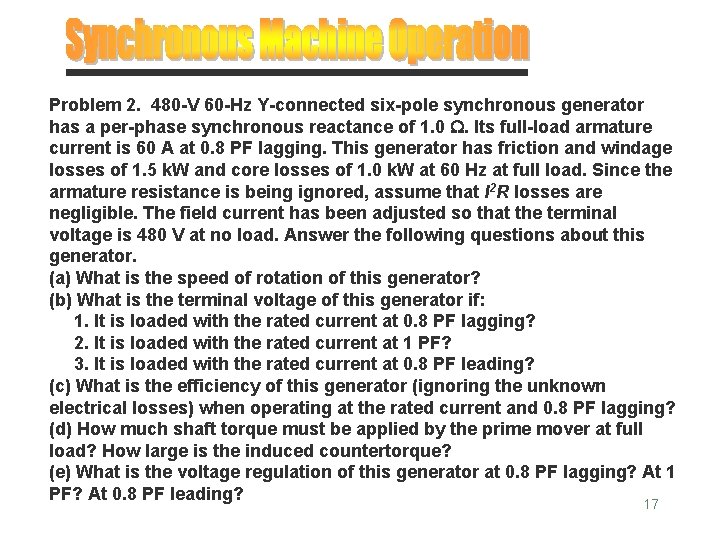
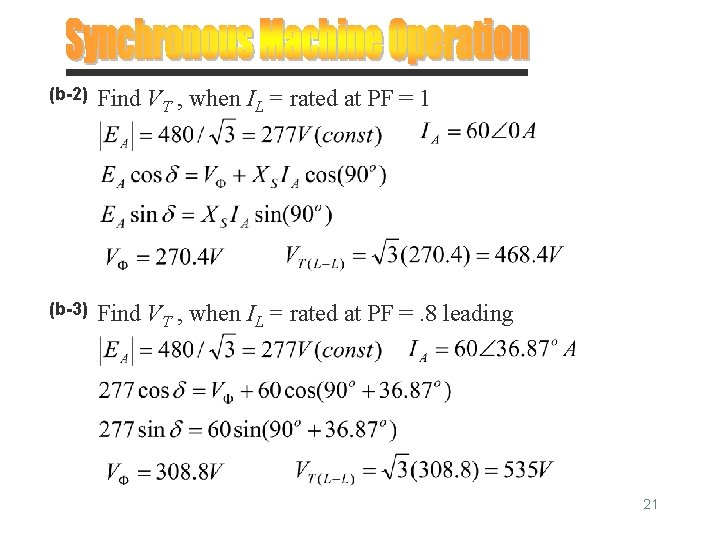
Problem 2. 480 -V 60 -Hz Y-connected six-pole synchronous generator has a per-phase synchronous reactance of 1. 0 . Its full-load armature current is 60 A at 0. 8 PF lagging. This generator has friction and windage losses of 1. 5 k. W and core losses of 1. 0 k. W at 60 Hz at full load. Since the armature resistance is being ignored, assume that I 2 R losses are negligible. The field current has been adjusted so that the terminal voltage is 480 V at no load. Answer the following questions about this generator. (a) What is the speed of rotation of this generator? (b) What is the terminal voltage of this generator if: 1. It is loaded with the rated current at 0. 8 PF lagging? 2. It is loaded with the rated current at 1 PF? 3. It is loaded with the rated current at 0. 8 PF leading? (c) What is the efficiency of this generator (ignoring the unknown electrical losses) when operating at the rated current and 0. 8 PF lagging? (d) How much shaft torque must be applied by the prime mover at full load? How large is the induced countertorque? (e) What is the voltage regulation of this generator at 0. 8 PF lagging? At 1 PF? At 0. 8 PF leading? 17
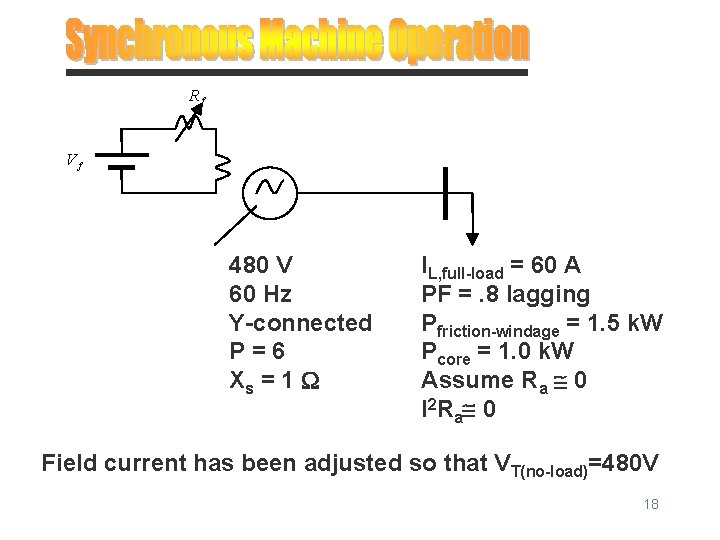
Rf Vf 480 V 60 Hz Y-connected P=6 Xs = 1 IL, full-load = 60 A PF =. 8 lagging Pfriction-windage = 1. 5 k. W Pcore = 1. 0 k. W Assume Ra 0 I 2 R a 0 Field current has been adjusted so that VT(no-load)=480 V 18
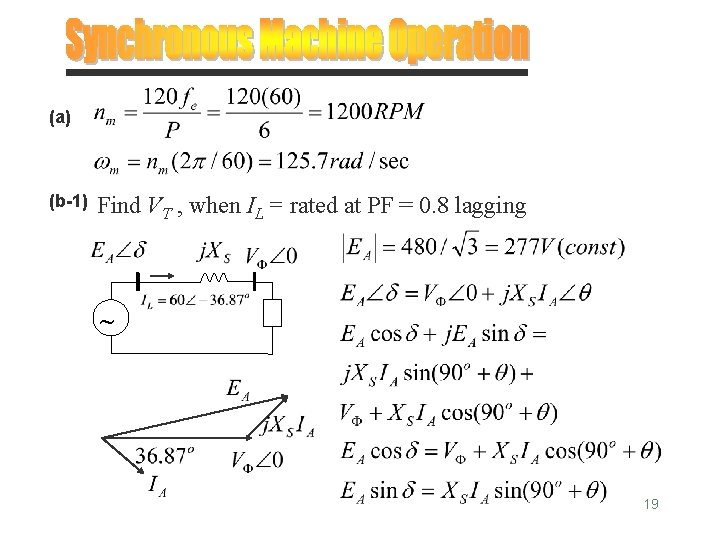
(a) (b-1) Find VT , when IL = rated at PF = 0. 8 lagging ~ 19
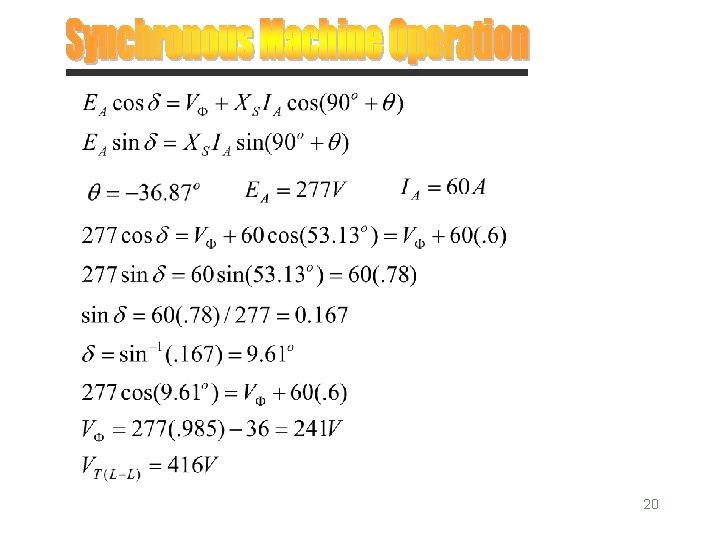
20
(b-2) Find VT , when IL = rated at PF = 1 (b-3) Find VT , when IL = rated at PF =. 8 leading 21