
A GCAM Hindcast Experiment Shows Useful Promise for
- Slides: 1
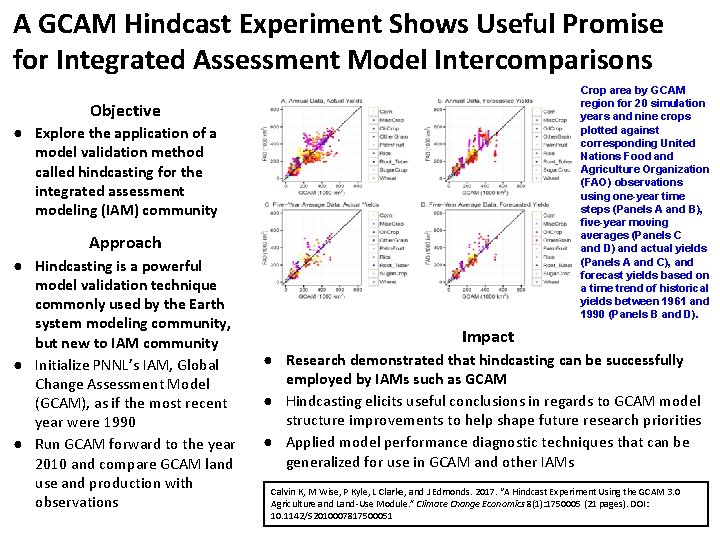
A GCAM Hindcast Experiment Shows Useful Promise for Integrated Assessment Model Intercomparisons Crop area by GCAM region for 20 simulation years and nine crops plotted against corresponding United Nations Food and Agriculture Organization (FAO) observations using one-year time steps (Panels A and B), five-year moving averages (Panels C and D) and actual yields (Panels A and C), and forecast yields based on a time trend of historical yields between 1961 and 1990 (Panels B and D). Objective ● Explore the application of a model validation method called hindcasting for the integrated assessment modeling (IAM) community Approach ● Hindcasting is a powerful model validation technique commonly used by the Earth system modeling community, but new to IAM community ● Initialize PNNL’s IAM, Global Change Assessment Model (GCAM), as if the most recent year were 1990 ● Run GCAM forward to the year 2010 and compare GCAM land use and production with observations Impact ● Research demonstrated that hindcasting can be successfully employed by IAMs such as GCAM ● Hindcasting elicits useful conclusions in regards to GCAM model structure improvements to help shape future research priorities ● Applied model performance diagnostic techniques that can be generalized for use in GCAM and other IAMs Calvin K, M Wise, P Kyle, L Clarke, and J Edmonds. 2017. “A Hindcast Experiment Using the GCAM 3. 0 Agriculture and Land-Use Module. ” Climate Change Economics 8(1): 1750005 (21 pages). DOI: 10. 1142/S 2010007817500051