
A Functional Role for the Minicolumn in Cortical
- Slides: 31
A Functional Role for the Minicolumn in Cortical Population Coding Gerard Rinkus Lisman Lab, Biology Dept. Brandeis University Cortical Modularity in Autism Symposium – Oct 12 -14, 2007 1
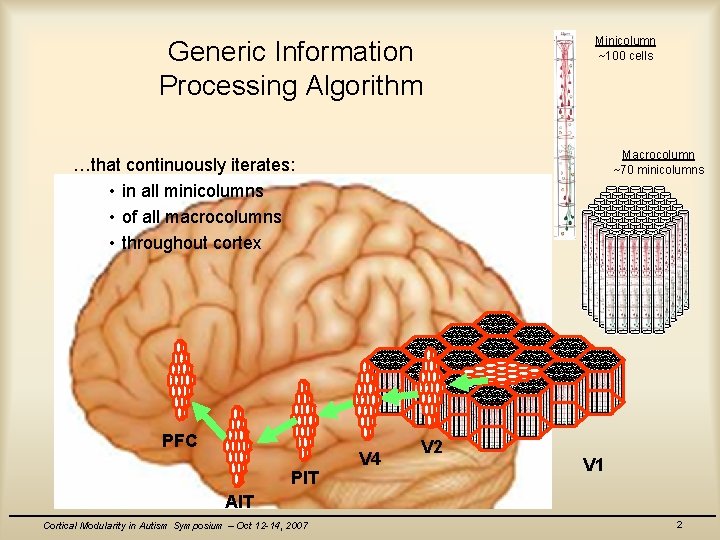
Generic Information Processing Algorithm Minicolumn ~100 cells Macrocolumn ~70 minicolumns …that continuously iterates: • in all minicolumns • of all macrocolumns • throughout cortex PFC PIT V 4 V 2 V 1 AIT Cortical Modularity in Autism Symposium – Oct 12 -14, 2007 2
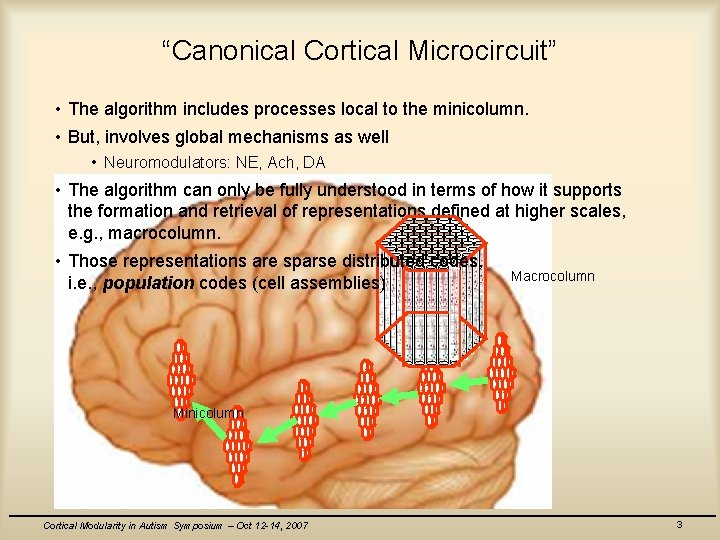
“Canonical Cortical Microcircuit” • The algorithm includes processes local to the minicolumn. • But, involves global mechanisms as well • Neuromodulators: NE, Ach, DA • The algorithm can only be fully understood in terms of how it supports the formation and retrieval of representations defined at higher scales, e. g. , macrocolumn. • Those representations are sparse distributed codes, i. e. , population codes (cell assemblies) Macrocolumn Minicolumn Cortical Modularity in Autism Symposium – Oct 12 -14, 2007 3
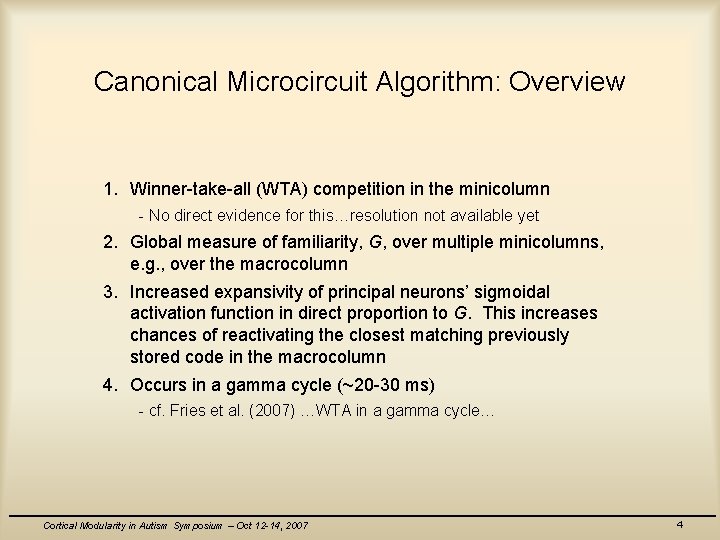
Canonical Microcircuit Algorithm: Overview 1. Winner-take-all (WTA) competition in the minicolumn - No direct evidence for this…resolution not available yet 2. Global measure of familiarity, G, over multiple minicolumns, e. g. , over the macrocolumn 3. Increased expansivity of principal neurons’ sigmoidal activation function in direct proportion to G. This increases chances of reactivating the closest matching previously stored code in the macrocolumn 4. Occurs in a gamma cycle (~20 -30 ms) - cf. Fries et al. (2007) …WTA in a gamma cycle… Cortical Modularity in Autism Symposium – Oct 12 -14, 2007 4
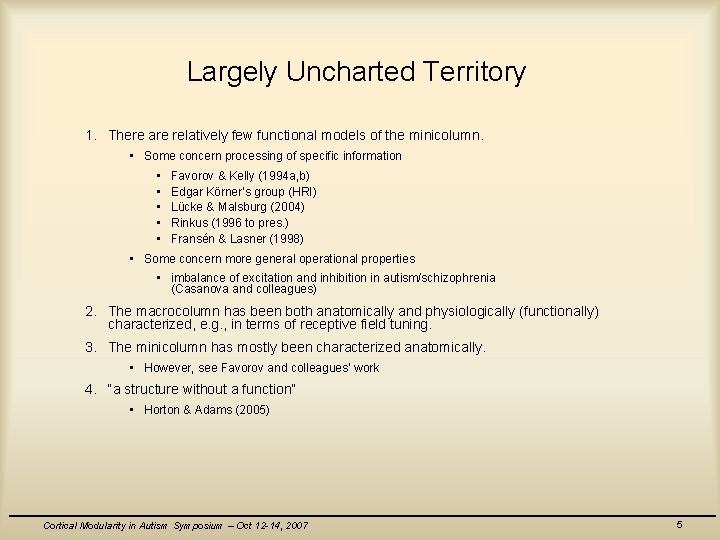
Largely Uncharted Territory 1. There are relatively few functional models of the minicolumn. • Some concern processing of specific information • • • Favorov & Kelly (1994 a, b) Edgar Körner’s group (HRI) Lücke & Malsburg (2004) Rinkus (1996 to pres. ) Fransén & Lasner (1998) • Some concern more general operational properties • imbalance of excitation and inhibition in autism/schizophrenia (Casanova and colleagues) 2. The macrocolumn has been both anatomically and physiologically (functionally) characterized, e. g. , in terms of receptive field tuning. 3. The minicolumn has mostly been characterized anatomically. • However, see Favorov and colleagues’ work 4. “a structure without a function” • Horton & Adams (2005) Cortical Modularity in Autism Symposium – Oct 12 -14, 2007 5
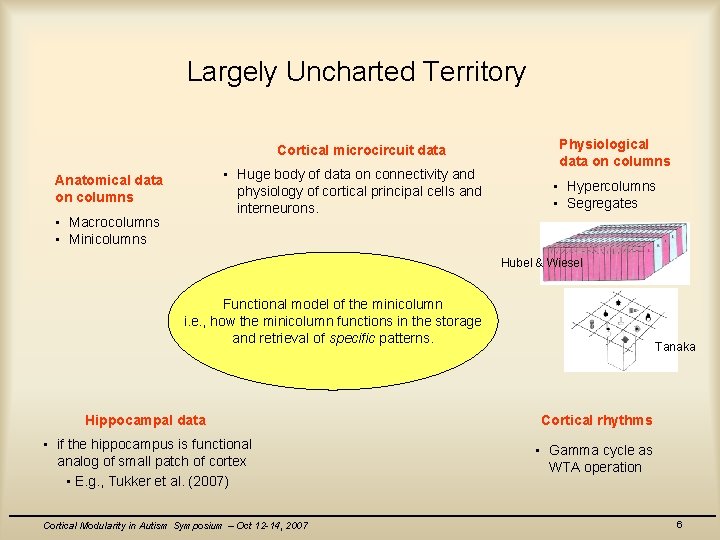
Largely Uncharted Territory Cortical microcircuit data • Huge body of data on connectivity and physiology of cortical principal cells and interneurons. Anatomical data on columns • Macrocolumns • Minicolumns Physiological data on columns • Hypercolumns • Segregates Hubel & Wiesel Functional model of the minicolumn i. e. , how the minicolumn functions in the storage and retrieval of specific patterns. Tanaka Hippocampal data Cortical rhythms • if the hippocampus is functional analog of small patch of cortex • E. g. , Tukker et al. (2007) • Gamma cycle as WTA operation Cortical Modularity in Autism Symposium – Oct 12 -14, 2007 6
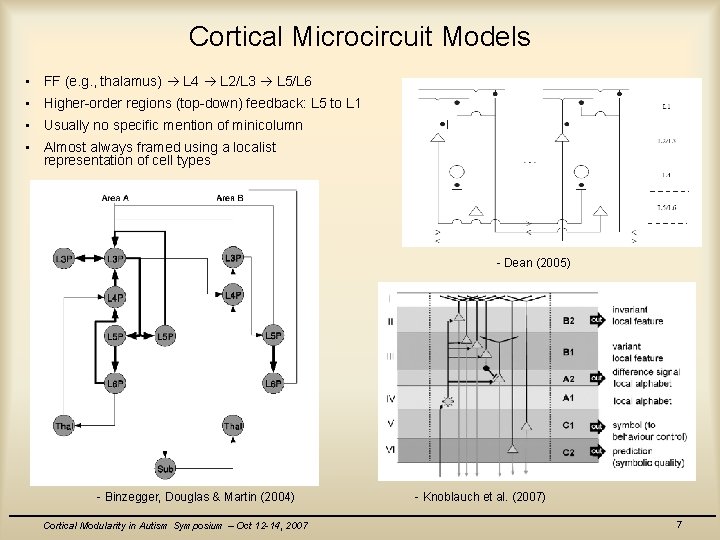
Cortical Microcircuit Models • FF (e. g. , thalamus) L 4 L 2/L 3 L 5/L 6 • Higher-order regions (top-down) feedback: L 5 to L 1 • Usually no specific mention of minicolumn • Almost always framed using a localist representation of cell types - Dean (2005) - Binzegger, Douglas & Martin (2004) Cortical Modularity in Autism Symposium – Oct 12 -14, 2007 - Knoblauch et al. (2007) 7
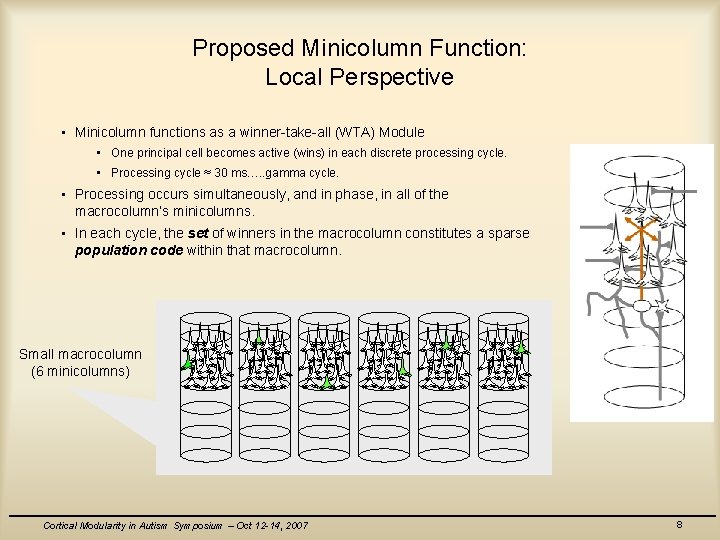
Proposed Minicolumn Function: Local Perspective • Minicolumn functions as a winner-take-all (WTA) Module • One principal cell becomes active (wins) in each discrete processing cycle. • Processing cycle ≈ 30 ms…. . gamma cycle. • Processing occurs simultaneously, and in phase, in all of the macrocolumn’s minicolumns. • In each cycle, the set of winners in the macrocolumn constitutes a sparse population code within that macrocolumn. Small macrocolumn (6 minicolumns) Cortical Modularity in Autism Symposium – Oct 12 -14, 2007 8
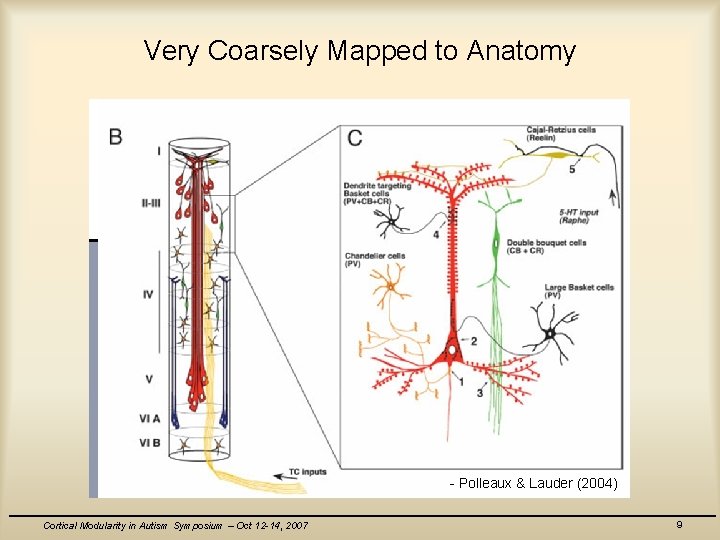
Very Coarsely Mapped to Anatomy - Polleaux & Lauder (2004) Cortical Modularity in Autism Symposium – Oct 12 -14, 2007 9
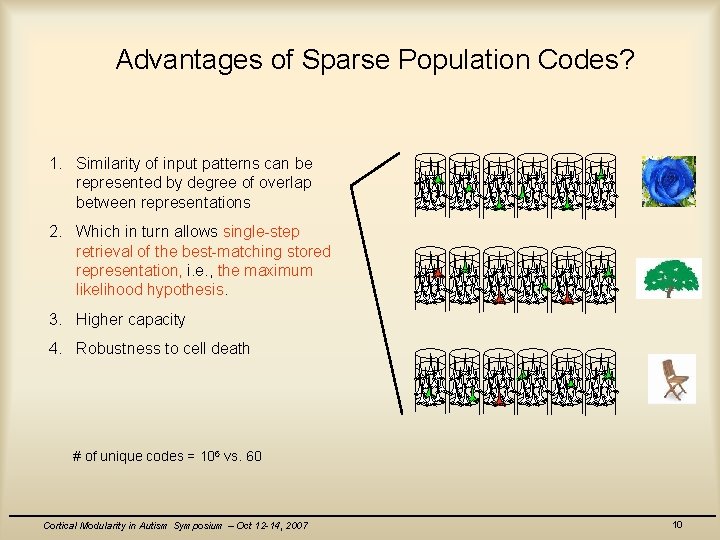
Advantages of Sparse Population Codes? 1. Similarity of input patterns can be represented by degree of overlap between representations 2. Which in turn allows single-step retrieval of the best-matching stored representation, i. e. , the maximum likelihood hypothesis. 3. Higher capacity 4. Robustness to cell death # of unique codes = 106 vs. 60 Cortical Modularity in Autism Symposium – Oct 12 -14, 2007 10
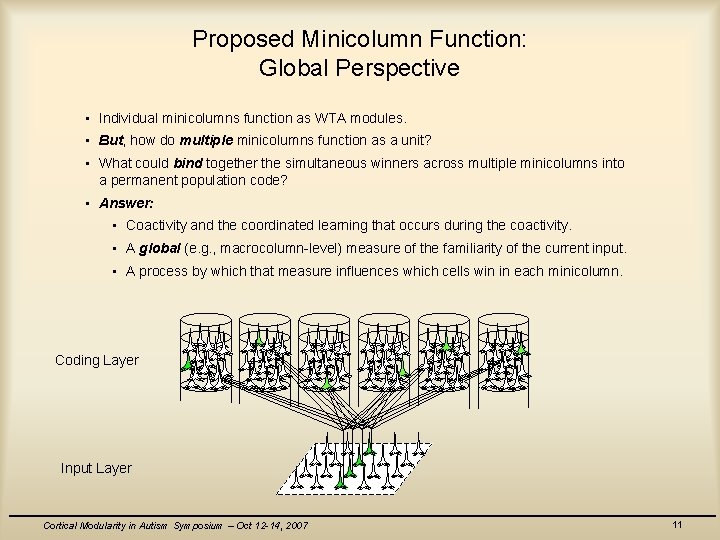
Proposed Minicolumn Function: Global Perspective • Individual minicolumns function as WTA modules. • But, how do multiple minicolumns function as a unit? • What could bind together the simultaneous winners across multiple minicolumns into a permanent population code? • Answer: • Coactivity and the coordinated learning that occurs during the coactivity. • A global (e. g. , macrocolumn-level) measure of the familiarity of the current input. • A process by which that measure influences which cells win in each minicolumn. Coding Layer Input Layer Cortical Modularity in Autism Symposium – Oct 12 -14, 2007 11
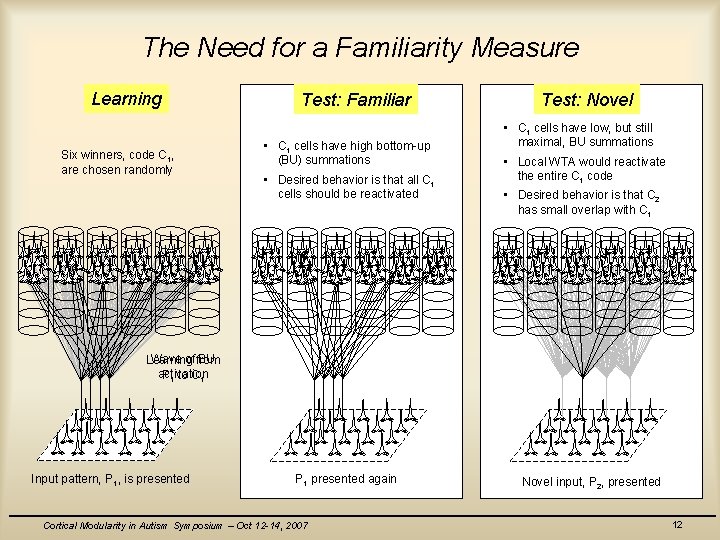
The Need for a Familiarity Measure Learning Six winners, code C 1, are chosen randomly Test: Familiar • C 1 cells have high bottom-up (BU) summations • Desired behavior is that all C 1 cells should be reactivated Test: Novel • C 1 cells have low, but still maximal, BU summations • Local WTA would reactivate the entire C 1 code • Desired behavior is that C 2 has small overlap with C 1 Wave of from BU Learning activation P 1 to C 1 Input pattern, P 1, is presented P 1 presented again Cortical Modularity in Autism Symposium – Oct 12 -14, 2007 Novel input, P 2, presented 12
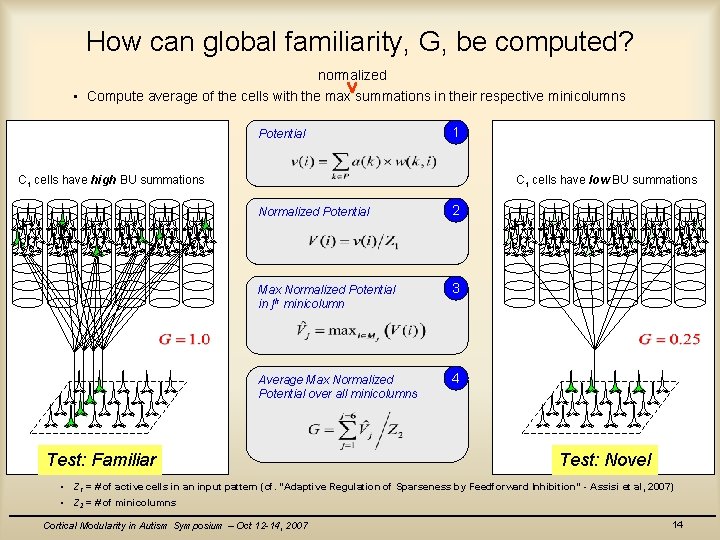
How can global familiarity, G, be computed? normalized • Compute average of the cells with the max summations in their respective minicolumns Potential 1 C 1 cells have high BU summations C 1 cells have low BU summations Normalized Potential 2 Max Normalized Potential in jth minicolumn 3 Average Max Normalized Potential over all minicolumns 4 Test: Familiar Test: Novel • Z 1 = # of active cells in an input pattern (cf. “Adaptive Regulation of Sparseness by Feedforward Inhibition” - Assisi et al, 2007) • Z 2 = # of minicolumns Cortical Modularity in Autism Symposium – Oct 12 -14, 2007 14
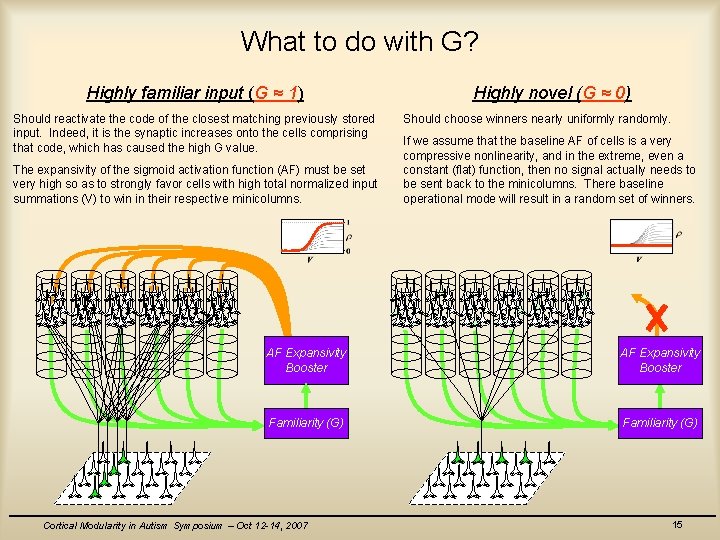
What to do with G? Highly familiar input (G ≈ 1) Should reactivate the code of the closest matching previously stored input. Indeed, it is the synaptic increases onto the cells comprising that code, which has caused the high G value. The expansivity of the sigmoid activation function (AF) must be set very high so as to strongly favor cells with high total normalized input summations (V) to win in their respective minicolumns. Highly novel (G ≈ 0) Should choose winners nearly uniformly randomly. If we assume that the baseline AF of cells is a very compressive nonlinearity, and in the extreme, even a constant (flat) function, then no signal actually needs to be sent back to the minicolumns. There baseline operational mode will result in a random set of winners. AF Expansivity Booster Familiarity (G) Cortical Modularity in Autism Symposium – Oct 12 -14, 2007 15
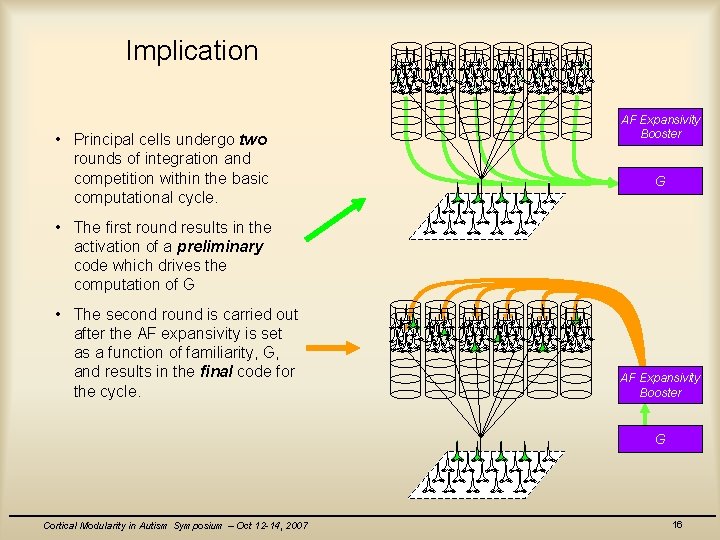
Implication • Principal cells undergo two rounds of integration and competition within the basic computational cycle. AF Expansivity Booster G • The first round results in the activation of a preliminary code which drives the computation of G • The second round is carried out after the AF expansivity is set as a function of familiarity, G, and results in the final code for the cycle. AF Expansivity Booster G Cortical Modularity in Autism Symposium – Oct 12 -14, 2007 16
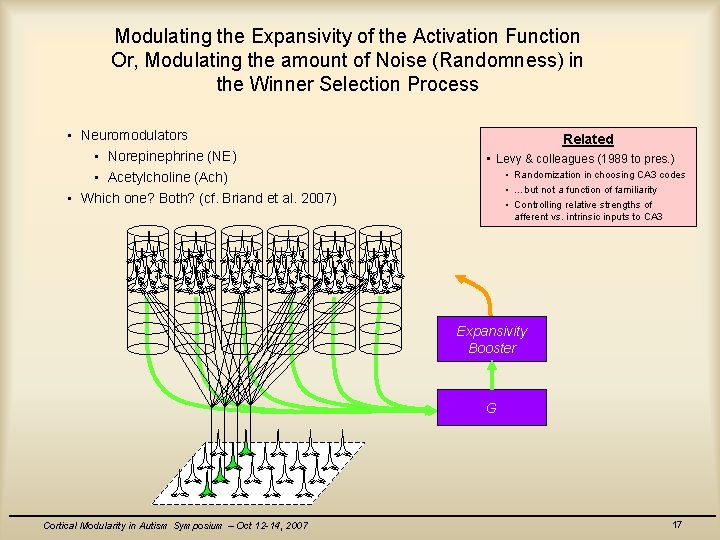
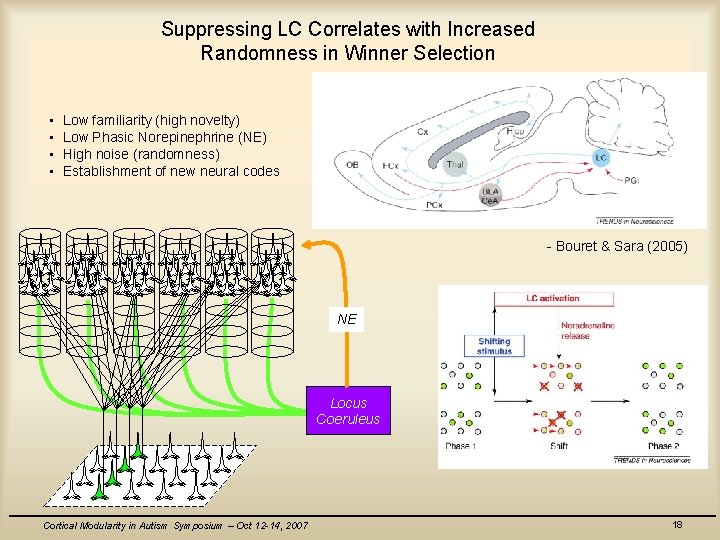
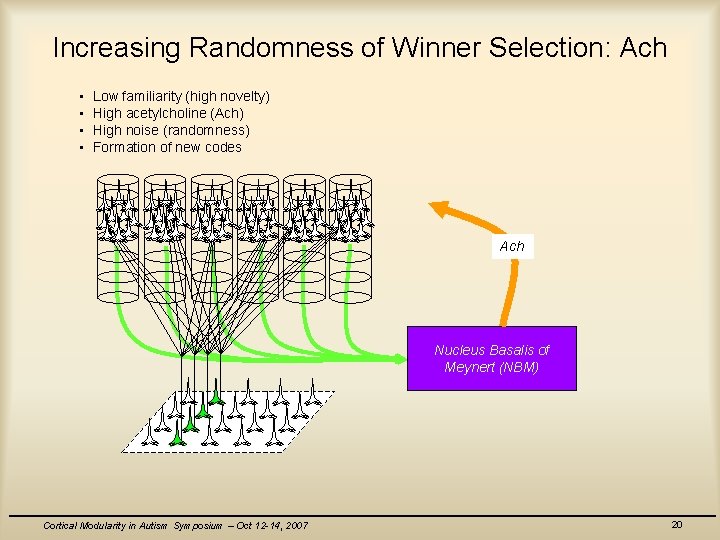
Modulating the Expansivity of the Activation Function Or, Modulating the amount of Noise (Randomness) in the Winner Selection Process • Neuromodulators • Norepinephrine (NE) • Acetylcholine (Ach) • Which one? Both? (cf. Briand et al. 2007) Related • Levy & colleagues (1989 to pres. ) • Randomization in choosing CA 3 codes • …but not a function of familiarity • Controlling relative strengths of afferent vs. intrinsic inputs to CA 3 Expansivity Booster G Cortical Modularity in Autism Symposium – Oct 12 -14, 2007 17
Suppressing LC Correlates with Increased Randomness in Winner Selection • • Low familiarity (high novelty) Low Phasic Norepinephrine (NE) High noise (randomness) Establishment of new neural codes - Bouret & Sara (2005) NE Locus Coeruleus Cortical Modularity in Autism Symposium – Oct 12 -14, 2007 18
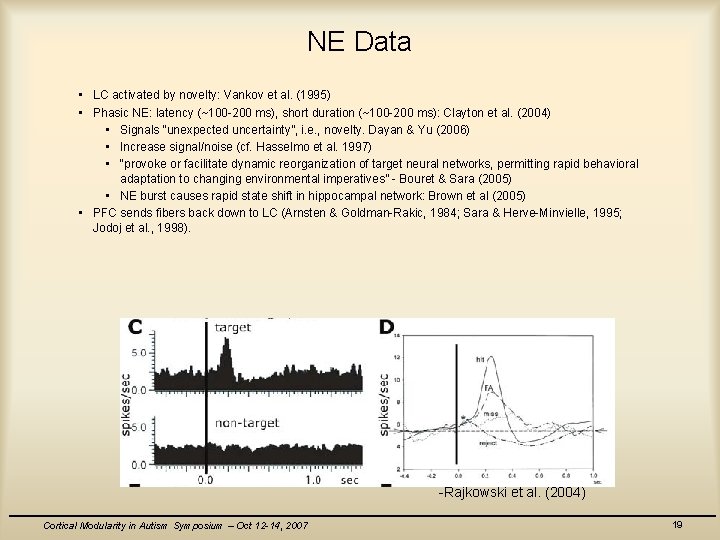
NE Data • LC activated by novelty: Vankov et al. (1995) • Phasic NE: latency (~100 -200 ms), short duration (~100 -200 ms): Clayton et al. (2004) • Signals “unexpected uncertainty”, i. e. , novelty. Dayan & Yu (2006) • Increase signal/noise (cf. Hasselmo et al. 1997) • “provoke or facilitate dynamic reorganization of target neural networks, permitting rapid behavioral adaptation to changing environmental imperatives” - Bouret & Sara (2005) • NE burst causes rapid state shift in hippocampal network: Brown et al (2005) • PFC sends fibers back down to LC (Arnsten & Goldman-Rakic, 1984; Sara & Herve-Minvielle, 1995; Jodoj et al. , 1998). -Rajkowski et al. (2004) Cortical Modularity in Autism Symposium – Oct 12 -14, 2007 19
Increasing Randomness of Winner Selection: Ach • • Low familiarity (high novelty) High acetylcholine (Ach) High noise (randomness) Formation of new codes Ach Nucleus Basalis of Meynert (NBM) Cortical Modularity in Autism Symposium – Oct 12 -14, 2007 20
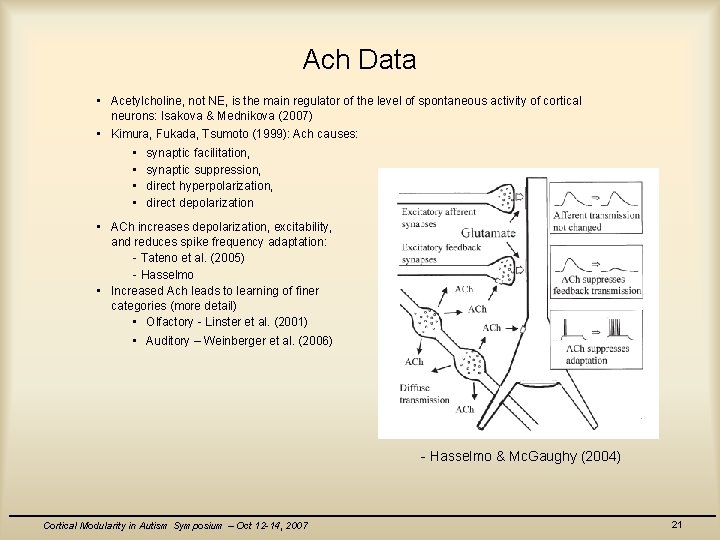
Ach Data • Acetylcholine, not NE, is the main regulator of the level of spontaneous activity of cortical neurons: Isakova & Mednikova (2007) • Kimura, Fukada, Tsumoto (1999): Ach causes: • synaptic facilitation, • synaptic suppression, • direct hyperpolarization, • direct depolarization • ACh increases depolarization, excitability, and reduces spike frequency adaptation: - Tateno et al. (2005) - Hasselmo • Increased Ach leads to learning of finer categories (more detail) • Olfactory - Linster et al. (2001) • Auditory – Weinberger et al. (2006) - Hasselmo & Mc. Gaughy (2004) Cortical Modularity in Autism Symposium – Oct 12 -14, 2007 21
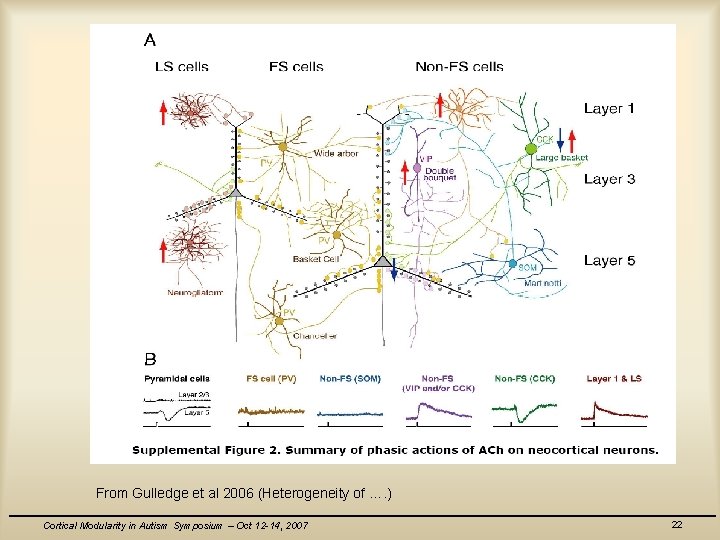
From Gulledge et al 2006 (Heterogeneity of …. ) Cortical Modularity in Autism Symposium – Oct 12 -14, 2007 22
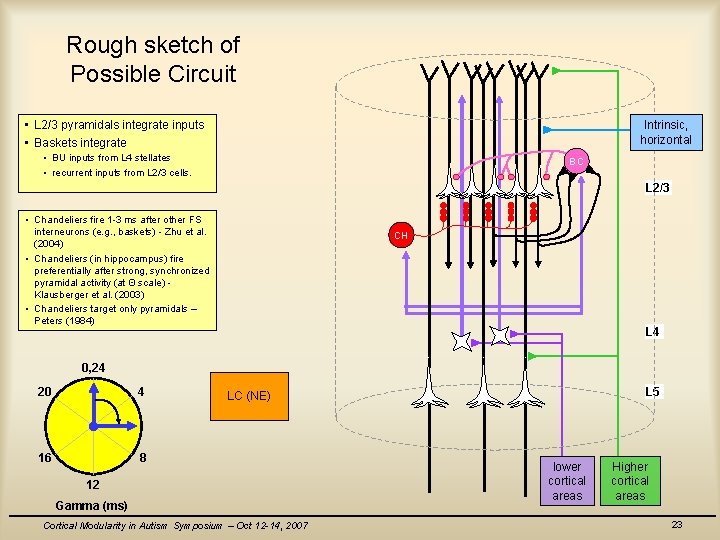
Rough sketch of Possible Circuit • L 2/3 pyramidals integrate inputs • Baskets integrate Intrinsic, horizontal • BU inputs from L 4 stellates • recurrent inputs from L 2/3 cells. BC L 2/3 • Chandeliers fire 1 -3 ms after other FS interneurons (e. g. , baskets) - Zhu et al. (2004) • Chandeliers (in hippocampus) fire preferentially after strong, synchronized pyramidal activity (at Θ scale) Klausberger et al. (2003) • Chandeliers target only pyramidals – Peters (1984) CH L 4 0, 24 20 4 16 8 L 5 LC (NE) 12 Gamma (ms) Cortical Modularity in Autism Symposium – Oct 12 -14, 2007 lower cortical areas Higher cortical areas 23
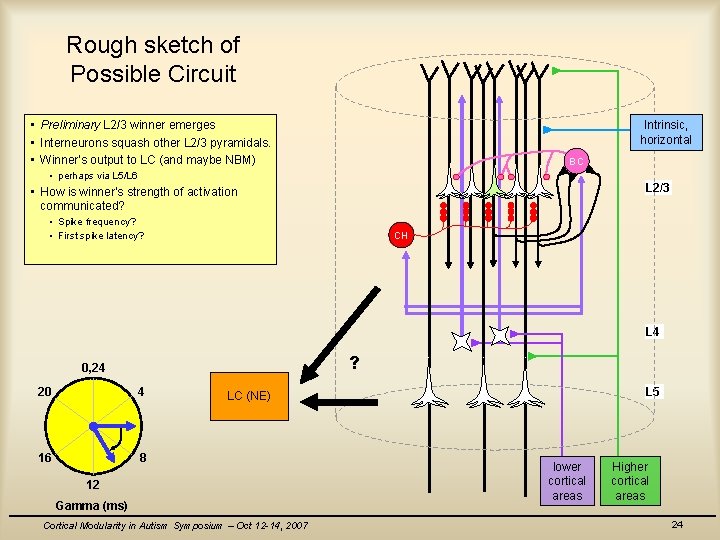
Rough sketch of Possible Circuit • Preliminary L 2/3 winner emerges • Interneurons squash other L 2/3 pyramidals. • Winner’s output to LC (and maybe NBM) Intrinsic, horizontal BC • perhaps via L 5/L 6 L 2/3 • How is winner’s strength of activation communicated? • Spike frequency? • First spike latency? CH L 4 ? 0, 24 20 4 16 8 L 5 LC (NE) 12 Gamma (ms) Cortical Modularity in Autism Symposium – Oct 12 -14, 2007 lower cortical areas Higher cortical areas 24
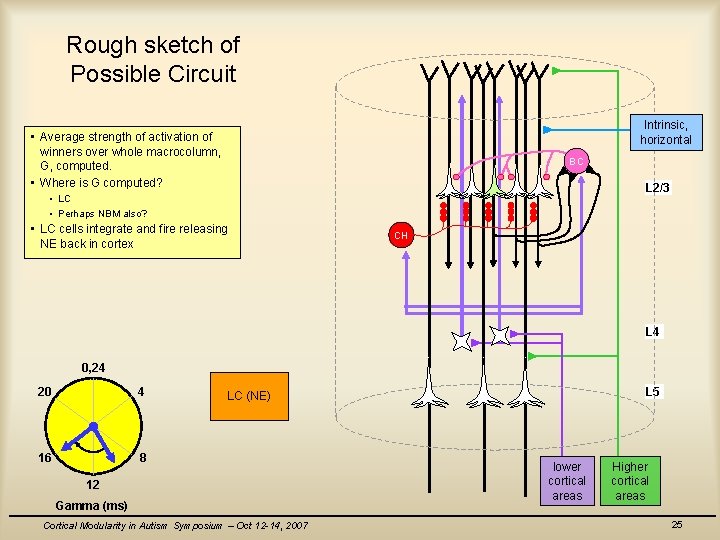
Rough sketch of Possible Circuit Intrinsic, horizontal • Average strength of activation of winners over whole macrocolumn, G, computed. • Where is G computed? BC L 2/3 • LC • Perhaps NBM also? • LC cells integrate and fire releasing NE back in cortex CH L 4 0, 24 20 4 16 8 L 5 LC (NE) 12 Gamma (ms) Cortical Modularity in Autism Symposium – Oct 12 -14, 2007 lower cortical areas Higher cortical areas 25
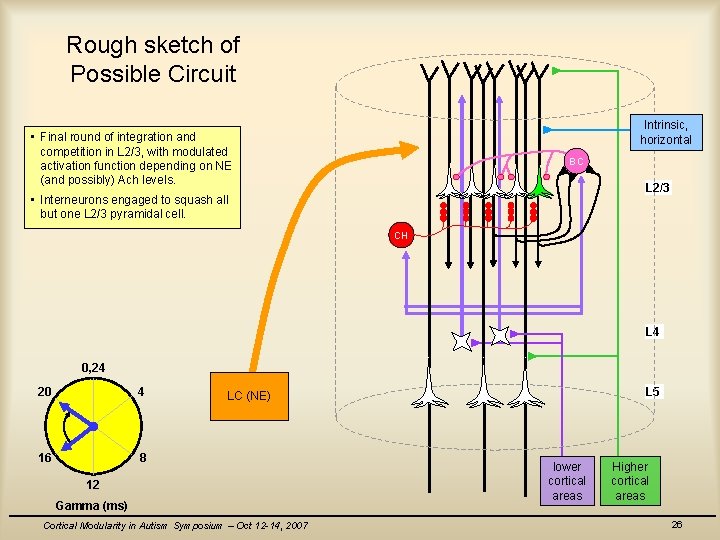
Rough sketch of Possible Circuit Intrinsic, horizontal • Final round of integration and competition in L 2/3, with modulated activation function depending on NE (and possibly) Ach levels. BC L 2/3 • Interneurons engaged to squash all but one L 2/3 pyramidal cell. CH L 4 0, 24 20 4 16 8 L 5 LC (NE) 12 Gamma (ms) Cortical Modularity in Autism Symposium – Oct 12 -14, 2007 lower cortical areas Higher cortical areas 26
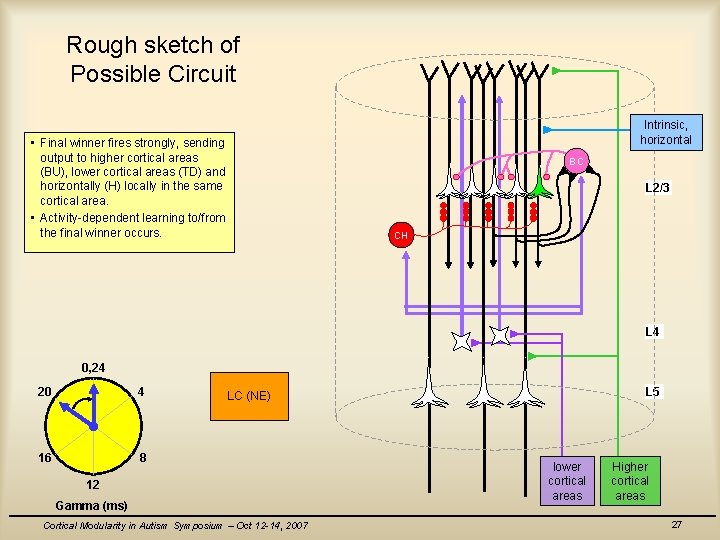
Rough sketch of Possible Circuit Intrinsic, horizontal • Final winner fires strongly, sending output to higher cortical areas (BU), lower cortical areas (TD) and horizontally (H) locally in the same cortical area. • Activity-dependent learning to/from the final winner occurs. BC L 2/3 CH L 4 0, 24 20 4 16 8 L 5 LC (NE) 12 Gamma (ms) Cortical Modularity in Autism Symposium – Oct 12 -14, 2007 lower cortical areas Higher cortical areas 27
Issues 1. NE, release latency is ~100 -100 ms from detection of match between expected and actual input. • Theory requires sub-gamma time scale, i. e. , ~10 ms, latency. • Solution: NE release depends only on results of algorithm running in PFC, NOT earlier cortices. • Similar consideration for Ach. • No direct data that minicolumn functions as a WTA module • Experimental methods cannot resolve the question yet. Cortical Modularity in Autism Symposium – Oct 12 -14, 2007 28
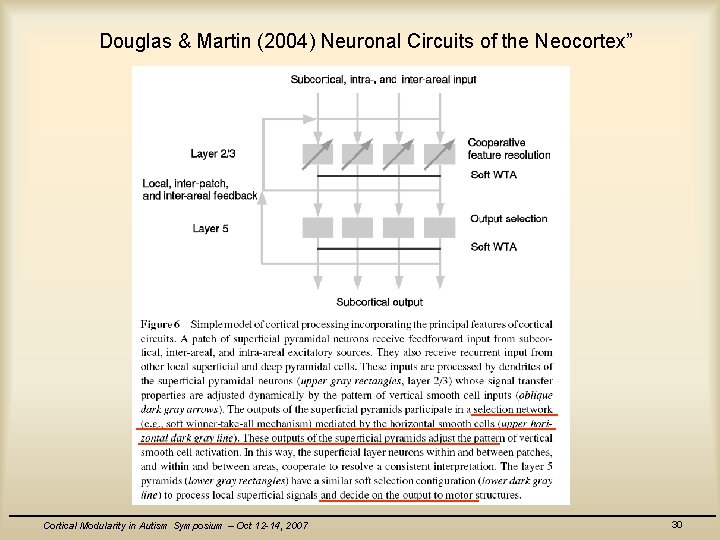
Questions 1. Do the baskets implement WTA in L 2/L 3? 2. Do the chandeliers keep L 2/L 3 pyramidals from firing while winners are being determined, i. e. , during integration of inputs? 3. Are the chandeliers used to prevent firing during both rounds of integration? 4. Do large and small baskets have distinct functional roles? 5. Must the round 1 (prelim. ) winners be completely inhibited (i. e. , back to some baseline) prior to the second round of integration, or not? 6. Rather than supposing that the same minicolumn sub-population, the L 2/3 pyramidals, is engaged twice in quick succession during a single cycle, could it be that the first round occurs in L 2/3 and the second in L 5 (or L 5/6) (see next slide)? 7. Which cortical cells send axons to LC and NBM (or BFCS)? 8. Assuming that L 2/3 is used for both rounds of representation in a cycle, preliminary and final, why would no learning occur onto cells that win in the first round? Cortical Modularity in Autism Symposium – Oct 12 -14, 2007 29
Douglas & Martin (2004) Neuronal Circuits of the Neocortex” Cortical Modularity in Autism Symposium – Oct 12 -14, 2007 30
Acknowledgement John Lisman (Brandeis) partially supported by NIH Conte Center grant P 50 MH 060450 Redwood Neuroscience Institute (Jeff Hawkins) Cortical Modularity in Autism Symposium – Oct 12 -14, 2007 32
References Cortical Modularity in Autism Symposium – Oct 12 -14, 2007 33