
a function whose value is a constant raised
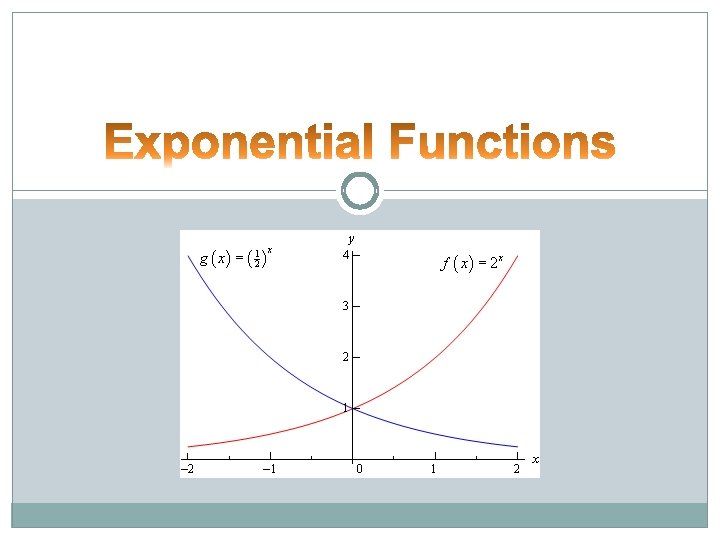

- Slides: 11
�a function whose value is a constant raised to the power of the argument, especially the function where the constant is e.
� A exponential function has a crescent moon shaped graph. Often used to model populations, express carbon dating and also often used in Physics. � Y=a*b^x � A= starting value � x= value that is repeatedly multiplied
�Domain is defined as the x values in a graph �For exponential functions the domain is all real numbers (-∞, ∞). �Why? The domain of this exponential function is all real numbers, since that is the domain of all exponential functions, because an exponential equation can be evaluated for all values of x.
�Range is defined as the y values on a graph. �The range of exponential functions always end with (x, ∞) but the x can be any number depending on where the graph is placed. �Why? Because exponential functions are flat on the bottom so the x will vary depending if the graph is at 0 or 5, the second value will always be infinite because the graph will continue on forever. �In order to find the range you find the y minimum value and the y maximum value and that is the range.
�An asymptote is a vertical or horizontal line on a graph which a function approaches. �Exponential functions may have vertical and horizontal asymptotes.
�Only complex exponential functions are said to be periodic. �If the periodic functions has a repeating pattern, then the function is said to have periodicity. � If the function does not repeat or have a pattern then it is said to not have periodicity.
�Exponential Functions can have roots. �There are normally roots along the midline, where the midline and a point on the graph hit. �Complex Exponential Functions have many roots.
�Exponential functions are popular in Physics, determining half life, carbon dating and creating model populations. �Many real world problems relate and use exponential graphs to express real world issues and solve real world problems.
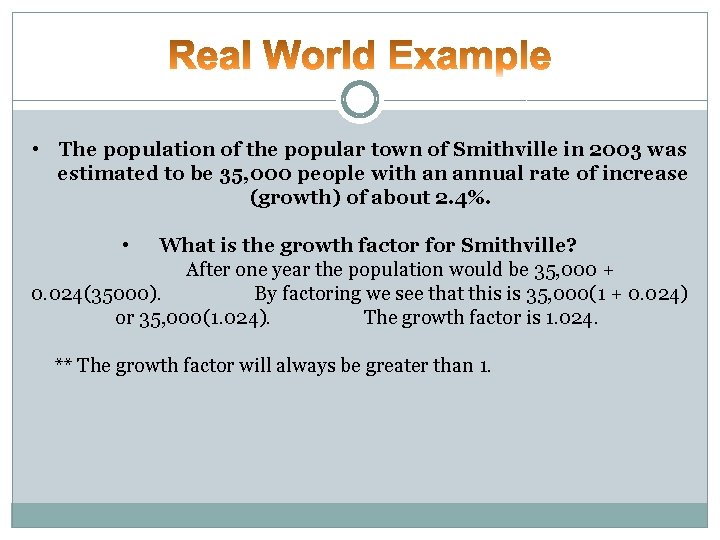
• The population of the popular town of Smithville in 2003 was estimated to be 35, 000 people with an annual rate of increase (growth) of about 2. 4%. • What is the growth factor for Smithville? After one year the population would be 35, 000 + 0. 024(35000). By factoring we see that this is 35, 000(1 + 0. 024) or 35, 000(1. 024). The growth factor is 1. 024. ** The growth factor will always be greater than 1.
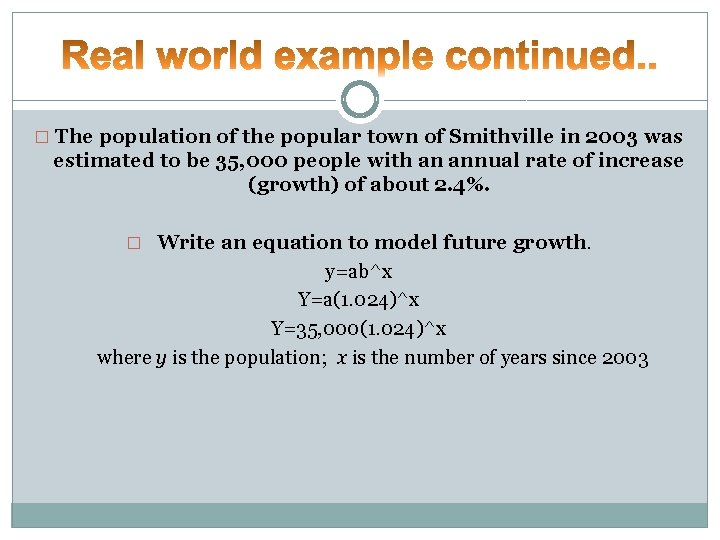
� The population of the popular town of Smithville in 2003 was estimated to be 35, 000 people with an annual rate of increase (growth) of about 2. 4%. � Write an equation to model future growth. y=ab^x Y=a(1. 024)^x Y=35, 000(1. 024)^x where y is the population; x is the number of years since 2003