
A Fully Automated Approach to Classifying Urban Land
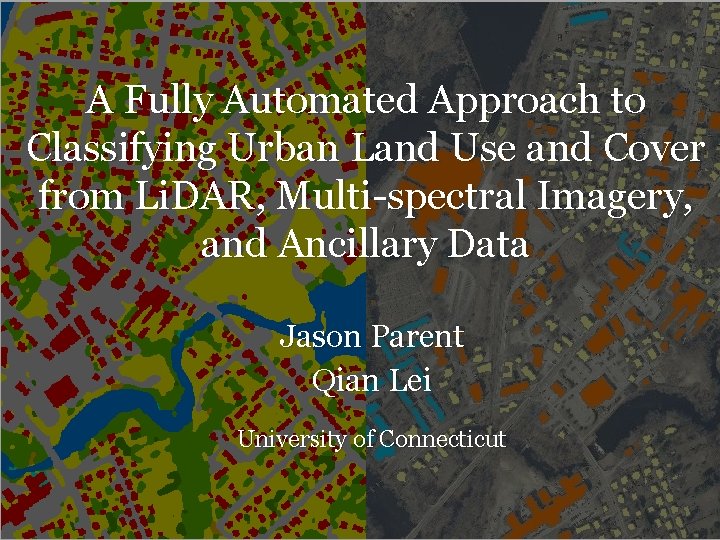
A Fully Automated Approach to Classifying Urban Land Use and Cover from Li. DAR, Multi-spectral Imagery, and Ancillary Data Jason Parent Qian Lei University of Connecticut
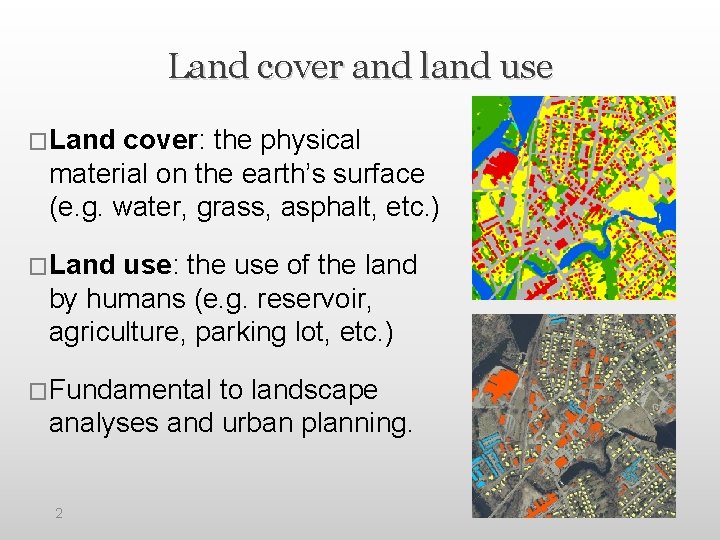
Land cover and land use �Land cover: the physical material on the earth’s surface (e. g. water, grass, asphalt, etc. ) �Land use: the use of the land by humans (e. g. reservoir, agriculture, parking lot, etc. ) �Fundamental to landscape analyses and urban planning. 2
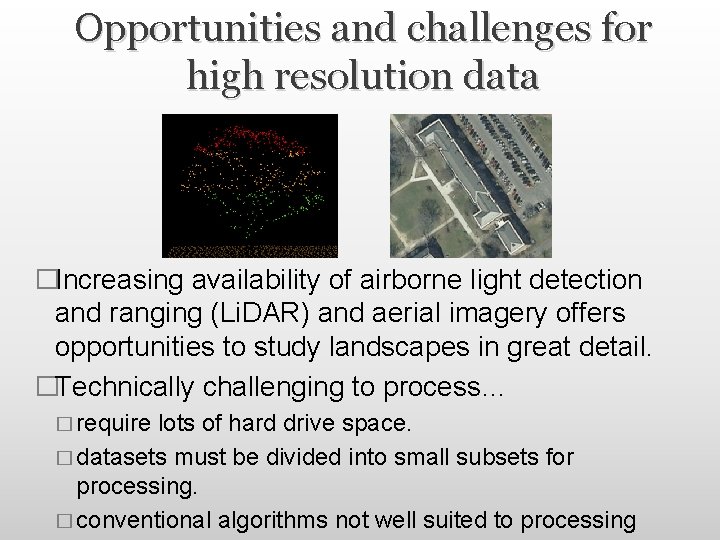
Opportunities and challenges for high resolution data �Increasing availability of airborne light detection and ranging (Li. DAR) and aerial imagery offers opportunities to study landscapes in great detail. �Technically challenging to process… � require lots of hard drive space. � datasets must be divided into small subsets for processing. � conventional algorithms not well suited to processing
Study objectives and justification �Develop fully automated algorithm to classify high resolution (1 -meter) land cover / land use which is applicable over large areas. � no previously presented algorithm has been feasible to apply over large areas. �Specifically, we developed python scripts with Arc. GIS to… � classify 1 -meter land cover from Li. DAR and multispectral data. � infer land use from object geometry and spatial context of land cover features. 4
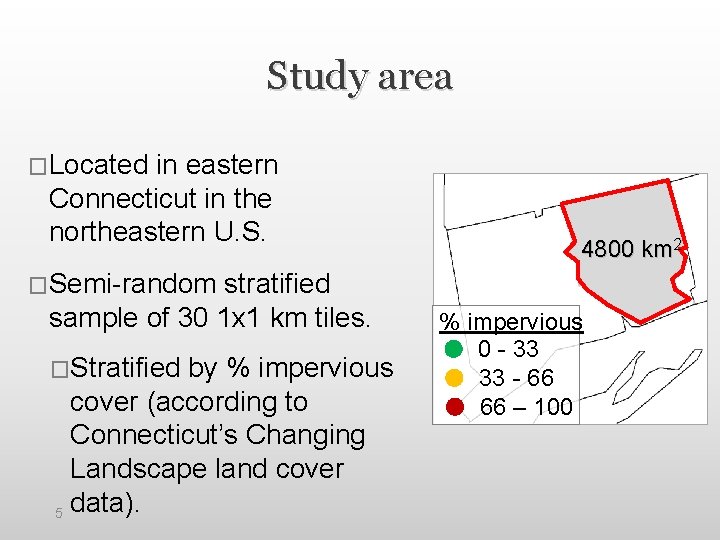
Study area �Located in eastern Connecticut in the northeastern U. S. stratified sample of 30 1 x 1 km tiles. 4800 km 2 �Semi-random �Stratified by % impervious cover (according to Connecticut’s Changing Landscape land cover 5 data). % impervious 0 - 33 33 - 66 66 – 100
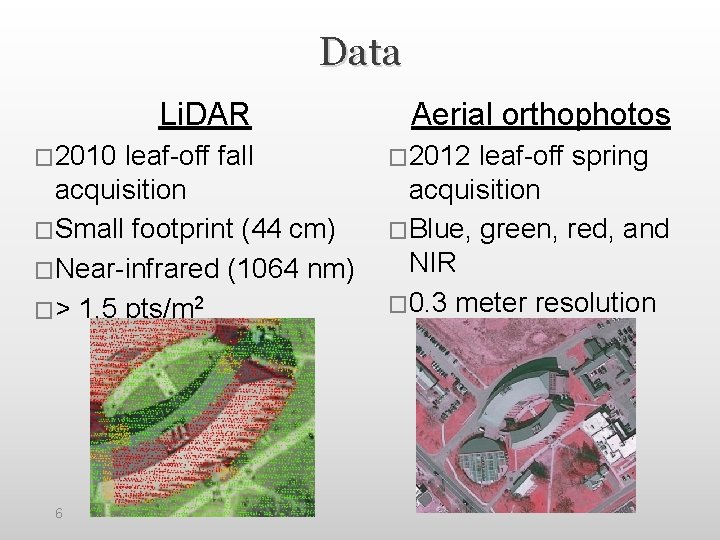
Data Li. DAR � 2010 leaf-off fall acquisition �Small footprint (44 cm) �Near-infrared (1064 nm) �> 1. 5 pts/m 2 6 Aerial orthophotos � 2012 leaf-off spring acquisition �Blue, green, red, and NIR � 0. 3 meter resolution
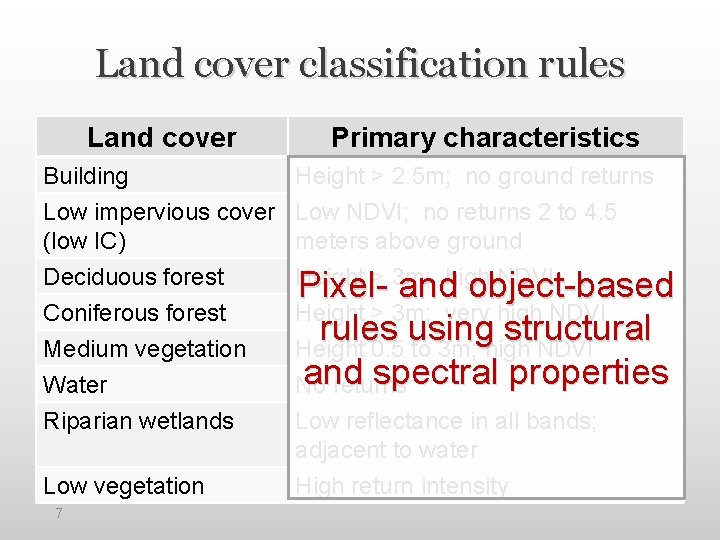
Land cover classification rules Land cover Primary characteristics Building Height > 2. 5 m; no ground returns Low impervious cover Low NDVI; no returns 2 to 4. 5 (low IC) meters above ground Deciduous forest Coniferous forest Medium vegetation Water Riparian wetlands Low vegetation 7 Height > 3 m; high NDVI Pixel- and object-based Height > 3 m; very high NDVI rules using structural Height 0. 5 to 3 m; high NDVI and spectral properties No returns Low reflectance in all bands; adjacent to water High return intensity
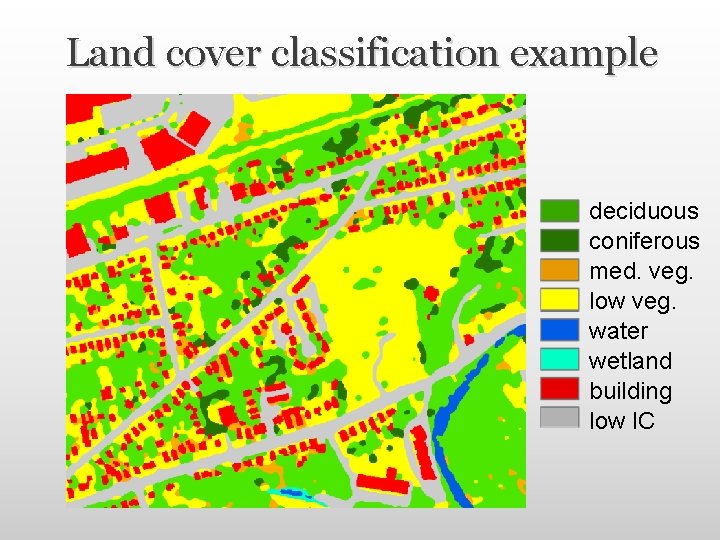
Land cover classification example deciduous coniferous med. veg. low veg. water wetland building low IC
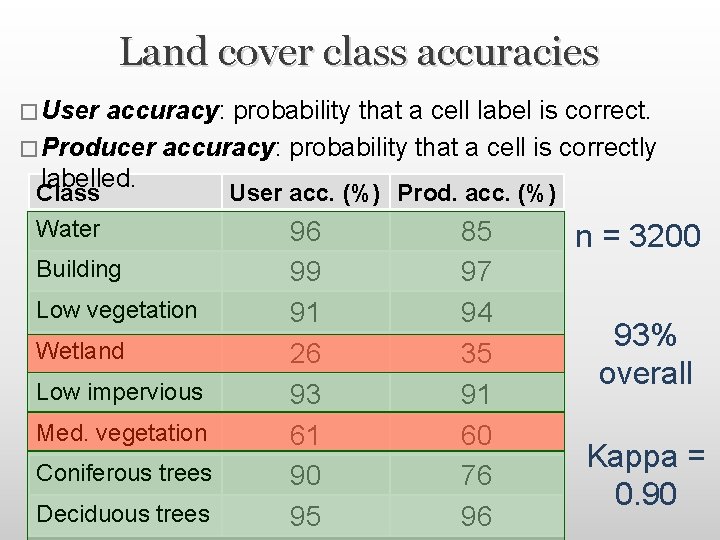
Land cover class accuracies � User accuracy: probability that a cell label is correct. � Producer accuracy: probability that a cell is correctly labelled. Class Water Building Low vegetation Wetland Low impervious Med. vegetation Coniferous trees Deciduous trees User acc. (%) Prod. acc. (%) 96 99 91 26 93 61 90 95 85 97 94 35 91 60 76 96 n = 3200 93% overall Kappa = 0. 90
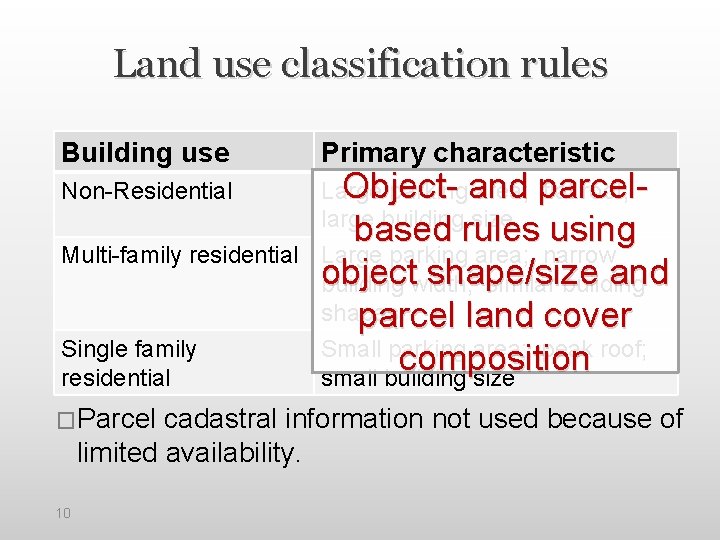
Land use classification rules Building use Non-Residential Multi-family residential Single family residential �Parcel Primary characteristic Object. Large parkingand area; parcelflat roof; large building size based rules using Large parking area; narrow object shape/size and building width; similar building shapes parcel land cover Small parking area; peak roof; composition small building size cadastral information not used because of limited availability. 10
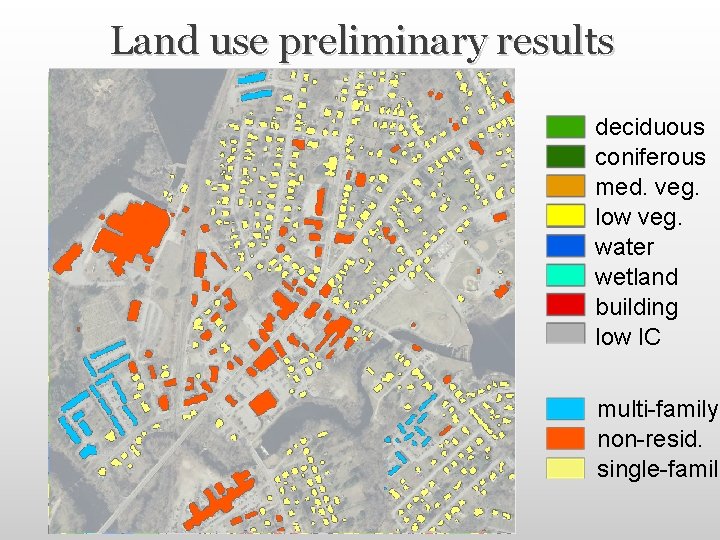
Land use preliminary results deciduous coniferous med. veg. low veg. water wetland building low IC multi-family non-resid. single-family
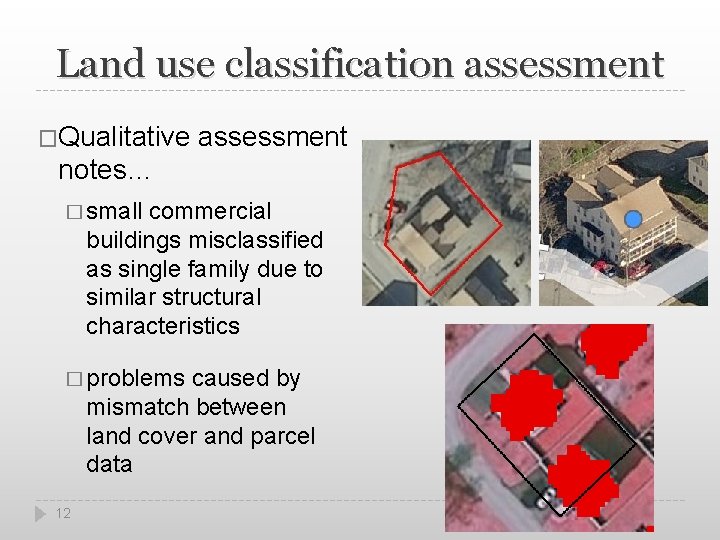
Land use classification assessment �Qualitative assessment notes… � small commercial buildings misclassified as single family due to similar structural characteristics � problems caused by mismatch between land cover and parcel data 12 12
Conclusions and future work �Land cover classification: � Use of airborne Li. DAR and multi-spectral data proved highly effective in classification of high resolution land cover. � Developed fully automated algorithm that performs well over large area. �Land use classification: � Use 13 of building shape and context is promising � Future work will develop rules for classification of… � roads vs. parking lots � urban vs. non-urban forest � agriculture vs. turf
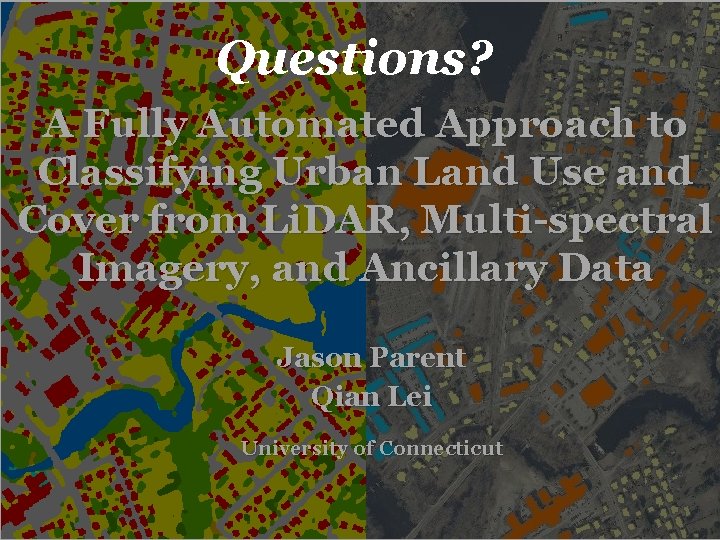
Questions? A Fully Automated Approach to Classifying Urban Land Use and Cover from Li. DAR, Multi-spectral Imagery, and Ancillary Data Jason Parent Qian Lei University of Connecticut
- Slides: 14