
A fresh look at hydrodynamics from fluctuation formulas




- Slides: 63
A fresh look at hydrodynamics from fluctuation formulas Shin-ichi Sasa and Masato Itami 2015/05/28@IPMU 1
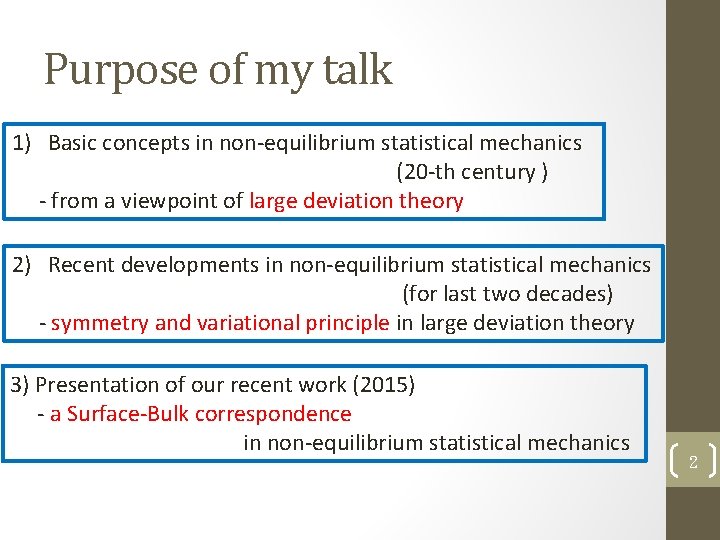
Purpose of my talk 1) Basic concepts in non-equilibrium statistical mechanics (20 -th century ) - from a viewpoint of large deviation theory 2) Recent developments in non-equilibrium statistical mechanics (for last two decades) - symmetry and variational principle in large deviation theory 3) Presentation of our recent work (2015) - a Surface-Bulk correspondence in non-equilibrium statistical mechanics 2
PART I Thermodynamics and Large deviation 3
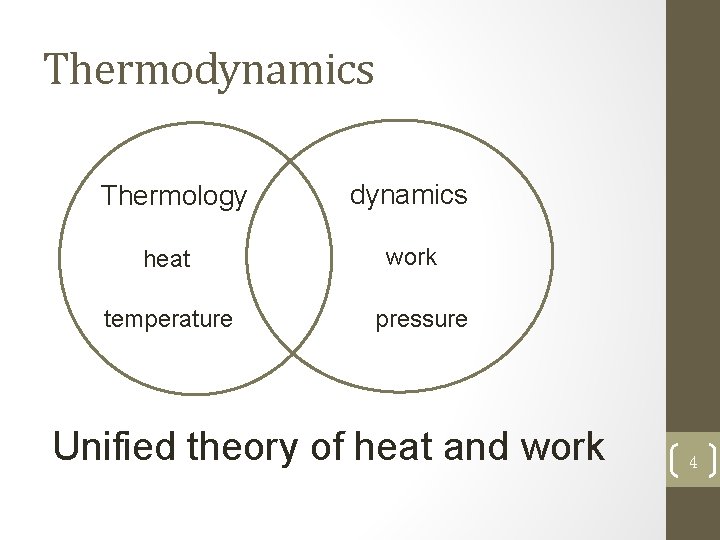
Thermodynamics Thermology heat temperature dynamics work pressure Unified theory of heat and work 4
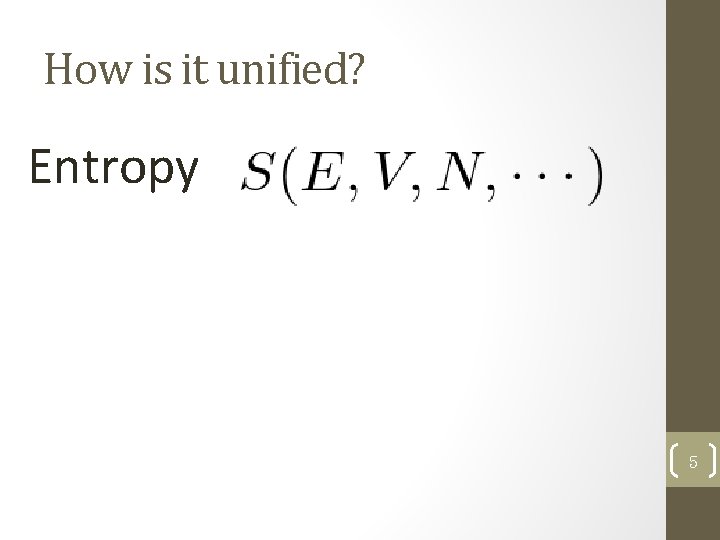
How is it unified? Entropy 5
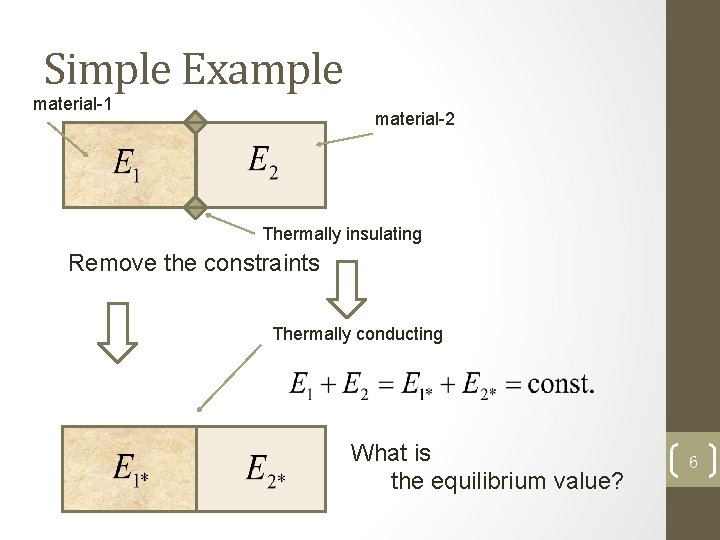
Simple Example material-1 material-2 Thermally insulating Remove the constraints Thermally conducting What is the equilibrium value? 6
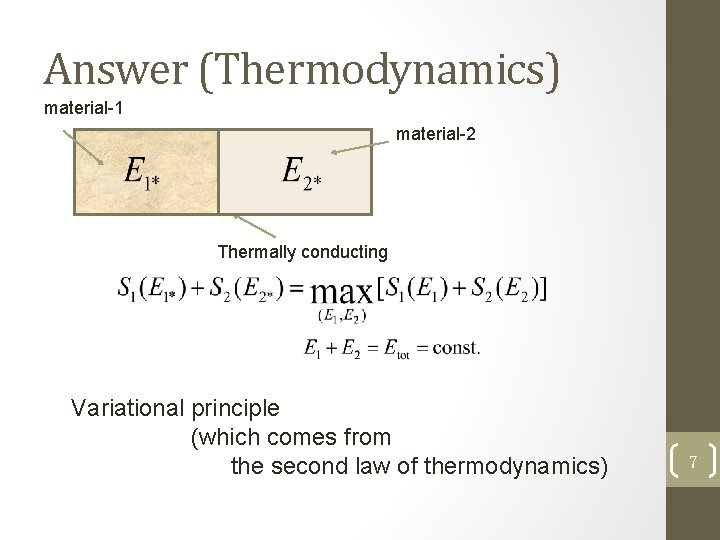
Answer (Thermodynamics) material-1 material-2 Thermally conducting Variational principle (which comes from the second law of thermodynamics) 7
Question Can you obtain the equilibrium value without thermodynamics (entropy) ? 8
Quick answer Yes, the equilibrium value is given as the most probable (typical) value almost all microscopic states show 9
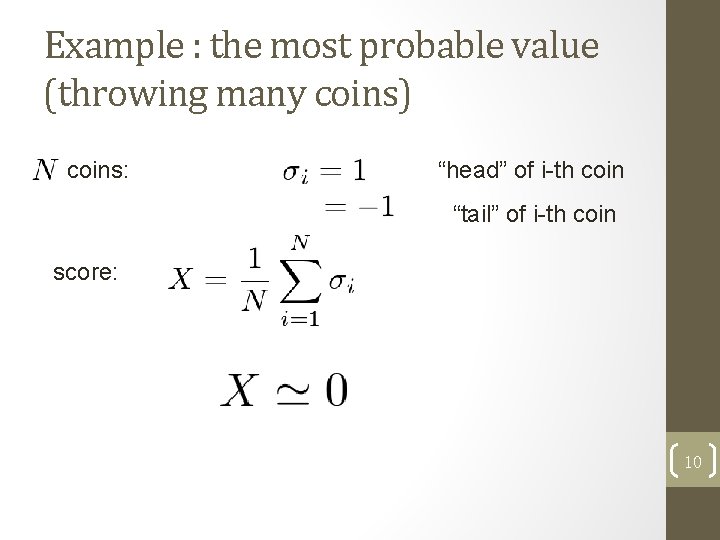
Example : the most probable value (throwing many coins) coins: “head” of i-th coin “tail” of i-th coin score: 10
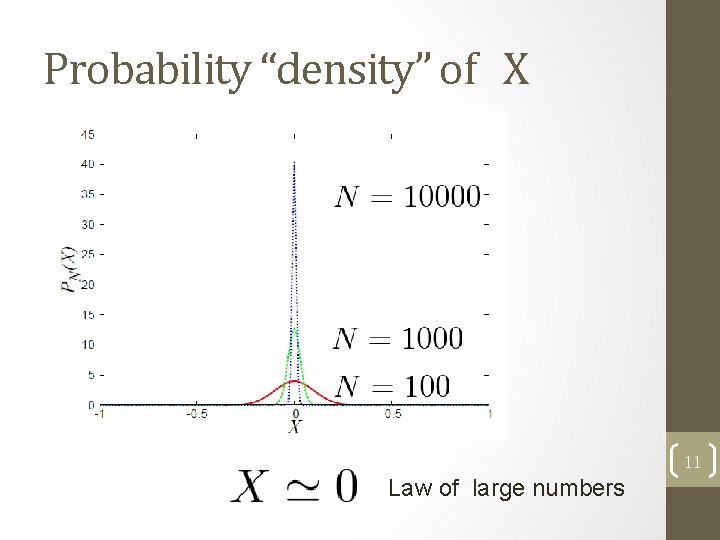
Probability “density” of X 11 Law of large numbers
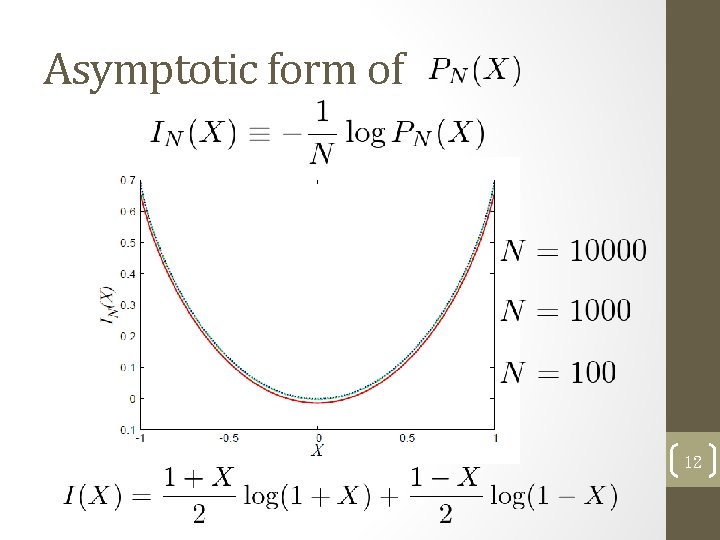
Asymptotic form of 12
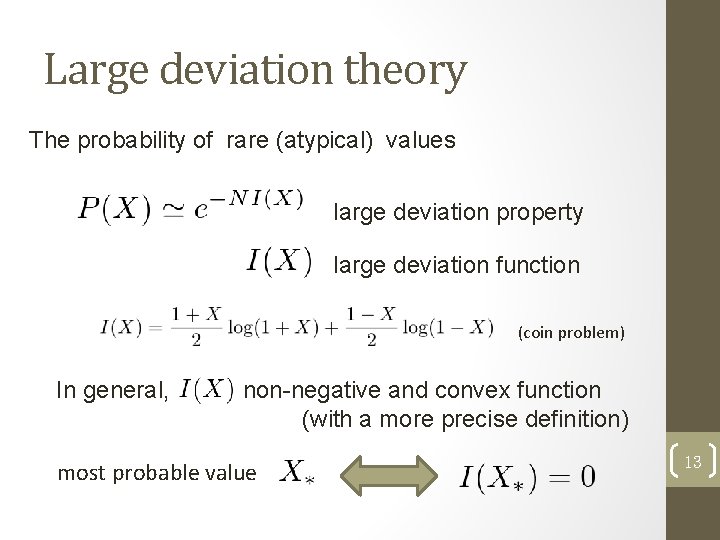
Large deviation theory The probability of rare (atypical) values large deviation property large deviation function (coin problem) In general, non-negative and convex function (with a more precise definition) most probable value 13
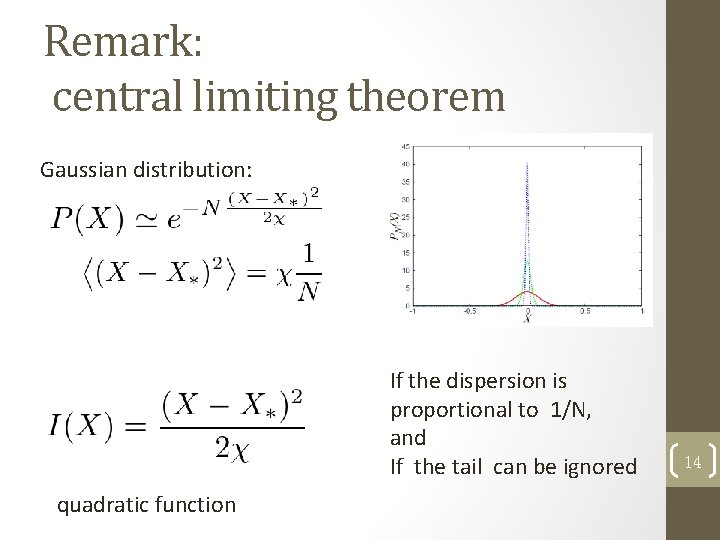
Remark: central limiting theorem Gaussian distribution: If the dispersion is proportional to 1/N, and If the tail can be ignored quadratic function 14
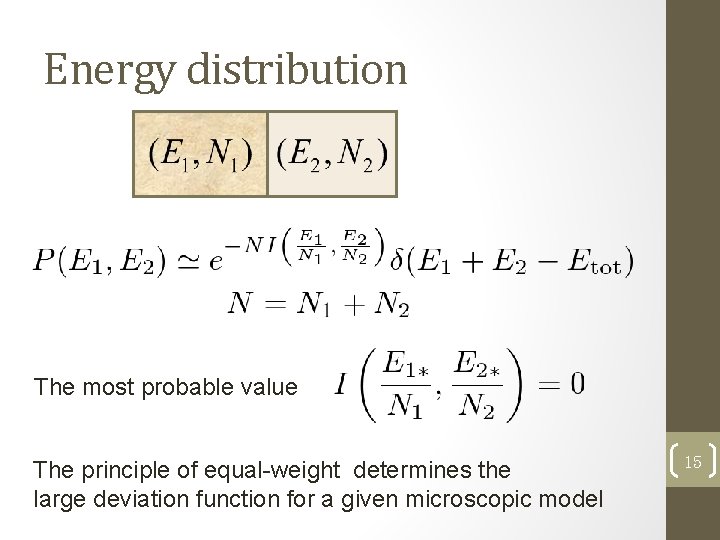
Energy distribution The most probable value The principle of equal-weight determines the large deviation function for a given microscopic model 15
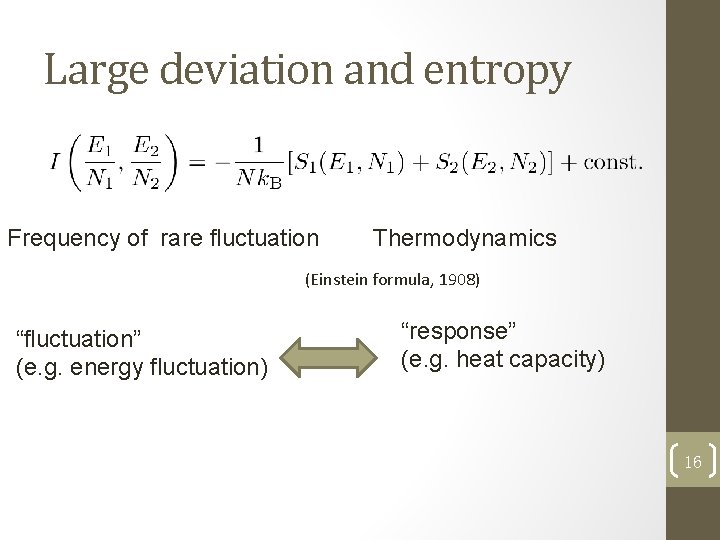
Large deviation and entropy Frequency of rare fluctuation Thermodynamics (Einstein formula, 1908) “fluctuation” (e. g. energy fluctuation) “response” (e. g. heat capacity) 16
PART II Dynamics and Large deviation 17
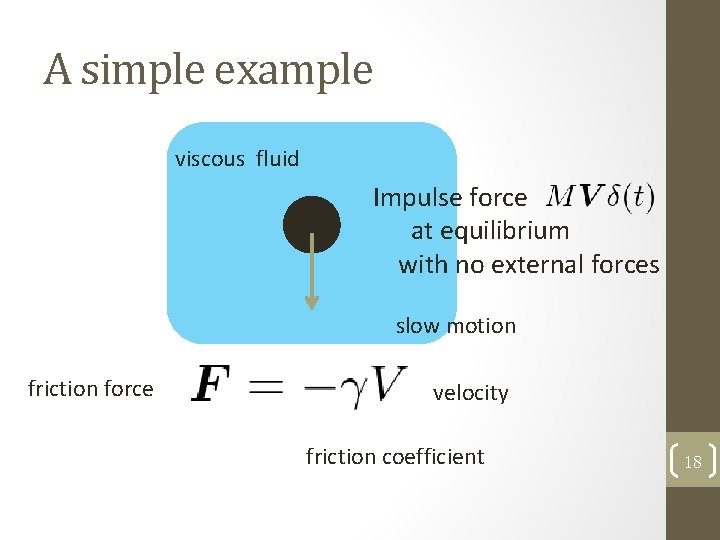
A simple example viscous fluid Impulse force at equilibrium with no external forces slow motion friction force velocity friction coefficient 18
What corresponds to thermodynamics ? 19
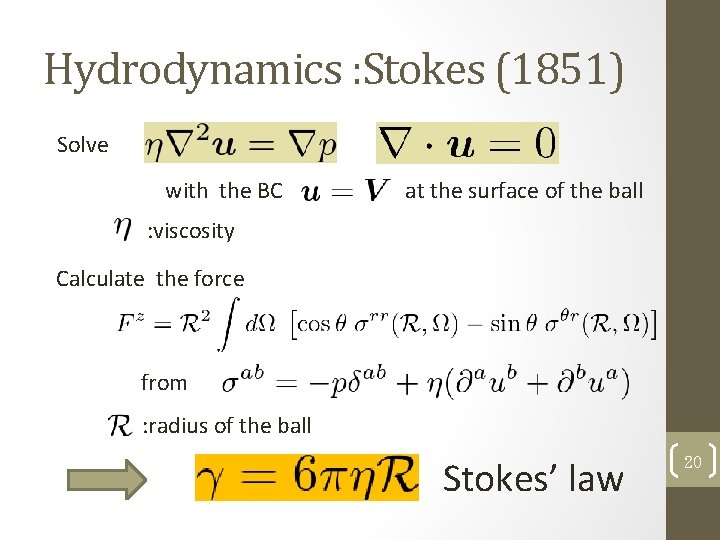
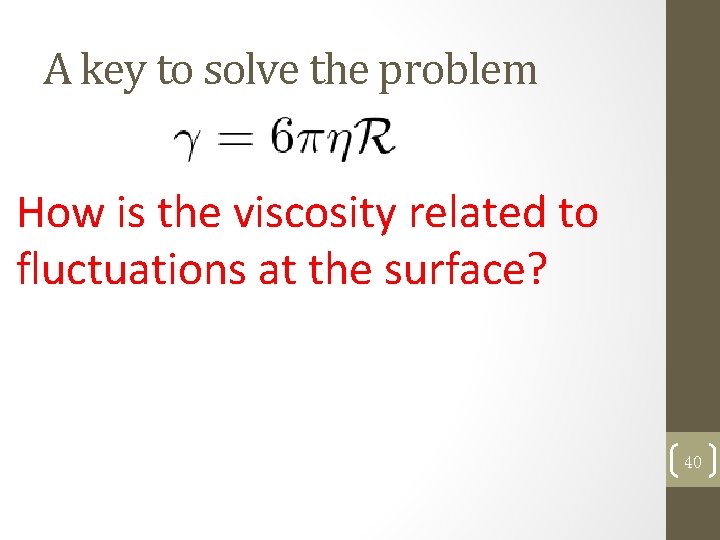
Hydrodynamics : Stokes (1851) Solve with the BC at the surface of the ball : viscosity Calculate the force from : radius of the ball Stokes’ law 20
Question Can you derive Stokes’ law without the hydrodynamic equations ? 21
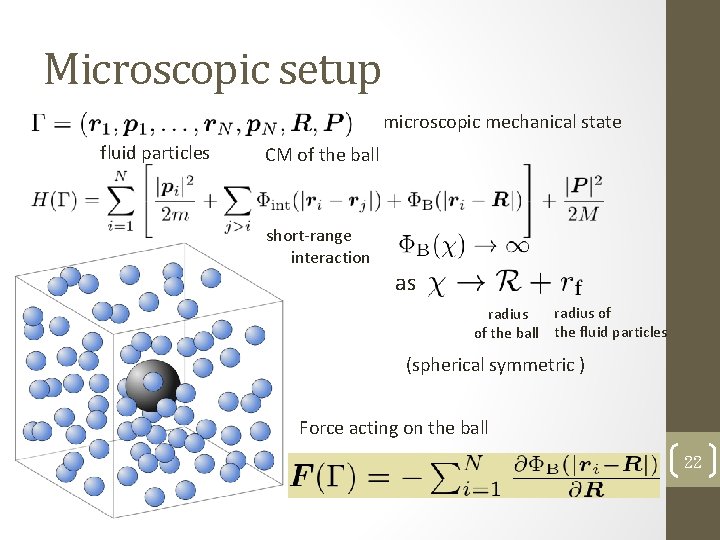
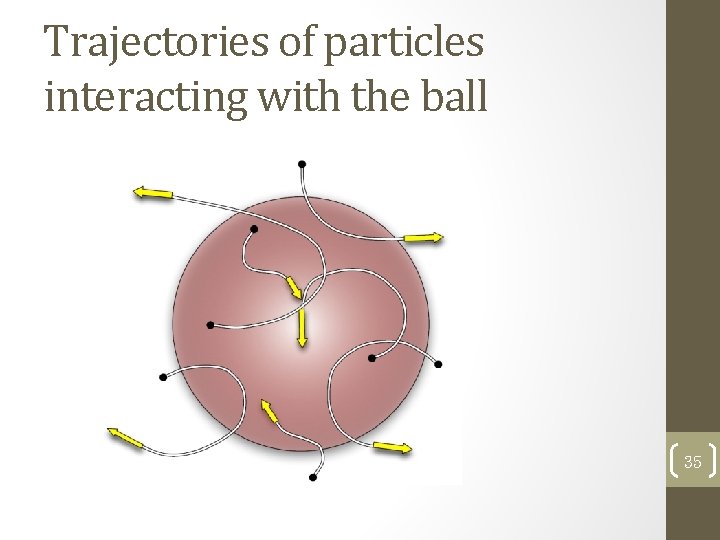
Microscopic setup microscopic mechanical state fluid particles CM of the ball short-range interaction as radius of the ball the fluid particles (spherical symmetric ) Force acting on the ball 22
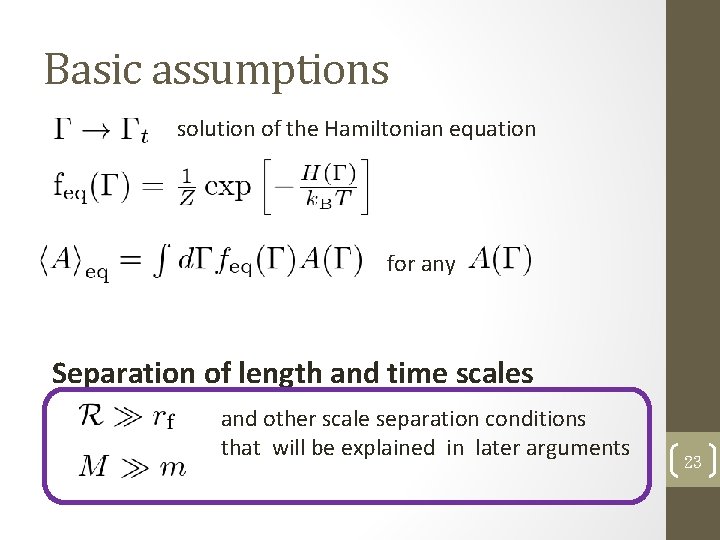
Basic assumptions solution of the Hamiltonian equation for any Separation of length and time scales and other scale separation conditions that will be explained in later arguments 23
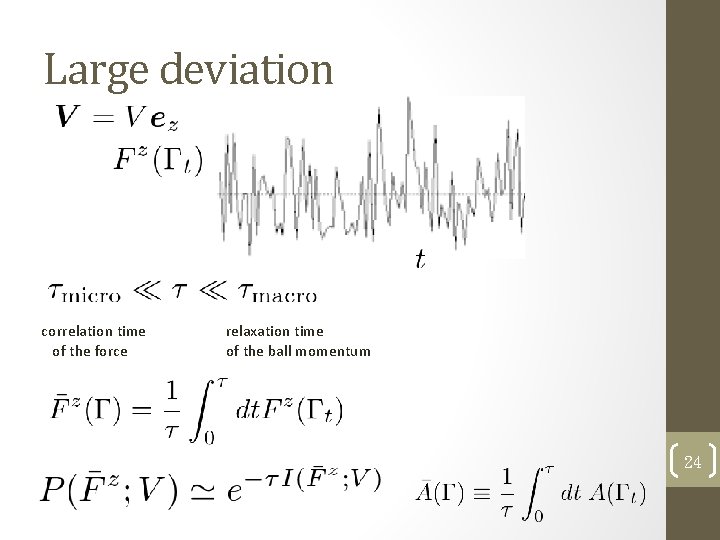
Large deviation correlation time of the force relaxation time of the ball momentum 24
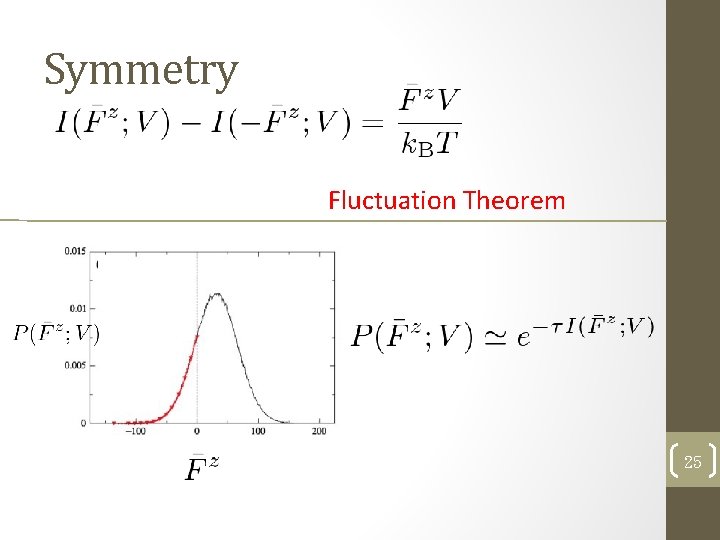
Symmetry Fluctuation Theorem 25
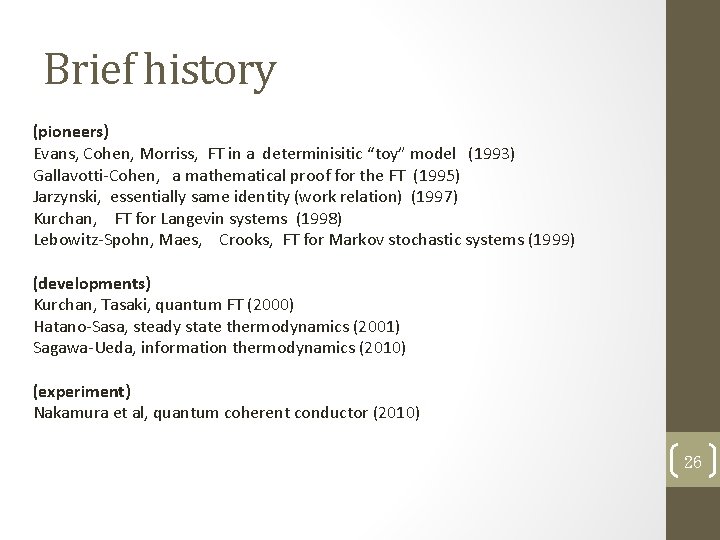
Brief history (pioneers) Evans, Cohen, Morriss, FT in a determinisitic “toy” model (1993) Gallavotti-Cohen, a mathematical proof for the FT (1995) Jarzynski, essentially same identity (work relation) (1997) Kurchan, FT for Langevin systems (1998) Lebowitz-Spohn, Maes, Crooks, FT for Markov stochastic systems (1999) (developments) Kurchan, Tasaki, quantum FT (2000) Hatano-Sasa, steady state thermodynamics (2001) Sagawa-Ueda, information thermodynamics (2010) (experiment) Nakamura et al, quantum coherent conductor (2010) 26
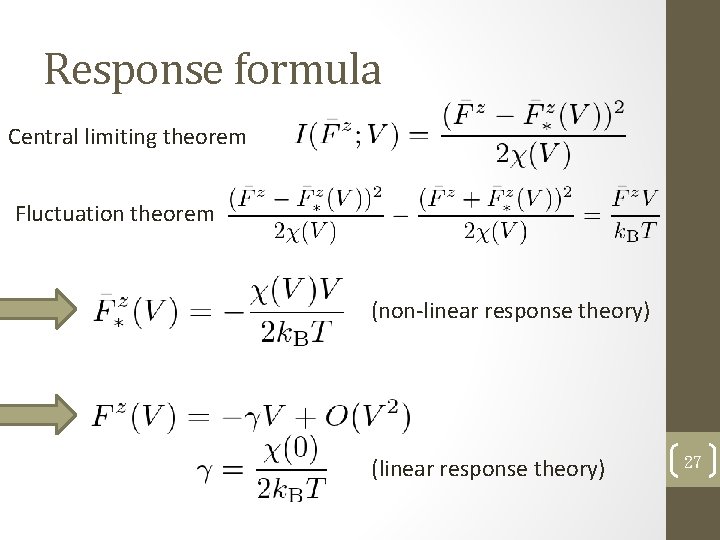
Response formula Central limiting theorem Fluctuation theorem (non-linear response theory) (linear response theory) 27
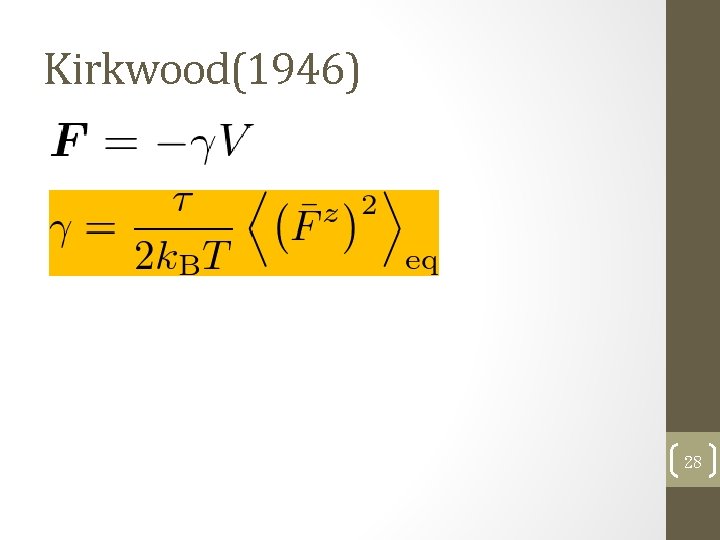
Kirkwood(1946) 28
PART III Proof of the fluctuation theorem 29
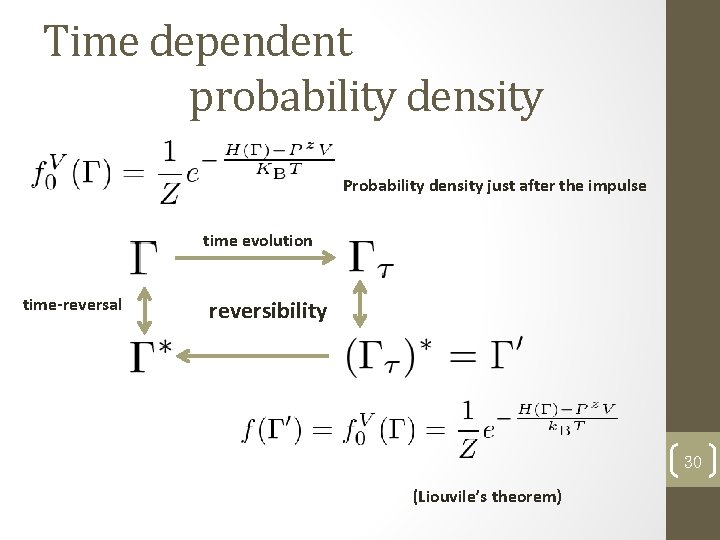
Time dependent probability density Probability density just after the impulse time evolution time-reversal reversibility 30 (Liouvile’s theorem)
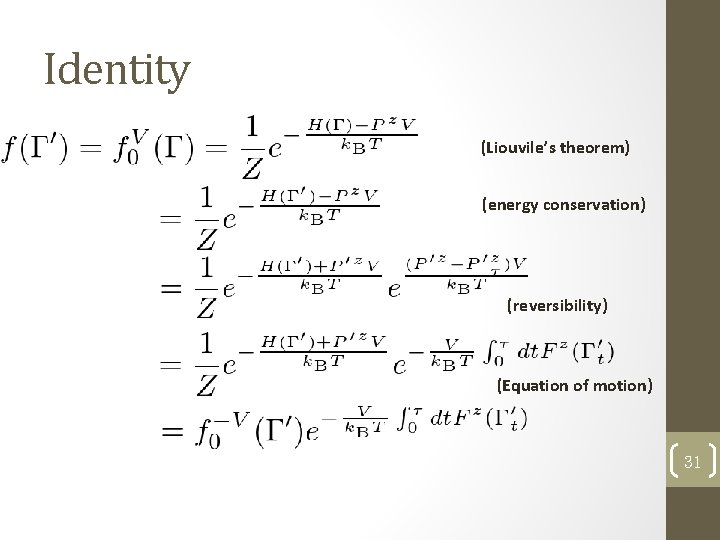
Identity (Liouvile’s theorem) (energy conservation) (reversibility) (Equation of motion) 31
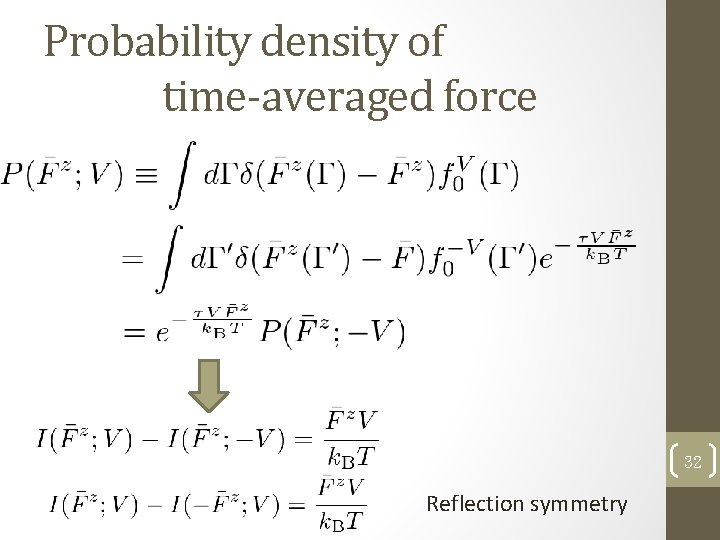
Probability density of time-averaged force 32 Reflection symmetry
PART IV Problem 33
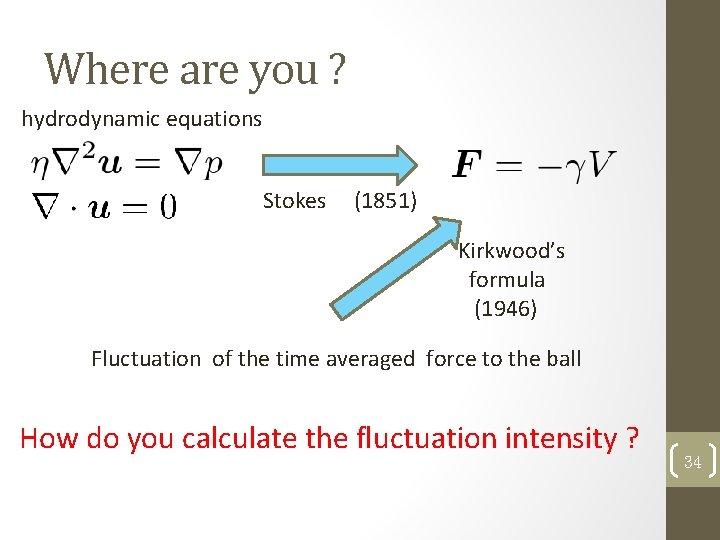
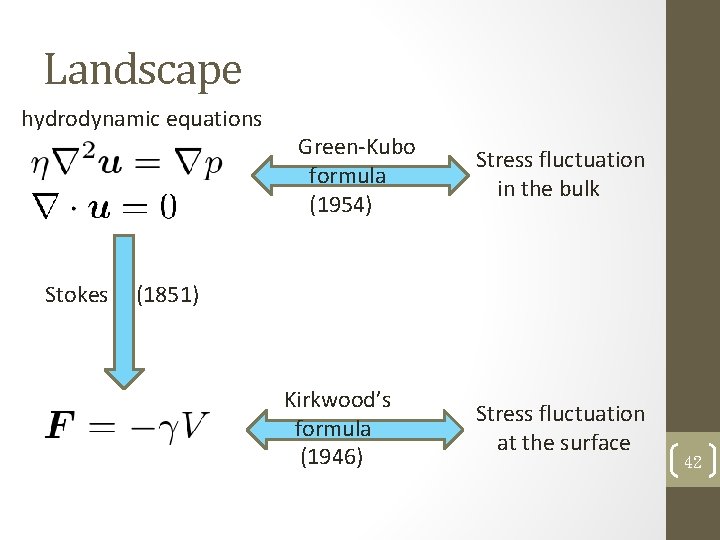
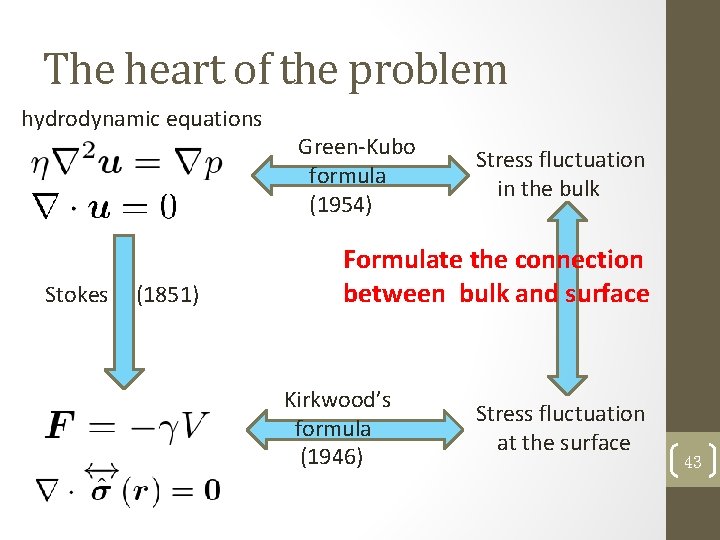
Where are you ? hydrodynamic equations Stokes (1851) Kirkwood’s formula (1946) Fluctuation of the time averaged force to the ball How do you calculate the fluctuation intensity ? 34
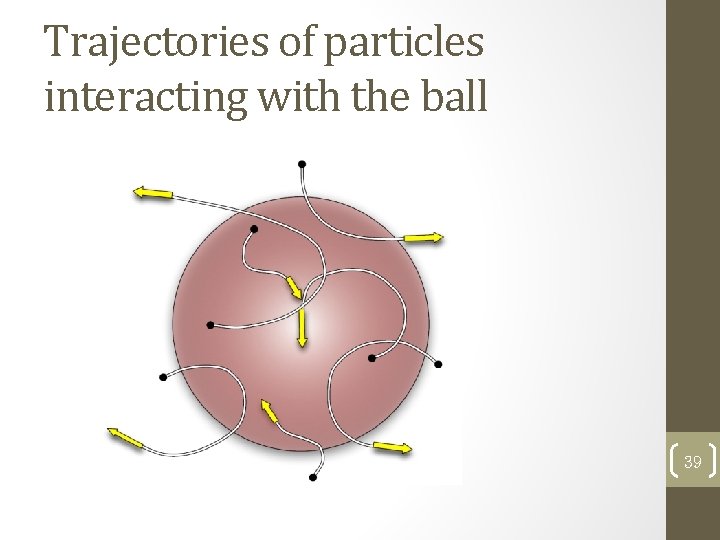
Trajectories of particles interacting with the ball 35
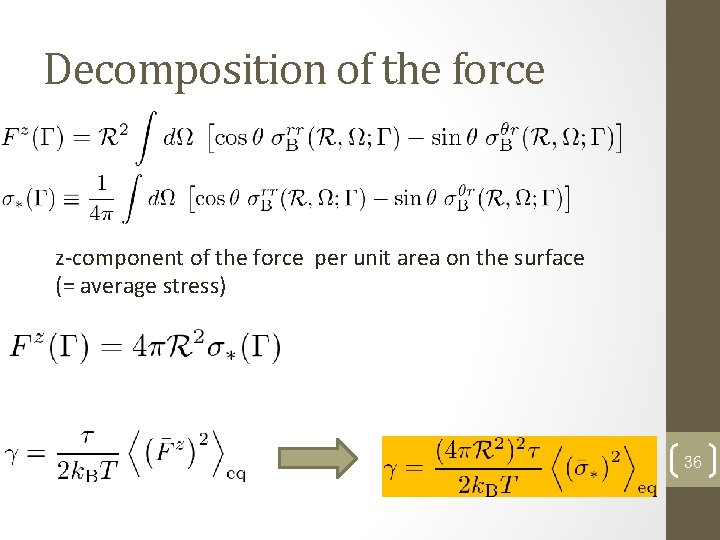
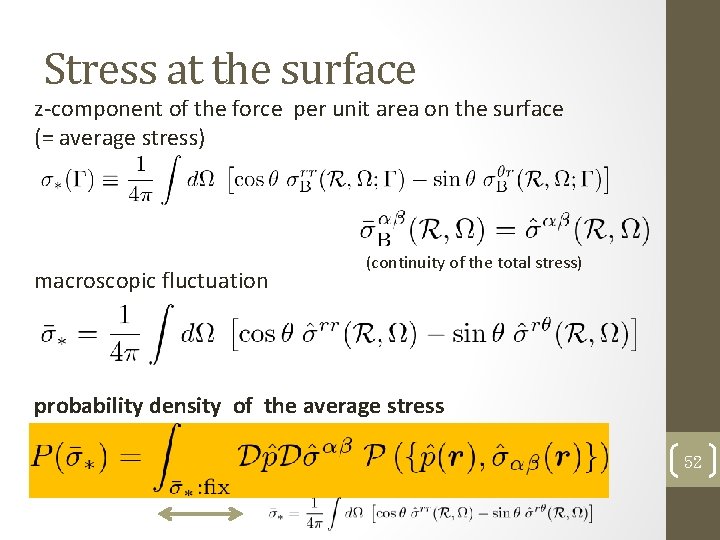
Decomposition of the force z-component of the force per unit area on the surface (= average stress) 36
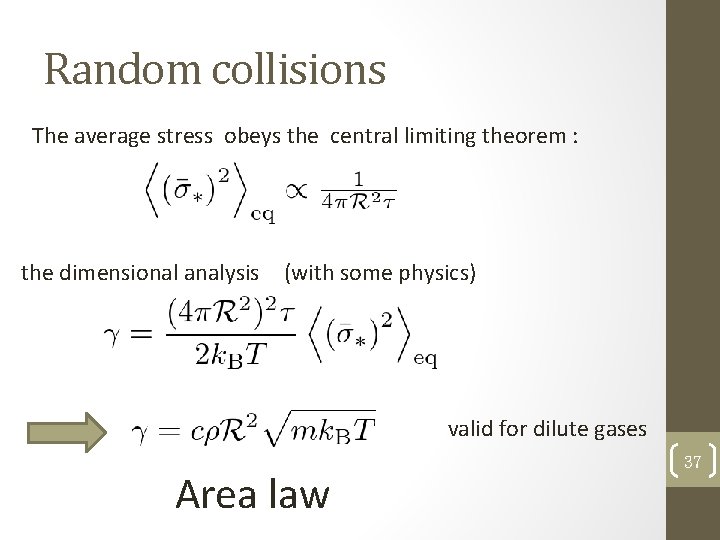
Random collisions The average stress obeys the central limiting theorem : the dimensional analysis (with some physics) valid for dilute gases Area law 37
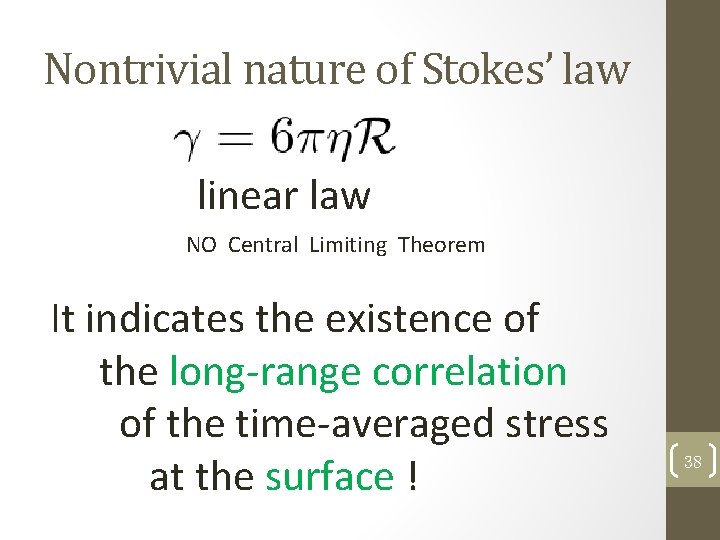
Nontrivial nature of Stokes’ law linear law NO Central Limiting Theorem It indicates the existence of the long-range correlation of the time-averaged stress at the surface ! 38
Trajectories of particles interacting with the ball 39
A key to solve the problem How is the viscosity related to fluctuations at the surface? 40
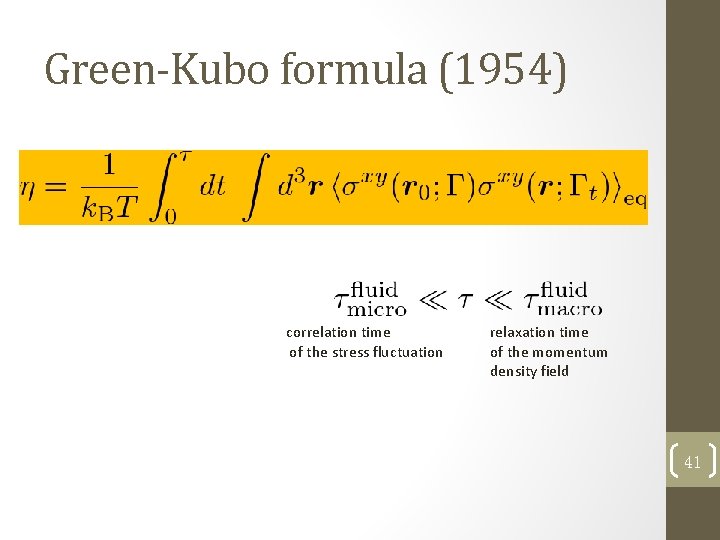
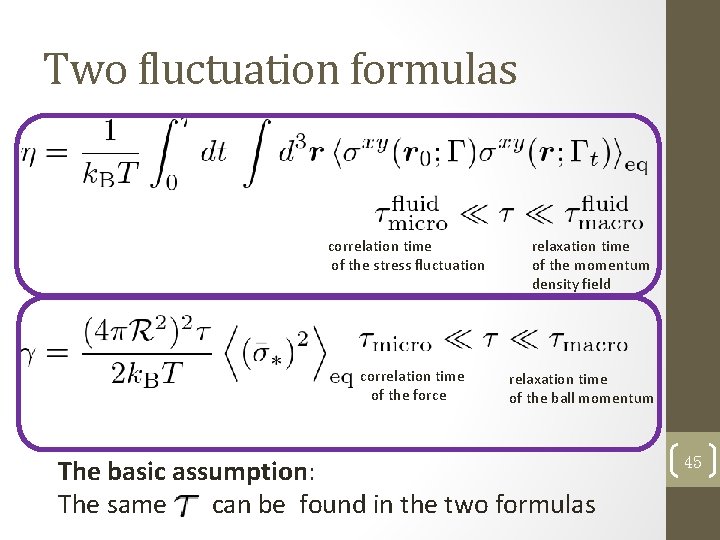
Green-Kubo formula (1954) correlation time of the stress fluctuation relaxation time of the momentum density field 41
Landscape hydrodynamic equations Stokes Green-Kubo formula (1954) Stress fluctuation in the bulk (1851) Kirkwood’s formula (1946) Stress fluctuation at the surface 42
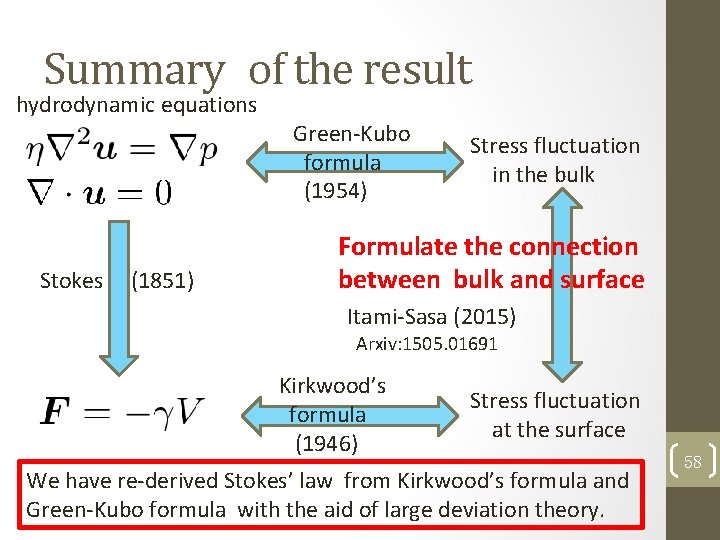
The heart of the problem hydrodynamic equations Stokes (1851) Green-Kubo formula (1954) Stress fluctuation in the bulk Formulate the connection between bulk and surface Kirkwood’s formula (1946) Stress fluctuation at the surface 43
PART V effective theory in the bulk 44
Two fluctuation formulas correlation time of the stress fluctuation correlation time of the force relaxation time of the momentum density field relaxation time of the ball momentum The basic assumption: The same can be found in the two formulas 45
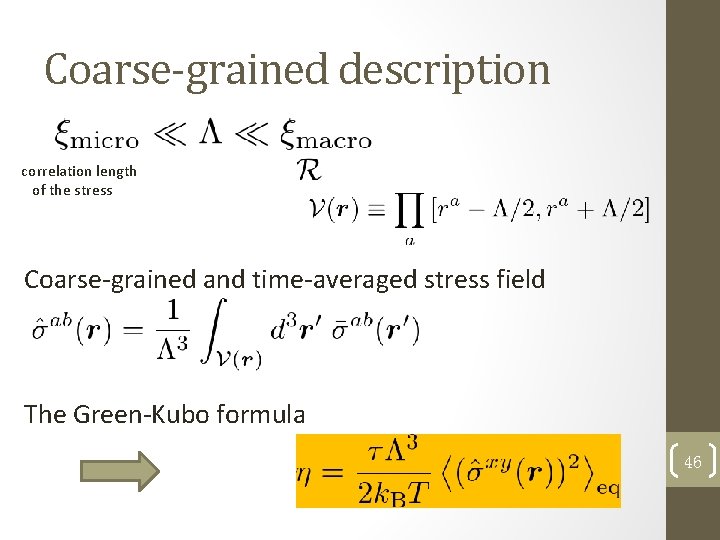
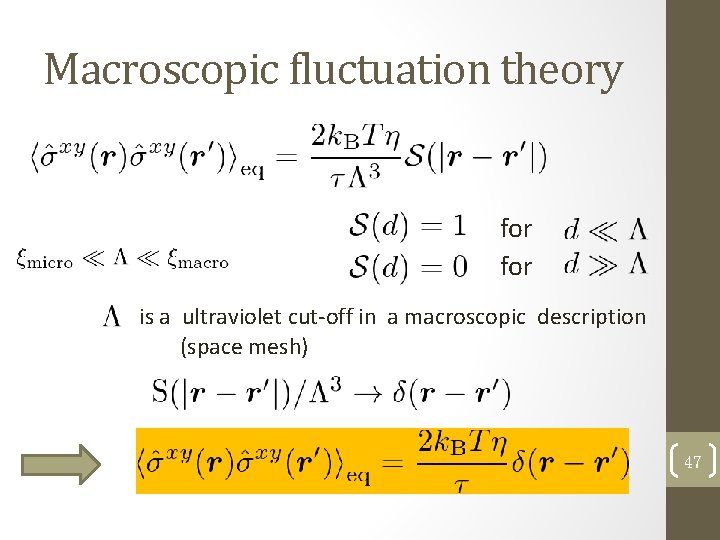
Coarse-grained description correlation length of the stress Coarse-grained and time-averaged stress field The Green-Kubo formula 46
Macroscopic fluctuation theory for is a ultraviolet cut-off in a macroscopic description (space mesh) 47
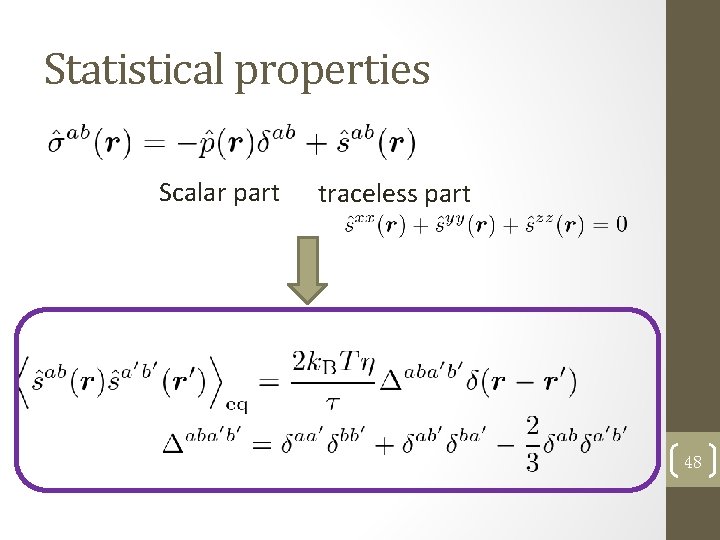
Statistical properties Scalar part traceless part 48
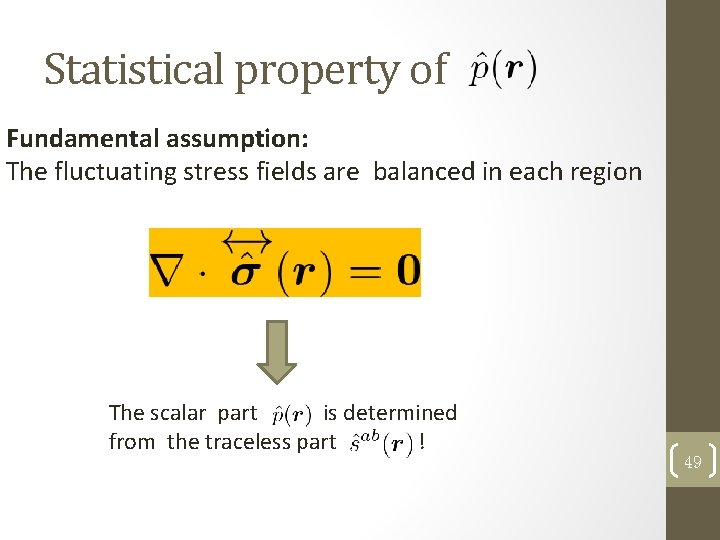
Statistical property of Fundamental assumption: The fluctuating stress fields are balanced in each region The scalar part is determined from the traceless part ! 49
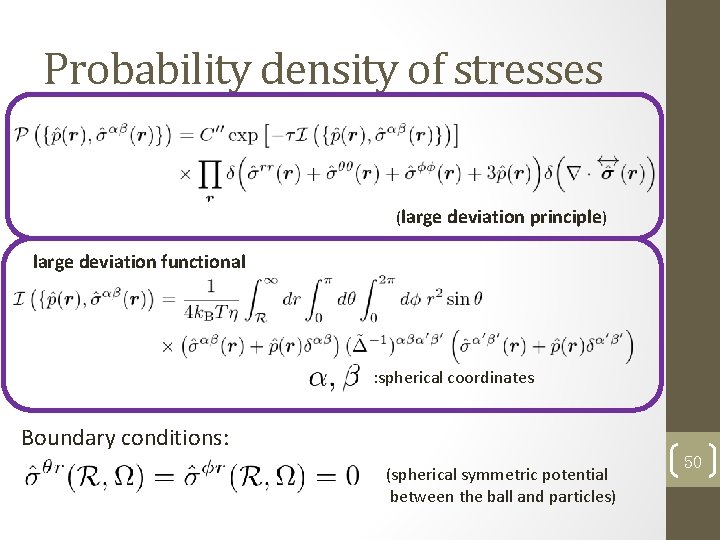
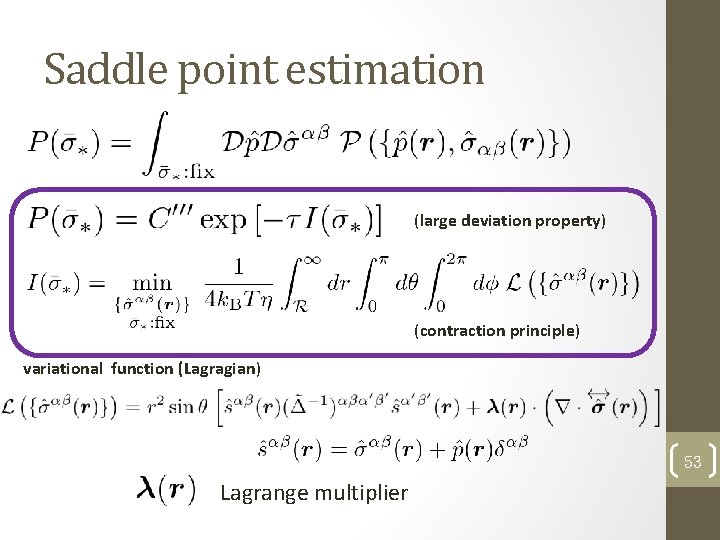
Probability density of stresses (large deviation principle) large deviation functional : spherical coordinates Boundary conditions: (spherical symmetric potential between the ball and particles) 50
PART VI Highlight 51
Stress at the surface z-component of the force per unit area on the surface (= average stress) macroscopic fluctuation (continuity of the total stress) probability density of the average stress 52
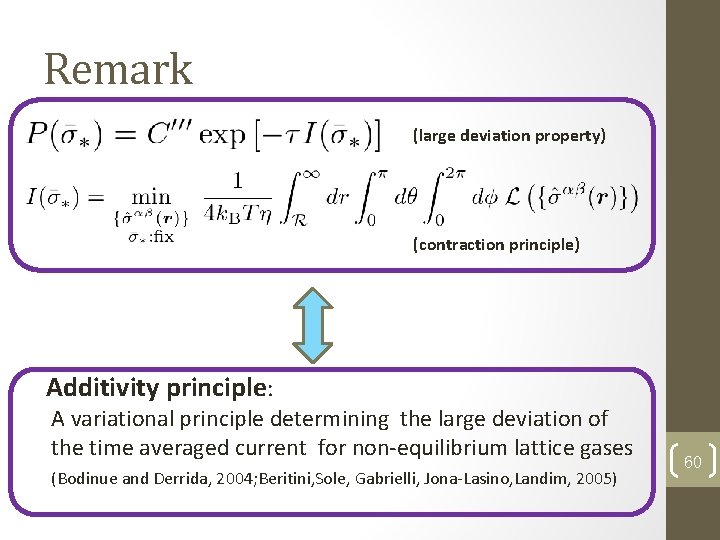
Saddle point estimation (large deviation property) (contraction principle) variational function (Lagragian) 53 Lagrange multiplier
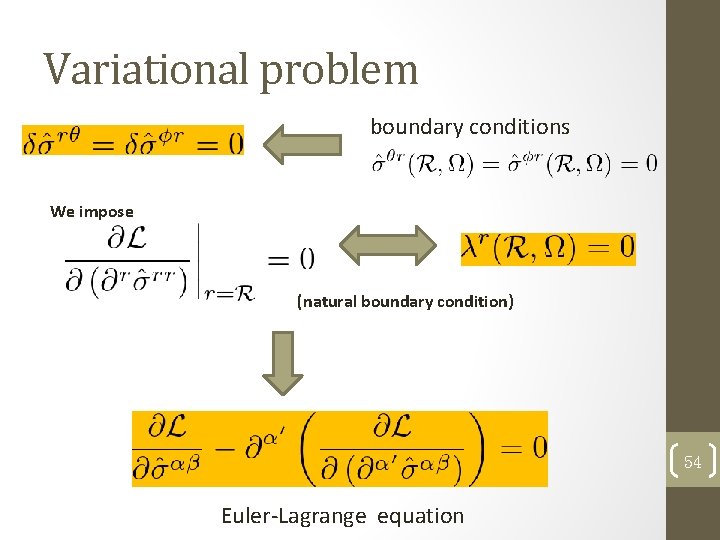
Variational problem boundary conditions We impose (natural boundary condition) 54 Euler-Lagrange equation
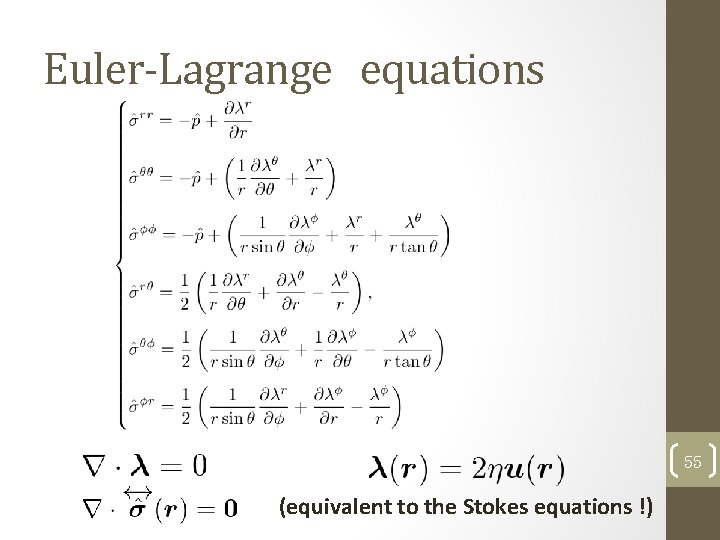
Euler-Lagrange equations 55 (equivalent to the Stokes equations !)
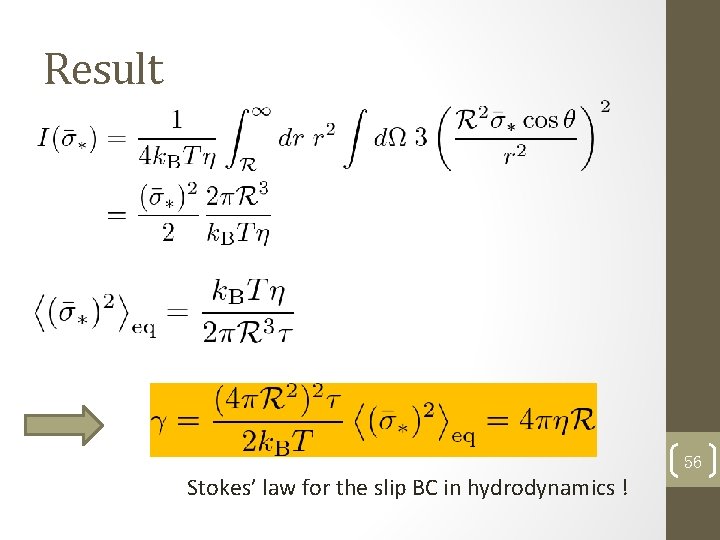
Result 56 Stokes’ law for the slip BC in hydrodynamics !
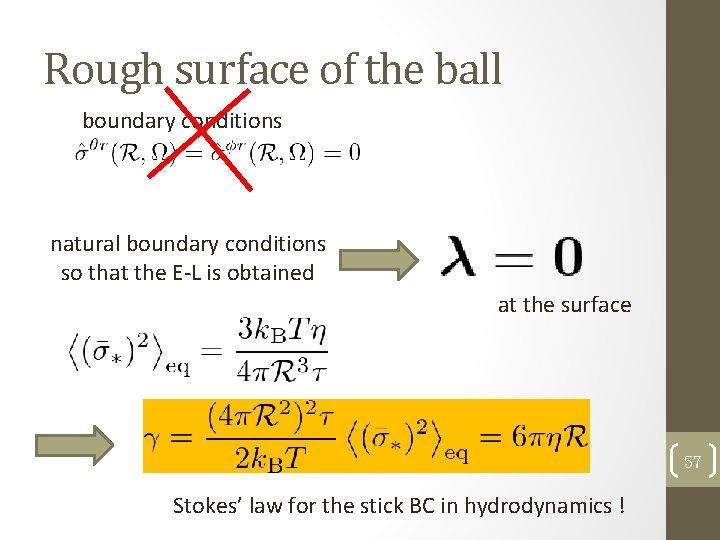
Rough surface of the ball boundary conditions natural boundary conditions so that the E-L is obtained at the surface 57 Stokes’ law for the stick BC in hydrodynamics !
Summary of the result hydrodynamic equations Stokes (1851) Green-Kubo formula (1954) Stress fluctuation in the bulk Formulate the connection between bulk and surface Itami-Sasa (2015) Arxiv: 1505. 01691 Kirkwood’s formula (1946) Stress fluctuation at the surface We have re-derived Stokes’ law from Kirkwood’s formula and Green-Kubo formula with the aid of large deviation theory. 58
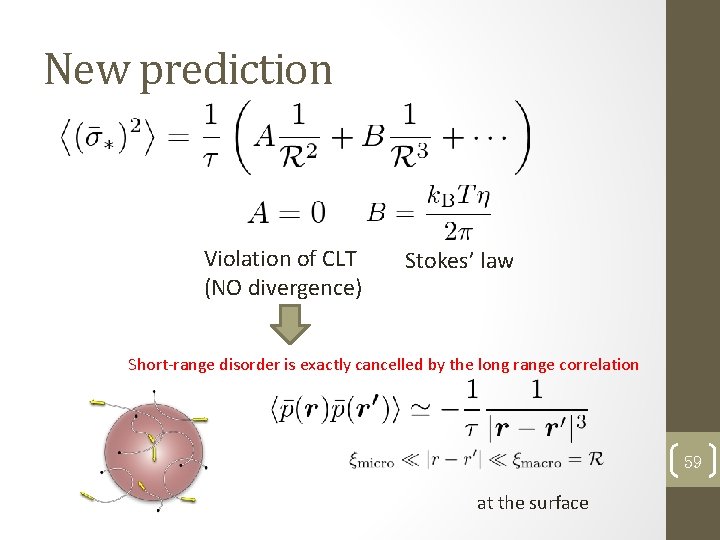
New prediction Violation of CLT (NO divergence) Stokes’ law Short-range disorder is exactly cancelled by the long range correlation 59 at the surface
Remark (large deviation property) (contraction principle) Additivity principle: A variational principle determining the large deviation of the time averaged current for non-equilibrium lattice gases (Bodinue and Derrida, 2004; Beritini, Sole, Gabrielli, Jona-Lasino, Landim, 2005) 60
PART VII Epilog 61
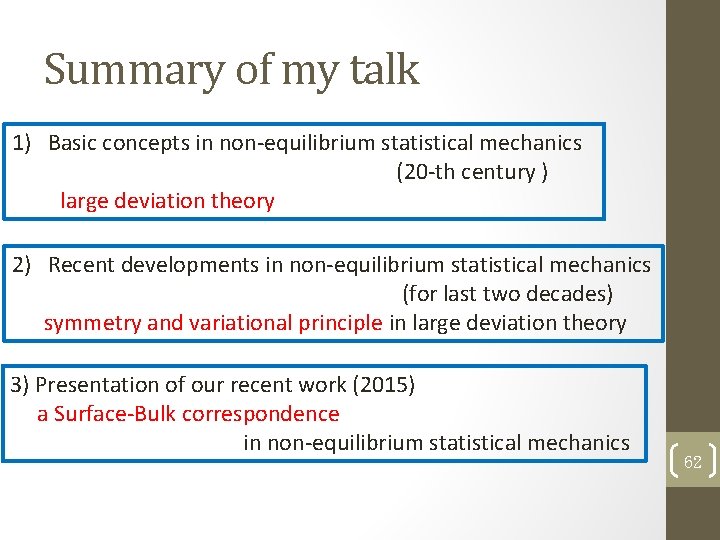
Summary of my talk 1) Basic concepts in non-equilibrium statistical mechanics (20 -th century ) large deviation theory 2) Recent developments in non-equilibrium statistical mechanics (for last two decades) symmetry and variational principle in large deviation theory 3) Presentation of our recent work (2015) a Surface-Bulk correspondence in non-equilibrium statistical mechanics 62
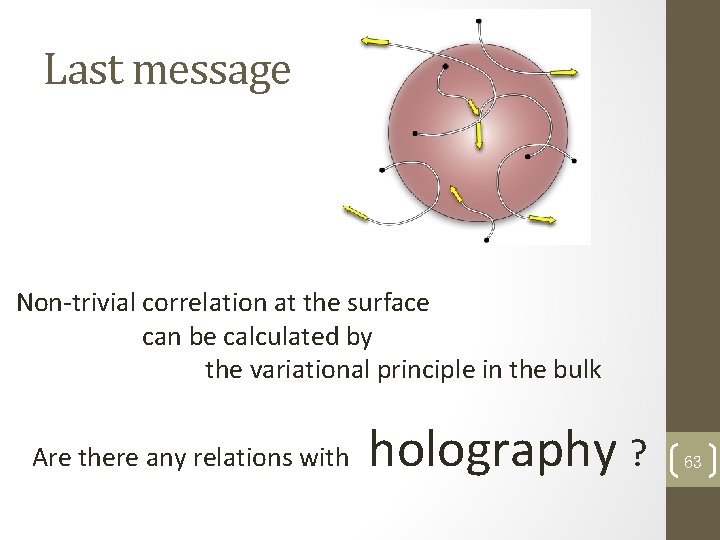
Last message Non-trivial correlation at the surface can be calculated by the variational principle in the bulk Are there any relations with holography ? 63