
A Framework to Analyze Processor Architectures for Next
- Slides: 9
A Framework to Analyze Processor Architectures for Next -Generation On-Board Space Computing Tyler M. Lovelly EEL 6686 Guest Lecture Ph. D. student University of Florida Donavon Bryan Kevin Cheng M. S. students University of Florida Rachel Kreynin February 25, 2014 B. S. student University of Florida Dr. Alan D. George Professor of ECE University of Florida Dr. Ann Gordon-Ross Assoc. Professor of ECE University of Florida Gabriel Mounce Deputy Chief, Space Electronic Tech. Air Force Research Laboratory
Introduction n Space computing presents unique challenges q q q n Harsh and inaccessible operating environment Stringent constraints on power, reliability, programmability Limitations for on-board performance and mission capabilities Increasing need for high-performance on-board computing q q q Demand for real-time sensor and autonomous processing Limited communication bandwidth to ground stations Existing rad-hard processors cannot meet performance requirements n n n Typically several generations behind commercial processors Based on architectures not specifically designed for space computing Framework created to analyze processor architectures for next-generation on-board space computing q q Study wide range of architectures based on performance and power Gain insights into architectural capabilities for key computations 2
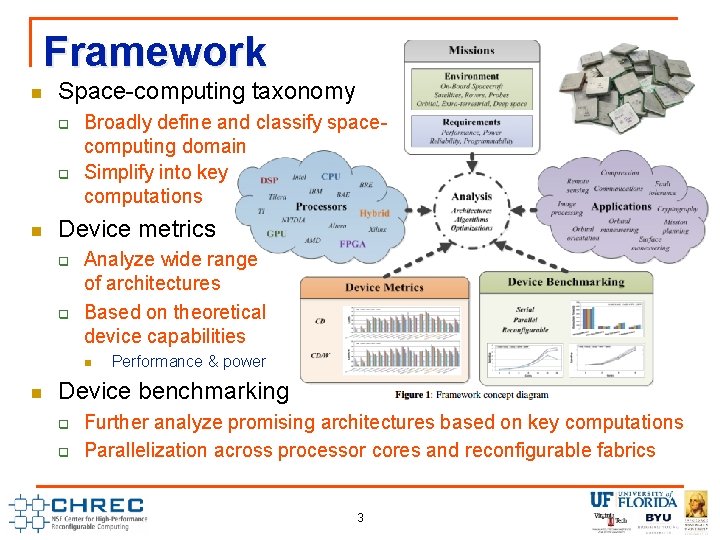
Framework n Space-computing taxonomy q q n Broadly define and classify spacecomputing domain Simplify into key computations Device metrics q q Analyze wide range of architectures Based on theoretical device capabilities n n Performance & power Device benchmarking q q Further analyze promising architectures based on key computations Parallelization across processor cores and reconfigurable fabrics 3
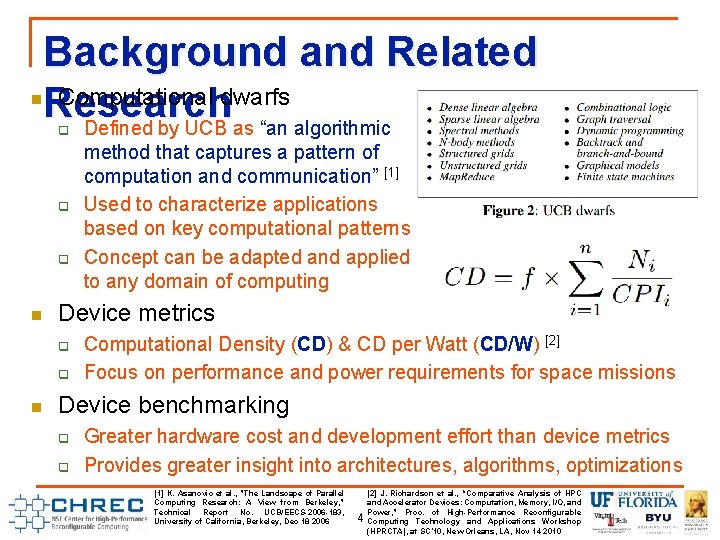
n Background and Related Computational dwarfs Research Defined by UCB as “an algorithmic q q q n Device metrics q q n method that captures a pattern of computation and communication” [1] Used to characterize applications based on key computational patterns Concept can be adapted and applied to any domain of computing Computational Density (CD) & CD per Watt (CD/W) [2] Focus on performance and power requirements for space missions Device benchmarking q q Greater hardware cost and development effort than device metrics Provides greater insight into architectures, algorithms, optimizations [1] K. Asanovic et al. , "The Landscape of Parallel Computing Research: A View from Berkeley, ” Technical Report No. UCB/EECS-2006 -183, University of California, Berkeley, Dec 18 2006 4 [2] J. Richardson et al. , “Comparative Analysis of HPC and Accelerator Devices: Computation, Memory, I/O, and Power, ” Proc. of High-Performance Reconfigurable Computing Technology and Applications Workshop (HPRCTA), at SC’ 10, New Orleans, LA, Nov 14 2010
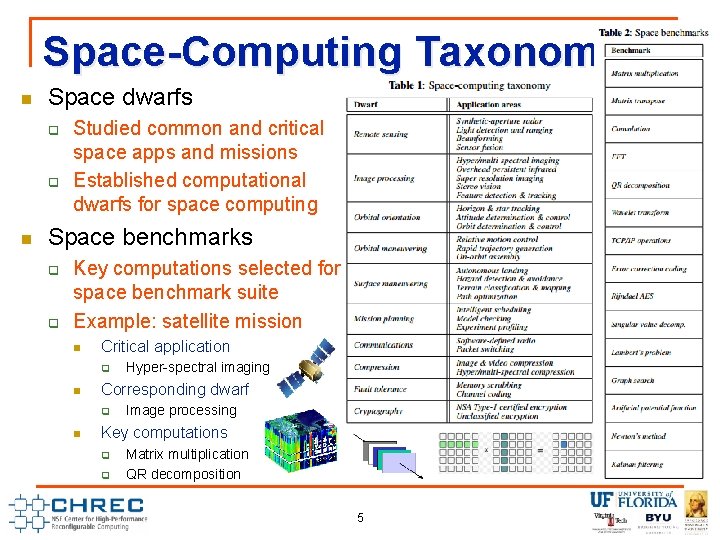
Space-Computing Taxonomy n Space dwarfs q q n Studied common and critical space apps and missions Established computational dwarfs for space computing Space benchmarks q q Key computations selected for space benchmark suite Example: satellite mission n Critical application q n Corresponding dwarf q n Hyper-spectral imaging Image processing Key computations q q Matrix multiplication QR decomposition 5
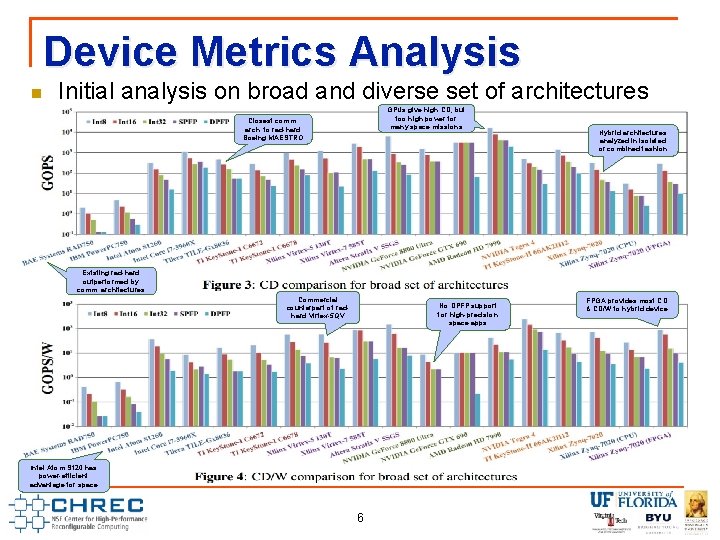
Device Metrics Analysis n Initial analysis on broad and diverse set of architectures GPUs give high CD, but too high power for many space missions Closest comm. arch. to rad-hard Boeing MAESTRO Hybrid architectures analyzed in isolated or combined fashion Existing rad-hard outperformed by comm. architectures Commercial counterpart of radhard Virtex-5 QV No DPFP support for high-precision space apps Intel Atom S 120 has power-efficient advantage for space 6 FPGA provides most CD & CD/W to hybrid device
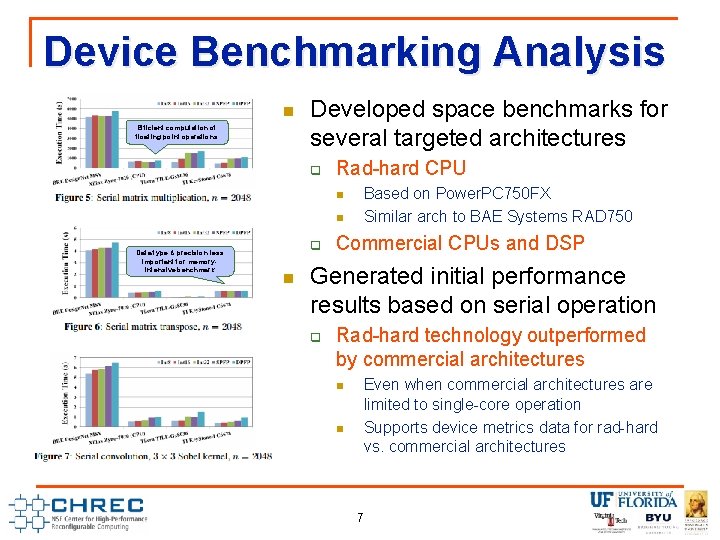
Device Benchmarking Analysis n Efficient computation of floating point operations Developed space benchmarks for several targeted architectures q Rad-hard CPU Based on Power. PC 750 FX Similar arch to BAE Systems RAD 750 n n Data type & precision less important for memoryintensive benchmark q n Commercial CPUs and DSP Generated initial performance results based on serial operation q Rad-hard technology outperformed by commercial architectures Even when commercial architectures are limited to single-core operation Supports device metrics data for rad-hard vs. commercial architectures n n 7
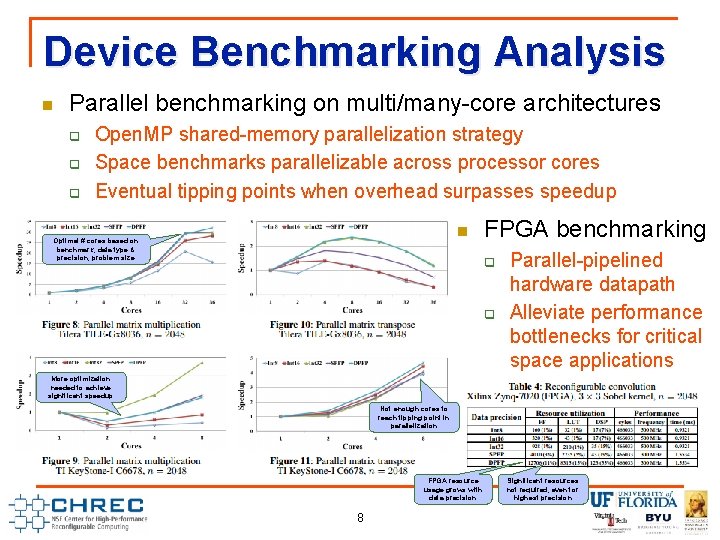
Device Benchmarking Analysis n Parallel benchmarking on multi/many-core architectures q q q Open. MP shared-memory parallelization strategy Space benchmarks parallelizable across processor cores Eventual tipping points when overhead surpasses speedup n Optimal # cores based on benchmark, data type & precision, problem size FPGA benchmarking q q Parallel-pipelined hardware datapath Alleviate performance bottlenecks for critical space applications More optimization needed to achieve significant speedup Not enough cores to reach tipping point in parallelization FPGA resource usage grows with data precision 8 Significant resources not required, even for highest precision
n Conclusions and Future Framework created to analyze processor architectures for Research next-generation on-board space computing q Space-computing taxonomy n n q Device metrics analysis n n q Wide range of architectures analyzed with CD and CD/W metrics Initial insights into performance and power efficiency for various architectures Device benchmarking analysis n n Established set of computational dwarfs for space Key computations selected for space benchmarking Conducted serial, parallel, and reconfigurable benchmarking Further supports metrics data that rad-hard tech becoming outdated Space apps parallelizable across processor cores and reconfig. fabrics Expand results with new devices and benchmarks q q Multi/many-core CPUs and DSPs; comm. and rad-hard Leverage established libraries and architecture-specific optimizations 9