
A Framework for Understanding Poverty PRESENTATION ON THE
- Slides: 53
A Framework for Understanding Poverty PRESENTATION ON THE THREE MAJOR SOCIAL CLASSES IN MODERN AMERICAN SOCIETY
A Framework for Understanding Poverty • Dr. Ruby K. Payne • **Teacher • ** Principal • **Consultant • **Administrator
CREDITS FOR PRESENTATION 1. Dr. Ruby K. Payne 2. Maria Dunstan —A Ruby Payne Trained Speaker who presented Ruby’s ideas at JWCC’s Fall Developmental Education Convocation on August 12, 2006. Originally Presented by Joyce Miller Boren Director of the Developmental Education Department at JWCC.
WHAT IS POVERTY ? ? » KEY POINTS • Poverty is relative!!!! • Poverty occurs in all races!! • Generational and situational poverty are different!!!
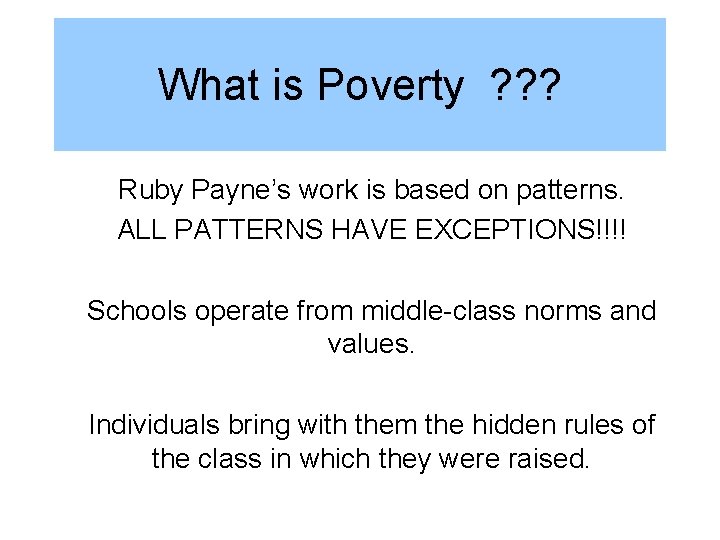
What is Poverty ? ? ? Ruby Payne’s work is based on patterns. ALL PATTERNS HAVE EXCEPTIONS!!!! Schools operate from middle-class norms and values. Individuals bring with them the hidden rules of the class in which they were raised.
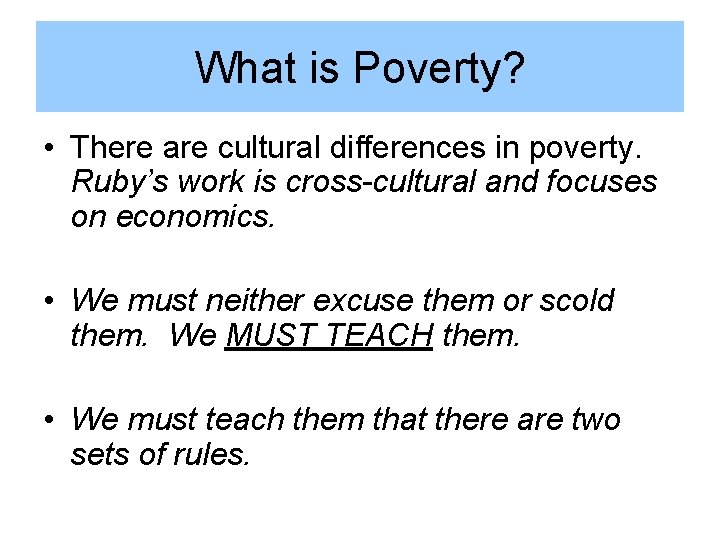
What is Poverty? • There are cultural differences in poverty. Ruby’s work is cross-cultural and focuses on economics. • We must neither excuse them or scold them. We MUST TEACH them. • We must teach them that there are two sets of rules.
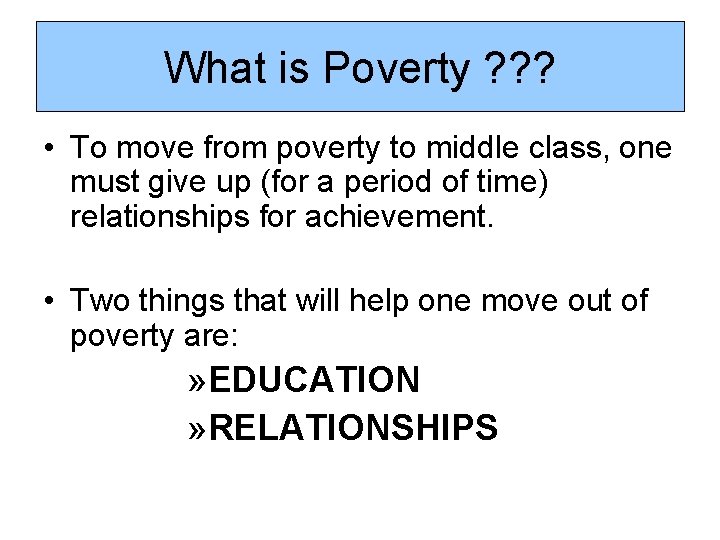
What is Poverty ? ? ? • To move from poverty to middle class, one must give up (for a period of time) relationships for achievement. • Two things that will help one move out of poverty are: » EDUCATION » RELATIONSHIPS
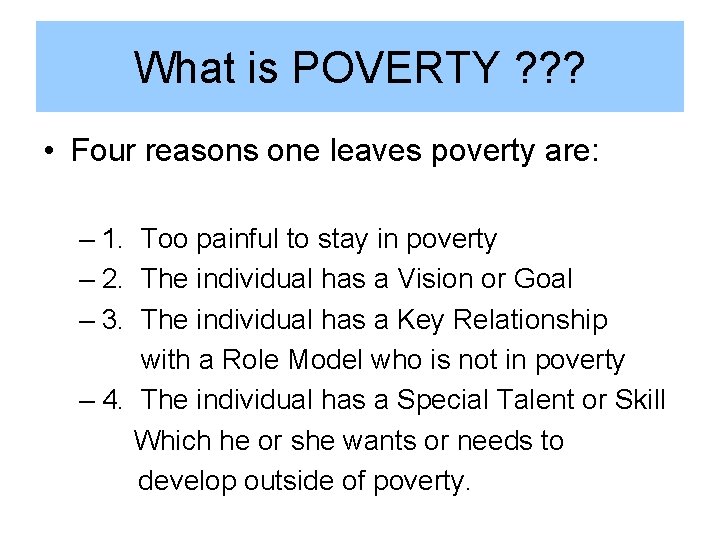
What is POVERTY ? ? ? • Four reasons one leaves poverty are: – 1. Too painful to stay in poverty – 2. The individual has a Vision or Goal – 3. The individual has a Key Relationship with a Role Model who is not in poverty – 4. The individual has a Special Talent or Skill Which he or she wants or needs to develop outside of poverty.
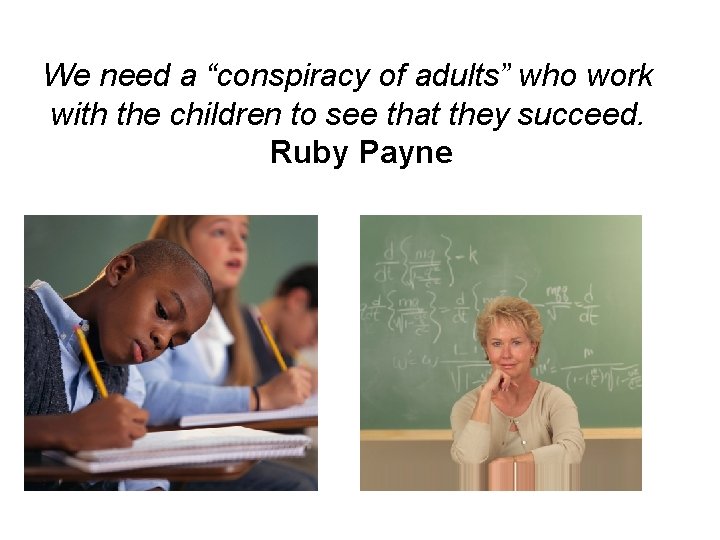
We need a “conspiracy of adults” who work with the children to see that they succeed. Ruby Payne
COULD YOU SURVIVE? ? ? ¡ …in Poverty? ¡ …in Middle Class ¡ …in Wealth?
CLASS PERCEPTIONS ¡ THERE ARE THREE SOCIAL CLASSES IN MODERN DAY AMERICA ¡ THE WEALTHY CLASS ¡ THE MIDDLE CLASS ¡ THE POVERTY CLASS
CLASS PERCEPTIONS THREE EXAMPLES ON HOW THE THREE CLASSES VIEW THE SUBJECTS OF: EDUCATION -FOOD -ART -
PERCEPTION OF EDUCATION ¡ - THE WEALTHY CLASS Education is a “given reality. ” Even More Important Than Gaining Knowledge; Is The Goal of Developing And Maintaining Social Connections.
PERCEPTION OF EDUCATION ¡ FOR THE MIDDLE CLASS -Education is the Key for Achieving Success And Living A Comfortable Lifestyle.
PERCEPTION OF EDUCATION ¡ FOR THOSE IN POVERTY -Education Often Is At “Best” A Distant Hope (Dream) And Largely Unobtainable Goal.
PERCEPTION OF FOOD ¡ FOR THE MIDDLE CLASS -Food Is meant To Be: TASTY AND NUTRITIOUS -Meal Times Are Meant To Be Family Bonding Experiences
PERCEPTION OF FOOD ¡ FOR ¡ ¡ THE WEALTHY CLASS It is Assumed that Food Will Be Tasty, Nutritious, and Plentiful. The Most Important Feature About Meal Time Is: “PRESENTATION” This includes Place Setting, Decorations, Arrangements and “How The Food Looks (Aesthetics). ” The Wealthy Are often judged by Their Peers By These Criterias. ¡
PERCEPTION OF FOOD FOR THOSE IN POVERTY -Their Goal is get Enough Food To Subsist On. Quantity of Food is More Important Than Quality. Food that is “Filling” and “Affordable” Takes Priority Over “Eating Healthy. ” ¡
PERCEPTION OF ART ¡ FOR THE WEALTHY CLASS -THE APPRECIATION OF “THE ARTS” AND ARTWORK ARE SIGNS OF CULTURE, WELL BREEDING, AND OFTEN ARE CONSIDERED TO BE FORMS OF FINANCIAL INVESTMENT.
PERCEPTION OF ART ¡ FOR THE MIDDLE CLASS -COLLECTING EXPENSIVE OBJECTS D’ART (Of art) IS UNCOMMON BUT OCCASIONALLY OBTAINABLE. IT IS OFTEN DONE FOR SENTIMENTAL REASONS AND AS A LEGACY TO GIVE TO THEIRS. IT IS A SIGN OF UPPER MOBILITY
BEING POOR ¡ Being poor is knowing you work as hard as anyone, anywhere. ¡ Being poor is people surprised to discover you’re not actually stupid. ¡ Being poor is people surprised to discover you’re not actually lazy.
PERCEPTION OF ART ¡ FOR THOSE IN POVERTY -THEIR APPRECIATION AND EXPOSURE TO THE “FINE ARTS” IS LIMITED TO VENUES OF POPULAR CULTURE AND PUBLIC INSTITUTIONS, MUSUEMS, CHURCHES, PUBLIC SPONSORED EVENTS SUCH AS PARK CONCERTS
BEING POOR ¡ Being poor is knowing exactly how much everything costs. ¡ Being poor is getting angry at your kids for asking for all the crap they see on TV. ¡ Being poor is having to keep buying $800 cars because they’re what you can afford, and then having the cars break down on you, because there’s not an $800 car in America worth a damn.
BEING POOR ¡ Being poor is coming back to the car with your children in the back seat, clutching that box of Raisin Bran you just bought and trying to think of a way to make the kids understand that the box must last. ¡ Being poor is a sidewalk with a lot of brown glass on it. ¡ Being poor is needing a 35 cent raise.
BEING POOR ¡ Being poor is a six-hour wait in an emergency room with a sick child asleep on your lap. ¡ Being poor is having to live with choices you didn’t know you made when you were 14 years old. ¡ Being poor is getting tired of people wanting you to be grateful.
BEING POOR ¡ Being poor is believing a GED actually makes a difference. ¡ Being poor is people angry at you for just walking around the mall. ¡ Being poor is the police bursting into the apartment right next to yours.
BEING POOR ¡ Being poor is hoping the toothache goes away. ¡ Being poor is knowing your kid goes to friends’ houses but never has friends over to yours. ¡ Being poor is living next to the freeway.
BEING POOR ¡ Being poor is off brand toys. ¡ Being poor is a heater in only one room of the house. ¡ Being poor is knowing you cannot leave $5. on the table when friends are around. ¡ Being poor is hoping you will be invited for dinner.
BEING POOR ¡ Being poor is going to the restroom before you get in lunch line so your friends will be ahead of you and won’t hear you say “I get free lunch” when you get to the cashier. ¡ Being poor is wondering if your well-off sibling is lying when he says he doesn’t mind when you ask for help.
BEING POOR ¡ Being poor is your kid’s teacher assuming you don’t have any books in your home. ¡ Being poor is $6. 00 short on the utility bill and no way to close the gap. ¡ Being poor is crying when you drop the mac and cheese on the floor. Being poor is knowing you are being judged. ¡
BEING POOR ¡ Being poor is a box of crayons and a $1 coloring book from a community center Santa. ¡ Being poor is checking the coin return slot of every soda machine you go by. ¡ Being poor is deciding that it’s all right to base a relationship on shelter.
BEING POOR ¡ Being poor is hoping your kids don’t have a growth spurt. ¡ Being poor is stealing meat from the store, frying it up before your mom gets home and then telling her she doesn’t have to make dinner tonight because you are not hungry anyway.
BEING POOR ¡ Being poor is wearing Goodwill underwear. ¡ Being poor is not enough space for anyone who lives with you. ¡ Being poor is feeling the glued soles tear off your supermarket shoes when you run around the playground. ¡ Being poor is thinking $8 an hour is a really good deal.
BEING POOR ¡ Being poor is your kid’s school being the one with 15 -year-old textbooks and no airconditioning. ¡ Being poor is relying on people who don’t give a damn about you. ¡ Being poor is an overnight shift under florescent lights.
BEING POOR ¡ Being poor is finding the letter your mom wrote to your dad, begging him for the child support. ¡ Being poor is a bathtub you have to empty into the toilet. ¡ Being poor is stopping the car to take a lamp from a stranger’s trash.
BEING POOR ¡ Being poor is not talking to that girl because she’ll probably just laugh at your clothes. ¡ Being poor is knowing you shouldn’t really spend that buck on a Lotto ticket. ¡ Being poor is hoping the register lady will spot you the dime.
BEING POOR ¡ Being poor is a cough that doesn’t go away. ¡ Being poor is a lumpy futon bed. ¡ Being poor is knowing where the shelter is. ¡ Being poor is knowing how hard it is to stop being poor.
BEING POOR ¡ Being poor is a #200 paycheck advance from a company that takes $250 when the paycheck comes in. ¡ Being poor is seeing how few options you have. ¡ Being poor is running in place. ¡ Being poor is people wondering why you didn’t leave.
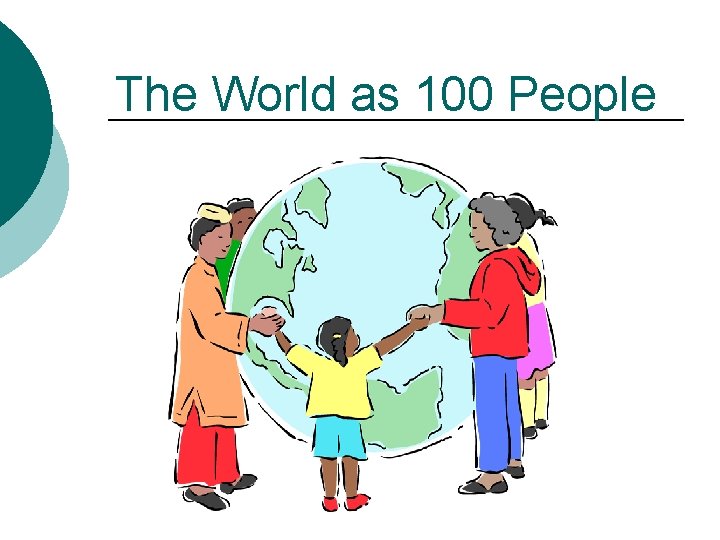
The World as 100 People
The World as 100 People ¡If we could shrink the earth’s population, with all the existing human ratios remaining the same, it would look like this……
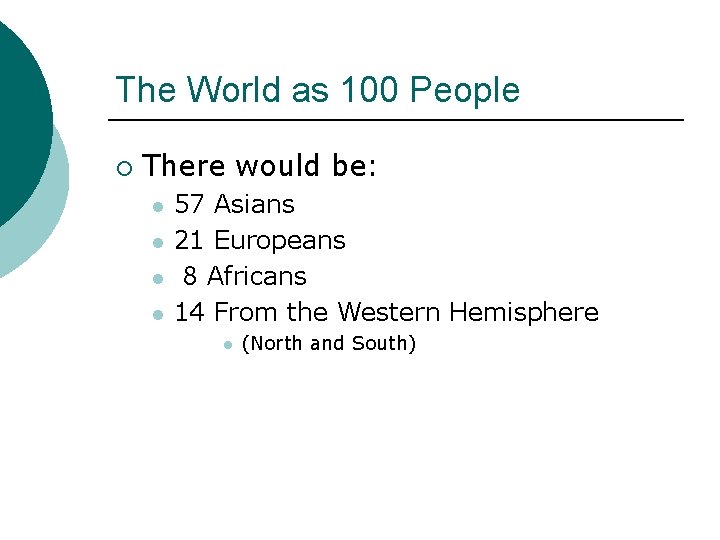
The World as 100 People ¡ There would be: l l 57 Asians 21 Europeans 8 Africans 14 From the Western Hemisphere l (North and South)
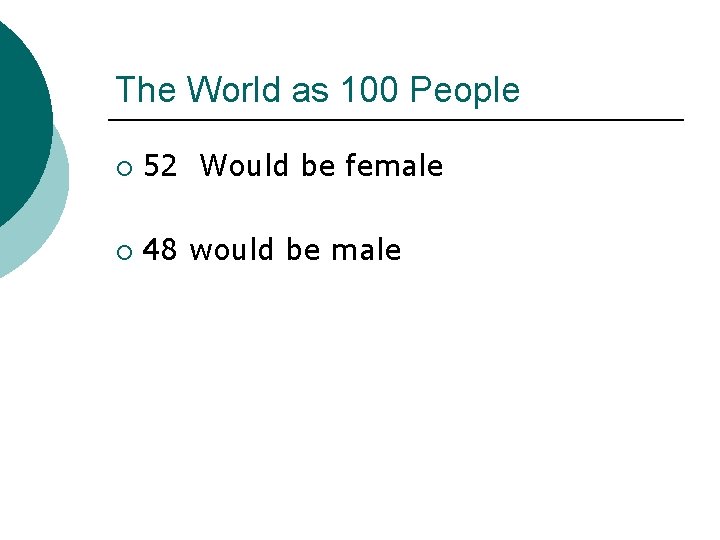
The World as 100 People ¡ 52 Would be female ¡ 48 would be male
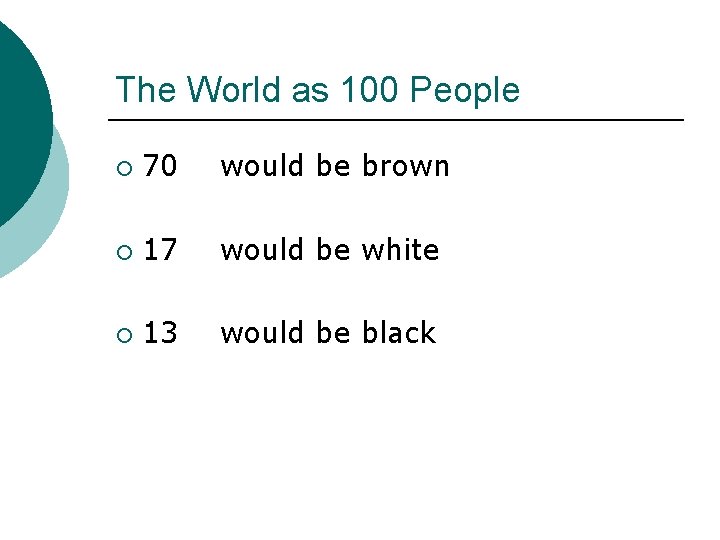
The World as 100 People ¡ 70 would be brown ¡ 17 would be white ¡ 13 would be black
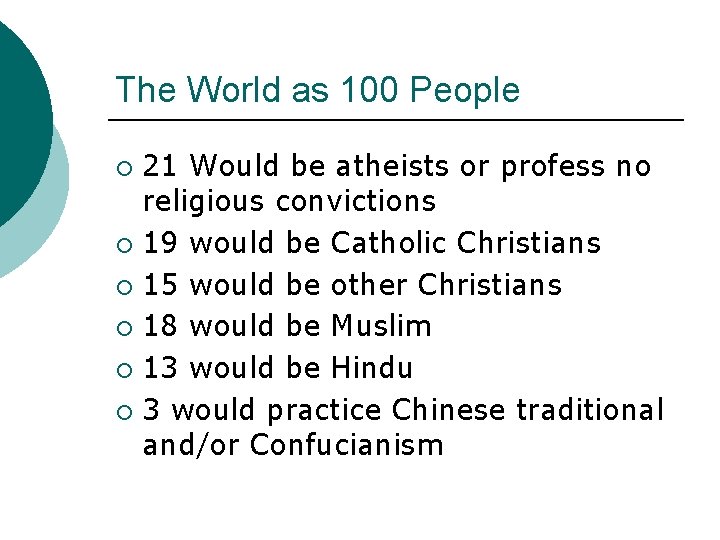
The World as 100 People 21 Would be atheists or profess no religious convictions ¡ 19 would be Catholic Christians ¡ 15 would be other Christians ¡ 18 would be Muslim ¡ 13 would be Hindu ¡ 3 would practice Chinese traditional and/or Confucianism ¡
The World as 100 People ¡ ¡ 2 would practice tribal religion 3 would represent all other religions of the world
The World as 100 People ¡ ¡ 59% of the world’s entire wealth would be in the hands of only 6 people and all six would be citizens of the United States 80% would live in substandard housing
The World as 100 People ¡ 70% would be unable to read ¡ 50% would suffer from malnutrition ¡ 1% would be near death ¡ 1% would be near birth
The World as 100 People ¡ 1% would have a college education ¡ 1% would own a computer
The World as 100 People ¡ When one considers our world from this compressed perspective, the need for knowledge, tolerance and understanding becomes glaringly apparent!!
The World as 100 People ¡ The idea of reducing the world’s population to a community of only 100 people is very useful and important. It makes us easily understand the differences in the world. There are many types of reports that use the Earth’s population reduced to 100 people, especially in the Internet. Ideas like this should be more often shared, especially nowadays when the world seems to be in need of dialogue and understanding among different cultures, in a way that it has never been before.
THANKS l On behalf of John Wood Community College, I wish to express my thanks to the Illinois Community College Faculty Association for granting us the monies to assist in the Developmental Education Convocation dealing with assessment and understanding students.
WHAT DID WE LEARN? ? ¡ ¡ We learned at JWCC to begin to understand some of our student’s background. We now are more aware of situations.
WHAT DO WE NEED ¡ Now that we are aware of situations, we need more sessions on how do we apply what we have learned.