
A Framework for Understanding Poverty CHAPTER 9 We
- Slides: 14
A Framework for Understanding Poverty CHAPTER 9
We need to rethink our instruction and instructional arrangements in order to improve achievement in students who come from poverty. In order to learn, students need certain cognitive skills to take in and process information. They also need schema to organize and store information. We often assume all student arrive at school with prior knowledge in place and the organization skills needed to process information. This is a fallacy. Teachers should provide the cognitive strategies needed to learn through mediation.
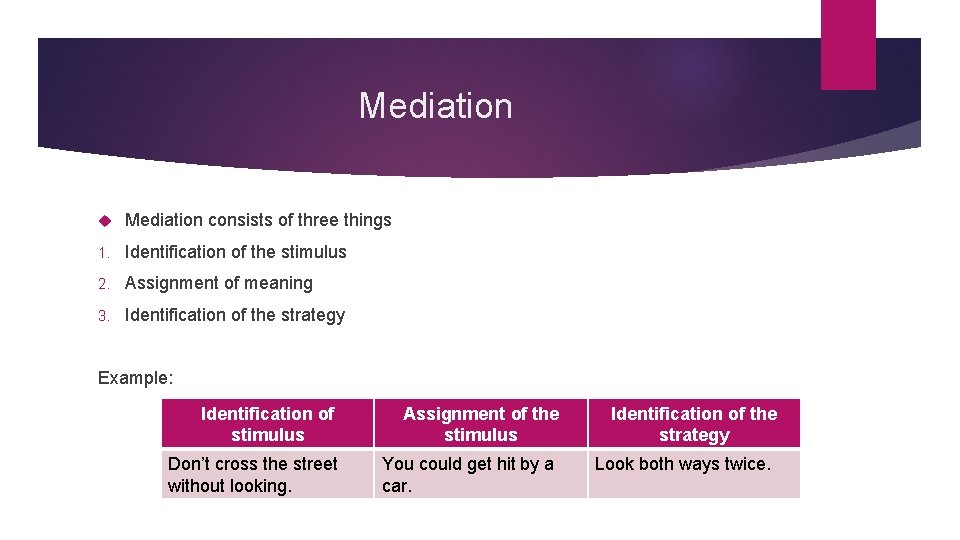
Mediation consists of three things 1. Identification of the stimulus 2. Assignment of meaning 3. Identification of the strategy Example: Identification of stimulus Assignment of the stimulus Don’t cross the street without looking. You could get hit by a car. Identification of the strategy Look both ways twice.
Why is mediation important? Building cognitive strategies helps students plan, organize, and handle new information. 1. If a child cannot plan, she cannot predict. 2. If she cannot predict, she cannot identify cause and effect. 3. If she cannot identify cause and effect, she cannot identify consequences. 4. If she cannot identify consequences, she cannot control impulsivity. 5. If she cannot control impulsivity, she has an inclination toward criminal activity.
In a recent 2008 study, EEG scans of 9 and 10 year olds’ brains in poverty revealed the finding that the childrens’ brains were similar to those of people who have had a stroke. The change was found in the prefrontal cortex that controls the executive functioning of the brain. Executive function being impulse control, planning, and working memory. These “missing links” result in cognitive issues. However, these missing links can be taught.
What are the missing links? Lack of systematic method of exploration (obtaining information) Impaired verbal tools (vocabulary) Impaired spatial orientation (orientation in space) Impaired temporal orientation (measure time) Impaired observations (memory) Lack of precision (data gathering) Inability to compare (hold more than one object in memory)
What strategies need to be built? Input strategies (data gathering) Elaboration strategies (data usage) Output strategies (communicating data) As teachers, we make the mistake of beginning instruction at the elaboration level instead of at the input level that impoverished students need.
Input strategies 1. Use planning behaviors 2. Focus perception on specific stimulus 3. Control impulsivity 4. Explore data systematically 5. Use appropriate and accurate labels 6. Organize space with stable systems of reference 7. Orient data in time 8. Identify constancies across variations 9. Gather precise and accurate data 10. Consider two sources of information at once. 11. Organize data. (parts of a whole) 12. Visually transport data.
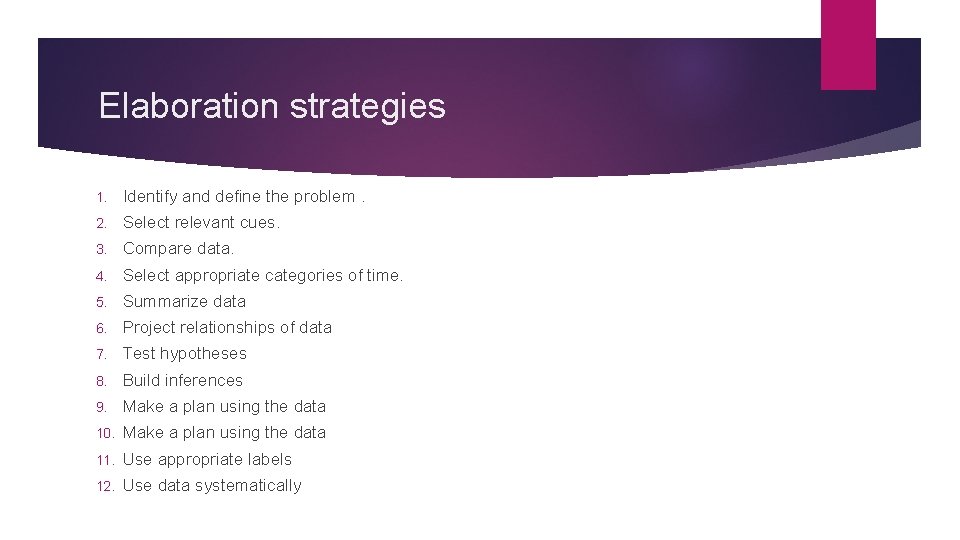
Elaboration strategies 1. Identify and define the problem. 2. Select relevant cues. 3. Compare data. 4. Select appropriate categories of time. 5. Summarize data 6. Project relationships of data 7. Test hypotheses 8. Build inferences 9. Make a plan using the data 10. Make a plan using the data 11. Use appropriate labels 12. Use data systematically
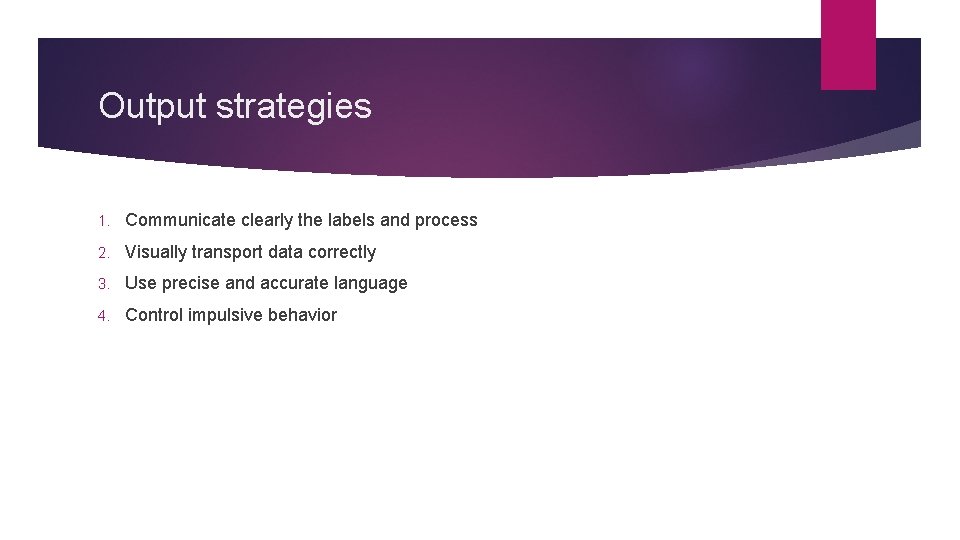
Output strategies 1. Communicate clearly the labels and process 2. Visually transport data correctly 3. Use precise and accurate language 4. Control impulsive behavior
Often times, students are expected to know how to interpret abstract representations though they have little experience with them. These students come from homes that lack print rich resources, and abstract representations. (symbols, books, calendars, clocks, maps, etc. ) Students lack experience with the “paper world” Instructionally, what can we do to help?
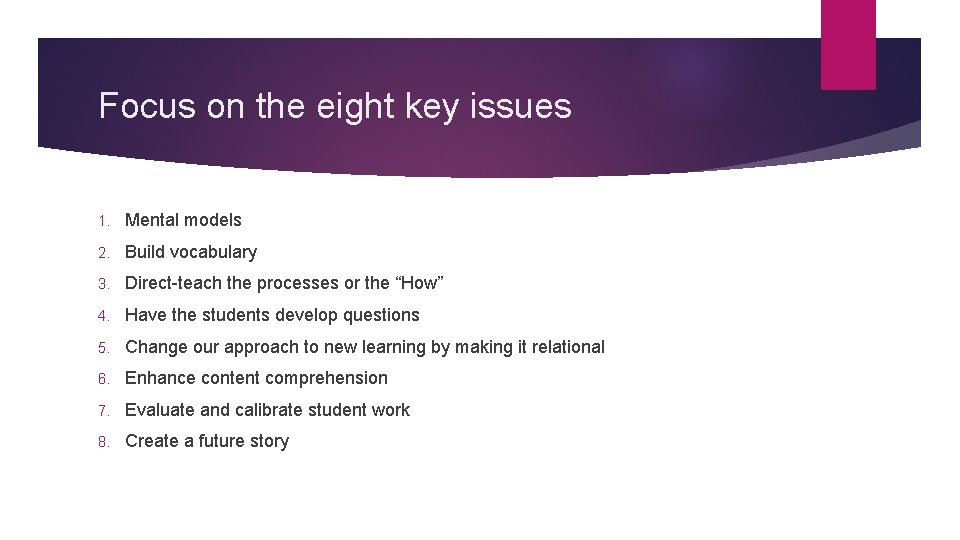
Focus on the eight key issues 1. Mental models 2. Build vocabulary 3. Direct-teach the processes or the “How” 4. Have the students develop questions 5. Change our approach to new learning by making it relational 6. Enhance content comprehension 7. Evaluate and calibrate student work 8. Create a future story
These efforts to meet children where they are, in their own heads, is the best approach to improve achievement for our children of poverty.
What does this mean for us as teachers? Make 80% of grade content based and only 20% on the process or steps the students take to get the answer. Focus on diagnostic approach rather than a programmatic approach Insistence, support, and high expectations paired with a relationship of mutual respect should be the determinants of our instructional decisions.