
A Framework for Planning Modeling and Communicating CAV
- Slides: 22
A Framework for Planning, Modeling, and Communicating CAV Impacts NCHRP 896 June, 2019 TRB Transportation Planning and Applications Conference
It’s the Year 2045… • Congestion is managed thru VMT fees, cordon line pricing, priced lanes and services… • Space. X NET has turned every mobile device into a workstation, anywhere, anytime… • There are 50% fewer brick & mortar stores than in 2020… • Light Weight EVs zoom safely around with kids and grandparents… • Pricing is variable according to means… Is this part of your current 2045 planning/modeling process? 2
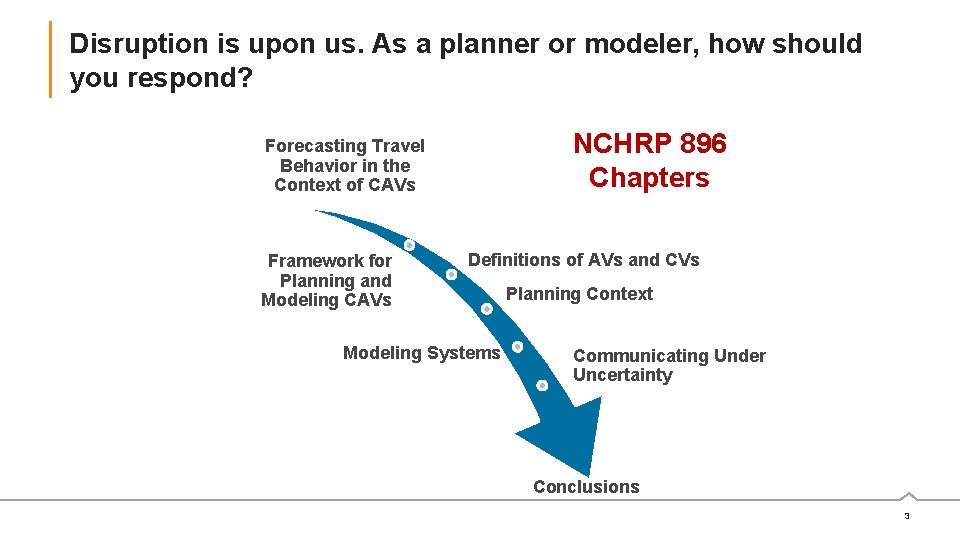
Disruption is upon us. As a planner or modeler, how should you respond? NCHRP 896 Chapters Forecasting Travel Behavior in the Context of CAVs Framework for Planning and Modeling CAVs Definitions of AVs and CVs Modeling Systems Planning Context Communicating Under Uncertainty Conclusions 3
CAVs put pressure on traditional planning assumptions. This study provides information about how state DOTs and MPOs can begin accounting for CAVs in planning and modeling activities. New assumptions may need to address: • Transportation Cost Impacts • Transportation Safety Impacts • Vehicle Operations Impacts • Electrification (fuel) impacts • Personal mobility and convenience impacts 4
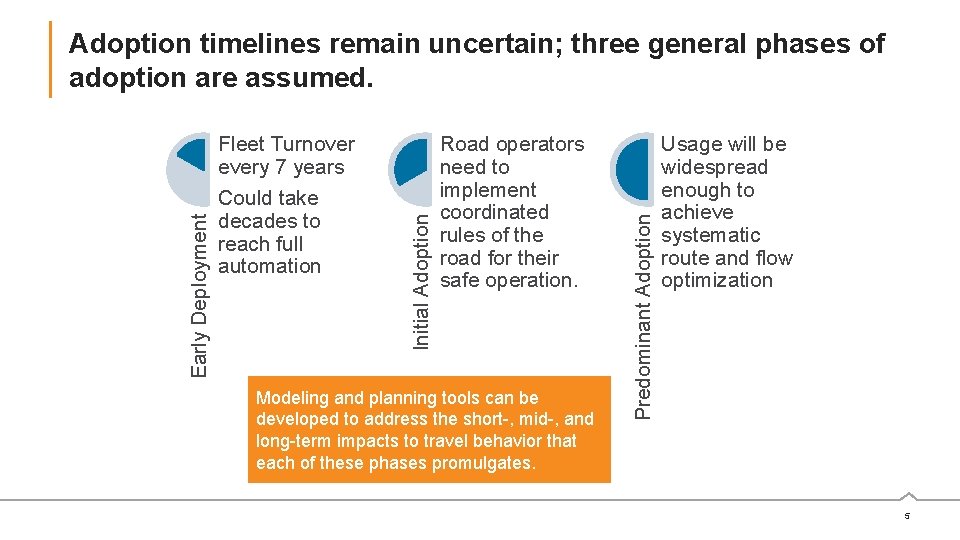
Road operators need to implement coordinated rules of the road for their safe operation. Modeling and planning tools can be developed to address the short-, mid-, and long-term impacts to travel behavior that each of these phases promulgates. Predominant Adoption Fleet Turnover every 7 years Could take decades to reach full automation Initial Adoption Early Deployment Adoption timelines remain uncertain; three general phases of adoption are assumed. Usage will be widespread enough to achieve systematic route and flow optimization 5
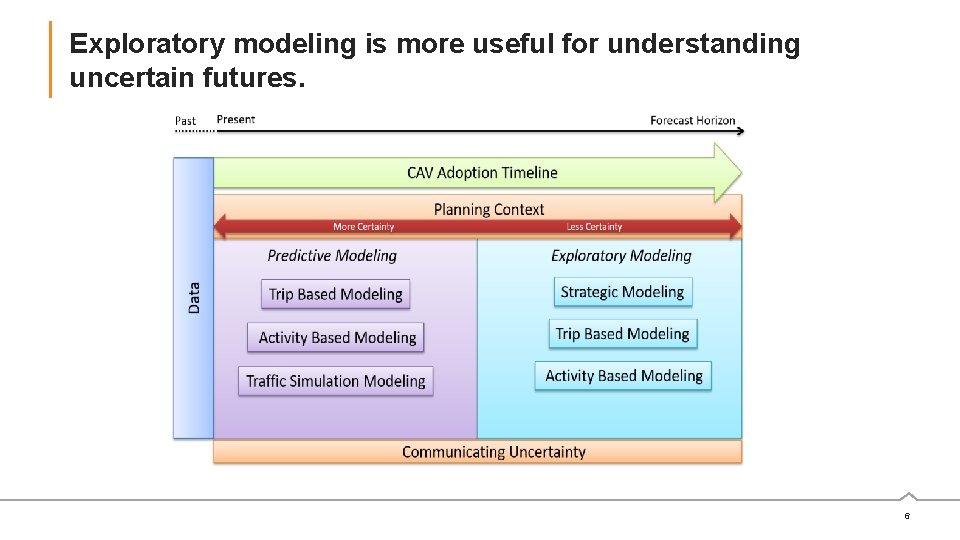
Exploratory modeling is more useful for understanding uncertain futures. 6
Critical Questions: Going Forward Is it OK to continue {Trend} forecasting > 10 Years into the future? Should we continue to invest $Billions in Big Infrastructure? What/Who defines the Scenarios? Can the Regional Planning Process – and Project Programming – adapt to Scenario Planning/Modeling? 7
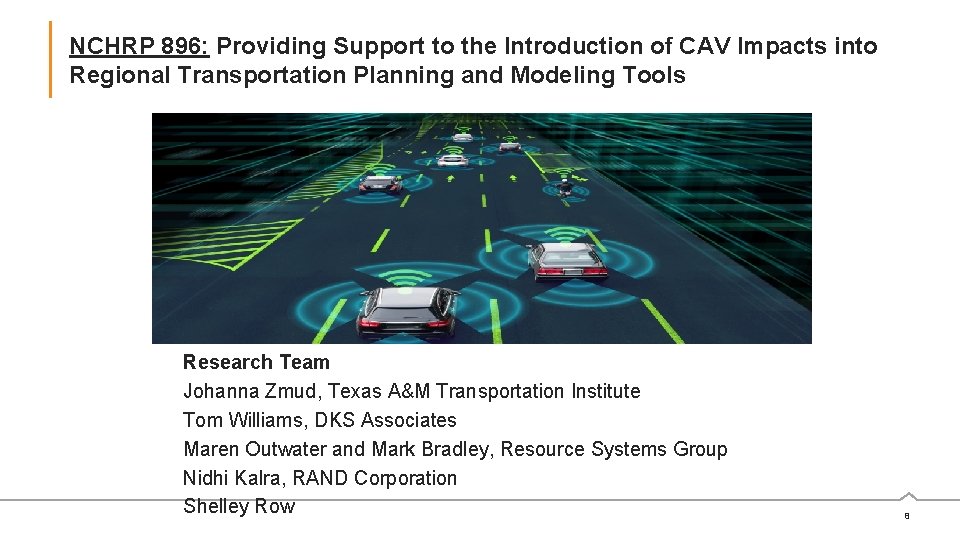
NCHRP 896: Providing Support to the Introduction of CAV Impacts into Regional Transportation Planning and Modeling Tools Research Team Johanna Zmud, Texas A&M Transportation Institute Tom Williams, DKS Associates Maren Outwater and Mark Bradley, Resource Systems Group Nidhi Kalra, RAND Corporation Shelley Row 8
Extras 9
The CAV framework addresses three types of modeling systems. Trip-based models are developed as aggregate models of population and employment in a region with disaggregate measures of transportation supply and an aggregate assignment process. Activity-based (AB) and dynamic traffic assignment (DTA) models are developed as disaggregate models of persons and firms in a region with disaggregate measures of transportation supply. Strategic models are developed as disaggregate models of persons and firms in a region with aggregate measures of transportation supply. The following slides present a panorama of the possible with respect to model adaptations. Which ones to implement depend on what one hopes to learn from the models. 10
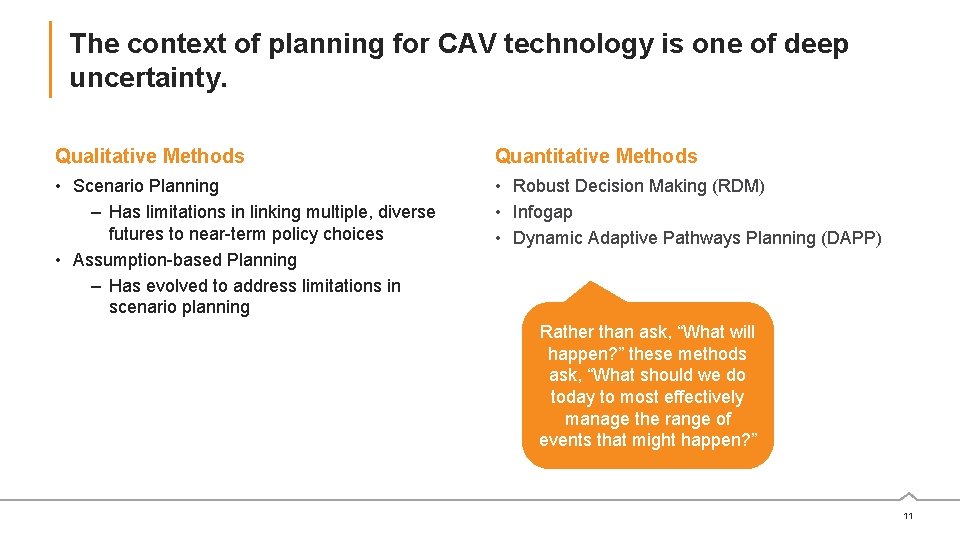
The context of planning for CAV technology is one of deep uncertainty. Qualitative Methods Quantitative Methods • Scenario Planning – Has limitations in linking multiple, diverse futures to near-term policy choices • Assumption-based Planning – Has evolved to address limitations in scenario planning • Robust Decision Making (RDM) • Infogap • Dynamic Adaptive Pathways Planning (DAPP) Rather than ask, “What will happen? ” these methods ask, “What should we do today to most effectively manage the range of events that might happen? ” 11
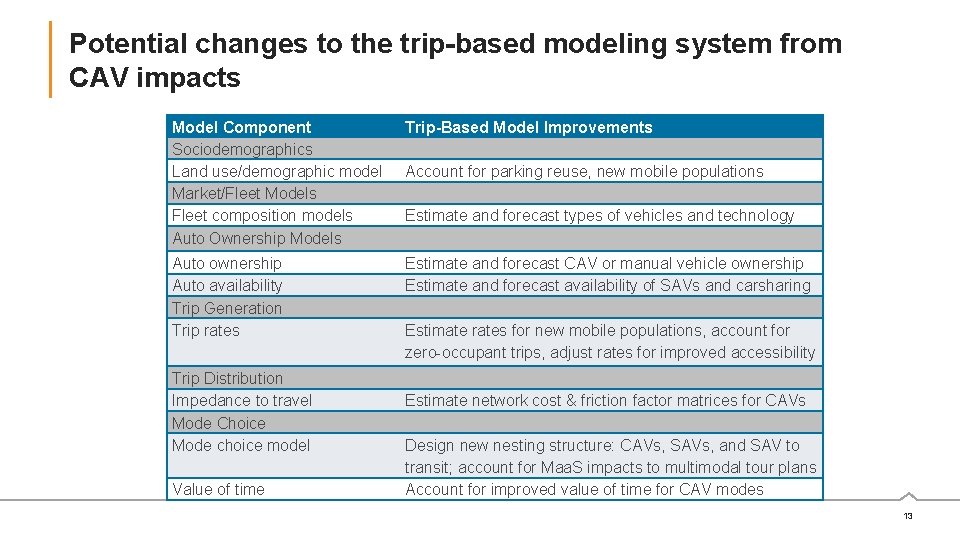
Adapting Trip-Based Models to CAVs. Trip-based models are long-range travel demand models that follow the conventional four-step process of trip generation, trip distribution, mode choice, and traffic assignment. These models have been calibrated, validated, and tested throughout the world, and they are used extensively across most MPOs and state DOTs. The study report discusses adapting the following components of tripbased models to account for CAVs: Land use modeling, Auto availability and mobility choices, Trip generation, Trip distribution, Mode choice, Routing and traffic assignment. 12
Potential changes to the trip-based modeling system from CAV impacts Model Component Sociodemographics Land use/demographic model Market/Fleet Models Fleet composition models Auto Ownership Models Trip-Based Model Improvements Auto ownership Auto availability Trip Generation Trip rates Estimate and forecast CAV or manual vehicle ownership Estimate and forecast availability of SAVs and carsharing Trip Distribution Impedance to travel Mode Choice Mode choice model Value of time Account for parking reuse, new mobile populations Estimate and forecast types of vehicles and technology Estimate rates for new mobile populations, account for zero-occupant trips, adjust rates for improved accessibility Estimate network cost & friction factor matrices for CAVs Design new nesting structure: CAVs, SAVs, and SAV to transit; account for Maa. S impacts to multimodal tour plans Account for improved value of time for CAV modes 13
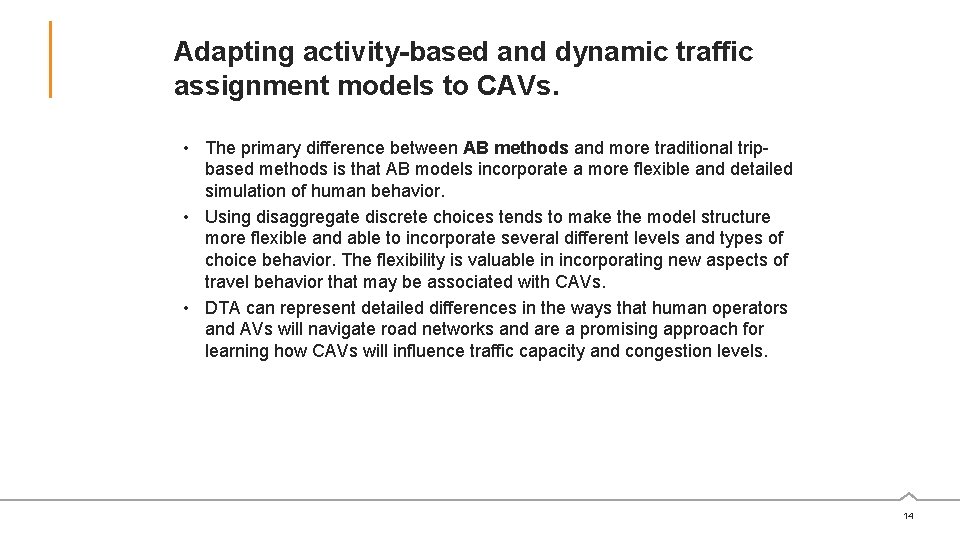
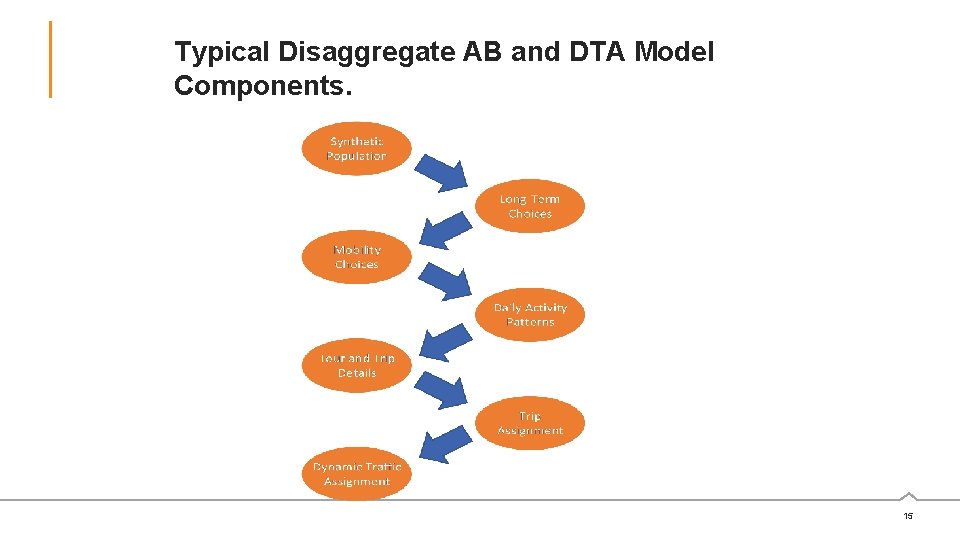
Adapting activity-based and dynamic traffic assignment models to CAVs. • The primary difference between AB methods and more traditional tripbased methods is that AB models incorporate a more flexible and detailed simulation of human behavior. • Using disaggregate discrete choices tends to make the model structure more flexible and able to incorporate several different levels and types of choice behavior. The flexibility is valuable in incorporating new aspects of travel behavior that may be associated with CAVs. • DTA can represent detailed differences in the ways that human operators and AVs will navigate road networks and are a promising approach for learning how CAVs will influence traffic capacity and congestion levels. 14
Typical Disaggregate AB and DTA Model Components. 15
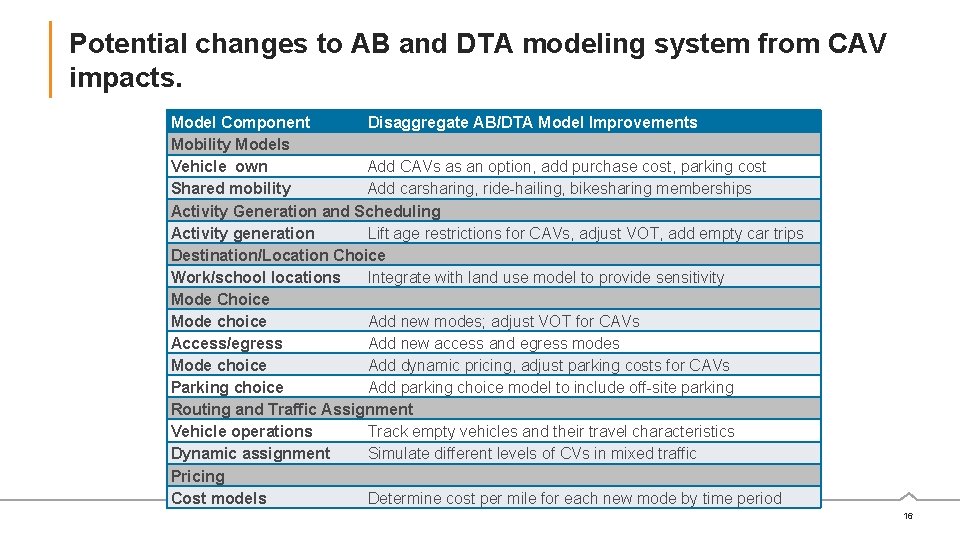
Potential changes to AB and DTA modeling system from CAV impacts. Model Component Disaggregate AB/DTA Model Improvements Mobility Models Vehicle own Add CAVs as an option, add purchase cost, parking cost Shared mobility Add carsharing, ride-hailing, bikesharing memberships Activity Generation and Scheduling Activity generation Lift age restrictions for CAVs, adjust VOT, add empty car trips Destination/Location Choice Work/school locations Integrate with land use model to provide sensitivity Mode Choice Mode choice Add new modes; adjust VOT for CAVs Access/egress Add new access and egress modes Mode choice Add dynamic pricing, adjust parking costs for CAVs Parking choice Add parking choice model to include off-site parking Routing and Traffic Assignment Vehicle operations Track empty vehicles and their travel characteristics Dynamic assignment Simulate different levels of CVs in mixed traffic Pricing Cost models Determine cost per mile for each new mode by time period 16
Adapting strategic models to CAVs. • Strategic models are intended for use as visioning tools, specifically to help guide transportation policies and investments. • Several forms of strategic models have been developed in recent years for transportation planning to address a gap in the technical understanding of an uncertain future. • The current strategic visioning frameworks were designed to be faster, allowing for extensive scenario testing. • Strategic models run many (even hundreds of) scenarios quickly, so that visualizers can interpret them interactively to assess the impacts derived from various combinations of policies and investments. 17
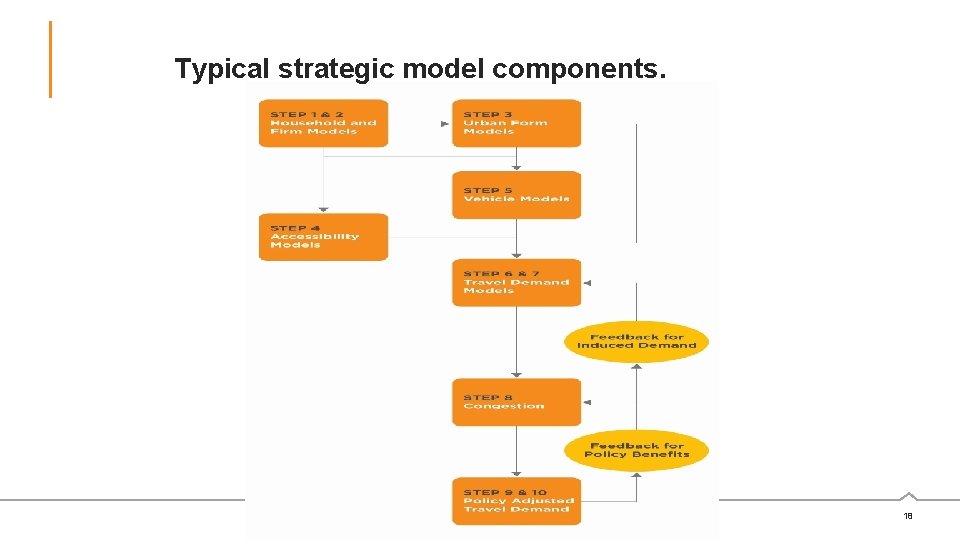
Typical strategic model components. 18
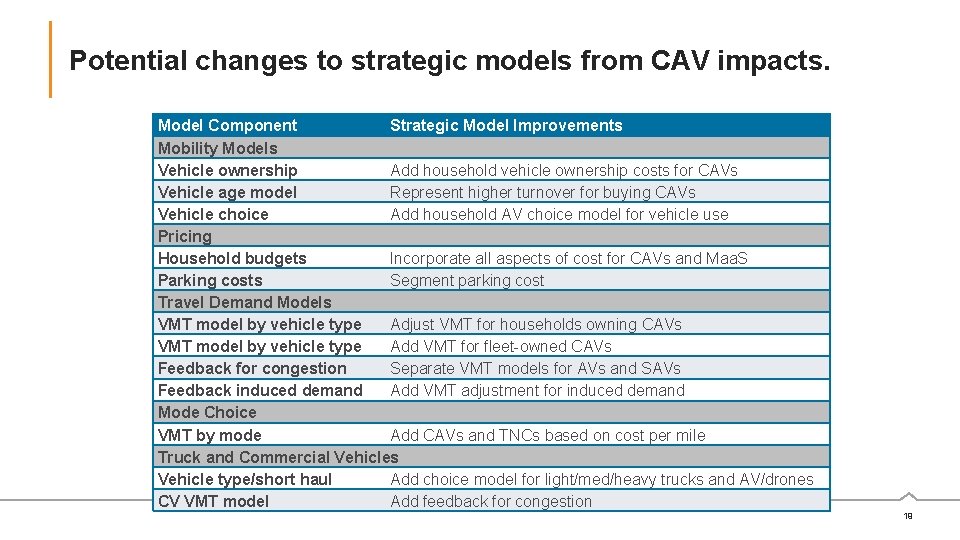
Potential changes to strategic models from CAV impacts. Model Component Strategic Model Improvements Mobility Models Vehicle ownership Add household vehicle ownership costs for CAVs Vehicle age model Represent higher turnover for buying CAVs Vehicle choice Add household AV choice model for vehicle use Pricing Household budgets Incorporate all aspects of cost for CAVs and Maa. S Parking costs Segment parking cost Travel Demand Models VMT model by vehicle type Adjust VMT for households owning CAVs VMT model by vehicle type Add VMT for fleet-owned CAVs Feedback for congestion Separate VMT models for AVs and SAVs Feedback induced demand Add VMT adjustment for induced demand Mode Choice VMT by mode Add CAVs and TNCs based on cost per mile Truck and Commercial Vehicles Vehicle type/short haul Add choice model for light/med/heavy trucks and AV/drones CV VMT model Add feedback for congestion 19
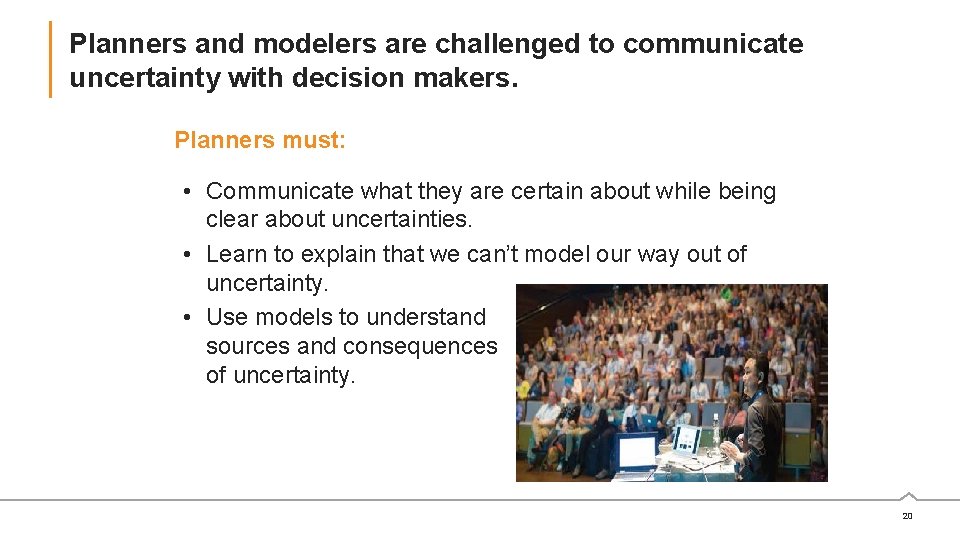
Planners and modelers are challenged to communicate uncertainty with decision makers. Planners must: • Communicate what they are certain about while being clear about uncertainties. • Learn to explain that we can’t model our way out of uncertainty. • Use models to understand sources and consequences of uncertainty. 20
While different agencies have unique needs, all should develop new planning and modeling processes for CAVs in the transportation environment. • MPOs and DOTs should consider adapting their planning processes to address the uncertainties posed by future CAV deployment and use. • Models can inform decision-making under uncertainty, but they cannot reduce that uncertainty. • Careful attention to model assumptions is the key to risk management and confident decision-making. 21
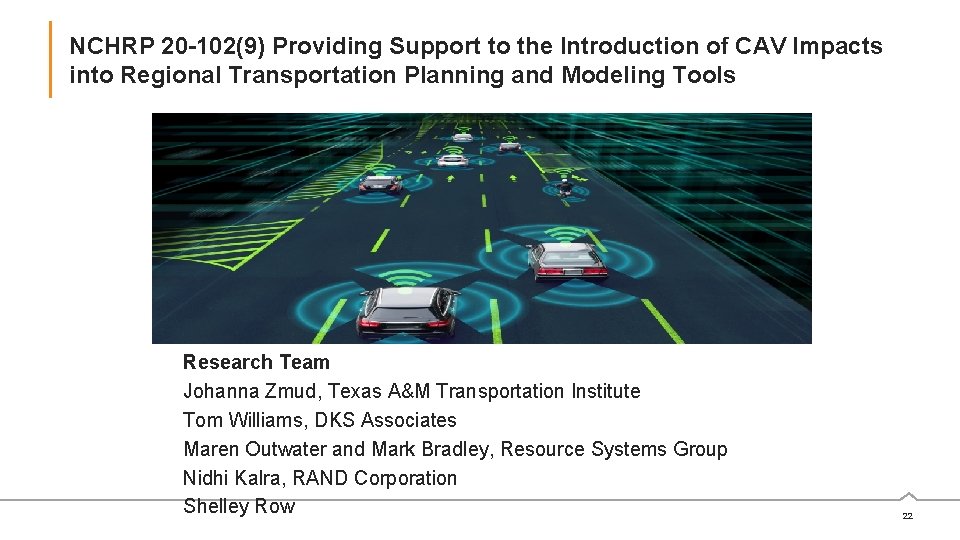
NCHRP 20 -102(9) Providing Support to the Introduction of CAV Impacts into Regional Transportation Planning and Modeling Tools Research Team Johanna Zmud, Texas A&M Transportation Institute Tom Williams, DKS Associates Maren Outwater and Mark Bradley, Resource Systems Group Nidhi Kalra, RAND Corporation Shelley Row 22