
A Framework for Human Resource Management 6 e
- Slides: 44
A Framework for Human Resource Management 6 e Gary Dessler Copyright © 2011 Pearson Education, Inc. Publishing as Prentice Hall
Testing and Selecting Employees CHAPTER 4 Copyright Education, Inc. Publishing as Prentice Hall Copyright©© 2011 Pearson Education, Publishing as Prentice
When you finish studying this chapter, you should be able to: • Define basic testing concepts, including validity and reliability • Discuss at least four basic types of personnel tests • Explain the pros and cons of background investigations, reference checks, and preemployment information services • Explain the factors and problems that can undermine an interview’s usefulness and techniques for eliminating them Copyright © 2011 Pearson Education, Inc. Publishing as Prentice Hall 4 -3
Why careful selection is important? 1. A manager’s performance always depends on subordinates 2. Want to screen out undesirables 3. Don’t want to waste money 4. The legal implications of incompetent selection—negligent hiring Copyright © 2011 Pearson Education, Inc. Publishing as Prentice Hall 4 -4
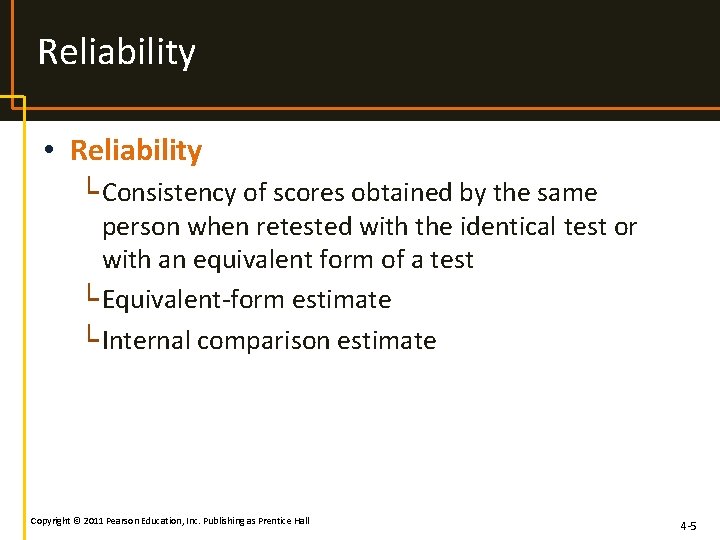
Reliability • Reliability └ Consistency of scores obtained by the same person when retested with the identical test or with an equivalent form of a test └ Equivalent-form estimate └ Internal comparison estimate Copyright © 2011 Pearson Education, Inc. Publishing as Prentice Hall 4 -5
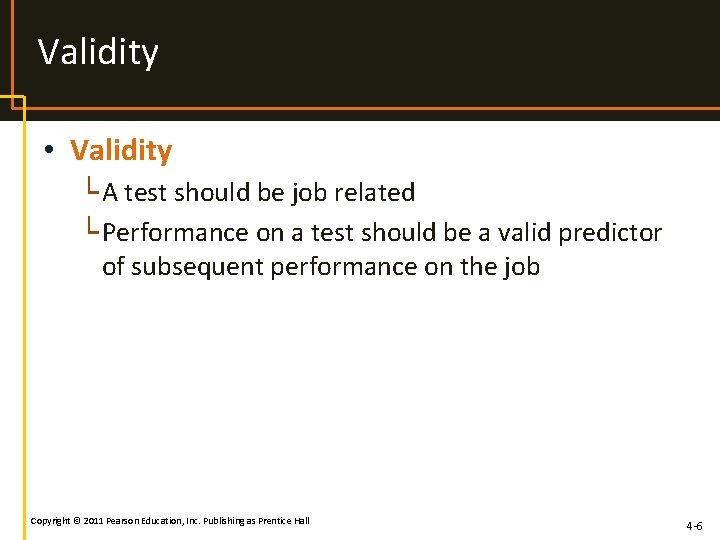
Validity • Validity └ A test should be job related └ Performance on a test should be a valid predictor of subsequent performance on the job Copyright © 2011 Pearson Education, Inc. Publishing as Prentice Hall 4 -6
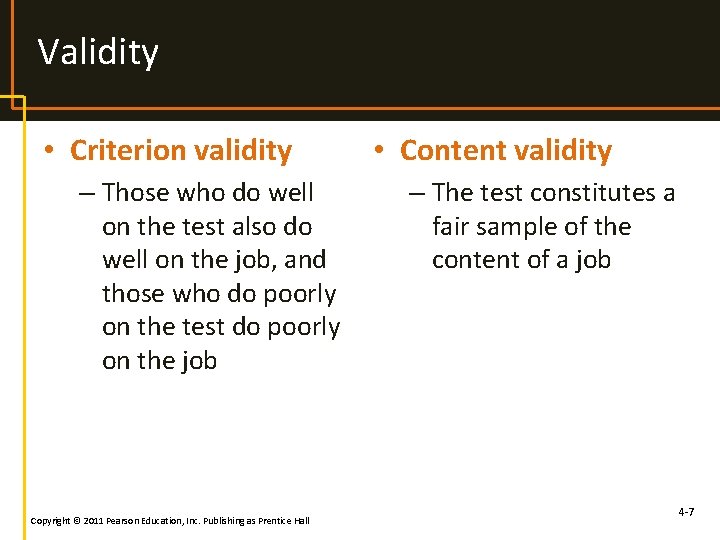
Validity • Criterion validity – Those who do well on the test also do well on the job, and those who do poorly on the test do poorly on the job Copyright © 2011 Pearson Education, Inc. Publishing as Prentice Hall • Content validity – The test constitutes a fair sample of the content of a job 4 -7
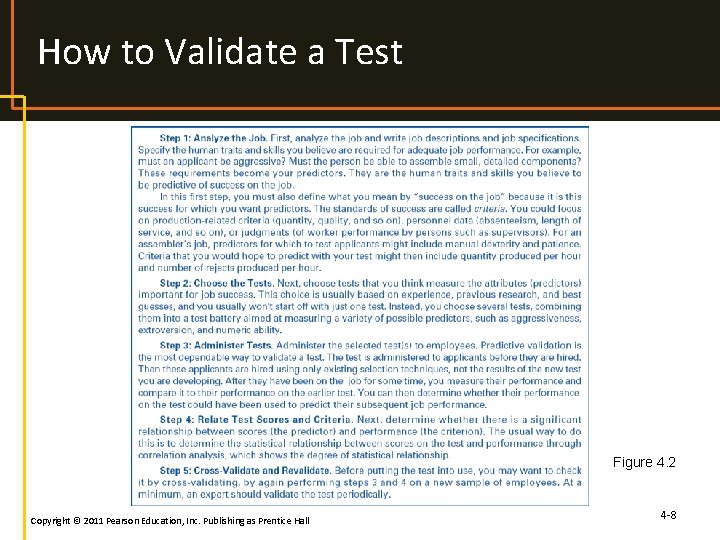
How to Validate a Test Figure 4. 2 Copyright © 2011 Pearson Education, Inc. Publishing as Prentice Hall 4 -8
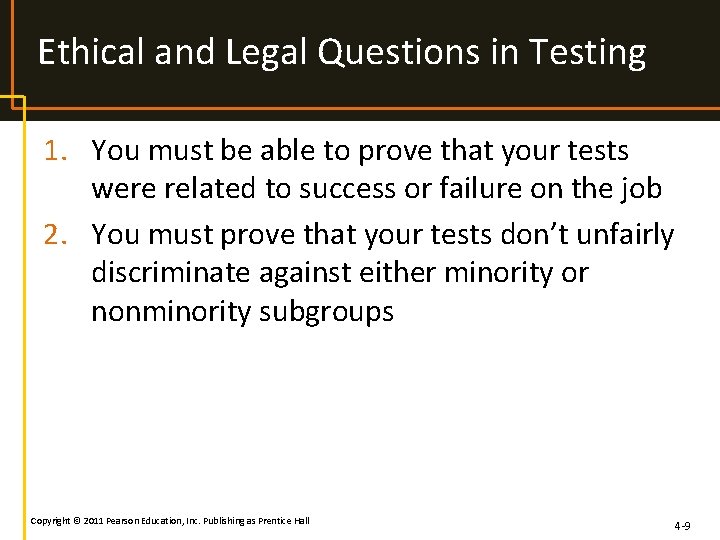
Ethical and Legal Questions in Testing 1. You must be able to prove that your tests were related to success or failure on the job 2. You must prove that your tests don’t unfairly discriminate against either minority or nonminority subgroups Copyright © 2011 Pearson Education, Inc. Publishing as Prentice Hall 4 -9
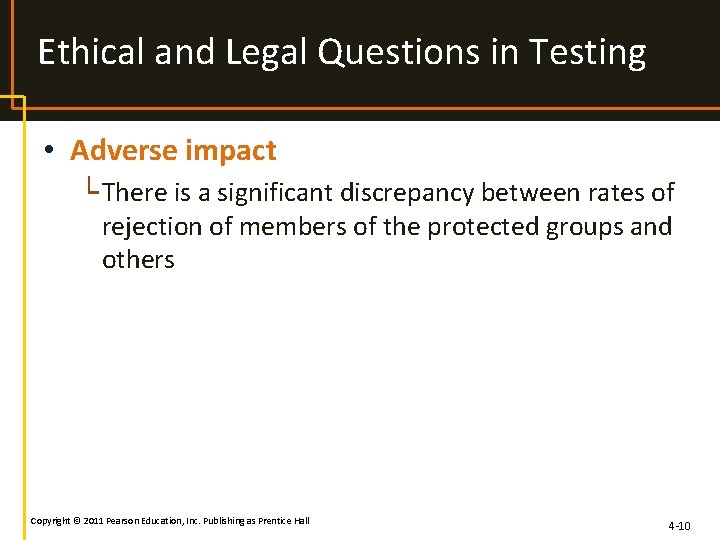
Ethical and Legal Questions in Testing • Adverse impact └ There is a significant discrepancy between rates of rejection of members of the protected groups and others Copyright © 2011 Pearson Education, Inc. Publishing as Prentice Hall 4 -10
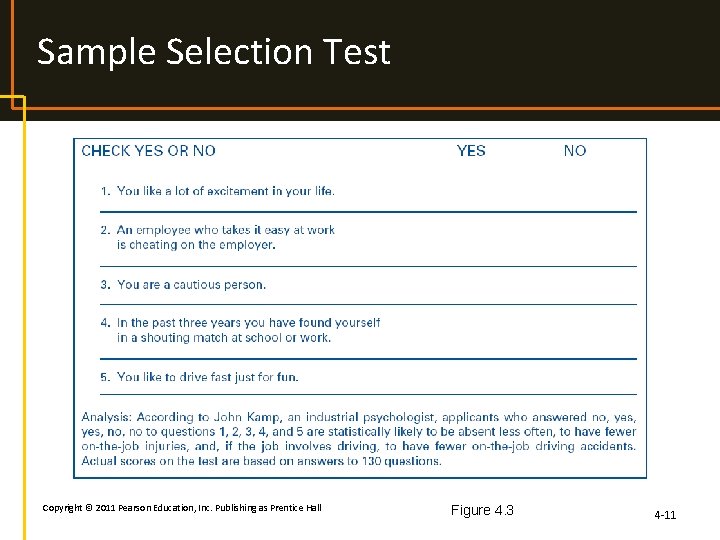
Sample Selection Test Copyright © 2011 Pearson Education, Inc. Publishing as Prentice Hall Figure 4. 3 4 -11
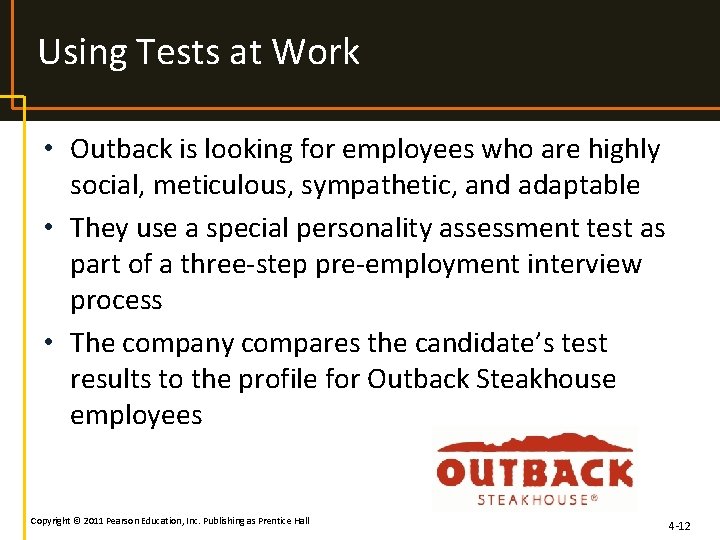
Using Tests at Work • Outback is looking for employees who are highly social, meticulous, sympathetic, and adaptable • They use a special personality assessment test as part of a three-step pre-employment interview process • The company compares the candidate’s test results to the profile for Outback Steakhouse employees Copyright © 2011 Pearson Education, Inc. Publishing as Prentice Hall 4 -12
Tests of Cognitive Abilities • Intelligence tests (IQ tests) └ Tests of general intellectual abilities including memory, vocabulary, verbal fluency, and numeric ability www. wonderlic. com Copyright © 2011 Pearson Education, Inc. Publishing as Prentice Hall 4 -13
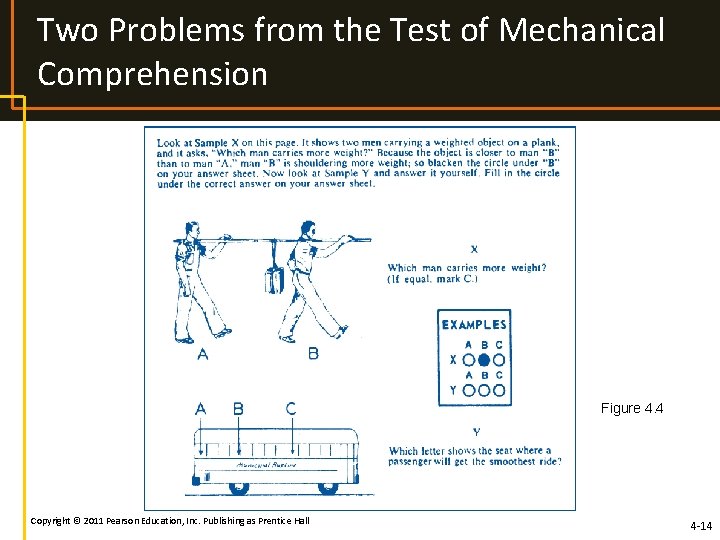
Two Problems from the Test of Mechanical Comprehension Figure 4. 4 Copyright © 2011 Pearson Education, Inc. Publishing as Prentice Hall 4 -14
Tests of Motor and Physical Abilities • Measure finger dexterity, strength, manual dexterity, and reaction time • Stromberg Dexterity Test └ Measures the speed and accuracy of simple judgment as well as the speed of finger, hand, and arm movements Copyright © 2011 Pearson Education, Inc. Publishing as Prentice Hall 4 -15
Personality Tests • Emphasize the “big five” personality dimensions as they apply to personnel testing • Extroversion, emotional stability, agreeableness, conscientiousness, openness to experience • Most difficult to evaluate and use Copyright © 2011 Pearson Education, Inc. Publishing as Prentice Hall 4 -16
Personality Tests • Conscientiousness shows a consistent relationship with all job performance criteria • Extroversion is a valid predictor of performance for managers and sales employees • Openness to experience and extroversion predicted training proficiency for all occupations Copyright © 2011 Pearson Education, Inc. Publishing as Prentice Hall 4 -17
Using Tests at Work • Interest inventories • Achievement tests – Compare one’s interests with those of people in various occupations – Measure of what a person has learned Copyright © 2011 Pearson Education, Inc. Publishing as Prentice Hall 4 -18
Web-based Testing • Financial firm Capital. One’s new online system eliminates the previous time-consuming paper -and-pencil test process • Applicants for call center jobs complete an online application and online math and biodata tests • Applicants also take an online role-playing call simulation Copyright © 2011 Pearson Education, Inc. Publishing as Prentice Hall 4 -19
Web-based Testing • Work sampling technique └ Tries to predict job performance by requiring job candidates to perform one or more actual samples of the job’s tasks └ An observer monitors and assesses performance Copyright © 2011 Pearson Education, Inc. Publishing as Prentice Hall 4 -20
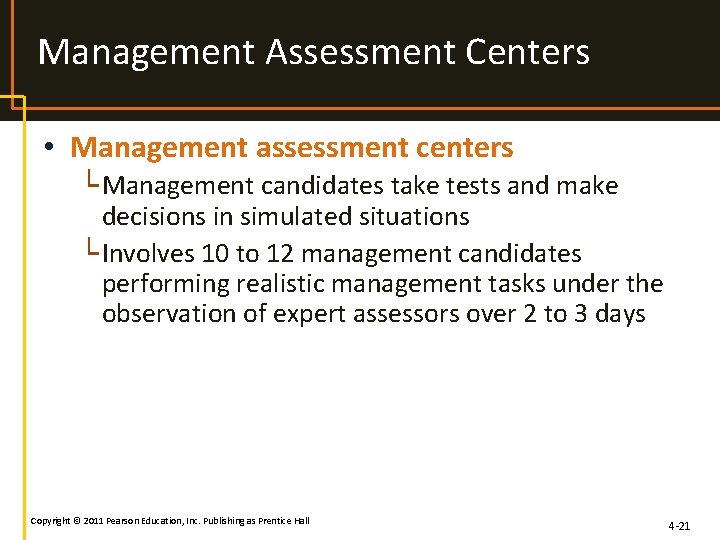
Management Assessment Centers • Management assessment centers └ Management candidates take tests and make decisions in simulated situations └ Involves 10 to 12 management candidates performing realistic management tasks under the observation of expert assessors over 2 to 3 days Copyright © 2011 Pearson Education, Inc. Publishing as Prentice Hall 4 -21
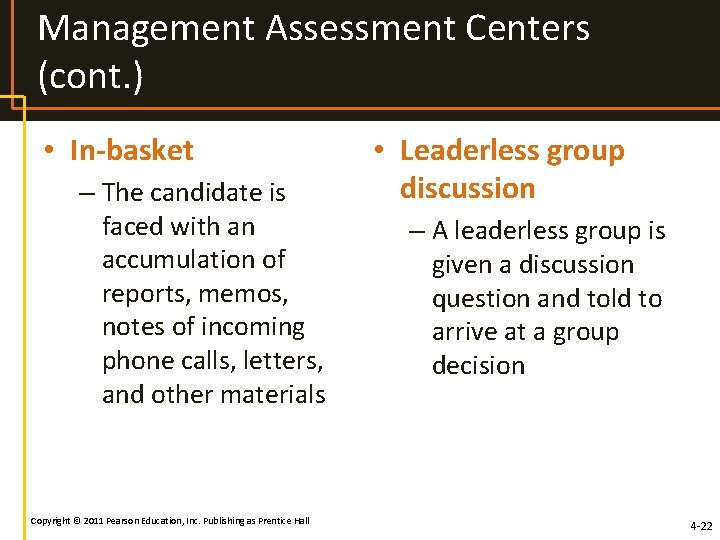
Management Assessment Centers (cont. ) • In-basket – The candidate is faced with an accumulation of reports, memos, notes of incoming phone calls, letters, and other materials Copyright © 2011 Pearson Education, Inc. Publishing as Prentice Hall • Leaderless group discussion – A leaderless group is given a discussion question and told to arrive at a group decision 4 -22
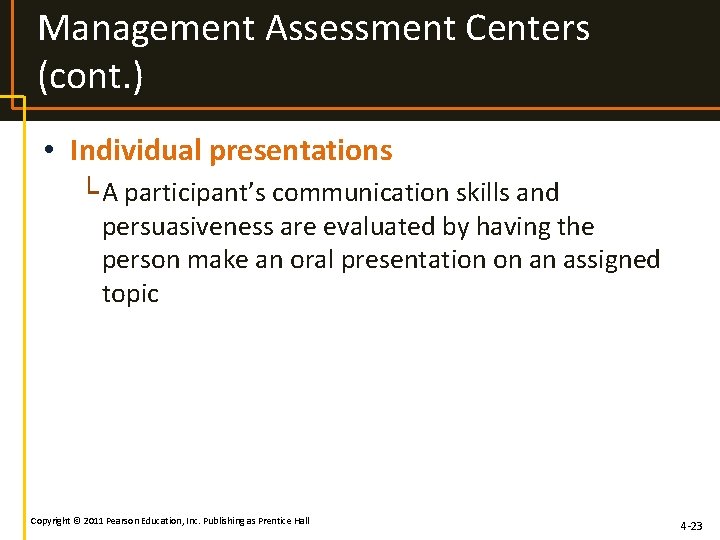
Management Assessment Centers (cont. ) • Individual presentations └ A participant’s communication skills and persuasiveness are evaluated by having the person make an oral presentation on an assigned topic Copyright © 2011 Pearson Education, Inc. Publishing as Prentice Hall 4 -23
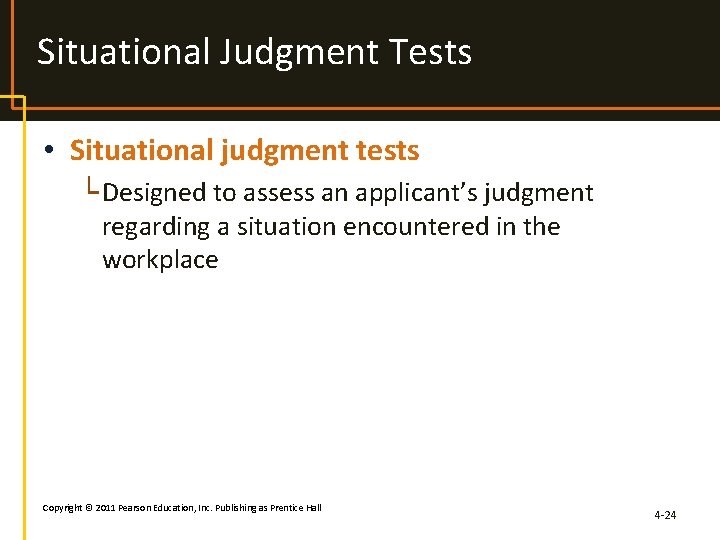
Situational Judgment Tests • Situational judgment tests └ Designed to assess an applicant’s judgment regarding a situation encountered in the workplace Copyright © 2011 Pearson Education, Inc. Publishing as Prentice Hall 4 -24
Selection Interview • Selection Interview └ Selection procedure designed to predict future job performance on the basis of applicants’ oral responses to oral inquiries Copyright © 2011 Pearson Education, Inc. Publishing as Prentice Hall 4 -25
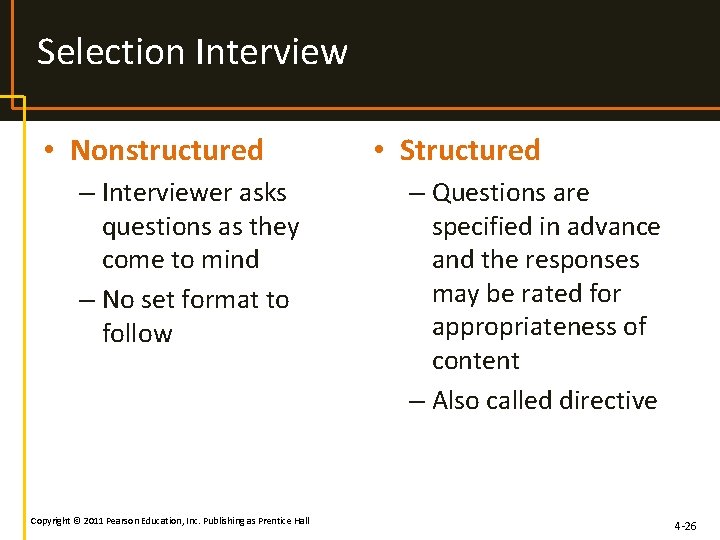
Selection Interview • Nonstructured – Interviewer asks questions as they come to mind – No set format to follow Copyright © 2011 Pearson Education, Inc. Publishing as Prentice Hall • Structured – Questions are specified in advance and the responses may be rated for appropriateness of content – Also called directive 4 -26
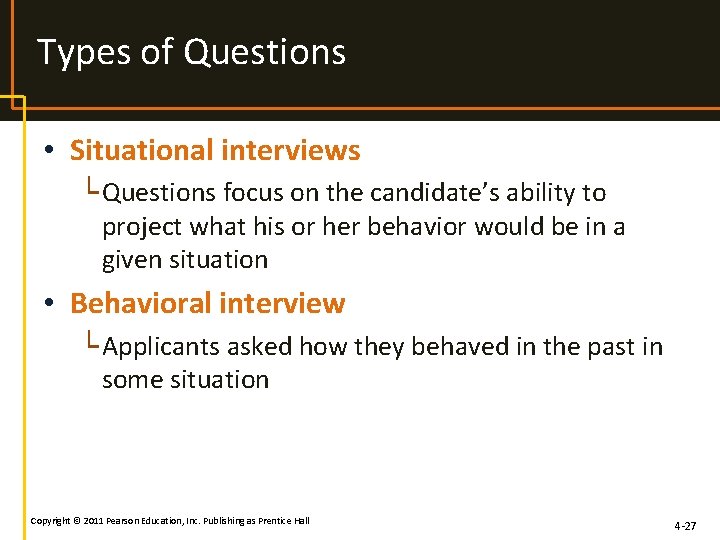
Types of Questions • Situational interviews └ Questions focus on the candidate’s ability to project what his or her behavior would be in a given situation • Behavioral interview └ Applicants asked how they behaved in the past in some situation Copyright © 2011 Pearson Education, Inc. Publishing as Prentice Hall 4 -27
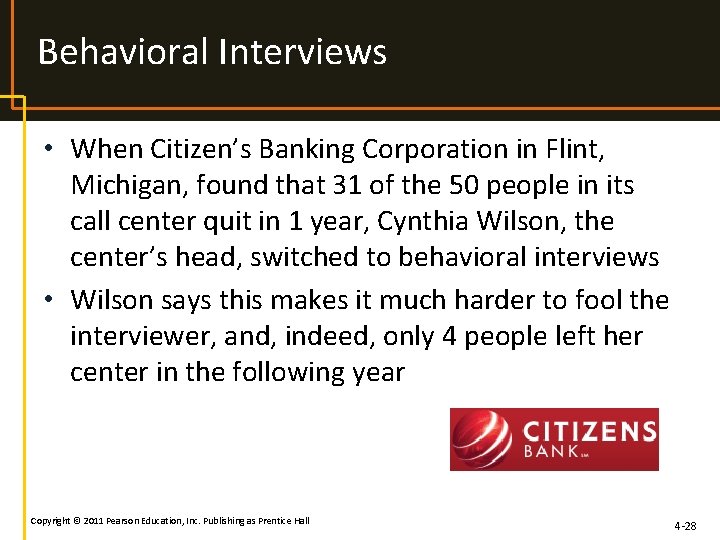
Behavioral Interviews • When Citizen’s Banking Corporation in Flint, Michigan, found that 31 of the 50 people in its call center quit in 1 year, Cynthia Wilson, the center’s head, switched to behavioral interviews • Wilson says this makes it much harder to fool the interviewer, and, indeed, only 4 people left her center in the following year Copyright © 2011 Pearson Education, Inc. Publishing as Prentice Hall 4 -28
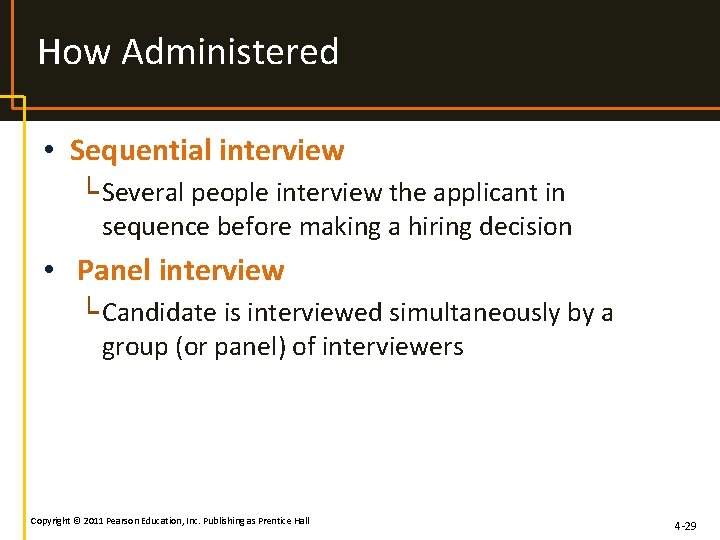
How Administered • Sequential interview └ Several people interview the applicant in sequence before making a hiring decision • Panel interview └ Candidate is interviewed simultaneously by a group (or panel) of interviewers Copyright © 2011 Pearson Education, Inc. Publishing as Prentice Hall 4 -29
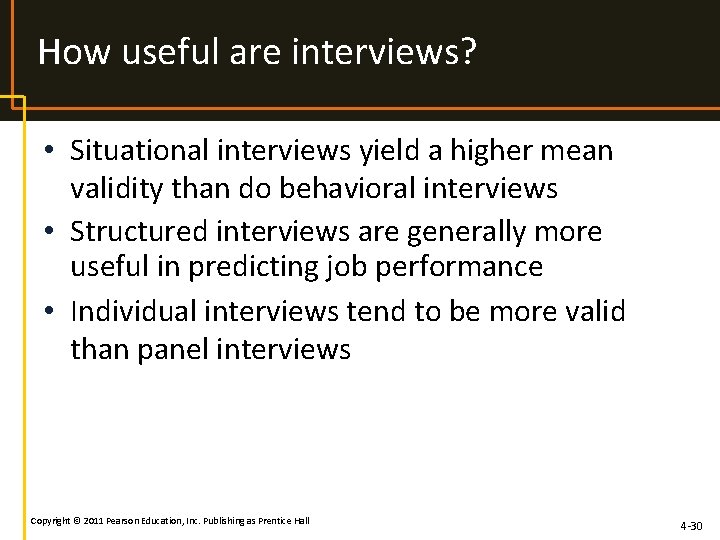
How useful are interviews? • Situational interviews yield a higher mean validity than do behavioral interviews • Structured interviews are generally more useful in predicting job performance • Individual interviews tend to be more valid than panel interviews Copyright © 2011 Pearson Education, Inc. Publishing as Prentice Hall 4 -30
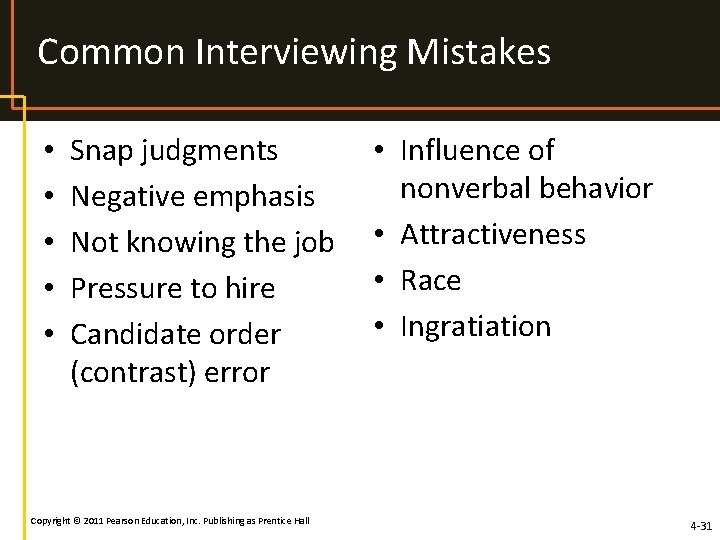
Common Interviewing Mistakes • • • Snap judgments Negative emphasis Not knowing the job Pressure to hire Candidate order (contrast) error Copyright © 2011 Pearson Education, Inc. Publishing as Prentice Hall • Influence of nonverbal behavior • Attractiveness • Race • Ingratiation 4 -31
Guidelines for Conducting an Interview Plan the interview • Start the interview with a clear picture of the traits of an ideal candidate Copyright © 2011 Pearson Education, Inc. Publishing as Prentice Hall 4 -32
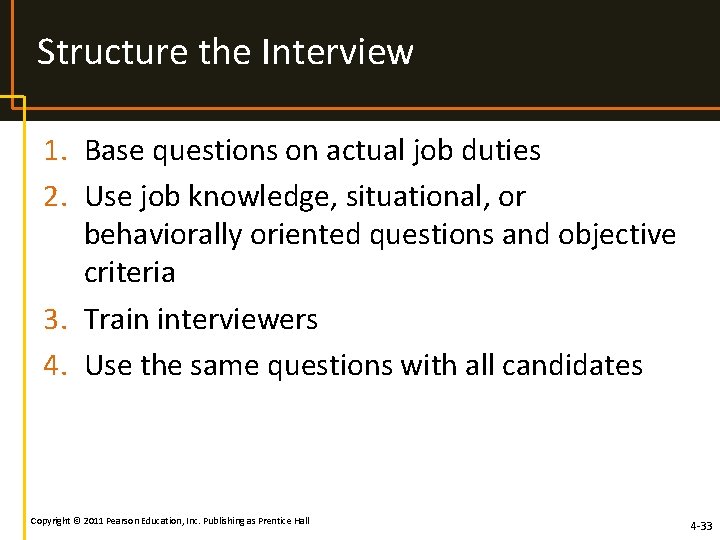
Structure the Interview 1. Base questions on actual job duties 2. Use job knowledge, situational, or behaviorally oriented questions and objective criteria 3. Train interviewers 4. Use the same questions with all candidates Copyright © 2011 Pearson Education, Inc. Publishing as Prentice Hall 4 -33
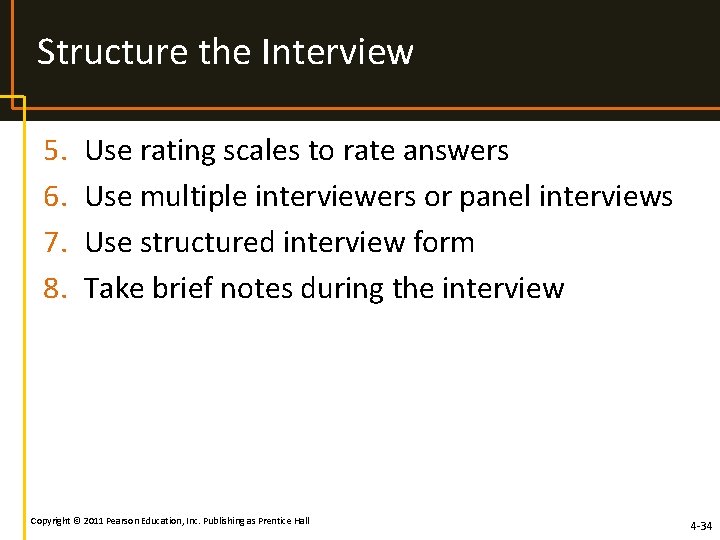
Structure the Interview 5. 6. 7. 8. Use rating scales to rate answers Use multiple interviewers or panel interviews Use structured interview form Take brief notes during the interview Copyright © 2011 Pearson Education, Inc. Publishing as Prentice Hall 4 -34
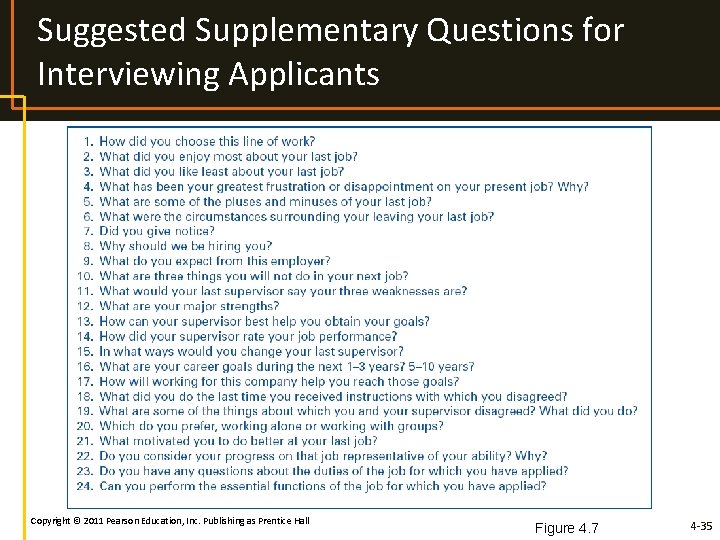
Suggested Supplementary Questions for Interviewing Applicants Copyright © 2011 Pearson Education, Inc. Publishing as Prentice Hall Figure 4. 7 4 -35
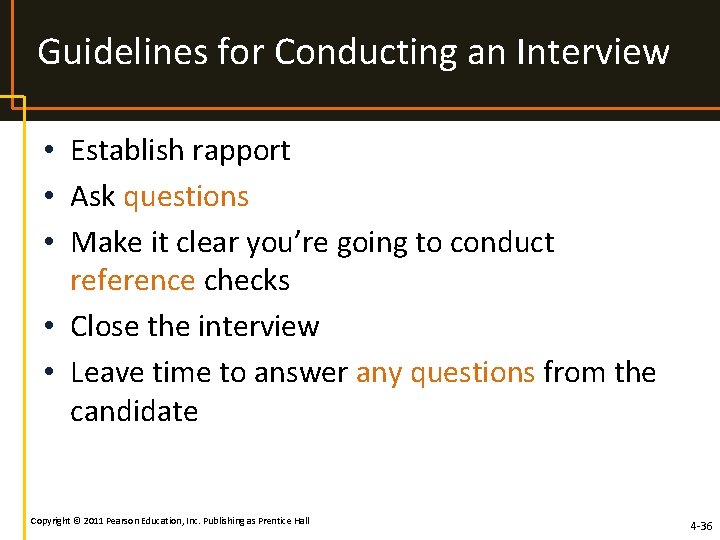
Guidelines for Conducting an Interview • Establish rapport • Ask questions • Make it clear you’re going to conduct reference checks • Close the interview • Leave time to answer any questions from the candidate Copyright © 2011 Pearson Education, Inc. Publishing as Prentice Hall 4 -36
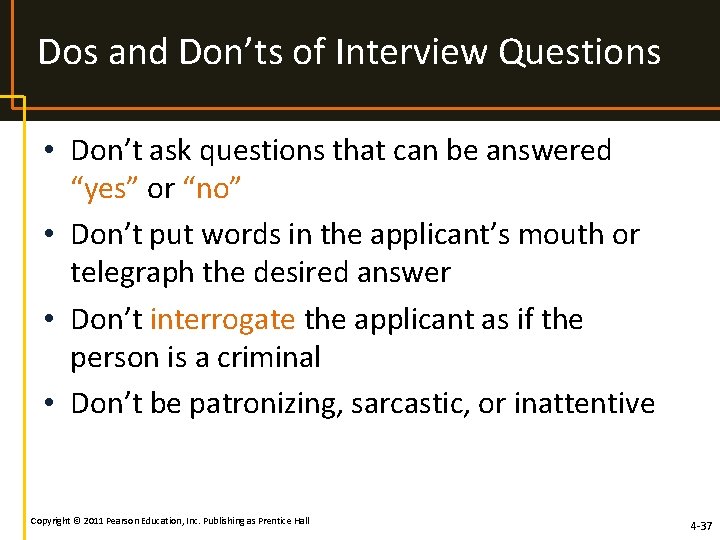
Dos and Don’ts of Interview Questions • Don’t ask questions that can be answered “yes” or “no” • Don’t put words in the applicant’s mouth or telegraph the desired answer • Don’t interrogate the applicant as if the person is a criminal • Don’t be patronizing, sarcastic, or inattentive Copyright © 2011 Pearson Education, Inc. Publishing as Prentice Hall 4 -37
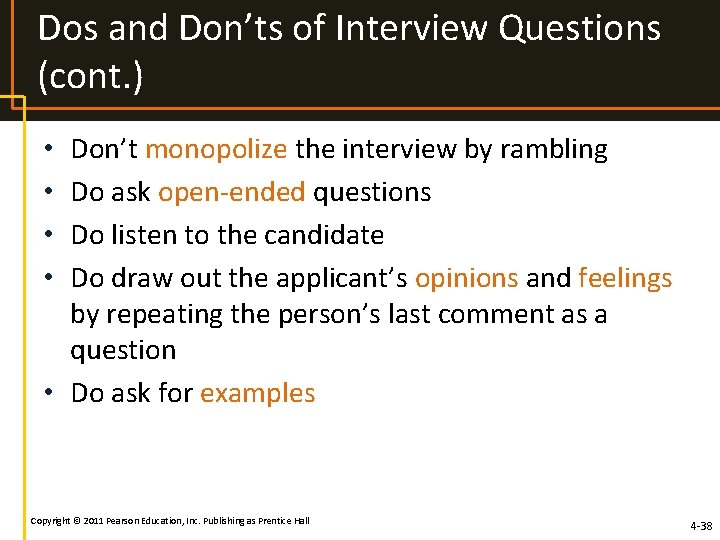
Dos and Don’ts of Interview Questions (cont. ) Don’t monopolize the interview by rambling Do ask open-ended questions Do listen to the candidate Do draw out the applicant’s opinions and feelings by repeating the person’s last comment as a question • Do ask for examples • • Copyright © 2011 Pearson Education, Inc. Publishing as Prentice Hall 4 -38
Reasons for Verifying Backgrounds • To verify the accuracy of factual information provided by the applicant • To uncover damaging background information such as criminal records and suspended drivers’ licenses Copyright © 2011 Pearson Education, Inc. Publishing as Prentice Hall 4 -39
Checking Social Networking Sites • More employers are checking candidates’ social networking sites’ postings • Recruiters found that 31% of applicants had lied about their qualifications and 19% had posted information about their drinking or drug use Copyright © 2011 Pearson Education, Inc. Publishing as Prentice Hall 4 -40
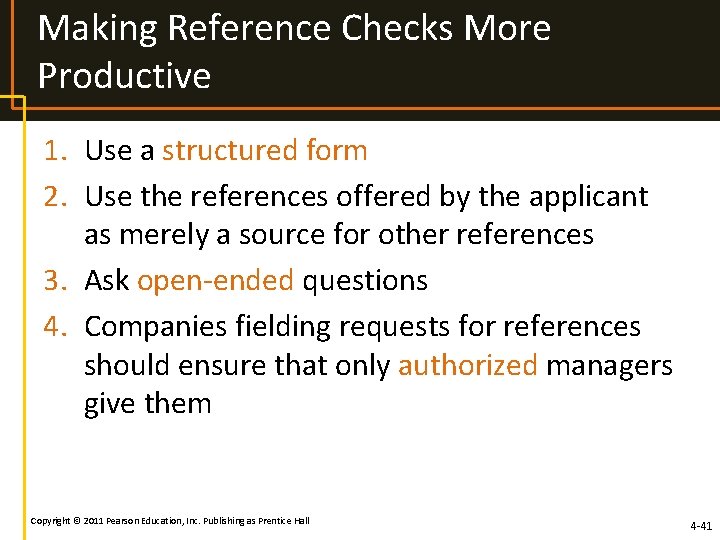
Making Reference Checks More Productive 1. Use a structured form 2. Use the references offered by the applicant as merely a source for other references 3. Ask open-ended questions 4. Companies fielding requests for references should ensure that only authorized managers give them Copyright © 2011 Pearson Education, Inc. Publishing as Prentice Hall 4 -41
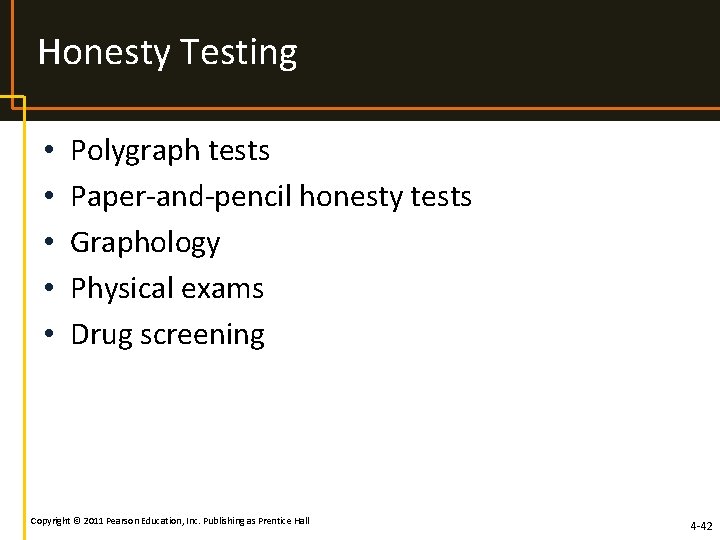
Honesty Testing • • • Polygraph tests Paper-and-pencil honesty tests Graphology Physical exams Drug screening Copyright © 2011 Pearson Education, Inc. Publishing as Prentice Hall 4 -42
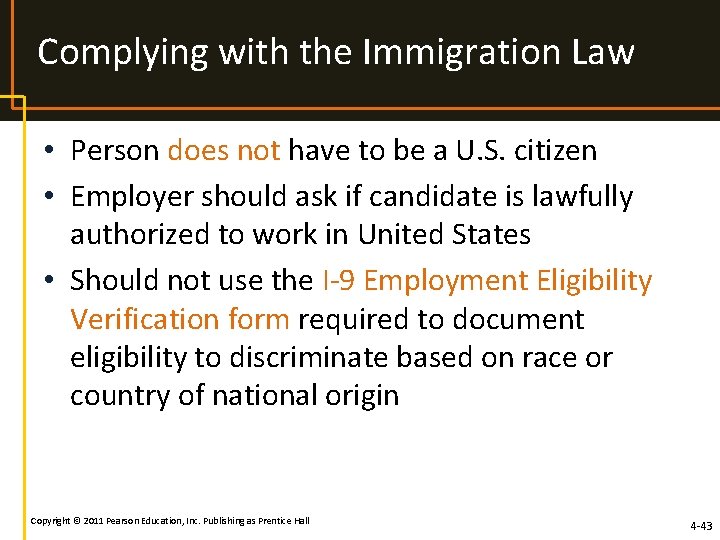
Complying with the Immigration Law • Person does not have to be a U. S. citizen • Employer should ask if candidate is lawfully authorized to work in United States • Should not use the I-9 Employment Eligibility Verification form required to document eligibility to discriminate based on race or country of national origin Copyright © 2011 Pearson Education, Inc. Publishing as Prentice Hall 4 -43
Copyright All rights reserved. No part of this publication may be reproduced, stored in a retrieval system, or transmitted, in any form or by any means, electronic, mechanical, photocopying, recording, or otherwise, without the prior written permission of the publisher. Printed in the United States of America. Copyright © 2011 Pearson Education, Inc. Publishing as Prentice Hall 4 -44