
A Framework for Human Resource Management 5 th
- Slides: 58
A Framework for Human Resource Management, 5 th ed. Gary Dessler Copyright © 2009 Pearson Education, Inc. Publishing as Prentice Hall 1
Managing Labor Relations and Collective Bargaining Ch 15 Copyright © 2009 Pearson Education, Inc. Publishing as Prentice Hall 2
When you finish studying this chapter, you should be able to: • Discuss the nature of the major federal labor relations laws. • Describe the process of a union drive and election. • Discuss the main steps in the collective bargaining process. Copyright © 2009 Pearson Education, Inc. Publishing as Prentice Hall 3
The Labor Movement • 13. 2% of workers belong to a union • Union membership peaked at 34% in 1955 • Membership has fallen due to shift from manufacturing jobs and new legislation Copyright © 2009 Pearson Education, Inc. Publishing as Prentice Hall 4
Why Do Workers Organize? • Employer unfairness • The availability of a union that the employees believed had clout Copyright © 2009 Pearson Education, Inc. Publishing as Prentice Hall 5
Why Do Workers Organize? (cont. ) • A butcher hired by Wal-Mart said he was told he would be able to start management training. • He said his supervisor never mentioned the promotion again after the employee hurt his back at work and was out for 5 weeks. • The store’s meat cutters eventually voted to unionize. • A week later Wal-Mart announced it would switch to completely prepackaged meat and the stores’ meat cutters would no longer be required. Copyright © 2009 Pearson Education, Inc. Publishing as Prentice Hall 6
What Do Unions Want? • Union security • Improved wages, hours, working conditions, and benefits for their members Copyright © 2009 Pearson Education, Inc. Publishing as Prentice Hall 7
Union Security • Closed shop - company can hire only union members • Union shop - company can hire nonunion people but they must join the union • Agency shop - employees who do not belong to the union must still pay union dues Copyright © 2009 Pearson Education, Inc. Publishing as Prentice Hall 8
Union Security (cont. ) • Open shop - up to the workers whether they join the union • Maintenance of membership arrangement - employees do not have to belong to the union but union members employed by the firm must maintain membership in the union for the contract period Copyright © 2009 Pearson Education, Inc. Publishing as Prentice Hall 9
What Do Unions Want? • Right-to-work - term used to describe statutory or constitutional provisions banning the requirement of union membership as a condition of employment Copyright © 2009 Pearson Education, Inc. Publishing as Prentice Hall 10
The AFL-CIO • American Federation of Labor and Congress of Industrial Organizations (AFL-CIO) - voluntary federation of about 100 national and international labor unions in the United States www. aflcio. org/ Copyright © 2009 Pearson Education, Inc. Publishing as Prentice Hall 11
Unions and the Law • Until about 1930, employers didn’t have to engage in collective bargaining with employees and were virtually unrestrained in their behavior toward unions Copyright © 2009 Pearson Education, Inc. Publishing as Prentice Hall 12
Unions and the Law Since 1930 labor law has gone through three clear changes: • Strong encouragement • Modified encouragement coupled with regulation • Detailed regulation of internal union affairs Copyright © 2009 Pearson Education, Inc. Publishing as Prentice Hall 13
Period of Strong Encouragement • Norris-La. Guardia Act (1932) - guaranteed to each employee the right to bargain collectively free from interference, restraint, or coercion Copyright © 2009 Pearson Education, Inc. Publishing as Prentice Hall 14
Period of Strong Encouragement (cont. ) • National Labor Relations Act (Wagner Act) - banned certain unfair labor practices - provided for secret-ballot elections and majority rule - created the National Labor Relations Board (NLRB) Copyright © 2009 Pearson Education, Inc. Publishing as Prentice Hall 15
Unfair Employer Labor Practices • Interfere with, restrain, or coerce employees • Dominate or interfere with either the formation of labor unions • Discriminating against employees for their legal union activities Copyright © 2009 Pearson Education, Inc. Publishing as Prentice Hall 16
Unfair Employer Labor Practices (cont. ) • Discharge or discriminate against employees simply because they file unfair practice charges • Refuse to bargain collectively Copyright © 2009 Pearson Education, Inc. Publishing as Prentice Hall 17
Period of Modified Encouragement Coupled with Regulation • Taft-Hartley Act - prohibits unfair union labor practices - enumerates the rights of employees as union members - enumerates the rights of employers - allows the president of the United States to temporarily bar national emergency strikes Copyright © 2009 Pearson Education, Inc. Publishing as Prentice Hall 18
Unfair Union Labor Practices 1. Restraining employees from exercising their bargaining rights 2. Causing an employer to discriminate in any way against an employee 3. Refusing to bargain in good faith Copyright © 2009 Pearson Education, Inc. Publishing as Prentice Hall 19
Taft-Hartley Act • Protected the rights of employees against their unions • Right-to-work laws • Gave employers full freedom to express their views concerning union organization • Allowed the U. S. president to intervene in national emergency strikes Copyright © 2009 Pearson Education, Inc. Publishing as Prentice Hall 20
Period of Detailed Regulation of Internal Union Affairs • Landrum-Griffin Act - aim was to protect union members from possible wrongdoing on the part of their unions • Bill of rights for union members Copyright © 2009 Pearson Education, Inc. Publishing as Prentice Hall 21
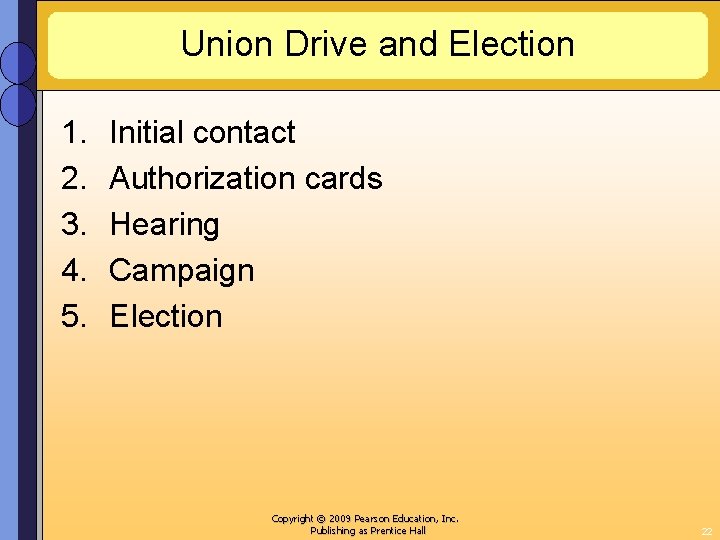
Union Drive and Election 1. 2. 3. 4. 5. Initial contact Authorization cards Hearing Campaign Election Copyright © 2009 Pearson Education, Inc. Publishing as Prentice Hall 22
Step 1: Initial Contact • Union determines the employees’ interest in organizing, and an organizing committee is established Copyright © 2009 Pearson Education, Inc. Publishing as Prentice Hall 23
Contact Guidelines • The law allows union organizers to solicit employees for membership as long as it doesn’t endanger the performance or safety of the employees • Much of the contact takes place off the job Copyright © 2009 Pearson Education, Inc. Publishing as Prentice Hall 24
Union Salting • Union salting - union organizing tactic by which workers who are in fact employed full time by a union as undercover union organizers hired by unwitting employers Copyright © 2009 Pearson Education, Inc. Publishing as Prentice Hall 25
The Web • When the Hotel Employees and Restaurant Employees Union, Local 2, wanted to turn up the heat on the San Francisco Marriott, it launched a new Web site. • The site explains the union’s 8 -month boycott and provides a helpful list of other, union-backed hotels where prospective guests can stay. Copyright © 2009 Pearson Education, Inc. Publishing as Prentice Hall 26
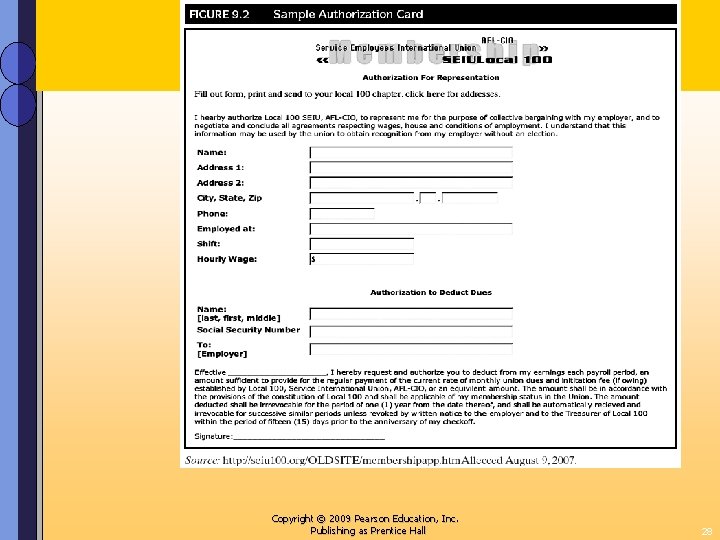
Step 2: Authorization Cards • Union must show that a sizable number of employees may be interested in being organized • Thirty percent of the eligible employees must sign Copyright © 2009 Pearson Education, Inc. Publishing as Prentice Hall 27
Copyright © 2009 Pearson Education, Inc. Publishing as Prentice Hall 28
Step 2: Authorization Cards (cont. ) • Both union and management typically use various forms of propaganda. • The union claims it can improve working conditions, raise wages, and increase benefits. • Management can also explain its record, and express facts and opinions. Copyright © 2009 Pearson Education, Inc. Publishing as Prentice Hall 29
Step 3: The Hearing • Employer may contest the union’s right, in which case it can insist on a hearing • Regional director of the NLRB sends a hearing officer to investigate • Bargaining unit - the group of employees that the union will be authorized to represent and bargain for collectively Copyright © 2009 Pearson Education, Inc. Publishing as Prentice Hall 30
Step 4: The Campaign • The union and employer appeal to employees for their votes • The union emphasizes that it will prevent unfairness, set up a grievance/seniority system, and improve unsatisfactory wages • Management emphasizes the financial cost of union dues Copyright © 2009 Pearson Education, Inc. Publishing as Prentice Hall 31
Supervisor’s Role • Supervisors must be knowledgeable about what they can do to legally hamper organizing activities, lest they commit unfair labor practices Copyright © 2009 Pearson Education, Inc. Publishing as Prentice Hall 32
Strategy and HR • As a company that provides excellent benefits and working conditions, Starbucks executives were surprised that some employees expressed a desire to unionize. • The allegations that some local managers may have tried to retaliate against employees who favored the union underscore why all employers must carefully train supervisors in how to react when the union comes to call. Copyright © 2009 Pearson Education, Inc. Publishing as Prentice Hall 33
Rules Regarding Literature and Solicitation • Nonemployees can always be barred from soliciting employees during their work time • Employers can usually stop employees from soliciting other employees if one or both employees are on paid-duty time • Most employers can bar nonemployees from the building’s work areas Copyright © 2009 Pearson Education, Inc. Publishing as Prentice Hall 34
Improving Productivity through HRIS • Managed by the Communications Workers of America, Alliance@IBM seeks to encourage IBM employees to join the Communications Workers of America. • It does so by providing information on a range of issues, such as why IBM employees need a union, questions and concerns about unions, and how employees can join the union and get involved Copyright © 2009 Pearson Education, Inc. Publishing as Prentice Hall 35
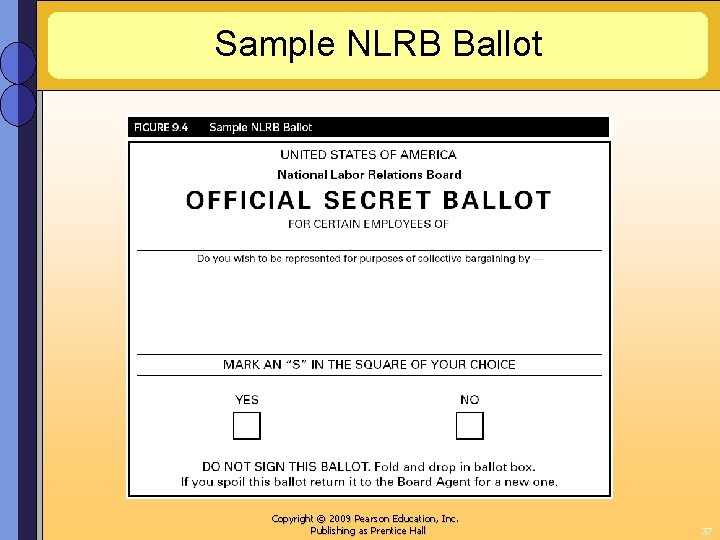
Step 5: The Election • Secret ballot • The NLRB provides the ballots as well as the voting booth and ballot box • It also counts the votes and certifies the results of the election • The union typically wins just over half of elections Copyright © 2009 Pearson Education, Inc. Publishing as Prentice Hall 36
Sample NLRB Ballot Copyright © 2009 Pearson Education, Inc. Publishing as Prentice Hall 37
Decertification Elections • Decertification - way to legally terminate the union’s right to represent them Copyright © 2009 Pearson Education, Inc. Publishing as Prentice Hall 38
What Is Collective Bargaining? • Management and labor are required to negotiate wages, hours, and terms and conditions of employment in “ good faith” • Good faith bargaining - both parties make every reasonable effort to arrive at an agreement Copyright © 2009 Pearson Education, Inc. Publishing as Prentice Hall 39
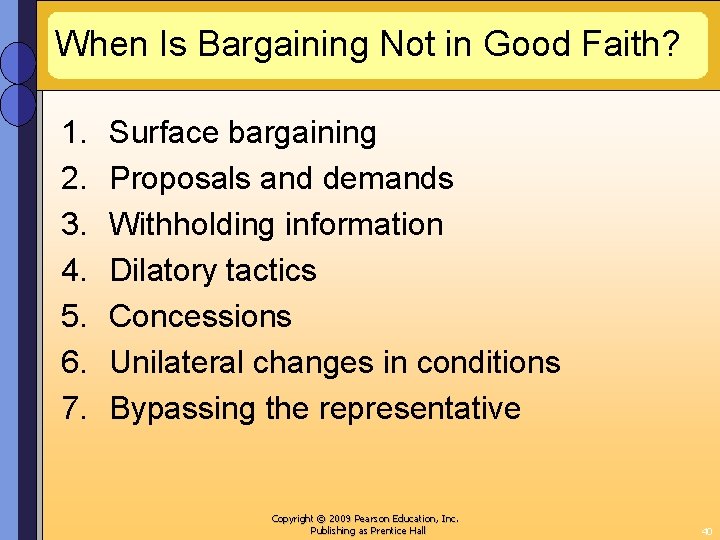
When Is Bargaining Not in Good Faith? 1. 2. 3. 4. 5. 6. 7. Surface bargaining Proposals and demands Withholding information Dilatory tactics Concessions Unilateral changes in conditions Bypassing the representative Copyright © 2009 Pearson Education, Inc. Publishing as Prentice Hall 40
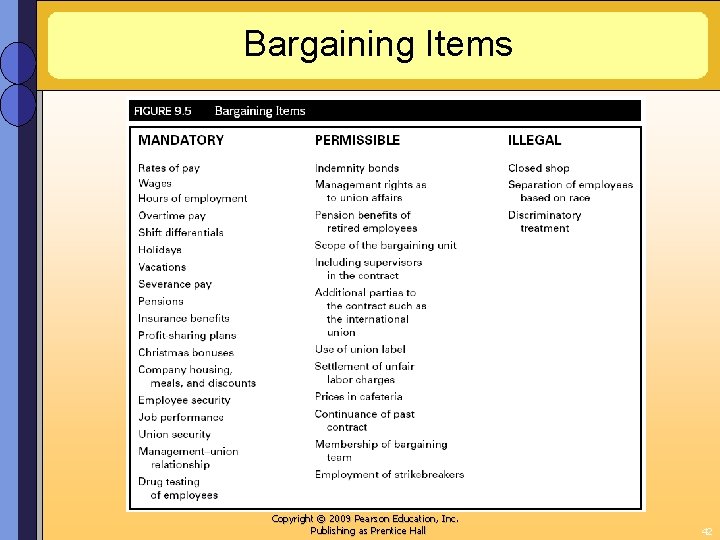
Bargaining Items • Mandatory • Voluntary • Illegal Copyright © 2009 Pearson Education, Inc. Publishing as Prentice Hall 41
Bargaining Items Copyright © 2009 Pearson Education, Inc. Publishing as Prentice Hall 42
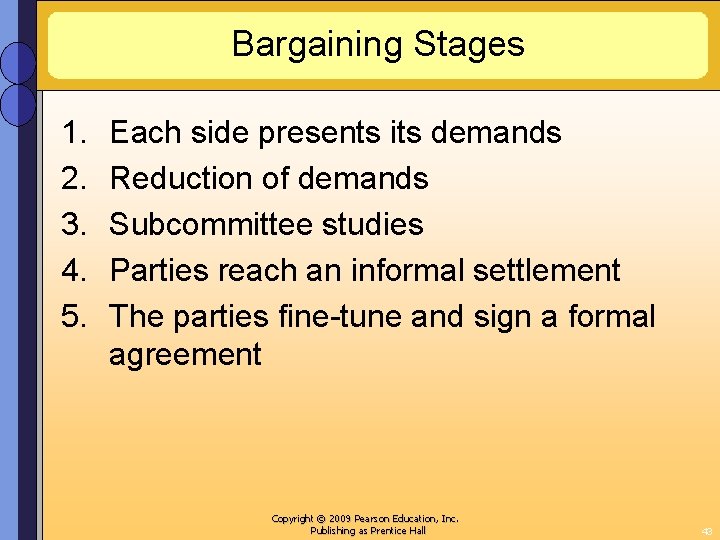
Bargaining Stages 1. 2. 3. 4. 5. Each side presents its demands Reduction of demands Subcommittee studies Parties reach an informal settlement The parties fine-tune and sign a formal agreement Copyright © 2009 Pearson Education, Inc. Publishing as Prentice Hall 43
Impasses • Insurmountable disagreements • Occurs because one party demands more than the other offers Copyright © 2009 Pearson Education, Inc. Publishing as Prentice Hall 44
Third-Party Involvement • Mediation - neutral third party tries to assist the principals in reaching agreement Copyright © 2009 Pearson Education, Inc. Publishing as Prentice Hall 45
Third-Party Involvement (cont. ) • Fact-finder - neutral party who studies the issues in a dispute and makes a public recommendation of what a reasonable settlement ought to be Copyright © 2009 Pearson Education, Inc. Publishing as Prentice Hall 46
Third-Party Involvement (cont. ) • Arbitration - can guarantee a solution to an impasse - may be voluntary or compulsory • Binding arbitration - both parties are committed to accepting the arbitrator’s award Copyright © 2009 Pearson Education, Inc. Publishing as Prentice Hall 47
Strikes • Economic strike - results from a failure to agree on the terms of a contract • Unfair labor practice strikes - protest illegal conduct by the employer Copyright © 2009 Pearson Education, Inc. Publishing as Prentice Hall 48
Strikes (cont. ) • Wildcat strike - an unauthorized strike occurring during the term of a contract • Sympathy strike - occurs when one union strikes in support of the strike of another Copyright © 2009 Pearson Education, Inc. Publishing as Prentice Hall 49
Picketing • Purpose is to inform the public about the existence of the labor dispute • Encourage others to refrain from doing business with employer Copyright © 2009 Pearson Education, Inc. Publishing as Prentice Hall 50
Employer Response to Picketing • Halt operations until strike is over • Contract out work during the duration of the strike • Continue operations using supervisors • Hiring replacement workers Copyright © 2009 Pearson Education, Inc. Publishing as Prentice Hall 51
Other Responses • Corporate campaign - organized effort by the union that exerts pressure on the corporation • Inside games - efforts to convince employees to impede or disrupt production Copyright © 2009 Pearson Education, Inc. Publishing as Prentice Hall 52
Other Responses (cont. ) • Lockout - refusal by the employer to provide opportunities to work • Injunctions - court order compelling a party or parties either to resume or to desist a certain action Copyright © 2009 Pearson Education, Inc. Publishing as Prentice Hall 53
Contract Agreement • May contain just general declarations of policy or a detailed specification of rules and procedures Copyright © 2009 Pearson Education, Inc. Publishing as Prentice Hall 54
Handling Grievances • Grievance process - steps that the employer and union have agreed to follow to ascertain if some action violated the agreement Copyright © 2009 Pearson Education, Inc. Publishing as Prentice Hall 55
Why the Union Decline? • Proportion of blue-collar jobs has been decreasing • Intense international competition • Permanent layoff of thousands of union members • Laws provide protections formerly provided by unions Copyright © 2009 Pearson Education, Inc. Publishing as Prentice Hall 56
How Unions are Changing Change to Win • Very aggressive about trying to organize workers • Focused on organizing women and minority workers • Focused more on organizing temporary or contingent workers • Targeting specific multinational companies for international campaigns Copyright © 2009 Pearson Education, Inc. Publishing as Prentice Hall 57
All rights reserved. No part of this publication may be reproduced, stored in a retrieval system, or transmitted, in any form or by any means, electronic, mechanical, photocopying, recording, or otherwise, without the prior written permission of the publisher. Printed in the United States of America. Copyright © 2009 Pearson Education, Inc. Publishing as Prentice Hall 58