
A Foundation Course in Human Values Professional Ethics

- Slides: 22
A Foundation Course in Human Values & Professional Ethics Presented By G. Vijaya Kumar III Year I SEM
Education Commissions: Need for Value Education “Every committee* on framing education policy has easily agreed that education on human values should be imparted… but we have not been able to implement it effectively. Even today the problem is how to teach human values in educational institutions. I am very happy to know that the attempts are being done by the technical institutions to impart knowledge and information about human values. May I pray and hope that our journey will march in this direction” HE The Governor of Punjab & Chancellor PTU, Shri. Shivraj Patil National Seminar “Human Values in Technical Education”, 11 Dec 2010 *Dr. Radhakrishnan, Dr. Kothari, UNESCO declaration on service to society, MHRD and so on 5
Expectations from Education should prepare the student for: Understanding ‘what to do’ – What is valuable, as a human being and Learning ‘how to do’ – skills, technology Are both required or we can do with just one of them? Both are important What would be the priority between these two? The Priority is 1. Understanding ‘what to do’, then Value Education 2. Learning ‘how to do’ and Doing Technical Education 7
Guidelines for Value Education 1. 2. 3. 4. 5. 6. Universal Rational Natural Verifiable All Encompassing Leading to Harmony – all time, all place, all individuals – logical, appeals to reasoning – to human being & to nature – through one’s own experience – covering all aspects of human existence – among human beings and with nature Based on the inputs of MHRD 8
Content Tried with Diverse Categories of People 1998 -2018… School Children (3. 5 Yrs +) Families Engineering Students Urban People Criminals in Jail Politicians Administrators Social Workers from NGOs Farmers and Rural Folk… It is relevant for All 10
Human Values course developed 1995 -2018 "A Foundation Course on Human Values & Professional Ethics", has been designed by Dr. RR Gaur, Prof. R Sangal & Shri. GP Bagaria It has been designed to be a part of the academic curriculum: 1. To develop a critical ability to distinguish between essence and form; or between what is of value and what is superficial in life (to appreciate the importance of fundamental issues related to their happiness and real success in the life & profession). What makes it interesting & challenging is the fact that the ability is to be developed not for a narrow area or field of study, but for everyday situations in life. It covers the widest possible canvas. 2. To move from discrimination to commitment (to develop sensitivity and awareness leading to commitment and courage to act on the basis of their own understanding, rather than merely on the basis of assumptions) It is not sufficient to develop the discrimination ability, it is important to act on such discrimination in a given situation on their own right. 11
Human Values course developed 1995 -2018 It follows a process of self verification, on the basis of one’s own Natural Acceptance, leading to self-empowerment It does not teach values. It encourages students to discover what they consider valuable. Accordingly, they should be able to discriminate between valuable and the superficial in real situations in their life. It facilitates discussion on: Their life goals, reflection on what they are and what they want to be Their relationships in family Their relationships with society Their relationships with nature/existence It is not a process of assuming nor a process of do’s & don’ts 12
Human Values Programme introduced at IIIT Hyderabad in 2005 Goal of IIIT: To contribute to transforming industry and society, by delivering research-led education, promoting innovation, and fostering human values Human Values is as an essential part of the academic curriculum. The two courses are HV 1 in 1 st sem & HV 2 in 4 th sem § Each week consists of 2 lectures of 1. 5 hrs each § Students do socially relevant humanities projects, detailed studies, reports or participate in social activities as a part of this course § Students meet every week in small groups along with 2 faculty mentors § At the end of the course a 4 -day workshop is conducted. Faculty, faculty spouses and senior students take the responsibility for conducting it Advanced courses include “Work & Life” & “Searching for a Humane Society” Medium of instruction is students’ mother tongue/language preferred by the student (e. g. in 2010 six workshops were run in parallel – 1 in Telugu, 2 in Hindi and 3 in English) 16
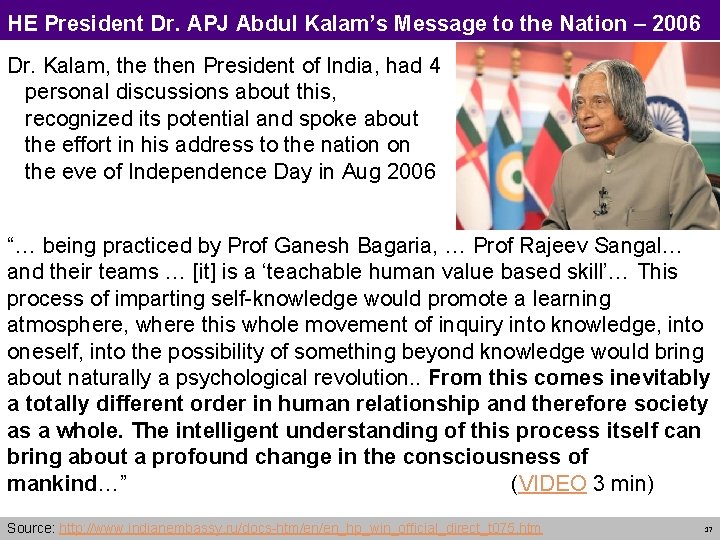
HE President Dr. APJ Abdul Kalam’s Message to the Nation – 2006 Dr. Kalam, then President of India, had 4 personal discussions about this, recognized its potential and spoke about the effort in his address to the nation on the eve of Independence Day in Aug 2006 “… being practiced by Prof Ganesh Bagaria, … Prof Rajeev Sangal… and their teams … [it] is a ‘teachable human value based skill’… This process of imparting self-knowledge would promote a learning atmosphere, where this whole movement of inquiry into knowledge, into oneself, into the possibility of something beyond knowledge would bring about naturally a psychological revolution. . From this comes inevitably a totally different order in human relationship and therefore society as a whole. The intelligent understanding of this process itself can bring about a profound change in the consciousness of mankind…” (VIDEO 3 min) Source: http: //www. indianembassy. ru/docs-htm/en/en_hp_win_official_direct_t 075. htm 17
Implementation Resources for Large Scale Implementation – 2005. . . 1. 2. 3. 4. 5. 6. 7. 8. Syllabus Teachers Manual (Lecture Plan 28 Lectures & 14 Practice Sessions) Text Book Posters Presentations, including Practice Sessions, Tutorials & Videos Video of Workshop Lectures (Lecture-by-Lecture) Weekly Meeting (also through Web. Ex) Web Site http: //www. universalhumanvalues. info 9. 10. 11. 12. 8 -Day Teachers' Orientation Program How to Share Values Examination & Evaluation Social Projects & Social Internship 13. Process of Implementation (stage by stage) Advanced Study 1. PSL 2 … 18
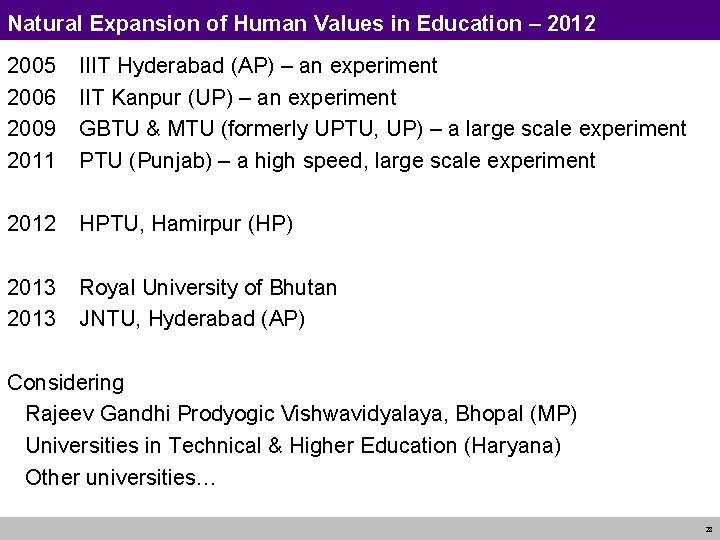
Natural Expansion of Human Values in Education – 2012 2005 2006 2009 2011 IIIT Hyderabad (AP) – an experiment IIT Kanpur (UP) – an experiment GBTU & MTU (formerly UPTU, UP) – a large scale experiment PTU (Punjab) – a high speed, large scale experiment 2012 HPTU, Hamirpur (HP) 2013 Royal University of Bhutan JNTU, Hyderabad (AP) Considering Rajeev Gandhi Prodyogic Vishwavidyalaya, Bhopal (MP) Universities in Technical & Higher Education (Haryana) Other universities… 28
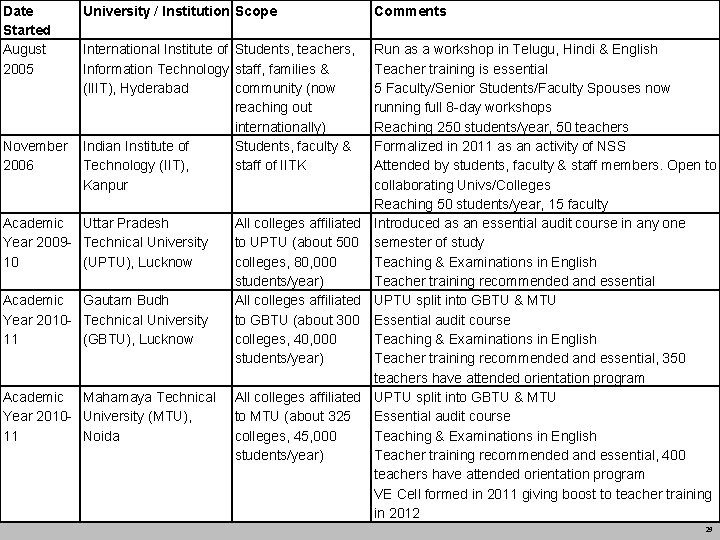
Date Started August 2005 University / Institution Scope International Institute of Students, teachers, Information Technology staff, families & (IIIT), Hyderabad community (now reaching out internationally) November Indian Institute of Students, faculty & 2006 Technology (IIT), staff of IITK Kanpur Academic Uttar Pradesh Year 2009 - Technical University 10 (UPTU), Lucknow Academic Gautam Budh Year 2010 - Technical University 11 (GBTU), Lucknow Academic Mahamaya Technical Year 2010 - University (MTU), 11 Noida All colleges affiliated to UPTU (about 500 colleges, 80, 000 students/year) All colleges affiliated to GBTU (about 300 colleges, 40, 000 students/year) All colleges affiliated to MTU (about 325 colleges, 45, 000 students/year) Comments Run as a workshop in Telugu, Hindi & English Teacher training is essential 5 Faculty/Senior Students/Faculty Spouses now running full 8 -day workshops Reaching 250 students/year, 50 teachers Formalized in 2011 as an activity of NSS Attended by students, faculty & staff members. Open to collaborating Univs/Colleges Reaching 50 students/year, 15 faculty Introduced as an essential audit course in any one semester of study Teaching & Examinations in English Teacher training recommended and essential UPTU split into GBTU & MTU Essential audit course Teaching & Examinations in English Teacher training recommended and essential, 350 teachers have attended orientation program UPTU split into GBTU & MTU Essential audit course Teaching & Examinations in English Teacher training recommended and essential, 400 teachers have attended orientation program VE Cell formed in 2011 giving boost to teacher training in 2012 29
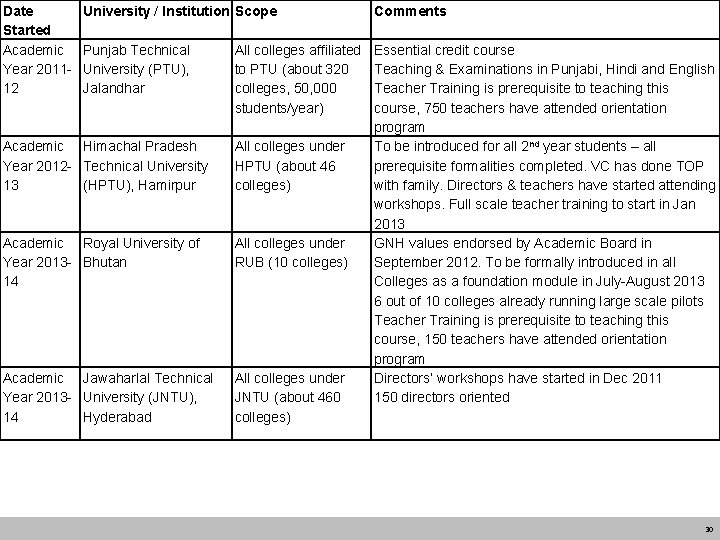
Date Started Academic Year 201112 University / Institution Scope Comments Punjab Technical University (PTU), Jalandhar Essential credit course Teaching & Examinations in Punjabi, Hindi and English Teacher Training is prerequisite to teaching this course, 750 teachers have attended orientation program To be introduced for all 2 nd year students – all prerequisite formalities completed. VC has done TOP with family. Directors & teachers have started attending workshops. Full scale teacher training to start in Jan 2013 GNH values endorsed by Academic Board in September 2012. To be formally introduced in all Colleges as a foundation module in July-August 2013 6 out of 10 colleges already running large scale pilots Teacher Training is prerequisite to teaching this course, 150 teachers have attended orientation program Directors’ workshops have started in Dec 2011 150 directors oriented All colleges affiliated to PTU (about 320 colleges, 50, 000 students/year) Academic Himachal Pradesh Year 2012 - Technical University 13 (HPTU), Hamirpur All colleges under HPTU (about 46 colleges) Academic Royal University of Year 2013 - Bhutan 14 All colleges under RUB (10 colleges) Academic Jawaharlal Technical Year 2013 - University (JNTU), 14 Hyderabad All colleges under JNTU (about 460 colleges) 30
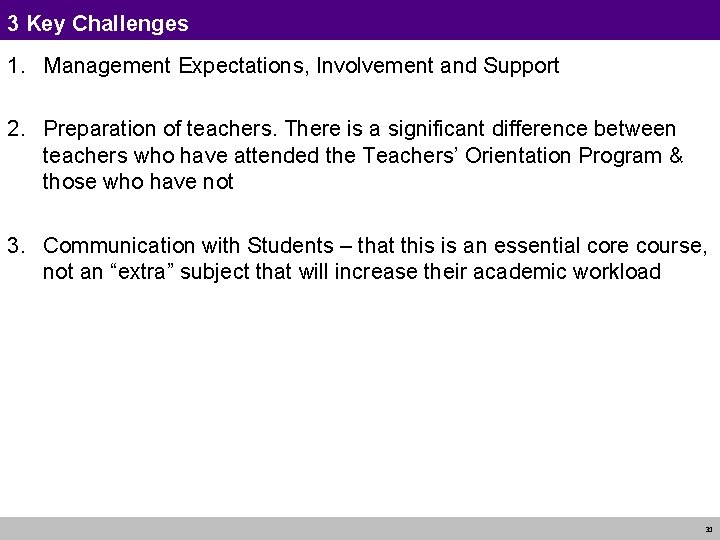
3 Key Challenges 1. Management Expectations, Involvement and Support 2. Preparation of teachers. There is a significant difference between teachers who have attended the Teachers’ Orientation Program & those who have not 3. Communication with Students – that this is an essential core course, not an “extra” subject that will increase their academic workload 31
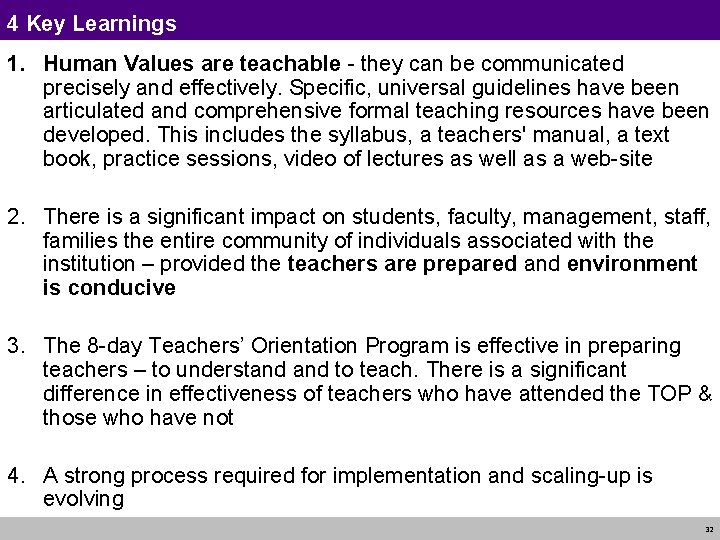
4 Key Learnings 1. Human Values are teachable - they can be communicated precisely and effectively. Specific, universal guidelines have been articulated and comprehensive formal teaching resources have been developed. This includes the syllabus, a teachers' manual, a text book, practice sessions, video of lectures as well as a web-site 2. There is a significant impact on students, faculty, management, staff, families the entire community of individuals associated with the institution – provided the teachers are prepared and environment is conducive 3. The 8 -day Teachers’ Orientation Program is effective in preparing teachers – to understand to teach. There is a significant difference in effectiveness of teachers who have attended the TOP & those who have not 4. A strong process required for implementation and scaling-up is evolving 32
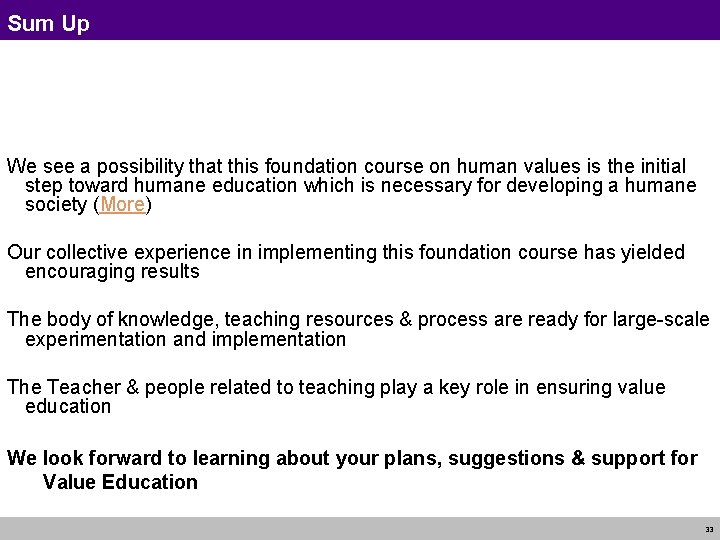
Sum Up The Role of Education – to facilitate the development of the competence (understanding, skills & practice) to live with Definite Human Conduct in all Human Beings, so that all can live happy & prosperous lives, while developing a humane society which is in harmony with rest-of-nature We see a possibility that this foundation course on human values is the initial step toward humane education which is necessary for developing a humane society (More) Our collective experience in implementing this foundation course has yielded encouraging results The body of knowledge, teaching resources & process are ready for large-scale experimentation and implementation The Teacher & people related to teaching play a key role in ensuring value education We look forward to learning about your plans, suggestions & support for Value Education 33
ADDITIONAL MATERIAL 34
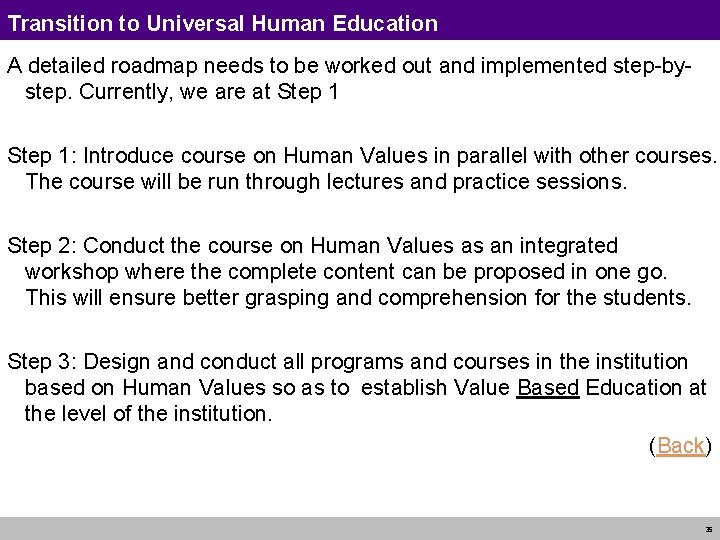
Transition to Universal Human Education A detailed roadmap needs to be worked out and implemented step-bystep. Currently, we are at Step 1: Introduce course on Human Values in parallel with other courses. The course will be run through lectures and practice sessions. Step 2: Conduct the course on Human Values as an integrated workshop where the complete content can be proposed in one go. This will ensure better grasping and comprehension for the students. Step 3: Design and conduct all programs and courses in the institution based on Human Values so as to establish Value Based Education at the level of the institution. (Back) 35
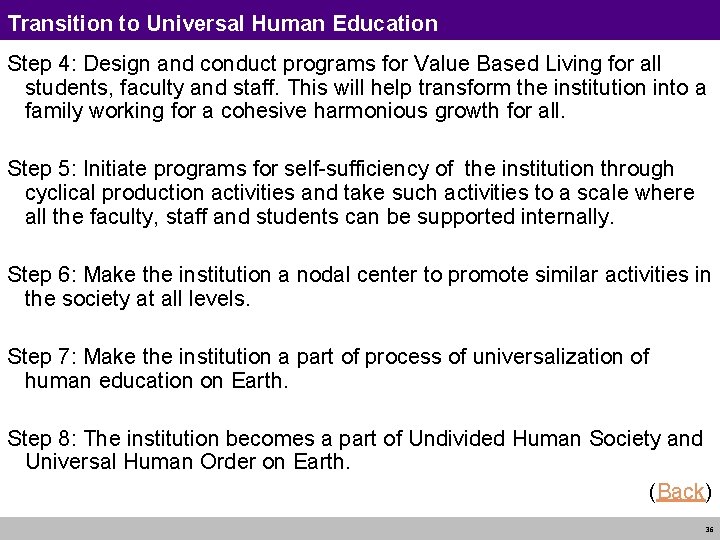
Transition to Universal Human Education Step 4: Design and conduct programs for Value Based Living for all students, faculty and staff. This will help transform the institution into a family working for a cohesive harmonious growth for all. Step 5: Initiate programs for self-sufficiency of the institution through cyclical production activities and take such activities to a scale where all the faculty, staff and students can be supported internally. Step 6: Make the institution a nodal center to promote similar activities in the society at all levels. Step 7: Make the institution a part of process of universalization of human education on Earth. Step 8: The institution becomes a part of Undivided Human Society and Universal Human Order on Earth. (Back) 36
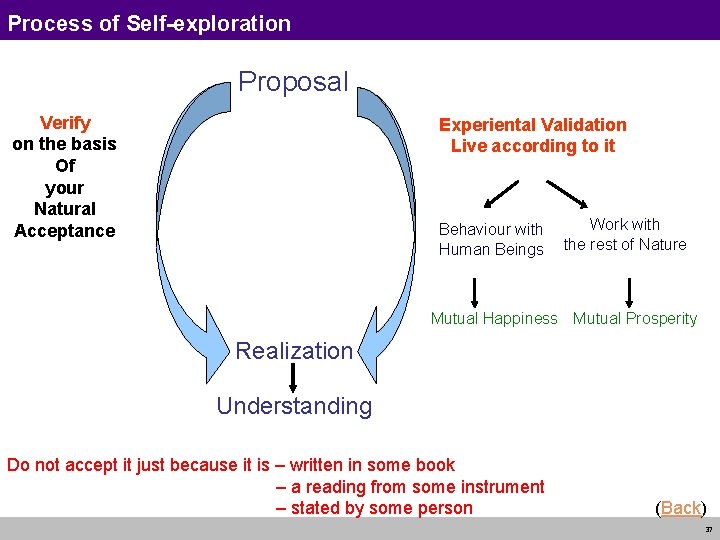
Process of Self-exploration Proposal Verify on the basis Of your Natural Acceptance Experiental Validation Live according to it Behaviour with Human Beings Work with the rest of Nature Mutual Happiness Mutual Prosperity Realization Understanding Do not accept it just because it is – written in some book – a reading from some instrument – stated by some person (Back) 37
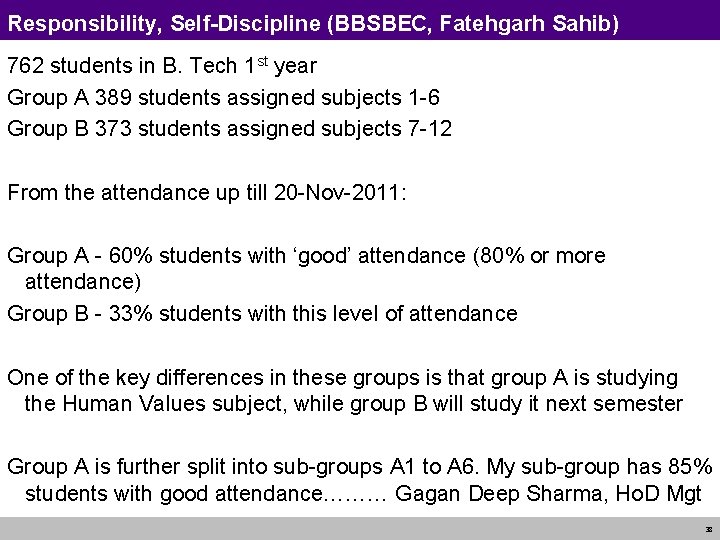
Responsibility, Self-Discipline (BBSBEC, Fatehgarh Sahib) 762 students in B. Tech 1 st year Group A 389 students assigned subjects 1 -6 Group B 373 students assigned subjects 7 -12 From the attendance up till 20 -Nov-2011: Group A - 60% students with ‘good’ attendance (80% or more attendance) Group B - 33% students with this level of attendance One of the key differences in these groups is that group A is studying the Human Values subject, while group B will study it next semester Group A is further split into sub-groups A 1 to A 6. My sub-group has 85% students with good attendance……… Gagan Deep Sharma, Ho. D Mgt 38
“My academic performance…”, a student of IIT Kanpur He graduated in Computer Science from IIT Kanpur. When he was in second year he was under academic probation and almost at the point of expulsion. After attending the workshop on Human Values, he developed confidence in himself – his semester performance index (SPI) shifted from 4 to 7. 5 to 6 to 9. He completed his B Tech with a strong CPI. Today he is working as a senior manager with a major telecom company. He actively participates in promoting human values and value-based living “Without this knowledge, through the workshop and it’s follow-up, I don’t know where I would have been… My academic performance is a side-effect of being more clear about my purpose” 39