
A FORMAL THEORY OF COMPETITION WAS DEVELOPED BY
A FORMAL THEORY OF COMPETITION WAS DEVELOPED BY LOTKA-VOLTERRA IN 1925 -1926 The theory predicts: COMPETITIVE EXCLUSION & COEXISTENCE The theory is based on the LOGISTIC GROWTH MODEL Read chapter 4: Basic Populus Models in Ecology
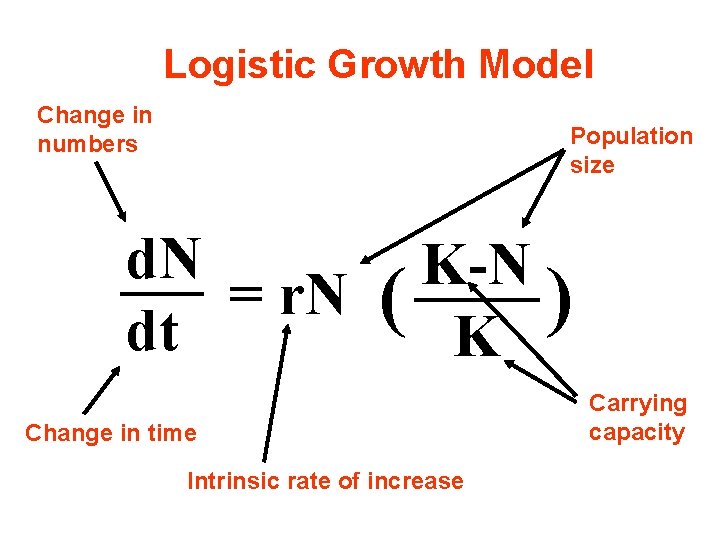
Logistic Growth Model Change in numbers Population size d. N = r. N dt K-N ( K ) Change in time Intrinsic rate of increase Carrying capacity
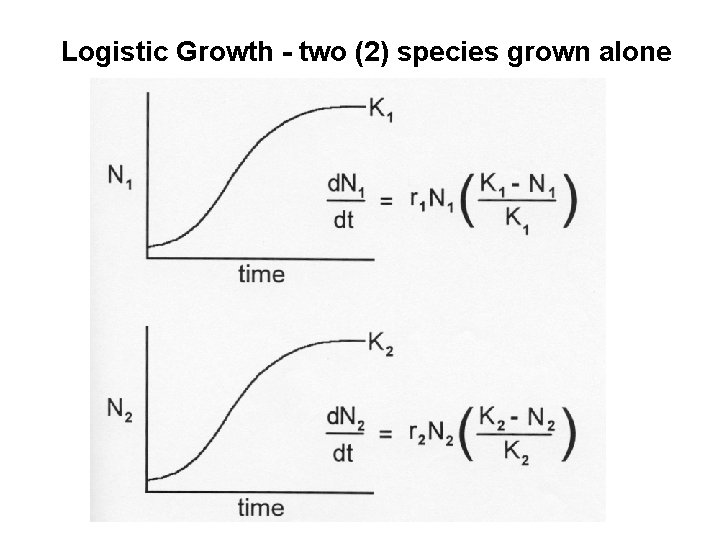
Logistic Growth - two (2) species grown alone
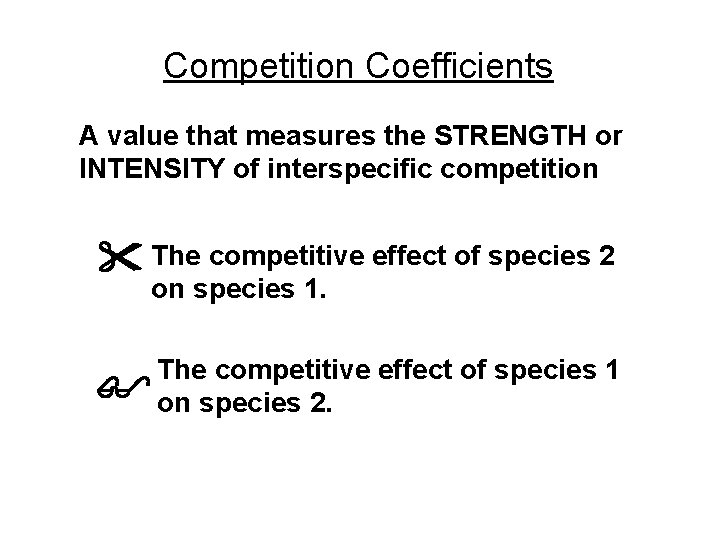
Competition Coefficients A value that measures the STRENGTH or INTENSITY of interspecific competition The competitive effect of species 2 on species 1. The competitive effect of species 1 on species 2.
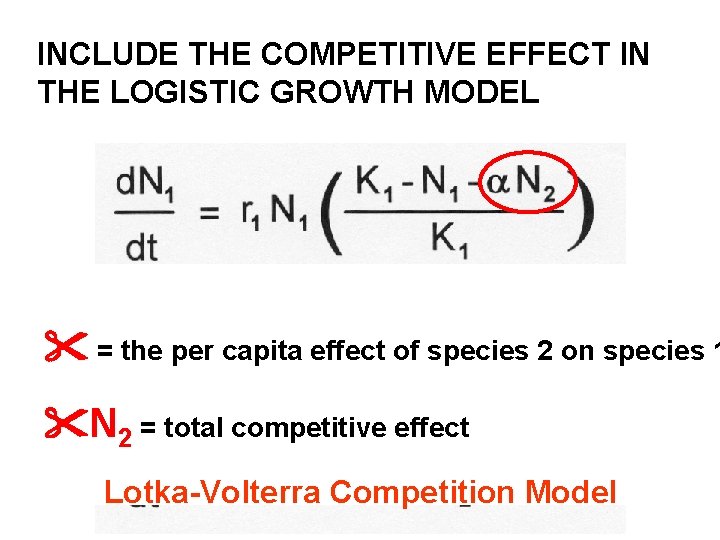
INCLUDE THE COMPETITIVE EFFECT IN THE LOGISTIC GROWTH MODEL = the per capita effect of species 2 on species 1 N 2 = total competitive effect Lotka-Volterra Competition Model
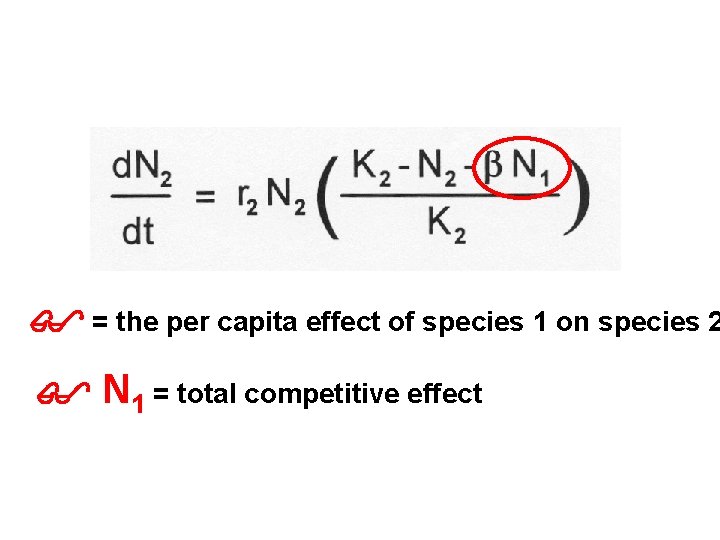
= the per capita effect of species 1 on species 2 N 1 = total competitive effect
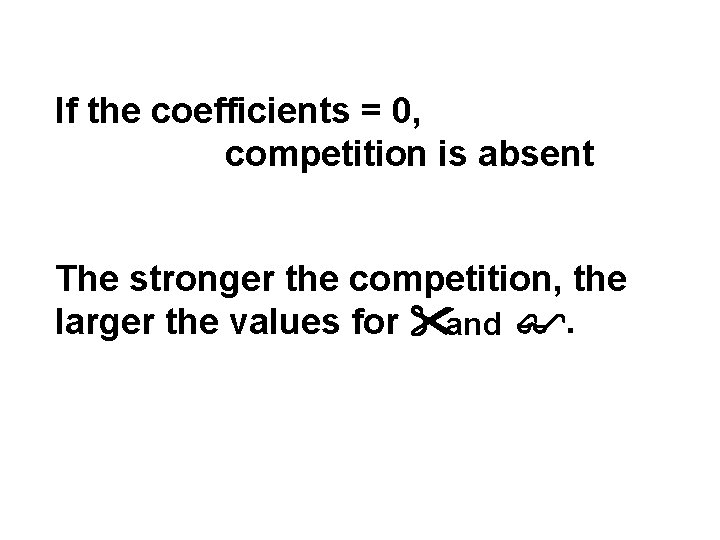
If the coefficients = 0, competition is absent The stronger the competition, the larger the values for and .
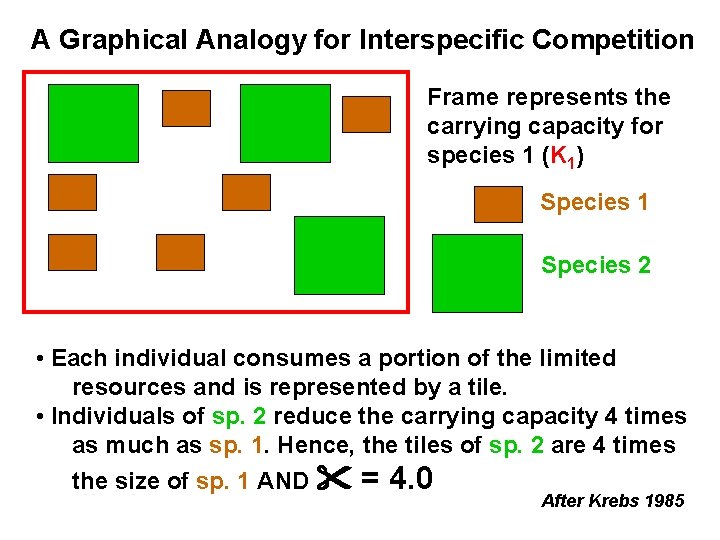
A Graphical Analogy for Interspecific Competition Frame represents the carrying capacity for species 1 (K 1) Species 1 Species 2 • Each individual consumes a portion of the limited resources and is represented by a tile. • Individuals of sp. 2 reduce the carrying capacity 4 times as much as sp. 1. Hence, the tiles of sp. 2 are 4 times the size of sp. 1 AND = 4. 0 After Krebs 1985
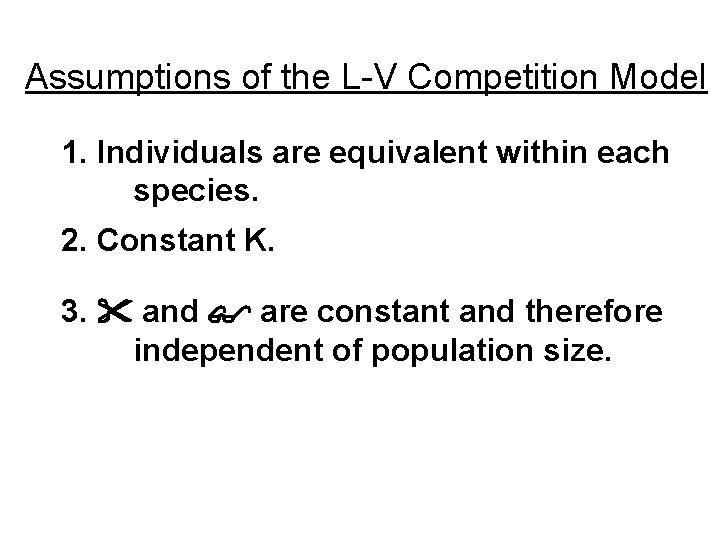
Assumptions of the L-V Competition Model 1. Individuals are equivalent within each species. 2. Constant K. 3. and are constant and therefore independent of population size.
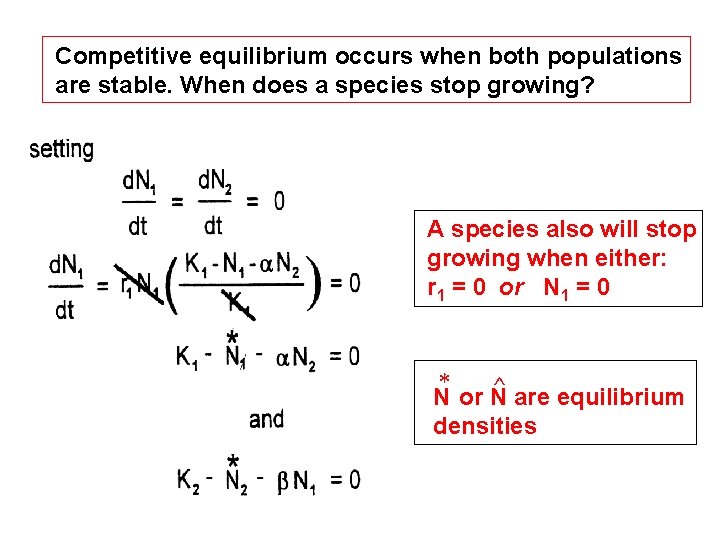
Competitive equilibrium occurs when both populations are stable. When does a species stop growing? A species also will stop growing when either: r 1 = 0 or N 1 = 0 * ^ N or N are equilibrium densities
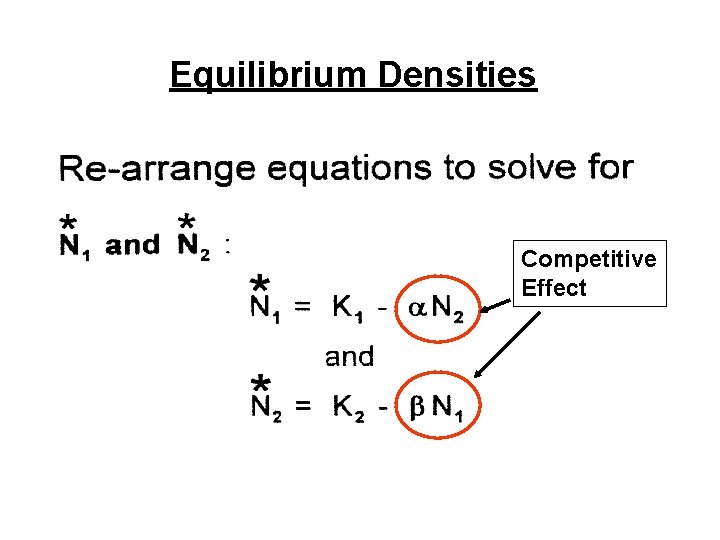
Equilibrium Densities Competitive Effect
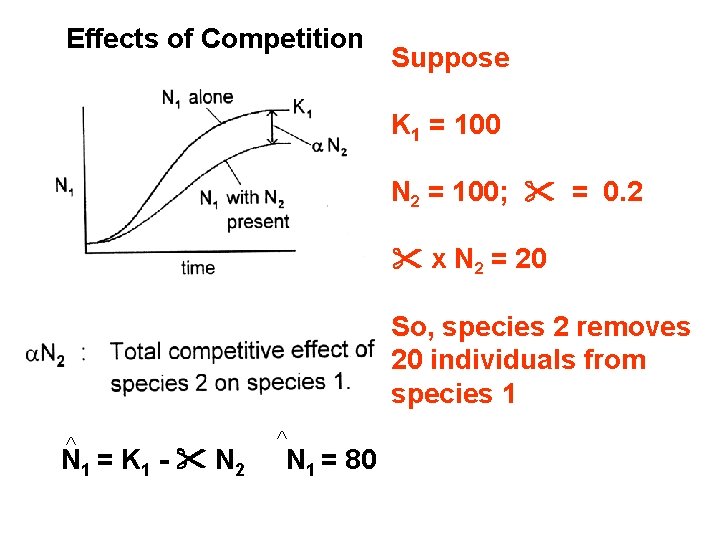
Effects of Competition Suppose K 1 = 100 N 2 = 100; = 0. 2 x N 2 = 20 So, species 2 removes 20 individuals from species 1 ^ N 1 = K 1 - N 2 ^ N 1 = 80
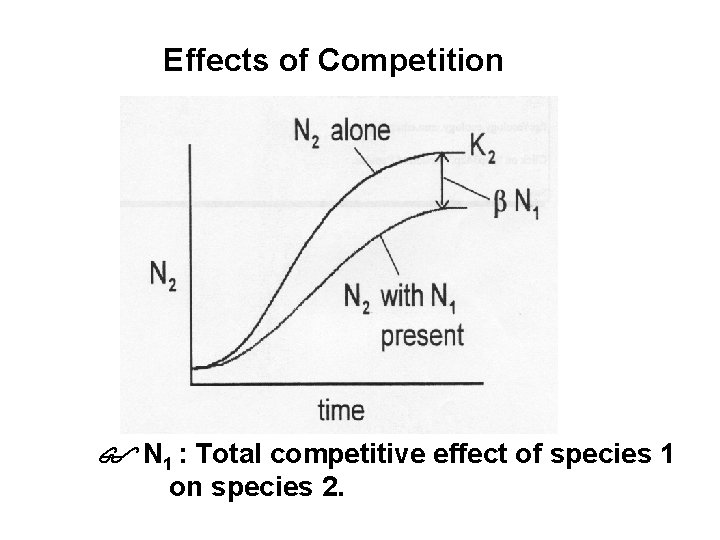
Effects of Competition N 1 : Total competitive effect of species 1 on species 2.
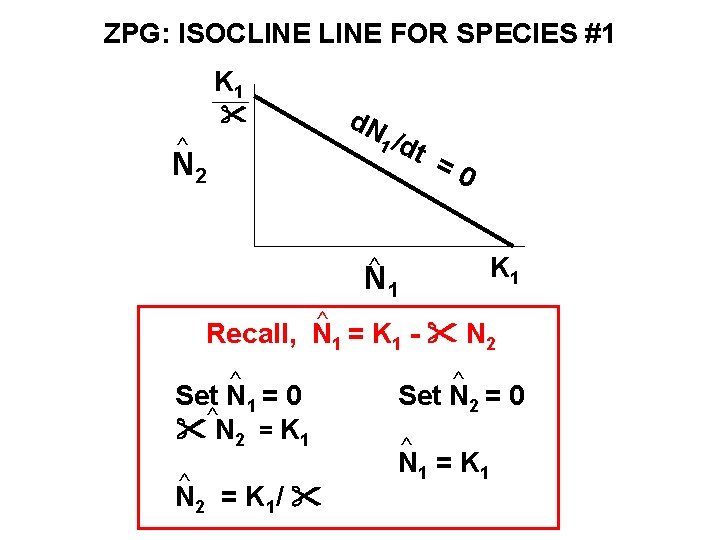
ZPG: ISOCLINE FOR SPECIES #1 K 1 d. N 1 /d ^ N 2 t = 0 ^ K 1 N 1 ^ Recall, N 1 = K 1 - N 2 ^ Set N 1 = 0 ^ N 2 = K 1 ^ N 2 = K 1/ ^ Set N 2 = 0 ^ N 1 = K 1
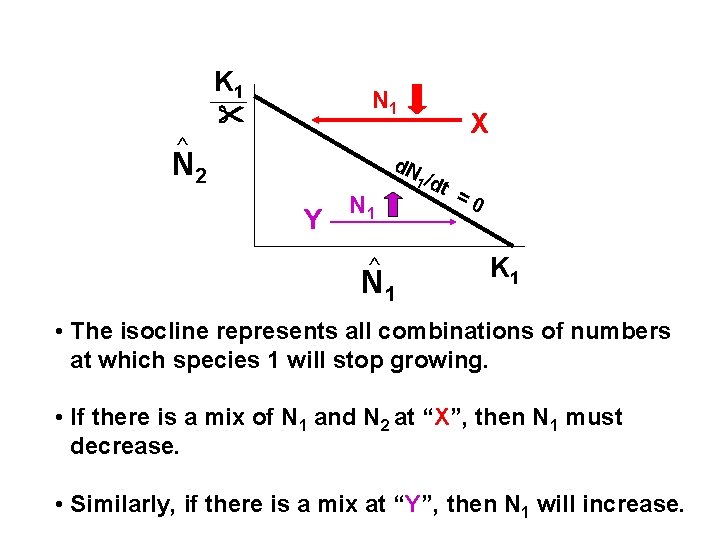
K 1 N 1 ^ N 2 X d. N Y N 1 ^ N 1 1 /d t = 0 K 1 • The isocline represents all combinations of numbers at which species 1 will stop growing. • If there is a mix of N 1 and N 2 at “X”, then N 1 must decrease. • Similarly, if there is a mix at “Y”, then N 1 will increase.
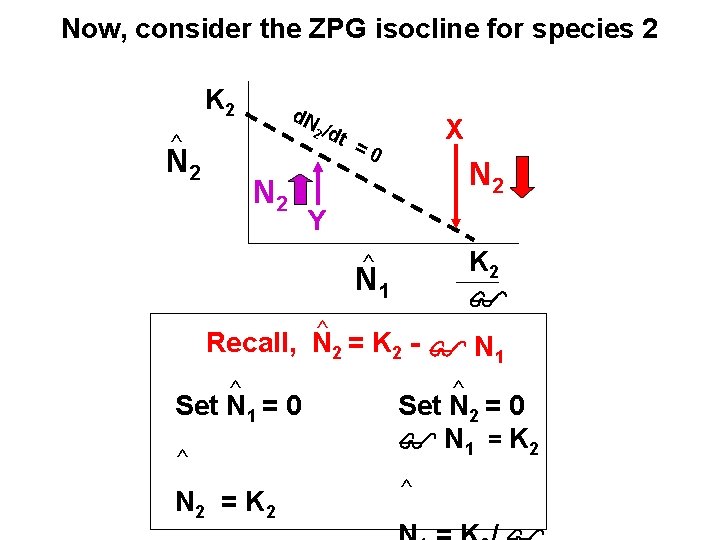
Now, consider the ZPG isocline for species 2 K 2 d. N ^ N 2 X 2 /d N 2 t = 0 N 2 Y K 2 ^ N 1 ^ Recall, N 2 = K 2 - N 1 ^ Set N 1 = 0 ^ N 2 = K 2 ^ Set N 2 = 0 N 1 = K 2 ^
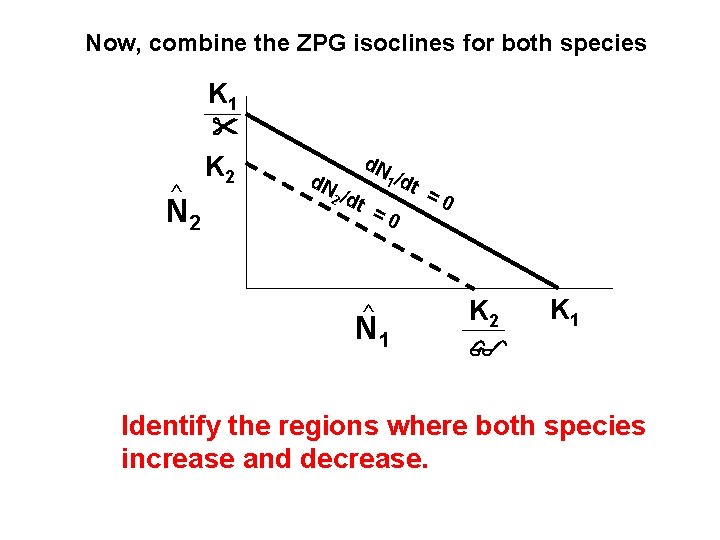
Now, combine the ZPG isoclines for both species K 1 ^ N 2 K 2 d. N 1 /d 2 /d t = 0 ^ N 1 t = 0 K 2 K 1 Identify the regions where both species increase and decrease.
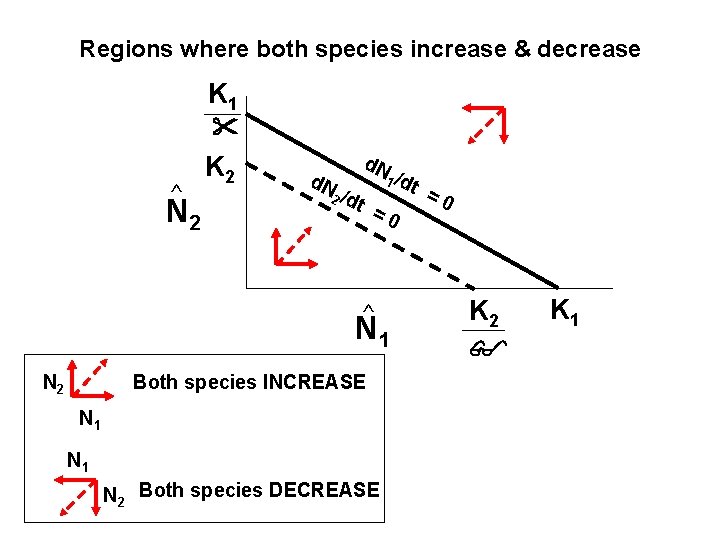
Regions where both species increase & decrease K 1 ^ N 2 K 2 d. N 1 /d 2 /d t = 0 ^ N 1 N 2 Both species INCREASE N 1 N 2 Both species DECREASE t = 0 K 2 K 1
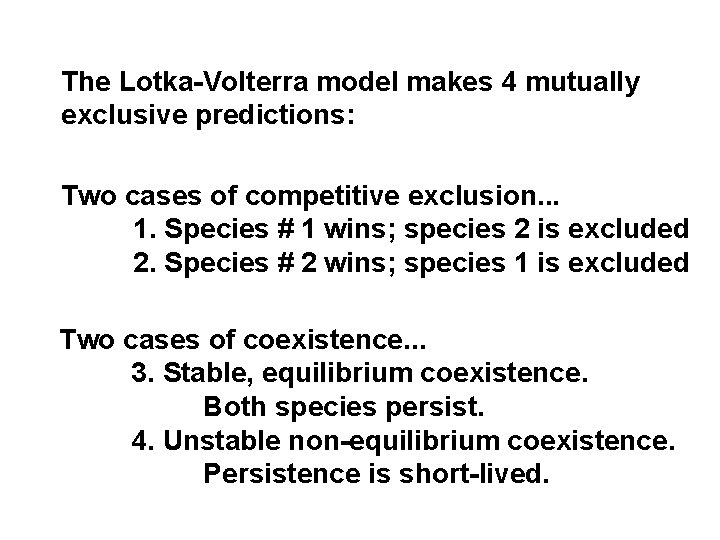
The Lotka-Volterra model makes 4 mutually exclusive predictions: Two cases of competitive exclusion. . . 1. Species # 1 wins; species 2 is excluded 2. Species # 2 wins; species 1 is excluded Two cases of coexistence. . . 3. Stable, equilibrium coexistence. Both species persist. 4. Unstable non-equilibrium coexistence. Persistence is short-lived.
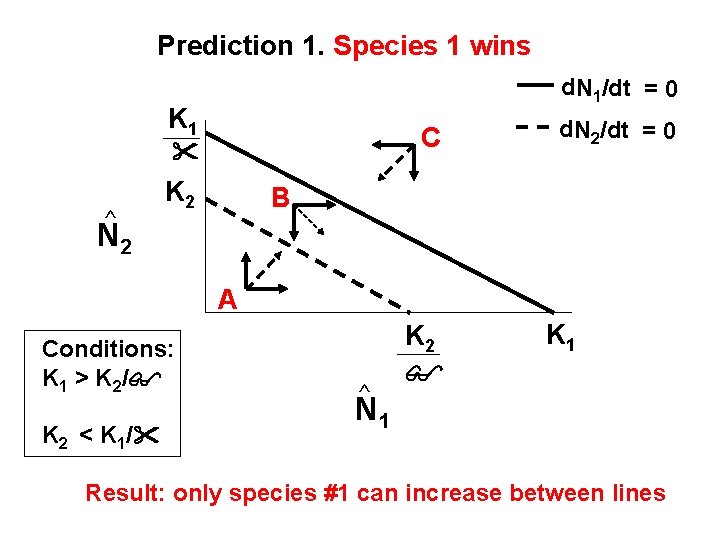
Prediction 1. Species 1 wins d. N 1/dt = 0 K 1 C ^ K 2 d. N 2/dt = 0 B N 2 A Conditions: K 1 > K 2/ K 2 < K 1/ ^ K 2 K 1 N 1 Result: only species #1 can increase between lines
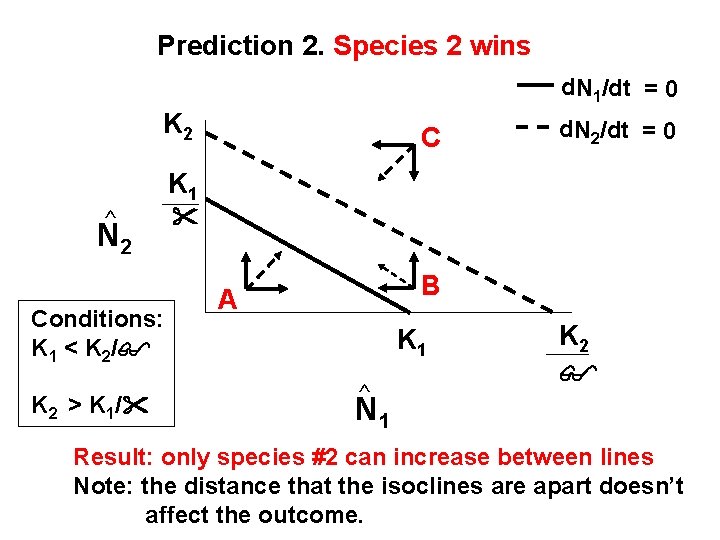
Prediction 2. Species 2 wins d. N 1/dt = 0 K 2 C d. N 2/dt = 0 K 1 ^ N 2 Conditions: K 1 < K 2/ K 2 > K 1/ B A K 1 ^ K 2 N 1 Result: only species #2 can increase between lines Note: the distance that the isoclines are apart doesn’t affect the outcome.

Prediction 3. Stable Equilibrium: isoclines cross in such a way that the behaviour of the system is towards coexistence of 2 species (weak interspecific competition). K 1 d. N 1/dt = 0 B d. N 2/dt = 0 D K 2 ^ N 2 A ^ N 1 C K 1 Indicate that densities of both species exist beneath their own K = stable equilibrium point K 2
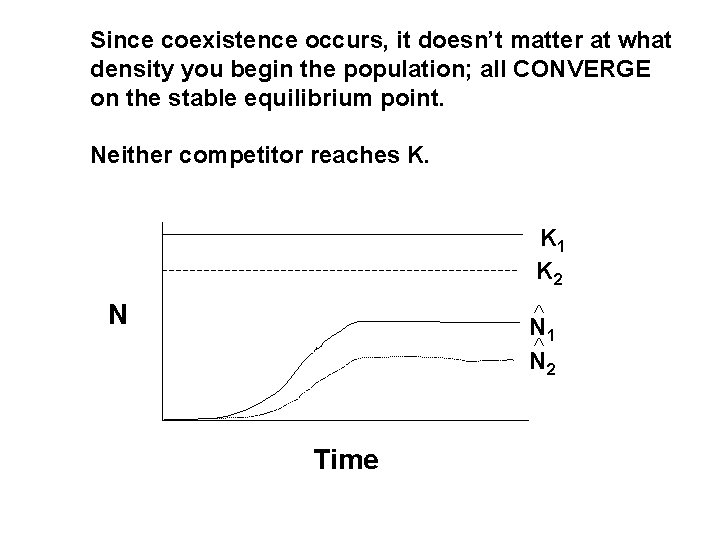
Since coexistence occurs, it doesn’t matter at what density you begin the population; all CONVERGE on the stable equilibrium point. Neither competitor reaches K. K 1 K 2 N ^ N 1 ^ N 2 Time
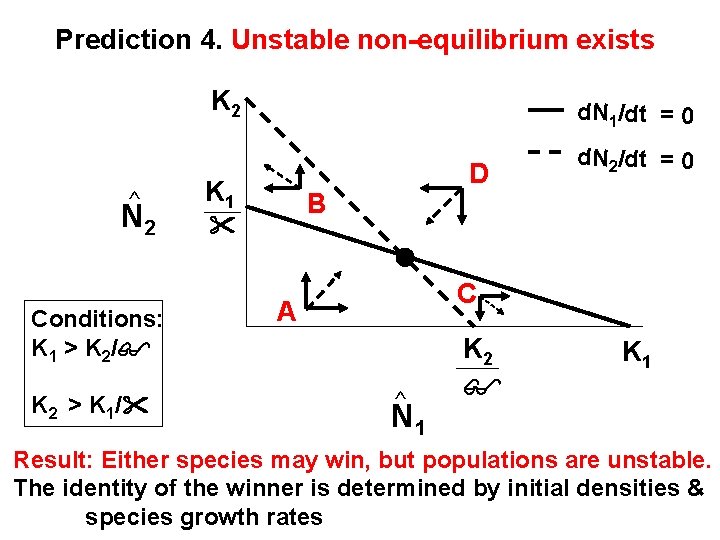
Prediction 4. Unstable non-equilibrium exists K 2 ^ N 2 Conditions: K 1 > K 2/ K 2 > K 1/ d. N 1/dt = 0 K 1 D B d. N 2/dt = 0 C A ^ N 1 K 2 K 1 Result: Either species may win, but populations are unstable. The identity of the winner is determined by initial densities & species growth rates
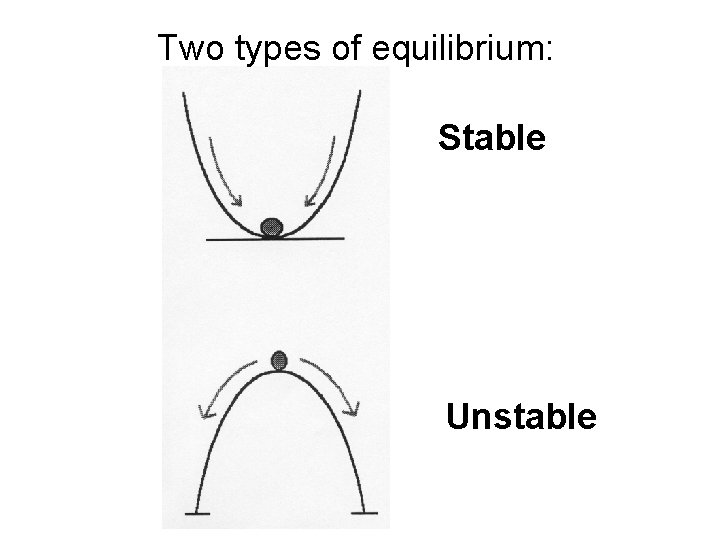
Two types of equilibrium: Stable Unstable
This corresponds to the 2 types of coexistence - one stable & one unstable. Stable coexistence - both competitors coexist. Unstable coexistence - both competitors can coexist, but it is unlikely. The coexistence is only temporary & typically ends in the competitive exclusion of one of the species.
CRITICISMS OF THE MODEL • Assumes density independent competition. • Deals only with competition between two species. • Assumes that we can ignore other ecological processes. • Assumes constant environmental conditions & logistic growth in the absence of competition.
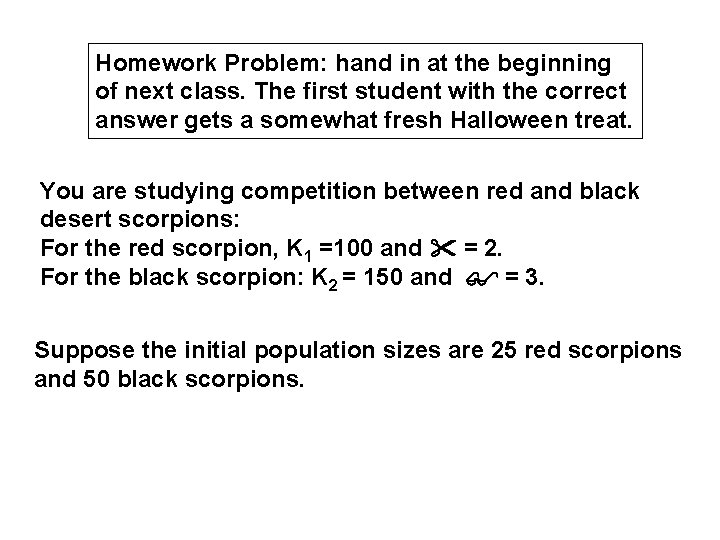
Homework Problem: hand in at the beginning of next class. The first student with the correct answer gets a somewhat fresh Halloween treat. You are studying competition between red and black desert scorpions: For the red scorpion, K 1 =100 and = 2. For the black scorpion: K 2 = 150 and = 3. Suppose the initial population sizes are 25 red scorpions and 50 black scorpions.
Homework: 1. Graph the isoclines for each species 2. Plot the initial population sizes 3. Predict the short term dynamics of each population 4. What is the final outcome of the interspecific competition?

Work with the living graphs on the website: www. whfreeman. com/ricklefs chapter 19
- Slides: 30