
A Formal Literary Paragraph What is a formal
- Slides: 23
A Formal Literary Paragraph
What is a formal literary paragraph? �An FLP is an analytical paragraph that makes and supports an argument. �You will be given a topic to discuss. �Your task is to create an idea based on the topic and to find relevant and supporting examples in the text to support your idea.
The FLP is the starting point � A FLP is written using similar techniques to an essay. �By practicing writing the FLP, you will also be establishing necessary essay writing skills.
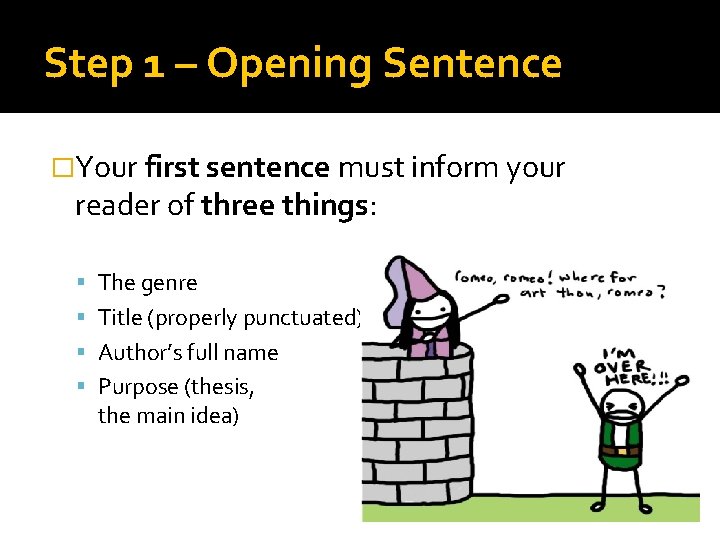
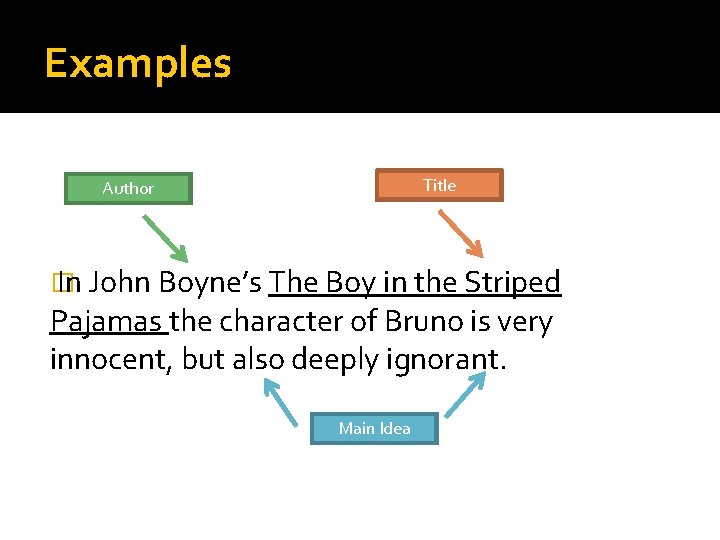
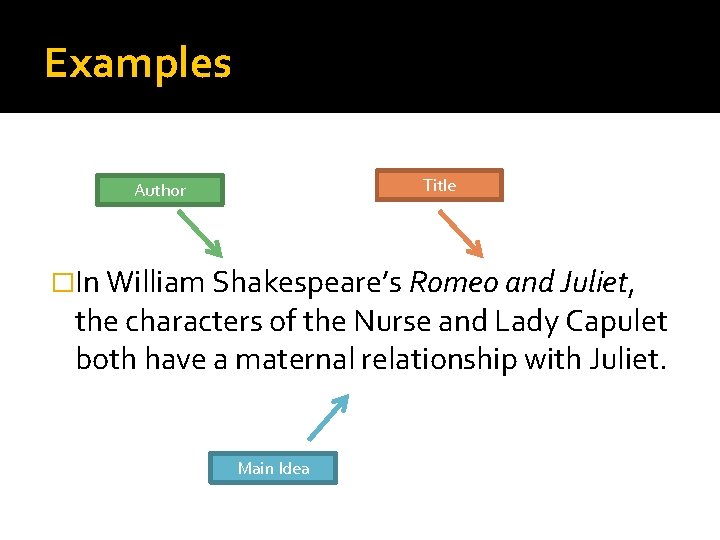
Step 1 – Opening Sentence �Your first sentence must inform your reader of three things: The genre Title (properly punctuated) Author’s full name Purpose (thesis, the main idea)
Examples Title Author � In John Boyne’s The Boy in the Striped Pajamas the character of Bruno is very innocent, but also deeply ignorant. Main Idea
Examples Title Author �In William Shakespeare’s Romeo and Juliet, the characters of the Nurse and Lady Capulet both have a maternal relationship with Juliet. Main Idea
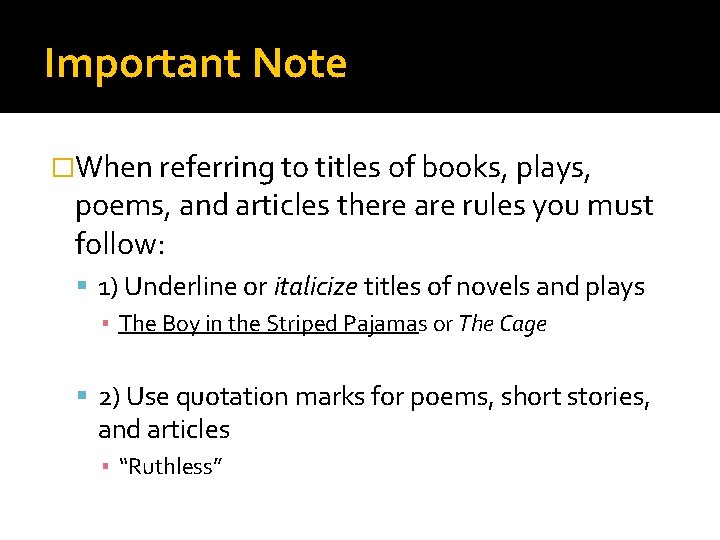
Important Note �When referring to titles of books, plays, poems, and articles there are rules you must follow: 1) Underline or italicize titles of novels and plays ▪ The Boy in the Striped Pajamas or The Cage 2) Use quotation marks for poems, short stories, and articles ▪ “Ruthless”
Step 3– Make your 3 points �You want to include a minimum of three points in your paragraph. �The best way to present your points is to use the ACE structure. �You will need to use the ACE structure three times.
ACE Your Writing �Assertion (your point) �Citation (a quote or paraphrase) �Explanation (explains how your citation supports your assertion)
Example � Assertion: Bruno is very innocent and does not really understand what is happening. � Citation: When Boyne has Bruno say “Heil Hitler”, Bruno thinks it is another way of saying goodbye (Boyne 54). � Explanation: This shows how much Bruno misunderstands the situation.
The Quote Sandwich �Quotations CANNOT be their own sentence �Remember that you always need to introduce your quote (assertion), cite your quote, then explain its importance. �When Boyne has Bruno say “Heil Hitler” (Boyne 54), Bruno thinks it is another way of saying goodbye.
Step 4 – A thoughtful conclusion �A strong concluding statement is extremely important. �You want to restate your main idea in a new and thought provoking way! �(This is the LINK in PEEL) �You can do this by asking yourself “big idea” questions, “why does this matter” or “how can this connect to the real world? ”
FLP Structure � Point - Opening Sentence � Evidence/Explain Three points, follow ACE#1 ACE#2 ACE#3 (Use transitional words to link between ideas) � Link – concluding statement. Answer the question “why does this matter” or “how can this apply to the real world? ”
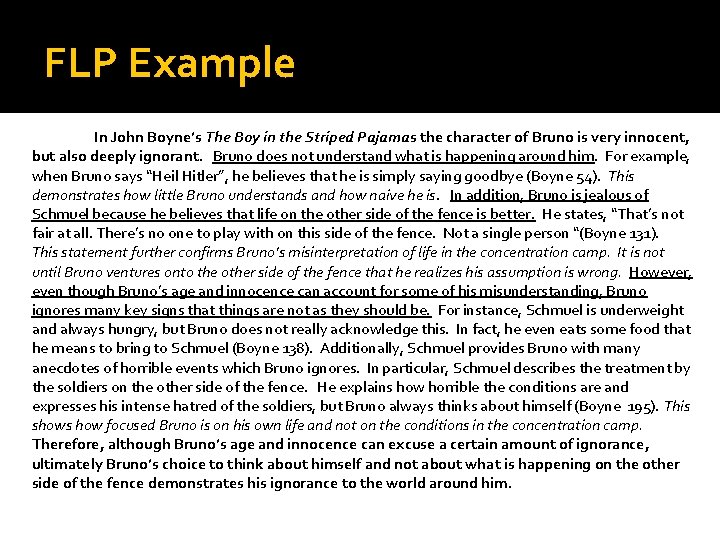
FLP Example In John Boyne’s The Boy in the Striped Pajamas the character of Bruno is very innocent, but also deeply ignorant. Bruno does not understand what is happening around him. For example, when Bruno says “Heil Hitler”, he believes that he is simply saying goodbye (Boyne 54). This demonstrates how little Bruno understands and how naive he is. In addition, Bruno is jealous of Schmuel because he believes that life on the other side of the fence is better. He states, “That’s not fair at all. There’s no one to play with on this side of the fence. Not a single person “(Boyne 131). This statement further confirms Bruno’s misinterpretation of life in the concentration camp. It is not until Bruno ventures onto the other side of the fence that he realizes his assumption is wrong. However, even though Bruno’s age and innocence can account for some of his misunderstanding, Bruno ignores many key signs that things are not as they should be. For instance, Schmuel is underweight and always hungry, but Bruno does not really acknowledge this. In fact, he even eats some food that he means to bring to Schmuel (Boyne 138). Additionally, Schmuel provides Bruno with many anecdotes of horrible events which Bruno ignores. In particular, Schmuel describes the treatment by the soldiers on the other side of the fence. He explains how horrible the conditions are and expresses his intense hatred of the soldiers, but Bruno always thinks about himself (Boyne 195). This shows how focused Bruno is on his own life and not on the conditions in the concentration camp. Therefore, although Bruno’s age and innocence can excuse a certain amount of ignorance, ultimately Bruno’s choice to think about himself and not about what is happening on the other side of the fence demonstrates his ignorance to the world around him.
6+ 1 Traits of Writing �The 6 + 1 Traits Ideas Organization Voice Word Choice Sentence Fluency Conventions Presentation
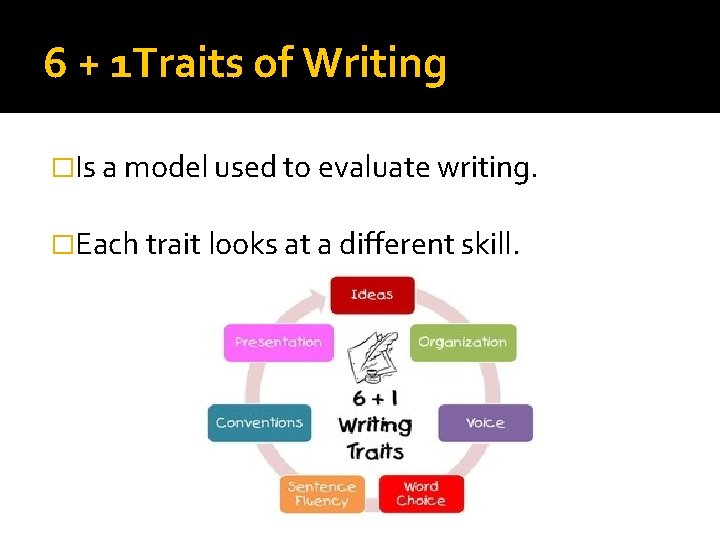
6 + 1 Traits of Writing �Is a model used to evaluate writing. �Each trait looks at a different skill.
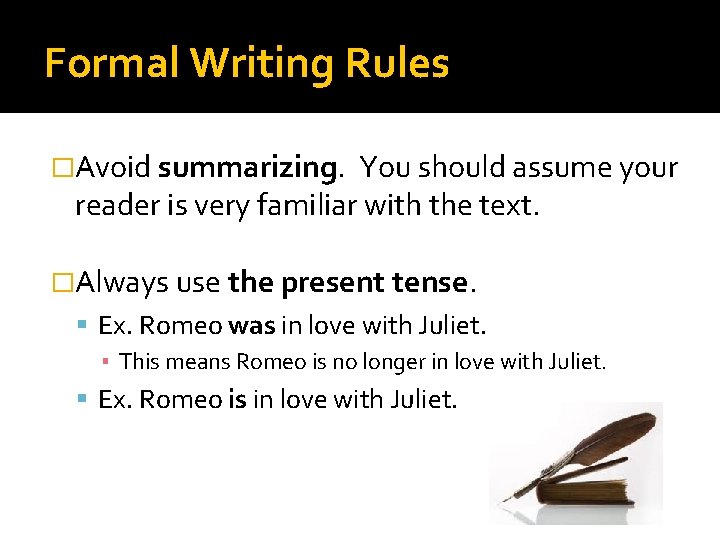
Formal Writing Rules �Avoid summarizing. You should assume your reader is very familiar with the text. �Always use the present tense. Ex. Romeo was in love with Juliet. ▪ This means Romeo is no longer in love with Juliet. Ex. Romeo is in love with Juliet.
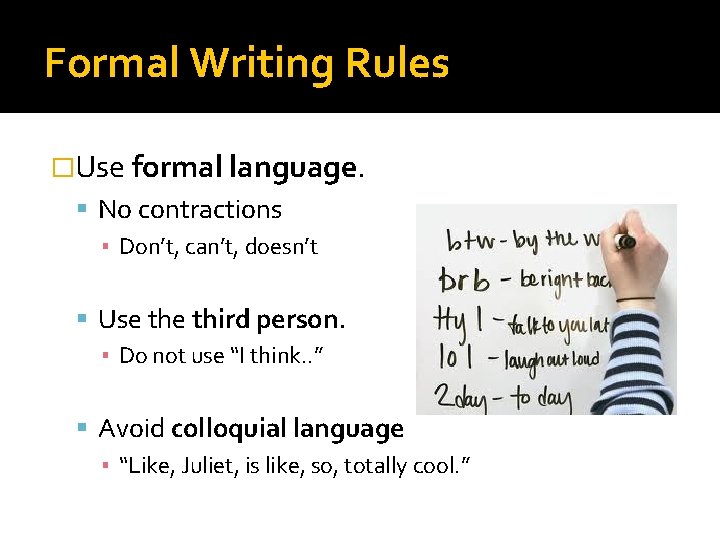
Formal Writing Rules �Use formal language. No contractions ▪ Don’t, can’t, doesn’t Use third person. ▪ Do not use “I think. . ” Avoid colloquial language ▪ “Like, Juliet, is like, so, totally cool. ”
Formal Writing Rules Avoid �Vague/general words Such as “stuff” “things” Be specific in your word choice �Got/Get Often not the verb you’re looking for. As soon as you use this “verb” re-evaluate! He got the letter – he received the letter
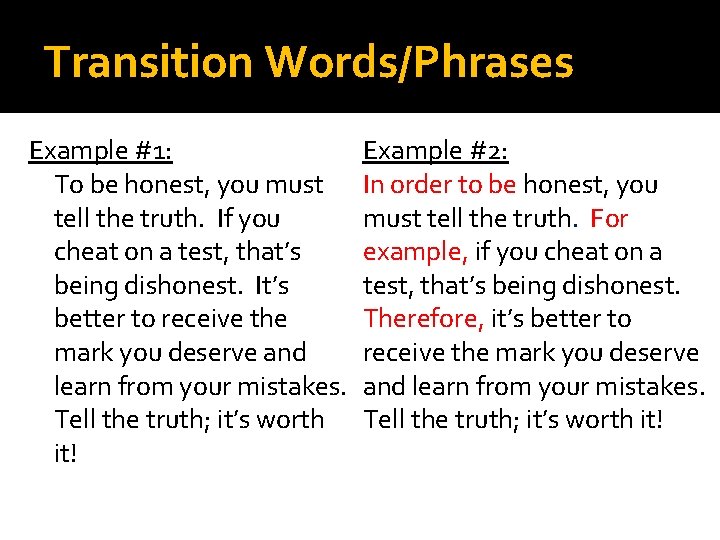
Formal Writing Rules �Use transition words to connect your ideas
Transition Words/Phrases Example #1: To be honest, you must tell the truth. If you cheat on a test, that’s being dishonest. It’s better to receive the mark you deserve and learn from your mistakes. Tell the truth; it’s worth it! Example #2: In order to be honest, you must tell the truth. For example, if you cheat on a test, that’s being dishonest. Therefore, it’s better to receive the mark you deserve and learn from your mistakes. Tell the truth; it’s worth it!
Practice �Look at the example FLP and underline all the transition words used.
Your Turn �Time to write your FLP!