
A food chain shows what is eaten by
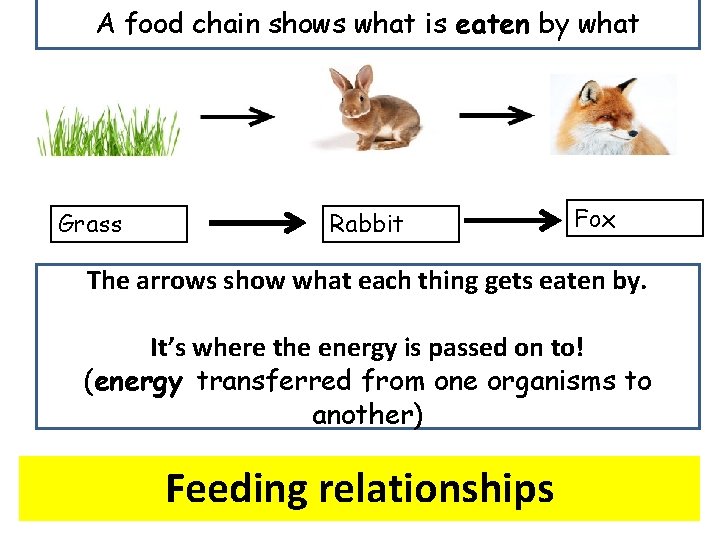
A food chain shows what is eaten by what Grass Rabbit Fox The arrows show what each thing gets eaten by. It’s where the energy is passed on to! (energy transferred from one organisms to another) Feeding relationships
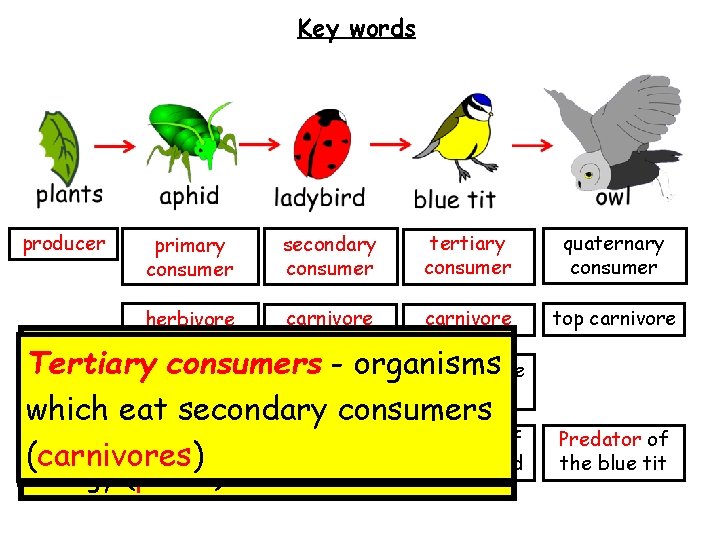
Key words producer primary consumer secondary consumer tertiary consumer quaternary consumer herbivore carnivore top carnivore Producers organisms which can Tertiary consumers organisms prey for the Secondary consumers - prey for the Primary consumer - organisms ladybird bluefrom tit owl make their own energy carbon which eat secondary consumers organisms which eat primary producers dioxide and water using sunlight for of predator of Predator (carnivores) consumers (carnivores) (herbivores) the ladybird the aphid energy (plants) Predator of the blue tit
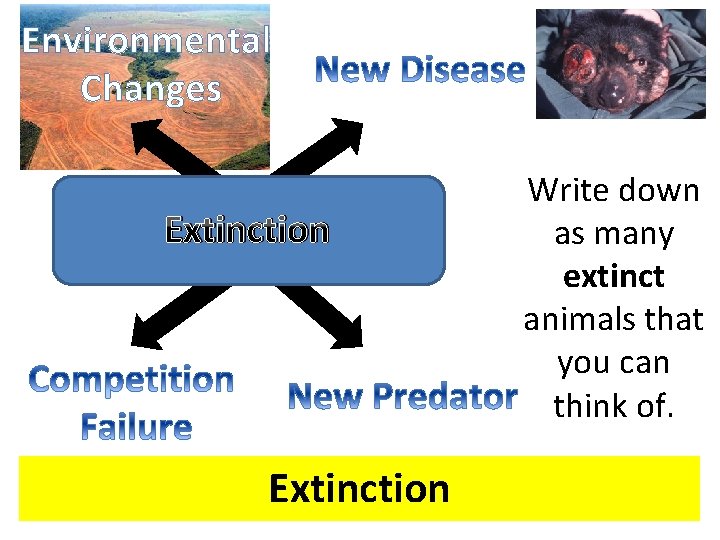
Environmental Changes Extinction Write down as many extinct animals that you can think of.
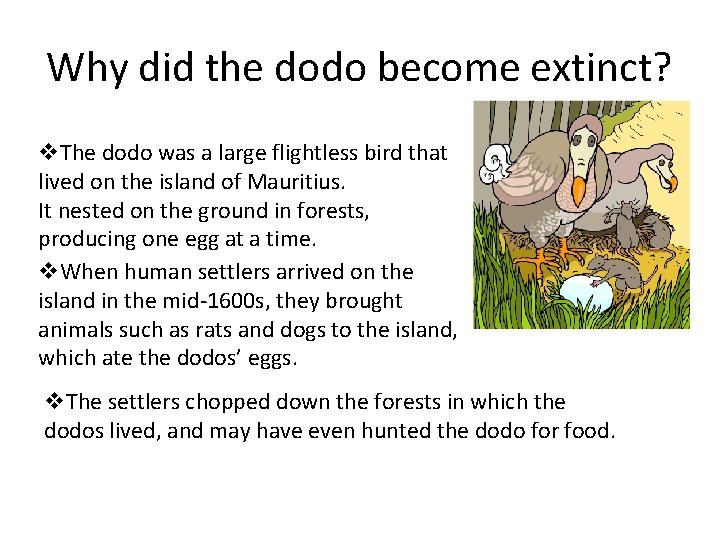
Why did the dodo become extinct? v. The dodo was a large flightless bird that lived on the island of Mauritius. It nested on the ground in forests, producing one egg at a time. v. When human settlers arrived on the island in the mid-1600 s, they brought animals such as rats and dogs to the island, which ate the dodos’ eggs. v. The settlers chopped down the forests in which the dodos lived, and may have even hunted the dodo for food.

Dinosaurs are now extinct. We don’t see dinosaurs wandering around outside anymore! They are extinct, which means that they no longer exist and we will never see a dinosaur again. So how do we know that they even existed in the first place?
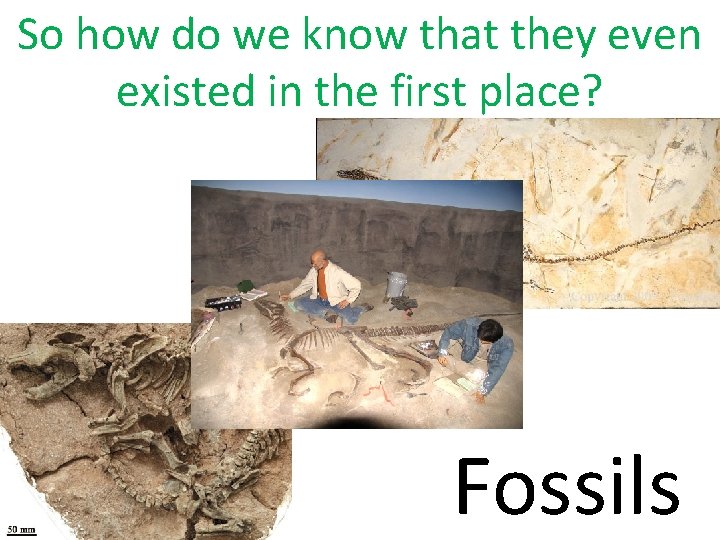
So how do we know that they even existed in the first place? Fossils
Why did the dinosaurs become extinct? • Organisms are adapted to their habitats. • Physical environmental factors, like temperature, help to create the environment of a habitat. • If an environment changes, the organisms may not be adapted to the new environment and so may die out. There a many different theories, each holds their own “weighting”. (how much evidence support theory).
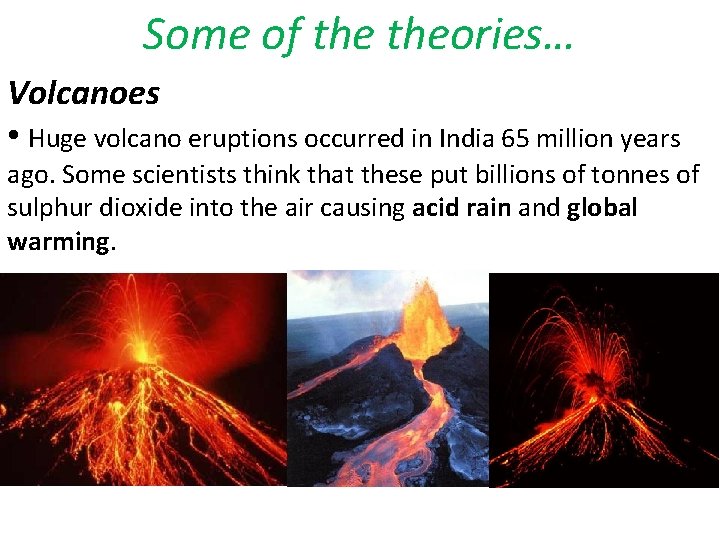
Some of theories… Volcanoes • Huge volcano eruptions occurred in India 65 million years ago. Some scientists think that these put billions of tonnes of sulphur dioxide into the air causing acid rain and global warming.
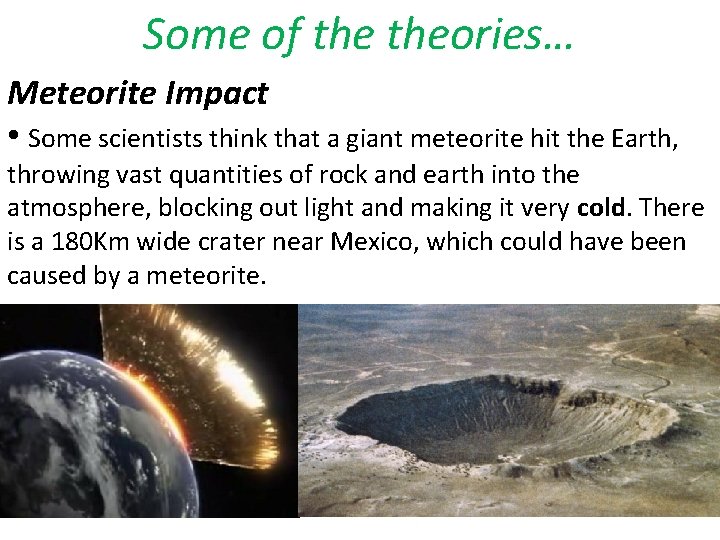
Some of theories… Meteorite Impact • Some scientists think that a giant meteorite hit the Earth, throwing vast quantities of rock and earth into the atmosphere, blocking out light and making it very cold. There is a 180 Km wide crater near Mexico, which could have been caused by a meteorite.
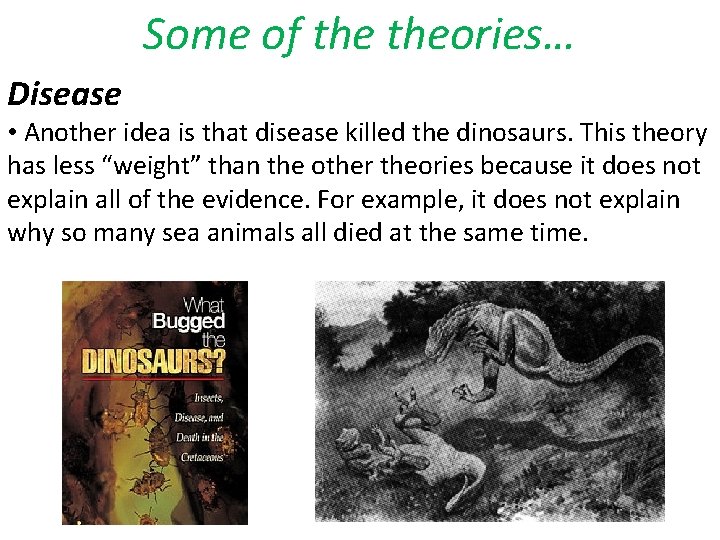
Some of theories… Disease • Another idea is that disease killed the dinosaurs. This theory has less “weight” than the other theories because it does not explain all of the evidence. For example, it does not explain why so many sea animals all died at the same time.
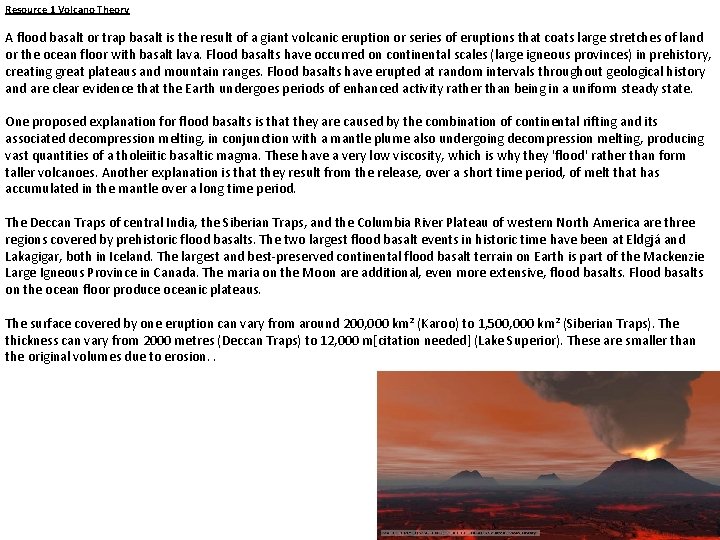
Resource 1 Volcano Theory A flood basalt or trap basalt is the result of a giant volcanic eruption or series of eruptions that coats large stretches of land or the ocean floor with basalt lava. Flood basalts have occurred on continental scales (large igneous provinces) in prehistory, creating great plateaus and mountain ranges. Flood basalts have erupted at random intervals throughout geological history and are clear evidence that the Earth undergoes periods of enhanced activity rather than being in a uniform steady state. One proposed explanation for flood basalts is that they are caused by the combination of continental rifting and its associated decompression melting, in conjunction with a mantle plume also undergoing decompression melting, producing vast quantities of a tholeiitic basaltic magma. These have a very low viscosity, which is why they 'flood' rather than form taller volcanoes. Another explanation is that they result from the release, over a short time period, of melt that has accumulated in the mantle over a long time period. The Deccan Traps of central India, the Siberian Traps, and the Columbia River Plateau of western North America are three regions covered by prehistoric flood basalts. The two largest flood basalt events in historic time have been at Eldgjá and Lakagigar, both in Iceland. The largest and best-preserved continental flood basalt terrain on Earth is part of the Mackenzie Large Igneous Province in Canada. The maria on the Moon are additional, even more extensive, flood basalts. Flood basalts on the ocean floor produce oceanic plateaus. The surface covered by one eruption can vary from around 200, 000 km² (Karoo) to 1, 500, 000 km² (Siberian Traps). The thickness can vary from 2000 metres (Deccan Traps) to 12, 000 m[citation needed] (Lake Superior). These are smaller than the original volumes due to erosion. .
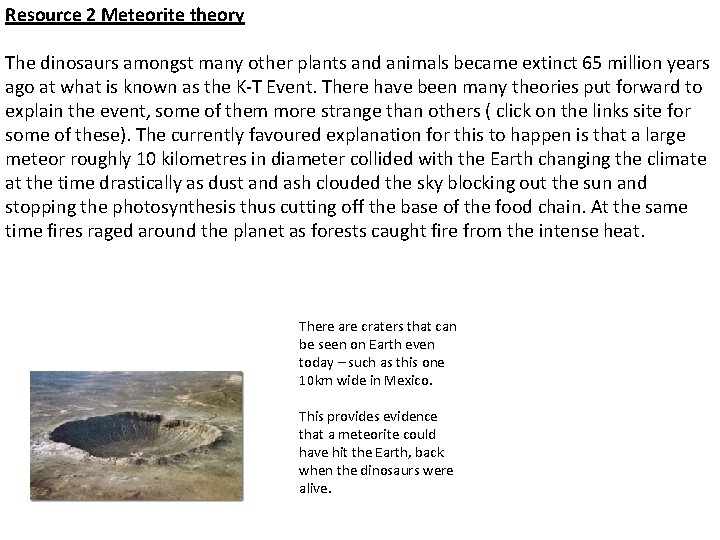
Resource 2 Meteorite theory The dinosaurs amongst many other plants and animals became extinct 65 million years ago at what is known as the K-T Event. There have been many theories put forward to explain the event, some of them more strange than others ( click on the links site for some of these). The currently favoured explanation for this to happen is that a large meteor roughly 10 kilometres in diameter collided with the Earth changing the climate at the time drastically as dust and ash clouded the sky blocking out the sun and stopping the photosynthesis thus cutting off the base of the food chain. At the same time fires raged around the planet as forests caught fire from the intense heat. There are craters that can be seen on Earth even today – such as this one 10 km wide in Mexico. This provides evidence that a meteorite could have hit the Earth, back when the dinosaurs were alive.
Resource 3 Disease Theory Hay fever killed the dinosaurs ? The theory: Flowering plants known as angiosperms arose around 65 million years ago, creating a mass allergic reaction among dinosaurs. How likely: Not very! Flowering plants were around for millions of years before the dinosaurs disappeared and we have no evidence whatsoever that their pollen was capable of killing the dinosaurs. Plus this wouldn't explain the massive marine extinction - there have never been any marine angiosperms. Obesity killed the dinosaurs The theory: The dinosaurs got too big and heavy, so much so they couldn't move about, defend themselves or withstand their own weight! How likely? There is absolutely no evidence to suggest the dinosaurs became so large and cumbersome that they couldn't move. Simply put, it is an evolutionary impossibility. Besides, most dinosaurs around by the end of the Cretaceous period were of medium or small size. Disease killed the dinosaurs ? The theory: Towards the end of the Cretaceous period, land bridges opened up between places such as Asia and North America, allowing species to migrate. This led to a spread of disease to which other animals were not resistant. How likely? It could happen - Native Americans were nearly wiped out by smallpox, while the European invaders were resistant. But this argument fails to explain the disappearance of a multitude of species that lived in the sea.
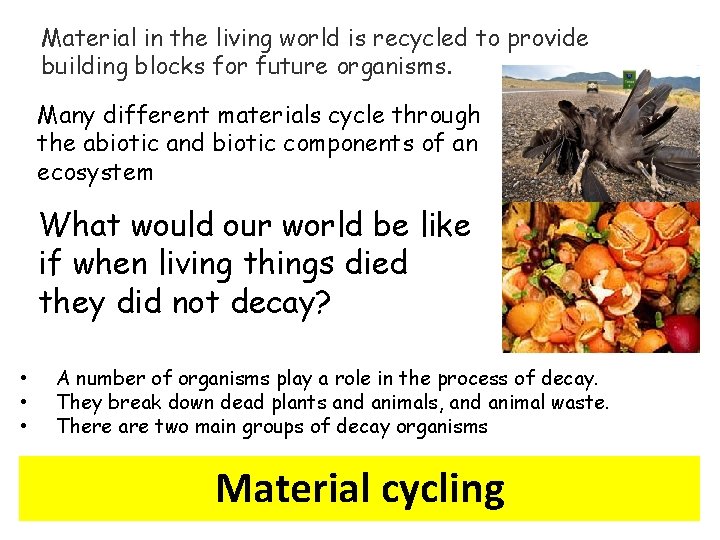
Material in the living world is recycled to provide building blocks for future organisms. Many different materials cycle through the abiotic and biotic components of an ecosystem What would our world be like if when living things died they did not decay? • • • A number of organisms play a role in the process of decay. They break down dead plants and animals, and animal waste. There are two main groups of decay organisms Material cycling
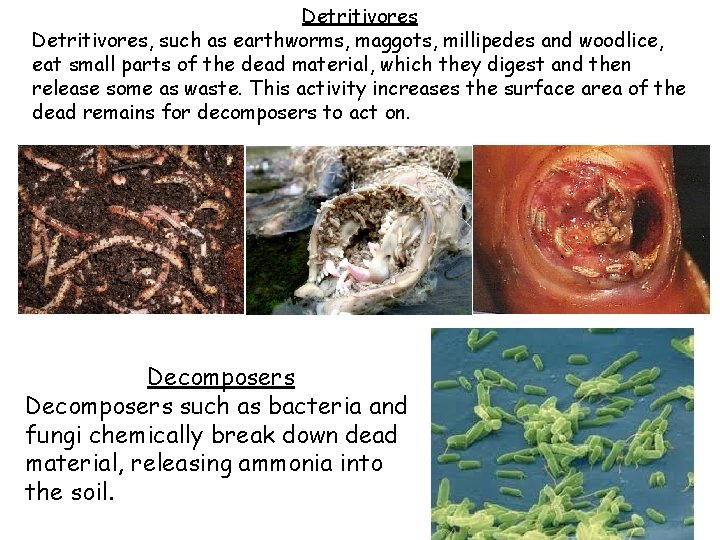
Detritivores, such as earthworms, maggots, millipedes and woodlice, eat small parts of the dead material, which they digest and then release some as waste. This activity increases the surface area of the dead remains for decomposers to act on. Decomposers such as bacteria and fungi chemically break down dead material, releasing ammonia into the soil.
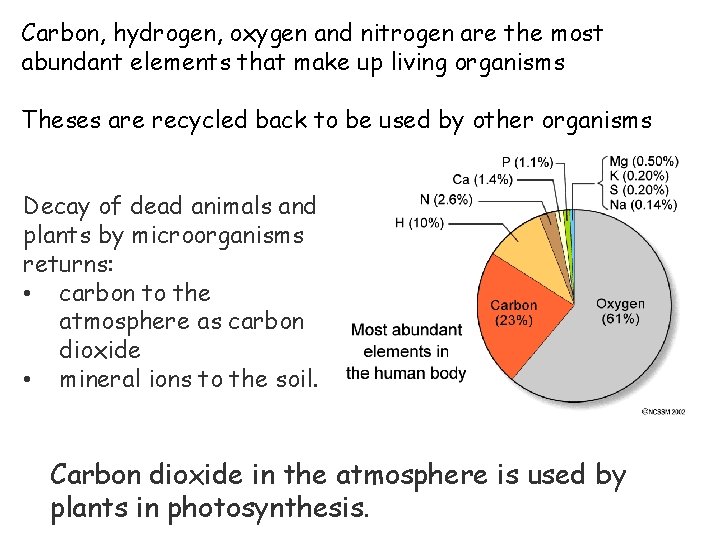
Carbon, hydrogen, oxygen and nitrogen are the most abundant elements that make up living organisms Theses are recycled back to be used by other organisms Decay of dead animals and plants by microorganisms returns: • carbon to the atmosphere as carbon dioxide • mineral ions to the soil. Carbon dioxide in the atmosphere is used by plants in photosynthesis.
The Body Farm • http: //www. youtube. com/watch? v=V_Siq. ND 9 b. NA&safe=active • Why do you think the study of decomposition is important? • Could you do this job? Why/why not?
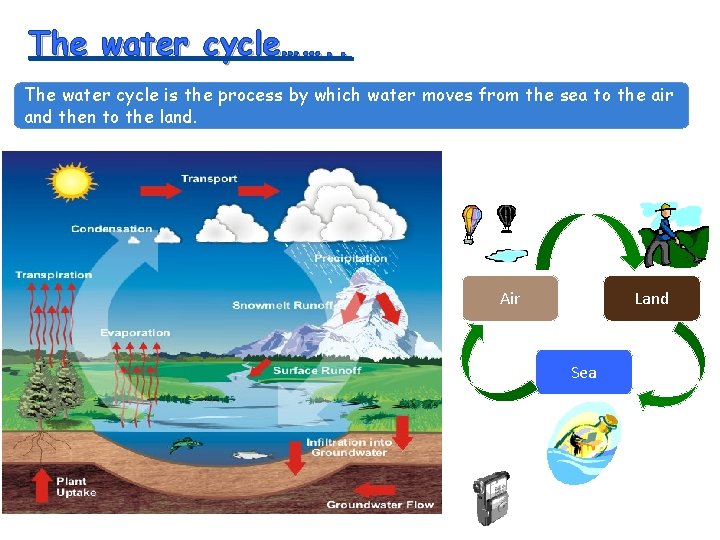
The water cycle……. . The water cycle is the process by which water moves from the sea to the air and then to the land. Air Land Sea
• The water cycle provides fresh water for plants and animals on land before draining into the seas. • Water is continuously evaporated, condensed, and precipitated.
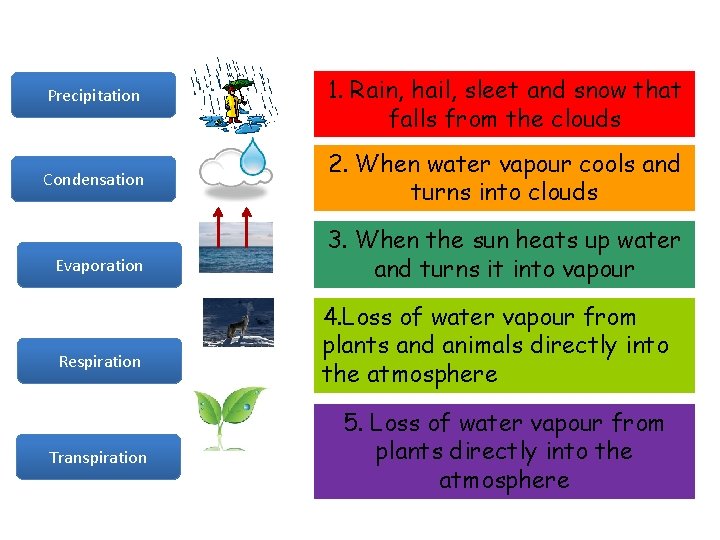
Precipitation 1. Rain, hail, sleet and snow that falls from the clouds Condensation 2. When water vapour cools and turns into clouds Evaporation Respiration Transpiration 3. When the sun heats up water and turns it into vapour 4. Loss of water vapour from plants and animals directly into the atmosphere 5. Loss of water vapour from plants directly into the atmosphere
Why is carbon important? • Carbon is the main constituent of all living cells • Carbon can form long chained-molecules which are the basis for fats, carbohydrates, nucleic acids (DNA and RNA) and proteins. The carbon cycle
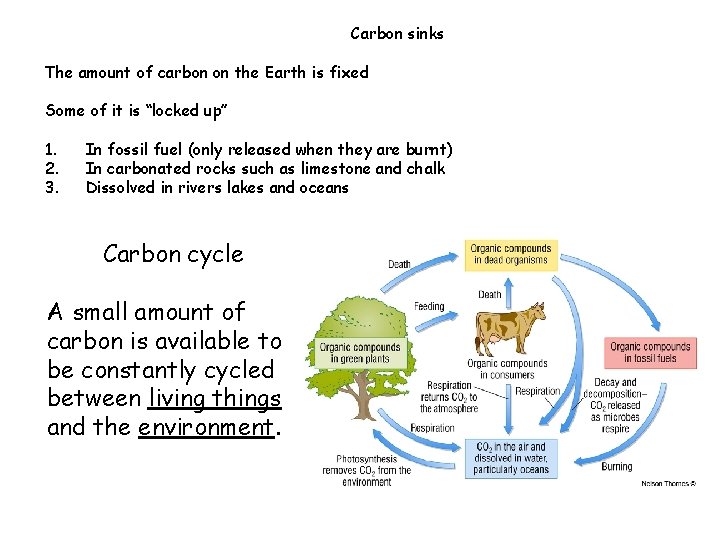
Carbon sinks The amount of carbon on the Earth is fixed Some of it is “locked up” 1. 2. 3. In fossil fuel (only released when they are burnt) In carbonated rocks such as limestone and chalk Dissolved in rivers lakes and oceans Carbon cycle A small amount of carbon is available to be constantly cycled between living things and the environment.
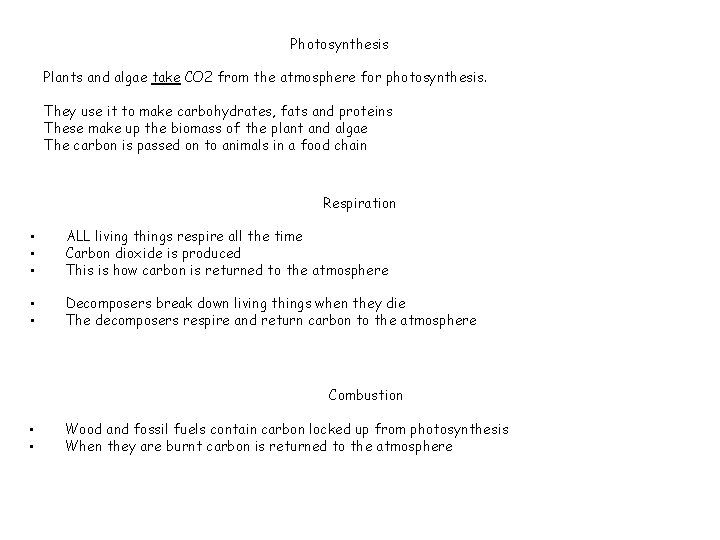
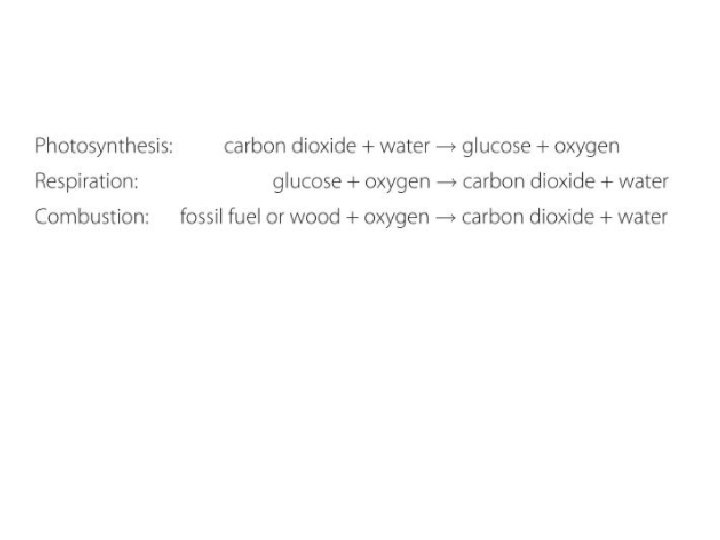
Photosynthesis Plants and algae take CO 2 from the atmosphere for photosynthesis. They use it to make carbohydrates, fats and proteins These make up the biomass of the plant and algae The carbon is passed on to animals in a food chain Respiration • • • ALL living things respire all the time Carbon dioxide is produced This is how carbon is returned to the atmosphere • • Decomposers break down living things when they die The decomposers respire and return carbon to the atmosphere Combustion • • Wood and fossil fuels contain carbon locked up from photosynthesis When they are burnt carbon is returned to the atmosphere
- Slides: 25