
A first word on probability Chapter 3 4
A first word on probability Chapter 3. 4
Acknowledgement • Some of the slides are take from Dr. Bulatov’s Lecture-Slides.
Use of Probabilty • One of the primary applications of counting is to calculate probabilities of random events. • Probability theory plays an important role in almost every area of science, economics, and business. • In computer science, randomization and probability are ubiquitous.
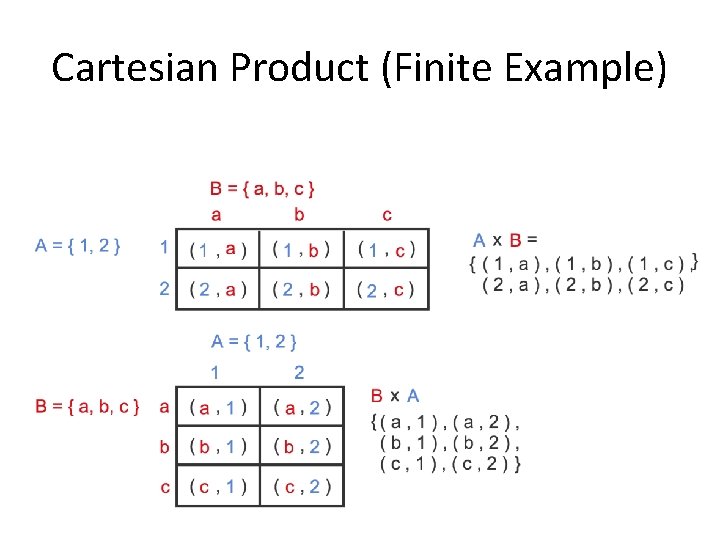
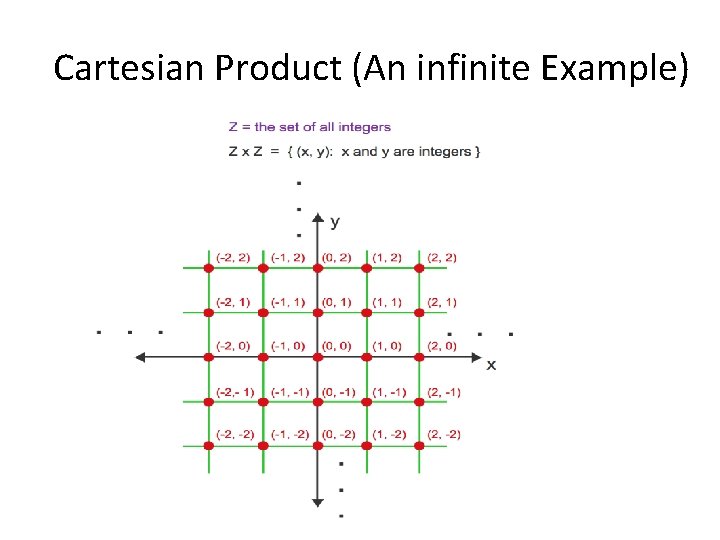
Cartesian Products • For sets A, B, the Cartesian product, or cross product, of A and B is denoted by A × B and equals {(a, b) | a A, b B}. • Elements of A × B are ordered pairs. For (a, b), (c, d) A × B , (a, b) = (c, d) if and only if a = c and b = d.
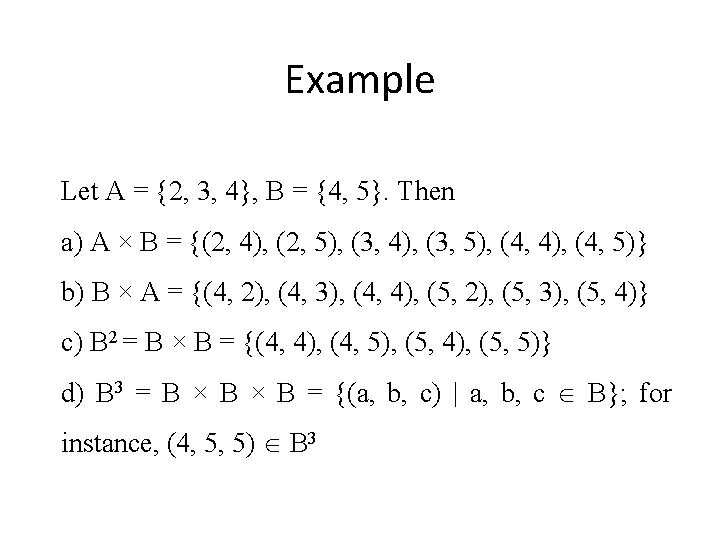
Example Let A = {2, 3, 4}, B = {4, 5}. Then a) A × B = {(2, 4), (2, 5), (3, 4), (3, 5), (4, 4), (4, 5)} b) B × A = {(4, 2), (4, 3), (4, 4), (5, 2), (5, 3), (5, 4)} c) B 2 = B × B = {(4, 4), (4, 5), (5, 4), (5, 5)} d) B 3 = B × B = {(a, b, c) | a, b, c B}; for instance, (4, 5, 5) B 3

Cartesian Products Properties: 1. If A, B are finite, it follows from the rule of product that |A × B| = |A|. |B| 2. Although we generally will not have A × B = B × A, we will have |A×B|=|B×A|
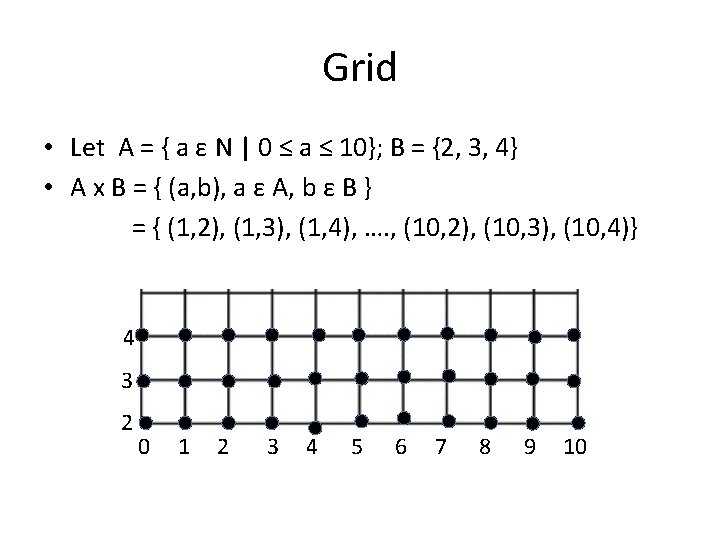
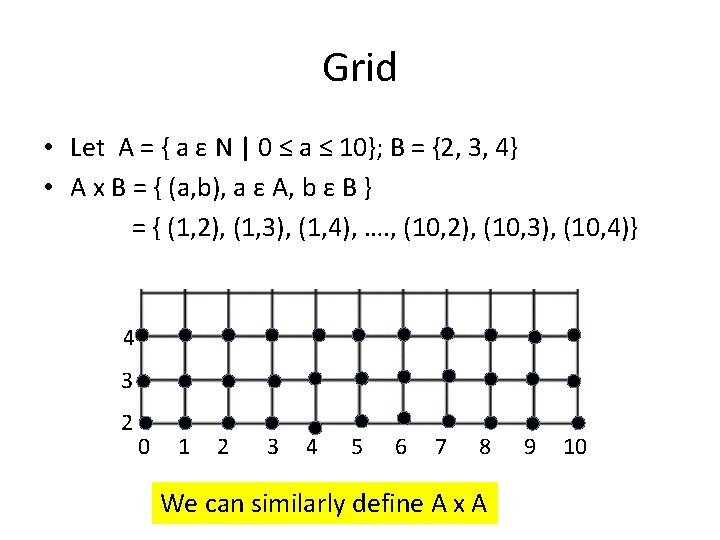
Grid • Let A = { a ε N | 0 ≤ a ≤ 10}; B = {2, 3, 4} • A x B = { (a, b), a ε A, b ε B } = { (1, 2), (1, 3), (1, 4), …. , (10, 2), (10, 3), (10, 4)} 4 3 2 0 1 2 3 4 5 6 7 8 We can similarly define A x A 9 10
A first word on probability Chapter 3. 4
Cartesian Product (Finite Example)
Cartesian Product (An infinite Example)
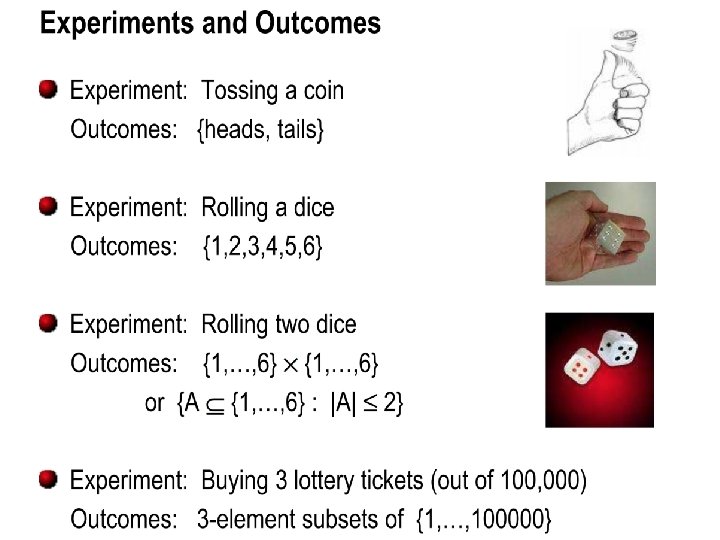
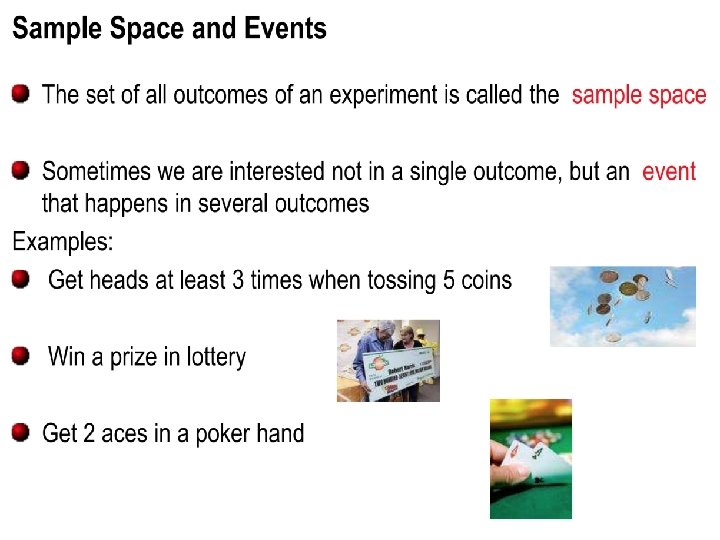
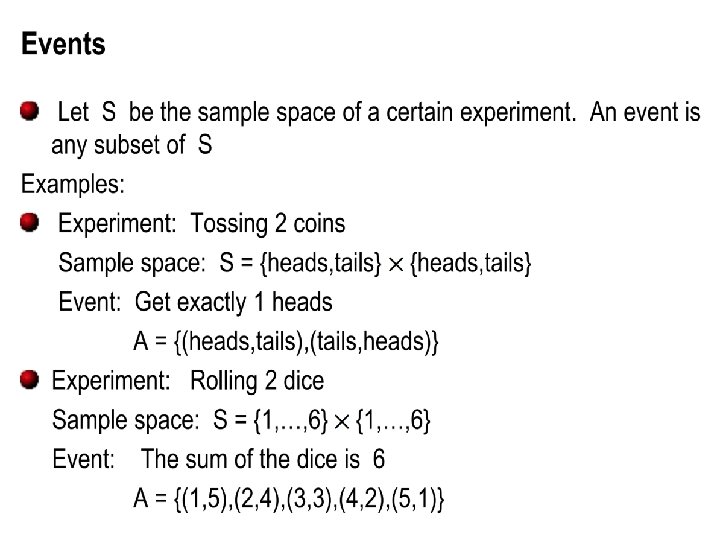
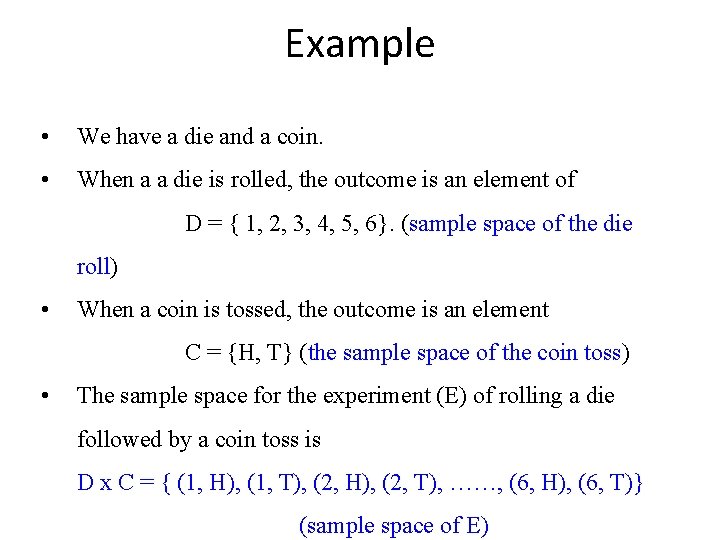
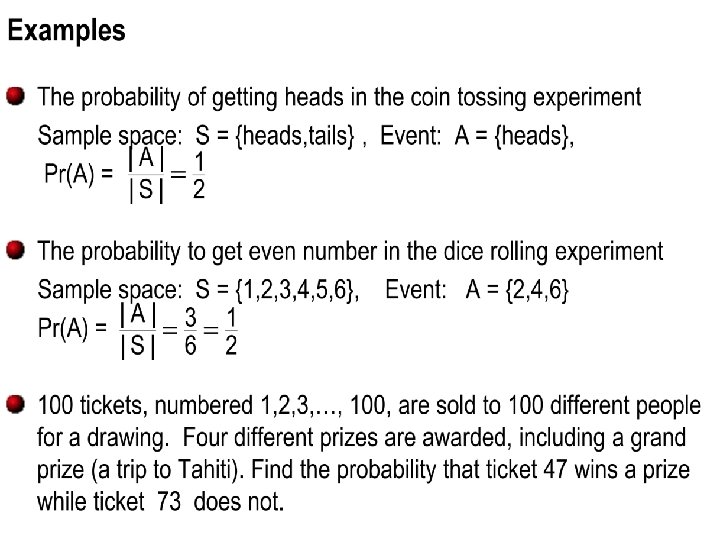
Example • We have a die and a coin. • When a a die is rolled, the outcome is an element of D = { 1, 2, 3, 4, 5, 6}. (sample space of the die roll) • When a coin is tossed, the outcome is an element C = {H, T} (the sample space of the coin toss) • The sample space for the experiment (E) of rolling a die followed by a coin toss is D x C = { (1, H), (1, T), (2, H), (2, T), ……, (6, H), (6, T)} (sample space of E)
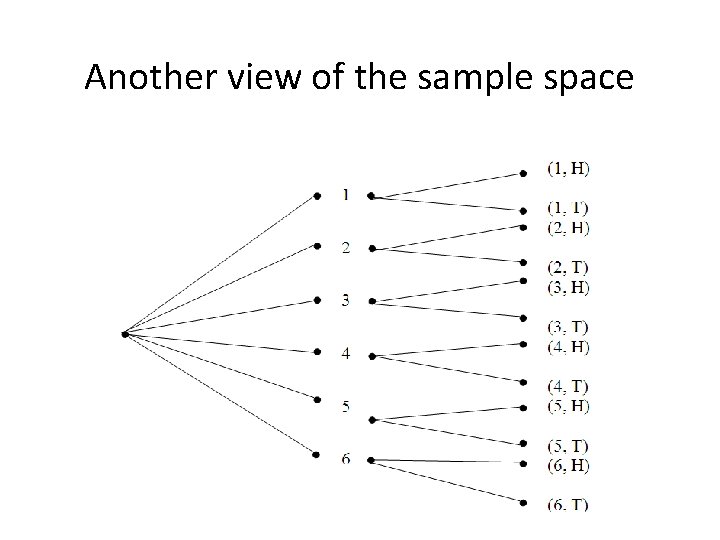
Another view of the sample space
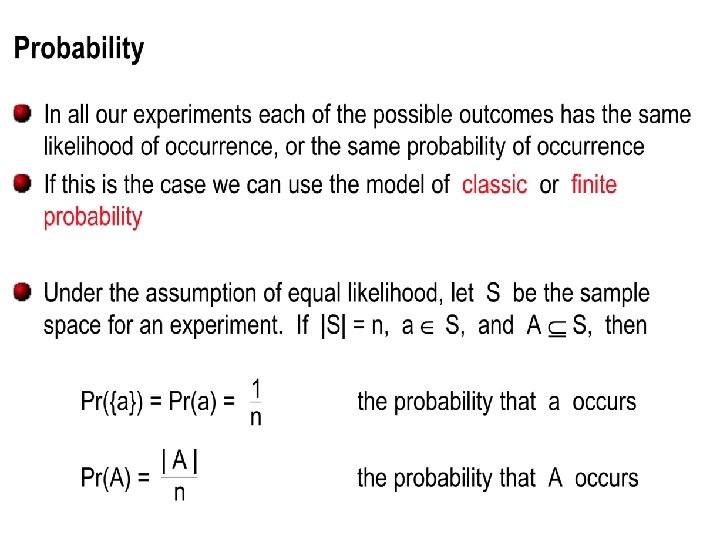
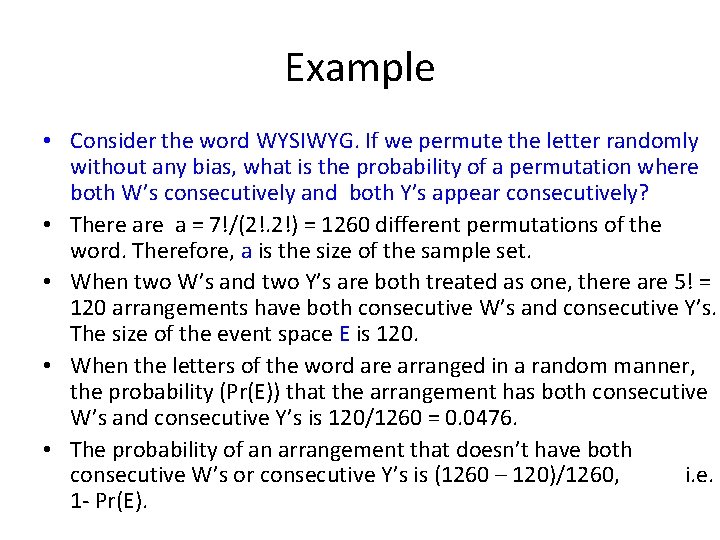
Example • Consider the word WYSIWYG. If we permute the letter randomly without any bias, what is the probability of a permutation where both W’s consecutively and both Y’s appear consecutively? • There a = 7!/(2!. 2!) = 1260 different permutations of the word. Therefore, a is the size of the sample set. • When two W’s and two Y’s are both treated as one, there are 5! = 120 arrangements have both consecutive W’s and consecutive Y’s. The size of the event space E is 120. • When the letters of the word are arranged in a random manner, the probability (Pr(E)) that the arrangement has both consecutive W’s and consecutive Y’s is 120/1260 = 0. 0476. • The probability of an arrangement that doesn’t have both consecutive W’s or consecutive Y’s is (1260 – 120)/1260, i. e. 1 - Pr(E).
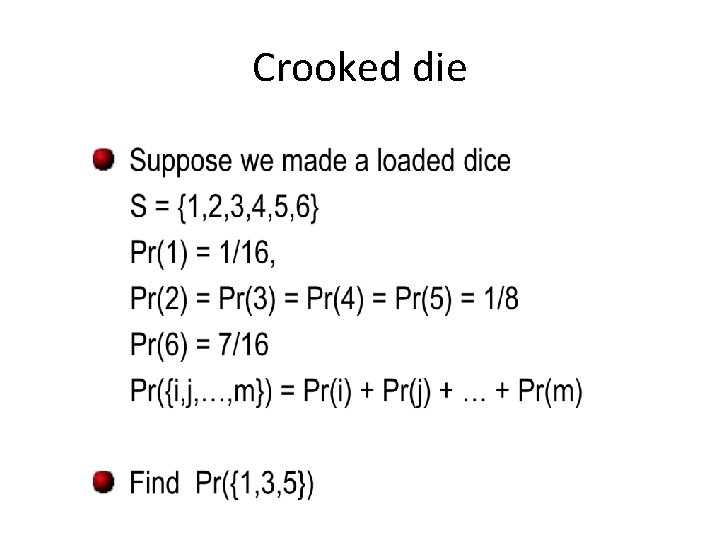
Crooked die
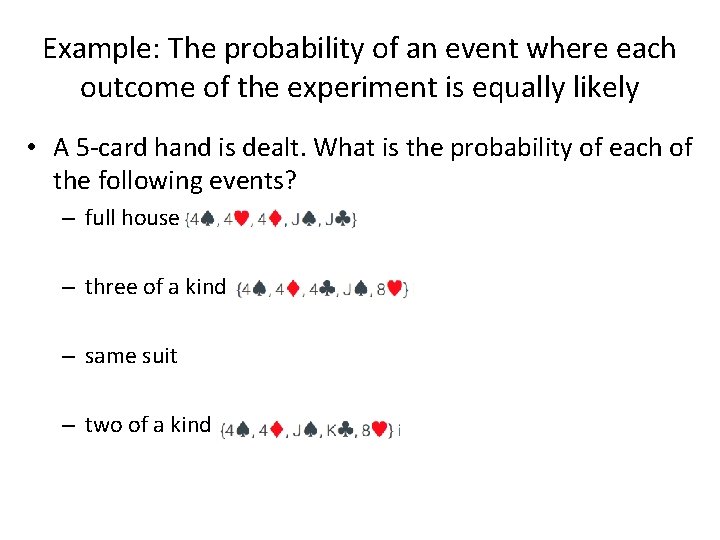
Example: The probability of an event where each outcome of the experiment is equally likely • A 5 -card hand is dealt. What is the probability of each of the following events? – full house – three of a kind – same suit – two of a kind
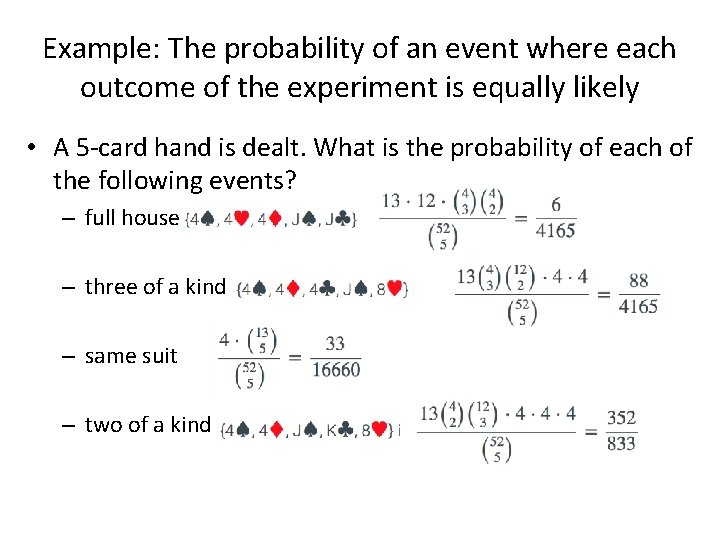
Example: The probability of an event where each outcome of the experiment is equally likely • A 5 -card hand is dealt. What is the probability of each of the following events? – full house – three of a kind – same suit – two of a kind
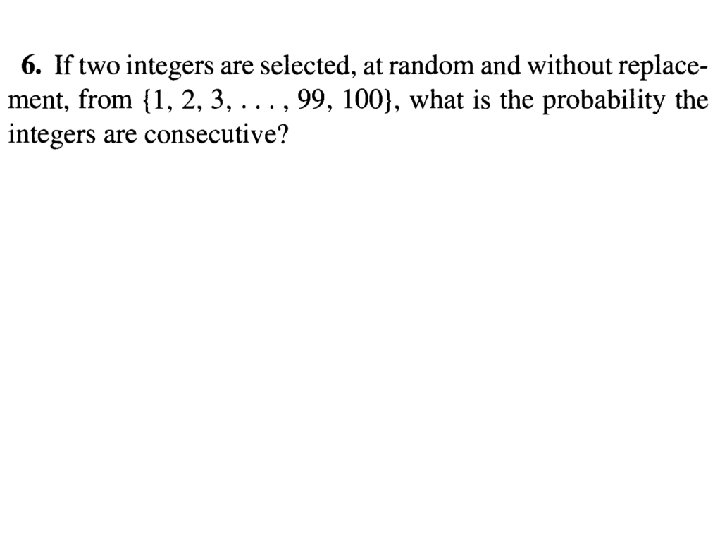
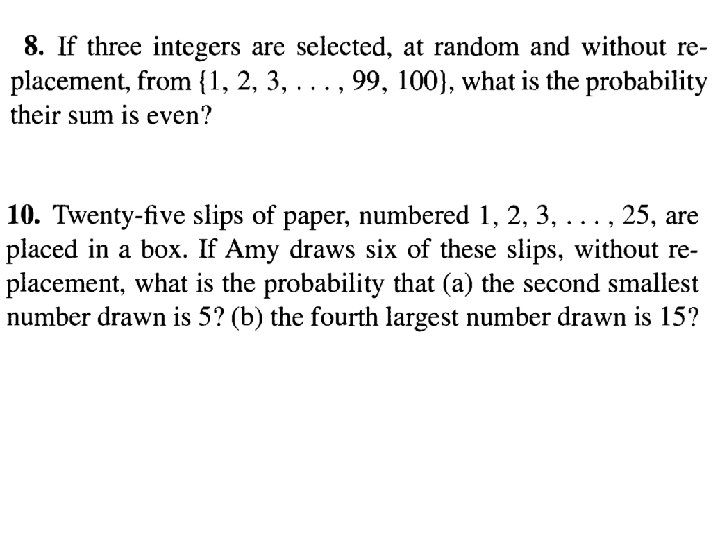
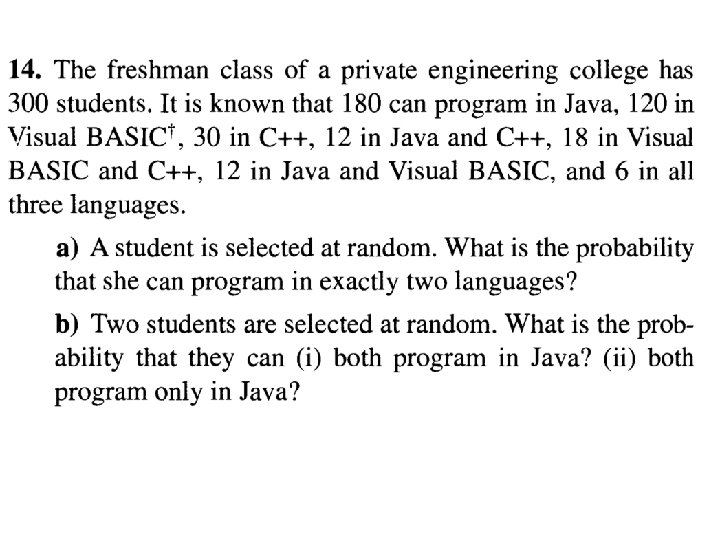
Practice Problem • Chapter 3. 4: 1, 5, 7, 9, 15
- Slides: 27