
A First Practical Algorithm for High Levels of
![Experimental Results Benchmark Algorithm #Nodes Visited Time [sec] #Completed in 1 hour #Fastest #Backtrack](https://slidetodoc.com/presentation_image_h2/9cbb414afddf33d67d2fa8340289748a/image-14.jpg "Experimental Results Benchmark Algorithm #Nodes Visited Time [sec] #Completed in 1 hour #Fastest #Backtrack")

- Slides: 16
A First Practical Algorithm for High Levels of Relational Consistency Shant Karakashian, Robert Woodward, Christopher Reeson, Berthe Y. Choueiry & Christian Bessiere Constraint Systems Laboratory, University of Nebraska. Lincoln LIRMM-CNRS, University of Montpellier Acknowledgements: • Kostas Stergiou and anonymous reviewers • Experiments conducted at UNL’s Holland Computing Center • NSF CAREER Award #0133568 • Robert Woodward supported by a UNL undergraduate research grant (UCARE) & by a B. M. Goldwater Scholarship 1
Outline • Introduction • Relational Consistency R(*, m)C : – Definition, Naïve algorithm, Properties • Preliminaries: Dual CSP • Our Approach – Algorithm – Index-Tree Data Structure – Advantages • A weakened version of R(*, m)C: w. R(*, m)C • Experimental Evaluations • Conclusions & Future Work 2
Introduction • Local consistency techniques are at the heart of solving CSPs • Low level consistency properties such as GAC are easy to apply & are effective for many problems • There are problems that require higher levels of consistency for finding a solution in a reasonable amount of time • We present a practical algorithm for enforcing relational m-wise consistency: R(*, m)C 3
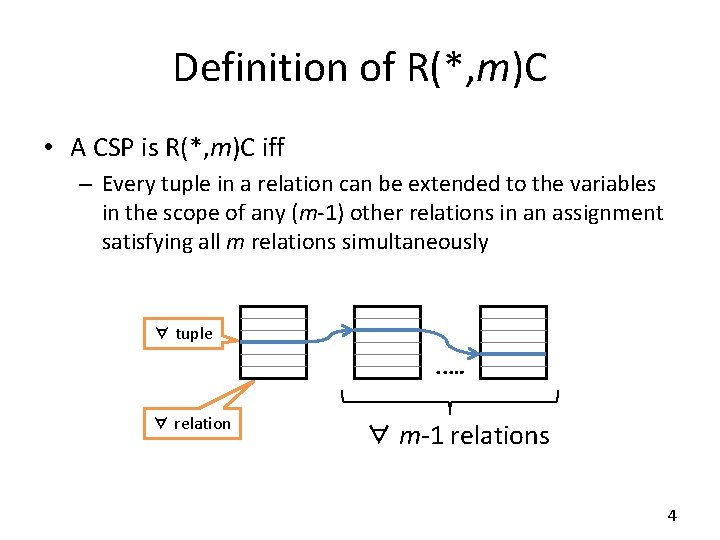
Definition of R(*, m)C • A CSP is R(*, m)C iff – Every tuple in a relation can be extended to the variables in the scope of any (m-1) other relations in an assignment satisfying all m relations simultaneously ∀ tuple . . … ∀ relation ∀ m-1 relations 4
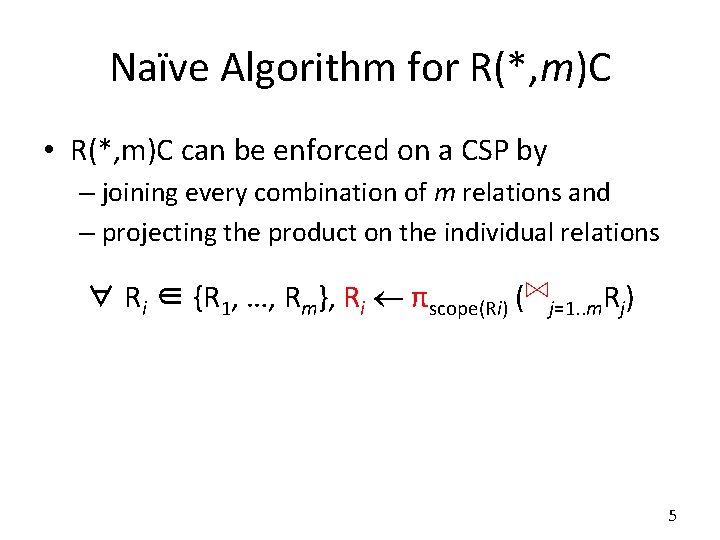
Naïve Algorithm for R(*, m)C • R(*, m)C can be enforced on a CSP by – joining every combination of m relations and – projecting the product on the individual relations ∀ Ri ∈ {R 1, …, Rm}, Ri πscope(Ri) (⋈j=1. . m. Rj) 5
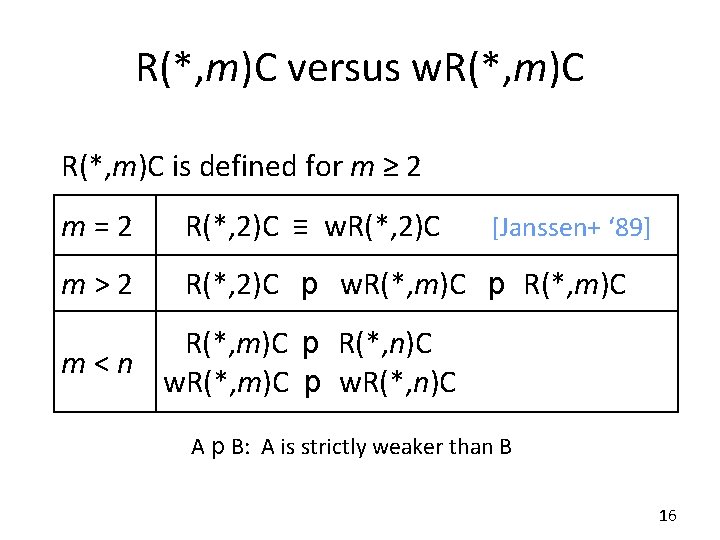
Properties of R(*, m)C • It does not change the structure of the constraint network • R(*, m)C p Rm. C [Dechter & van Beek ’ 97] • It filters the relations by removing tuples • It is parameterized – We can control the level of consistency (m) 6
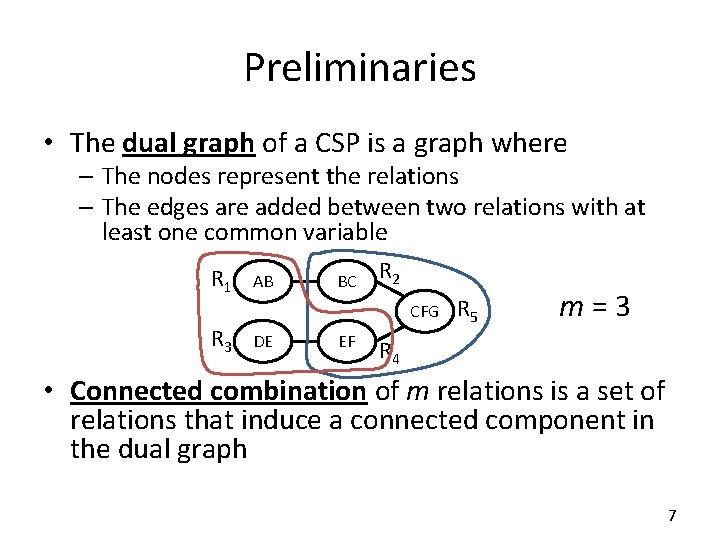
Preliminaries • The dual graph of a CSP is a graph where – The nodes represent the relations – The edges are added between two relations with at least one common variable R 1 AB BC R 2 CFG R 3 DE EF R 5 m=3 R 4 • Connected combination of m relations is a set of relations that induce a connected component in the dual graph 7
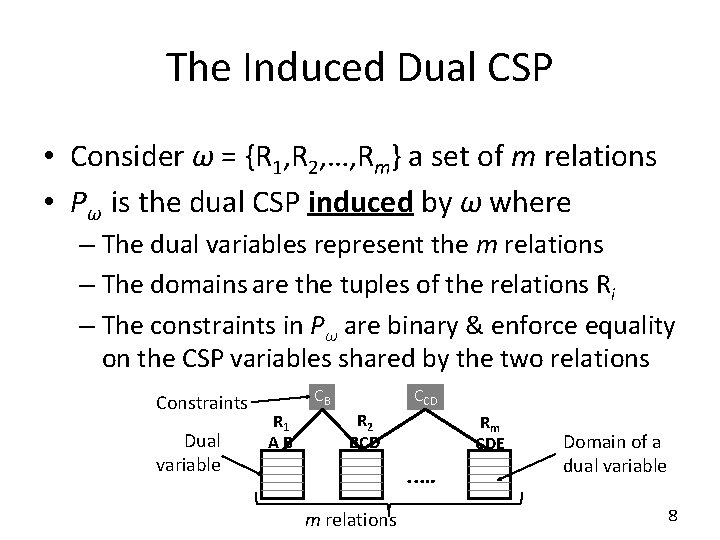
The Induced Dual CSP • Consider ω = {R 1, R 2, …, Rm} a set of m relations • Pω is the dual CSP induced by ω where – The dual variables represent the m relations – The domains are the tuples of the relations Ri – The constraints in Pω are binary & enforce equality on the CSP variables shared by the two relations Constraints Dual variable CB R 1 AB CCD R 2 BCD Rm CDE . . … m relations Domain of a dual variable 8
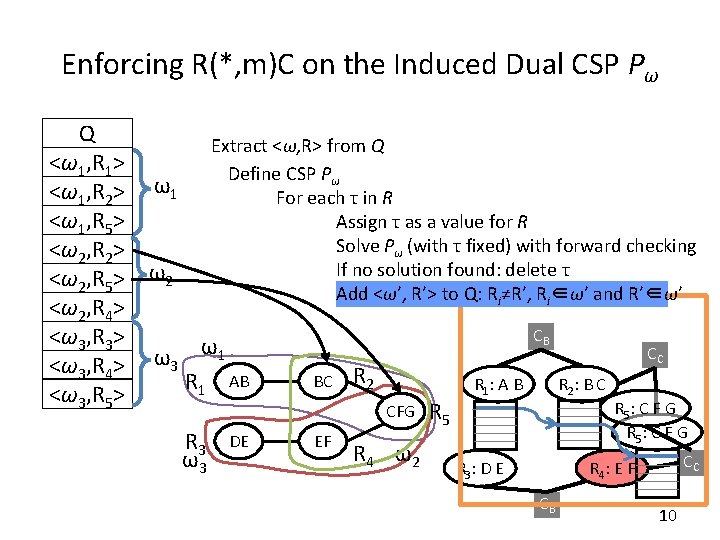
Enforcing R(*, m)C on the Induced Dual CSP Pω Q Extract <ω, R> from Q <ω1, R 1> Define CSP Pω <ω1, R 2> ω1 For each τ in R Assign τ as a value for R <ω1, R 5> Solve Pω (with τ fixed) with forward checking <ω2, R 2> If no solution found: delete τ <ω2, R 5> ω2 Add <ω’, R’> to Q: Ri≠R’, Ri∈ω’ and R’∈ω’ <ω2, R 4> CB <ω3, R 3> ω CC 1 ω 3 <ω3, R 4> BC R 2 R 1 AB R 1: A B R 2: B C <ω3, R 5> R 5: C F G CFG R 5: C F G EF R 3 DE R 4 ω2 CC ω3 R 3: D E R 4: E F CB 10
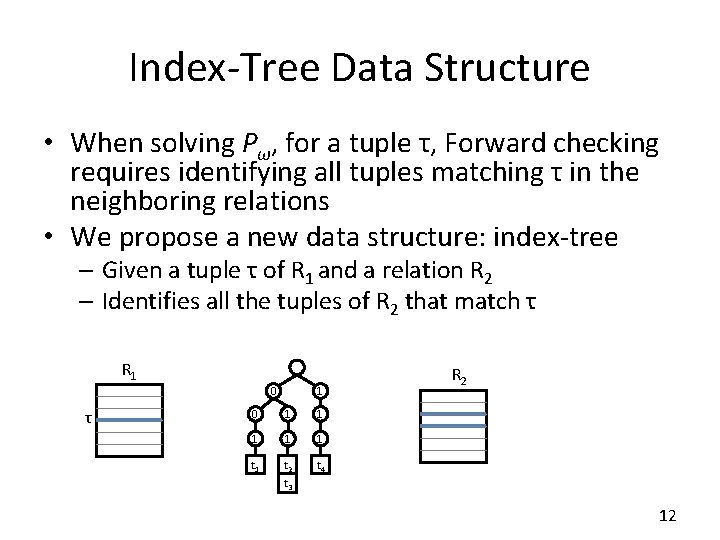
Index-Tree Data Structure • When solving Pω, for a tuple τ, Forward checking requires identifying all tuples matching τ in the neighboring relations • We propose a new data structure: index-tree – Given a tuple τ of R 1 and a relation R 2 – Identifies all the tuples of R 2 that match τ R 1 0 τ 1 0 1 1 1 t 2 t 4 R 2 t 3 12
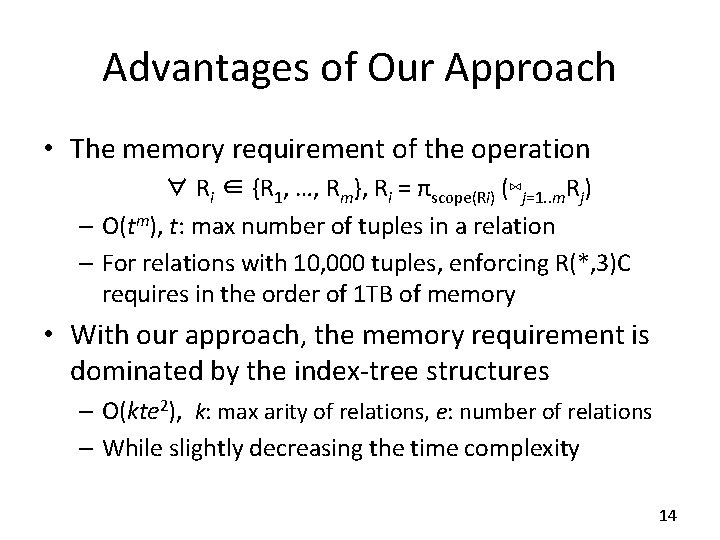
Advantages of Our Approach • The memory requirement of the operation ∀ Ri ∈ {R 1, …, Rm}, Ri = πscope(Ri) (⋈j=1. . m. Rj) – O(tm), t: max number of tuples in a relation – For relations with 10, 000 tuples, enforcing R(*, 3)C requires in the order of 1 TB of memory • With our approach, the memory requirement is dominated by the index-tree structures – O(kte 2), k: max arity of relations, e: number of relations – While slightly decreasing the time complexity 14
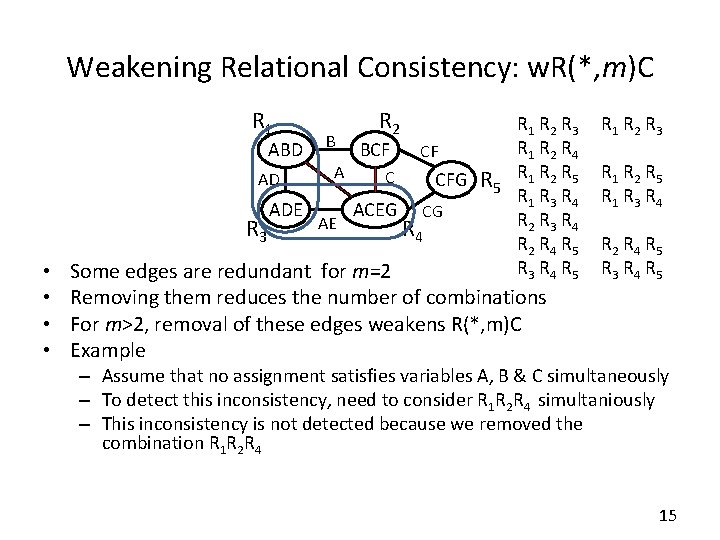
Weakening Relational Consistency: w. R(*, m)C R 1 ABD AD R 3 • • ADE B A AE R 2 BCF CF C ACEG CFG CG R 4 R 5 R 1 R 2 R 3 R 1 R 2 R 4 R 1 R 2 R 5 R 1 R 3 R 4 R 2 R 4 R 5 R 3 R 4 R 5 Some edges are redundant for m=2 Removing them reduces the number of combinations For m>2, removal of these edges weakens R(*, m)C Example R 1 R 2 R 3 R 1 R 2 R 5 R 1 R 3 R 4 R 2 R 4 R 5 R 3 R 4 R 5 – Assume that no assignment satisfies variables A, B & C simultaneously – To detect this inconsistency, need to consider R 1 R 2 R 4 simultaniously – This inconsistency is not detected because we removed the combination R 1 R 2 R 4 15
R(*, m)C versus w. R(*, m)C is defined for m ≥ 2 m=2 R(*, 2)C ≡ w. R(*, 2)C m>2 R(*, 2)C p w. R(*, m)C p R(*, m)C [Janssen+ ‘ 89] R(*, m)C p R(*, n)C m<n w. R(*, m)C p w. R(*, n)C A p B: A is strictly weaker than B 16
Experimental Results Benchmark Algorithm #Nodes Visited Time [sec] #Completed in 1 hour #Fastest #Backtrack Free modified. Renault GAC 1, 324, 309. 8 402. 44 26 14 4/50 Max #tuples: 48, 721 max. RPWC 2, 110. 8 305. 37 31 3 19/50 w. R(*, 2)C 192. 5 2. 99 46 27 41/50 w. R(*, 3)C 82. 5 7. 55 50 4 48/50 w. R(*, 4)C 82. 5 33. 88 50 2 50/50 30, 501. 7 1, 795. 26 9 2 0/20 941. 3 1, 162. 22 16 14 0/20 rand-8 -20 -5 GAC Max #tuples : 78, 799 w. R(*, 2)C dag-rand w. R(*, 2)C 0. 0 27. 21 25 25 25/25 Max #tuples: 150, 000 w. R(*, 3)C 0. 0 37. 75 25 0 25/25 1, 876, 247. 6 542. 48 8 0 0/24 aim-200 GAC Max #tuples: 7 max. RPWC 842, 488. 8 414. 05 8 1 0/24 w. R(*, 2)C 2, 670. 2 35. 51 12 7 4/24 w. R(*, 3)C 580. 2 35. 91 14 7 8/24 w. R(*, 4)C 443. 8 240. 13 14 2 9/24
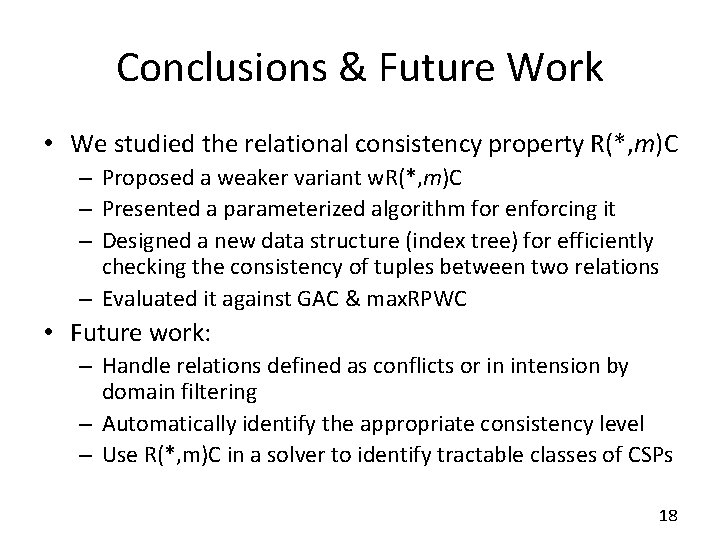
Conclusions & Future Work • We studied the relational consistency property R(*, m)C – Proposed a weaker variant w. R(*, m)C – Presented a parameterized algorithm for enforcing it – Designed a new data structure (index tree) for efficiently checking the consistency of tuples between two relations – Evaluated it against GAC & max. RPWC • Future work: – Handle relations defined as conflicts or in intension by domain filtering – Automatically identify the appropriate consistency level – Use R(*, m)C in a solver to identify tractable classes of CSPs 18
Thank You for Your Attention Questions? 19