
A First Look into Code Generation for Deep
![Code example • Transpose a tensor with shape [1, 2, 3, 4] by permutation](https://slidetodoc.com/presentation_image_h2/1976aa32c92e01c42694b3864cf2ba69/image-5.jpg "Code example • Transpose a tensor with shape [1, 2, 3, 4] by permutation")
![Code example • Relu operator operating on a [2, 2] tensor • Automatic generated](https://slidetodoc.com/presentation_image_h2/1976aa32c92e01c42694b3864cf2ba69/image-6.jpg "Code example • Relu operator operating on a [2, 2] tensor • Automatic generated")

![References • [1] https: //onnx. ai • [2] https: //github. com/microsoft/onnxruntime • [3] https:](https://slidetodoc.com/presentation_image_h2/1976aa32c92e01c42694b3864cf2ba69/image-13.jpg "References • [1] https: //onnx. ai • [2] https: //github. com/microsoft/onnxruntime • [3] https:")
- Slides: 13
A First Look into Code Generation for Deep Learning operators Sitong An, PPP 28 th Jan
Overview • With much emphasis on algorithm development, deployment (i. e. doing inference on data in production environment, usually in C++ and with CPUs) used to be relatively neglected • TF/Py. Torch etc. can only run inference on its own model. Dependency is heavy. Usage in production environment in C++ is cumbersome. • ONNX [1], Open Neural Network Exchange, aim to define a common standard for describing DL models, with graphs, nodes and operators. • I initially proposed to develop an ONNX-based inference engine
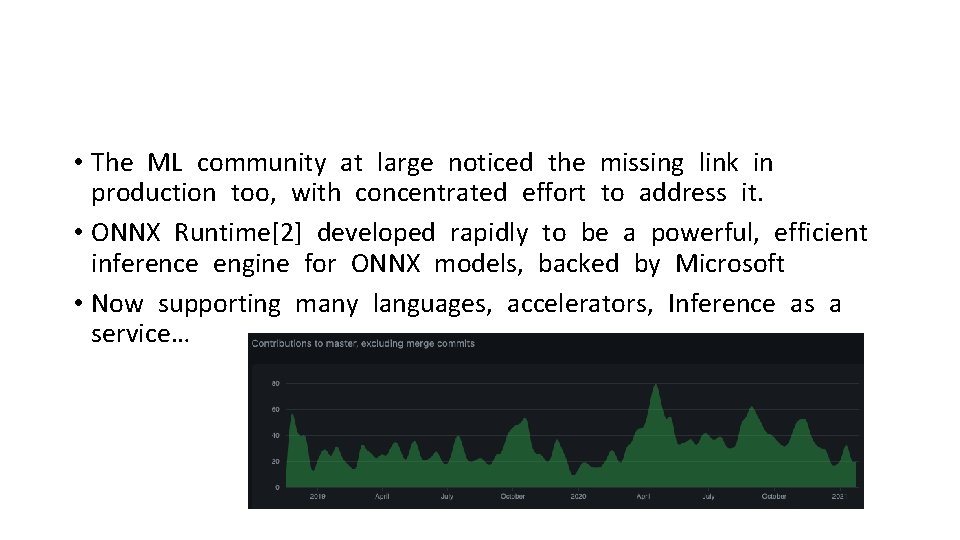
• The ML community at large noticed the missing link in production too, with concentrated effort to address it. • ONNX Runtime[2] developed rapidly to be a powerful, efficient inference engine for ONNX models, backed by Microsoft • Now supporting many languages, accelerators, Inference as a service…
• The original inference engine proposed has been developed to an initial demonstrator status (simple DNN network) • We decided not to try to invent the wheel while others are inventing a bigger one • ONNX Runtime still imposes a relatively large dependency • C++ example [3], note that its C++ API is still marked experimental • Efforts exist to integrate ONNXRuntime into CMSSW [4] -> had to fix a hardcoded thread pool for the LSTM operator • How about an inference engine that takes ONNX model as input and automatically generate snippets of C++ code that hard-code the inference function, easily invokable directly from any C++ project, with the only dependency on BLAS?
Code example • Transpose a tensor with shape [1, 2, 3, 4] by permutation [3, 2, 1, 0] • i. e. the output tensor will have a shape of [4, 3, 2, 1] • Automatic generated code: for (int id = 0; id < 24 ; id++){ tensor_2[id / 24 % 1 * 1 + id / 12 % 2 * 1 + id / 4 % 3 * 2 + id / 1 % 4 * 6] = tensor_1[id]; }
Code example • Relu operator operating on a [2, 2] tensor • Automatic generated code: for (int id = 0; id < 4 ; id++){ tensor_6[id] = ((tensor_5[id] > 0 )? tensor_5[id] : 0); }
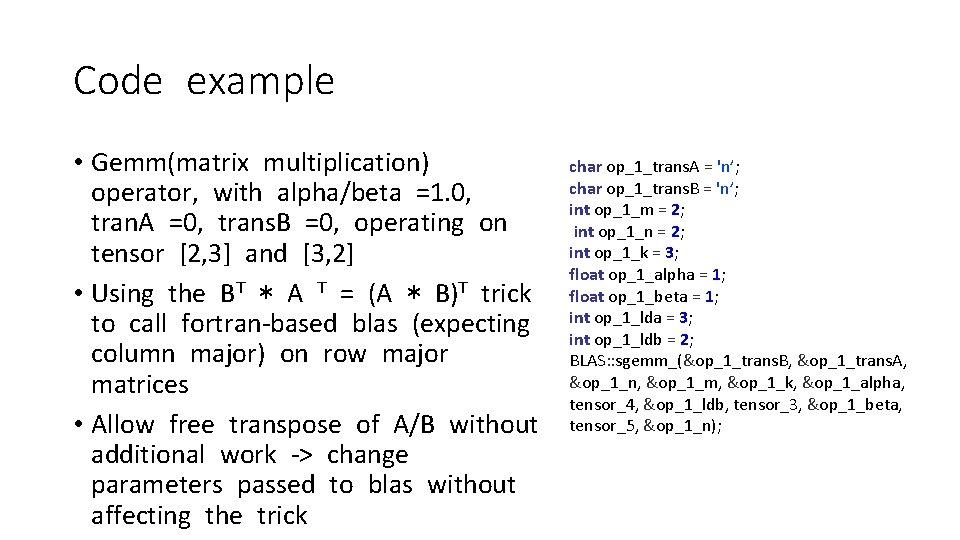
Code example • Gemm(matrix multiplication) operator, with alpha/beta =1. 0, tran. A =0, trans. B =0, operating on tensor [2, 3] and [3, 2] • Using the BT * A T = (A * B)T trick to call fortran-based blas (expecting column major) on row major matrices • Allow free transpose of A/B without additional work -> change parameters passed to blas without affecting the trick char op_1_trans. A = 'n’; char op_1_trans. B = 'n’; int op_1_m = 2; int op_1_n = 2; int op_1_k = 3; float op_1_alpha = 1; float op_1_beta = 1; int op_1_lda = 3; int op_1_ldb = 2; BLAS: : sgemm_(&op_1_trans. B, &op_1_trans. A, &op_1_n, &op_1_m, &op_1_k, &op_1_alpha, tensor_4, &op_1_ldb, tensor_3, &op_1_beta, tensor_5, &op_1_n);
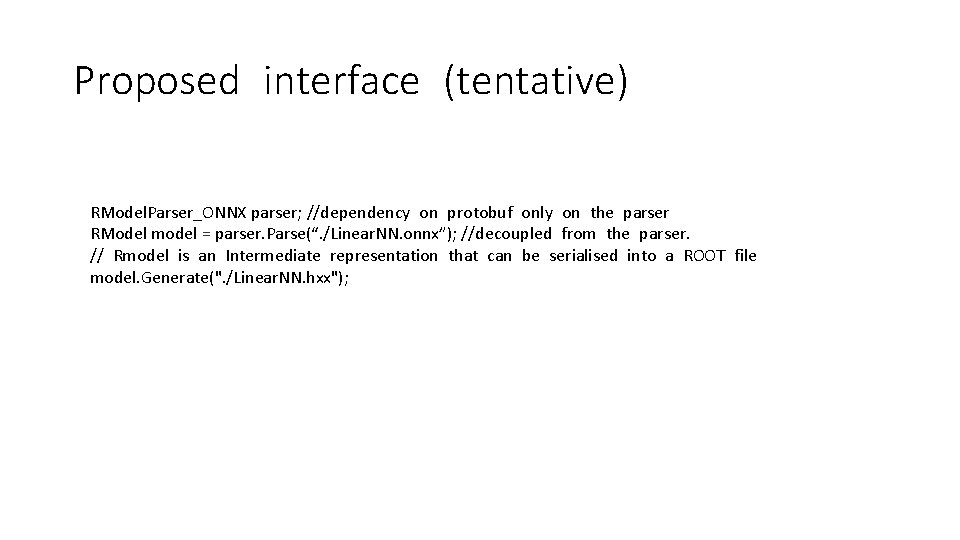
Proposed interface (tentative) RModel. Parser_ONNX parser; //dependency on protobuf only on the parser RModel model = parser. Parse(“. /Linear. NN. onnx”); //decoupled from the parser. // Rmodel is an Intermediate representation that can be serialised into a ROOT file model. Generate(". /Linear. NN. hxx");
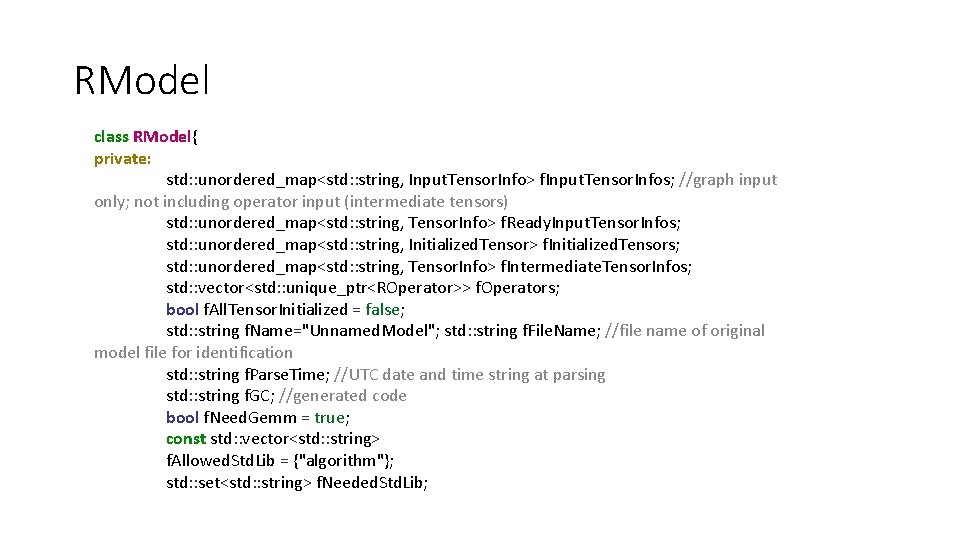
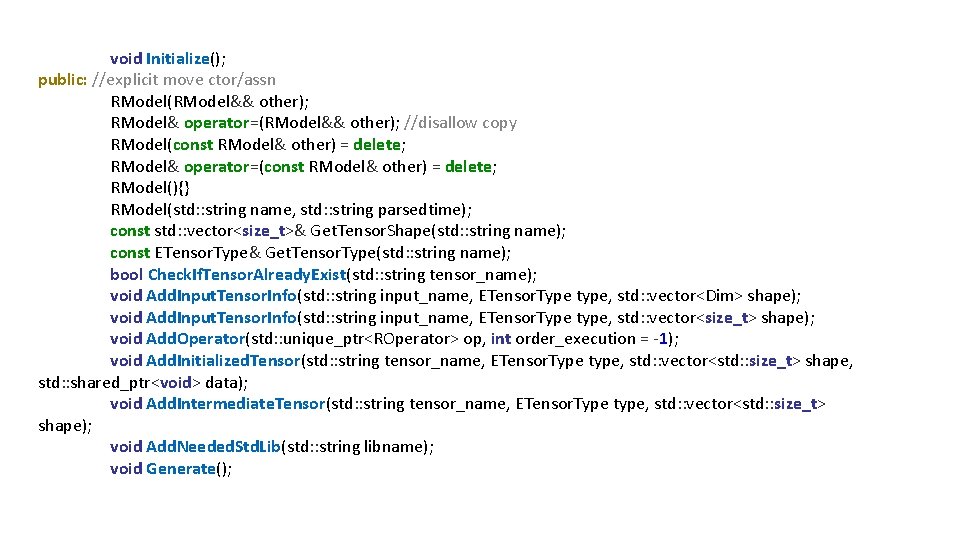
RModel class RModel{ private: std: : unordered_map<std: : string, Input. Tensor. Info> f. Input. Tensor. Infos; //graph input only; not including operator input (intermediate tensors) std: : unordered_map<std: : string, Tensor. Info> f. Ready. Input. Tensor. Infos; std: : unordered_map<std: : string, Initialized. Tensor> f. Initialized. Tensors; std: : unordered_map<std: : string, Tensor. Info> f. Intermediate. Tensor. Infos; std: : vector<std: : unique_ptr<ROperator>> f. Operators; bool f. All. Tensor. Initialized = false; std: : string f. Name="Unnamed. Model"; std: : string f. File. Name; //file name of original model file for identification std: : string f. Parse. Time; //UTC date and time string at parsing std: : string f. GC; //generated code bool f. Need. Gemm = true; const std: : vector<std: : string> f. Allowed. Std. Lib = {"algorithm"}; std: : set<std: : string> f. Needed. Std. Lib;
void Initialize(); public: //explicit move ctor/assn RModel(RModel&& other); RModel& operator=(RModel&& other); //disallow copy RModel(const RModel& other) = delete; RModel& operator=(const RModel& other) = delete; RModel(){} RModel(std: : string name, std: : string parsedtime); const std: : vector<size_t>& Get. Tensor. Shape(std: : string name); const ETensor. Type& Get. Tensor. Type(std: : string name); bool Check. If. Tensor. Already. Exist(std: : string tensor_name); void Add. Input. Tensor. Info(std: : string input_name, ETensor. Type type, std: : vector<Dim> shape); void Add. Input. Tensor. Info(std: : string input_name, ETensor. Type type, std: : vector<size_t> shape); void Add. Operator(std: : unique_ptr<ROperator> op, int order_execution = -1); void Add. Initialized. Tensor(std: : string tensor_name, ETensor. Type type, std: : vector<std: : size_t> shape, std: : shared_ptr<void> data); void Add. Intermediate. Tensor(std: : string tensor_name, ETensor. Type type, std: : vector<std: : size_t> shape); void Add. Needed. Std. Lib(std: : string libname); void Generate();
• Soon to run a full-run test on a simple DNN model • Next time on PPP: benchmarking results • -> Does this style of code generation allow us to make full use of JITting? • How to better accommodate potential integration with RDF? • How to better make use of cling optimization?
• Suggestions/recommendations?
References • [1] https: //onnx. ai • [2] https: //github. com/microsoft/onnxruntime • [3] https: //github. com/microsoft/onnxruntime/blob/master/samples/c_cxx/ model-explorer/model-explorer. cpp • [4] https: //indico. cern. ch/event/844092/contributions/3632227/attachment s/1945670/3228075/ML_Inference_CMSSW_20191115_H_Qu. pdf