
A First Book of ANSI C Fourth Edition
A First Book of ANSI C Fourth Edition Chapter 2 Getting Started in C Programming A First Book of ANSI C, Fourth Edition

Objectives • • Introduction to C Programming Style Data Types Arithmetic Operations A First Book of ANSI C, Fourth Edition 2
Objectives (continued) • Variables and Declarations • Case Study: Temperature Conversion • Common Programming and Compiler Errors A First Book of ANSI C, Fourth Edition 3
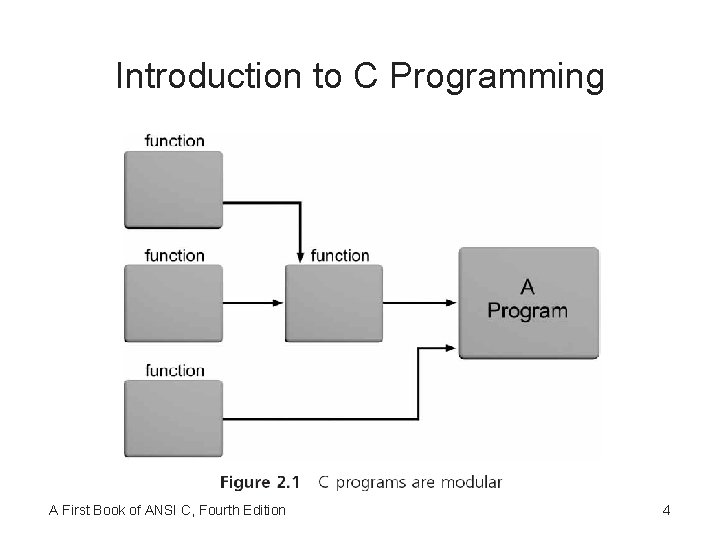
Introduction to C Programming A First Book of ANSI C, Fourth Edition 4
Introduction to C Programming (continued) • C provides a comprehensive set of functions – Stored in a set of files known as the standard library – The standard library consists of 15 header files A First Book of ANSI C, Fourth Edition 5

Introduction to C Programming (continued) A First Book of ANSI C, Fourth Edition 6
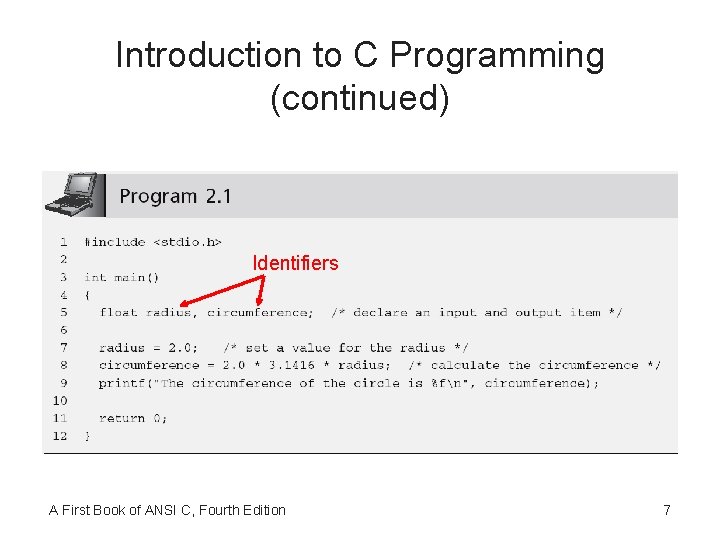
Introduction to C Programming (continued) Identifiers A First Book of ANSI C, Fourth Edition 7
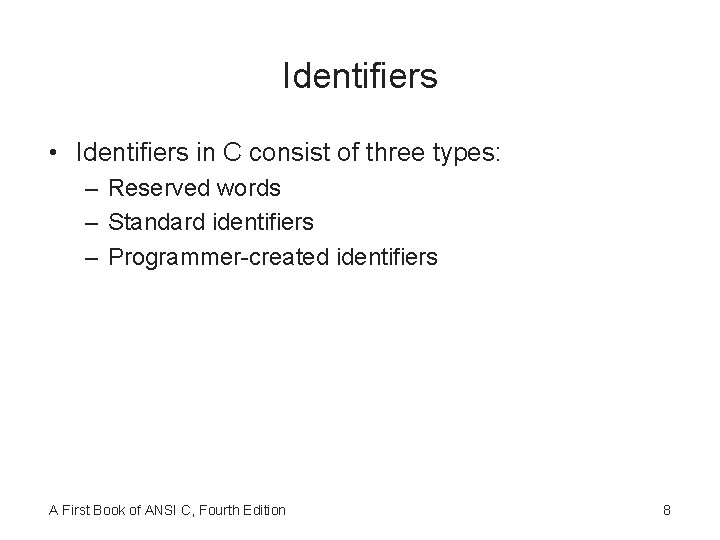
Identifiers • Identifiers in C consist of three types: – Reserved words – Standard identifiers – Programmer-created identifiers A First Book of ANSI C, Fourth Edition 8
Identifiers (continued) • Reserved word: word that is predefined by the programming language for a special purpose and can only be used in a specified manner for its intended purpose – Also referred to as keywords in C A First Book of ANSI C, Fourth Edition 9
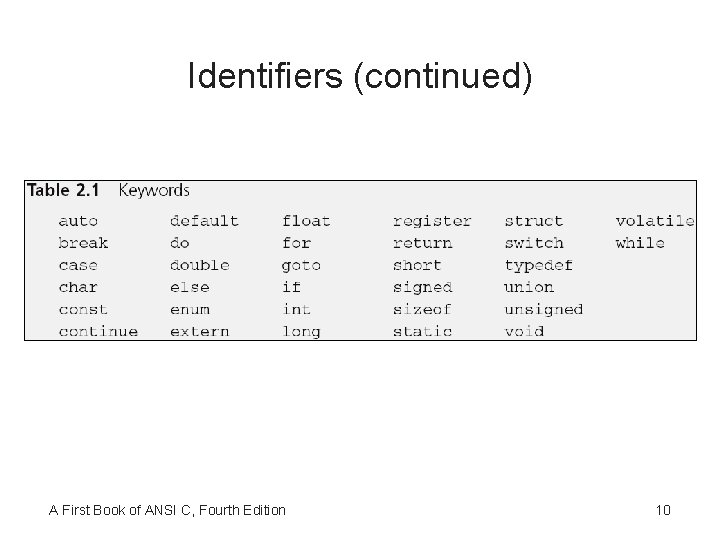
Identifiers (continued) A First Book of ANSI C, Fourth Edition 10
Identifiers (continued) • Standard identifiers: words predefined in C • Most of the standard identifiers are the names of functions that are provided in the C standard library • It is good programming practice to use standard identifiers only for their intended purpose A First Book of ANSI C, Fourth Edition 11
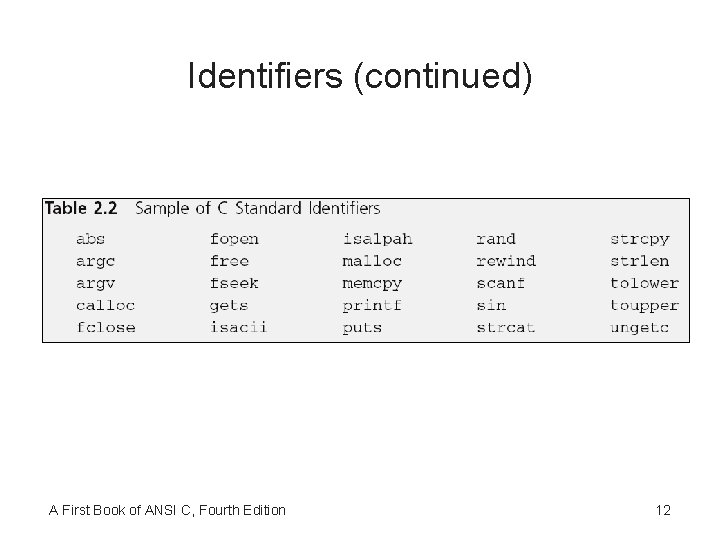
Identifiers (continued) A First Book of ANSI C, Fourth Edition 12
Identifiers (continued) • Programmer-created identifiers: selected by the programmer – – Also called programmer-created names Used for naming data and functions Must conform to C’s identifier rules Can be any combination of letters, digits, or underscores (_) subject to the following rules: • First character must be a letter or underscore (_) • Only letters, digits, or underscores may follow the initial character • Blank spaces are not allowed • Cannot be a reserved word A First Book of ANSI C, Fourth Edition 13
Identifiers (continued) • Examples of invalid C programmer-created names: – 4 ab 7 – calculate total – while • All uppercase letters used to indicate a constant • A function name must be followed by parentheses • An identifier should be descriptive: deg. To. Radians() – Bad identifier choices: easy, duh, just. Do. It • C is a case-sensitive language – TOTAL, and total represent different identifiers A First Book of ANSI C, Fourth Edition 14
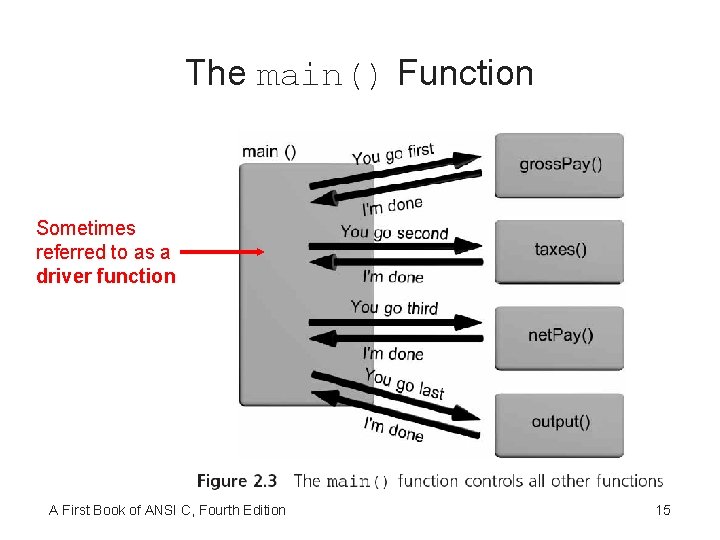
The main() Function Sometimes referred to as a driver function A First Book of ANSI C, Fourth Edition 15
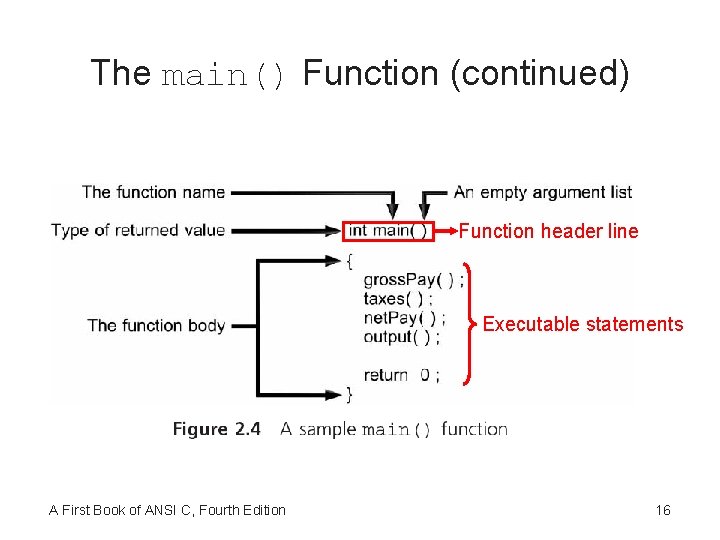
The main() Function (continued) Function header line Executable statements A First Book of ANSI C, Fourth Edition 16
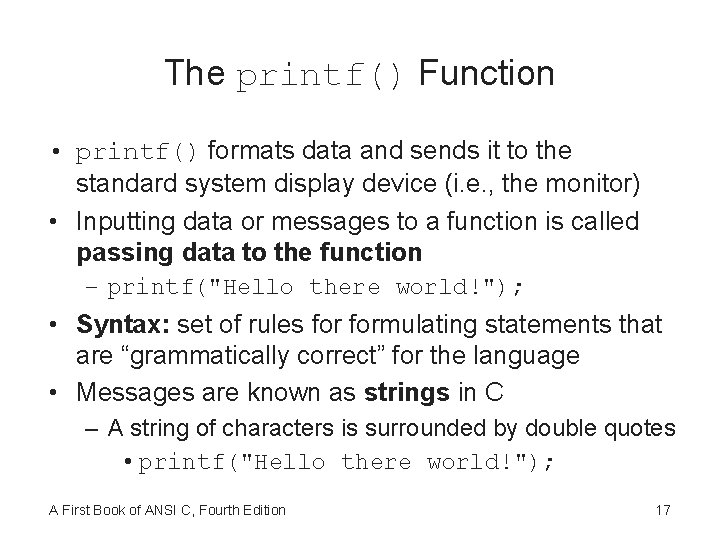
The printf() Function • printf() formats data and sends it to the standard system display device (i. e. , the monitor) • Inputting data or messages to a function is called passing data to the function – printf("Hello there world!"); • Syntax: set of rules formulating statements that are “grammatically correct” for the language • Messages are known as strings in C – A string of characters is surrounded by double quotes • printf("Hello there world!"); A First Book of ANSI C, Fourth Edition 17
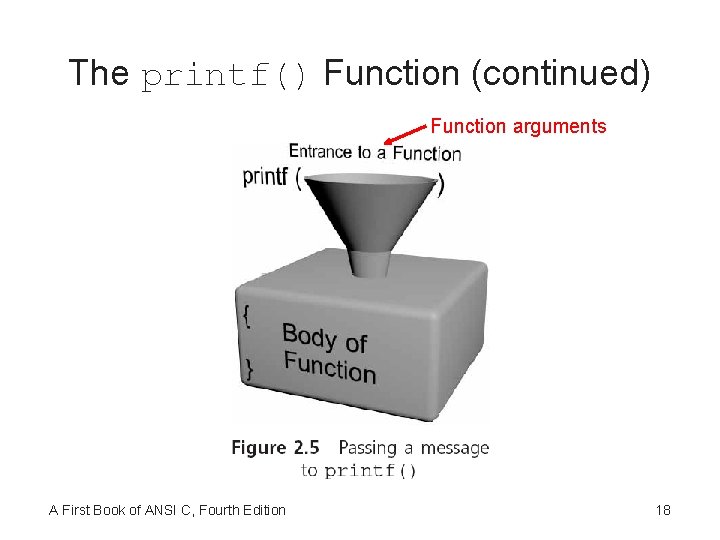
The printf() Function (continued) Function arguments A First Book of ANSI C, Fourth Edition 18
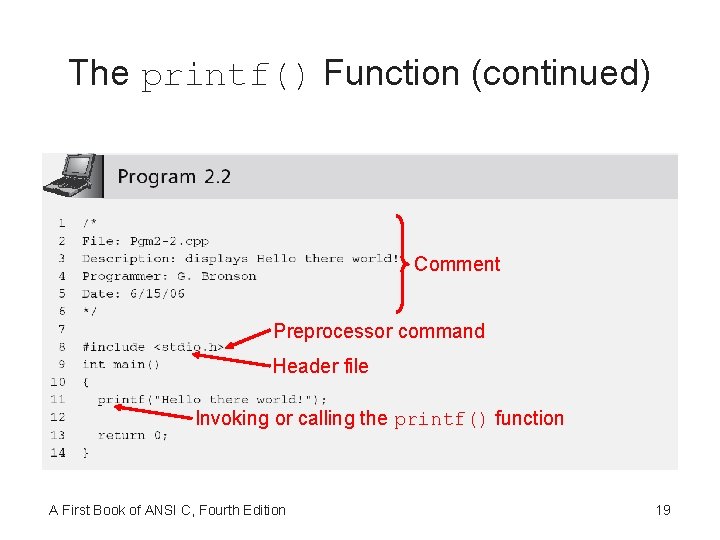
The printf() Function (continued) Comment Preprocessor command Header file Invoking or calling the printf() function A First Book of ANSI C, Fourth Edition 19
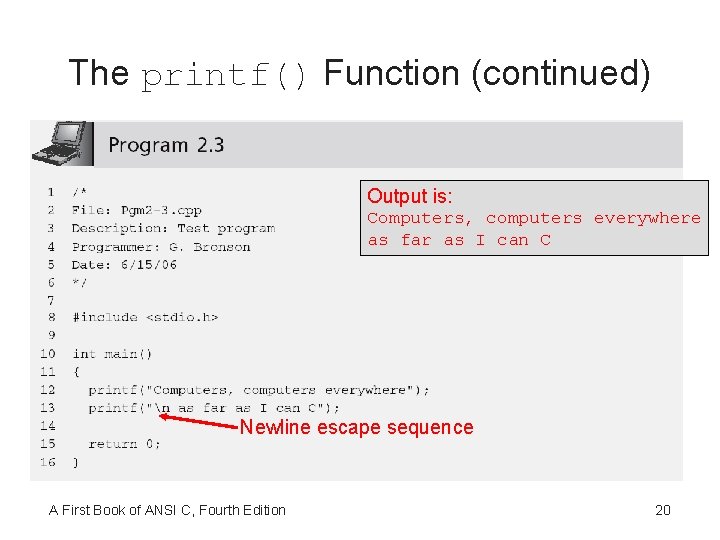
The printf() Function (continued) Output is: Computers, computers everywhere as far as I can C Newline escape sequence A First Book of ANSI C, Fourth Edition 20
Programming Style: Indentation • Except for strings, function names, and reserved words, C ignores all white space – White space: any combination of one or more blank spaces, tabs, or new lines • In standard form: – A function name is placed, with the parentheses, on a line by itself starting at the left-hand corner – The opening brace follows on the next line, under the first letter of the function name – The closing function brace is placed by itself at the start of the last line of the function A First Book of ANSI C, Fourth Edition 21
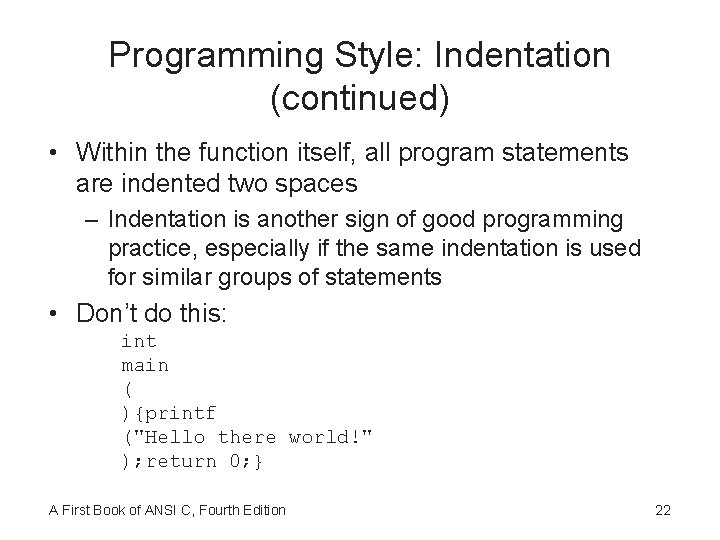
Programming Style: Indentation (continued) • Within the function itself, all program statements are indented two spaces – Indentation is another sign of good programming practice, especially if the same indentation is used for similar groups of statements • Don’t do this: int main ( ){printf ("Hello there world!" ); return 0; } A First Book of ANSI C, Fourth Edition 22
Programming Style: Comments • Comments help clarify what a program does, what a group of statements is meant to accomplish, etc. • The symbols /*, with no white space between them, designate the start of a comment; the symbols */ designate the end of a comment /* this is a comment */ • Comments can be placed anywhere within a program and have no effect on program execution • Under no circumstances may comments be nested /* this comment is /* always */ invalid */ A First Book of ANSI C, Fourth Edition 23
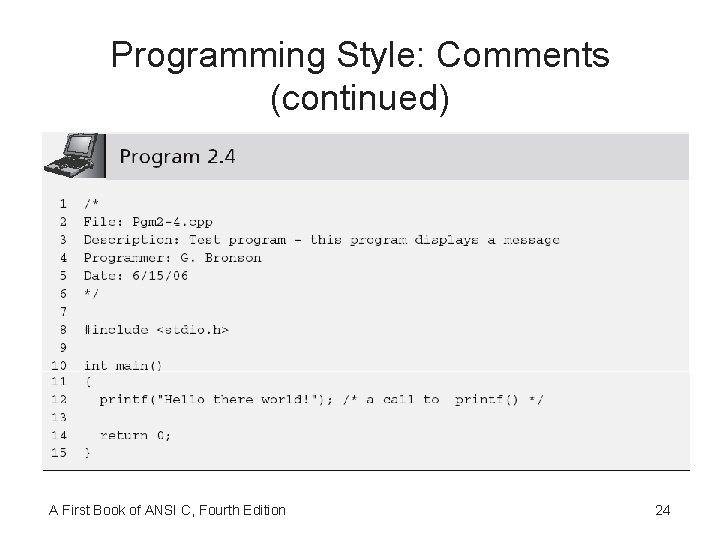
Programming Style: Comments (continued) A First Book of ANSI C, Fourth Edition 24
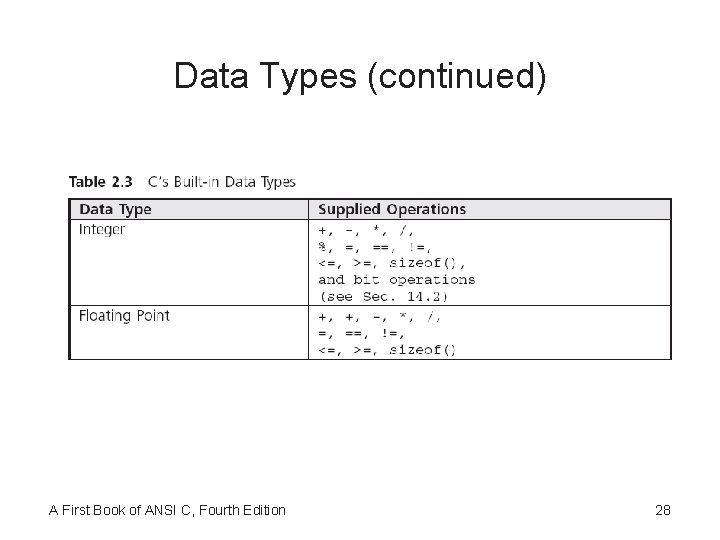
Data Types • Data type: set of values and a set of operations that can be applied to these values • Built-in data type: is provided as an integral part of the language; also known as primitive type A First Book of ANSI C, Fourth Edition 25
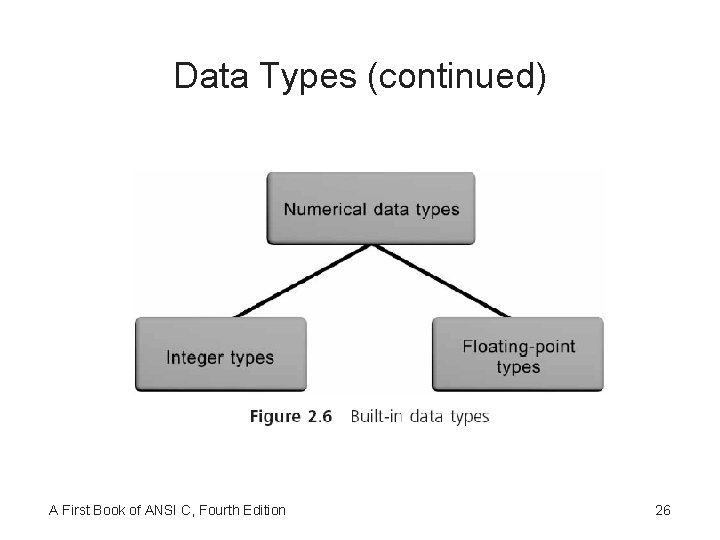
Data Types (continued) A First Book of ANSI C, Fourth Edition 26
Data Types (continued) • A literal is an acceptable value for a data type – Also called a literal value or constant – 2, 3. 6, − 8. 2, and "Hello World!" are literal values because they literally display their values A First Book of ANSI C, Fourth Edition 27
Data Types (continued) A First Book of ANSI C, Fourth Edition 28
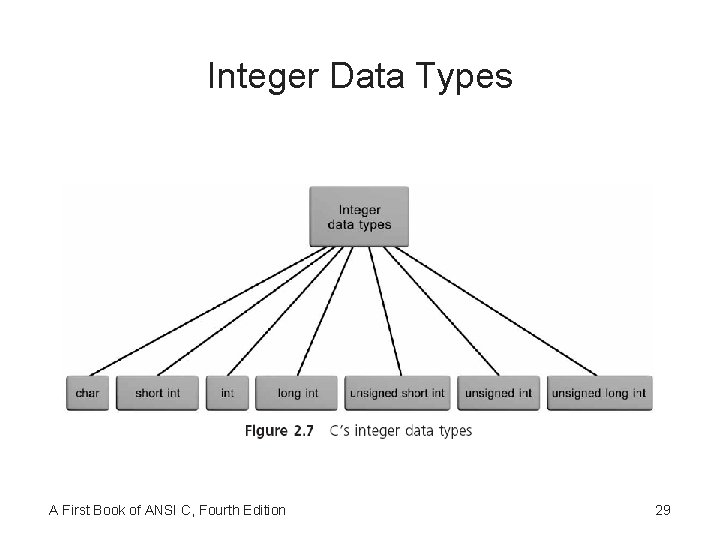
Integer Data Types A First Book of ANSI C, Fourth Edition 29
Integer Data Types (continued) • int: whole numbers (integers) – For example: 0, -10, 253, -26351 – Not allowed: commas, decimal points, special symbols • char: stores individual characters (ASCII) – For example: 'A', '$', 'b', '!' A First Book of ANSI C, Fourth Edition 30
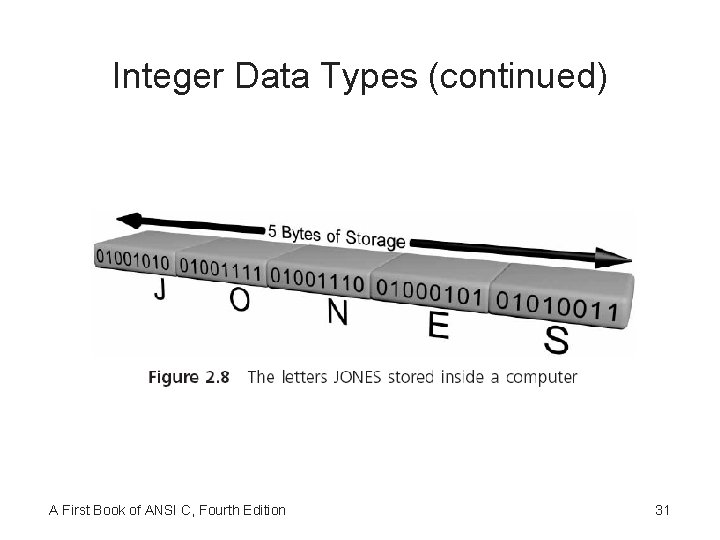
Integer Data Types (continued) A First Book of ANSI C, Fourth Edition 31
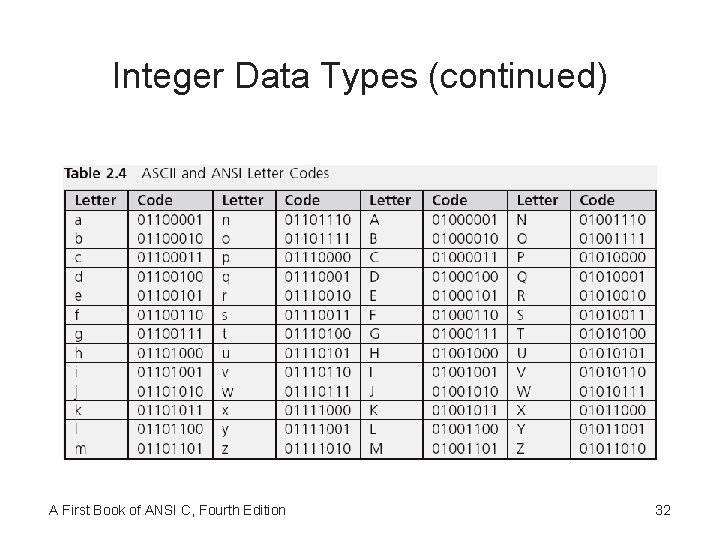
Integer Data Types (continued) A First Book of ANSI C, Fourth Edition 32
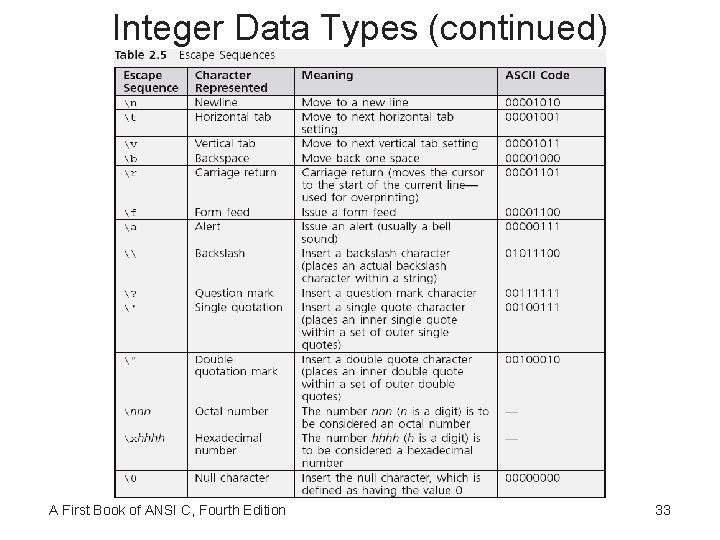
Integer Data Types (continued) A First Book of ANSI C, Fourth Edition 33
Floating-Point Data Types • A floating-point value (real number) can be the number zero or any positive or negative number that contains a decimal point – For example: +10. 625, 5. , -6. 2, 3251. 92, +2 – Not allowed: commas, decimal points, special symbols • float: single-precision number • double: double-precision number • Storage allocation for each data type depends on the compiler (use sizeof()) A First Book of ANSI C, Fourth Edition 34
Floating-Point Data Types (continued) • float literal is indicated by appending an f or F • long double is created by appending an l or L – 9. 234 indicates a double literal – 9. 234 f indicates a float literal – 9. 234 L indicates a long double literal A First Book of ANSI C, Fourth Edition 35
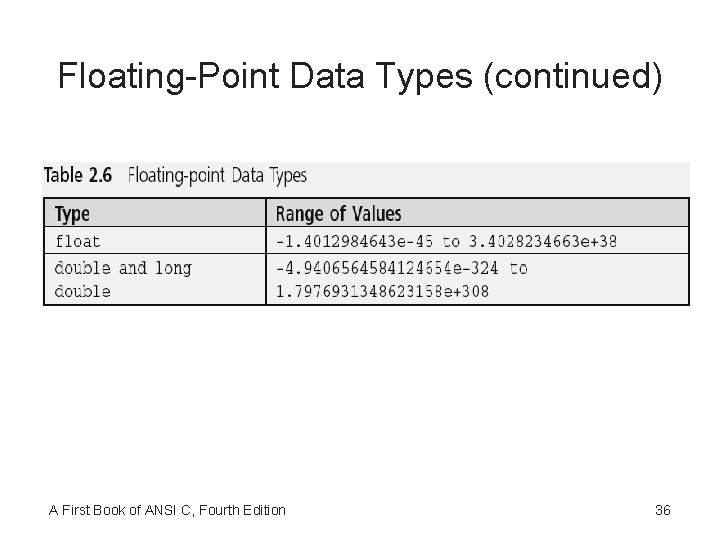
Floating-Point Data Types (continued) A First Book of ANSI C, Fourth Edition 36
Exponential Notation • In numerical theory, the term precision typically refers to numerical accuracy A First Book of ANSI C, Fourth Edition 37
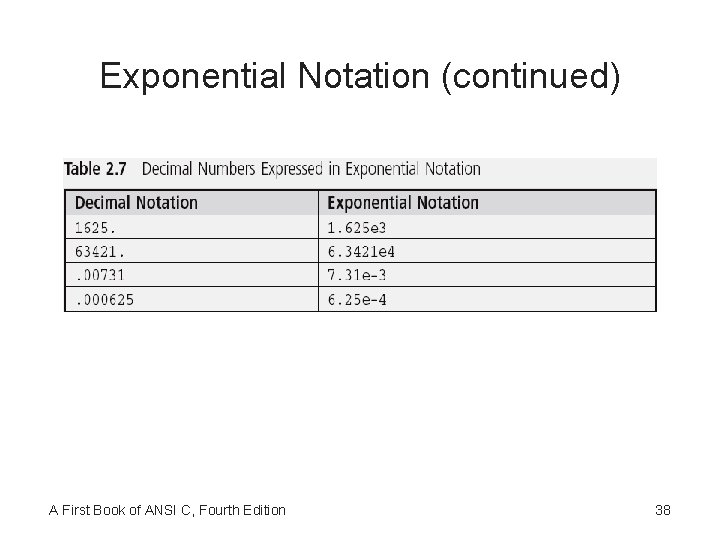
Exponential Notation (continued) A First Book of ANSI C, Fourth Edition 38
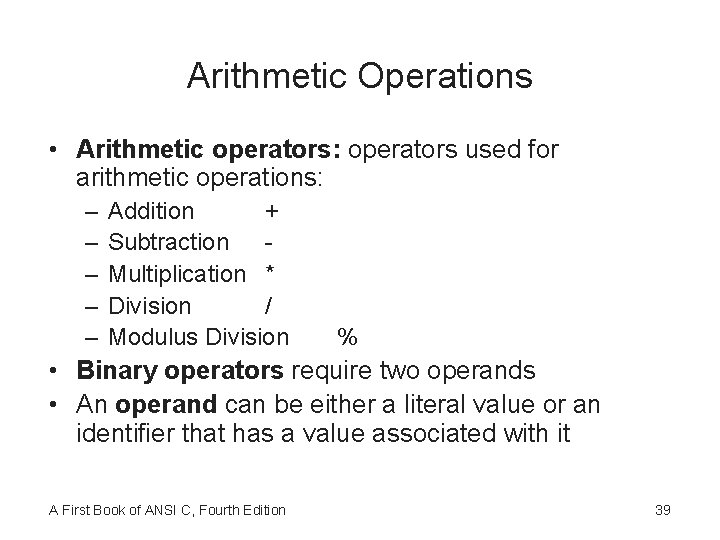
Arithmetic Operations • Arithmetic operators: operators used for arithmetic operations: – – – Addition + Subtraction Multiplication * Division / Modulus Division % • Binary operators require two operands • An operand can be either a literal value or an identifier that has a value associated with it A First Book of ANSI C, Fourth Edition 39
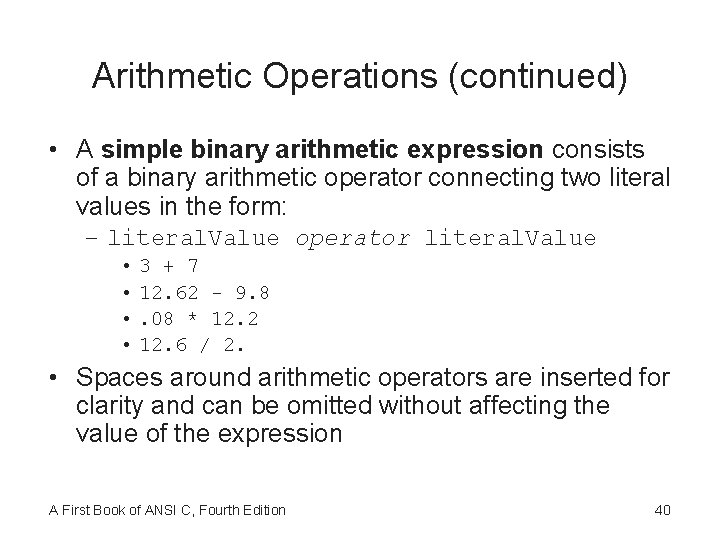
Arithmetic Operations (continued) • A simple binary arithmetic expression consists of a binary arithmetic operator connecting two literal values in the form: – literal. Value operator literal. Value • 3 + 7 • 12. 62 - 9. 8 • . 08 * 12. 2 • 12. 6 / 2. • Spaces around arithmetic operators are inserted for clarity and can be omitted without affecting the value of the expression A First Book of ANSI C, Fourth Edition 40
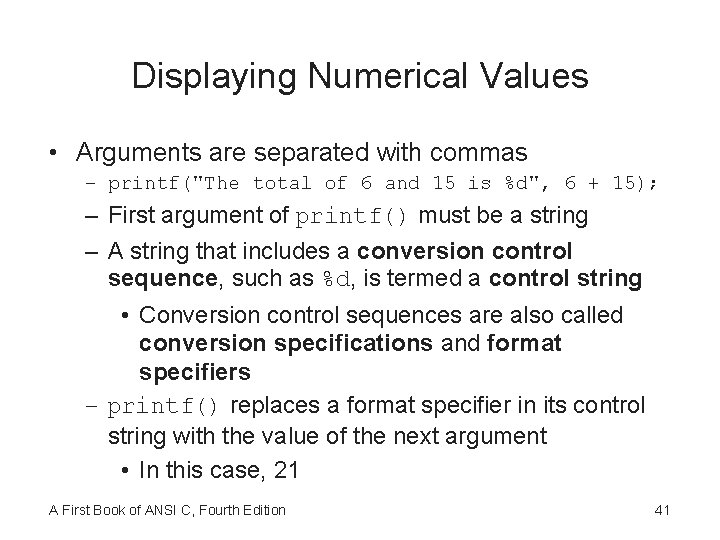
Displaying Numerical Values • Arguments are separated with commas – printf("The total of 6 and 15 is %d", 6 + 15); – First argument of printf() must be a string – A string that includes a conversion control sequence, such as %d, is termed a control string • Conversion control sequences are also called conversion specifications and format specifiers – printf() replaces a format specifier in its control string with the value of the next argument • In this case, 21 A First Book of ANSI C, Fourth Edition 41
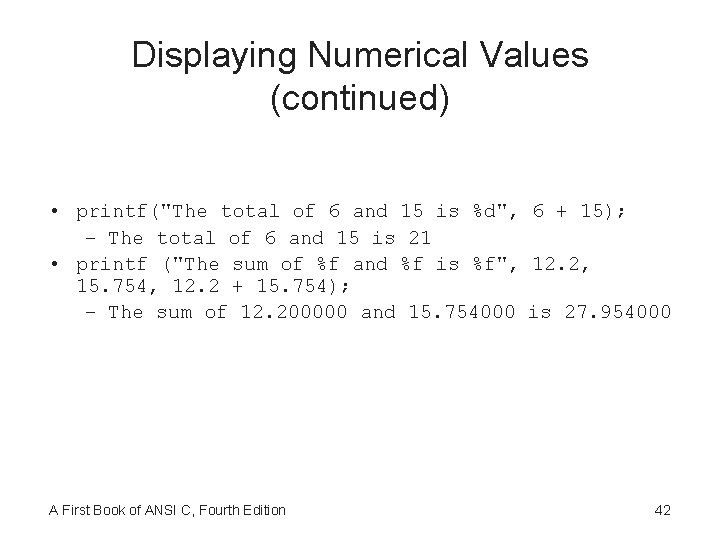
Displaying Numerical Values (continued) • printf("The total of 6 and 15 is %d", 6 + 15); – The total of 6 and 15 is 21 • printf ("The sum of %f and %f is %f", 12. 2, 15. 754, 12. 2 + 15. 754); – The sum of 12. 200000 and 15. 754000 is 27. 954000 A First Book of ANSI C, Fourth Edition 42
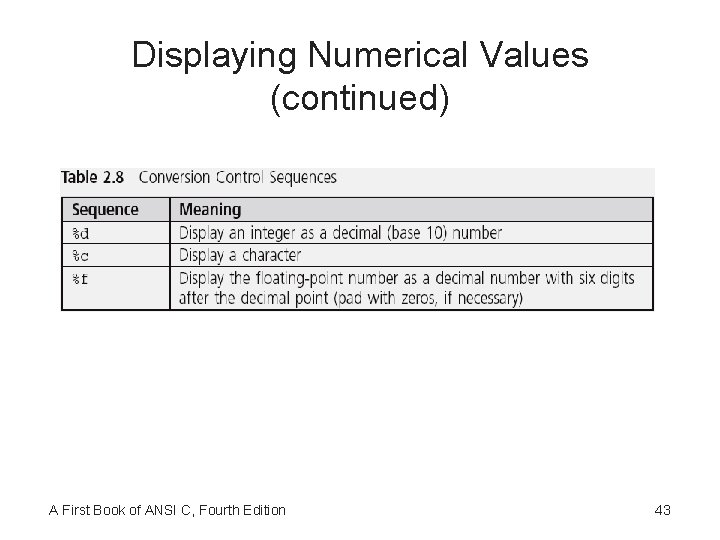
Displaying Numerical Values (continued) A First Book of ANSI C, Fourth Edition 43
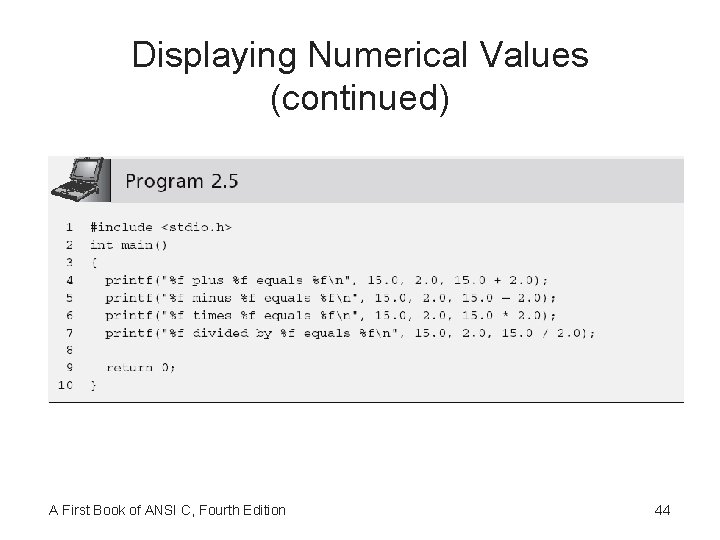
Displaying Numerical Values (continued) A First Book of ANSI C, Fourth Edition 44
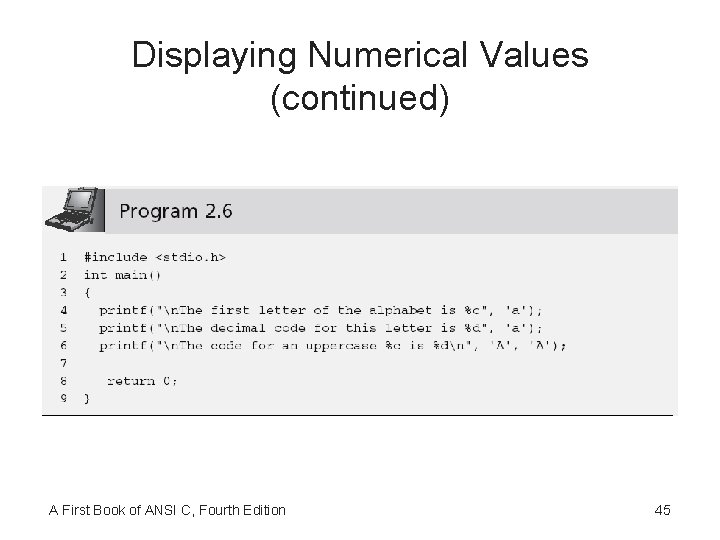
Displaying Numerical Values (continued) A First Book of ANSI C, Fourth Edition 45
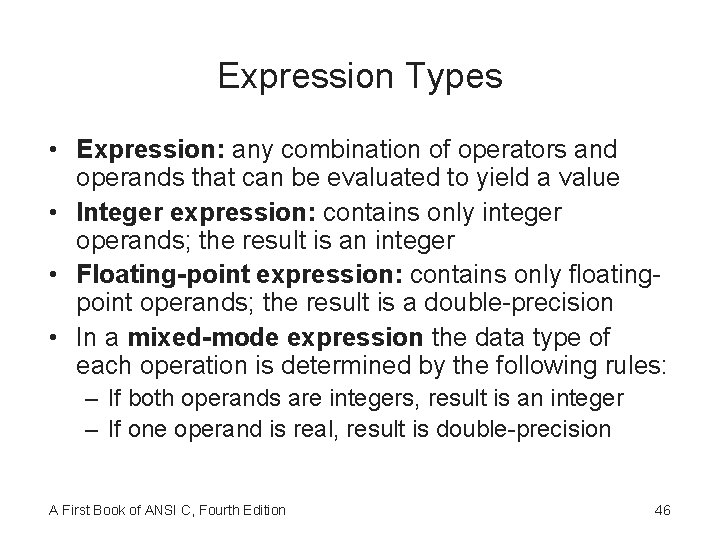
Expression Types • Expression: any combination of operators and operands that can be evaluated to yield a value • Integer expression: contains only integer operands; the result is an integer • Floating-point expression: contains only floatingpoint operands; the result is a double-precision • In a mixed-mode expression the data type of each operation is determined by the following rules: – If both operands are integers, result is an integer – If one operand is real, result is double-precision A First Book of ANSI C, Fourth Edition 46
Integer Division • 15/2 = 7 – Integers cannot contain a fractional part – Remainder is truncated • % is the modulus or remainder operator – 9 % 4 is 1 – 17 % 3 is 2 – 14 % 2 is 0 A First Book of ANSI C, Fourth Edition 47
Negation • A unary operator is one that operates on a single operand, e. g. , negation (-) • The minus sign in front of a single numerical value negates (reverses the sign of) the number A First Book of ANSI C, Fourth Edition 48
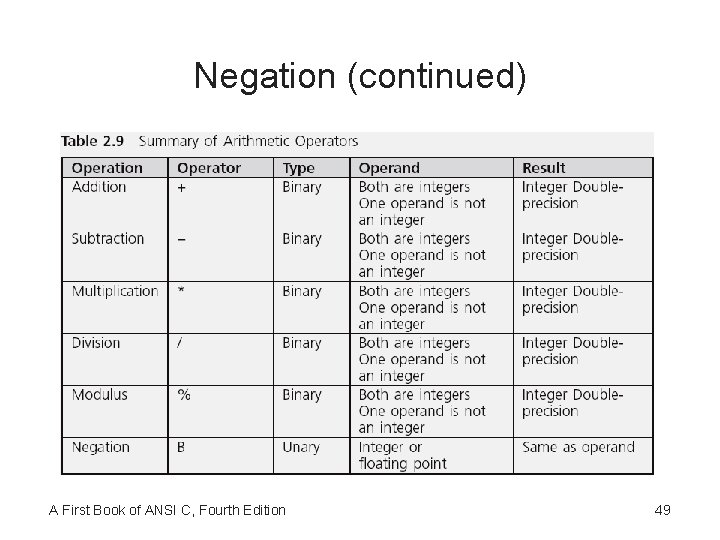
Negation (continued) A First Book of ANSI C, Fourth Edition 49
Operator Precedence and Associativity • Two binary arithmetic operator symbols must never be placed side by side • Parentheses may be used to form groupings – Expressions in parentheses are evaluated first • Parentheses may be enclosed by other parentheses • Parentheses cannot be used to indicate multiplication A First Book of ANSI C, Fourth Edition 50
Operator Precedence and Associativity (continued) • Three levels of precedence: 1. All negations are done first 2. Multiplication, division, and modulus operations are computed next; expressions containing more than one of these operators are evaluated from left to right as each operator is encountered 3. Addition and subtraction are computed last; expressions containing more than one addition or subtraction are evaluated from left to right as each operator is encountered A First Book of ANSI C, Fourth Edition 51
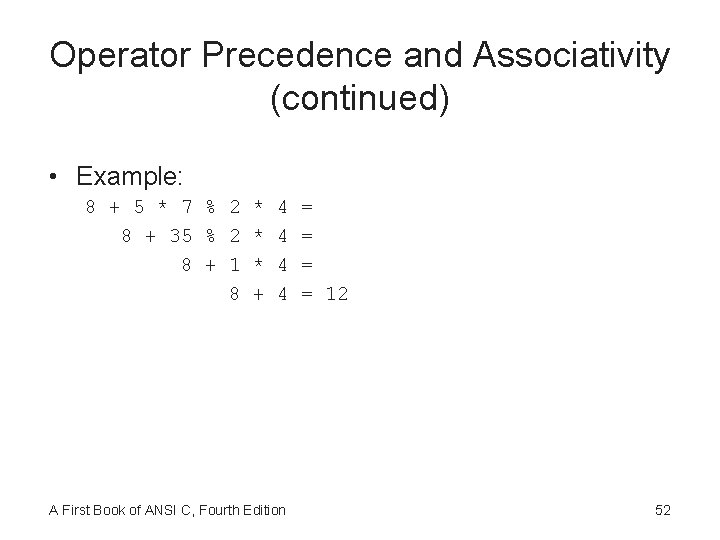
Operator Precedence and Associativity (continued) • Example: 8 + 5 * 7 % 2 * 8 + 35 % 2 * 8 + 1 * 8 + 4 4 A First Book of ANSI C, Fourth Edition = = 12 52
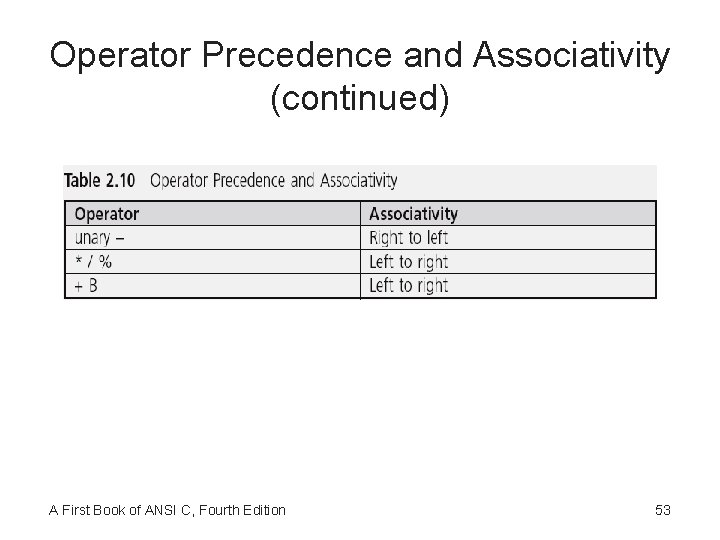
Operator Precedence and Associativity (continued) A First Book of ANSI C, Fourth Edition 53
Variables and Declarations • Variables are names given by programmers to computer storage • Variable name usually limited to 255 characters • Variable names are case sensitive A First Book of ANSI C, Fourth Edition 54
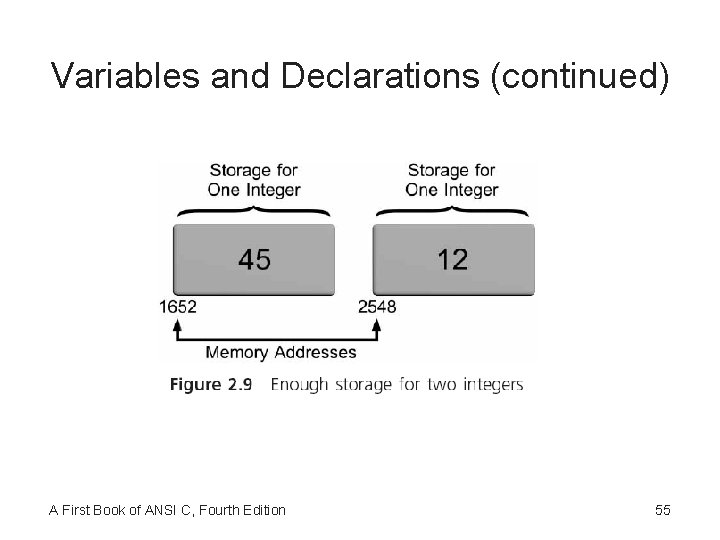
Variables and Declarations (continued) A First Book of ANSI C, Fourth Edition 55
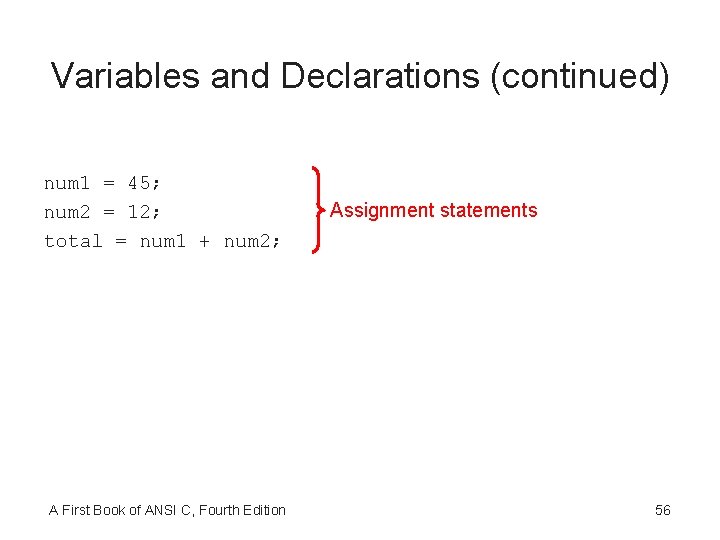
Variables and Declarations (continued) num 1 = 45; num 2 = 12; total = num 1 + num 2; A First Book of ANSI C, Fourth Edition Assignment statements 56
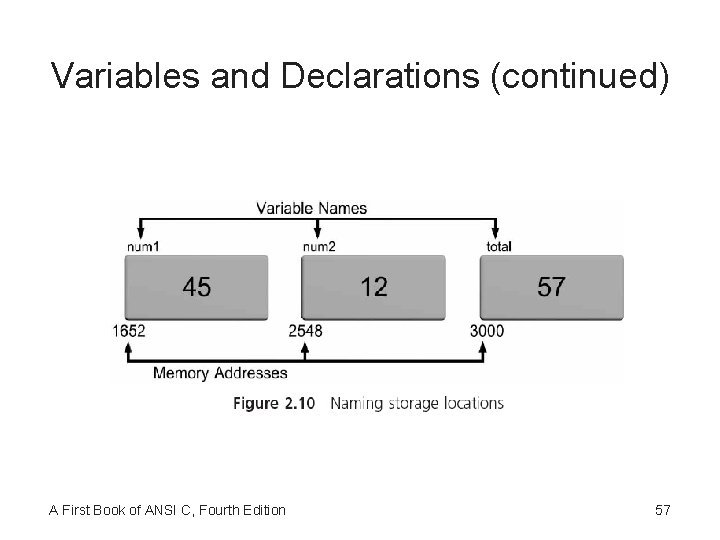
Variables and Declarations (continued) A First Book of ANSI C, Fourth Edition 57
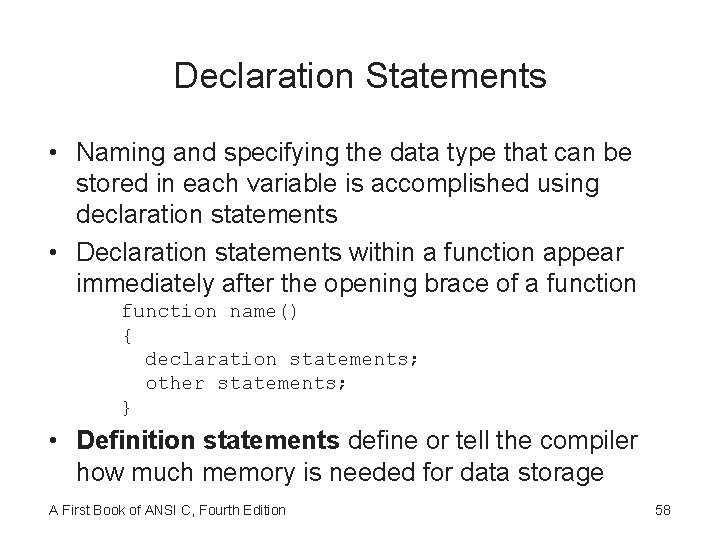
Declaration Statements • Naming and specifying the data type that can be stored in each variable is accomplished using declaration statements • Declaration statements within a function appear immediately after the opening brace of a function name() { declaration statements; other statements; } • Definition statements define or tell the compiler how much memory is needed for data storage A First Book of ANSI C, Fourth Edition 58
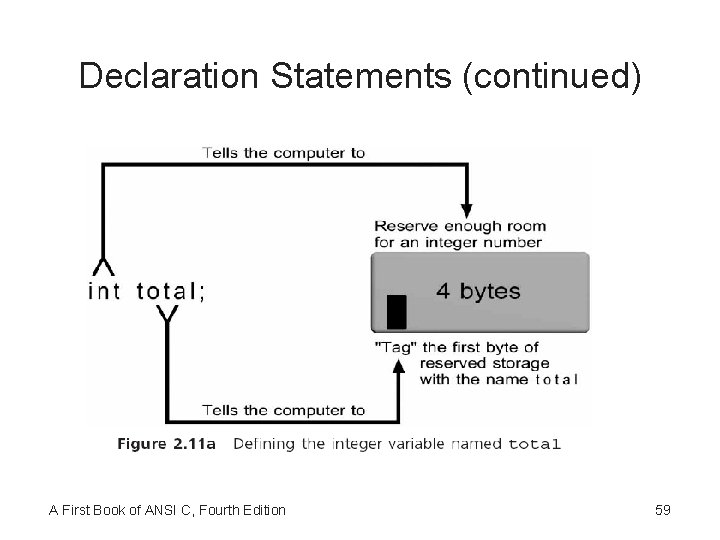
Declaration Statements (continued) A First Book of ANSI C, Fourth Edition 59
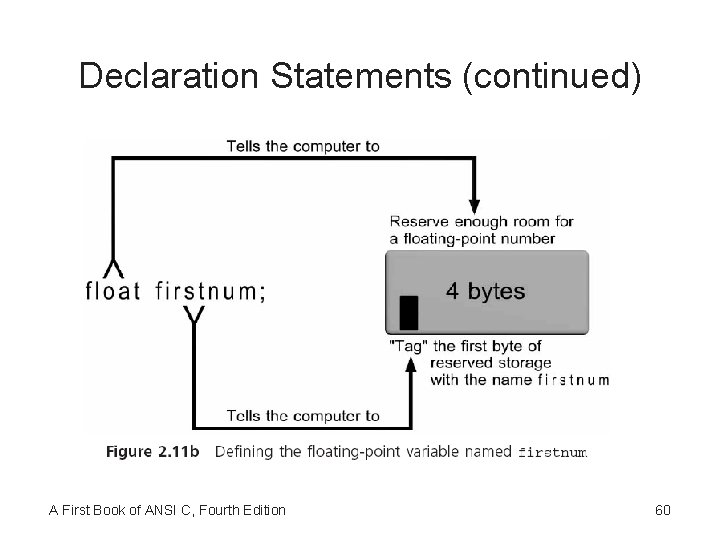
Declaration Statements (continued) A First Book of ANSI C, Fourth Edition 60
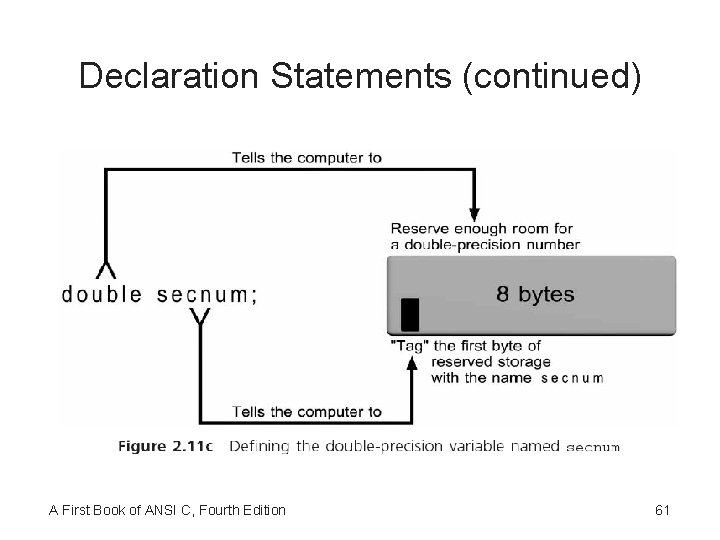
Declaration Statements (continued) A First Book of ANSI C, Fourth Edition 61
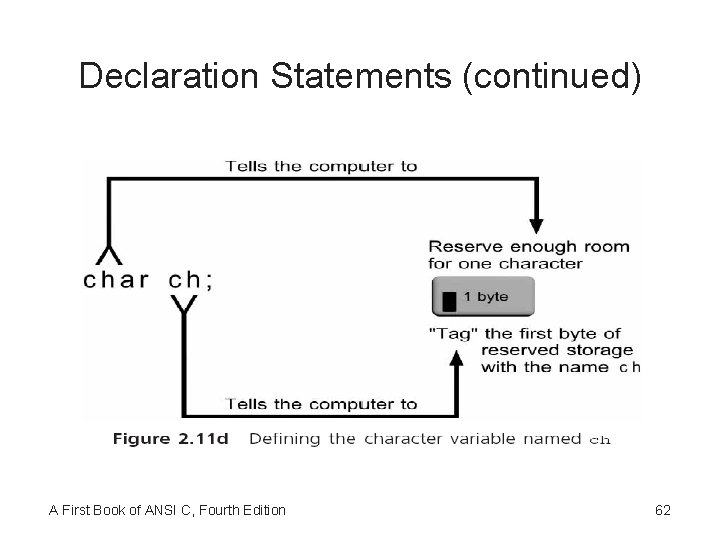
Declaration Statements (continued) A First Book of ANSI C, Fourth Edition 62
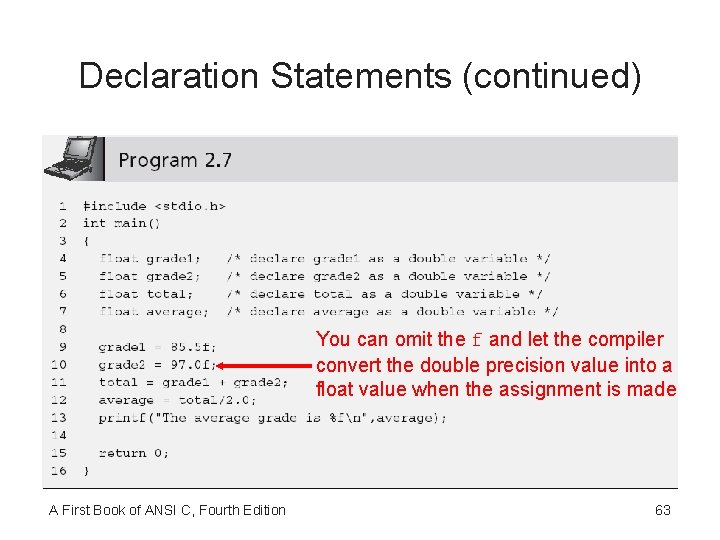
Declaration Statements (continued) You can omit the f and let the compiler convert the double precision value into a float value when the assignment is made A First Book of ANSI C, Fourth Edition 63
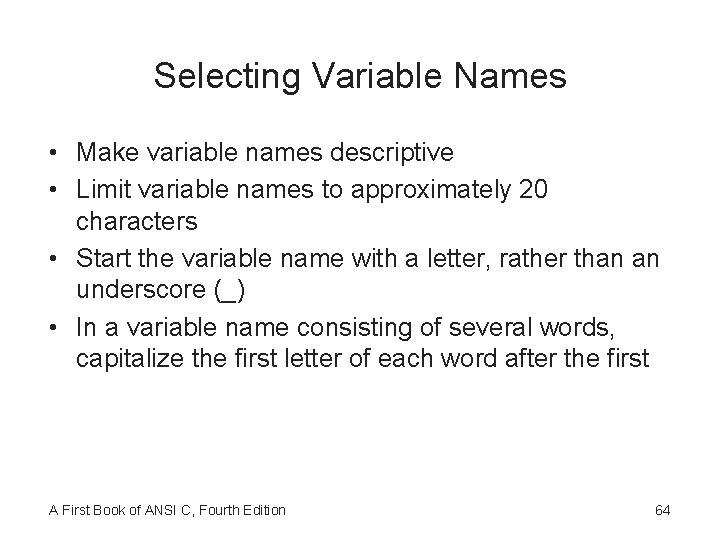
Selecting Variable Names • Make variable names descriptive • Limit variable names to approximately 20 characters • Start the variable name with a letter, rather than an underscore (_) • In a variable name consisting of several words, capitalize the first letter of each word after the first A First Book of ANSI C, Fourth Edition 64
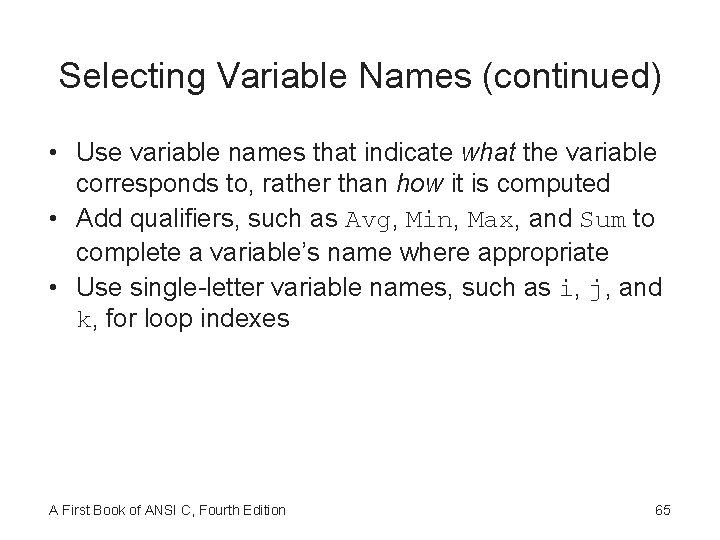
Selecting Variable Names (continued) • Use variable names that indicate what the variable corresponds to, rather than how it is computed • Add qualifiers, such as Avg, Min, Max, and Sum to complete a variable’s name where appropriate • Use single-letter variable names, such as i, j, and k, for loop indexes A First Book of ANSI C, Fourth Edition 65
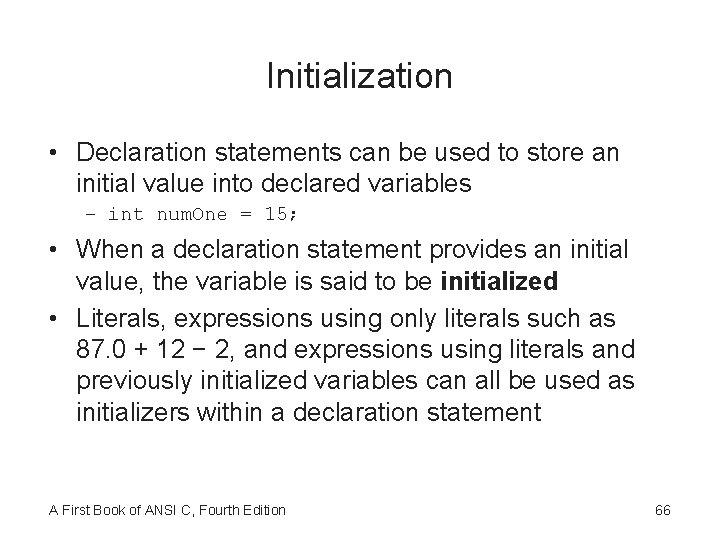
Initialization • Declaration statements can be used to store an initial value into declared variables – int num. One = 15; • When a declaration statement provides an initial value, the variable is said to be initialized • Literals, expressions using only literals such as 87. 0 + 12 − 2, and expressions using literals and previously initialized variables can all be used as initializers within a declaration statement A First Book of ANSI C, Fourth Edition 66
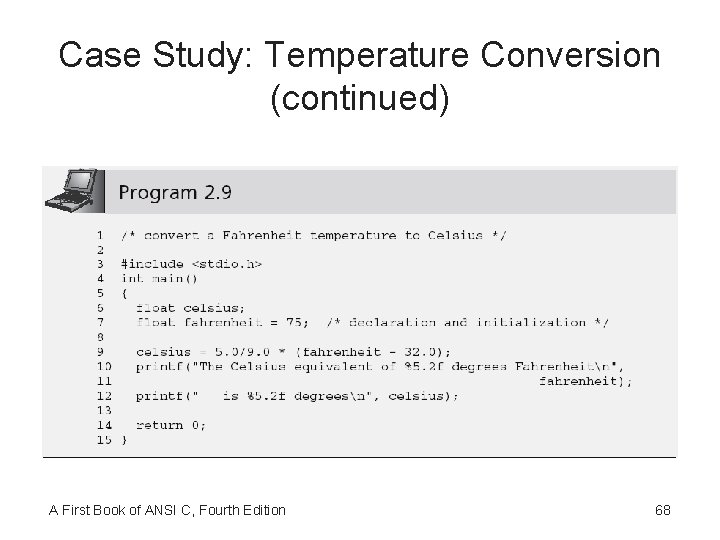
Case Study: Temperature Conversion • A friend of yours is going to Spain, where temperatures are reported using the Celsius temperature scale. She has asked you to provide her with a list of temperatures in degrees Fahrenheit, and the equivalent temperature in degrees Celsius. The formula relating the two temperatures is Celsius = 5/9(Fahrenheit − 32). Initially, you are to write and test a program that correctly converts the Fahrenheit temperature of 75 degrees into its Celsius equivalent. A First Book of ANSI C, Fourth Edition 67
Case Study: Temperature Conversion (continued) A First Book of ANSI C, Fourth Edition 68
Common Programming Errors • Omitting the parentheses, (), after main • Omitting or incorrectly typing the opening brace, {, that signifies the start of a function body • Omitting or incorrectly typing the closing brace, }, that signifies the end of a function • Misspelling the name of a function; for example, typing print() instead of printf() • Forgetting to close a string passed to printf() with a double quote symbol A First Book of ANSI C, Fourth Edition 69
Common Programming Errors (continued) • Omitting the semicolon at the end of each executable statement • Forgetting to include n to indicate a new line • Forgetting to declare all the variables used in a program • Storing an incorrect data type in a declared variable • Using a variable in an expression before a value has been assigned to the variable A First Book of ANSI C, Fourth Edition 70
Common Programming Errors (continued) • Dividing integer values incorrectly • Mixing data types in the same expression without clearly understanding the effect produced • Not including the correct conversion control sequence in printf() function calls for the data types of the remaining arguments • Not closing the control string in printf() with a double quote symbol followed by a comma when additional arguments are passed to printf() • Forgetting to separate all arguments passed to printf() with commas A First Book of ANSI C, Fourth Edition 71

Common Compiler Errors A First Book of ANSI C, Fourth Edition 72
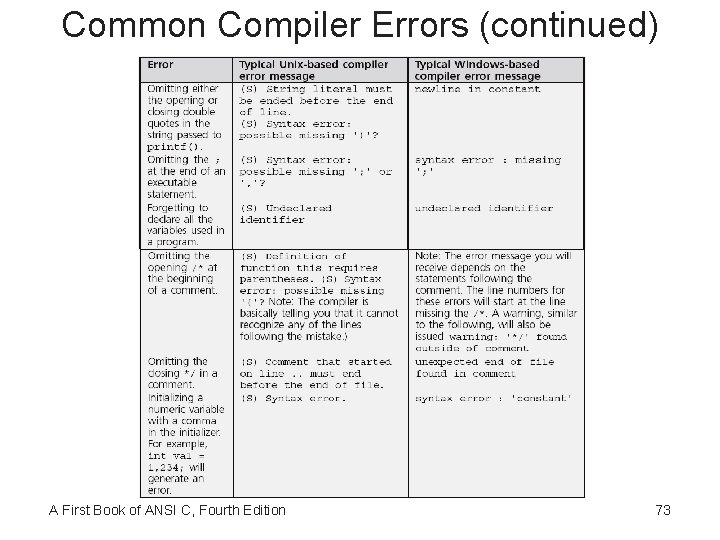
Common Compiler Errors (continued) A First Book of ANSI C, Fourth Edition 73
Summary • A C program consists of one or more functions • A function is a C language description of an algorithm • Many functions are supplied in a standard library of functions provided with each C compiler • Simple C programs consist of the single function named main() • An executable statement causes some specific action to be performed when the program is executed A First Book of ANSI C, Fourth Edition 74
Summary (continued) • All executable C statements must be terminated by a semicolon • The printf() function displays text or numerical results • The two basic numerical data types used almost exclusively in current C programs are integers and double-precision numbers • An expression is a sequence of one or more operands separated by operators A First Book of ANSI C, Fourth Edition 75
Summary (continued) • Expressions are evaluated according to the precedence and associativity of the operators used • printf() can display all of C’s data types • Every variable in a C program must be – Declared with a data type – Used after it is declared • Declaration statements inform the compiler of a function’s valid variable names A First Book of ANSI C, Fourth Edition 76
- Slides: 76