
A few lessons learned from a pilot project
- Slides: 32
A few lessons learned from a pilot project in sustainability science Nathan Mantua Climate Impacts Group Center for Science in the Earth System JISAO, University of Washington Seattle, WA 98195 May 8, 2006 Fisheries 497 A www. cses. washington. edu/cig/
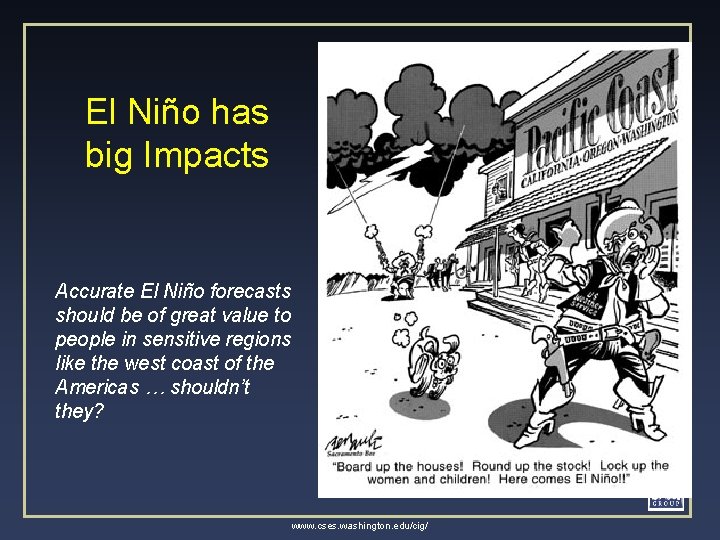
El Niño has big Impacts Accurate El Niño forecasts should be of great value to people in sensitive regions like the west coast of the Americas … shouldn’t they? www. cses. washington. edu/cig/
Origins of the CIG project § There were high hopes for translating advances in climate science into real benefits for society in the early 1990 s – The El Niño forecasting problem appeared to be solved, but there wasn’t a national infrastructure for translating climate forecasts into useful and useable resource forecast information – Global warming impacts studies were being reported by the IPCC at continental scales, but what did these mean to “real people”? www. cses. washington. edu/cig/
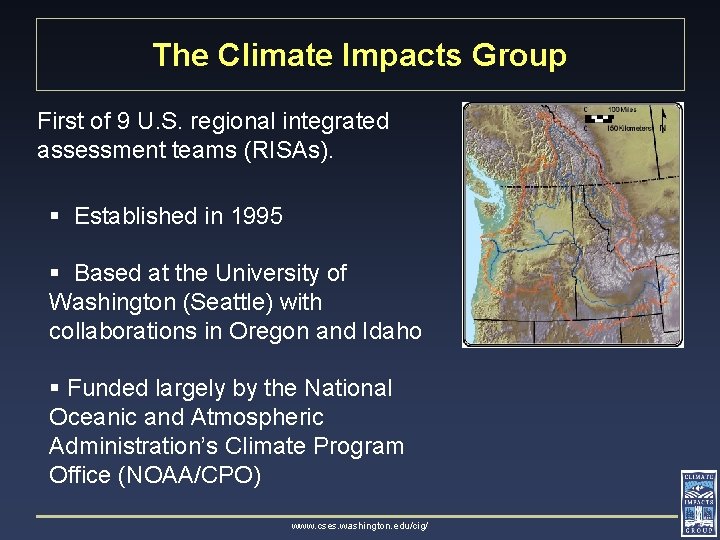
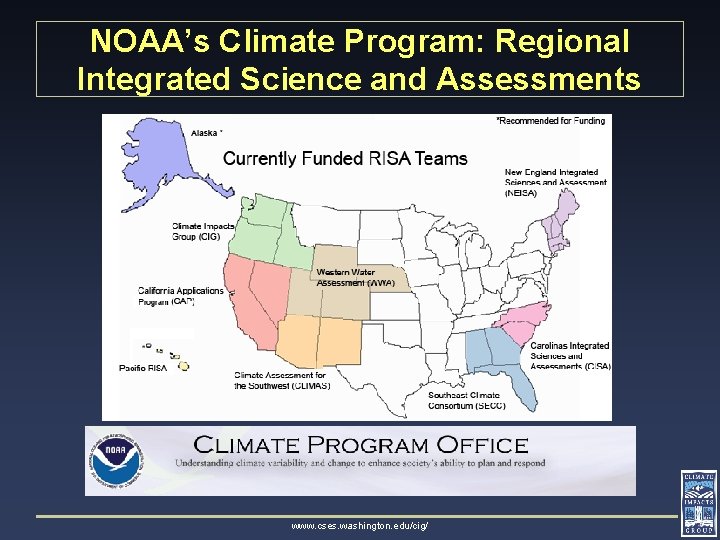
The Climate Impacts Group First of 9 U. S. regional integrated assessment teams (RISAs). § Established in 1995 § Based at the University of Washington (Seattle) with collaborations in Oregon and Idaho § Funded largely by the National Oceanic and Atmospheric Administration’s Climate Program Office (NOAA/CPO) www. cses. washington. edu/cig/
NOAA’s Climate Program: Regional Integrated Science and Assessments www. cses. washington. edu/cig/
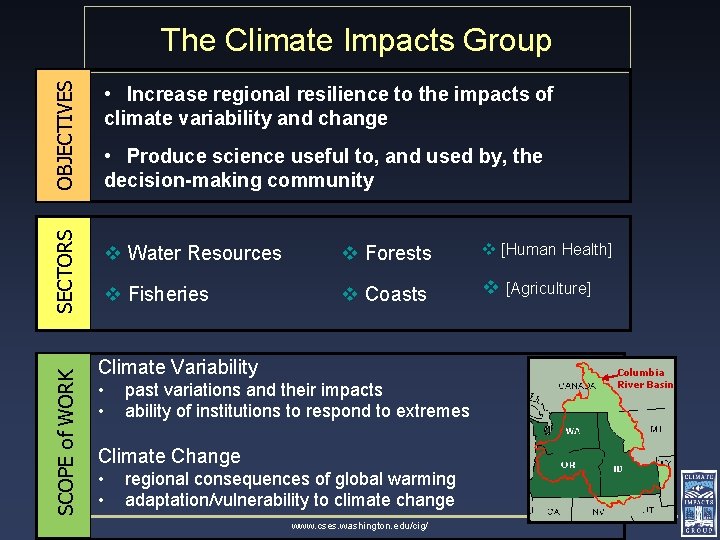
SCOPE of WORK SECTORS OBJECTIVES The Climate Impacts Group • Increase regional resilience to the impacts of climate variability and change • Produce science useful to, and used by, the decision-making community v Water Resources v Forests v [Human Health] v Fisheries v Coasts v [Agriculture] Climate Variability • • past variations and their impacts ability of institutions to respond to extremes Climate Change • • regional consequences of global warming adaptation/vulnerability to climate change www. cses. washington. edu/cig/ Columbia River Basin
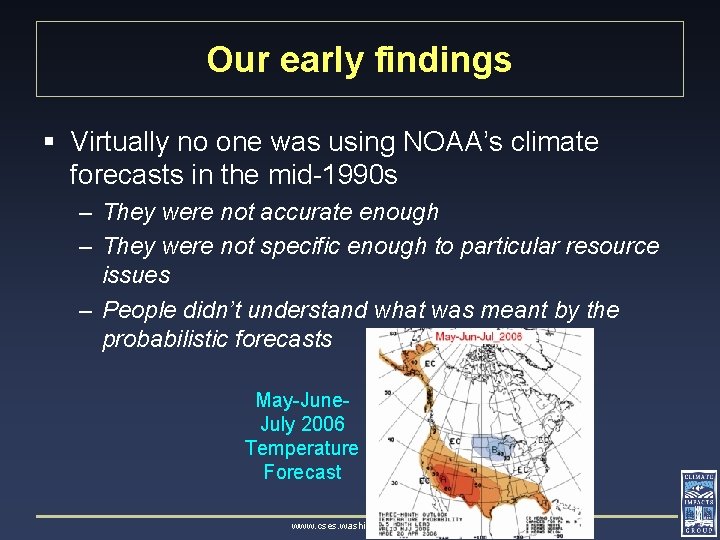
Our early findings § Virtually no one was using NOAA’s climate forecasts in the mid-1990 s – They were not accurate enough – They were not specific enough to particular resource issues – People didn’t understand what was meant by the probabilistic forecasts May-June. July 2006 Temperature Forecast www. cses. washington. edu/cig/
LESSON 1 Resource agencies make forecasts all the time, and the research community focuses on improving forecasts, but there aren’t always (often? ) strong links between these communities www. cses. washington. edu/cig/
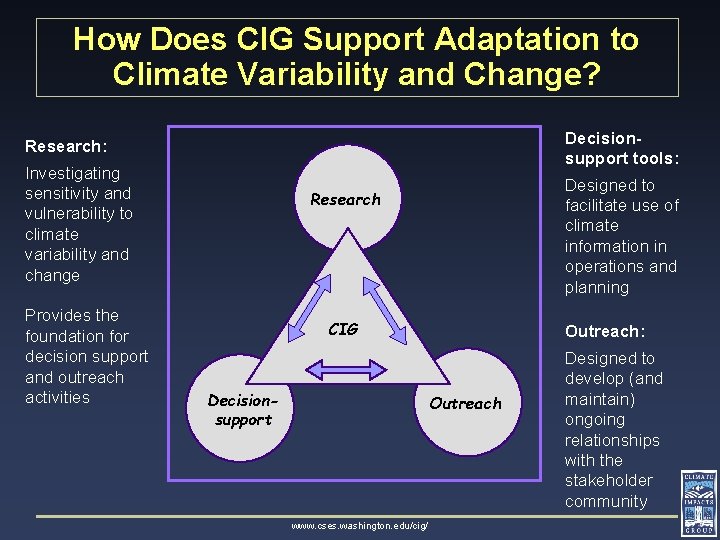
How Does CIG Support Adaptation to Climate Variability and Change? Decisionsupport tools: Research: Investigating sensitivity and vulnerability to climate variability and change Provides the foundation for decision support and outreach activities Designed to facilitate use of climate information in operations and planning Research CIG Decisionsupport Outreach: Outreach www. cses. washington. edu/cig/ Designed to develop (and maintain) ongoing relationships with the stakeholder community
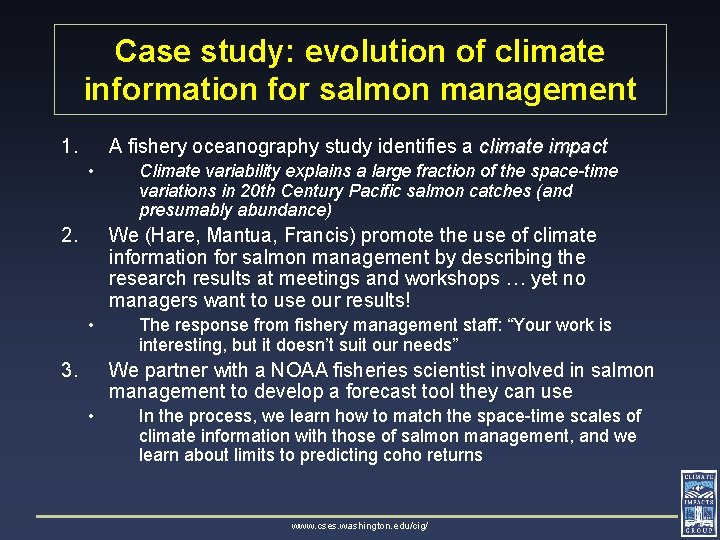
Case study: evolution of climate information for salmon management 1. A fishery oceanography study identifies a climate impact • 2. Climate variability explains a large fraction of the space-time variations in 20 th Century Pacific salmon catches (and presumably abundance) We (Hare, Mantua, Francis) promote the use of climate information for salmon management by describing the research results at meetings and workshops … yet no managers want to use our results! • 3. The response from fishery management staff: “Your work is interesting, but it doesn’t suit our needs” We partner with a NOAA fisheries scientist involved in salmon management to develop a forecast tool they can use • In the process, we learn how to match the space-time scales of climate information with those of salmon management, and we learn about limits to predicting coho returns www. cses. washington. edu/cig/
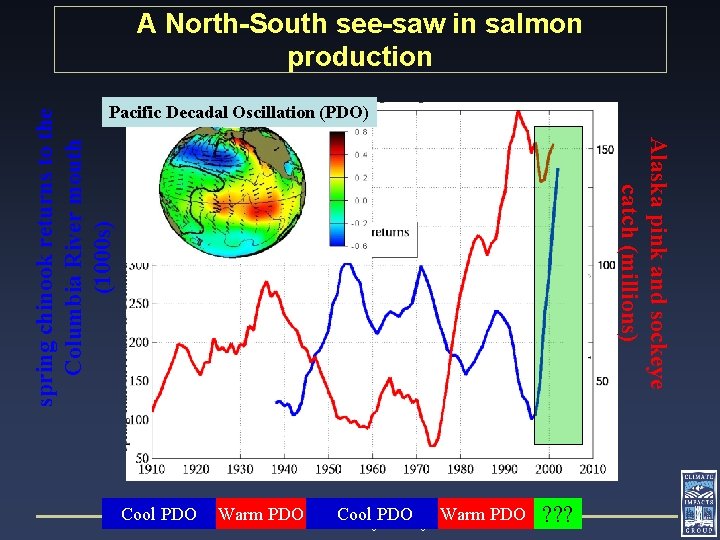
A North-South see-saw in salmon production Alaska pink and sockeye catch (millions) spring chinook returns to the Columbia River mouth (1000 s) Pacific Decadal Oscillation (PDO) Cool PDO Warm PDO Cool PDO www. cses. washington. edu/cig/ Warm PDO ? ? ?
(millions) Composition Commercial catch Commercial Sockeye Salmon Catches Since 1883 Bristol Bay, Alaska www. cses. washington. edu/cig/ Hilborn et al. 2003, PNAS
Recruits-per-spawner for Bristol Bay sockeye (by major river system) Year www. cses. washington. edu/cig/ Hilborn et al. 2003, PNAS
Lesson 2 The scales considered in our research were no match for the scales most important for salmon managers – Our work was interesting, but unusable www. cses. washington. edu/cig/
OPI (hatchery) coho marine survival Why? Leading hypothesis: changes in ocean conditions impact the entire marine food-web www. cses. washington. edu/cig/
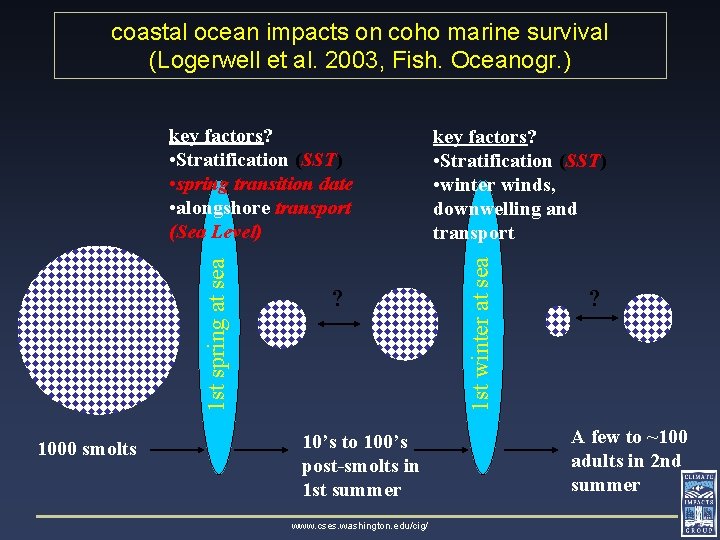
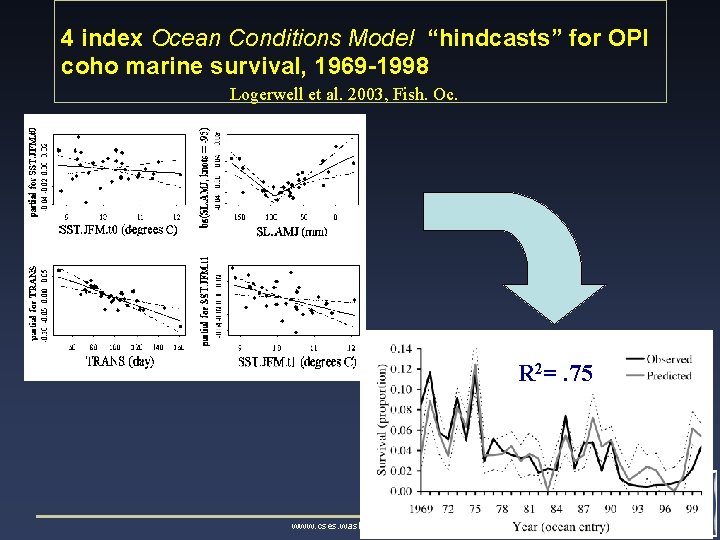
coastal ocean impacts on coho marine survival (Logerwell et al. 2003, Fish. Oceanogr. ) 1000 smolts ? 10’s to 100’s post-smolts in 1 st summer www. cses. washington. edu/cig/ key factors? • Stratification (SST) • winter winds, downwelling and transport 1 st winter at sea 1 st spring at sea key factors? • Stratification (SST) • spring transition date • alongshore transport (Sea Level) ? A few to ~100 adults in 2 nd summer
4 index Ocean Conditions Model “hindcasts” for OPI coho marine survival, 1969 -1998 Logerwell et al. 2003, Fish. Oc. R 2=. 75 www. cses. washington. edu/cig/
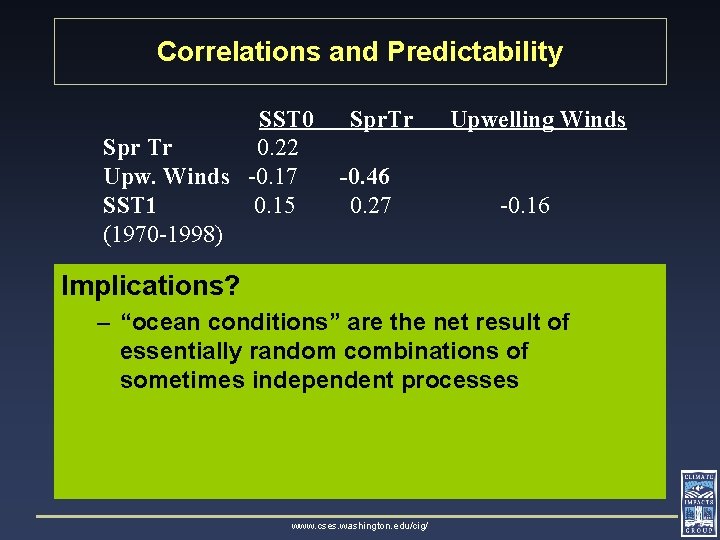
Correlations and Predictability SST 0 Spr Tr 0. 22 Upw. Winds -0. 17 SST 1 0. 15 (1970 -1998) Spr. Tr -0. 46 0. 27 Upwelling Winds -0. 16 Implications? – “ocean conditions” are the net result of essentially random combinations of sometimes independent processes www. cses. washington. edu/cig/
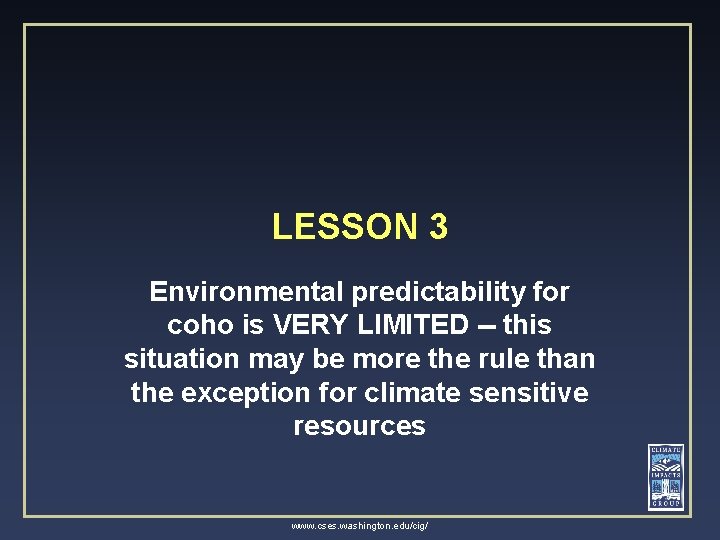
LESSON 3 Environmental predictability for coho is VERY LIMITED -- this situation may be more the rule than the exception for climate sensitive resources www. cses. washington. edu/cig/
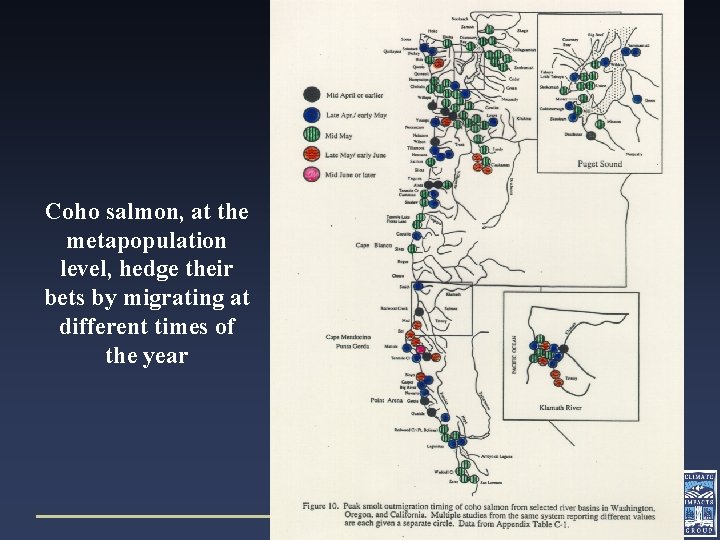
Life in uncertain environments Bet hedging behaviors one evolutionary response: § diversity of time-space habitat use – a variety of sensitivities for different streams (e. g. Hymer WDFW) – different ocean sensitivities (e. g. Bottsford et al. ) for different stocks, incl. Hatchery vs. wild fish www. cses. washington. edu/cig/
Coho salmon, at the metapopulation level, hedge their bets by migrating at different times of the year www. cses. washington. edu/cig/
fishery management www. cses. washington. edu/cig/
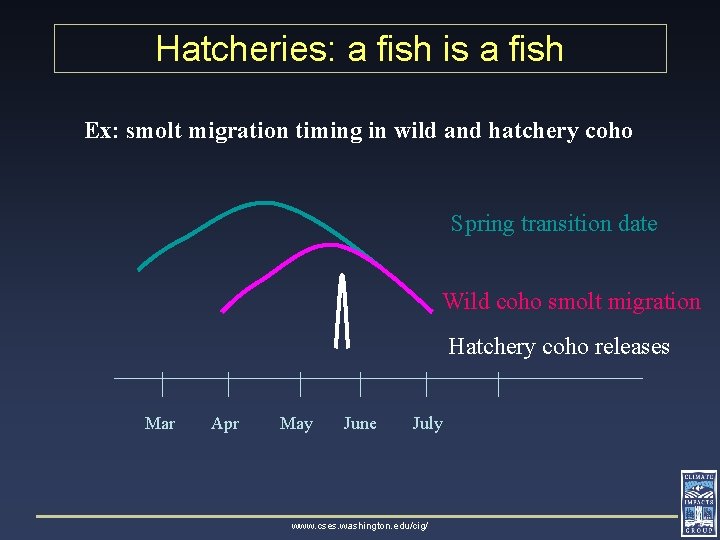
Hatcheries: a fish is a fish Ex: smolt migration timing in wild and hatchery coho Spring transition date Wild coho smolt migration Hatchery coho releases Mar Apr May June July www. cses. washington. edu/cig/
So what? (what I’ve learned) § Sustaining “fish” and sustaining a “fishery” are not the same things – expectations and actions for these two goals are often at odds with each other § right now, fishery managers generally failing to deal with “climate” – true for year-to-year and decade-to-decade variations www. cses. washington. edu/cig/
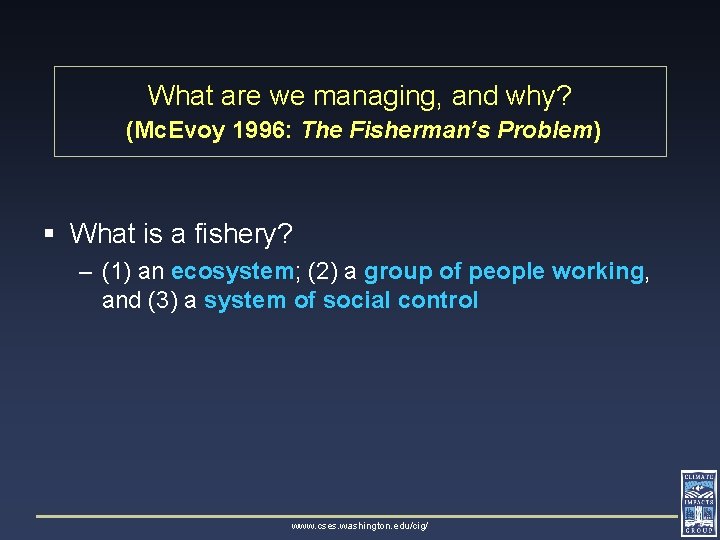
What are we managing, and why? (Mc. Evoy 1996: The Fisherman’s Problem) § What is a fishery? – (1) an ecosystem; (2) a group of people working, and (3) a system of social control www. cses. washington. edu/cig/
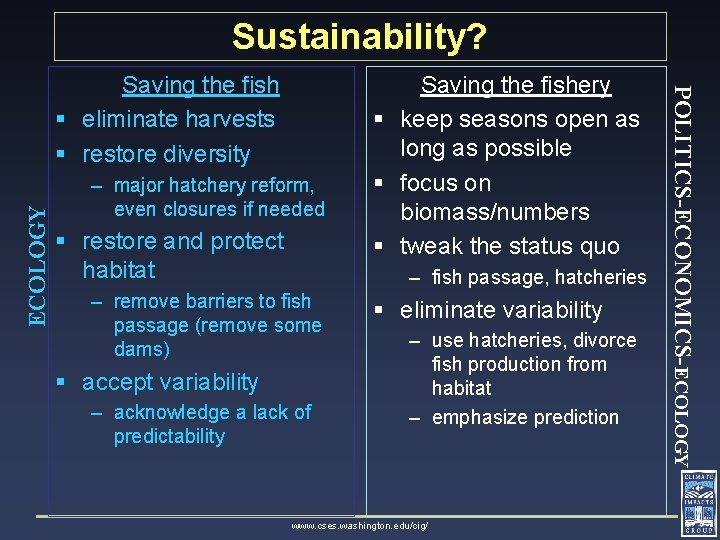
Sustainability? ECOLOGY – major hatchery reform, even closures if needed § restore and protect habitat Saving the fishery § keep seasons open as long as possible § focus on biomass/numbers § tweak the status quo – fish passage, hatcheries – remove barriers to fish passage (remove some dams) § accept variability – acknowledge a lack of predictability § eliminate variability – use hatcheries, divorce fish production from habitat – emphasize prediction www. cses. washington. edu/cig/ POLITICS-ECONOMICS-ECOLOGY Saving the fish § eliminate harvests § restore diversity
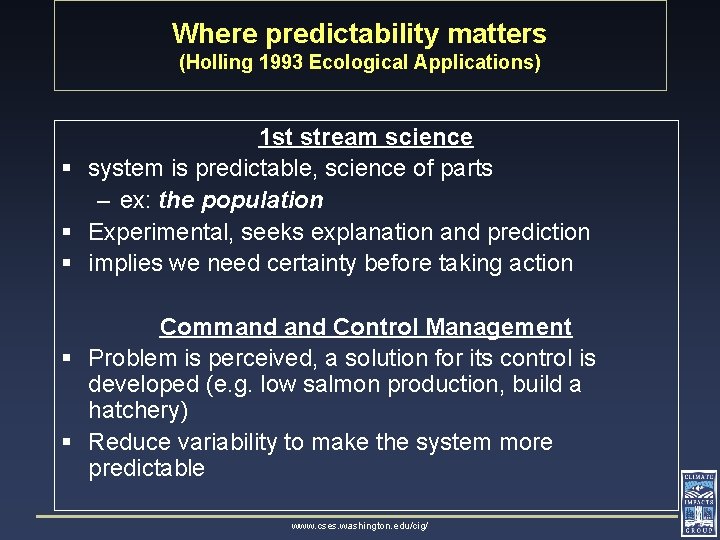
Where predictability matters (Holling 1993 Ecological Applications) 1 st stream science § system is predictable, science of parts – ex: the population § Experimental, seeks explanation and prediction § implies we need certainty before taking action Command Control Management § Problem is perceived, a solution for its control is developed (e. g. low salmon production, build a hatchery) § Reduce variability to make the system more predictable www. cses. washington. edu/cig/
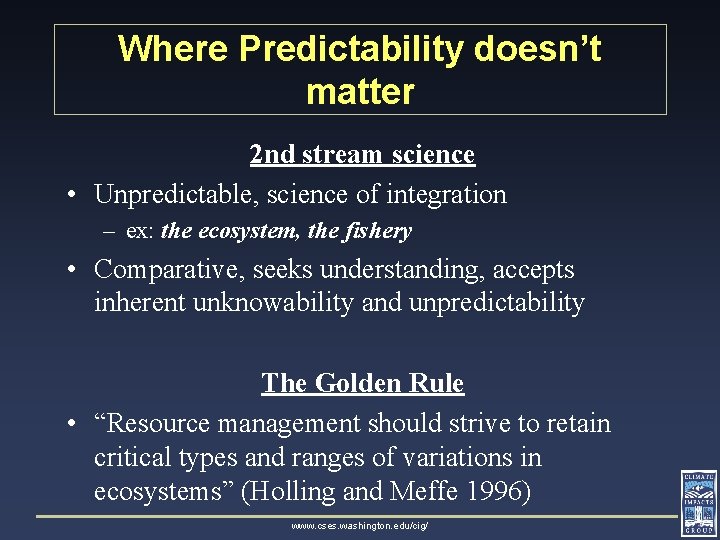
Where Predictability doesn’t matter 2 nd stream science • Unpredictable, science of integration – ex: the ecosystem, the fishery • Comparative, seeks understanding, accepts inherent unknowability and unpredictability The Golden Rule • “Resource management should strive to retain critical types and ranges of variations in ecosystems” (Holling and Meffe 1996) www. cses. washington. edu/cig/
The problem? § We can’t solve 2 nd stream problems with 1 st stream approaches www. cses. washington. edu/cig/
Summary and Conclusions § climate information has the potential to improve resource management – short term help for salmon fisheries through monitoring+biophys models – Longer range guidance for the trajectory of regional climate changes in response to global warming § environmental prediction issues now a source of conflict between managing fish and fisheries for sustainability – scientists must own up to the fact that we cannot predict the future www. cses. washington. edu/cig/
Saving the fish § Embrace uncertainty – wild salmon evolved behaviors that cope with environmental uncertainty § restore natural climate insurance for salmon – do this by restoring lost diversity of life history behaviors; this diversity is directly linked to availability of healthy, complex freshwater habitat § Save the Fishery – People must be part of the solution www. cses. washington. edu/cig/
Saving the Fishery § Save the Fish § Rethink/revise goals of fishery management – Industrial fishery model is doomed to failure (lots of fish = healthy fishery) because it fails to deal with the unknowability in the fishery system www. cses. washington. edu/cig/