
A Few Housekeeping Notes QA time will follow
- Slides: 30
A Few Housekeeping Notes • Q&A time will follow presentation • During the presentation, use the chat box in Web. Ex to ask questions • Please remain muted unless you need to speak. This minimizes background noise. • When you speak, please identify yourself by name and work area to help others recognize you. • This Web. Ex is being recorded and will be posted on the CTSI website
Welcome to Duke CTSI Grand Rounds March 14, 2019 Moderated by L. Ebony Boulware, MPH, MD Director, Duke CTSI Please note that you have been muted upon entry to this Web. Ex. Click the microphone by your name in the participant list to unmute as needed. This presentation is being recorded.
Biostatistics Collaborations At Duke Gina-Maria Pomann, Ph. D Director and Statistical Scientist CTSI Biostatistics, Epidemiology, & Research Design (BERD) Methods Core Department of Biostatistics and Bioinformatics
Duke Clinical Translational Science Institute BERD Core Mission: To work with interdisciplinary network of clinical and translational investigators conducting research at Duke by providing expertise in study design, implementation of quantitative methodology, and interpretation of results.
Duke Clinical Translational Science Institute BERD Core A team of faculty and staff biostatisticians and affiliated methodologists with diverse and extensive experience conducting a broad range of research projects. • 18+ staff Biostatisticians (5 Ph. Ds, 13 Masters) • Affiliated experts in qualitative analysis and bioinformatics • 55 faculty in the Biostatistics and Bioinformatics Department • Over 40+ collaborative teams throughout Duke
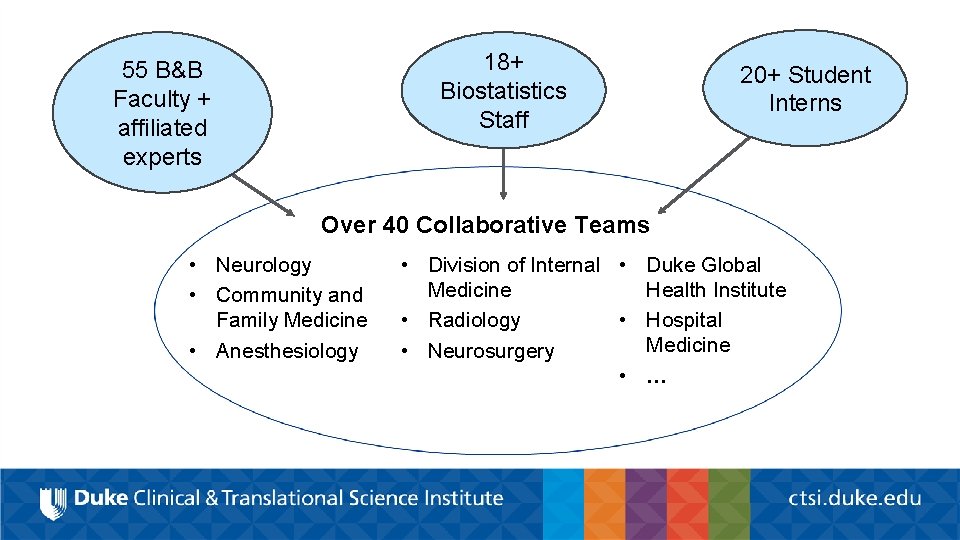
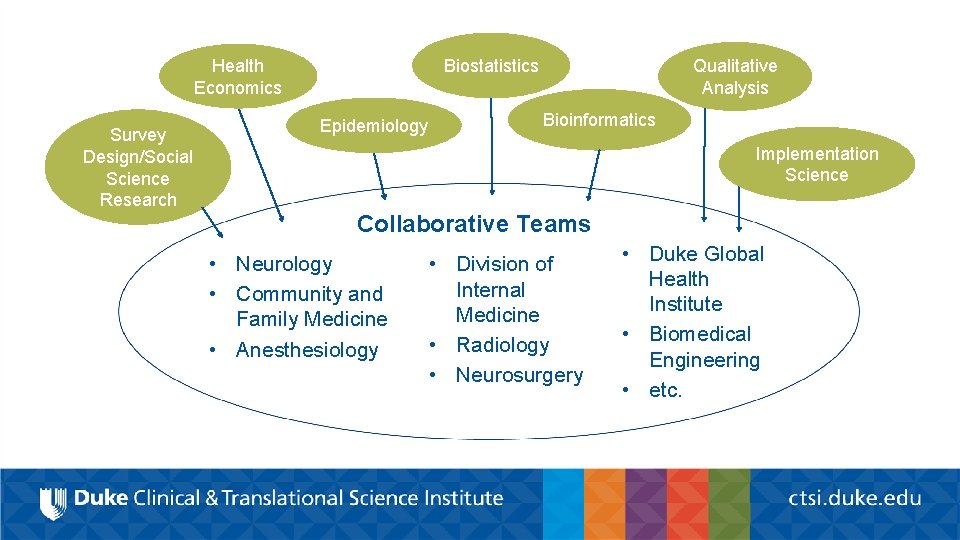
18+ Biostatistics Staff 55 B&B Faculty + affiliated experts 20+ Student Interns Over 40 Collaborative Teams • Neurology • Community and Family Medicine • Anesthesiology • Division of Internal • Duke Global Health Institute Medicine • Hospital • Radiology Medicine • Neurosurgery • …
We Collaborate at Every Step of the Scientific Process Observation / Pattern • We brainstorm with investigators Scientific question • • Hypotheses Study design / Data collection Analysis Results / Conclusions
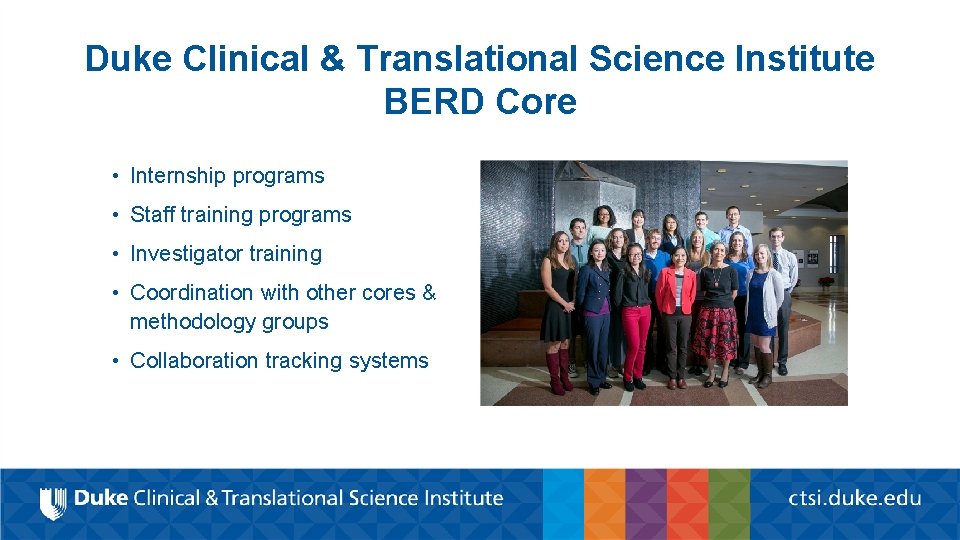
Duke Clinical & Translational Science Institute BERD Core • Internship programs • Staff training programs • Investigator training • Coordination with other cores & methodology groups • Collaboration tracking systems
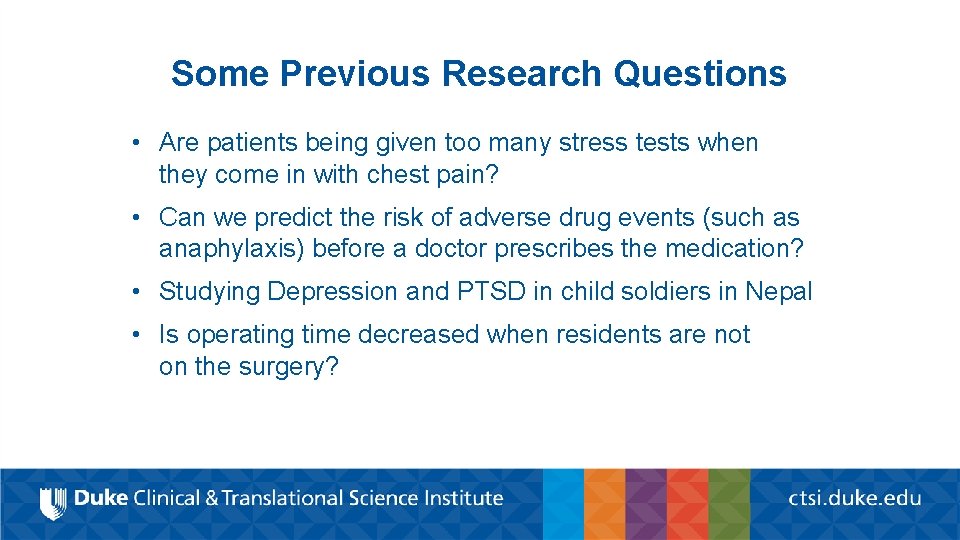
Some Previous Research Questions • Are patients being given too many stress tests when they come in with chest pain? • Can we predict the risk of adverse drug events (such as anaphylaxis) before a doctor prescribes the medication? • Studying Depression and PTSD in child soldiers in Nepal • Is operating time decreased when residents are not on the surgery?
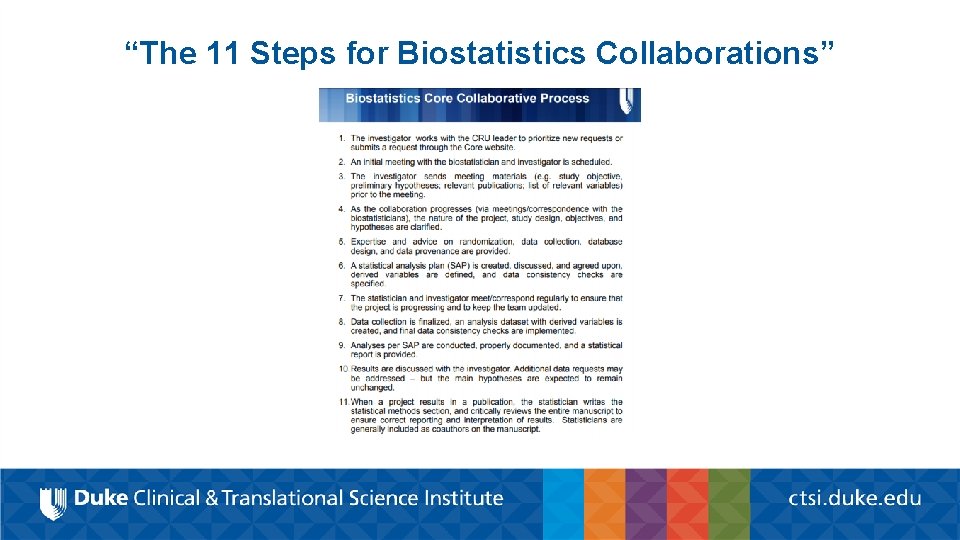
“The 11 Steps for Biostatistics Collaborations”
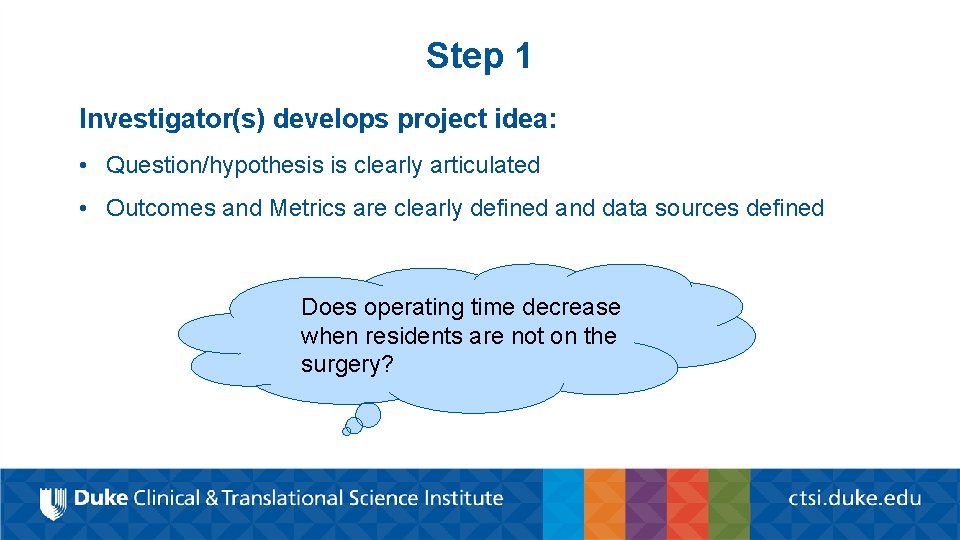
Step 1 Investigator(s) develops project idea: • Question/hypothesis is clearly articulated • Outcomes and Metrics are clearly defined and data sources defined Does operating time decrease when residents are not on the surgery?
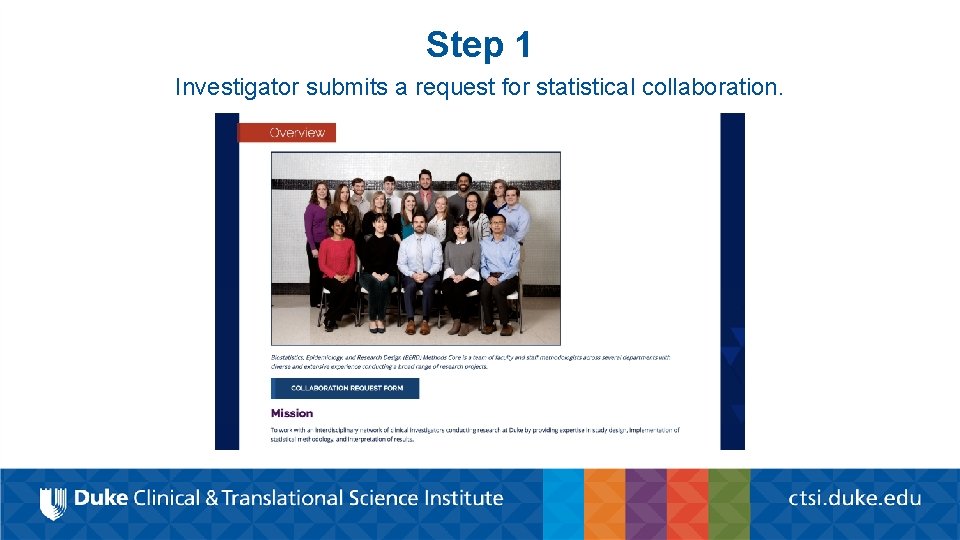
Step 1 Investigator submits a request for statistical collaboration.
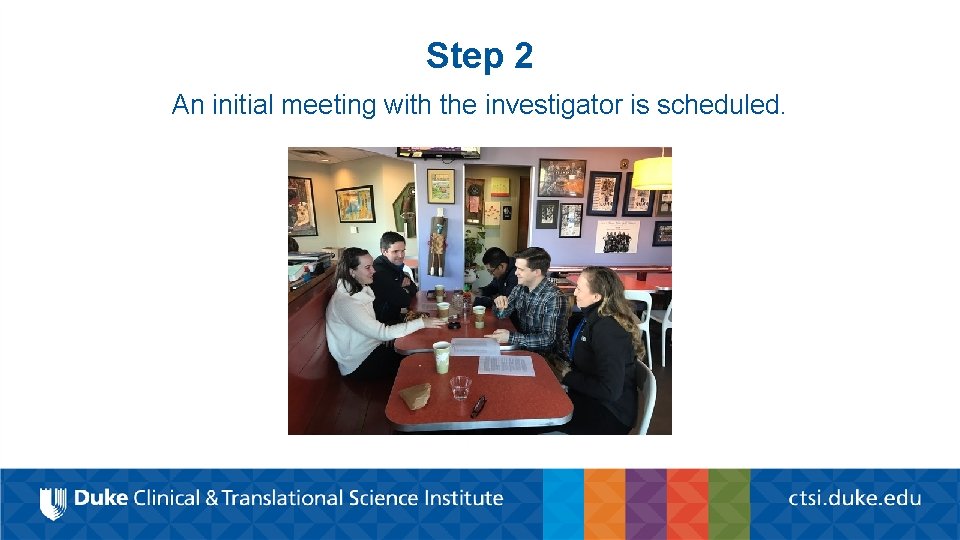
Step 2 An initial meeting with the investigator is scheduled.
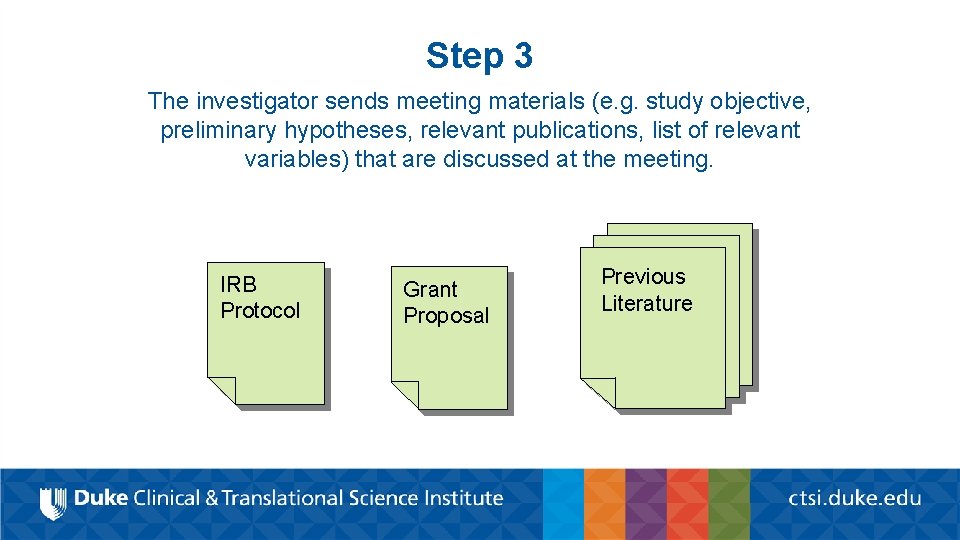
Step 3 The investigator sends meeting materials (e. g. study objective, preliminary hypotheses, relevant publications, list of relevant variables) that are discussed at the meeting. IRB Protocol Grant Proposal Previous Literature
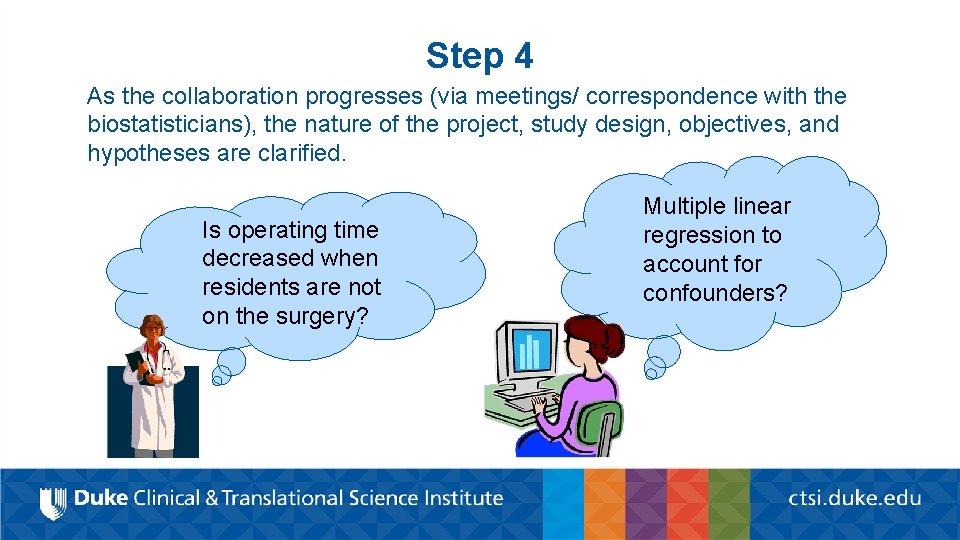
Step 4 As the collaboration progresses (via meetings/ correspondence with the biostatisticians), the nature of the project, study design, objectives, and hypotheses are clarified. Is operating time decreased when residents are not on the surgery? Multiple linear regression to account for confounders?
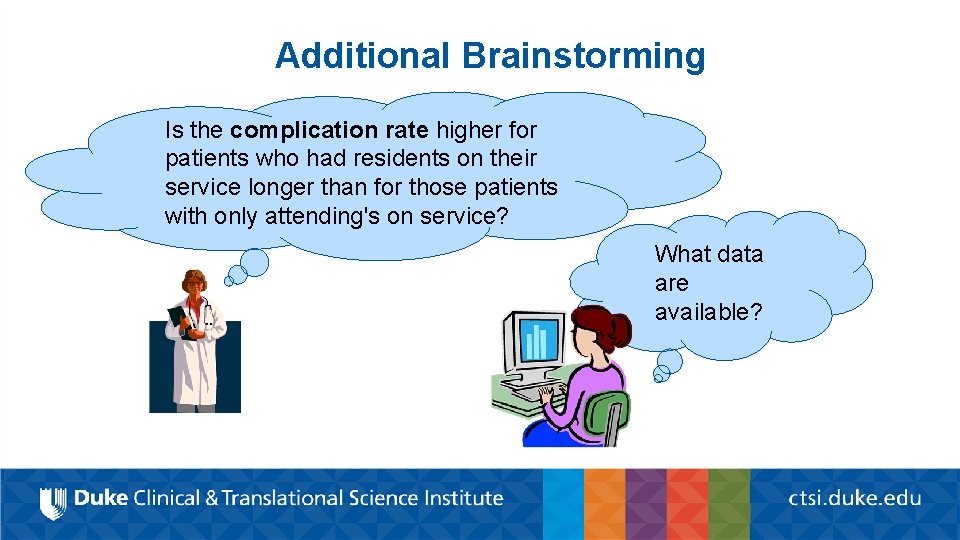
Additional Brainstorming Is the complication rate higher for patients who had residents on their service longer than for those patients with only attending's on service? What data are available?
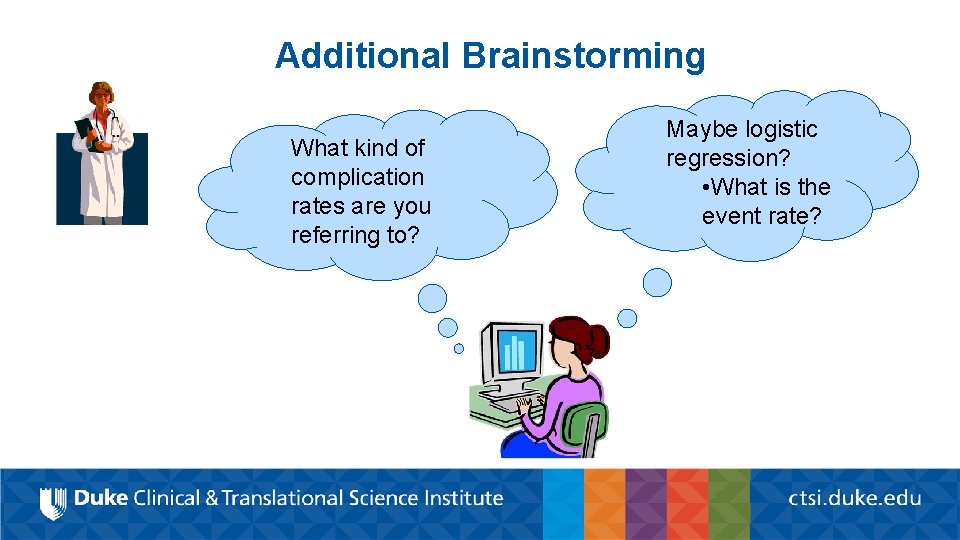
Additional Brainstorming What kind of complication rates are you referring to? Maybe logistic regression? • What is the event rate?
Step 5 Expertise and advice on randomization, data collection, database design, and data provenances is provided.
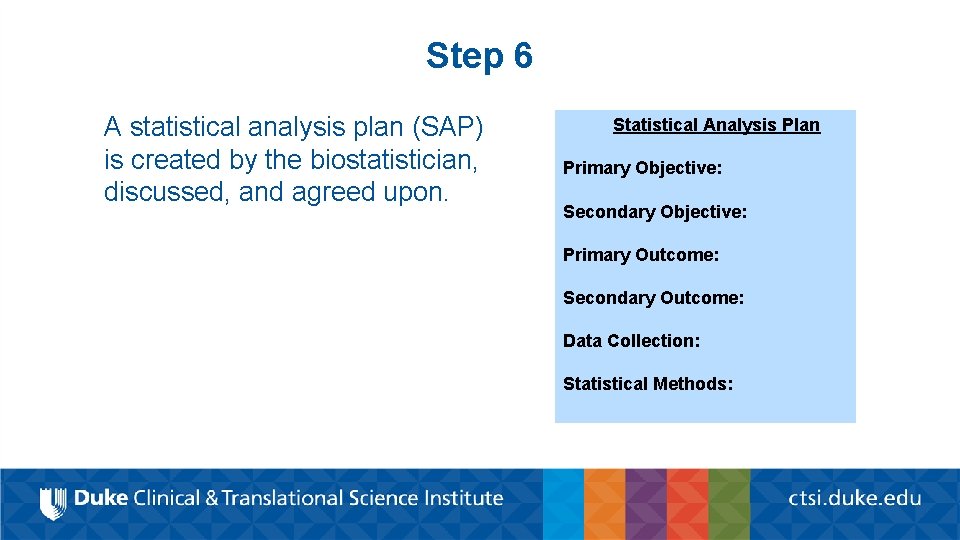
Step 6 A statistical analysis plan (SAP) is created by the biostatistician, discussed, and agreed upon. S=Statistical Analysis Plan Primary Objective: Secondary Objective: Primary Outcome: Secondary Outcome: Data Collection: Statistical Methods:
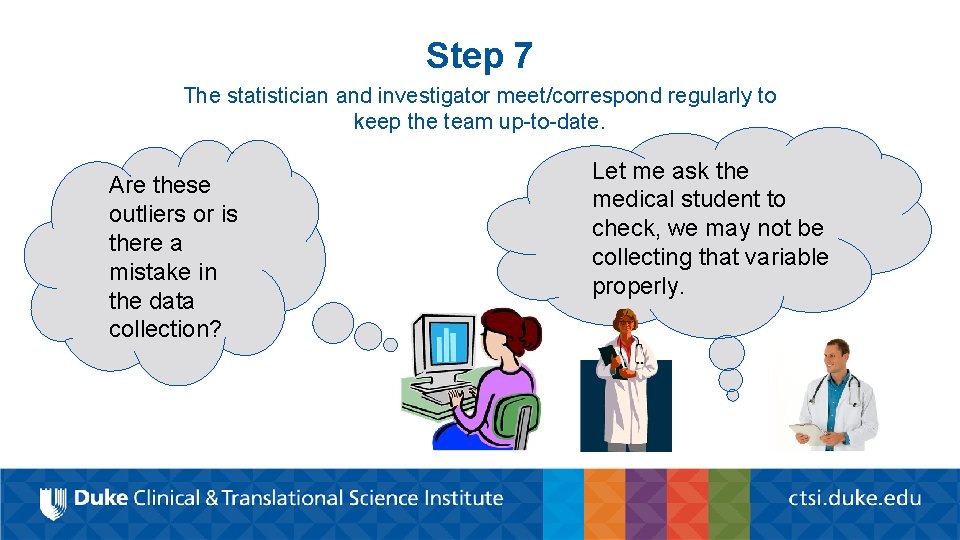
Step 7 The statistician and investigator meet/correspond regularly to keep the team up-to-date. Are these outliers or is there a mistake in the data collection? Let me ask the medical student to check, we may not be collecting that variable properly.
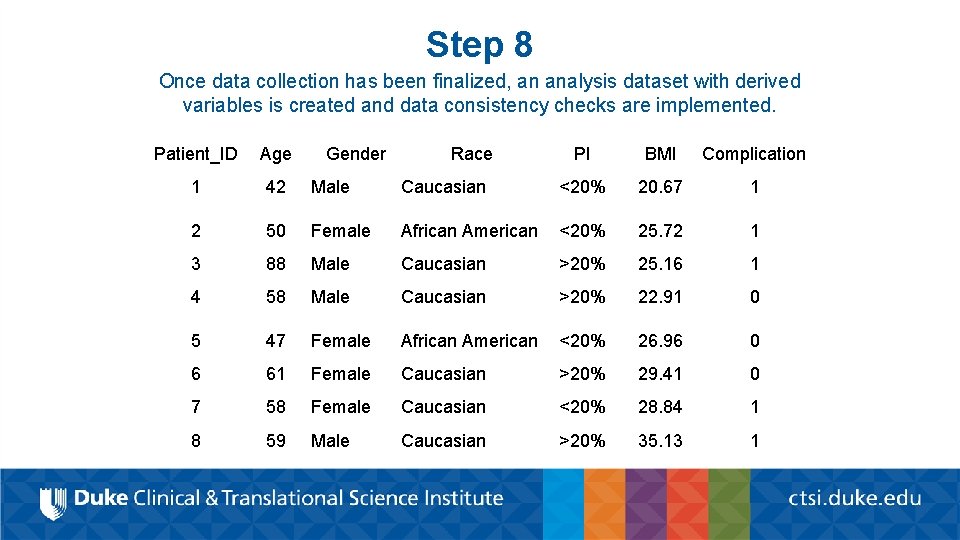
Step 8 Once data collection has been finalized, an analysis dataset with derived variables is created and data consistency checks are implemented. Patient_ID Age Gender 1 42 Male 2 50 3 Race PI BMI Complication Caucasian <20% 20. 67 1 Female African American <20% 25. 72 1 88 Male Caucasian >20% 25. 16 1 4 58 Male Caucasian >20% 22. 91 0 5 47 Female African American <20% 26. 96 0 6 61 Female Caucasian >20% 29. 41 0 7 58 Female Caucasian <20% 28. 84 1 8 59 Male Caucasian >20% 35. 13 1
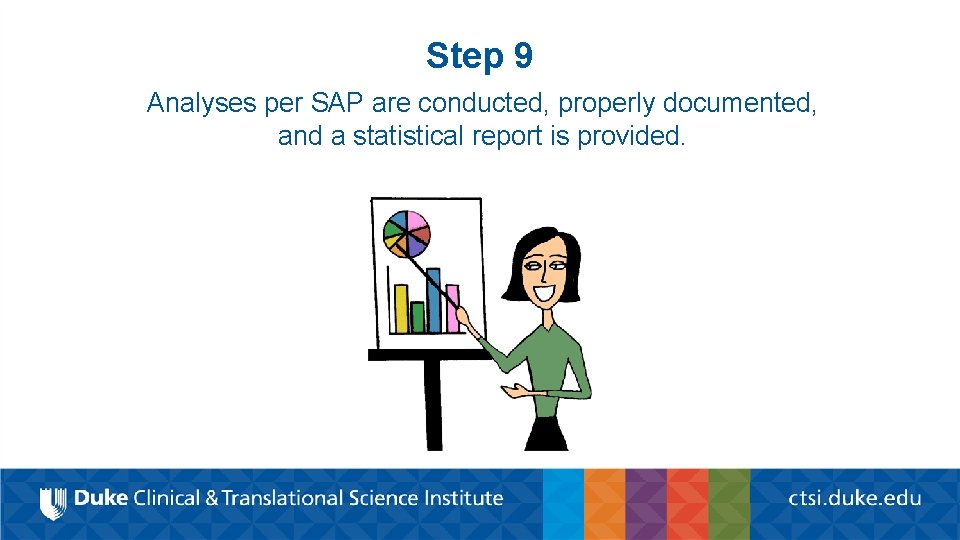
Step 9 Analyses per SAP are conducted, properly documented, and a statistical report is provided.
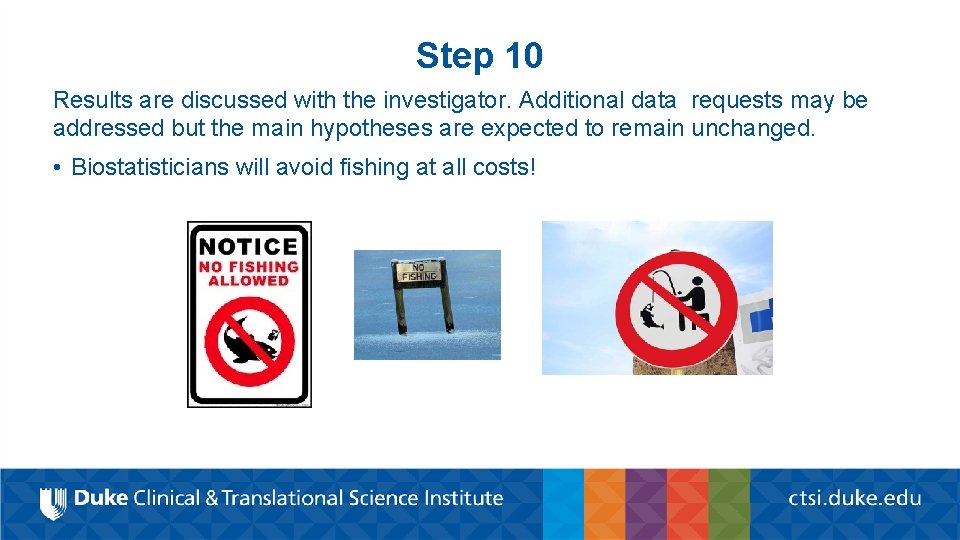
Step 10 Results are discussed with the investigator. Additional data requests may be addressed but the main hypotheses are expected to remain unchanged. • Biostatisticians will avoid fishing at all costs!
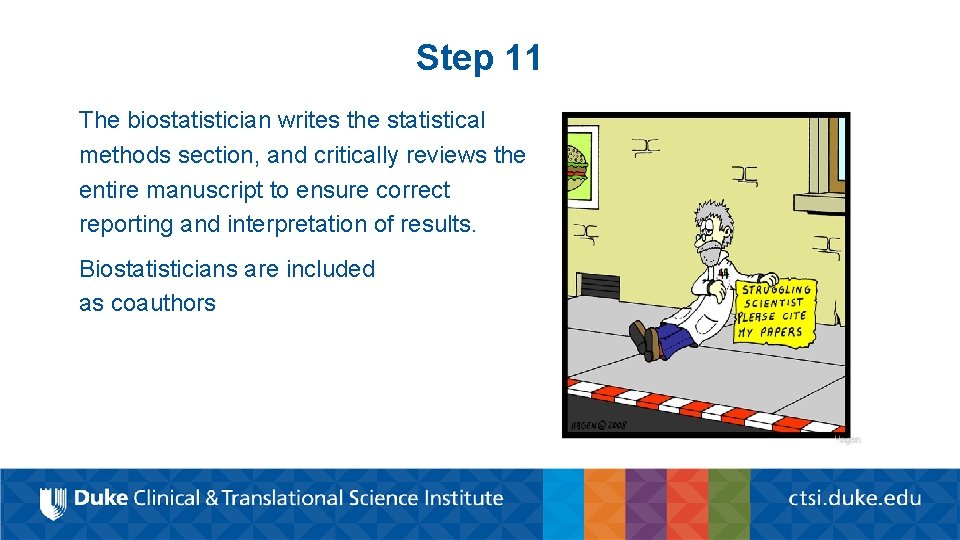
Step 11 The biostatistician writes the statistical methods section, and critically reviews the entire manuscript to ensure correct reporting and interpretation of results. Biostatisticians are included as coauthors
Can Biostatisticians do it all?
Cross Disciplinary Methods Teams Don’t replicate resources – build connections • Why have a biostatistician learn details of RNA-Seq or focus group analysis when we have a core that does this daily?
Cross Disciplinary Methods Teams Educate methodologists of the benefit of multiple collaborators – DIVERSITY is key • Biostatisticians can learn the intuition behind methods by working alongside the informatician/qualitative researcher • One Biostatistician may have more expertise with image analysis and another with causal inference
Health Economics Survey Design/Social Science Research Biostatistics Epidemiology Qualitative Analysis Bioinformatics Implementation Science Collaborative Teams • Neurology • Community and Family Medicine • Anesthesiology • Division of Internal Medicine • Radiology • Neurosurgery • Duke Global Health Institute • Biomedical Engineering • etc.
Contact Gina-Maria. Pomann@duke. edu http: //biostat. duke. edu/berd-methods-core
CTSI Grand Rounds | March 14, 2019 Thank you! Please join us for our next Grand Rounds: Duke Early Phase Clinical Research Unit (DEPRU) May 16, 2019 | 12: 00 p. m.