
A Features Common to All Cell Types B
A. Features Common to All Cell Types B. Prokaryotic Cells C. Eukaryotic Cells D. Viruses Microbial Cell Structure A. Features common to all cell types B. Prokaryotic cells 1. General features 2. Prokaryotic Cell Structures C. Eukaryotic cells 1. General Features 2. Eukaryotic Cell Structures D. Viruses Updated: Jan 23, 2007
A. Features Common to All Cell Types B. Prokaryotic Cells C. Eukaryotic Cells D. Viruses A. Features common to all cell types 1. Bounded by a plasma membrane 2. Contain cytoplasm 3. Utilize energy and raw materials through metabolism 4. Have both DNA and RNA 5. Reproduce by cell division processes
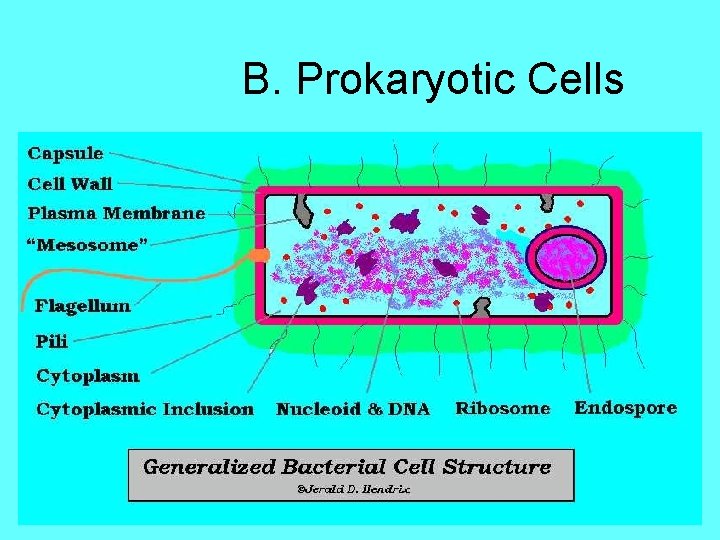
A. Features Common to All Cell Types B. Prokaryotic Cells 1. General Features 2. Prokaryotic Cell Structures a. Plasma membrane b. The cytoplasmic matrix c. Ribosomes d. Cytoplasmic inclusions e. The nucleoid f. Prokaryotic cell walls g. Capsules, slime layers, and S-layers h. Fimbriae and pili i. Bacterial flagella and motility j. Bacterial spores C. Eukaryotic Cells D. Viruses B. Prokaryotic Cells 1. General Features a) Have: no (or few) internal membranes b) Many processes that are associated with organelles in eukaryotes (e. g. Respiration, photosynthesis) are mediated by specialized regions of the plasma membrane in prokaryotes
A. Features Common to All Cell Types B. Prokaryotic Cells 1. General Features 2. Prokaryotic Cell Structures a. Plasma membrane b. The cytoplasmic matrix c. Ribosomes d. Cytoplasmic inclusions e. The nucleoid f. Prokaryotic cell walls g. Capsules, slime layers, and S-layers h. Fimbriae and pili i. Bacterial flagella and motility j. Bacterial spores C. Eukaryotic Cells D. Viruses B. Prokaryotic Cells 1. General Features (cont. ) c) There is no membrane-bound nucleus in prokaryotes. Instead the DNA is located within a specialized region of the cytoplasm of the cell called the nucleoid region. There is no nuclear membrane surrounding the nucleoid. d) Includes: the bacteria & archaea the terms “prokaryotic cell” and “bacterial cell” often are used interchangeably
A. Features Common to All Cell Types B. Prokaryotic Cells 1. General Features 2. Prokaryotic Cell Structures a. Plasma membrane b. The cytoplasmic matrix c. Ribosomes d. Cytoplasmic inclusions e. The nucleoid f. Prokaryotic cell walls g. Capsules, slime layers, and S-layers h. Fimbriae and pili i. Bacterial flagella and motility j. Bacterial spores C. Eukaryotic Cells D. Viruses B. Prokaryotic Cells 1. General Features (cont. ) e) Shapes & Arrangements: See shapes handout f) Sizes • Typically ~ 0. 1 - 20 m (with some exceptions) • Typical coccus: ~ 1 m (e. g. Staphylococcus) • Typical short rod: ~ 1 x 5 m (e. g. E. coli) • Barely within the best resolution of a
B. Prokaryotic Cells
A. Features Common to All Cell Types B. Prokaryotic Cells 1. General Features 2. Prokaryotic Cell Structures a. Plasma membrane b. The cytoplasmic matrix c. Ribosomes d. Cytoplasmic inclusions e. The nucleoid f. Prokaryotic cell walls g. Capsules, slime layers, and S-layers h. Fimbriae and pili i. Bacterial flagella and motility j. Bacterial spores C. Eukaryotic Cells D. Viruses B. 2. Prokaryotic Cell Structures a) Plasma membrane • • Structure – Phospholipid Bilayer with Associated Proteins – Cholesterol is absent (except in the mycoplasma group) – Hopanoids are often present – Some archaea have plasma membranes with unusual lipids and monolayer structures Functions – Maintain Cell Integrity – Regulate Transport – Specialized Functions in Bacteria
A. Features Common to All Cell Types B. Prokaryotic Cells 1. General Features 2. Prokaryotic Cell Structures a. Plasma membrane b. The cytoplasmic matrix c. Ribosomes d. Cytoplasmic inclusions e. The nucleoid f. Prokaryotic cell walls g. Capsules, slime layers, and S-layers h. Fimbriae and pili i. Bacterial flagella and motility j. Bacterial spores C. Eukaryotic Cells D. Viruses B. 2. Prokaryotic Cell Structures a) Plasma membrane (cont. ) • Internal membranes – “Mesosomes” – Respiratory and Photosynthetic folds
A. Features Common to All Cell Types B. Prokaryotic Cells 1. General Features 2. Prokaryotic Cell Structures a. Plasma membrane b. The cytoplasmic matrix c. Ribosomes d. Cytoplasmic inclusions e. The nucleoid f. Prokaryotic cell walls g. Capsules, slime layers, and S-layers h. Fimbriae and pili i. Bacterial flagella and motility j. Bacterial spores C. Eukaryotic Cells D. Viruses B. 2. Prokaryotic Cell Structures a) The cytoplasmic matrix • Composition: – Viscous aqueous suspension of proteins, nucleic acid, dissolved organic compounds, mineral salts – Network of protein fibers similar to the eukaryotic cytoskeleton
A. Features Common to All Cell Types B. Prokaryotic Cells 1. General Features 2. Prokaryotic Cell Structures a. Plasma membrane b. The cytoplasmic matrix c. Ribosomes d. Cytoplasmic inclusions e. The nucleoid f. Prokaryotic cell walls g. Capsules, slime layers, and S-layers h. Fimbriae and pili i. Bacterial flagella and motility j. Bacterial spores C. Eukaryotic Cells D. Viruses B. 2. Prokaryotic Cell Structures a) Ribosomes • • • Sites of protein synthesis Typically several thousand ribosomes per bacterial cell, depending on the state of its metabolic activity Smaller than eukaryotic ribosomes
A. Features Common to All Cell Types B. Prokaryotic Cells 1. General Features 2. Prokaryotic Cell Structures a. Plasma membrane b. The cytoplasmic matrix c. Ribosomes d. Cytoplasmic inclusions e. The nucleoid f. Prokaryotic cell walls g. Capsules, slime layers, and S-layers h. Fimbriae and pili i. Bacterial flagella and motility j. Bacterial spores C. Eukaryotic Cells D. Viruses B. 2. Prokaryotic Cell Structures a) Cytoplasmic inclusions • • • Glycogen Granules Poly- -hydroxybutyrate granules Lipid droplets Gas vacuoles Metachromatic granules (Phosphate crystals or volutin granules) Sulfur Granules
A. Features Common to All Cell Types B. Prokaryotic Cells 1. General Features 2. Prokaryotic Cell Structures a. Plasma membrane b. The cytoplasmic matrix c. Ribosomes d. Cytoplasmic inclusions e. The nucleoid f. Prokaryotic cell walls g. Capsules, slime layers, and S-layers h. Fimbriae and pili i. Bacterial flagella and motility j. Bacterial spores C. Eukaryotic Cells D. Viruses B. 2. Prokaryotic Cell Structures a) Nucleoid • • Chromosomal DNA – Typically, one chromosome per bacterial cell – Consists of double-stranded, circular DNA – A few recently discovered groups have >1 chromosome per cell and linear chromosomes Plasmid DNA – R-Plasmids – F-Plasmids
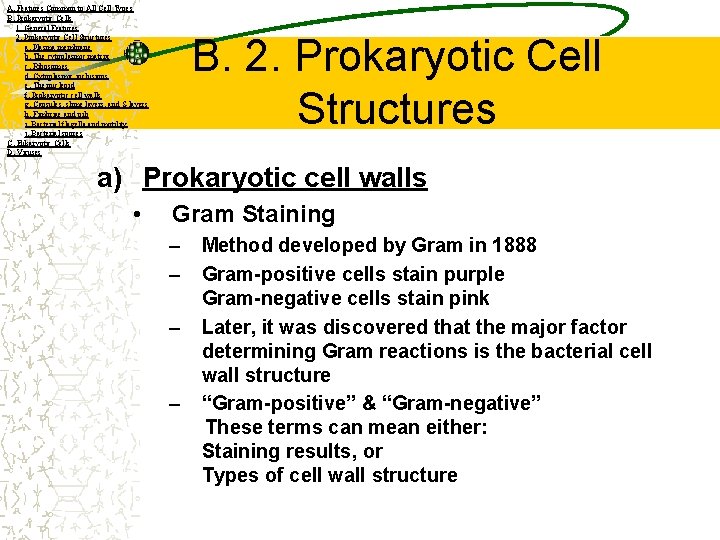
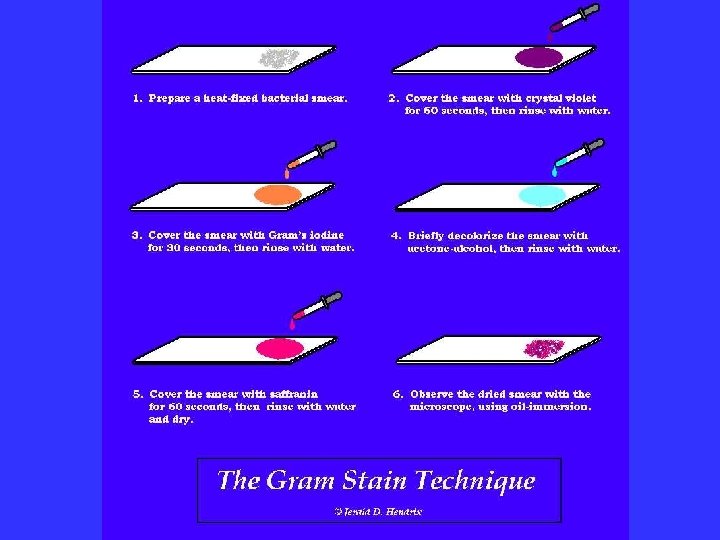
A. Features Common to All Cell Types B. Prokaryotic Cells 1. General Features 2. Prokaryotic Cell Structures a. Plasma membrane b. The cytoplasmic matrix c. Ribosomes d. Cytoplasmic inclusions e. The nucleoid f. Prokaryotic cell walls g. Capsules, slime layers, and S-layers h. Fimbriae and pili i. Bacterial flagella and motility j. Bacterial spores C. Eukaryotic Cells D. Viruses B. 2. Prokaryotic Cell Structures a) Prokaryotic cell walls • Gram Staining – – Method developed by Gram in 1888 Gram-positive cells stain purple Gram-negative cells stain pink Later, it was discovered that the major factor determining Gram reactions is the bacterial cell wall structure “Gram-positive” & “Gram-negative” These terms can mean either: Staining results, or Types of cell wall structure
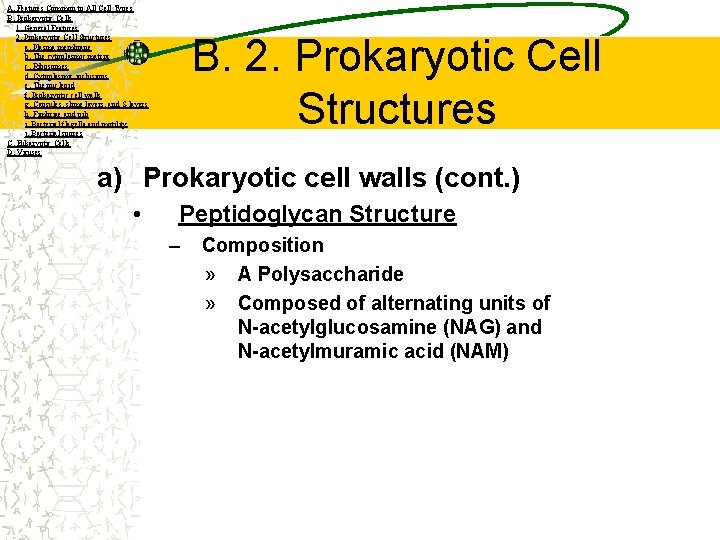
A. Features Common to All Cell Types B. Prokaryotic Cells 1. General Features 2. Prokaryotic Cell Structures a. Plasma membrane b. The cytoplasmic matrix c. Ribosomes d. Cytoplasmic inclusions e. The nucleoid f. Prokaryotic cell walls g. Capsules, slime layers, and S-layers h. Fimbriae and pili i. Bacterial flagella and motility j. Bacterial spores C. Eukaryotic Cells D. Viruses B. 2. Prokaryotic Cell Structures a) Prokaryotic cell walls (cont. ) • Peptidoglycan Structure – Composition » A Polysaccharide » Composed of alternating units of N-acetylglucosamine (NAG) and N-acetylmuramic acid (NAM)
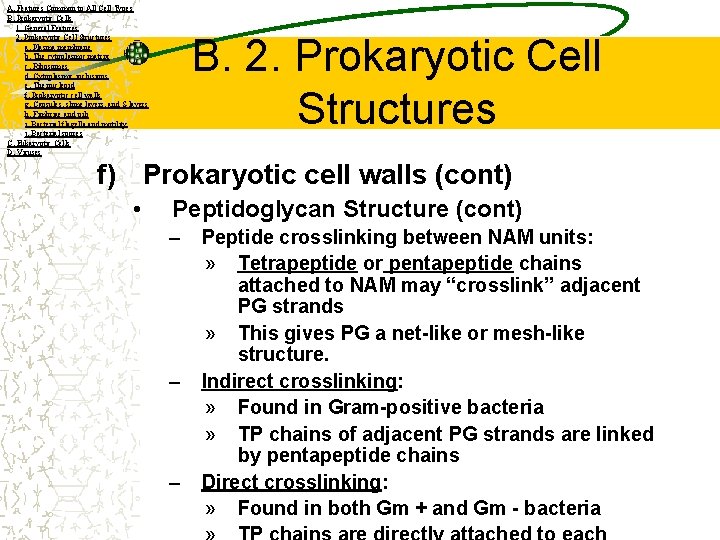
A. Features Common to All Cell Types B. Prokaryotic Cells 1. General Features 2. Prokaryotic Cell Structures a. Plasma membrane b. The cytoplasmic matrix c. Ribosomes d. Cytoplasmic inclusions e. The nucleoid f. Prokaryotic cell walls g. Capsules, slime layers, and S-layers h. Fimbriae and pili i. Bacterial flagella and motility j. Bacterial spores C. Eukaryotic Cells D. Viruses B. 2. Prokaryotic Cell Structures f) Prokaryotic cell walls (cont) • Peptidoglycan Structure (cont) – – – Peptide crosslinking between NAM units: » Tetrapeptide or pentapeptide chains attached to NAM may “crosslink” adjacent PG strands » This gives PG a net-like or mesh-like structure. Indirect crosslinking: » Found in Gram-positive bacteria » TP chains of adjacent PG strands are linked by pentapeptide chains Direct crosslinking: » Found in both Gm + and Gm - bacteria
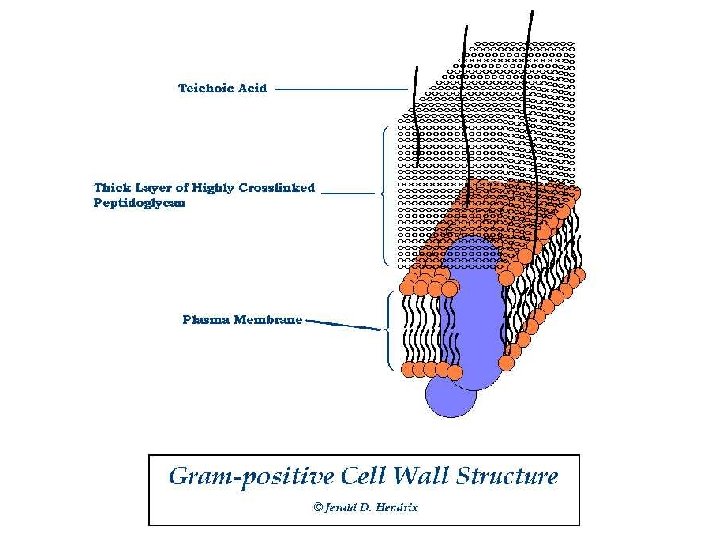
A. Features Common to All Cell Types B. Prokaryotic Cells 1. General Features 2. Prokaryotic Cell Structures a. Plasma membrane b. The cytoplasmic matrix c. Ribosomes d. Cytoplasmic inclusions e. The nucleoid f. Prokaryotic cell walls g. Capsules, slime layers, and S-layers h. Fimbriae and pili i. Bacterial flagella and motility j. Bacterial spores C. Eukaryotic Cells D. Viruses B. 2. Prokaryotic Cell Structures f) Prokaryotic cell walls (cont. ) • Gram-positive Cell Wall – – – Thick layer of Peptidoglycan » 20 -80 nm in thickness » Extensively crosslinked, both with indirect & direct links Teichoic Acids » Polymers of glycerol or ribitol » Inserted into the PG layer » Sometimes attached to plasma membrane lipids Periplasmic Space » Space between the PG layer and the plasma membrane » Much smaller than in gram negative bacteria --
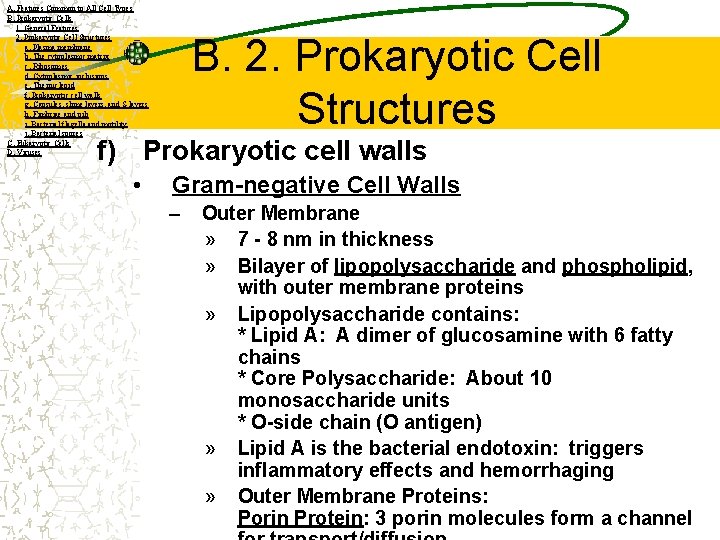
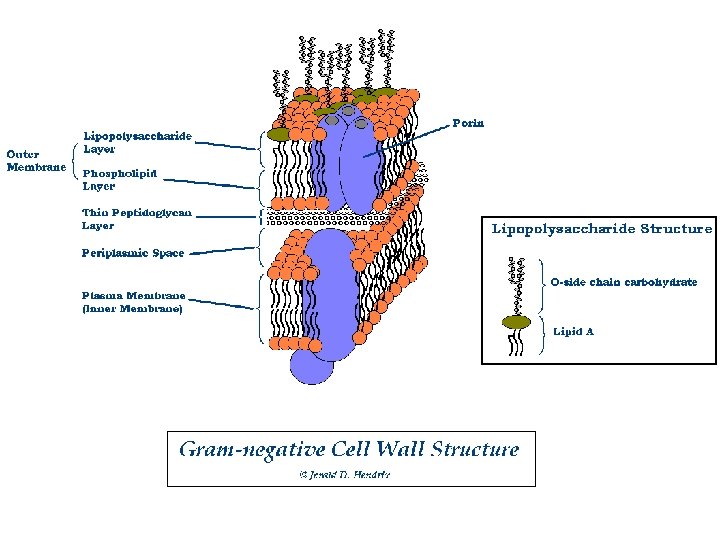
A. Features Common to All Cell Types B. Prokaryotic Cells 1. General Features 2. Prokaryotic Cell Structures a. Plasma membrane b. The cytoplasmic matrix c. Ribosomes d. Cytoplasmic inclusions e. The nucleoid f. Prokaryotic cell walls g. Capsules, slime layers, and S-layers h. Fimbriae and pili i. Bacterial flagella and motility j. Bacterial spores C. Eukaryotic Cells D. Viruses B. 2. Prokaryotic Cell Structures f) Prokaryotic cell walls • Gram-negative Cell Walls – Outer Membrane » 7 - 8 nm in thickness » Bilayer of lipopolysaccharide and phospholipid, with outer membrane proteins » Lipopolysaccharide contains: * Lipid A: A dimer of glucosamine with 6 fatty chains * Core Polysaccharide: About 10 monosaccharide units * O-side chain (O antigen) » Lipid A is the bacterial endotoxin: triggers inflammatory effects and hemorrhaging » Outer Membrane Proteins: Porin Protein: 3 porin molecules form a channel
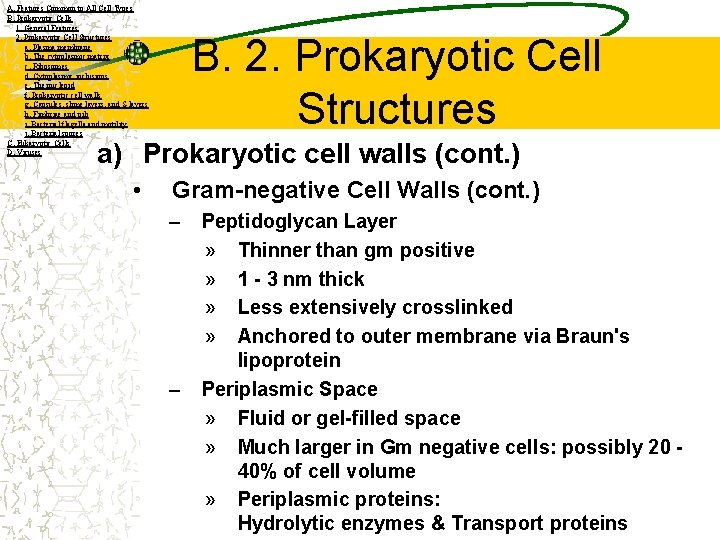
A. Features Common to All Cell Types B. Prokaryotic Cells 1. General Features 2. Prokaryotic Cell Structures a. Plasma membrane b. The cytoplasmic matrix c. Ribosomes d. Cytoplasmic inclusions e. The nucleoid f. Prokaryotic cell walls g. Capsules, slime layers, and S-layers h. Fimbriae and pili i. Bacterial flagella and motility j. Bacterial spores C. Eukaryotic Cells D. Viruses B. 2. Prokaryotic Cell Structures a) Prokaryotic cell walls (cont. ) • Gram-negative Cell Walls (cont. ) – – Peptidoglycan Layer » Thinner than gm positive » 1 - 3 nm thick » Less extensively crosslinked » Anchored to outer membrane via Braun's lipoprotein Periplasmic Space » Fluid or gel-filled space » Much larger in Gm negative cells: possibly 20 - 40% of cell volume » Periplasmic proteins: Hydrolytic enzymes & Transport proteins
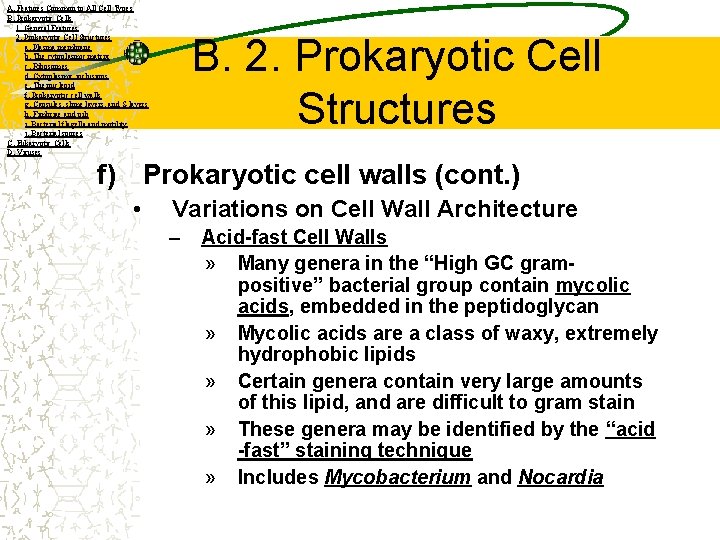
A. Features Common to All Cell Types B. Prokaryotic Cells 1. General Features 2. Prokaryotic Cell Structures a. Plasma membrane b. The cytoplasmic matrix c. Ribosomes d. Cytoplasmic inclusions e. The nucleoid f. Prokaryotic cell walls g. Capsules, slime layers, and S-layers h. Fimbriae and pili i. Bacterial flagella and motility j. Bacterial spores C. Eukaryotic Cells D. Viruses B. 2. Prokaryotic Cell Structures f) Prokaryotic cell walls (cont. ) • Variations on Cell Wall Architecture – Acid-fast Cell Walls » Many genera in the “High GC grampositive” bacterial group contain mycolic acids, embedded in the peptidoglycan » Mycolic acids are a class of waxy, extremely hydrophobic lipids » Certain genera contain very large amounts of this lipid, and are difficult to gram stain » These genera may be identified by the “acid -fast” staining technique » Includes Mycobacterium and Nocardia
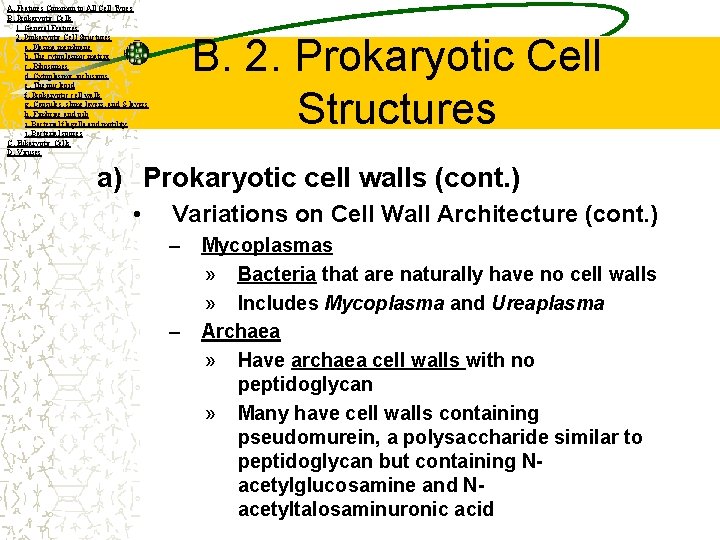
A. Features Common to All Cell Types B. Prokaryotic Cells 1. General Features 2. Prokaryotic Cell Structures a. Plasma membrane b. The cytoplasmic matrix c. Ribosomes d. Cytoplasmic inclusions e. The nucleoid f. Prokaryotic cell walls g. Capsules, slime layers, and S-layers h. Fimbriae and pili i. Bacterial flagella and motility j. Bacterial spores C. Eukaryotic Cells D. Viruses B. 2. Prokaryotic Cell Structures a) Prokaryotic cell walls (cont. ) • Variations on Cell Wall Architecture (cont. ) – – Mycoplasmas » Bacteria that are naturally have no cell walls » Includes Mycoplasma and Ureaplasma Archaea » Have archaea cell walls with no peptidoglycan » Many have cell walls containing pseudomurein, a polysaccharide similar to peptidoglycan but containing Nacetylglucosamine and Nacetyltalosaminuronic acid
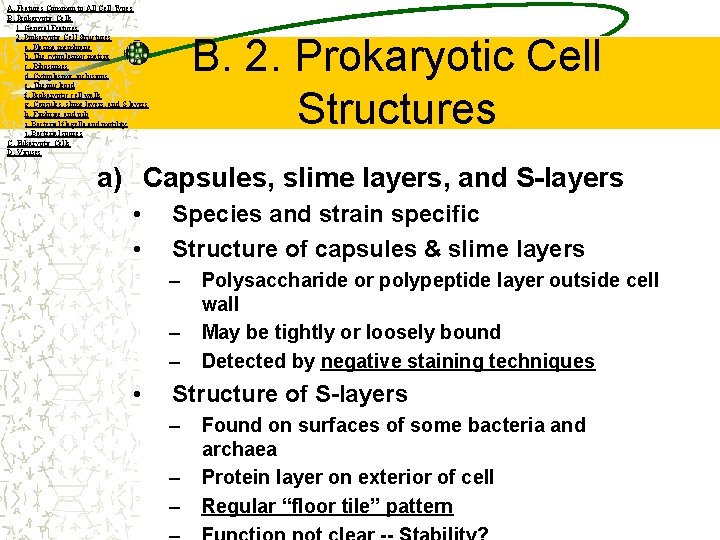
A. Features Common to All Cell Types B. Prokaryotic Cells 1. General Features 2. Prokaryotic Cell Structures a. Plasma membrane b. The cytoplasmic matrix c. Ribosomes d. Cytoplasmic inclusions e. The nucleoid f. Prokaryotic cell walls g. Capsules, slime layers, and S-layers h. Fimbriae and pili i. Bacterial flagella and motility j. Bacterial spores C. Eukaryotic Cells D. Viruses B. 2. Prokaryotic Cell Structures a) Capsules, slime layers, and S-layers • • Species and strain specific Structure of capsules & slime layers – – – • Polysaccharide or polypeptide layer outside cell wall May be tightly or loosely bound Detected by negative staining techniques Structure of S-layers – – – Found on surfaces of some bacteria and archaea Protein layer on exterior of cell Regular “floor tile” pattern
A. Features Common to All Cell Types B. Prokaryotic Cells 1. General Features 2. Prokaryotic Cell Structures a. Plasma membrane b. The cytoplasmic matrix c. Ribosomes d. Cytoplasmic inclusions e. The nucleoid f. Prokaryotic cell walls g. Capsules, slime layers, and S-layers h. Fimbriae and pili i. Bacterial flagella and motility j. Bacterial spores C. Eukaryotic Cells D. Viruses B. 2. Prokaryotic Cell Structures a) Capsules, slime layers, and S-layers (cont. ) • Functions of capsules & slime layers – Attachment – Resistance to desiccation – Nutrient Storage – Evasion of phagocytosis e. g. in Streptococcus pneumoniae S strain is encapsulated & virulent R strain is non-encapsulated & non-virulent
A. Features Common to All Cell Types B. Prokaryotic Cells 1. General Features 2. Prokaryotic Cell Structures a. Plasma membrane b. The cytoplasmic matrix c. Ribosomes d. Cytoplasmic inclusions e. The nucleoid f. Prokaryotic cell walls g. Capsules, slime layers, and S-layers h. Fimbriae and pili i. Bacterial flagella and motility j. Bacterial spores C. Eukaryotic Cells D. Viruses B. 2. Prokaryotic Cell Structures a) Fimbriae and Pili • • • Short, hair-like filaments of protein on certain bacterial cells Believed to function in attachment In a few species, specialized pili (sex pili, encoded by genes on the F plasmid) enable the transfer of DNA from one cell to another (conjugation)
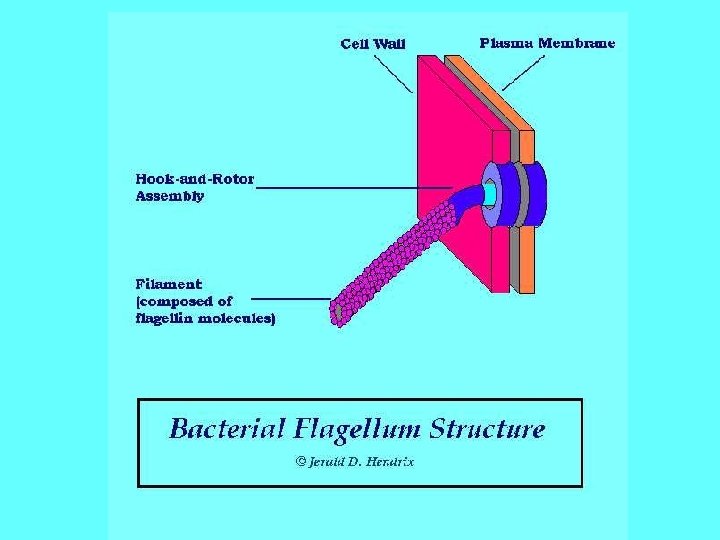
A. Features Common to All Cell Types B. Prokaryotic Cells 1. General Features 2. Prokaryotic Cell Structures a. Plasma membrane b. The cytoplasmic matrix c. Ribosomes d. Cytoplasmic inclusions e. The nucleoid f. Prokaryotic cell walls g. Capsules, slime layers, and S-layers h. Fimbriae and pili i. Bacterial flagella and motility j. Bacterial spores C. Eukaryotic Cells D. Viruses B. 2. Prokaryotic Cell Structures a) Bacterial flagella and motility • Function – – • Motility Almost all motile bacteria are motile by means of flagella Motile vs. nonmotile bacteria Detected by flagella staining or by motility agar Different species have different flagella arrangements Structure – – Filament Composed of the protein flagellin Hook & Rotor Assembly
A. Features Common to All Cell Types B. Prokaryotic Cells 1. General Features 2. Prokaryotic Cell Structures a. Plasma membrane b. The cytoplasmic matrix c. Ribosomes d. Cytoplasmic inclusions e. The nucleoid f. Prokaryotic cell walls g. Capsules, slime layers, and S-layers h. Fimbriae and pili i. Bacterial flagella and motility j. Bacterial spores C. Eukaryotic Cells D. Viruses B. 2. Prokaryotic Cell Structures a) Bacterial flagella and motility (cont. ) • Mechanism of Motility – – “Run and Tumble” Movement controlled by the direction of the flagellar spin Counterclockwise spin = Straight Run Clockwise spin = Random Tumble
A. Features Common to All Cell Types B. Prokaryotic Cells 1. General Features 2. Prokaryotic Cell Structures a. Plasma membrane b. The cytoplasmic matrix c. Ribosomes d. Cytoplasmic inclusions e. The nucleoid f. Prokaryotic cell walls g. Capsules, slime layers, and S-layers h. Fimbriae and pili i. Bacterial flagella and motility j. Bacterial spores C. Eukaryotic Cells D. Viruses i) B. 2. Prokaryotic Cell Structures Bacterial flagella and motility (cont. ) • Chemotaxis – – Response to the concentration of chemical attractants and repellants As a bacterium approaches an attractant: the lengths of the straight runs increase As a bacterium approaches a repellant: the lengths of the straight runs decrease Mechanism of chemotaxis: Stimulation of chemotactic receptors in the PM: this triggers a “cascade” of enzymatic activity that alters the timer setting of the flagella rotors
A. Features Common to All Cell Types B. Prokaryotic Cells 1. General Features 2. Prokaryotic Cell Structures a. Plasma membrane b. The cytoplasmic matrix c. Ribosomes d. Cytoplasmic inclusions e. The nucleoid f. Prokaryotic cell walls g. Capsules, slime layers, and S-layers h. Fimbriae and pili i. Bacterial flagella and motility j. Bacterial spores C. Eukaryotic Cells D. Viruses B. 2. Prokaryotic Cell Structures a) Bacterial spores • Function – – • To permit the organism to survive during conditions of desiccation, nutrient depletion, and waste buildup Bacterial spores are NOT a reproductive structure, like plant or fungal spores Occurrence – – Produced by very few genera of bacteria Major examples Bacillus Clostridium
A. Features Common to All Cell Types B. Prokaryotic Cells 1. General Features 2. Prokaryotic Cell Structures a. Plasma membrane b. The cytoplasmic matrix c. Ribosomes d. Cytoplasmic inclusions e. The nucleoid f. Prokaryotic cell walls g. Capsules, slime layers, and S-layers h. Fimbriae and pili i. Bacterial flagella and motility j. Bacterial spores C. Eukaryotic Cells D. Viruses B. 2. Prokaryotic Cell Structures a) Bacterial spores (cont. ) • Significance in Medicine & Industry – – – Spores are resistant to killing Cannot be killed by moist heat at 100°C (boiling) Killing spores by moist heat requires heating to 120°C for 15 -20 min (autoclaving or pressure cooking)
A. Features Common to All Cell Types B. Prokaryotic Cells 1. General Features 2. Prokaryotic Cell Structures a. Plasma membrane b. The cytoplasmic matrix c. Ribosomes d. Cytoplasmic inclusions e. The nucleoid f. Prokaryotic cell walls g. Capsules, slime layers, and S-layers h. Fimbriae and pili i. Bacterial flagella and motility j. Bacterial spores C. Eukaryotic Cells D. Viruses B. 2. Prokaryotic Cell Structures a) Bacterial spores (cont. ) • Sporulation – – – The process of spore formation Governed by genetic mechanism A copy of the bacterial chromosome is surrounded by a thick, durable spore coat This forms an endospore within a vegetative cell When the vegetative cell dies and ruptures, the free spore is released
A. Features Common to All Cell Types B. Prokaryotic Cells 1. General Features 2. Prokaryotic Cell Structures a. Plasma membrane b. The cytoplasmic matrix c. Ribosomes d. Cytoplasmic inclusions e. The nucleoid f. Prokaryotic cell walls g. Capsules, slime layers, and S-layers h. Fimbriae and pili i. Bacterial flagella and motility j. Bacterial spores C. Eukaryotic Cells D. Viruses B. 2. Prokaryotic Cell Structures a) Bacterial spores (cont. ) • Spore Germination – – When a spore encounters favorable growth conditions The spore coat ruptures and a new vegetative cell is formed
A. Features Common to All Cell Types B. Prokaryotic Cells C. Eukaryotic Cells 1. General Features 2. Eukaryotic cell structures a. Nucleus b. Ribosomes c. Cytomembrane system d. Mitochondria e. Chloroplasts f. Cytoskeleton g. Vacuoles h. Peroxisomes D. Viruses C. Eukaryotic Cells 1. General Features a) Have: complex internal membrane system compartmentalization membrane-enclosed organelles b) DNA is enclosed in a membrane-bound nucleus c) Includes: animal & plant cells, fungi, & protists (protozoa & algae)
A. Features Common to All Cell Types B. Prokaryotic Cells C. Eukaryotic Cells 1. General Features 2. Eukaryotic cell structures a. Nucleus b. Ribosomes c. Cytomembrane system d. Mitochondria e. Chloroplasts f. Cytoskeleton g. Vacuoles h. Peroxisomes D. Viruses C. 2. Eukaryotic Cell Structures 1. Eukaryotic Cell Structures a) Nucleus • • Location of the cell’s DNA Major processes: – – DNA replication DNA expression (transcription)
A. Features Common to All Cell Types B. Prokaryotic Cells C. Eukaryotic Cells 1. General Features 2. Eukaryotic cell structures a. Nucleus b. Ribosomes c. Cytomembrane system d. Mitochondria e. Chloroplasts f. Cytoskeleton g. Vacuoles h. Peroxisomes D. Viruses C. 2. Eukaryotic Cell Structures b) Ribosomes • • Thousands are located suspended in the cytoplasm and attached to the rough endoplasmic reticulum Major process: – • • Protein synthesis (translation) Ribosomes in the eukaryotic cytoplasm are larger than prokaryotic ribosomes Ribosomes are also found within mitochondria and chloroplasts; the ribosomes of these organelles are very similar in structure & size to prokaryotic
A. Features Common to All Cell Types B. Prokaryotic Cells C. Eukaryotic Cells 1. General Features 2. Eukaryotic cell structures a. Nucleus b. Ribosomes c. Cytomembrane system d. Mitochondria e. Chloroplasts f. Cytoskeleton g. Vacuoles h. Peroxisomes D. Viruses C. 2. Eukaryotic Cell Structures c) Cytomembrane system • Folded sacks of membranes within the cytoplasm • Carry out processing and export of the cell’s proteins • Major components: – Endoplasmic reticulum (rough and smooth) – Golgi apparatus – Transport vesicles – Lysosomes
A. Features Common to All Cell Types B. Prokaryotic Cells C. Eukaryotic Cells 1. General Features 2. Eukaryotic cell structures a. Nucleus b. Ribosomes c. Cytomembrane system d. Mitochondria e. Chloroplasts f. Cytoskeleton g. Vacuoles h. Peroxisomes D. Viruses C. 2. Eukaryotic Cell Structures d) Mitochondria • Located in the cell’s cytoplasm • Major process: cellular respiration • – The mitochondria oxidize nutrient molecules with the help of oxygen – Some of the energy is conserved in the form of chemical energy (energy-containing chemical compounds) that can be used for biological processes Evolved from bacteria by a process called endosymbiosis
A. Features Common to All Cell Types B. Prokaryotic Cells C. Eukaryotic Cells 1. General Features 2. Eukaryotic cell structures a. Nucleus b. Ribosomes c. Cytomembrane system d. Mitochondria e. Chloroplasts f. Cytoskeleton g. Vacuoles h. Peroxisomes D. Viruses C. 2. Eukaryotic Cell Structures e) Chloroplasts • Located in the cytoplasm of plant cells, algae cells, and certain protozoan cells • Major process: photosynthesis – • Using the energy from light, CO 2 is converted into carbohydrates such as glucose Evolved from bacteria by endosymbiosis
A. Features Common to All Cell Types B. Prokaryotic Cells C. Eukaryotic Cells 1. General Features 2. Eukaryotic cell structures a. Nucleus b. Ribosomes c. Cytomembrane system d. Mitochondria e. Chloroplasts f. Cytoskeleton g. Vacuoles h. Peroxisomes D. Viruses C. 2. Eukaryotic Cell Structures f) Cytoskeleton • Microfilaments • Microtubules • Intermediate filaments g) Vacuoles h) Peroxisomes
A. Features Common to All Cell Types B. Prokaryotic Cells C. Eukaryotic Cells D. Viruses 1. Structure of a “Virus Particle” a) Noncellular Biological Entity b) Contains either DNA or RNA (not both) c) Nucleic Acid is surrounded or coated by a protein shell (capsid) d) Some viruses possess a membranelike envelope surrounding the particle
A. Features Common to All Cell Types B. Prokaryotic Cells C. Eukaryotic Cells D. Viruses 1. Viral Replication a) b) c) d) No independent metabolism or replication Replicate only inside an infected host cell Do not replicate via a process of cell division Replicate via a process of: • • • Attachment and Penetration Disassembly (uncoating) Synthesis of Viral Protein and Nucleic Acid Reassembly of new viral particles Release of new viral particles
- Slides: 43