
A Fast File System For UNIX By Marshall

A Fast File System For UNIX By Marshall Kirk Mc. Kusick, William N. Joy Samuel J. Leffler Robert S. Fabry Presented by Zhifei Wang
Outline § Introduction § Old file system overview § New file system § New organization § Functional Enhancement § Performance § Conclusion
Introduction § UNIX File Abstraction § Everything as sequential byte stream § Old File System § Developed at Bell Labs § Each disk drive is divided into one or more partitions § Each disk partition may contain one file system § File system never spans multiple partitions
Old File System § File System Layout § I-Nodes § Problems
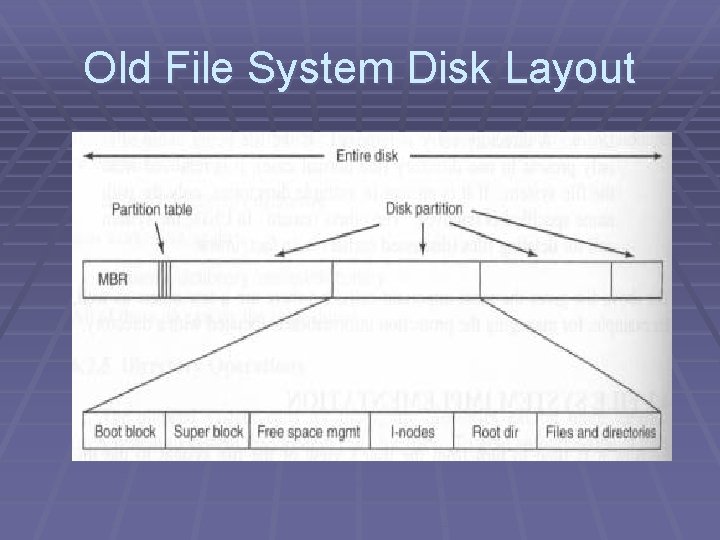
Old File System Disk Layout

INodes: 1. File ownership information 2. Time Stamps for last modification/acces s 3. Array of pointers to data blocks of the underlying file

INodes
Old File System § Problem § Low Throughput § Long seek time § Why? § Transfer only 512 bytes once, at most § No read-ahead § Almost every access needs seek
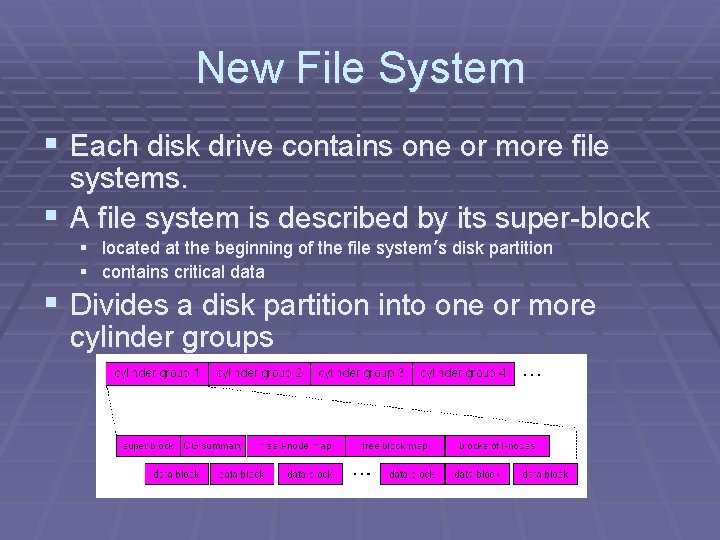
New File System § Each disk drive contains one or more file systems. § A file system is described by its super-block § located at the beginning of the file system’s disk partition § contains critical data § Divides a disk partition into one or more cylinder groups
New File System – Cylinder Group § Redundant copy of super-block kept at varying offset so it spirals through the disk § i-nodes § Bit map describing available blocks Summary info describing usage of data blocks
New File System – Optimization at storage utilization § Larger blocks can be transferred in a single disk transaction § By increasing block size, disk access in NFS can transfer 4 times information than OFS per disk transaction. § eg: File in NFS – 4096 byte blocks § Problem: Huge Waste § Most UNIX file systems are composed of small files § Large block size wastes internal space
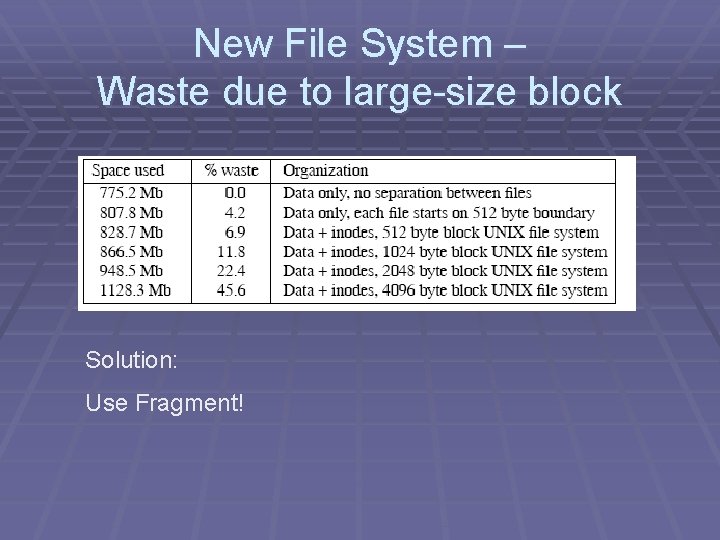
New File System – Waste due to large-size block Solution: Use Fragment!
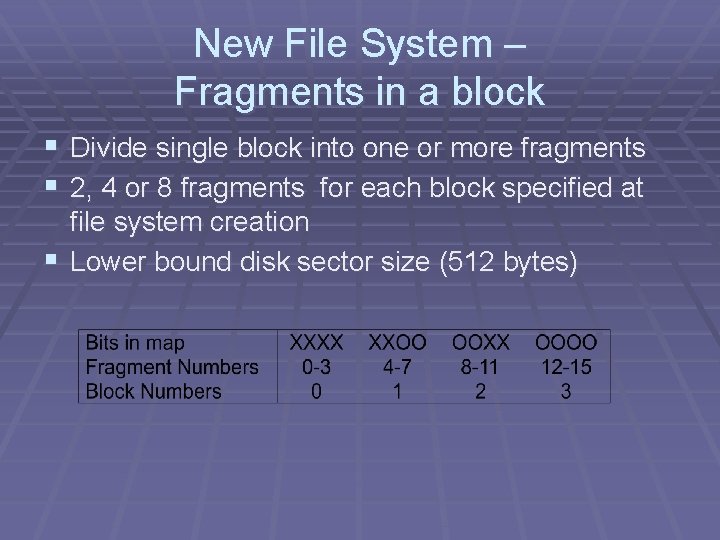
New File System – Fragments in a block § Divide single block into one or more fragments § 2, 4 or 8 fragments for each block specified at file system creation § Lower bound disk sector size (512 bytes)
New File System – Space Allocation § New space to be allocated upon write system call § Each time the system checks to see if the size of the file has increased Strategies: § If enough space, just do it. § No fragmented blocks and no space in last block § Write in already-allocated / new full block § File contains one or more fragments with no space § If (size of new data + size of data already in fragments) > size of a full block, then a new block allocated and contents of the fragment are copied. Then continue to do as situation 2 § But, this would cause problem! § Don’t make completely full, 90% is optimal
New File System – Parameterization § Goal § To parameterize the processor capabilities & mass storage characteristics so that blocks can be allocated in an optimum configuration-dependent way § Parameters used § § § Speed of the processor Hardware support for mass storage transfers Characteristics of the mass storage devices
New File System – Parameterization (cont’d) § How to achieve optimum configuration § Allocate new blocks on same cylinder as previous block § Cylinder group summary info keeps count of available blocks in cylinder group at different rotational positions § 8 rotational positions § Super-block contains vector of lists called rotational layout tables § Parameter that defines the number of milliseconds between completion of a data transfer and the initiation of another data transfer on same cylinder can be changed at any time
New File System – Layout Policy § Goal: § Increase locality of reference to minimize seek latency § Improve layout of data to make larger transfers possible § Global Policies § Make placement decisions for new i-nodes and data blocks § Calculate rotationally optimal block layouts § Decide when to force long seek because insufficient blocks § Local Policies § Use locally optimal scheme to lay out data blocks § Must strike a balance to avoid too much locality
New File System – Layout Policy (cont’d) § Tries to place all i-nodes of files in a directory in the same cylinder group § Allocation of i-nodes is done randomly/using a next free strategy within a cylinder group § Small & constant upper bound on the number of disk transfers (to access the i-nodes for all files in a directory) § When data blocks are used, file spilling is handled by redirecting block allocation to a different cylinder group § Advantage over OFS § All i-nodes for a particular cylinder group can be read with 8 -16 disk transfers (OFS require a disk transfer to fetch i-node)
New File System – Layout Policy (cont’d) § Global policy routines call local allocation routines § If requested block not available § Use next available, rotationally closest block § If no blocks open on same cylinder, use block in same cylinder group § If cylinder group full, quadratically hash to choose another cylinder group § Exhaustive search
New File System – Functional Enhancements § Long file names § File names can be of arbitrary length. (255 chars) § File Locking § Old File System § No provision for locking files § Processes consumed CPU time by looping over attempts to create locks § Locks left lying around because of system crashes had to be manually removed § Process running as administrator were forced to use a different mechanism. § New File System § Provides file locking. [ 2 Schemes : Hard locks , Advisory locks ]
New File System – Functional Enhancements (cont’d) § Symbolic Links § Implemented as a file that contains a pathname § When system encounters a symbolic link while interpreting a component of a pathname, the contents of the symbolic link is pre-pended to the rest of the pathname, and this name is interpreted to yield the resulting pathname § Allows references across physical file systems and supports inter-machine linkage. § Rename § § Old system required 3 system calls New implementation to avoid losing file with only temporary name if system crashes
New File System – Functional Enhancements (cont’d) § Quotas § Old system - Any single user can allocate all available space in the file system § New system - Quota mechanism sets limit on both number of inodes and the number of disk blocks that a user may allocate.
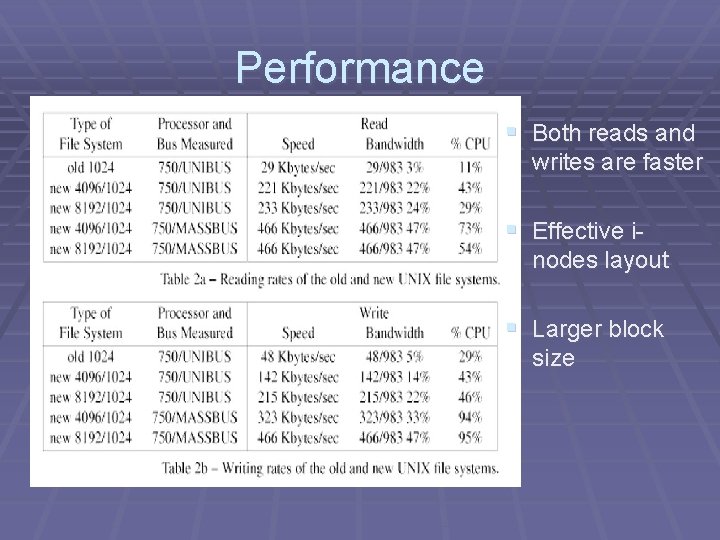
Performance § Both reads and writes are faster § Effective inodes layout § Larger block size
Performance § Inode layout policy is effective § Large directory having many directories within. § # disk accesses for inodes cut by a factor of 2. § Large directory containing only files. § # disk accesses for inodes cut by a factor of 8. § Bandwidth § Old file system uses only 3 -5% of disk bandwidth § New file system uses up to 47% § Reads and writes faster § Due to larger block size in new file system § Writes same speed as reads in contrast to old system
Conclusion § NFS is the basis for Unix File System § Nearly all UNIX machines use a variant of NFS including § Solaris § Unix BSD, Free Unix § Mac OS offers UFS as an alternative to its HFS § Linux offers partial support for UFS
Reference § Andrew S. Tanenbaum, Modern Operating Systems § Wikipedia. org
- Slides: 26