
A Dynamic Soil Layer Model for Assessing the
- Slides: 1
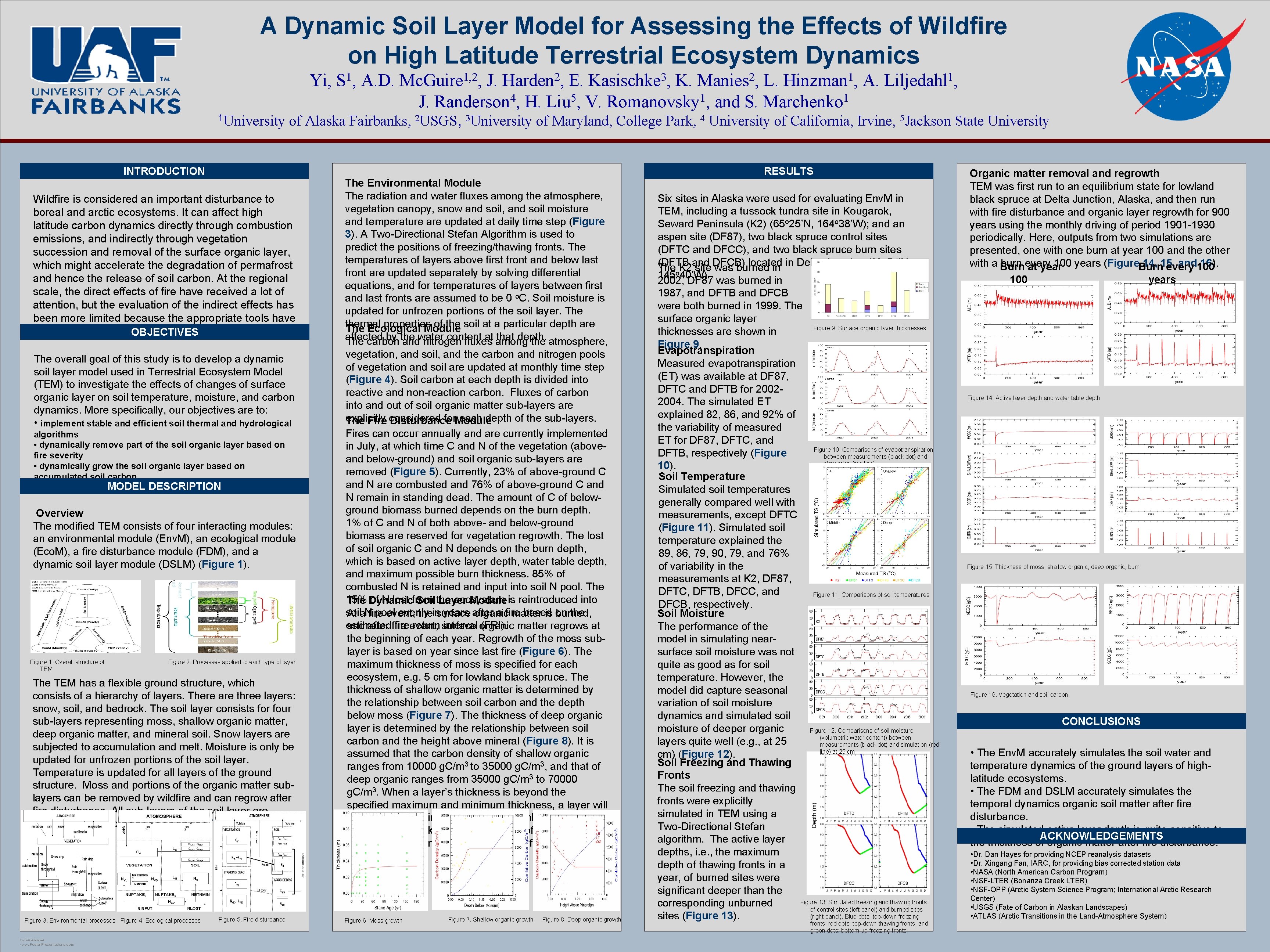
A Dynamic Soil Layer Model for Assessing the Effects of Wildfire on High Latitude Terrestrial Ecosystem Dynamics Yi, 1 University 1 S, A. D. 1, 2 Mc. Guire , 2 Harden , 3 Kasischke , J. E. K. L. A. J. Randerson 4, H. Liu 5, V. Romanovsky 1, and S. Marchenko 1 The overall goal of this study is to develop a dynamic soil layer model used in Terrestrial Ecosystem Model (TEM) to investigate the effects of changes of surface organic layer on soil temperature, moisture, and carbon dynamics. More specifically, our objectives are to: • implement stable and efficient soil thermal and hydrological algorithms • dynamically remove part of the soil organic layer based on fire severity • dynamically grow the soil organic layer based on accumulated soil carbon MODEL DESCRIPTION Overview The modified TEM consists of four interacting modules: an environmental module (Env. M), an ecological module (Eco. M), a fire disturbance module (FDM), and a dynamic soil layer module (DSLM) (Figure 1). Figure 2. Processes applied to each type of layer The TEM has a flexible ground structure, which consists of a hierarchy of layers. There are three layers: snow, soil, and bedrock. The soil layer consists for four sub-layers representing moss, shallow organic matter, deep organic matter, and mineral soil. Snow layers are subjected to accumulation and melt. Moisture is only be updated for unfrozen portions of the soil layer. Temperature is updated for all layers of the ground structure. Moss and portions of the organic matter sublayers can be removed by wildfire and can regrow after fire disturbance. All sub-layers of the soil layer are considered in calculating C balance (Figure 2). TEMPLATE DESIGN © 2007 www. Poster. Presentations. com 1 Liljedahl , RESULTS Wildfire is considered an important disturbance to boreal and arctic ecosystems. It can affect high latitude carbon dynamics directly through combustion emissions, and indirectly through vegetation succession and removal of the surface organic layer, which might accelerate the degradation of permafrost and hence the release of soil carbon. At the regional scale, the direct effects of fire have received a lot of attention, but the evaluation of the indirect effects has been more limited because the appropriate tools have not yet developed for. OBJECTIVES application at the regional scale. Figure 3. Environmental processes Figure 4. Ecological processes 1 Hinzman , of Alaska Fairbanks, 2 USGS, 3 University of Maryland, College Park, 4 University of California, Irvine, 5 Jackson State University INTRODUCTION Figure 1. Overall structure of TEM 2 Manies , Figure 5. Fire disturbance The Environmental Module The radiation and water fluxes among the atmosphere, vegetation canopy, snow and soil, and soil moisture and temperature are updated at daily time step (Figure 3). A Two-Directional Stefan Algorithm is used to predict the positions of freezing/thawing fronts. The temperatures of layers above first front and below last front are updated separately by solving differential equations, and for temperatures of layers between first and last fronts are assumed to be 0 o. C. Soil moisture is updated for unfrozen portions of the soil layer. The thermal properties of the soil at a particular depth are The Ecological Module affected by the content at among that depth. The carbon andwater nitrogen fluxes the atmosphere, vegetation, and soil, and the carbon and nitrogen pools of vegetation and soil are updated at monthly time step (Figure 4). Soil carbon at each depth is divided into reactive and non-reaction carbon. Fluxes of carbon into and out of soil organic matter sub-layers are explicitly for. Module each depth of the sub-layers. The Fire considered Disturbance Fires can occur annually and are currently implemented in July, at which time C and N of the vegetation (aboveand below-ground) and soil organic sub-layers are removed (Figure 5). Currently, 23% of above-ground C and N are combusted and 76% of above-ground C and N remain in standing dead. The amount of C of belowground biomass burned depends on the burn depth. 1% of C and N of both above- and below-ground biomass are reserved for vegetation regrowth. The lost of soil organic C and N depends on the burn depth, which is based on active layer depth, water table depth, and maximum possible burn thickness. 85% of combusted N is retained and input into soil N pool. The 15% of N lost from ecosystem The Dynamic Soil the Layer Module is reintroduced into soil pool evenly years after a fire based the At a. Nfire event, theinsurface organic matter is on burned, estimated fireevent, return surface interval organic (FRI). matter regrows at and after fire the beginning of each year. Regrowth of the moss sublayer is based on year since last fire (Figure 6). The maximum thickness of moss is specified for each ecosystem, e. g. 5 cm for lowland black spruce. The thickness of shallow organic matter is determined by the relationship between soil carbon and the depth below moss (Figure 7). The thickness of deep organic layer is determined by the relationship between soil carbon and the height above mineral (Figure 8). It is assumed that the carbon density of shallow organic ranges from 10000 g. C/m 3 to 35000 g. C/m 3, and that of deep organic ranges from 35000 g. C/m 3 to 70000 g. C/m 3. When a layer’s thickness is beyond the specified maximum and minimum thickness, a layer will either be divided into two layers or combined into adjacent layer to keep the calculation of soil temperature and moisture stable and efficient. Figure 6. Moss growth Figure 7. Shallow organic growth Figure 8. Deep organic growth Six sites in Alaska were used for evaluating Env. M in TEM, including a tussock tundra site in Kougarok, Seward Peninsula (K 2) (65 o 25’N, 164 o 38’W); and an aspen site (DF 87), two black spruce control sites (DFTC and DFCC), and two black spruce burn sites o 54’N, (DFTB and DFCB) located in Delta Junction (63 Theo. K 2 site was burned in 145 40’W). 2002, DF 87 was burned in 1987, and DFTB and DFCB were both burned in 1999. The surface organic layer Figure 9. Surface organic layer thicknesses are shown in Figure 9. Evapotranspiration Measured evapotranspiration (ET) was available at DF 87, DFTC and DFTB for 20022004. The simulated ET explained 82, 86, and 92% of the variability of measured ET for DF 87, DFTC, and Figure 10. Comparisons of evapotranspiration DFTB, respectively (Figure between measurements (black dot) and simulation (red line) 10). Soil Temperature Simulated soil temperatures generally compared well with measurements, except DFTC (Figure 11). Simulated soil temperature explained the 89, 86, 79, 90, 79, and 76% of variability in the measurements at K 2, DF 87, DFTC, DFTB, DFCC, and Figure 11. Comparisons of soil temperatures DFCB, respectively. Soil Moisture The performance of the model in simulating nearsurface soil moisture was not quite as good as for soil temperature. However, the model did capture seasonal variation of soil moisture dynamics and simulated soil moisture of deeper organic Figure 12. Comparisons of soil moisture (volumetric water content) between layers quite well (e. g. , at 25 measurements (black dot) and simulation (red line) at 25 cm. cm) (Figure 12). Soil Freezing and Thawing Fronts The soil freezing and thawing fronts were explicitly simulated in TEM using a Two-Directional Stefan algorithm. The active layer depths, i. e. , the maximum depth of thawing fronts in a year, of burned sites were significant deeper than the Figure 13. Simulated freezing and thawing fronts corresponding unburned of control sites (left panel) and burned sites (right panel). Blue dots: top-down freezing sites (Figure 13). fronts, red dots: top-down thawing fronts, and green dots: bottom-up freezing fronts Organic matter removal and regrowth TEM was first run to an equilibrium state for lowland black spruce at Delta Junction, Alaska, and then run with fire disturbance and organic layer regrowth for 900 years using the monthly driving of period 1901 -1930 periodically. Here, outputs from two simulations are presented, one with one burn at year 100 and the other with a Burn burn every 100 years (Figure. Burn 14, 15, and 100 16). at year every 100 years Figure 14. Active layer depth and water table depth Figure 15. Thickness of moss, shallow organic, deep organic, burn Figure 16. Vegetation and soil carbon CONCLUSIONS • The Env. M accurately simulates the soil water and temperature dynamics of the ground layers of highlatitude ecosystems. • The FDM and DSLM accurately simulates the temporal dynamics organic soil matter after fire disturbance. • The simulated active layer depth is quite sensitive to ACKNOWLEDGEMENTS the thickness of organic matter after fire disturbance. • Dr. Dan Hayes for providing NCEP reanalysis datasets • Dr. Xingang Fan, IARC, for providing bias corrected station data • NASA (North American Carbon Program) • NSF-LTER (Bonanza Creek LTER) • NSF-OPP (Arctic System Science Program; International Arctic Research Center) • USGS (Fate of Carbon in Alaskan Landscapes) • ATLAS (Arctic Transitions in the Land-Atmosphere System)