
A DualCritic Reinforcement Learning Framework for Framelevel Bit
A Dual-Critic Reinforcement Learning Framework for Frame-level Bit Allocation in HEVC/H. 265 Yung-Han Ho*, Guo-Lun Jin*, Yun Liang*, Wen-Hsiao Peng* and Xiaobo Li+ *National Chiao Tung University (NCTU), Taiwan +Alibaba Group

Outline �Introduction �Reinforcement learning (RL) basics �Proposed method �Experimental results �Concluding remarks 2
Introduction � This work presents an AI-assisted video compression � It addresses frame-level bit allocation for video rate control � We apply for the first time RL to constrained optimization � It outperforms significantly the rate control scheme in x 265 3
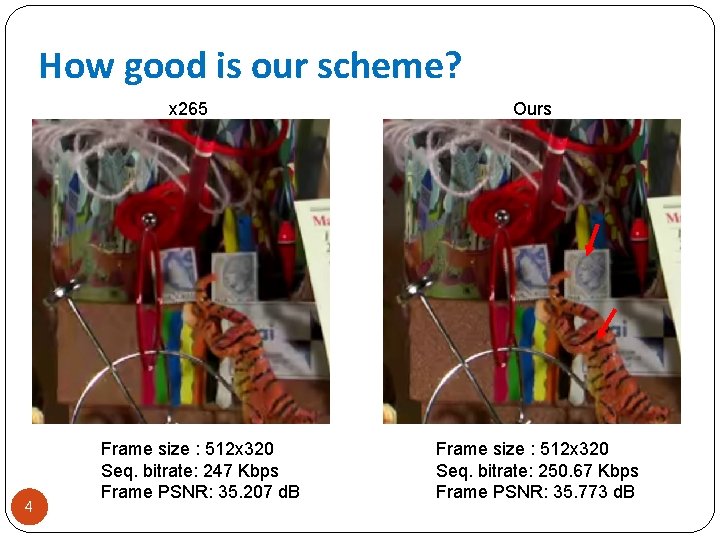
How good is our scheme? x 265 4 Frame size : 512 x 320 Seq. bitrate: 247 Kbps Frame PSNR: 35. 207 d. B Ours Frame size : 512 x 320 Seq. bitrate: 250. 67 Kbps Frame PSNR: 35. 773 d. B
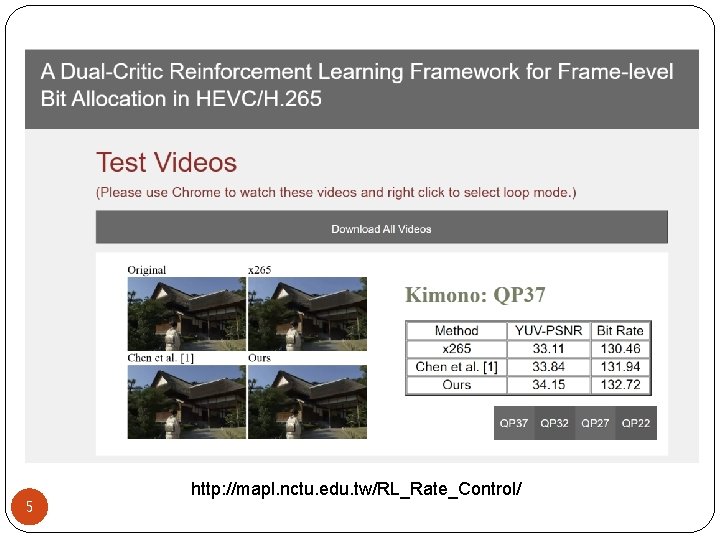
5 http: //mapl. nctu. edu. tw/RL_Rate_Control/
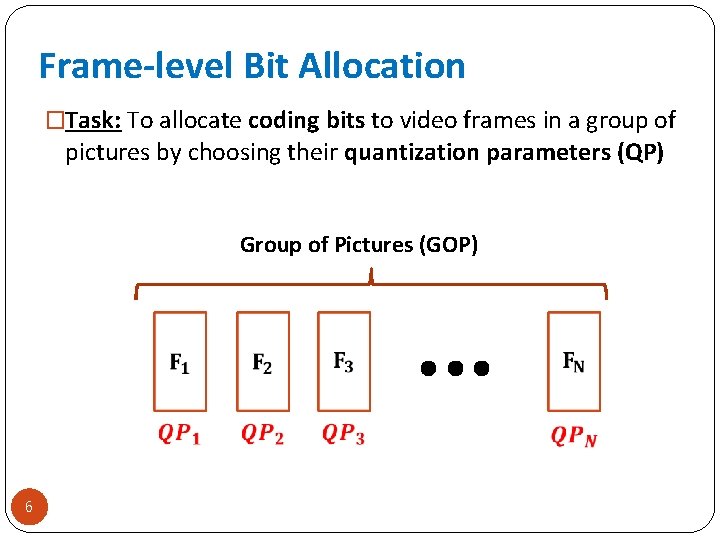
Frame-level Bit Allocation �Task: To allocate coding bits to video frames in a group of pictures by choosing their quantization parameters (QP) Group of Pictures (GOP) 6
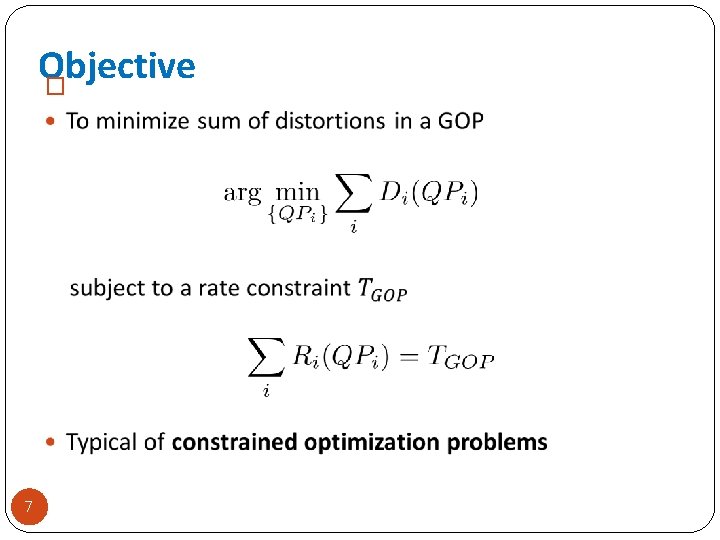
Objective � 7
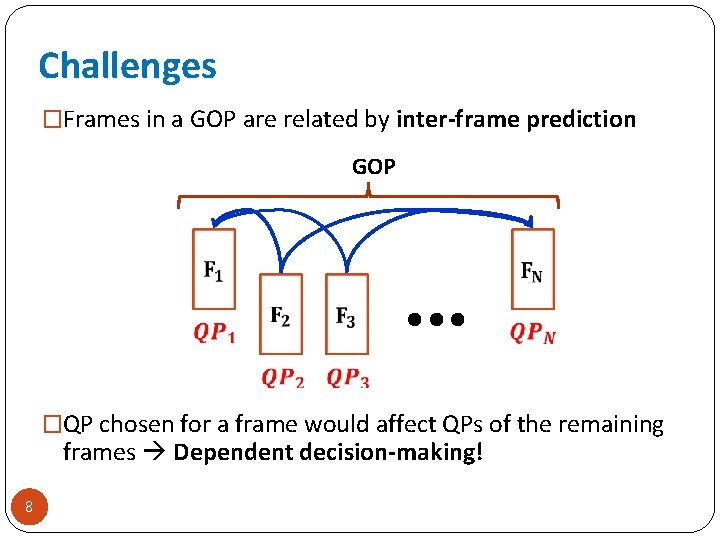
Challenges �Frames in a GOP are related by inter-frame prediction GOP �QP chosen for a frame would affect QPs of the remaining frames Dependent decision-making! 8
Outline �Introduction �Reinforcement learning (RL) basics �Proposed method �Frame-level bit allocation as RL problem �State and reward signals �Dual-critic RL framework �Experimental results �Concluding remarks 9
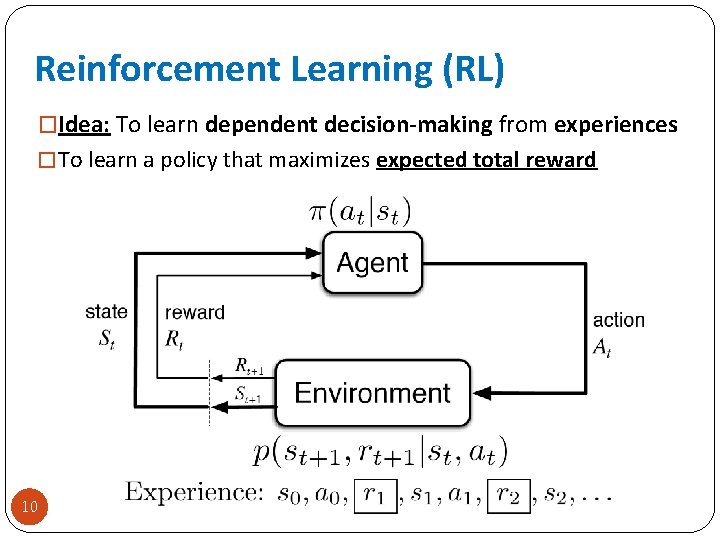
Reinforcement Learning (RL) �Idea: To learn dependent decision-making from experiences � To learn a policy that maximizes expected total reward 10
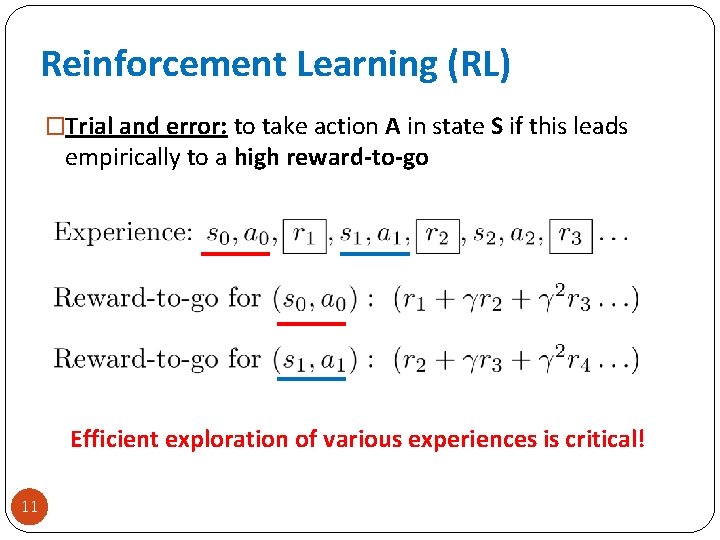
Reinforcement Learning (RL) �Trial and error: to take action A in state S if this leads empirically to a high reward-to-go Efficient exploration of various experiences is critical! 11

Deep Deterministic Policy Gradient (DDPG) �RL framework that trains Actor by learning Critic �Critic learns the reward-to-go Q(s, a) �Actor learns to maximize the reward-to-go 12
Outline �Introduction �Reinforcement learning (RL) basics �Proposed method �Frame-level bit allocation as RL problem �State and reward signals �Dual-critic RL framework �Experimental results �Concluding remarks 13
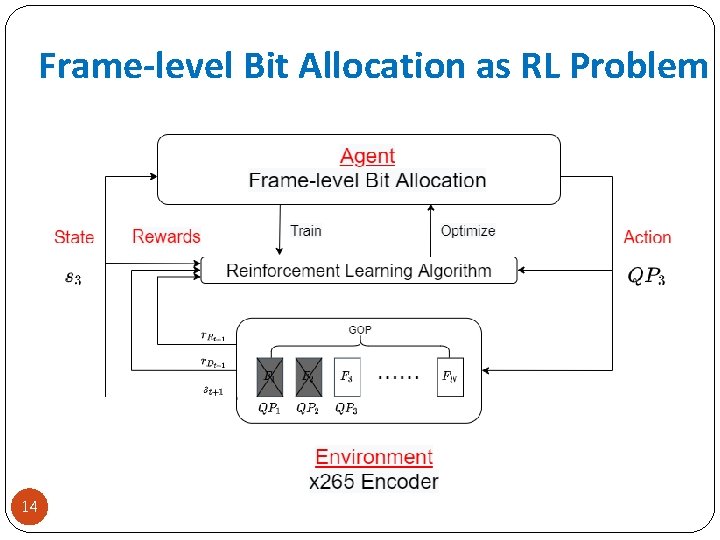
Frame-level Bit Allocation as RL Problem 14
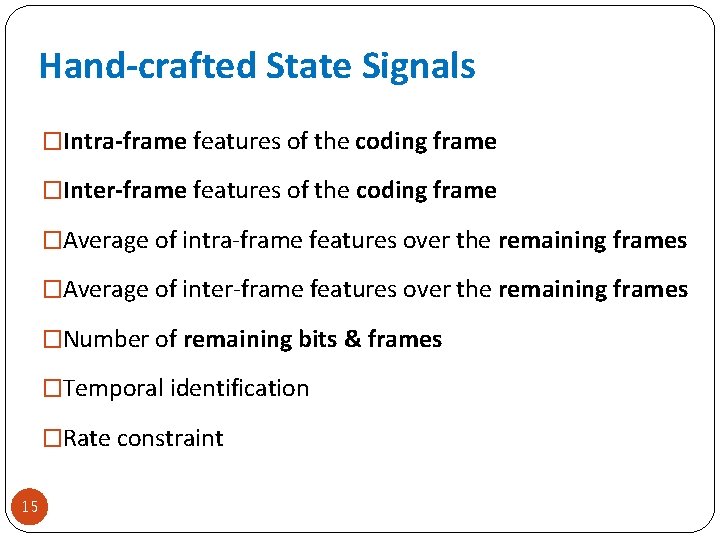
Hand-crafted State Signals �Intra-frame features of the coding frame �Inter-frame features of the coding frame �Average of intra-frame features over the remaining frames �Average of inter-frame features over the remaining frames �Number of remaining bits & frames �Temporal identification �Rate constraint 15
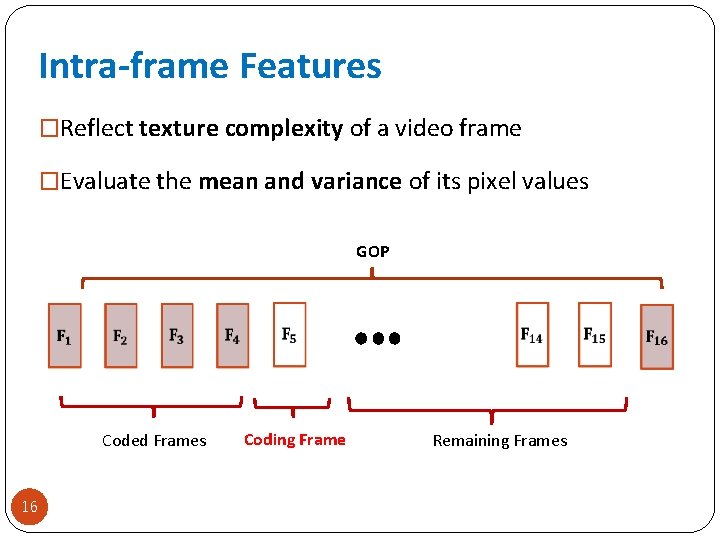
Intra-frame Features �Reflect texture complexity of a video frame �Evaluate the mean and variance of its pixel values GOP Coded Frames 16 Coding Frame Remaining Frames
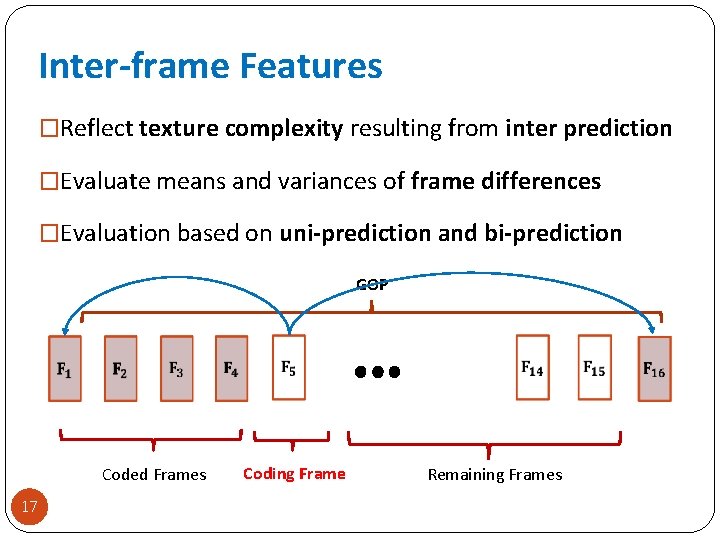
Inter-frame Features �Reflect texture complexity resulting from inter prediction �Evaluate means and variances of frame differences �Evaluation based on uni-prediction and bi-prediction GOP Coded Frames 17 Coding Frame Remaining Frames
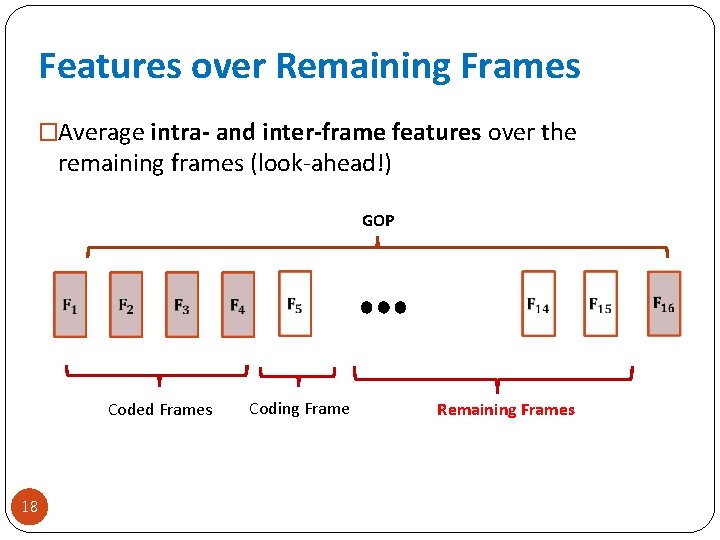
Features over Remaining Frames �Average intra- and inter-frame features over the remaining frames (look-ahead!) GOP Coded Frames 18 Coding Frame Remaining Frames
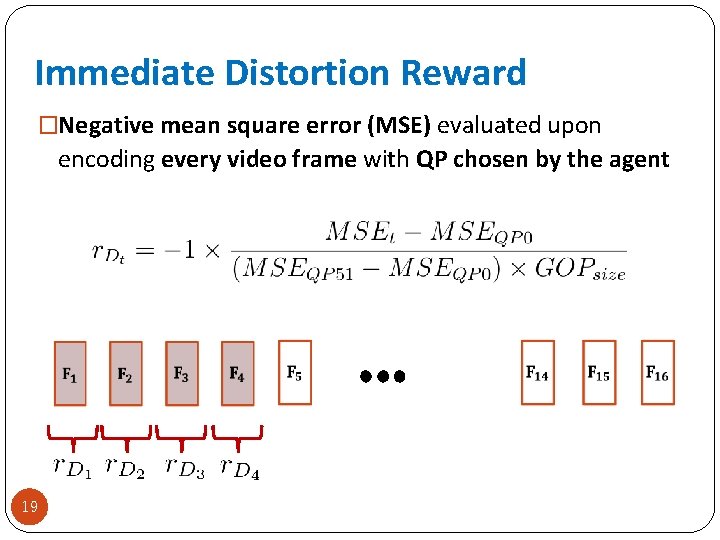
Immediate Distortion Reward �Negative mean square error (MSE) evaluated upon encoding every video frame with QP chosen by the agent 19
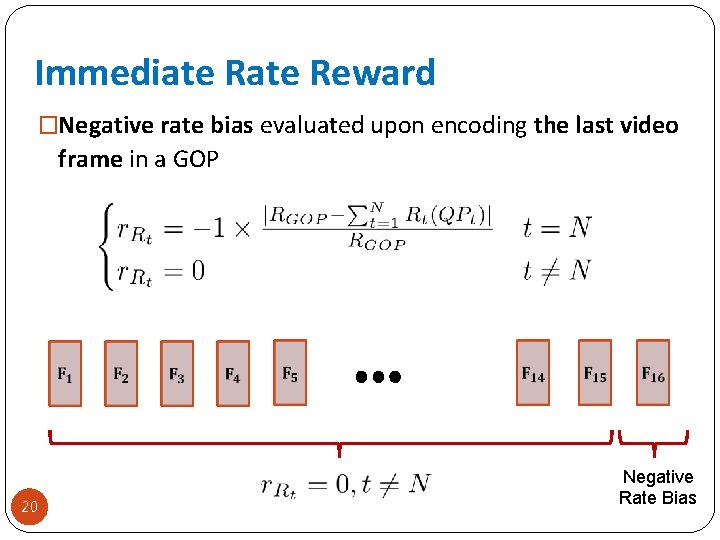
Immediate Reward �Negative rate bias evaluated upon encoding the last video frame in a GOP 20 Negative Rate Bias
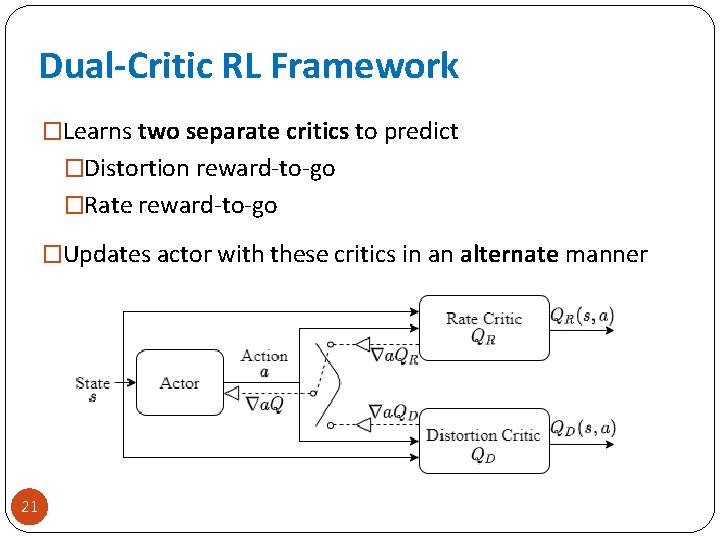
Dual-Critic RL Framework �Learns two separate critics to predict �Distortion reward-to-go �Rate reward-to-go �Updates actor with these critics in an alternate manner 21
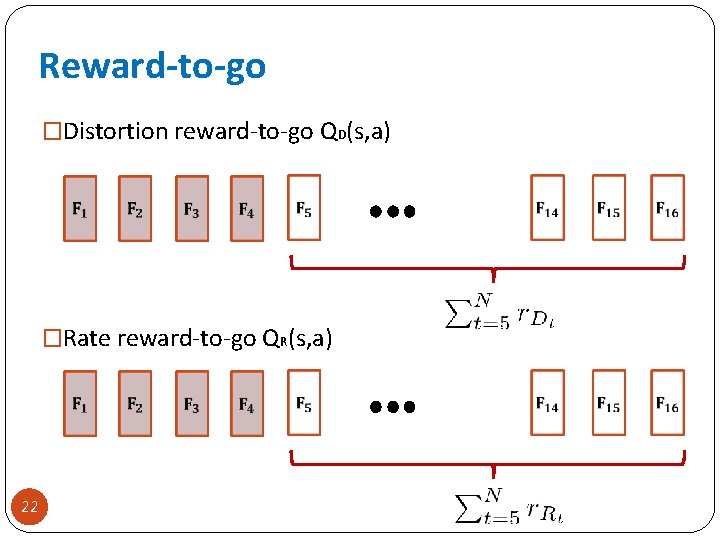
Reward-to-go �Distortion reward-to-go QD(s, a) �Rate reward-to-go QR(s, a) 22
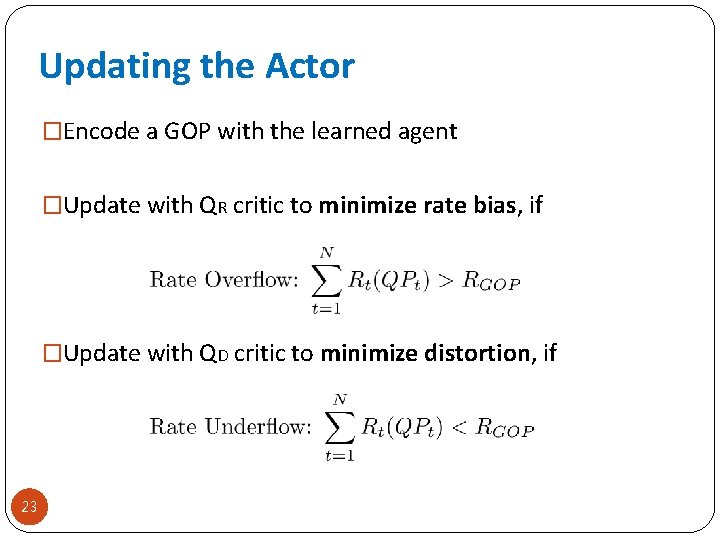
Updating the Actor �Encode a GOP with the learned agent �Update with QR critic to minimize rate bias, if �Update with QD critic to minimize distortion, if 23
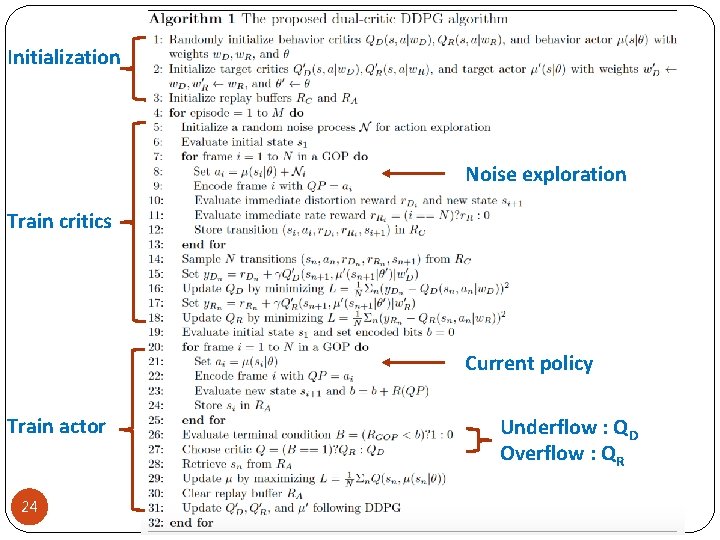
Initialization Noise exploration Train critics Current policy Train actor 24 Underflow : QD Overflow : QR
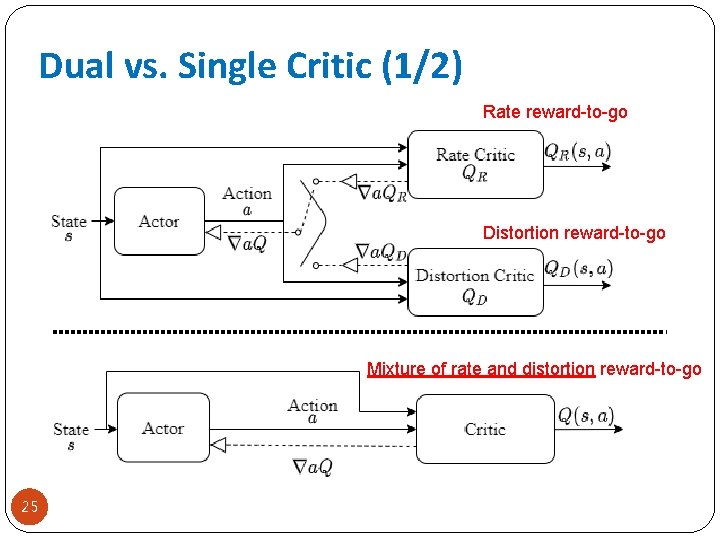
Dual vs. Single Critic (1/2) Rate reward-to-go Distortion reward-to-go Mixture of rate and distortion reward-to-go 25
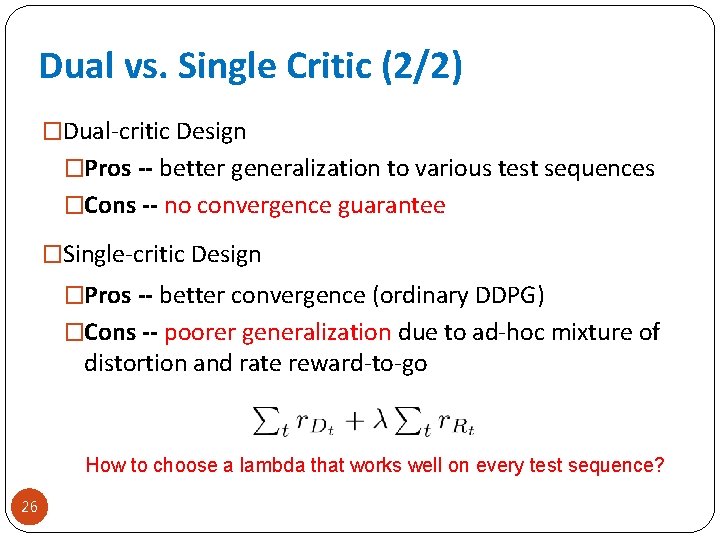
Dual vs. Single Critic (2/2) �Dual-critic Design �Pros -- better generalization to various test sequences �Cons -- no convergence guarantee �Single-critic Design �Pros -- better convergence (ordinary DDPG) �Cons -- poorer generalization due to ad-hoc mixture of distortion and rate reward-to-go How to choose a lambda that works well on every test sequence? 26
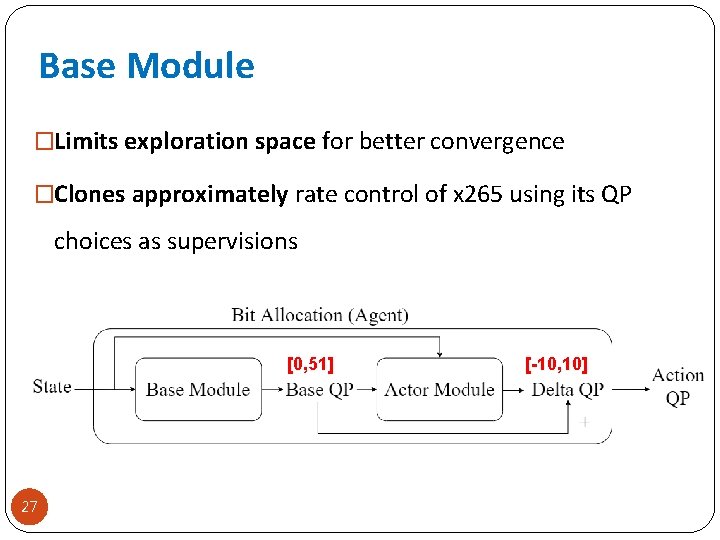
Base Module �Limits exploration space for better convergence �Clones approximately rate control of x 265 using its QP choices as supervisions [0, 51] 27 [-10, 10]
Outline �Introduction �Reinforcement learning (RL) basics �Proposed method �Experimental results �Settings �Rate-distortion performance �Runtime �QP Assignment �Concluding remarks 28
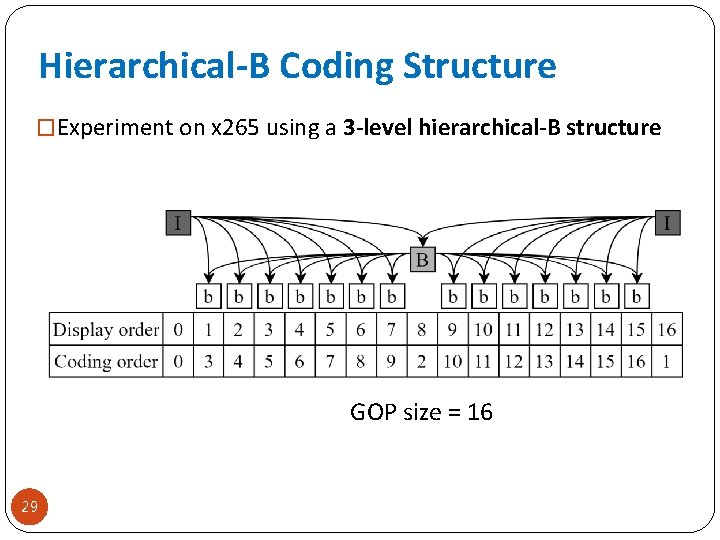
Hierarchical-B Coding Structure �Experiment on x 265 using a 3 -level hierarchical-B structure GOP size = 16 29
Target Bitrates �Follow the same GOP-level bit allocation as x 265 �Encode every sequence with fixed QP’s (22, 27, 32, 37) to get sequence-level bitrates �Turn on rate control of x 265 (1 -pass vs. 2 -pass ABR) �Observe the GOP-level bitrates of x 265 �Use these bitrates as our GOP target bitrates 30 VBV condition: --bitrate : --vbv-bufsize : --vbv-maxrate = 1: 2: 1
Other Details �Separate models for four target bitrates �Both our method and the single-critic method [1] operate with the same base module �Performance metrics: BD-PSNR and rate deviations 31 [1] Chen et al. “Reinforcement Learning for HEVC/H. 265 Frame-level Bit Allocation, ” IEEE DSP, 2018.
![Datasets �Training datasets (32 videos): UVG [2], MCL-JCV [3], and Class A sequences in](http://slidetodoc.com/presentation_image_h2/3bb45a7405487102a4db6103fa0594c8/image-32.jpg "Datasets �Training datasets (32 videos): UVG [2], MCL-JCV [3], and Class A sequences in")
Datasets �Training datasets (32 videos): UVG [2], MCL-JCV [3], and Class A sequences in JCT-VC dataset �Test datasets (9 videos): Class B and Class C sequences in JCT-VC dataset �To speed up training, all videos are rescaled to 512 × 320 [2] Mercat et al. “UVG dataset: 50/120 fps 4 k sequences for video codec analysis and development”. ACM Multimedia Systems Conference, 2020 [3] H. Wang et al. “MCL-JCV: A jnd-based H. 264/AVC video quality assessment dataset”. IEEE ICIP, 2016 32
Outline �Introduction �Reinforcement learning (RL) basics �Proposed method �Experimental results �Settings �Rate-distortion performance �Encoding runtime �QP assignment �Concluding remarks 33
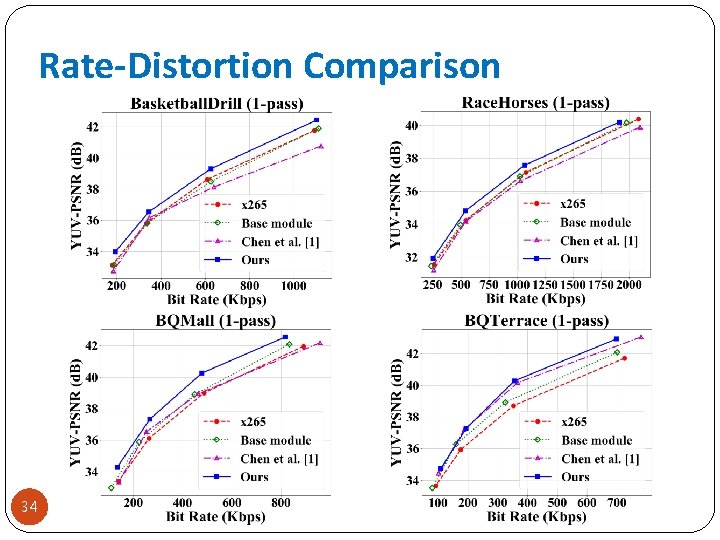
Rate-Distortion Comparison 34
![BD-PSNR with 1 -pass ABR as anchor 35 [1] Chen et al. , “Reinforcement](http://slidetodoc.com/presentation_image_h2/3bb45a7405487102a4db6103fa0594c8/image-35.jpg "BD-PSNR with 1 -pass ABR as anchor 35 [1] Chen et al. , “Reinforcement")
BD-PSNR with 1 -pass ABR as anchor 35 [1] Chen et al. , “Reinforcement Learning for HEVC/H. 265 Frame-level Bit Allocation, ” IEEE DSP, 2018.
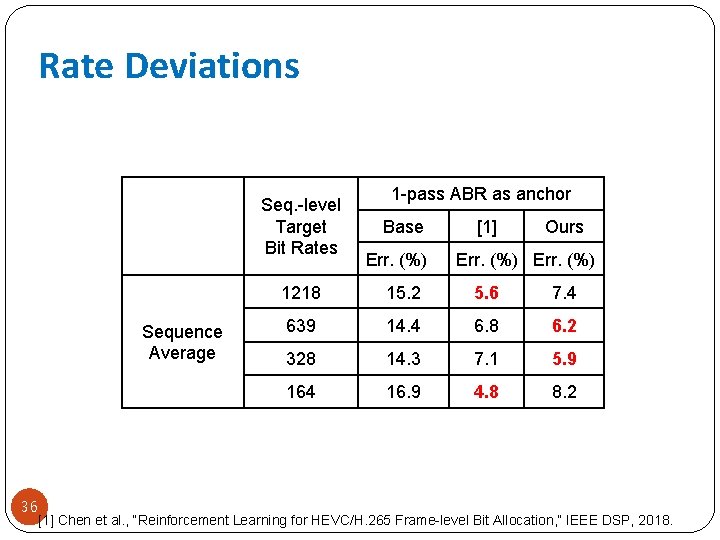
Rate Deviations Seq. -level Target Bit Rates Sequence Average 36 1 -pass ABR as anchor Base Err. (%) [1] Ours Err. (%) 1218 15. 2 5. 6 7. 4 639 14. 4 6. 8 6. 2 328 14. 3 7. 1 5. 9 164 16. 9 4. 8 8. 2 [1] Chen et al. , “Reinforcement Learning for HEVC/H. 265 Frame-level Bit Allocation, ” IEEE DSP, 2018.
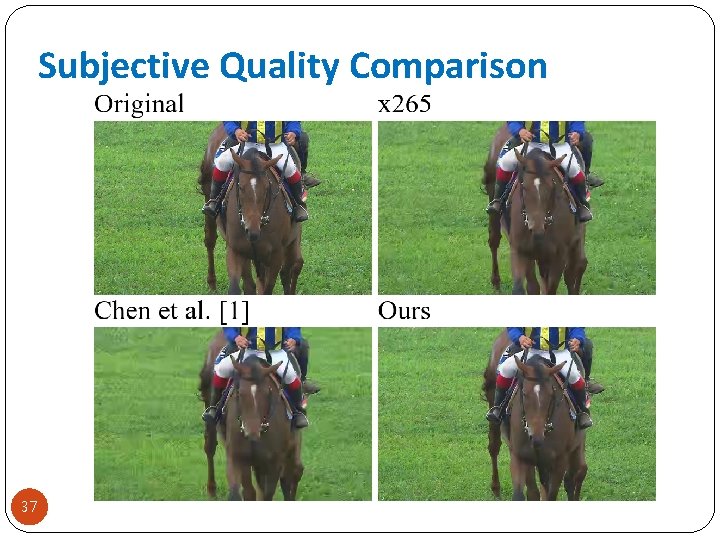
Subjective Quality Comparison 37
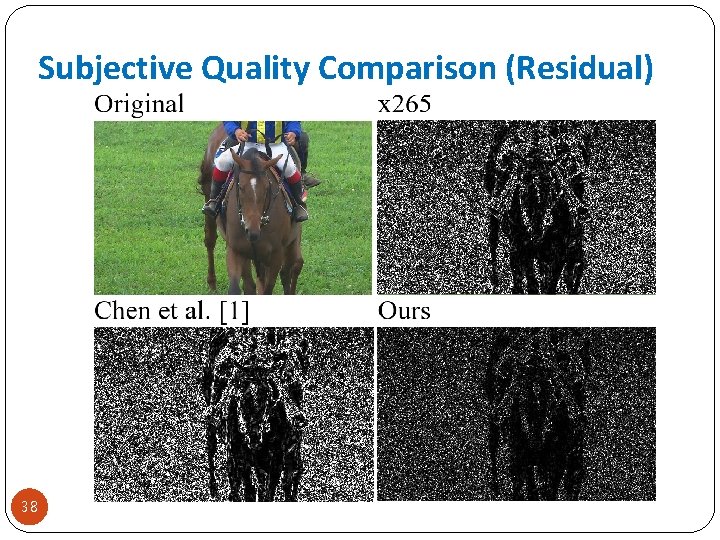
Subjective Quality Comparison (Residual) 38
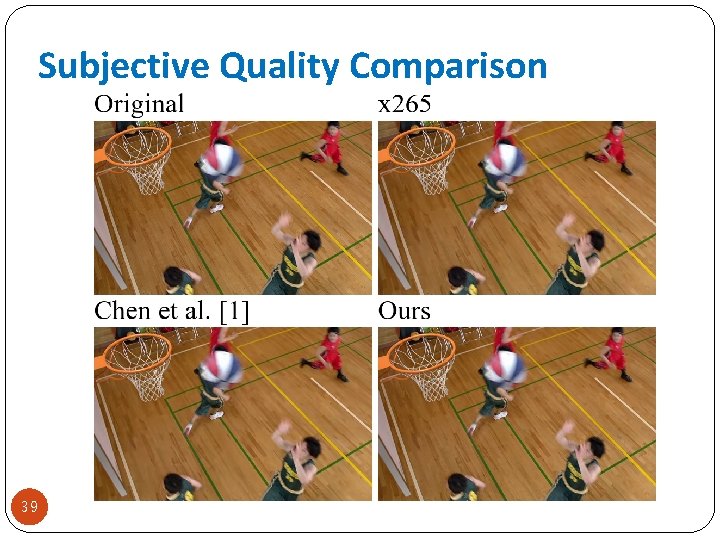
Subjective Quality Comparison 39
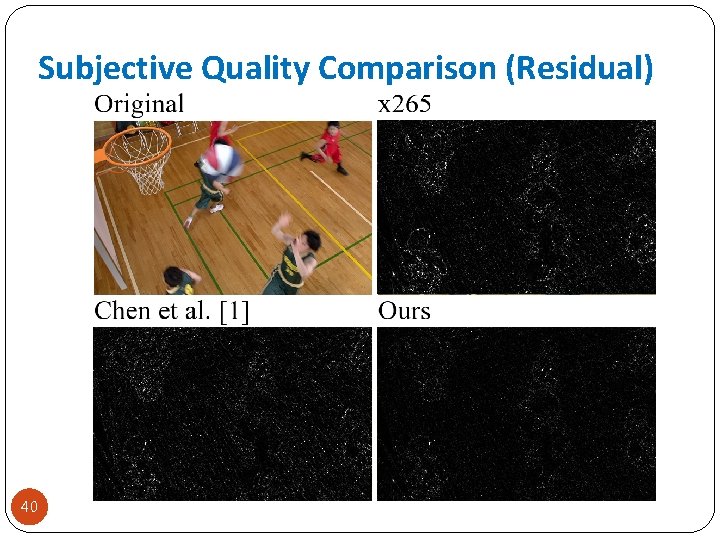
Subjective Quality Comparison (Residual) 40
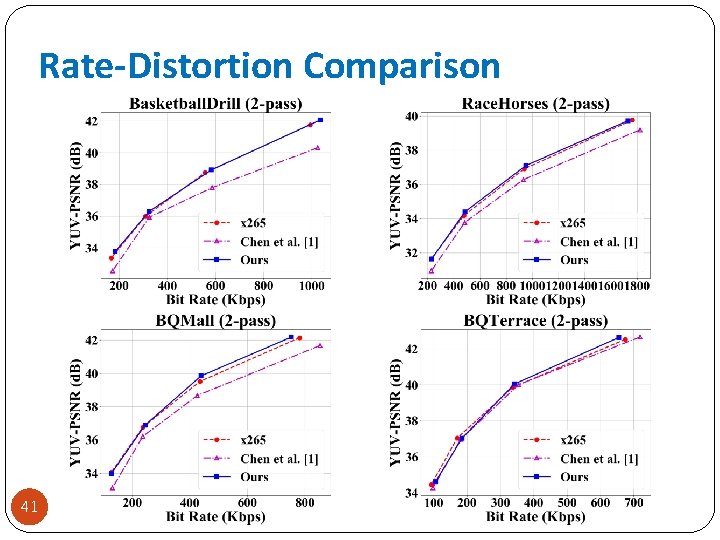
Rate-Distortion Comparison 41
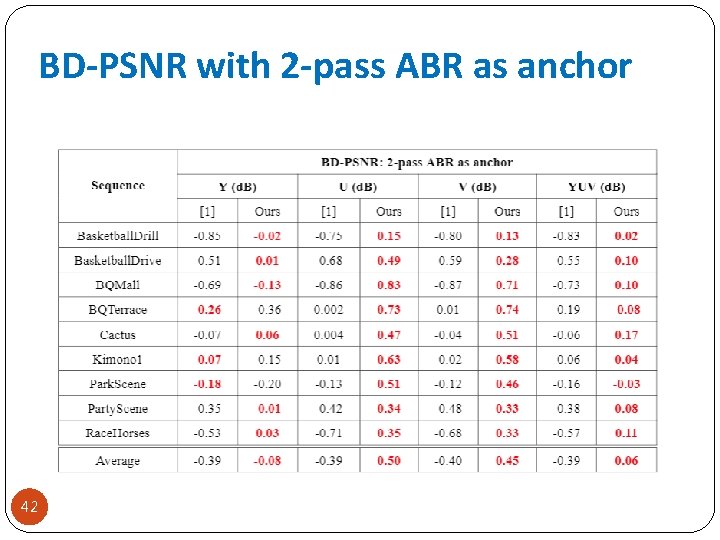
BD-PSNR with 2 -pass ABR as anchor 42
Outline �Introduction �Reinforcement learning (RL) basics �Proposed method �Experimental results �Settings �Rate-distortion performance �Encoding runtime �QP assignment �Concluding remarks 43
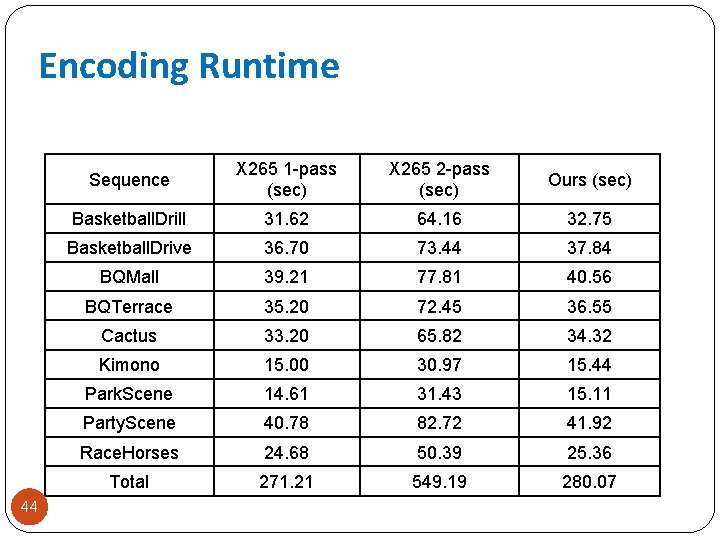
Encoding Runtime 44 Sequence X 265 1 -pass (sec) X 265 2 -pass (sec) Ours (sec) Basketball. Drill 31. 62 64. 16 32. 75 Basketball. Drive 36. 70 73. 44 37. 84 BQMall 39. 21 77. 81 40. 56 BQTerrace 35. 20 72. 45 36. 55 Cactus 33. 20 65. 82 34. 32 Kimono 15. 00 30. 97 15. 44 Park. Scene 14. 61 31. 43 15. 11 Party. Scene 40. 78 82. 72 41. 92 Race. Horses 24. 68 50. 39 25. 36 Total 271. 21 549. 19 280. 07
Outline �Introduction �Reinforcement learning (RL) basics �Proposed method �Experimental results �Settings �Rate-distortion performance �Encoding runtime �QP assignment �Concluding remarks 45
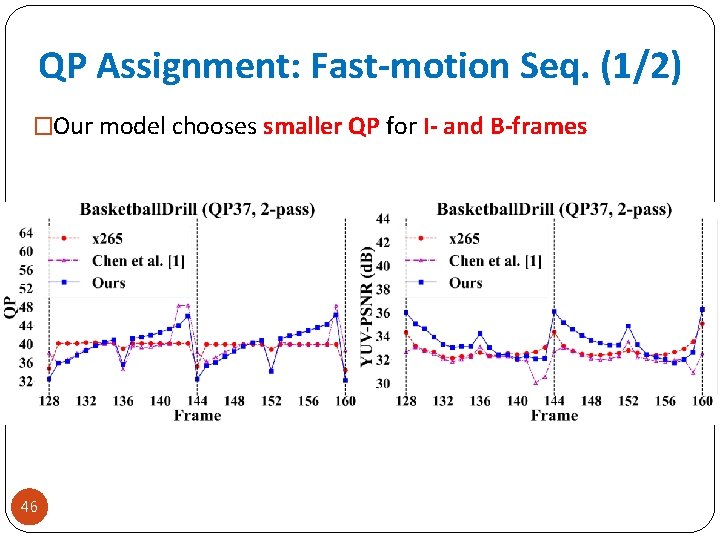
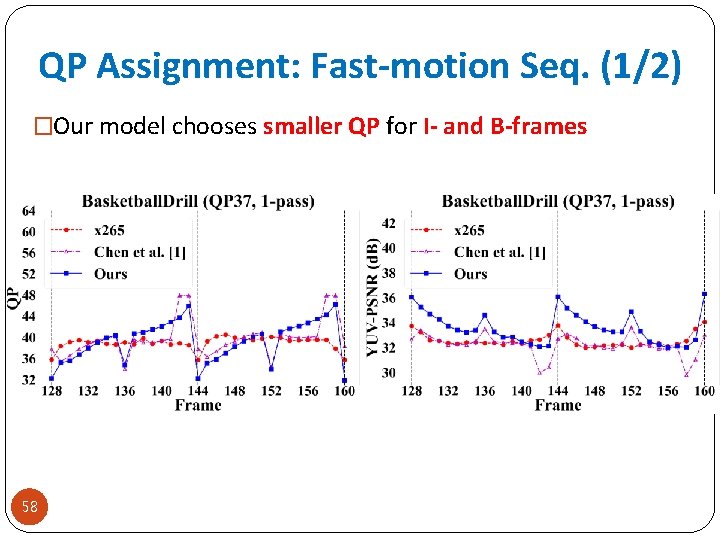
QP Assignment: Fast-motion Seq. (1/2) �Our model chooses smaller QP for I- and B-frames 46
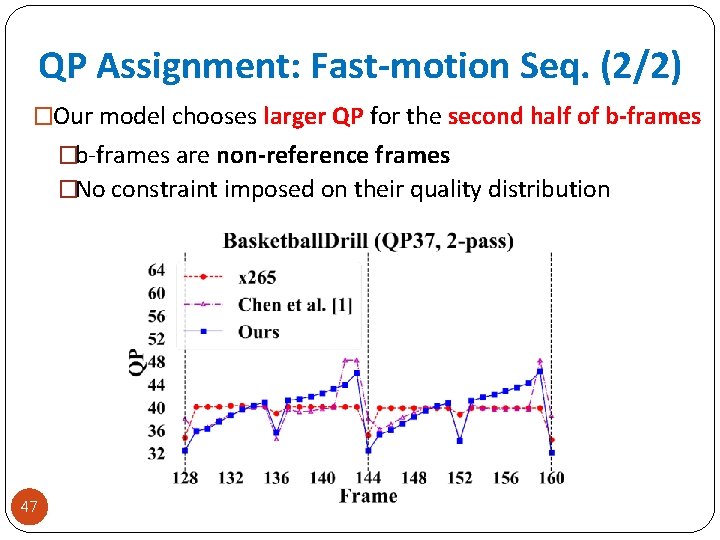
QP Assignment: Fast-motion Seq. (2/2) �Our model chooses larger QP for the second half of b-frames �b-frames are non-reference frames �No constraint imposed on their quality distribution 47
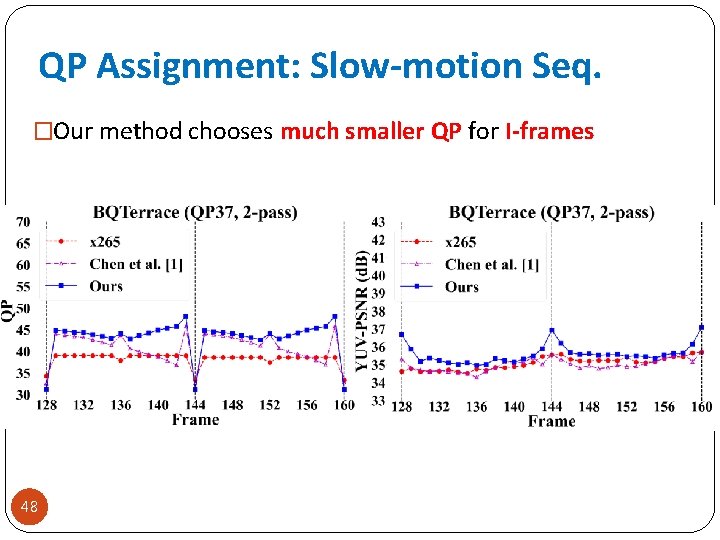
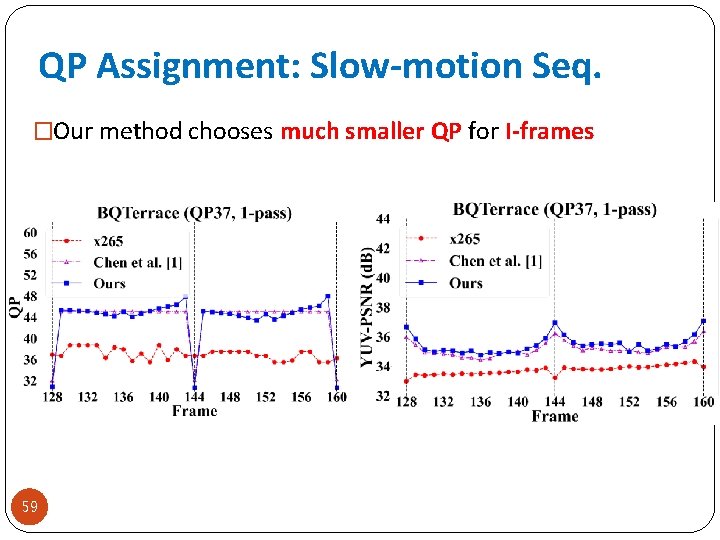
QP Assignment: Slow-motion Seq. �Our method chooses much smaller QP for I-frames 48
Outline �Introduction �Reinforcement learning (RL) basics �Proposed method �Experimental results �Concluding remarks 49
Concluding Remarks �This work introduces a dual-critic RL framework for frame- level bit allocation �It overcomes the need of combining the rate and distortion rewards in a heuristic manner �Our method achieves promising R-D performance and fairly precise rate control accuracy 50

51
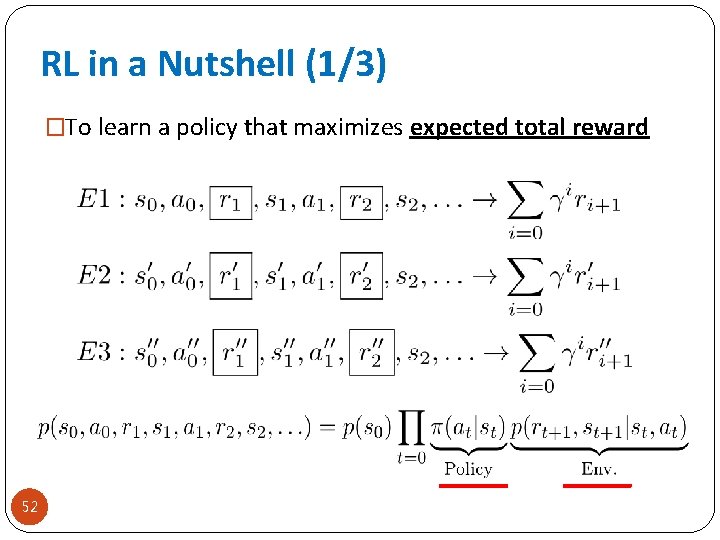
RL in a Nutshell (1/3) �To learn a policy that maximizes expected total reward 52
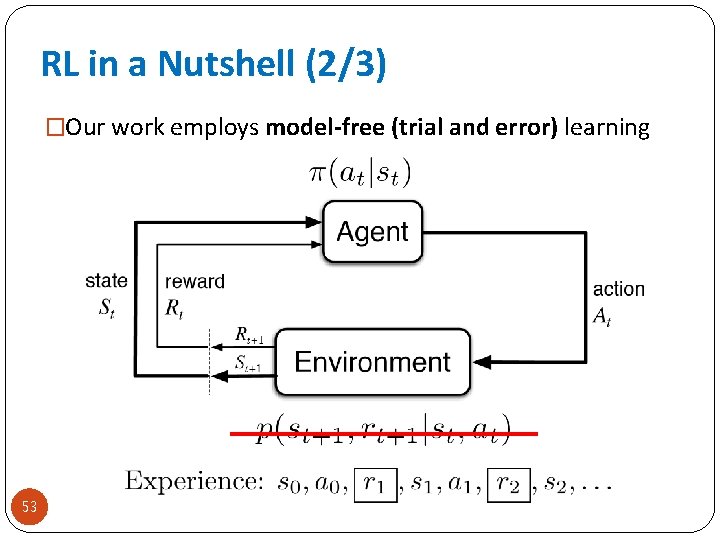
RL in a Nutshell (2/3) �Our work employs model-free (trial and error) learning 53
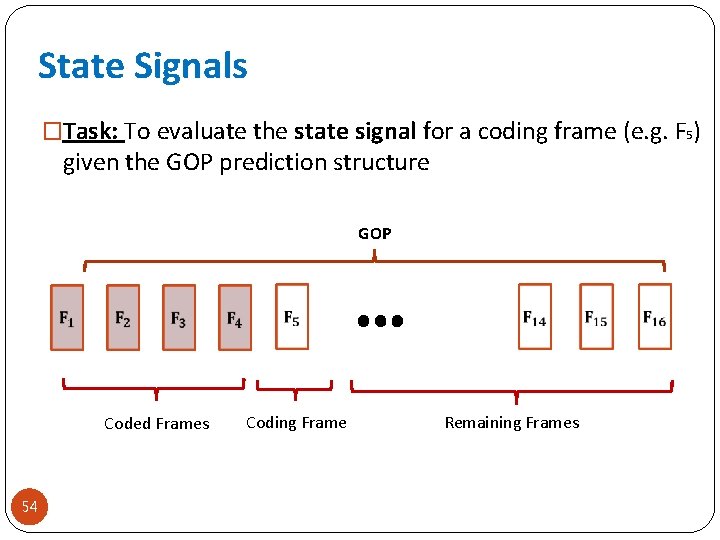
State Signals �Task: To evaluate the state signal for a coding frame (e. g. F 5) given the GOP prediction structure GOP Coded Frames 54 Coding Frame Remaining Frames
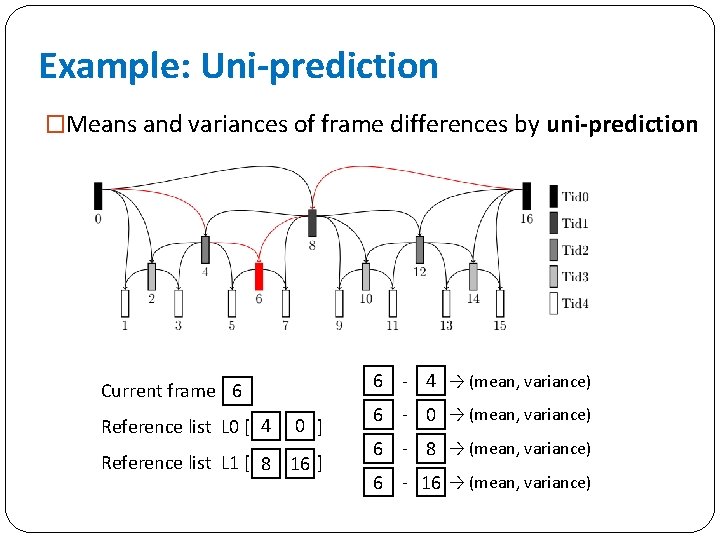
Example: Uni-prediction �Means and variances of frame differences by uni-prediction 6 - 4 → (mean, variance) Current frame 6 Reference list L 0 [ 4 0 ] Reference list L 1 [ 8 16 ] 6 - 0 → (mean, variance) 6 - 8 → (mean, variance) 6 - 16 → (mean, variance)
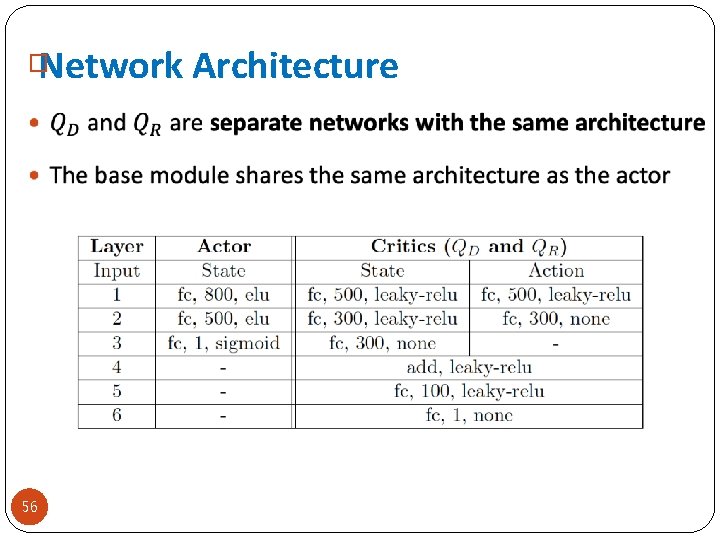
Network Architecture � 56
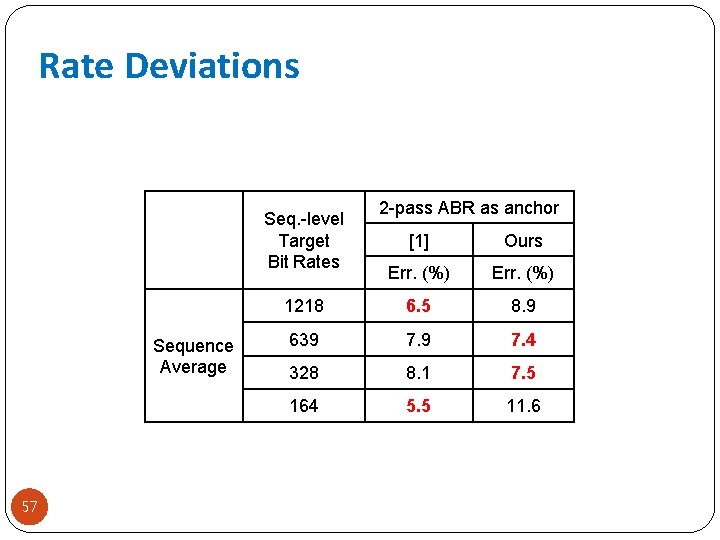
Rate Deviations Seq. -level Target Bit Rates Sequence Average 57 2 -pass ABR as anchor [1] Ours Err. (%) 1218 6. 5 8. 9 639 7. 4 328 8. 1 7. 5 164 5. 5 11. 6
QP Assignment: Fast-motion Seq. (1/2) �Our model chooses smaller QP for I- and B-frames 58
QP Assignment: Slow-motion Seq. �Our method chooses much smaller QP for I-frames 59
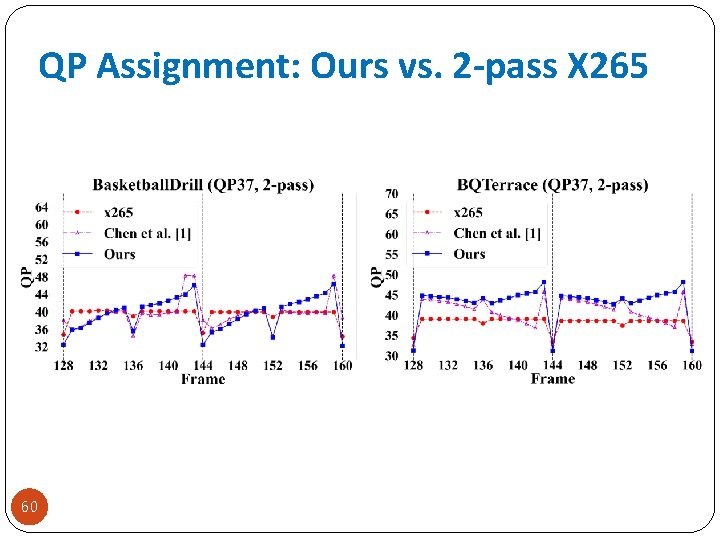
QP Assignment: Ours vs. 2 -pass X 265 60
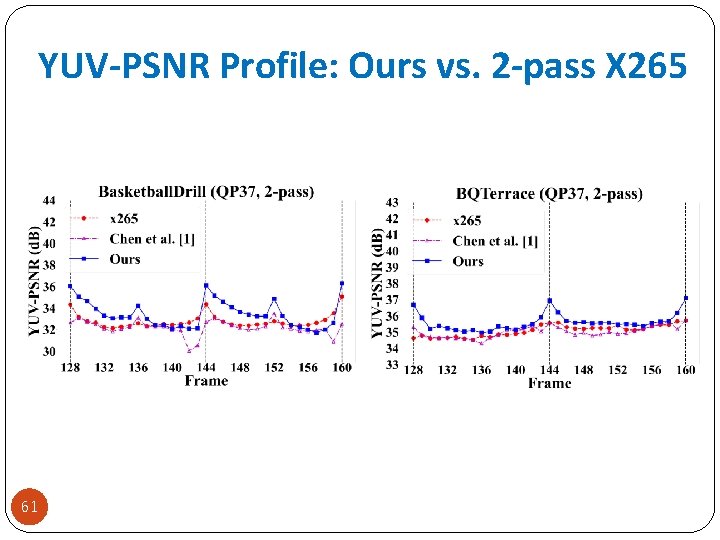
YUV-PSNR Profile: Ours vs. 2 -pass X 265 61
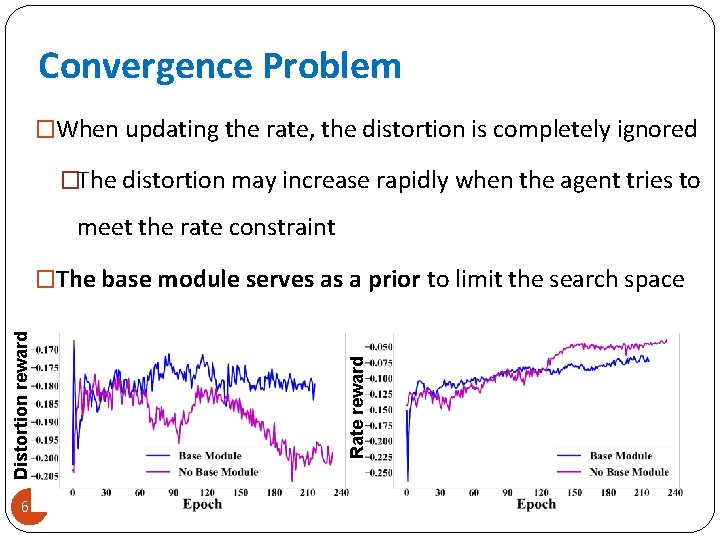
Convergence Problem �When updating the rate, the distortion is completely ignored �The distortion may increase rapidly when the agent tries to meet the rate constraint 62 Rate reward Distortion reward �The base module serves as a prior to limit the search space
- Slides: 62