
A DNP Quality Improvement Project Addressing Low HIV
- Slides: 1
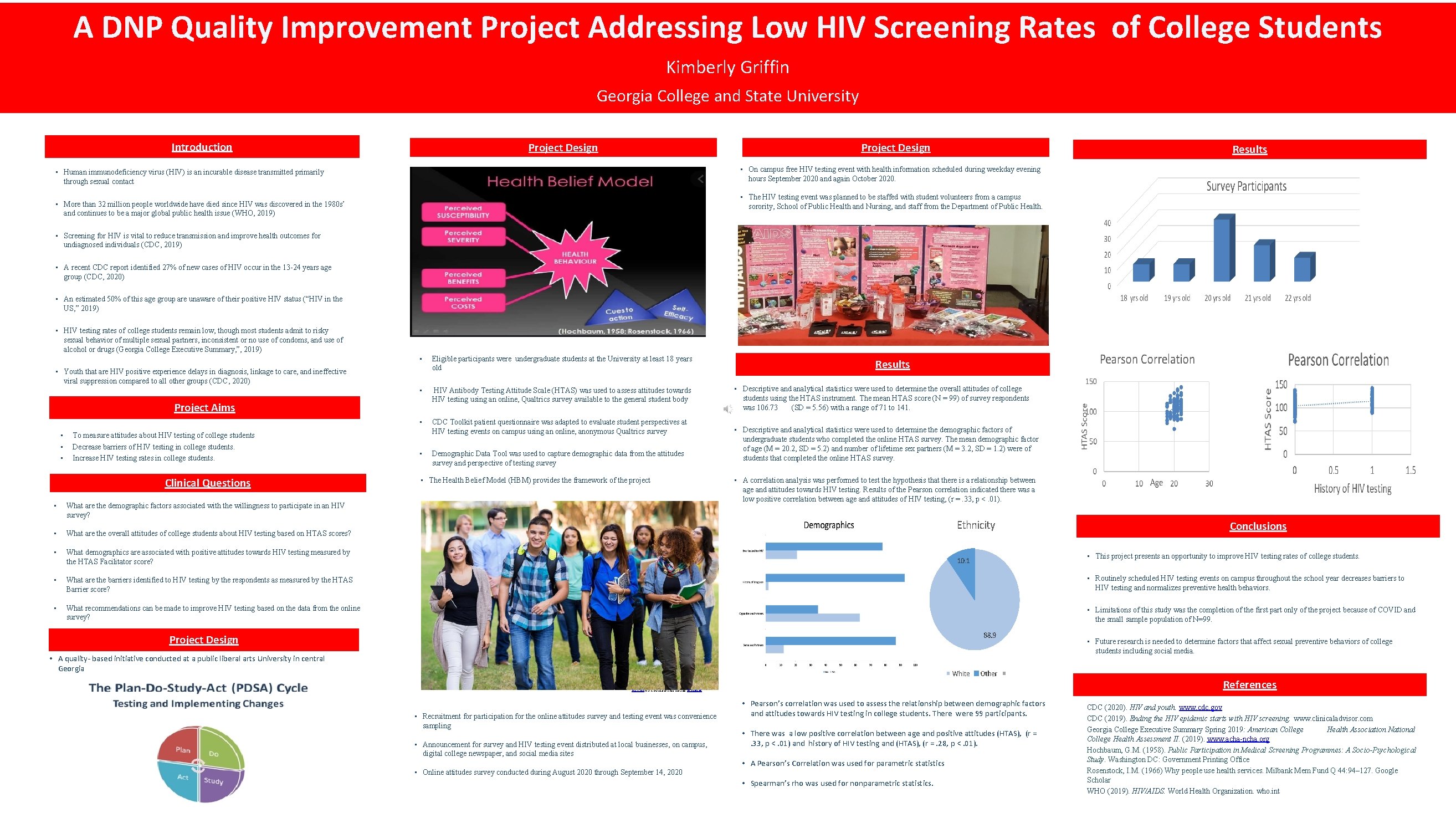
A DNP Quality Improvement Project Addressing Low HIV Screening Rates of College Students Kimberly Griffin Georgia College and State University Introduction Project Design Results • On campus free HIV testing event with health information scheduled during weekday evening hours September 2020 and again October 2020. • Human immunodeficiency virus (HIV) is an incurable disease transmitted primarily through sexual contact • The HIV testing event was planned to be staffed with student volunteers from a campus sorority, School of Public Health and Nursing, and staff from the Department of Public Health. • More than 32 million people worldwide have died since HIV was discovered in the 1980 s’ and continues to be a major global public health issue (WHO, 2019) • Screening for HIV is vital to reduce transmission and improve health outcomes for undiagnosed individuals (CDC, 2019) • A recent CDC report identified 27% of new cases of HIV occur in the 13 -24 years age group (CDC, 2020) • An estimated 50% of this age group are unaware of their positive HIV status (“HIV in the US, ” 2019) • HIV testing rates of college students remain low, though most students admit to risky sexual behavior of multiple sexual partners, inconsistent or no use of condoms, and use of alcohol or drugs (Georgia College Executive Summary, ”, 2019) • Eligible participants were undergraduate students at the University at least 18 years old • HIV Antibody Testing Attitude Scale (HTAS) was used to assess attitudes towards HIV testing using an online, Qualtrics survey available to the general student body • CDC Toolkit patient questionnaire was adapted to evaluate student perspectives at HIV testing events on campus using an online, anonymous Qualtrics survey • Demographic Data Tool was used to capture demographic data from the attitudes survey and perspective of testing survey • Youth that are HIV positive experience delays in diagnosis, linkage to care, and ineffective viral suppression compared to all other groups (CDC, 2020) Project Aims • • • To measure attitudes about HIV testing of college students Decrease barriers of HIV testing in college students. Increase HIV testing rates in college students. Clinical Questions • The Health Belief Model (HBM) provides the framework of the project Results • Descriptive and analytical statistics were used to determine the overall attitudes of college students using the HTAS instrument. The mean HTAS score (N = 99) of survey respondents was 106. 73 (SD = 5. 56) with a range of 71 to 141. • Descriptive and analytical statistics were used to determine the demographic factors of undergraduate students who completed the online HTAS survey. The mean demographic factor of age (M = 20. 2, SD = 5. 2) and number of lifetime sex partners (M = 3. 2, SD = 1. 2) were of students that completed the online HTAS survey. • A correlation analysis was performed to test the hypothesis that there is a relationship between age and attitudes towards HIV testing. Results of the Pearson correlation indicated there was a low positive correlation between age and attitudes of HIV testing, (r =. 33, p <. 01). • What are the demographic factors associated with the willingness to participate in an HIV survey? • What are the overall attitudes of college students about HIV testing based on HTAS scores? • What demographics are associated with positive attitudes towards HIV testing measured by the HTAS Facilitator score? • What are the barriers identified to HIV testing by the respondents as measured by the HTAS Barrier score? • Routinely scheduled HIV testing events on campus throughout the school year decreases barriers to HIV testing and normalizes preventive health behaviors. • What recommendations can be made to improve HIV testing based on the data from the online survey? • Limitations of this study was the completion of the first part only of the project because of COVID and the small sample population of N=99. Conclusions Et Project Design • This project presents an opportunity to improve HIV testing rates of college students. • Future research is needed to determine factors that affect sexual preventive behaviors of college students including social media. • A quality- based initiative conducted at a public liberal arts University in central Georgia References This Photo by Unknown Author is licensed under CC BY-SA-NC • Recruitment for participation for the online attitudes survey and testing event was convenience sampling • Announcement for survey and HIV testing event distributed at local businesses, on campus, digital college newspaper, and social media sites • Online attitudes survey conducted during August 2020 through September 14, 2020 • Pearson’s correlation was used to assess the relationship between demographic factors and attitudes towards HIV testing in college students. There were 99 participants. • There was a low positive correlation between age and positive attitudes (HTAS), (r =. 33, p <. 01) and history of HIV testing and (HTAS), (r =. 28, p <. 01). • A Pearson’s Correlation was used for parametric statistics • Spearman’s rho was used for nonparametric statistics. CDC (2020). HIV and youth. www. cdc. gov CDC (2019). Ending the HIV epidemic starts with HIV screening. www. clinicaladvisor. com Georgia College Executive Summary Spring 2019: American College Health Association National College Health Assessment II. (2019). www. acha-ncha. org Hochbaum, G. M. (1958). Public Participation in Medical Screening Programmes: A Socio-Psychological Study. Washington DC: Government Printing Office Rosenstock, I. M. (1966) Why people use health services. Milbank Mem Fund Q 44: 94– 127. Google Scholar WHO (2019). HIV/AIDS. World Health Organization. who. int