
A Distributed Processing Architecture for Vision Based Domestic
A Distributed Processing Architecture for Vision Based Domestic Robot Navigation Marcel-Titus Marginean and Chao Lu Computer & Information Sciences Towson University 11/1/2013 ICCCS 1
A Distributed Processing Architecture for Vision Based Domestic Robot Navigation Highlights: Distributed architecture for indoor robot navigation ➢On board and external computer vision ➢Communication protocol for cooperative localization and mapping ➢Distributed processing and decision making ➢ 11/1/2013 ICCCS 2

A Distributed Processing Architecture for Vision Based Domestic Robot Navigation Rationale: Aging population grows, and they require assistance ➢Robots can help with domestic tasks ➢Enable Independent Living instead of Institutionalization ➢Allows the aging population to live in their own homes while monitoring the health status and providing assistance ➢ 11/1/2013 ICCCS 3
A Distributed Processing Architecture for Vision Based Domestic Robot Navigation Rationale-Cont. Houses already have networks and surveillance cams ➢Vision processing is very CPU/Memory intensive ➢Energy efficient embedded computers on robots still low in resources ➢Redundancies provides fault / error tolerance ➢ 11/1/2013 ICCCS 4
A Distributed Processing Architecture for Vision Based Domestic Robot Navigation Rationale-Cont. Computer Vision is most promising technology in robot navigation ➢We employ helper technologies to ease the load ➢Innate / priory knowledge about the environment should be used to reduce the scope of the problem ➢ 11/1/2013 ICCCS 5
A Distributed Processing Architecture for Vision Based Domestic Robot Navigation Previous work: Mehdi et al. helped navigation with ultrasonic sensors and RFID tags ➢Souza and Gonclaves used stereo vision for mapping ➢Fernandez et al. placed artificial landmarks on the ceiling and used a vertical looking camera on the robot ➢At Cluj-Napoca a laser beam has been used to detect dynamic obstacles ➢ 11/1/2013 ICCCS 6
A Distributed Processing Architecture for Vision Based Domestic Robot Navigation Previous work-Cont. Pizaro et al. used a rig of calibrated and synchronized cameras ➢Chakravarty, Punarjay, Jarvis and Ray also helped the mobile robot navigation with external cameras ➢ 11/1/2013 ICCCS 7
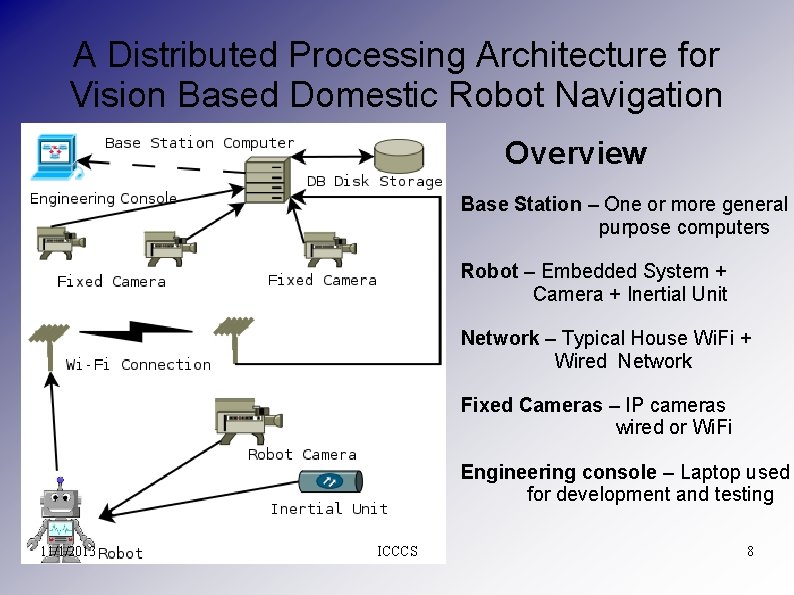
A Distributed Processing Architecture for Vision Based Domestic Robot Navigation Overview Base Station – One or more general purpose computers Robot – Embedded System + Camera + Inertial Unit Network – Typical House Wi. Fi + Wired Network Fixed Cameras – IP cameras wired or Wi. Fi Engineering console – Laptop used for development and testing 11/1/2013 ICCCS 8

A Distributed Processing Architecture for Vision Based Domestic Robot Navigation Epipolar Geometry: Two or more cameras oversee the same scene from two different points and orientations ➢The projections of a point in space on the two image planes are related by an equation involving the Essential Matrix ➢ 8 pairs of matching points are to be identified in order to be able to calculate the Essential Matrix ➢Pose and relative position of cameras can be calculated from Essential Matrix using (SVD) Singular Value Decomposition method ➢ 11/1/2013 ICCCS 9
A Distributed Processing Architecture for Vision Based Domestic Robot Navigation Epipolar Geometry: One camera can be the camera on the robot and the other the camera mounted on the wall ➢? Can be used to either calculate the robot position in respect to fixed camera or to accurately map objects in the environment ➢Susceptible to failures if difference in pose / position is too large or if similar patterns located in different places are encountered ➢ 11/1/2013 ICCCS 10
A Distributed Processing Architecture for Vision Based Domestic Robot Navigation Object Tracking: Fixed camera oversee the scene and can map the movement of the robot ➢A Gaussian Mixture Model is used for background subtraction in order to detect the moving or moved objects in respect to fixed background ➢Each moving object is defined by a status vector containing id, position, velocity and the confidence in the measurement. ➢ 11/1/2013 ICCCS 11
A Distributed Processing Architecture for Vision Based Domestic Robot Navigation Optical Flow Navigation: Used by on-board (robot) computer to detect potential collisions and for reactive navigation when outside of the view of fixed cameras. ➢Optical flow field is a velocity field representing the projection on the image plane of the motion of objects in 3 D space. ➢Can be used to calculate the distance from the moving robot to the obstacles in front or to maintain distance from walls when navigating into a hallway. ➢ 11/1/2013 ICCCS 12
A Distributed Processing Architecture for Vision Based Domestic Robot Navigation Fixed Infrastructure: Wall mounted DCS-930 L and DCS-932 L IP cameras located near ceiling overlooking the room ➢Typical house network with 802. 11 n Wi-Fi router having 10/100 wired Ethernet ➢A pair of computers running Mageia Linux connected to the router with wired Ethernet. Called Base Station they are used for video processing, model/map building, object tracking and mission planing ➢Object recognition for future research and will also take place on the Base Station ➢ 11/1/2013 ICCCS 13
A Distributed Processing Architecture for Vision Based Domestic Robot Navigation Mobile Infrastructure: Mobile platform having Ackerman Steering ➢Beagle. Board-XM embedded computer running Debian ARM Linux connected to network with USB Wi-Fi dongle ➢LI-5 M 03 Camera Board connected directly to Beagle. Board bus ➢Inertial measurement unit with ADXL 345 accelerometer and L 3 G 4200 MEMS gyroscope ➢Additional circuitry ➢For future research we have in the plan to explore the Adapteva’s Paralella board to add extra processing ➢ 11/1/2013 ICCCS 14
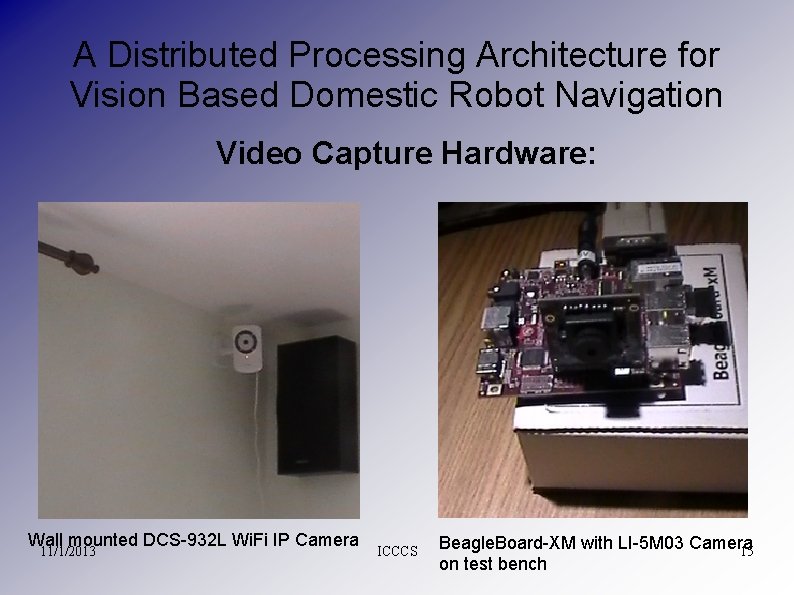
A Distributed Processing Architecture for Vision Based Domestic Robot Navigation Video Capture Hardware: Wall mounted DCS-932 L Wi. Fi IP Camera 11/1/2013 ICCCS Beagle. Board-XM with LI-5 M 03 Camera 15 on test bench
A Distributed Processing Architecture for Vision Based Domestic Robot Navigation Software Development Environment: Open. CV 2. 4. 5 for image processing ➢QT 4. 8. 5 and Open. GL libs for GUI development ➢C++ programming language, gcc version 2. 7. 2 ➢Eclipse CDT and QT-Creator as IDE ➢Mageia Linux Desktop ➢ 11/1/2013 ICCCS 16
A Distributed Processing Architecture for Vision Based Domestic Robot Navigation Software Architecture: Modular Architecture using Active Objects ➢Message Passing Asynchronous Protocol ➢Messages structure designed to minimize the use of network bandwidth ➢Most of image processing localized on each module. Large data sent between modules only “AS NEEDED” upon request ➢Communication Infrastructure API abstracts the location of modules ➢Each Module is an Active Object with at least two threads (communication, main processing) ➢ 11/1/2013 ICCCS 17
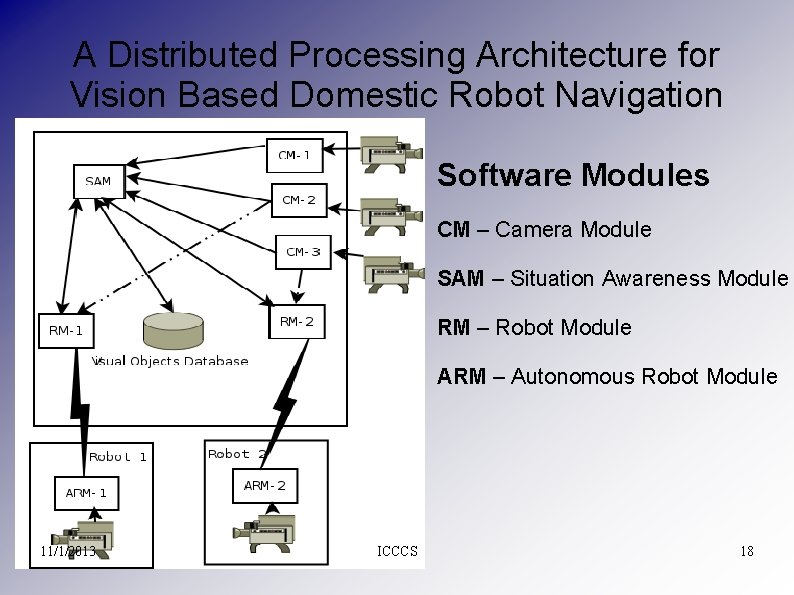
A Distributed Processing Architecture for Vision Based Domestic Robot Navigation Software Modules CM – Camera Module SAM – Situation Awareness Module RM – Robot Module ARM – Autonomous Robot Module 11/1/2013 ICCCS 18
A Distributed Processing Architecture for Vision Based Domestic Robot Navigation Camera Module: One CM for each fixed camera. Capture, preprocessing, blob tracking ➢Sending periodic Blob Tracking Vectors to SAM ➢Upon request, send whole images or sub-images for analysis by other modules ➢ 11/1/2013 ICCCS 19
A Distributed Processing Architecture for Vision Based Domestic Robot Navigation Situation Awareness Module: Maintain a live map of the environment, keeping track of people, objects and robots. ➢Receive periodic tracking vectors from CMs and RMs and match blobs with robots and provide robot tracking info ➢Future developments may include object recognition and maintaining a database for recognition task ➢ 11/1/2013 ICCCS 20
A Distributed Processing Architecture for Vision Based Domestic Robot Navigation Robot Module: Robot path planning and mission control ➢Uses epipolar geometry to map objects or robot pose by requesting images from both ARM and CM ➢Translate tracking information from SAM global coordinate system into robot’s local coordinate system ➢Future research direction may include landmark tracking ➢ 11/1/2013 ICCCS 21
A Distributed Processing Architecture for Vision Based Domestic Robot Navigation Autonomous Robot Module: Optical Flow (OF) processing and reactive OF navigation ➢PID controller to maintain a required trajectory ➢Honors request from RM for (sub) images ➢Able to temporary overrule RM commands if optical flow detect high potential for collision ➢Future research direction may include more processing power to enable true autonomy, more sensors and actuators for “eye-hand coordination” ➢ 11/1/2013 ICCCS 22
A Distributed Processing Architecture for Vision Based Domestic Robot Navigation Typical navigation scenario: RM interrogates SAM for a map ➢RM uses Dijkstra algorithm to find the path ➢RM downloads navigation instructions into ARM ➢CMs keeps broadcasting blob position to SAM ➢SAM provides real-time tracking information to RM ➢ARM uses a PID controller to navigate on path using tracking info from SAM as feedback ➢ 11/1/2013 ICCCS 23
A Distributed Processing Architecture for Vision Based Domestic Robot Navigation Typical navigation scenario: Robot encounter obstacles unknown to SAM ➢Optical flow on ARM detects it as an obstacle ➢ARM sends obstacle info to RM ➢RM requests image from a CM and from ARM ➢RM maps the object using epipolar geometry ➢Send information to SAM to update the occupancy grid ➢Navigation re-starts with new path planning ➢ 11/1/2013 ICCCS 24
A Distributed Processing Architecture for Vision Based Domestic Robot Navigation Ideas for future direction in research: Explore landmark based navigation and object recognition ➢Increase the processing power on mobile unit by using something like Adapteva’s Paralella board ➢The ability to create a Visual Aspect Indexed Database for object recognition from a large subset of classes of objects ➢ 11/1/2013 ICCCS 25
- Slides: 25