
A DISTRIBUTED NEWTON METHOD FOR NETWORK UTILITY MAXIMIZATION
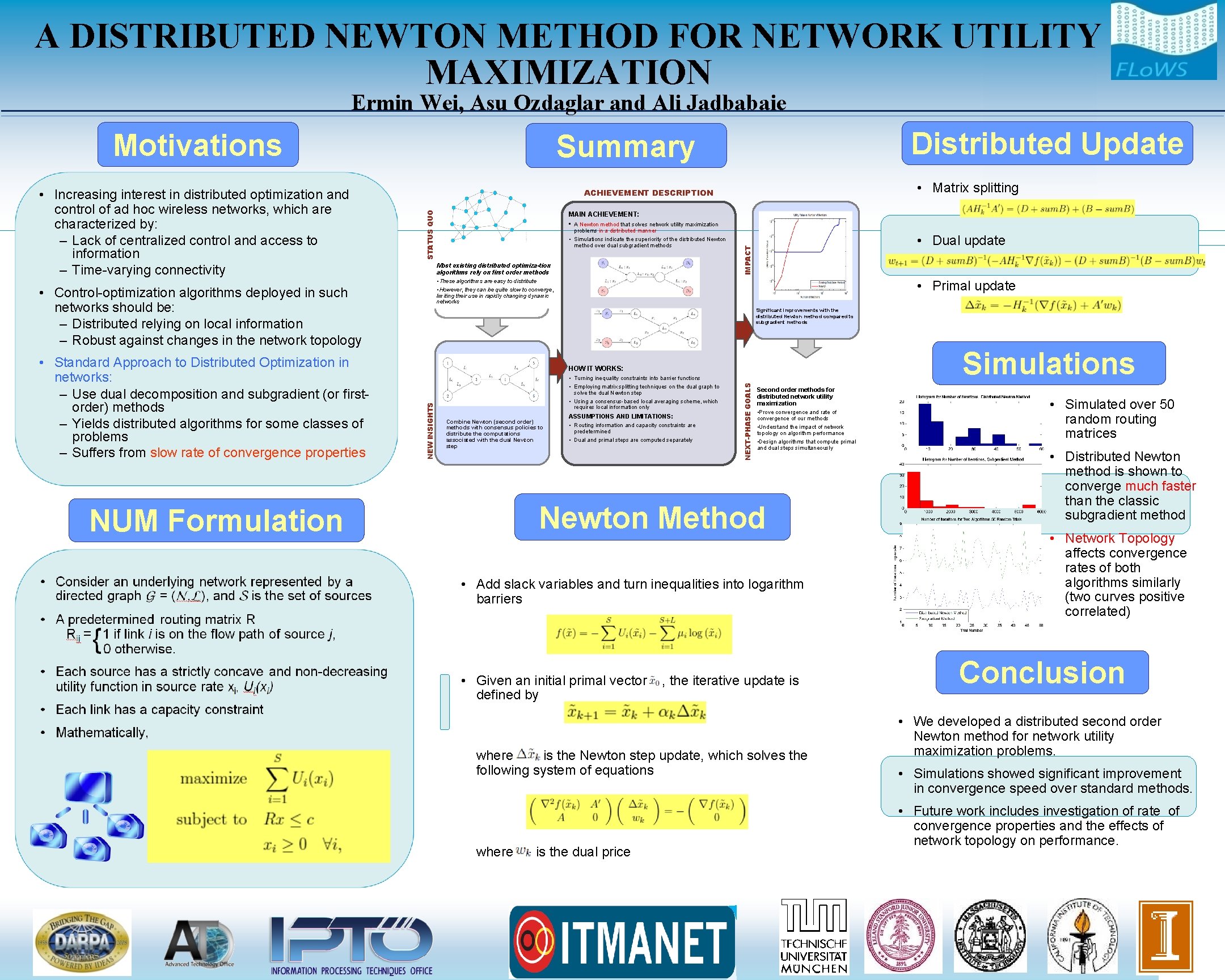
A DISTRIBUTED NEWTON METHOD FOR NETWORK UTILITY MAXIMIZATION Ermin Wei, Asu Ozdaglar and Ali Jadbabaie Motivations MAIN ACHIEVEMENT: • A Newton method that solves network utility maximization • Dual update IMPACT problems in a distributed manner • Simulations indicate the superiority of the distributed Newton method over dual subgradient methods Most existing distributed optimiza-tion algorithms rely on first order methods • These algorithms are easy to distribute • However, they can be quite slow to converge, limiting their use in rapidly changing dynamic networks • Control-optimization algorithms deployed in such networks should be: – Distributed relying on local information – Robust against changes in the network topology • Primal update Significant improvements with the distributed Newton method compared to subgradient methods Simulations • Turning inequality constraints into barrier functions • Employing matrix splitting techniques on the dual graph to solve the dual Newton step • Using a consensus-based local averaging scheme, which requires local information only Combine Newton (second order) methods with consensus policies to distribute the computations associated with the dual Newton step ASSUMPTIONS AND LIMITATIONS: • Routing information and capacity constraints are predetermined • Dual and primal steps are computed separately NEXT-PHASE GOALS HOW IT WORKS: NEW INSIGHTS • Standard Approach to Distributed Optimization in networks: – Use dual decomposition and subgradient (or firstorder) methods – Yields distributed algorithms for some classes of problems – Suffers from slow rate of convergence properties • Matrix splitting ACHIEVEMENT DESCRIPTION STATUS QUO • Increasing interest in distributed optimization and control of ad hoc wireless networks, which are characterized by: – Lack of centralized control and access to information – Time-varying connectivity Distributed Update Summary Second order methods for distributed network utility maximization • Prove convergence and rate of convergence of our methods • Understand the impact of network topology on algorithm performance • Design algorithms that compute primal and dual steps simultaneously Newton Method NUM Formulation • Add slack variables and turn inequalities into logarithm barriers • Given an initial primal vector defined by , the iterative update is where is the Newton step update, which solves the following system of equations where is the dual price • Simulated over 50 random routing matrices • Distributed Newton method is shown to converge much faster than the classic subgradient method • Network Topology affects convergence rates of both algorithms similarly (two curves positive correlated) Conclusion • We developed a distributed second order Newton method for network utility maximization problems. • Simulations showed significant improvement in convergence speed over standard methods. • Future work includes investigation of rate of convergence properties and the effects of network topology on performance.
- Slides: 1