
A Distributed LedgerEnabled Interworking Model for the Wireless
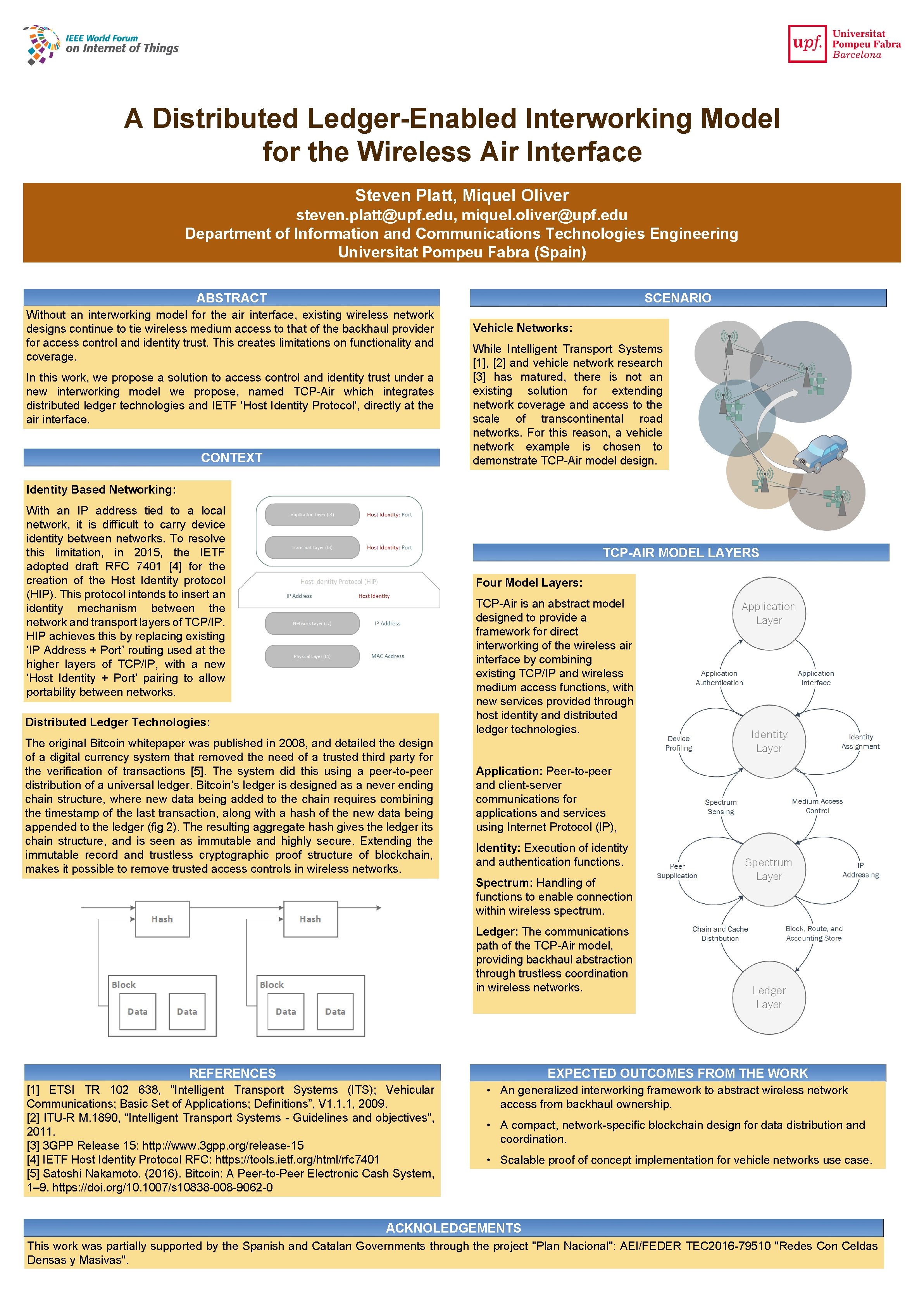
A Distributed Ledger-Enabled Interworking Model for the Wireless Air Interface Steven Platt, Miquel Oliver steven. platt@upf. edu, miquel. oliver@upf. edu Department of Information and Communications Technologies Engineering Universitat Pompeu Fabra (Spain) ABSTRACT SCENARIO Without an interworking model for the air interface, existing wireless network designs continue to tie wireless medium access to that of the backhaul provider for access control and identity trust. This creates limitations on functionality and coverage. In this work, we propose a solution to access control and identity trust under a new interworking model we propose, named TCP-Air which integrates distributed ledger technologies and IETF 'Host Identity Protocol', directly at the air interface. CONTEXT Vehicle Networks: While Intelligent Transport Systems [1], [2] and vehicle network research [3] has matured, there is not an existing solution for extending network coverage and access to the scale of transcontinental road networks. For this reason, a vehicle network example is chosen to demonstrate TCP-Air model design. Identity Based Networking: With an IP address tied to a local network, it is difficult to carry device identity between networks. To resolve this limitation, in 2015, the IETF adopted draft RFC 7401 [4] for the creation of the Host Identity protocol (HIP). This protocol intends to insert an identity mechanism between the network and transport layers of TCP/IP. HIP achieves this by replacing existing ‘IP Address + Port’ routing used at the higher layers of TCP/IP, with a new ‘Host Identity + Port’ pairing to allow portability between networks. TCP-AIR MODEL LAYERS Four Model Layers: TCP-Air is an abstract model designed to provide a framework for direct interworking of the wireless air interface by combining existing TCP/IP and wireless medium access functions, with new services provided through host identity and distributed ledger technologies. Distributed Ledger Technologies: The original Bitcoin whitepaper was published in 2008, and detailed the design of a digital currency system that removed the need of a trusted third party for the verification of transactions [5]. The system did this using a peer-to-peer distribution of a universal ledger. Bitcoin’s ledger is designed as a never ending chain structure, where new data being added to the chain requires combining the timestamp of the last transaction, along with a hash of the new data being appended to the ledger (fig 2). The resulting aggregate hash gives the ledger its chain structure, and is seen as immutable and highly secure. Extending the immutable record and trustless cryptographic proof structure of blockchain, makes it possible to remove trusted access controls in wireless networks. Application: Peer-to-peer and client-server communications for applications and services using Internet Protocol (IP), Identity: Execution of identity and authentication functions. Spectrum: Handling of functions to enable connection within wireless spectrum. Ledger: The communications path of the TCP-Air model, providing backhaul abstraction through trustless coordination in wireless networks. REFERENCES EXPECTED OUTCOMES FROM THE WORK [1] ETSI TR 102 638, “Intelligent Transport Systems (ITS); Vehicular Communications; Basic Set of Applications; Definitions”, V 1. 1. 1, 2009. [2] ITU-R M. 1890, “Intelligent Transport Systems - Guidelines and objectives”, 2011. [3] 3 GPP Release 15: http: //www. 3 gpp. org/release-15 [4] IETF Host Identity Protocol RFC: https: //tools. ietf. org/html/rfc 7401 [5] Satoshi Nakamoto. (2016). Bitcoin: A Peer-to-Peer Electronic Cash System, 1– 9. https: //doi. org/10. 1007/s 10838 -008 -9062 -0 • An generalized interworking framework to abstract wireless network access from backhaul ownership. • A compact, network-specific blockchain design for data distribution and coordination. • Scalable proof of concept implementation for vehicle networks use case. ACKNOLEDGEMENTS This work was partially supported by the Spanish and Catalan Governments through the project "Plan Nacional": AEI/FEDER TEC 2016 -79510 "Redes Con Celdas Densas y Masivas".
- Slides: 1