
A Discuss the meaning and importance of reproduction
- Slides: 37
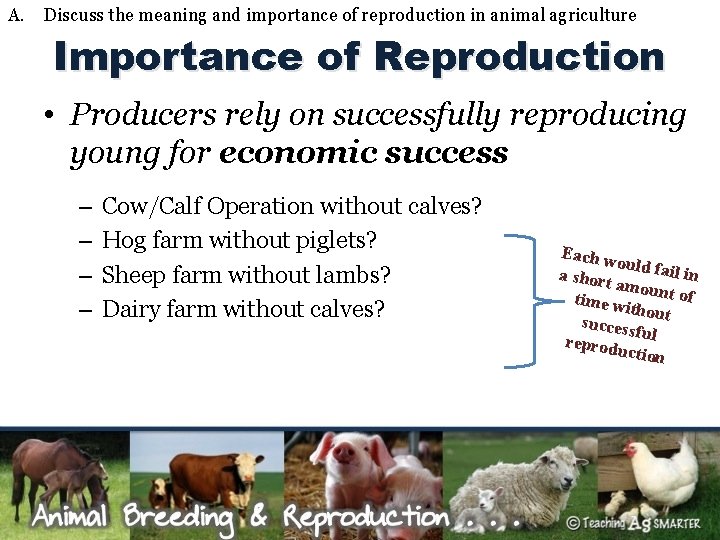
A. Discuss the meaning and importance of reproduction in animal agriculture Importance of Reproduction • Producers rely on successfully reproducing young for economic success – – Cow/Calf Operation without calves? Hog farm without piglets? Sheep farm without lambs? Dairy farm without calves? Each w ou a short ld fail in amount of time wi thout success f reprodu ul ction
A. Discuss the meaning and importance of reproduction in animal agriculture Importance of Reproduction • Our food supply would be in jeopardy without sound animal reproductive practices
B. Describe benefits of using genetically superior animals for breeding Choosing Superior Animals • Responsible Animal Breeding: – Only breed animals with desirable characteristics to be passed on: • Natural selection would eliminate most genetic problems, but artificial selection does not • It is our responsibility to be responsible animal breeders
B. Describe benefits of using genetically superior animals for breeding Choosing Superior Animals • Responsible Animal Breeding: – Improve the next generation • Hybrid Vigor • Eliminate poor characteristics • Improve efficiency of food production
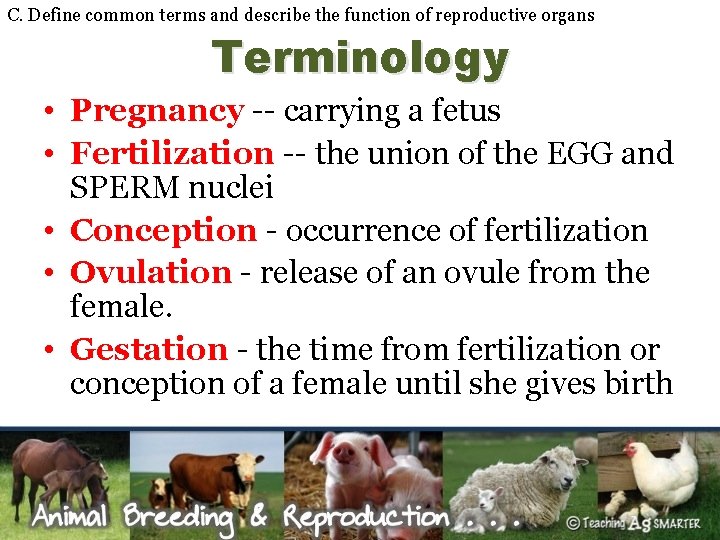
C. Define common terms and describe the function of reproductive organs Terminology • Pregnancy -- carrying a fetus • Fertilization -- the union of the EGG and SPERM nuclei • Conception - occurrence of fertilization • Ovulation - release of an ovule from the female. • Gestation - the time from fertilization or conception of a female until she gives birth
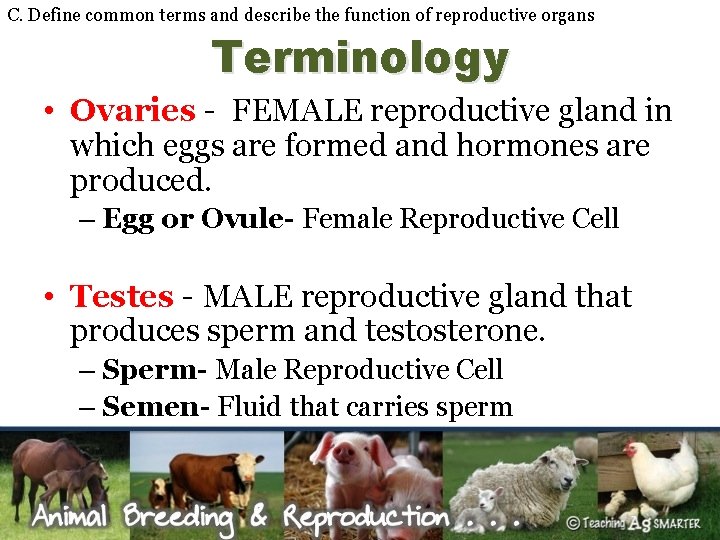
C. Define common terms and describe the function of reproductive organs Terminology • Ovaries - FEMALE reproductive gland in which eggs are formed and hormones are produced. – Egg or Ovule- Female Reproductive Cell • Testes - MALE reproductive gland that produces sperm and testosterone. – Sperm- Male Reproductive Cell – Semen- Fluid that carries sperm
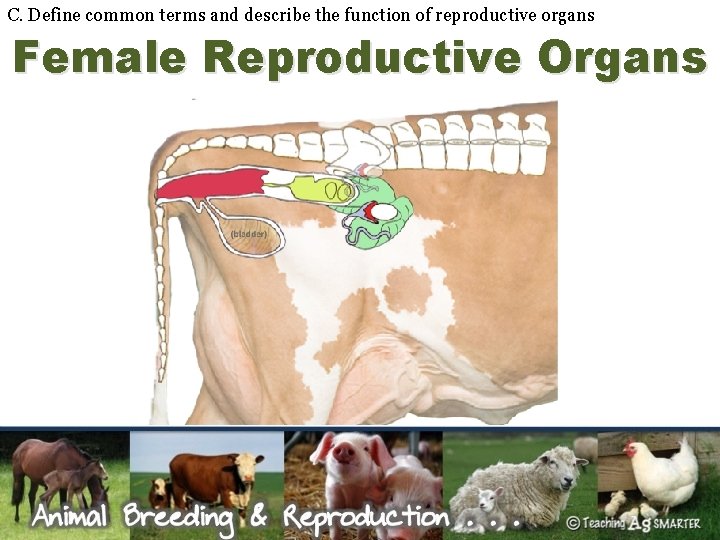
C. Define common terms and describe the function of reproductive organs Female Reproductive Organs
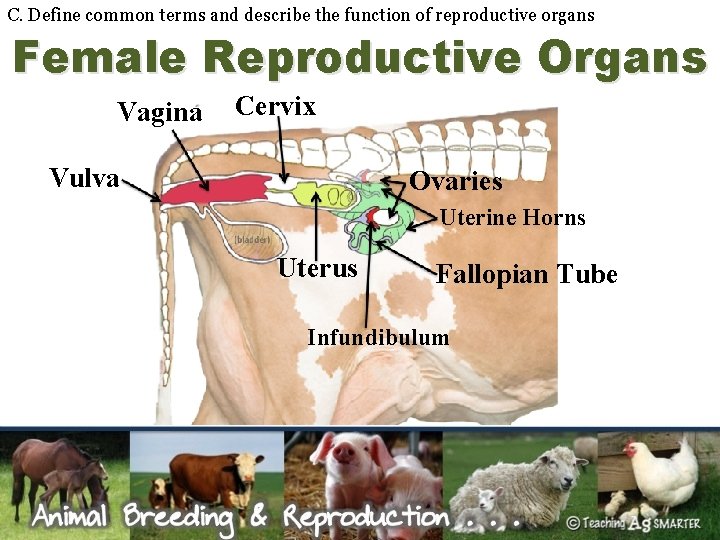
C. Define common terms and describe the function of reproductive organs Female Reproductive Organs Vagina Cervix Vulva Ovaries Uterine Horns Uterus Fallopian Tube Infundibulum
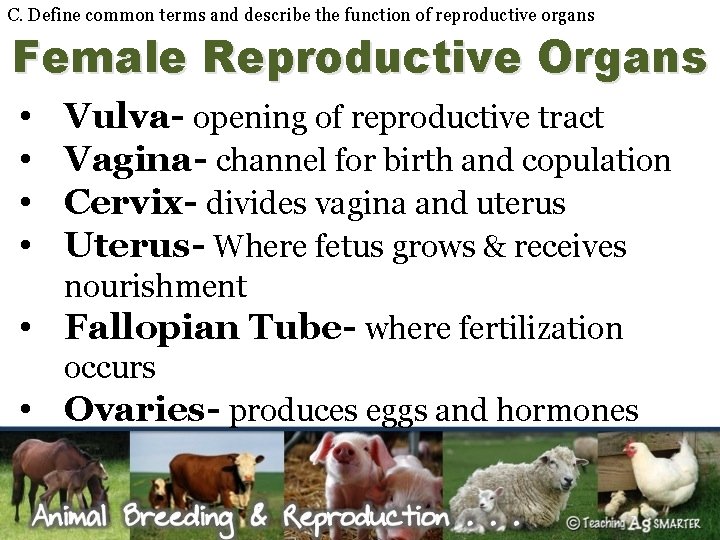
C. Define common terms and describe the function of reproductive organs Female Reproductive Organs • • Vulva- opening of reproductive tract Vagina- channel for birth and copulation Cervix- divides vagina and uterus Uterus- Where fetus grows & receives nourishment • Fallopian Tube- where fertilization occurs • Ovaries- produces eggs and hormones
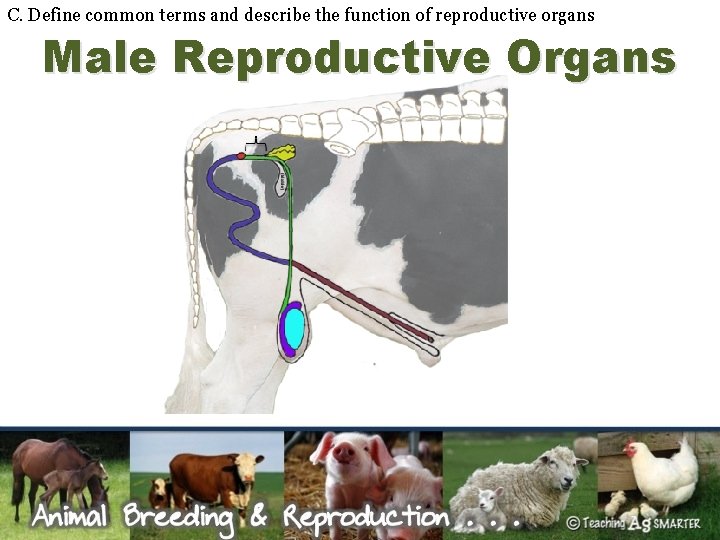
C. Define common terms and describe the function of reproductive organs Male Reproductive Organs
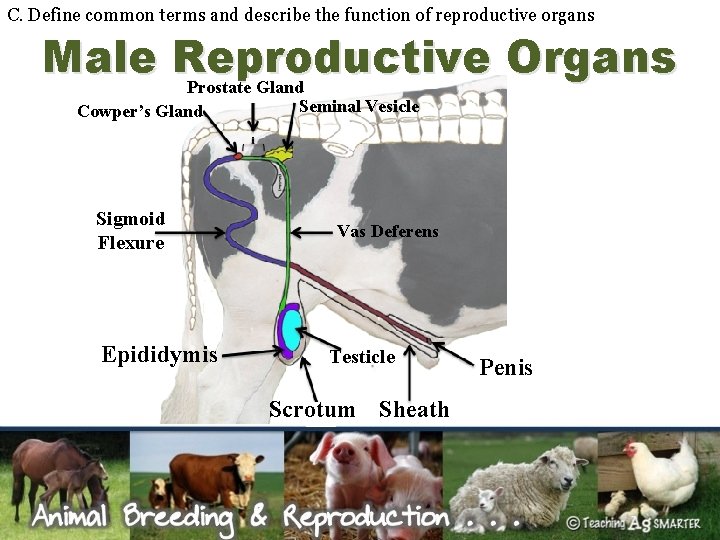
C. Define common terms and describe the function of reproductive organs Male Reproductive Organs Prostate Gland Cowper’s Gland Sigmoid Flexure Epididymis Seminal Vesicle Vas Deferens Testicle Scrotum Sheath Penis
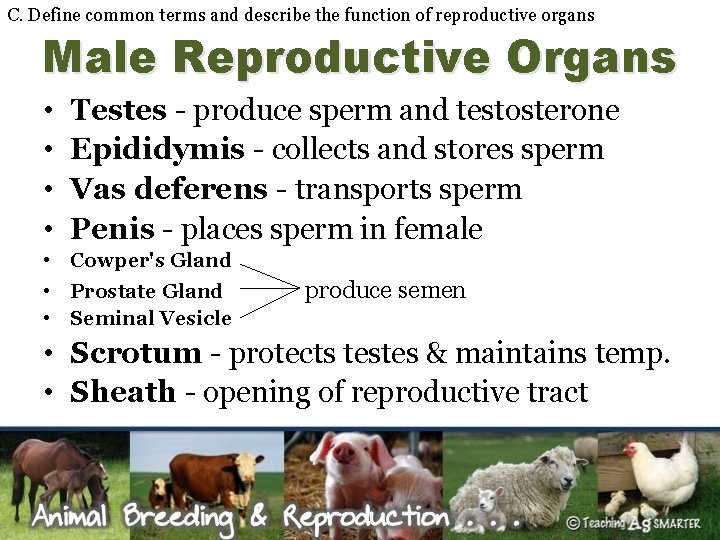
C. Define common terms and describe the function of reproductive organs Male Reproductive Organs • • Testes - produce sperm and testosterone Epididymis - collects and stores sperm Vas deferens - transports sperm Penis - places sperm in female • Cowper's Gland • Prostate Gland • Seminal Vesicle produce semen • Scrotum - protects testes & maintains temp. • Sheath - opening of reproductive tract
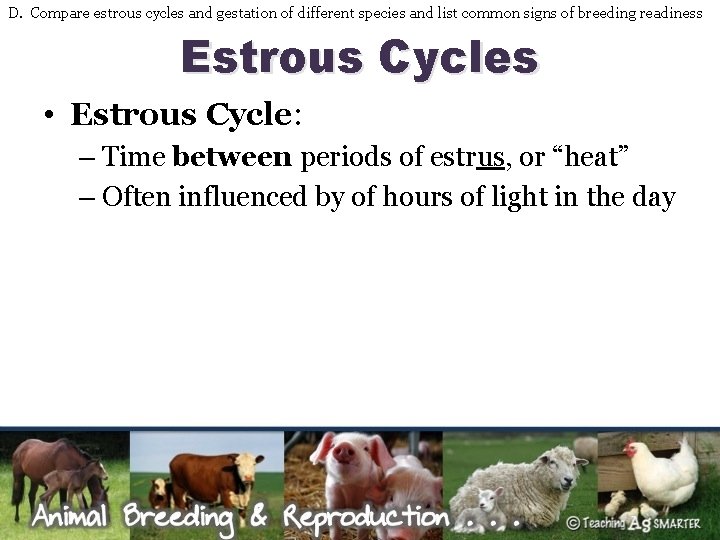
D. Compare estrous cycles and gestation of different species and list common signs of breeding readiness Estrous Cycles • Estrous Cycle: – Time between periods of estrus, or “heat” – Often influenced by of hours of light in the day
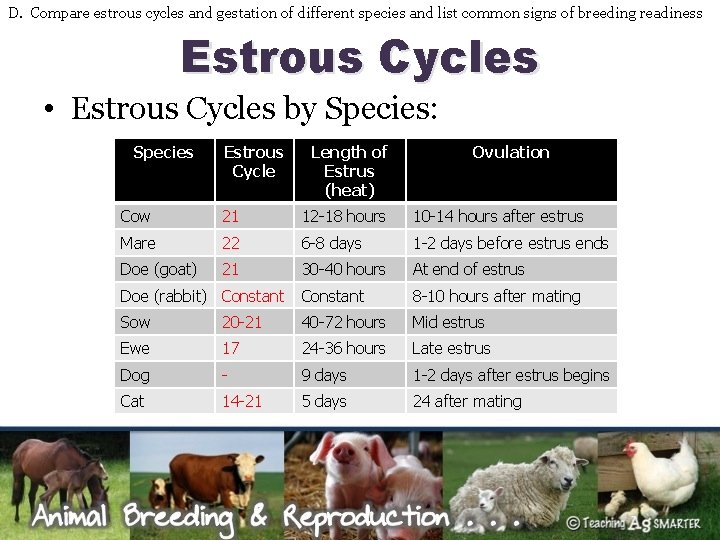
D. Compare estrous cycles and gestation of different species and list common signs of breeding readiness Estrous Cycles • Estrous Cycles by Species: Species Estrous Cycle Length of Estrus (heat) Ovulation Cow 21 12 -18 hours 10 -14 hours after estrus Mare 22 6 -8 days 1 -2 days before estrus ends Doe (goat) 21 30 -40 hours At end of estrus Doe (rabbit) Constant 8 -10 hours after mating Sow 20 -21 40 -72 hours Mid estrus Ewe 17 24 -36 hours Late estrus Dog - 9 days 1 -2 days after estrus begins Cat 14 -21 5 days 24 after mating
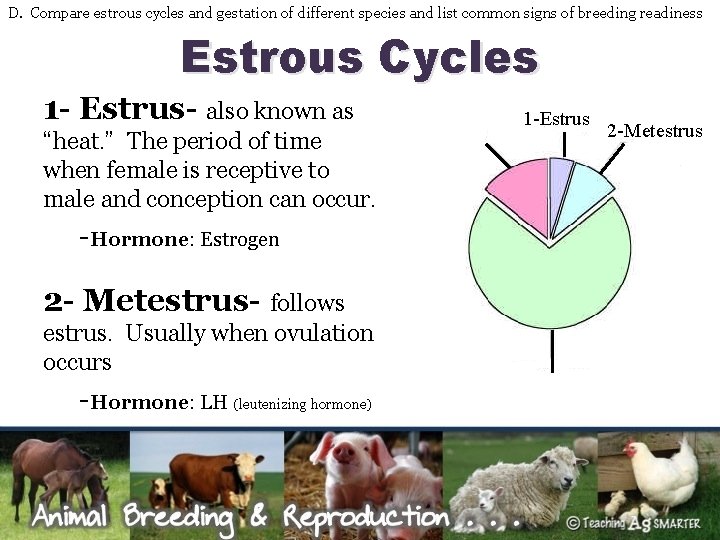
D. Compare estrous cycles and gestation of different species and list common signs of breeding readiness Estrous Cycles 1 - Estrus- also known as “heat. ” The period of time when female is receptive to male and conception can occur. -Hormone: Estrogen 2 - Metestrus- follows estrus. Usually when ovulation occurs -Hormone: LH (leutenizing hormone) 1 -Estrus 2 -Metestrus
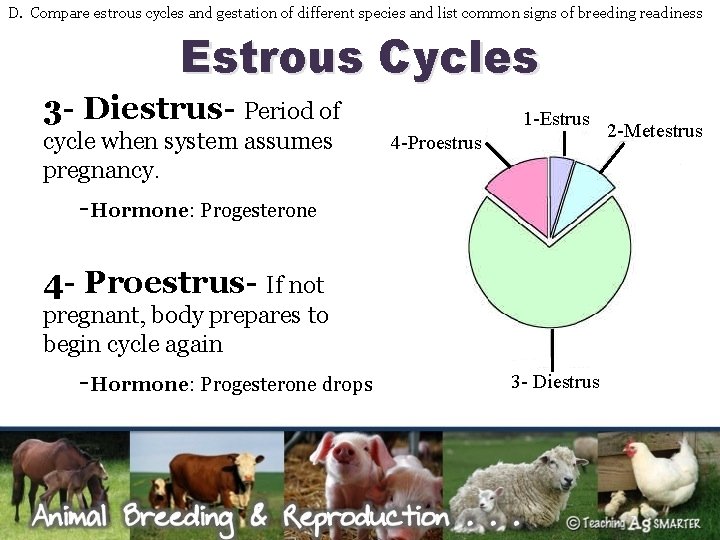
D. Compare estrous cycles and gestation of different species and list common signs of breeding readiness Estrous Cycles 3 - Diestrus- Period of cycle when system assumes pregnancy. 1 -Estrus 4 -Proestrus -Hormone: Progesterone 4 - Proestrus- If not pregnant, body prepares to begin cycle again -Hormone: Progesterone drops 3 - Diestrus 2 -Metestrus
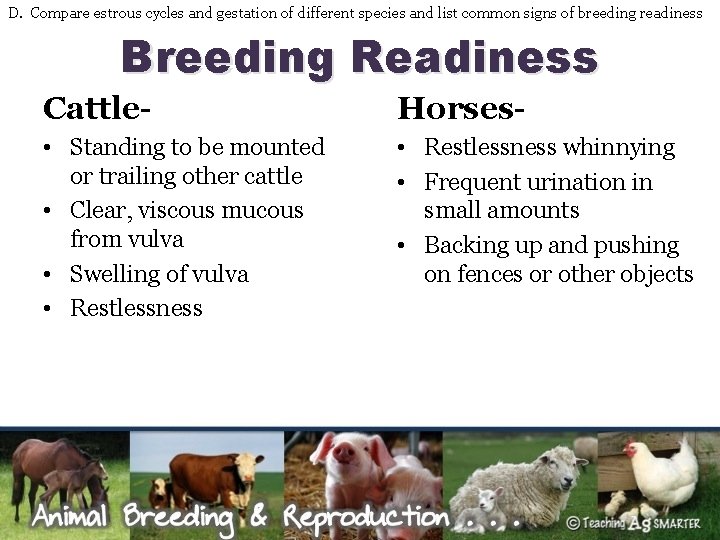
D. Compare estrous cycles and gestation of different species and list common signs of breeding readiness Breeding Readiness Cattle- Horses- • Standing to be mounted or trailing other cattle • Clear, viscous mucous from vulva • Swelling of vulva • Restlessness whinnying • Frequent urination in small amounts • Backing up and pushing on fences or other objects
D. Compare estrous cycles and gestation of different species and list common signs of breeding readiness Gestation • Length of PREGNANCY. • Begins with FERTILIZATION and ends with parturition (birth). • All animals have different gestation lengths. Usually the LARGER the animal, the LONGER the gestation.
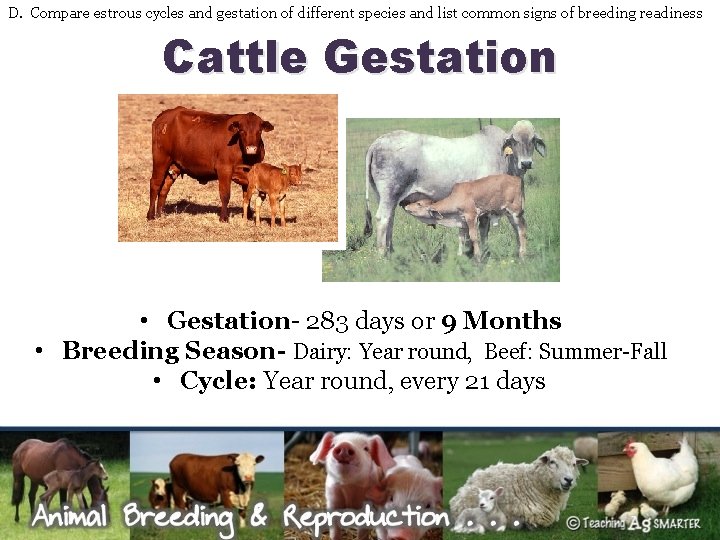
D. Compare estrous cycles and gestation of different species and list common signs of breeding readiness Cattle Gestation • Gestation- 283 days or 9 Months • Breeding Season- Dairy: Year round, Beef: Summer-Fall • Cycle: Year round, every 21 days
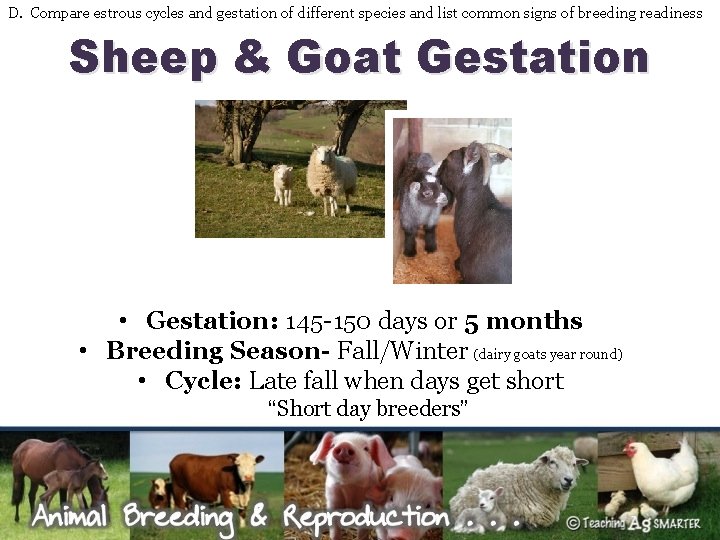
D. Compare estrous cycles and gestation of different species and list common signs of breeding readiness Sheep & Goat Gestation • Gestation: 145 -150 days or 5 months • Breeding Season- Fall/Winter (dairy goats year round) • Cycle: Late fall when days get short “Short day breeders”
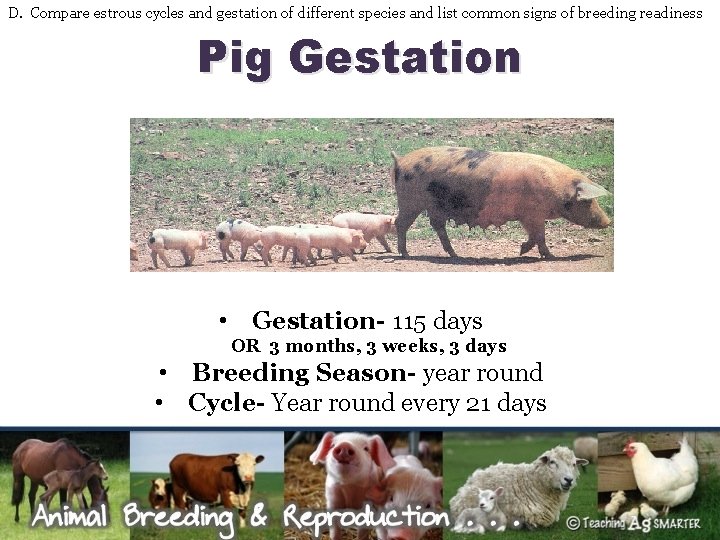
D. Compare estrous cycles and gestation of different species and list common signs of breeding readiness Pig Gestation • Gestation- 115 days OR 3 months, 3 weeks, 3 days • Breeding Season- year round • Cycle- Year round every 21 days
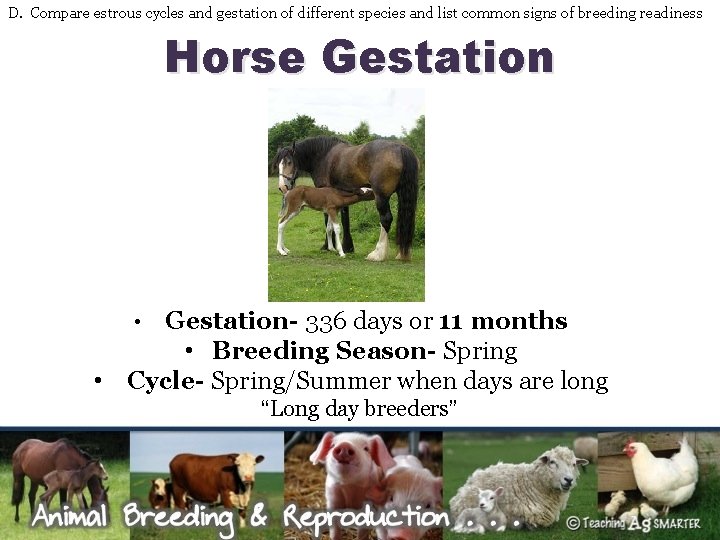
D. Compare estrous cycles and gestation of different species and list common signs of breeding readiness Horse Gestation- 336 days or 11 months • Breeding Season- Spring • Cycle- Spring/Summer when days are long • “Long day breeders”
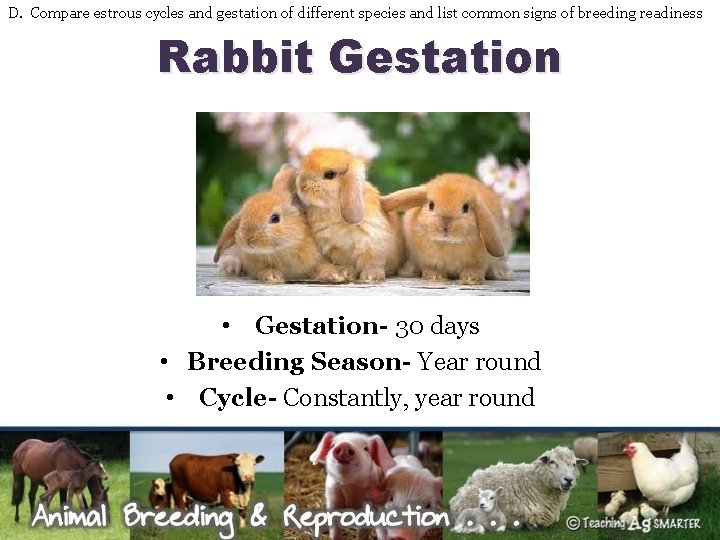
D. Compare estrous cycles and gestation of different species and list common signs of breeding readiness Rabbit Gestation • Gestation- 30 days • Breeding Season- Year round • Cycle- Constantly, year round
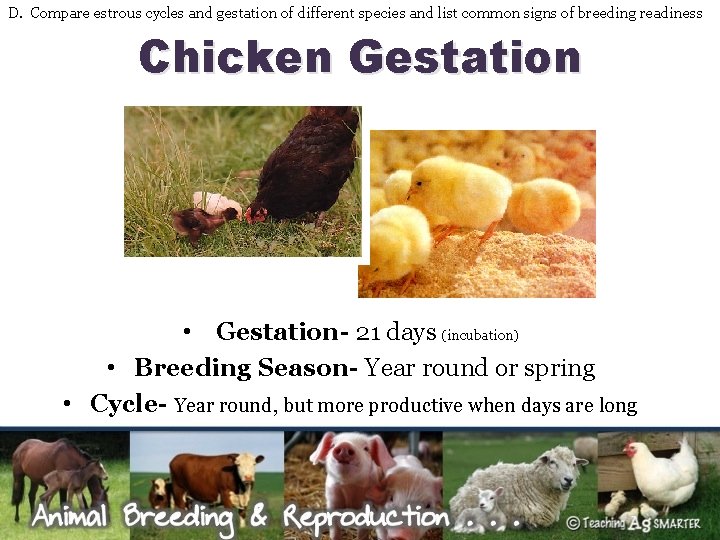
D. Compare estrous cycles and gestation of different species and list common signs of breeding readiness Chicken Gestation • Gestation- 21 days (incubation) • Breeding Season- Year round or spring • Cycle- Year round, but more productive when days are long
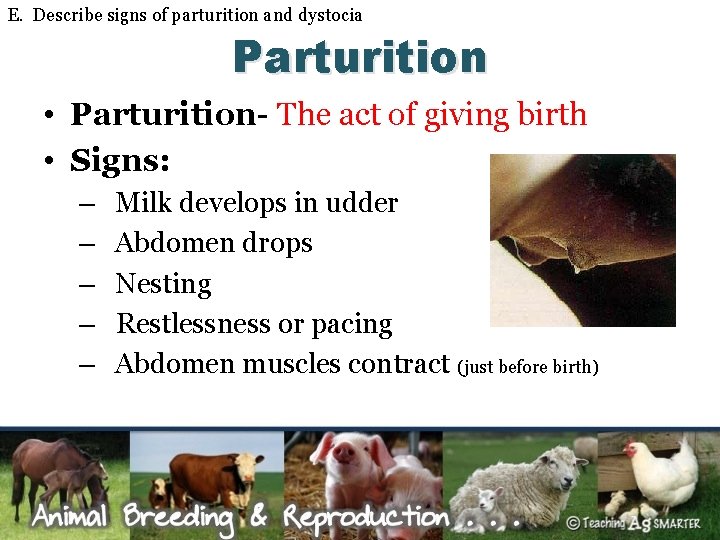
E. Describe signs of parturition and dystocia Parturition • Parturition- The act of giving birth • Signs: – – – Milk develops in udder Abdomen drops Nesting Restlessness or pacing Abdomen muscles contract (just before birth)
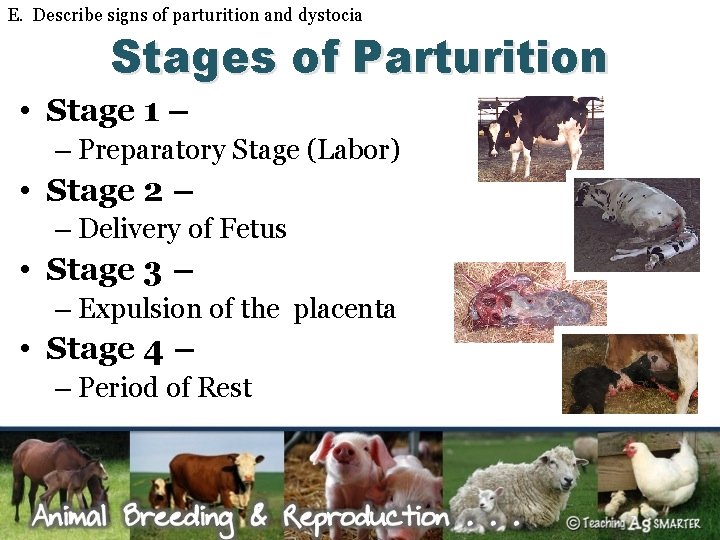
E. Describe signs of parturition and dystocia Stages of Parturition • Stage 1 – – Preparatory Stage (Labor) • Stage 2 – – Delivery of Fetus • Stage 3 – – Expulsion of the placenta • Stage 4 – – Period of Rest
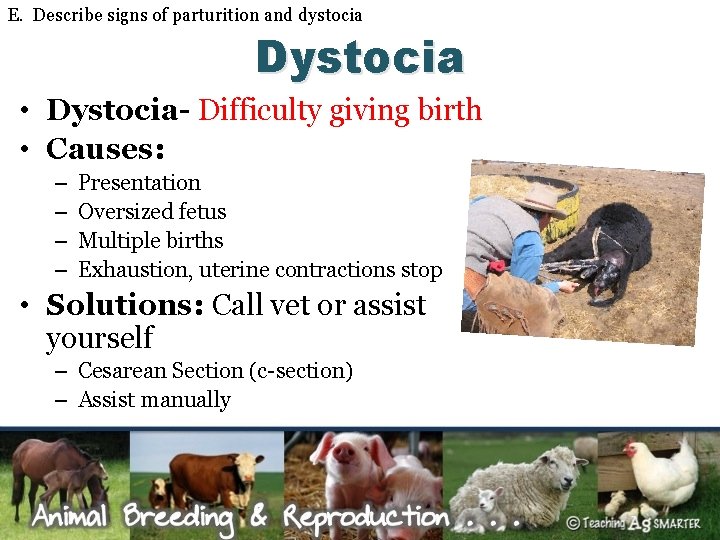
E. Describe signs of parturition and dystocia Dystocia • Dystocia- Difficulty giving birth • Causes: – – Presentation Oversized fetus Multiple births Exhaustion, uterine contractions stop • Solutions: Call vet or assist yourself – Cesarean Section (c-section) – Assist manually
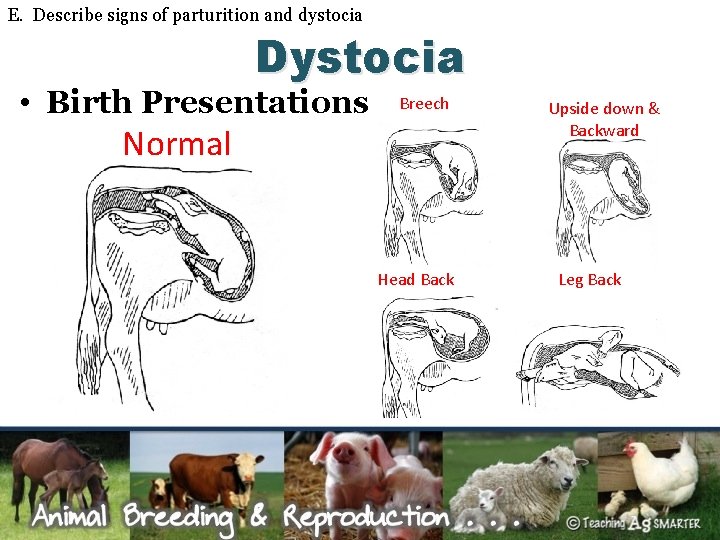
E. Describe signs of parturition and dystocia Dystocia • Birth Presentations Breech Normal Head Back Upside down & Backward Leg Back
F. Describe the purpose and benefits of reproductive technologies Reproductive Technologies • Any method of reproduction that is not a natural method
F. Describe the purpose and benefits of reproductive technologies Reproductive Technologies Artificial Insemination Collecting and placing sperm from the male to the female reproductive tract without natural mating
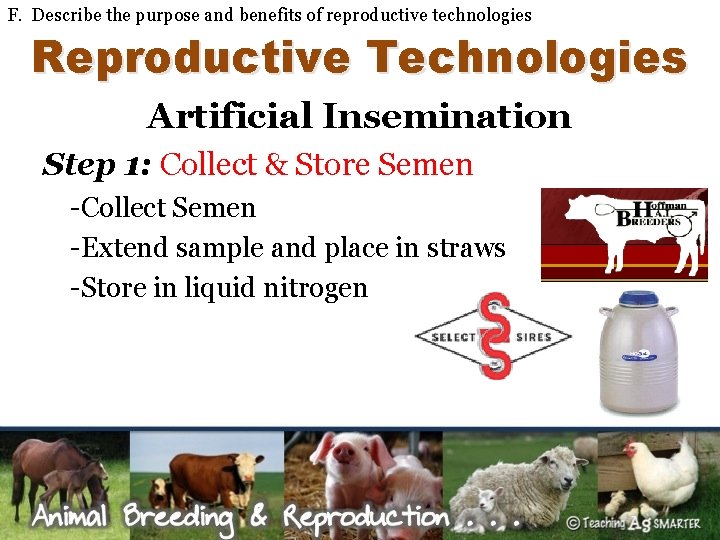
F. Describe the purpose and benefits of reproductive technologies Reproductive Technologies Artificial Insemination Step 1: Collect & Store Semen -Collect Semen -Extend sample and place in straws -Store in liquid nitrogen
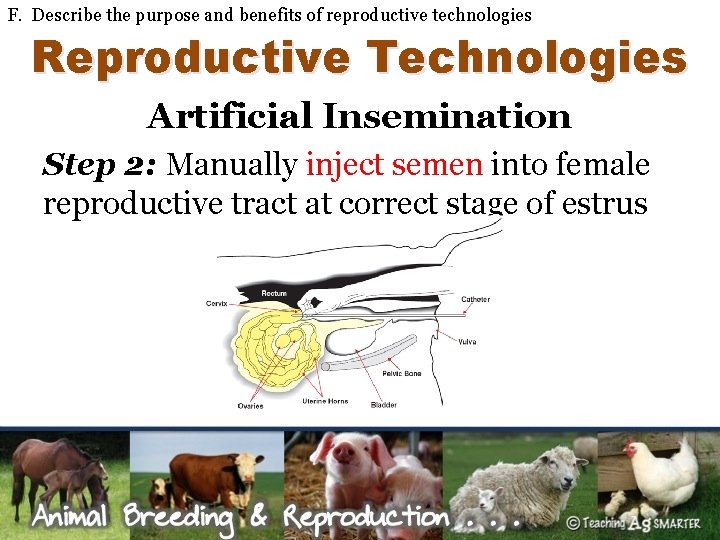
F. Describe the purpose and benefits of reproductive technologies Reproductive Technologies Artificial Insemination Step 2: Manually inject semen into female reproductive tract at correct stage of estrus
F. Describe the purpose and benefits of reproductive technologies Reproductive Technologies Advantages of Artificial Insemination 1 - Wider selection & use of outstanding sires 2 - Rapid Genetic and herd improvement 3 - Overcome physical barriers to mating – Examples: Aggressive behavior or injuries 4 - Danger of the bull is eliminated 5 - Eliminate cost of purchasing and keeping a bull
F. Describe the purpose and benefits of reproductive technologies Reproductive Technologies Disadvantages of Artificial Insemination 1 - Skilled Technician or training required 2 -Very close supervision of females is necessary to accurately determine stage of estrus
F. Describe the purpose and benefits of reproductive technologies Reproductive Technologies Synchronized Ovulation The process of causing a herd of cows or heifers to come into estrus and ovulate at or near the same time
F. Describe the purpose and benefits of reproductive technologies Reproductive Technologies Embryo Transfer The transfer of fertilized egg(s) from a donor female to one or more recipient females Utilizes genetics of superior FEMALES by producing more offspring per year than by natural breeding methods
F. Describe the purpose and benefits of reproductive technologies Reproductive Technologies Cloning Producing an EXACT genetic copy of an organism