
A Direction to History Thinking About the Evolution
A Direction to History? Thinking About the Evolution of Societies
Big Ideas n n n This is an attempt to put some of the social transformations we see in a wider context (I. e. 'Big Picture') Are there patterns to history? What new kinds of social relations might emerge? What sort of end state are we heading for? Social theories always linked to ideas about Utopia and ideology (ie Marxism, religious unfolding of God's plan)

Functions of Society n n Most theories address three functions of society: culture, polity and economy Some look 'below' to biological or psychological drives
Types of Theory n n Economic (or Technological): Marxism, Differentiation theory Political: Institutionalism, Weber's 'iron cage' bureaucratisation, Event-Driven, 'Great Men' theory Cultural: Hegelianism, Daniel Bell's theory, post-modernism Biological: Evolutionary psychology

Direction of History n n n Evolutionary: Marx, Bell's post-industrial society, differentiation theory (Spencer, Durkheim, Parsons), Fukuyama Discontinuous: Conflict theory, postmodernism, Giddens Cyclical: Bell's cultural theory, Hegelianism, Toynbee
Key Actors: 'Who' Leads Change n Which class or individuals: n n n n King/Leader Nobility Military Bourgeoisie Professionals Elites or masses Leaders or elite circles
Evolutionary Theory n n Influenced by Darwin Herbert Spencer an early exponent Argument by analogy rather than sociobiology Society is an organism that evolves like life did
Evolutionary Theory n Original society was largely undifferentiated hunter-gatherer society n n n Relative equality within the tribe All have the same role (hunter, gatherer). All did all jobs Civilisation involved a specialisation into rulers and peasants/slaves n n Later a class of warriors Class of religious officials Administrators Occupation: Agriculture, Mines, labourers, artisans
Evolutionary View of Society n n n First agriculture, then coal-powered industry allows society to adapt and become 'fitter' (support more population) Social relations evolve from tribal to feudal to capitalist Post-industrial theorists point to increasing specialisation within capitalism: n niche marketing (ie specialist TV channels & shops) specialist skills (ie medical specialties) specialisation of knowledge (ie scientific disciplines and sub-disciplines)
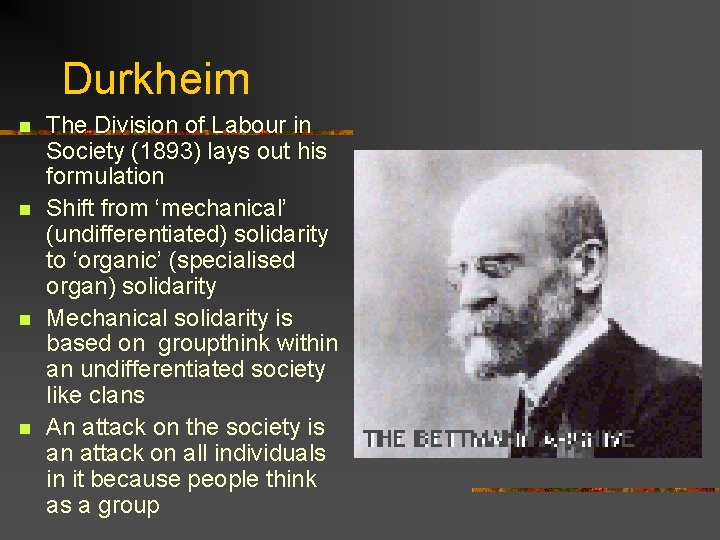
Durkheim n n The Division of Labour in Society (1893) lays out his formulation Shift from ‘mechanical’ (undifferentiated) solidarity to ‘organic’ (specialised organ) solidarity Mechanical solidarity is based on groupthink within an undifferentiated society like clans An attack on the society is an attack on all individuals in it because people think as a group
Durkheim… n n n Laws are formulated based on retaliation because crime against one is crime against all Shift from mechanical to organic solidarity based on mutual dependence in a complex society People become more individually-minded, yet still bound together by their mutual interdependency National differences matter less than differences based on occupational function People’s identities change from tribe/clan to occupational ‘corporation’, a kind of guild-like association for modern functional specialisations
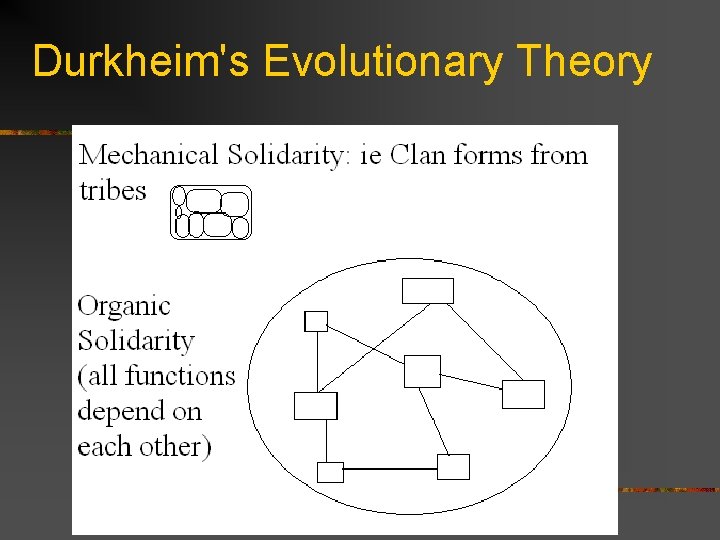
Durkheim's Evolutionary Theory
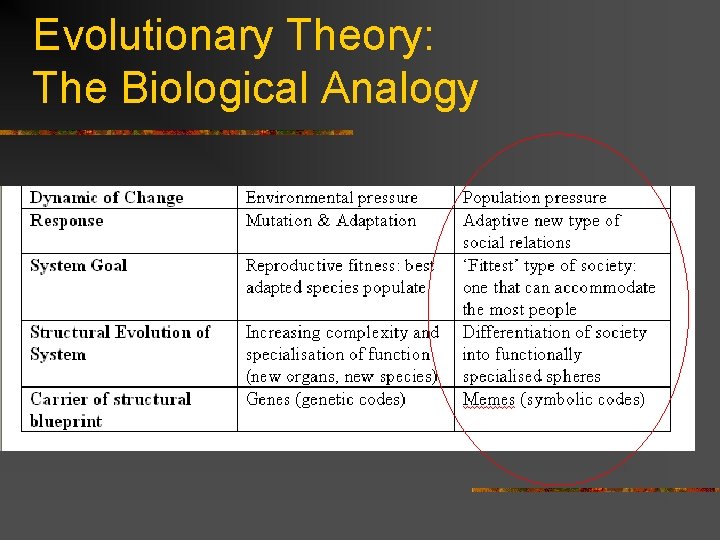
Evolutionary Theory: The Biological Analogy
Culturalist/Idealist Theories Fewer culturalist theories n Hegelianism the best known n ‘Spirit’, a mystical conception, drives history rather than mere events: “ Spirit does not toss itself about in the external play of chance occurrences; on the contrary, it is that which determines history absolutely, and it stands firm against the chance occurrences which it dominates and exploits for its own purpose. “ – Hegel, Phenomenology of Spirit n

Hegelian Dialectic n n Thesis & Antithesis Contradictions produce a synthesis which resolves the contradictions. Albeit temporarily Progressive evolution as society moves from thesis, antithesis, to synthesis This process is known as dialectic
Marx n n n Evolution from feudal to capitalist and then to socialist society Driver is the techno-economic ‘base’, namely the mode of production (agriculture, then industry) ‘Contradictions’ in society between economic classes Contradictions produce change. Utopia is the worker’s socialist society Materialist version of Hegel
Parsons’ Modernisation Theory, c. 1950 s-60 s n n n Main functions in society included economy, polity, ‘societal community’ and culture Change can emerge from any of the 4, and this leads to adjustments in the other functional strata Culture ranks ‘higher’ in information input, lowest in energy. Economy is vice-versa 5 stages of society: primitive, archaic, historic, seedbed, modern General pattern: shift from ascription to meritocracy, from particularity to universality, from collective to the individual
Parsons’ 6 Evolutionary Steps 1. 2. 3. 4. 5. 6. n Social stratification Cultural legitimation Bureaucratic administration Money and Markets Generalised Legal System Democratic Association Parsons’ work reflected evolutionary assumptions of both Marxist and non. Marxist scholars
The Rise of the West? n n n Were not the first to stratify or to have cultural legitimation or writing BUT: Professional Bureaucracy becomes important by 16 th c. Only Chinese can rival Money and markets more developed by middle ages in towns, serving more people spread Roman (universalistic, rational) law from 12 th c. Democratic association spreads in Italian city-states from 14 th c and within states after French Revolution
Post-1960 s Conflict Theory n Critiques of evolutionists: n n Teleological & optimistic Ignores conflict All about structures. Ignores actors – including important individuals Downplays the role of randomness, contingency and sharp breaks (as opposed to historical patterns)
Neo-Evolutionists n n n Giddens or Habermas defend the modern project of rationality and individuality and speak of modernity superseding tradition Fukuyama’s ‘End of History and the Last Man’ (1992) is very much in the style of Hegel, Parsons, Durkheim and Giddens Liberalism in culture, democracy in politics and mixed capitalism in the economy represent the end-state for human society after 1989
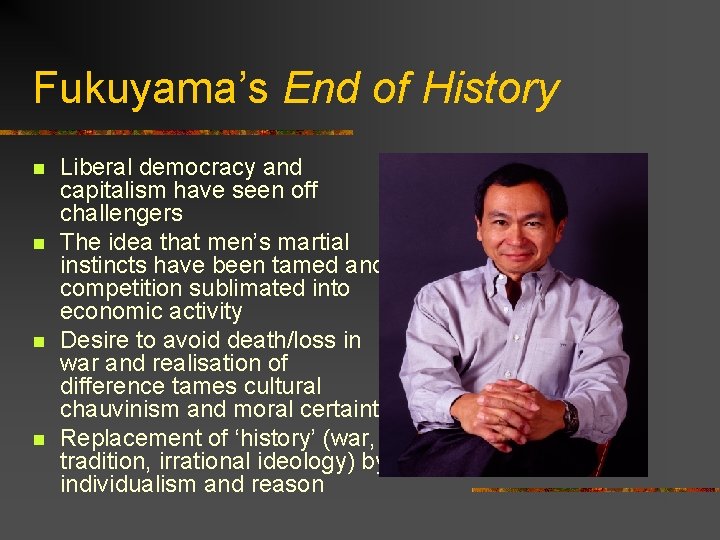
Fukuyama’s End of History n n Liberal democracy and capitalism have seen off challengers The idea that men’s martial instincts have been tamed and competition sublimated into economic activity Desire to avoid death/loss in war and realisation of difference tames cultural chauvinism and moral certainty Replacement of ‘history’ (war, tradition, irrational ideology) by individualism and reason
Problems for Fukuyama and other evolutionists: n n Is runaway egoism sustainable? Will rationality really prevail? How to explain power of religious fundamentalism and ethnic nationalism even in the advanced West? What if the West loses to a less individualistic power?
Conclusion Social theories – tie in with theories of history and major ideologies n Evolutionary theories vs discontinuous n Economic, Political and Culturalist theories n Structural or Actor-based theories n Recent theories like Fukuyama or Giddens continue emphasis on reason, individualism over tradition n
- Slides: 24