
A Different Way to Look at Total Compensation


- Slides: 23
A Different Way to Look at Total Compensation: Cost Basis Versus Relative-Value Basis National Conference of Public Employee Retirement Systems Webinar September 13, 2016 Presented By: Elliot R. Susseles, CCP Copyright © 2016 by The Segal Group, Inc. , parent of The Segal Company. All rights reserved. Senior Vice President The Segal Company
Why Evaluate Total Compensation on Cost vs. Relative-Value? Ø The competitiveness of a public employer’s total compensation package affects the organization’s ability to recruit and retain talent Ø Total compensation can be measured on both an employer cost basis or a relative-value basis Ø The cost basis measures annual employer costs associated with salary, health benefits, defined benefits and defined contribution retirement plans and Social Security Ø The relative-value perspective takes into consideration employer costs for base pay, benefits and the relative strength of benefit plan design 1
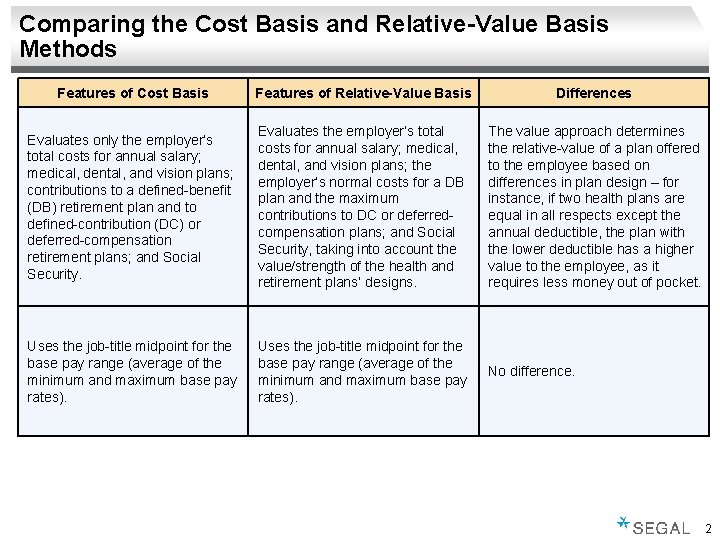
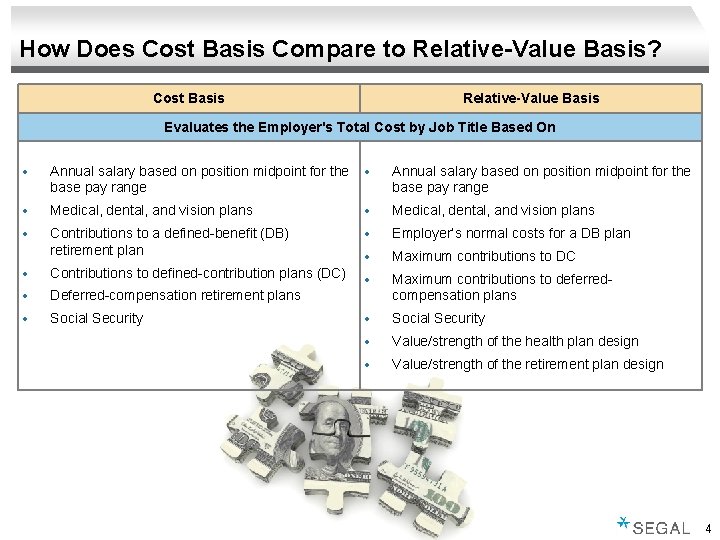
Comparing the Cost Basis and Relative-Value Basis Methods Features of Cost Basis Features of Relative-Value Basis Differences Evaluates only the employer’s total costs for annual salary; medical, dental, and vision plans; contributions to a defined-benefit (DB) retirement plan and to defined-contribution (DC) or deferred-compensation retirement plans; and Social Security. Evaluates the employer’s total costs for annual salary; medical, dental, and vision plans; the employer’s normal costs for a DB plan and the maximum contributions to DC or deferredcompensation plans; and Social Security, taking into account the value/strength of the health and retirement plans’ designs. The value approach determines the relative-value of a plan offered to the employee based on differences in plan design – for instance, if two health plans are equal in all respects except the annual deductible, the plan with the lower deductible has a higher value to the employee, as it requires less money out of pocket. Uses the job-title midpoint for the base pay range (average of the minimum and maximum base pay rates). No difference. 2
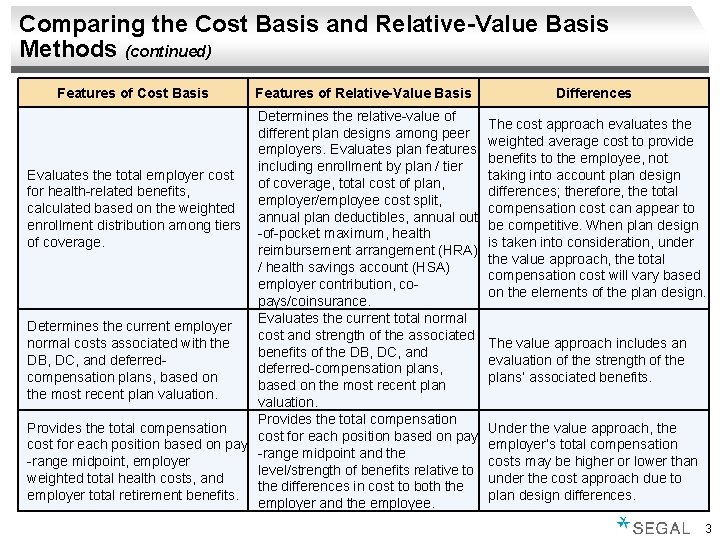
Comparing the Cost Basis and Relative-Value Basis Methods (continued) Features of Cost Basis Features of Relative-Value Basis Determines the relative-value of different plan designs among peer employers. Evaluates plan features including enrollment by plan / tier Evaluates the total employer cost of coverage, total cost of plan, for health-related benefits, employer/employee cost split, calculated based on the weighted annual plan deductibles, annual out enrollment distribution among tiers -of-pocket maximum, health of coverage. reimbursement arrangement (HRA) / health savings account (HSA) employer contribution, copays/coinsurance. Evaluates the current total normal Determines the current employer cost and strength of the associated normal costs associated with the benefits of the DB, DC, and deferred-compensation plans, based on the most recent plan valuation. Provides the total compensation cost for each position based on pay -range midpoint and the -range midpoint, employer level/strength of benefits relative to weighted total health costs, and the differences in cost to both the employer total retirement benefits. employer and the employee. Differences The cost approach evaluates the weighted average cost to provide benefits to the employee, not taking into account plan design differences; therefore, the total compensation cost can appear to be competitive. When plan design is taken into consideration, under the value approach, the total compensation cost will vary based on the elements of the plan design. The value approach includes an evaluation of the strength of the plans’ associated benefits. Under the value approach, the employer’s total compensation costs may be higher or lower than under the cost approach due to plan design differences. 3
How Does Cost Basis Compare to Relative-Value Basis? Cost Basis Relative-Value Basis Evaluates the Employer's Total Cost by Job Title Based On Annual salary based on position midpoint for the base pay range Medical, dental, and vision plans Contributions to a defined-benefit (DB) retirement plan Employer’s normal costs for a DB plan Maximum contributions to DC Maximum contributions to deferredcompensation plans Social Security Value/strength of the health plan design Value/strength of the retirement plan design Contributions to defined-contribution plans (DC) Deferred-compensation retirement plans Social Security 4
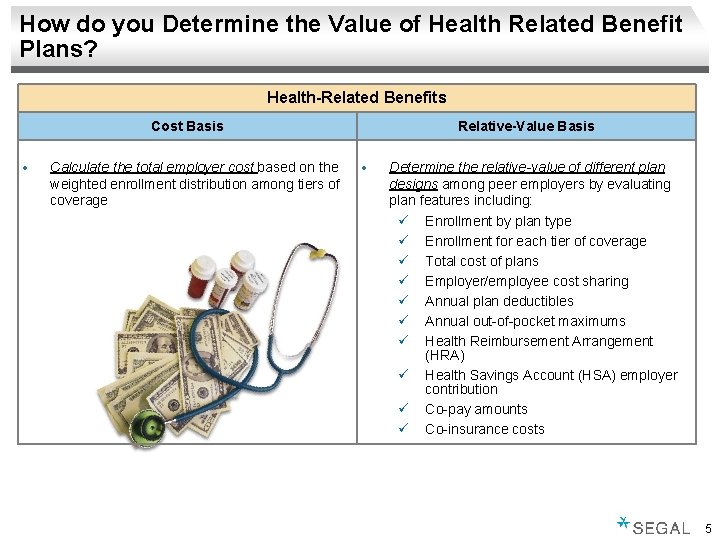
How do you Determine the Value of Health Related Benefit Plans? Health-Related Benefits Cost Basis Calculate the total employer cost based on the weighted enrollment distribution among tiers of coverage Relative-Value Basis Determine the relative-value of different plan designs among peer employers by evaluating plan features including: Enrollment by plan type Enrollment for each tier of coverage Total cost of plans Employer/employee cost sharing Annual plan deductibles Annual out-of-pocket maximums Health Reimbursement Arrangement (HRA) Health Savings Account (HSA) employer contribution Co-pay amounts Co-insurance costs 5
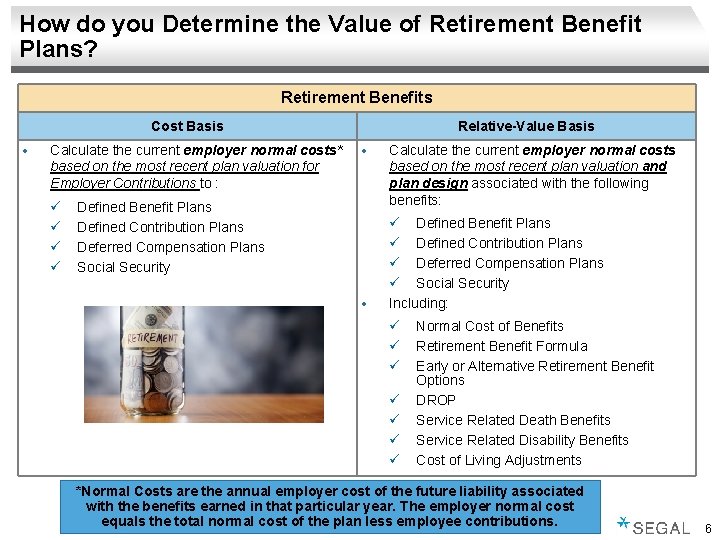
How do you Determine the Value of Retirement Benefit Plans? Retirement Benefits Cost Basis Calculate the current employer normal costs* based on the most recent plan valuation for Employer Contributions to : Relative-Value Basis Defined Benefit Plans Defined Contribution Plans Deferred Compensation Plans Social Security Calculate the current employer normal costs based on the most recent plan valuation and plan design associated with the following benefits: Defined Benefit Plans Defined Contribution Plans Deferred Compensation Plans Social Security Including: Normal Cost of Benefits Retirement Benefit Formula Early or Alternative Retirement Benefit Options DROP Service Related Death Benefits Service Related Disability Benefits Cost of Living Adjustments *Normal Costs are the annual employer cost of the future liability associated with the benefits earned in that particular year. The employer normal cost equals the total normal cost of the plan less employee contributions. 6
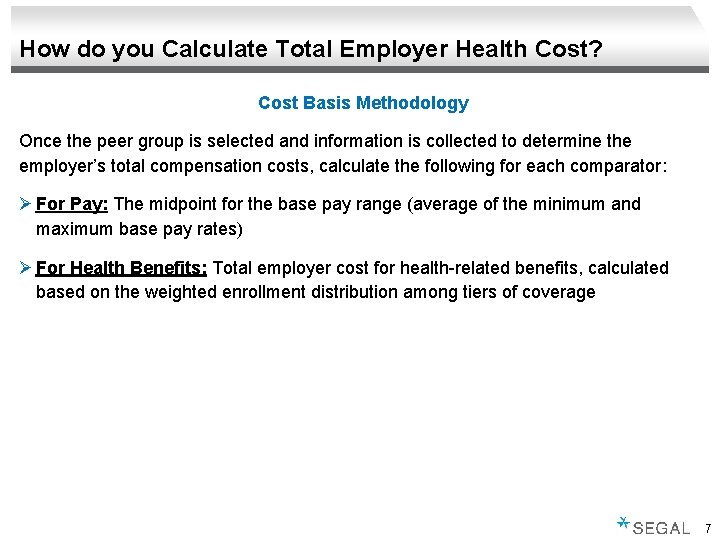
How do you Calculate Total Employer Health Cost? Cost Basis Methodology Once the peer group is selected and information is collected to determine the employer’s total compensation costs, calculate the following for each comparator: Ø For Pay: The midpoint for the base pay range (average of the minimum and maximum base pay rates) Ø For Health Benefits: Total employer cost for health-related benefits, calculated based on the weighted enrollment distribution among tiers of coverage 7
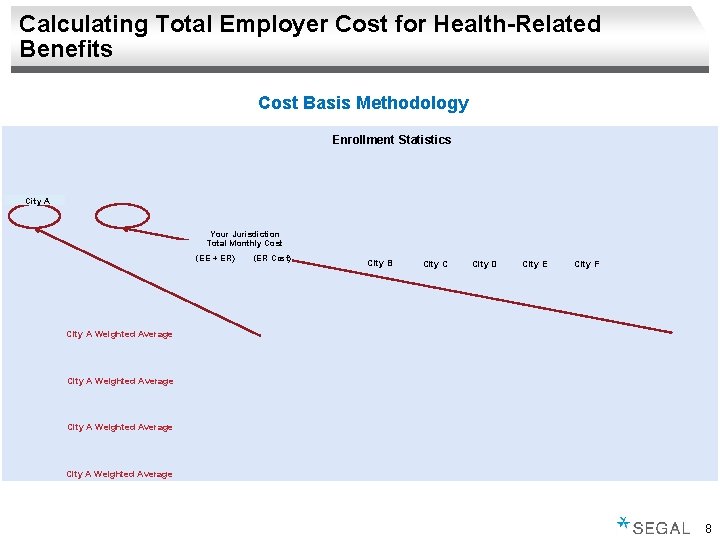
Calculating Total Employer Cost for Health-Related Benefits Cost Basis Methodology Enrollment Statistics City A Your Jurisdiction Total Monthly Cost (EE + ER) (ER Cost) City B City C City D City E City F City A Weighted Average 8
How do you Calculate Total Employer Retirement Cost? Cost Basis Methodology Ø For Retirement Benefits: The current employer normal costs (annual cost of the last year of service) associated with the DB retirement plan, based on the most recent plan valuation, and the maximum employer contribution to both DC and/or deferred-compensation plans, as well as Social Security, if applicable 9
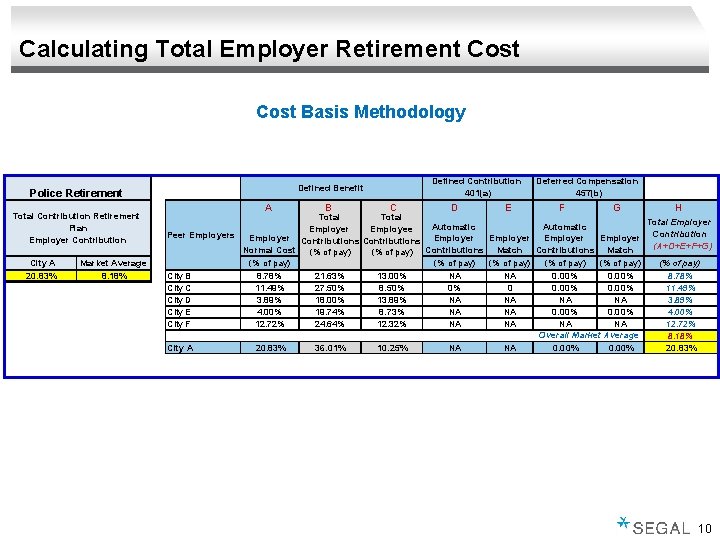
Calculating Total Employer Retirement Cost Basis Methodology Total Contribution Retirement Plan Employer Contribution Market Average Your Jurisdiction City A 20. 83% 8. 18% Defined Contribution 401(a) Defined Benefit Police Retirement A B C D E Deferred Compensation 457(b) F G Total Automatic Employer Employee Peer Employers Employer Contributions Employer Normal Cost (% of pay) Contributions Match (% of pay) (% of pay) City B 8. 78% 21. 63% 13. 00% NA NA 0. 00% City C 11. 49% 27. 50% 8. 50% 0% 0 0. 00% City D 3. 89% 18. 00% 13. 89% NA NA 4. 00% 19. 74% 8. 73% NA NA 0. 00% City E City F 12. 72% 24. 64% 12. 32% NA NA Overall Market Average Your Jurisdiction City A 20. 83% 36. 01% 10. 25% NA NA 0. 00% H Total Employer Contribution (A+D+E+F+G) (% of pay) 8. 78% 11. 49% 3. 89% 4. 00% 12. 72% 8. 18% 20. 83% 10
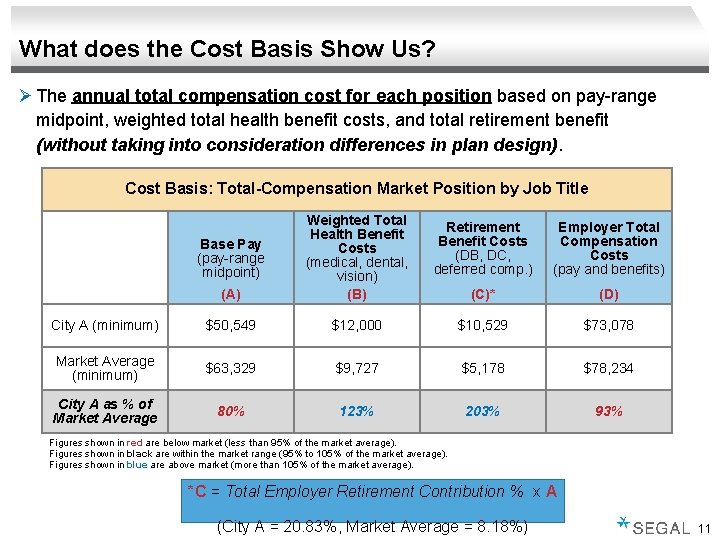
What does the Cost Basis Show Us? Ø The annual total compensation cost for each position based on pay-range midpoint, weighted total health benefit costs, and total retirement benefit (without taking into consideration differences in plan design). Cost Basis: Total-Compensation Market Position by Job Title Retirement Benefit Costs (DB, DC, deferred comp. ) Employer Total Compensation Costs (pay and benefits) (A) Weighted Total Health Benefit Costs (medical, dental, vision) (B) (C)* (D) City A (minimum) $50, 549 $12, 000 $10, 529 $73, 078 Market Average (minimum) $63, 329 $9, 727 $5, 178 $78, 234 City A as % of Market Average 80% 123% 203% 93% Base Pay (pay-range midpoint) Figures shown in red are below market (less than 95% of the market average). Figures shown in black are within the market range (95% to 105% of the market average). Figures shown in blue are above market (more than 105% of the market average). *C = Total Employer Retirement Contribution % x A (City A = 20. 83%, Market Average = 8. 18%) 11
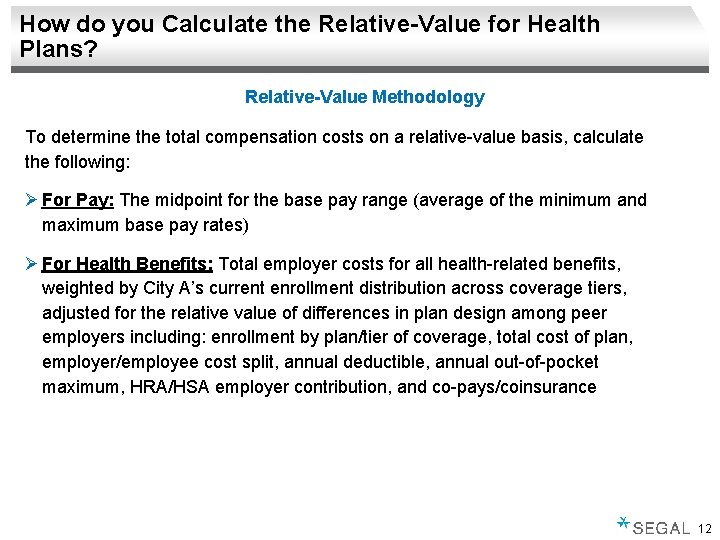
How do you Calculate the Relative-Value for Health Plans? Relative-Value Methodology To determine the total compensation costs on a relative-value basis, calculate the following: Ø For Pay: The midpoint for the base pay range (average of the minimum and maximum base pay rates) Ø For Health Benefits: Total employer costs for all health-related benefits, weighted by City A’s current enrollment distribution across coverage tiers, adjusted for the relative value of differences in plan design among peer employers including: enrollment by plan/tier of coverage, total cost of plan, employer/employee cost split, annual deductible, annual out-of-pocket maximum, HRA/HSA employer contribution, and co-pays/coinsurance 12
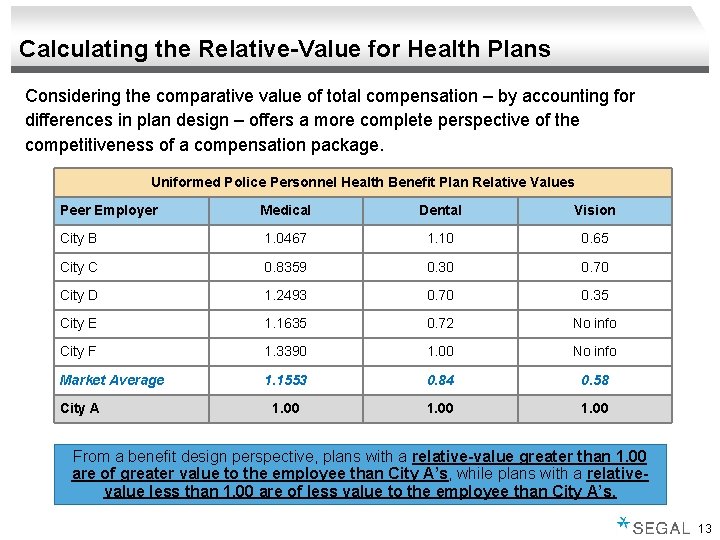
Calculating the Relative-Value for Health Plans Considering the comparative value of total compensation – by accounting for differences in plan design – offers a more complete perspective of the competitiveness of a compensation package. Uniformed Police Personnel Health Benefit Plan Relative Values Peer Employer Medical Dental Vision City B 1. 0467 1. 10 0. 65 City C 0. 8359 0. 30 0. 70 City D 1. 2493 0. 70 0. 35 City E 1. 1635 0. 72 No info City F 1. 3390 1. 00 No info Market Average 1. 1553 0. 84 0. 58 1. 00 City A From a benefit design perspective, plans with a relative-value greater than 1. 00 are of greater value to the employee than City A’s, while plans with a relativevalue less than 1. 00 are of less value to the employee than City A’s. 13
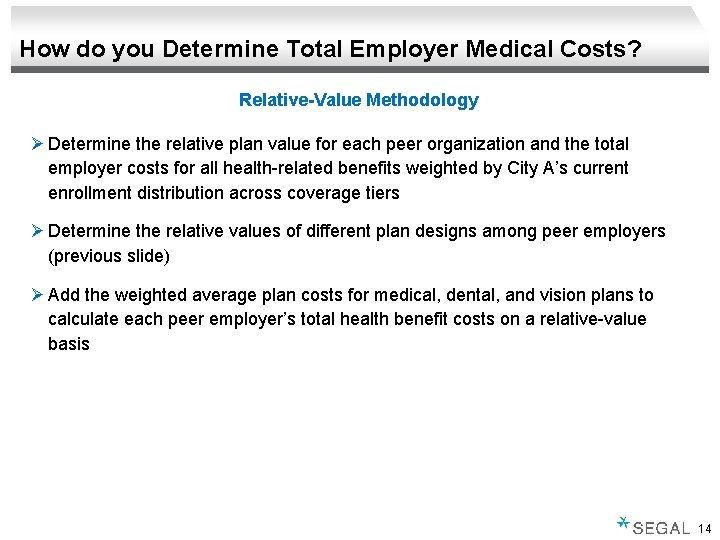
How do you Determine Total Employer Medical Costs? Relative-Value Methodology Ø Determine the relative plan value for each peer organization and the total employer costs for all health-related benefits weighted by City A’s current enrollment distribution across coverage tiers Ø Determine the relative values of different plan designs among peer employers (previous slide) Ø Add the weighted average plan costs for medical, dental, and vision plans to calculate each peer employer’s total health benefit costs on a relative-value basis 14
Determining Total Employer Medical Costs Relative-Value Methodology A B C D E F Relative-Value For Medical Costs Peer Primary Plan(s) PPO 60% / UHC City B HMO 40% 75/25 HRA Medical City C Plan Aetna - Buy-up POS City D Plan Aetna - Basic POS City E Plan City F Citi. Med - PPO Assumed Enrollment Distribution Your Jurisdiction Cigna EPO (Base City A Plan) Relative Value Peer Cost Sharing %- Single Coverage Peer Cost Sharing %- Family Coverage Weighted Single Coverage Family Coverage Relative-Value Average Medical Cost (Employer Cost) Calculation 1. 0467 100% $6, 523 67% $14, 865 $11, 028 0. 8359 80% $4, 167 53% $9, 390 $6, 988 1. 2493 75% $5, 839 78% $20, 654 $13, 839 1. 1635 1. 3390 90% 100% $6, 525 $8, 344 69% 100% $17, 016 $28, 381 $12, 191 $19, 164 46% 1. 0000 90% C = A x B x Total annual health cost for your Jurisdiction’s single coverage plan ($519) x 12 $5, 604 54% 82% E = A x D x Total annual health cost for your Jurisdiction’s family coverage plan ($1, 766) x 12 $17, 448 $12, 000 F = (C x 46%) + (E x 54%) Find the Relative-Value and Weighted Average cost for each peer. Repeat the same process for Dental and Vision Plans. 15
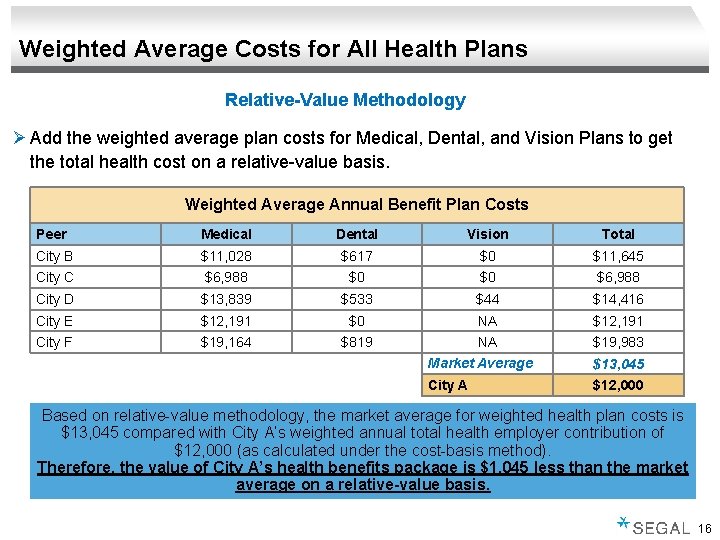
Weighted Average Costs for All Health Plans Relative-Value Methodology Ø Add the weighted average plan costs for Medical, Dental, and Vision Plans to get the total health cost on a relative-value basis. Weighted Average Annual Benefit Plan Costs Peer Medical Dental Vision Total City B $11, 028 $617 $0 $11, 645 City C $6, 988 $0 $0 $6, 988 City D $13, 839 $533 $44 $14, 416 City E $12, 191 $0 NA $12, 191 City F $19, 164 $819 NA Market Average $19, 983 City A $12, 000 $13, 045 Based on relative-value methodology, the market average for weighted health plan costs is $13, 045 compared with City A’s weighted annual total health employer contribution of $12, 000 (as calculated under the cost-basis method). Therefore, the value of City A’s health benefits package is $1, 045 less than the market average on a relative-value basis. 16
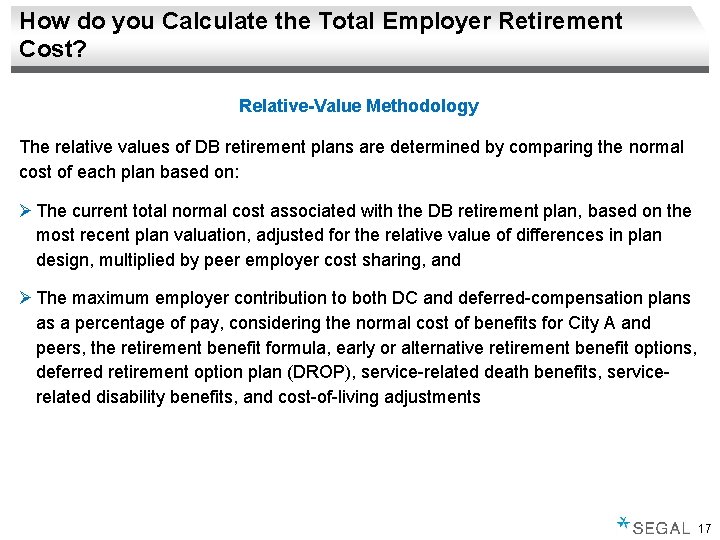
How do you Calculate the Total Employer Retirement Cost? Relative-Value Methodology The relative values of DB retirement plans are determined by comparing the normal cost of each plan based on: Ø The current total normal cost associated with the DB retirement plan, based on the most recent plan valuation, adjusted for the relative value of differences in plan design, multiplied by peer employer cost sharing, and Ø The maximum employer contribution to both DC and deferred-compensation plans as a percentage of pay, considering the normal cost of benefits for City A and peers, the retirement benefit formula, early or alternative retirement benefit options, deferred retirement option plan (DROP), service-related death benefits, servicerelated disability benefits, and cost-of-living adjustments 17
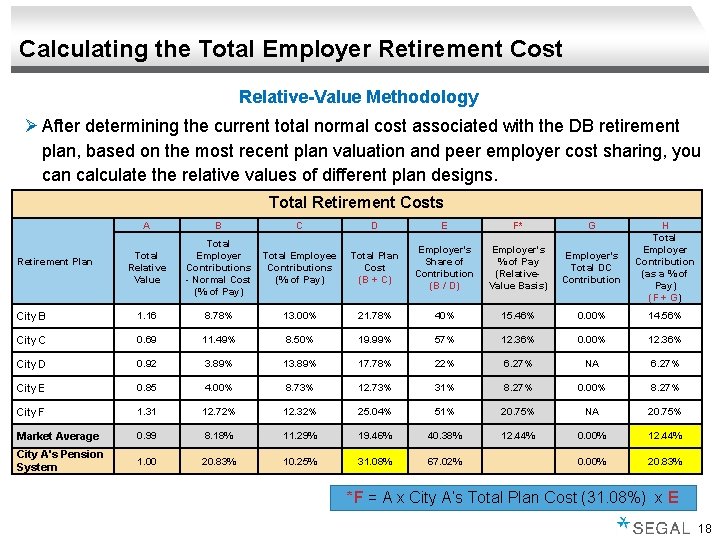
Calculating the Total Employer Retirement Cost Relative-Value Methodology Ø After determining the current total normal cost associated with the DB retirement plan, based on the most recent plan valuation and peer employer cost sharing, you can calculate the relative values of different plan designs. Total Retirement Costs A B C D E F* G Total Relative Value Total Employer Contributions - Normal Cost (% of Pay) Total Employee Contributions (% of Pay) Total Plan Cost (B + C) Employer's Share of Contribution (B / D) Employer's % of Pay (Relative. Value Basis) Employer's Total DC Contribution City B 1. 16 8. 78% 13. 00% 21. 78% 40% 15. 46% 0. 00% 14. 56% City C 0. 69 11. 49% 8. 50% 19. 99% 57% 12. 36% 0. 00% 12. 36% City D 0. 92 3. 89% 17. 78% 22% 6. 27% NA 6. 27% City E 0. 85 4. 00% 8. 73% 12. 73% 31% 8. 27% 0. 00% 8. 27% City F 1. 31 12. 72% 12. 32% 25. 04% 51% 20. 75% NA 20. 75% Market Average 0. 99 8. 18% 11. 29% 19. 46% 40. 38% 12. 44% 0. 00% 12. 44% City A's Pension System 1. 00 20. 83% 10. 25% 31. 08% 67. 02% 0. 00% 20. 83% Retirement Plan H Total Employer Contribution (as a % of Pay) (F + G) *F = A x City A’s Total Plan Cost (31. 08%) x E 18
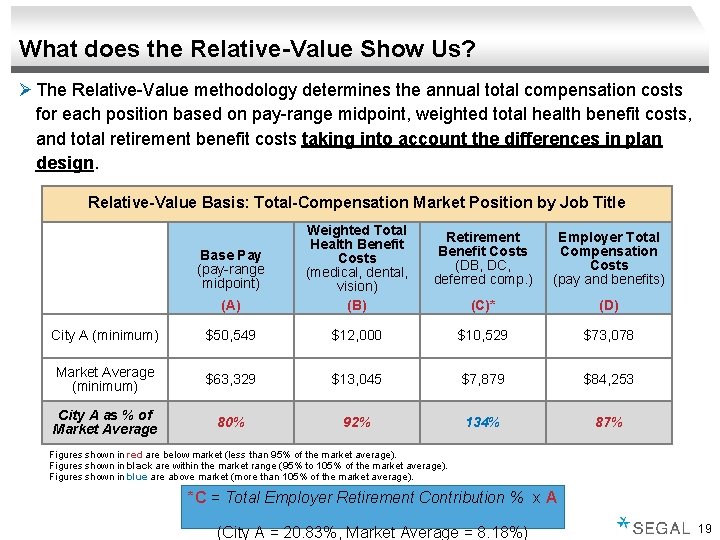
What does the Relative-Value Show Us? Ø The Relative-Value methodology determines the annual total compensation costs for each position based on pay-range midpoint, weighted total health benefit costs, and total retirement benefit costs taking into account the differences in plan design. Relative-Value Basis: Total-Compensation Market Position by Job Title Retirement Benefit Costs (DB, DC, deferred comp. ) Employer Total Compensation Costs (pay and benefits) (A) Weighted Total Health Benefit Costs (medical, dental, vision) (B) (C)* (D) City A (minimum) $50, 549 $12, 000 $10, 529 $73, 078 Market Average (minimum) $63, 329 $13, 045 $7, 879 $84, 253 City A as % of Market Average 80% 92% 134% 87% Base Pay (pay-range midpoint) Figures shown in red are below market (less than 95% of the market average). Figures shown in black are within the market range (95% to 105% of the market average). Figures shown in blue are above market (more than 105% of the market average). *C = Total Employer Retirement Contribution % x A (City A = 20. 83%, Market Average = 8. 18%) 19
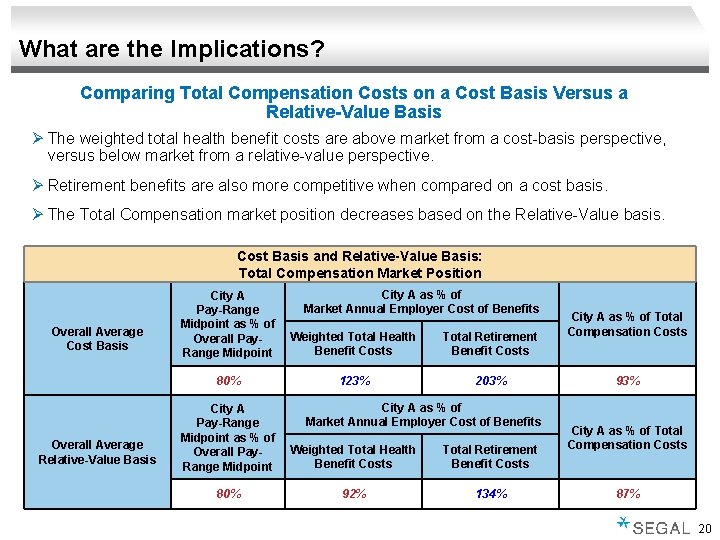
What are the Implications? Comparing Total Compensation Costs on a Cost Basis Versus a Relative-Value Basis Ø The weighted total health benefit costs are above market from a cost-basis perspective, versus below market from a relative-value perspective. Ø Retirement benefits are also more competitive when compared on a cost basis. Ø The Total Compensation market position decreases based on the Relative-Value basis. Cost Basis and Relative-Value Basis: Total Compensation Market Position Overall Average Cost Basis Overall Average Relative-Value Basis City A as % of Market Annual Employer Cost of Benefits City A Pay-Range Midpoint as % of Overall Pay. Range Midpoint Weighted Total Health Benefit Costs Total Retirement Benefit Costs 80% 123% 203% City A as % of Market Annual Employer Cost of Benefits City A Pay-Range Midpoint as % of Overall Pay. Range Midpoint Weighted Total Health Benefit Costs Total Retirement Benefit Costs 80% 92% 134% City A as % of Total Compensation Costs 93% City A as % of Total Compensation Costs 87% 20
Summary Ø Measuring total compensation on a cost basis and relative-value basis – can provide valuable information regarding the relative merit of benefits as part of a comparative total compensation analysis. Ø Considering both the comparative cost and the comparative value of total compensation – by accounting for differences in plan design – offers a more complete perspective of the competitiveness of a compensation package. Ø Taking plan design differences into consideration adds a dimension of relative value, thereby providing a more complete picture of the value of benefit design elements. Ø This information enhances understanding of the total compensation arrangement between employers and employees. Ø Knowledge of the process used to assess both cost and value is important for all those involved in negotiating or establishing a total rewards policy. 21
Discussion 1920 N Street, NW, Suite 400 Washington, DC 20036 -1659 202 -833 -6436 www. segalco. com Elliot R. Susseles, CCP Senior Vice President esusseles@segalco. com 22