
A Dictionary is a Necessity The Importance of
- Slides: 22
“A Dictionary is a Necessity” The Importance of a Paperback Dictionary in a World of Technology Power. Point Created by The Dictionary Project © Spring 2016 Post Office Box 1845 Charleston, South Carolina 29402 843 -856 -2706 843 -388 -8375 www. dictionaryproject. org
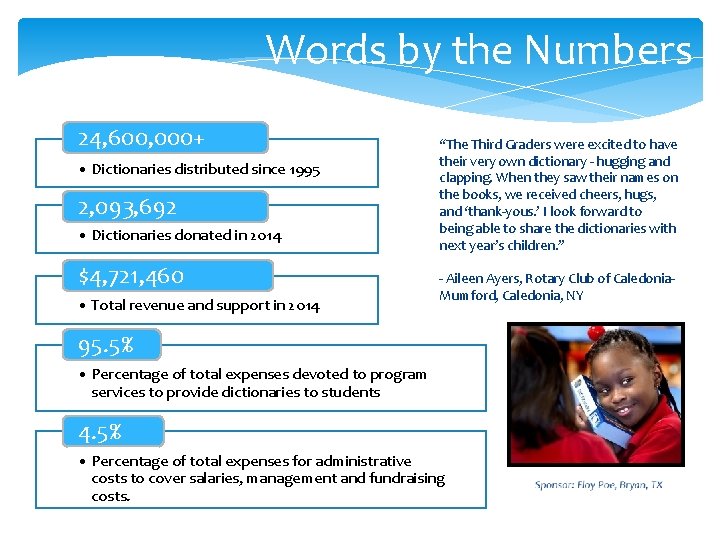
Words by the Numbers 24, 600, 000+ • Dictionaries distributed since 1995 2, 093, 692 • Dictionaries donated in 2014 $4, 721, 460 • Total revenue and support in 2014 “The Third Graders were excited to have their very own dictionary - hugging and clapping. When they saw their names on the books, we received cheers, hugs, and ‘thank-yous. ’ I look forward to being able to share the dictionaries with next year’s children. ” - Aileen Ayers, Rotary Club of Caledonia. Mumford, Caledonia, NY 95. 5% • Percentage of total expenses devoted to program services to provide dictionaries to students 4. 5% • Percentage of total expenses for administrative costs to cover salaries, management and fundraising costs.
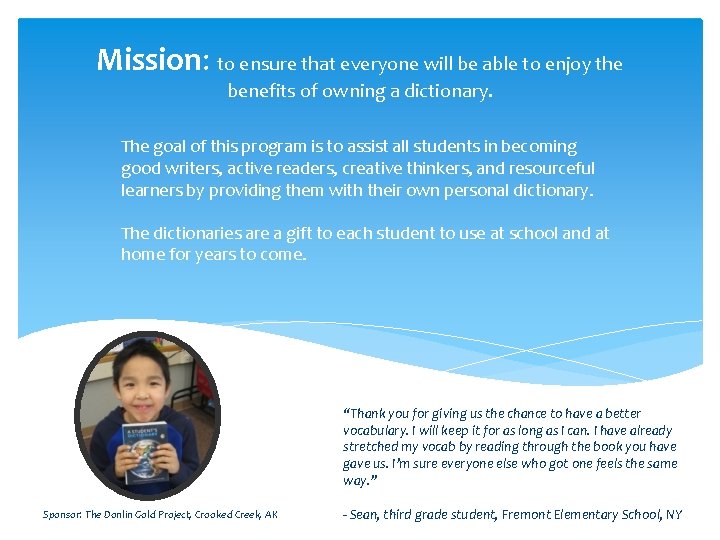
Mission: to ensure that everyone will be able to enjoy the benefits of owning a dictionary. The goal of this program is to assist all students in becoming good writers, active readers, creative thinkers, and resourceful learners by providing them with their own personal dictionary. The dictionaries are a gift to each student to use at school and at home for years to come. “Thank you for giving us the chance to have a better vocabulary. I will keep it for as long as I can. I have already stretched my vocab by reading through the book you have gave us. I’m sure everyone else who got one feels the same way. ” Sponsor: The Donlin Gold Project, Crooked Creek, AK - Sean, third grade student, Fremont Elementary School, NY
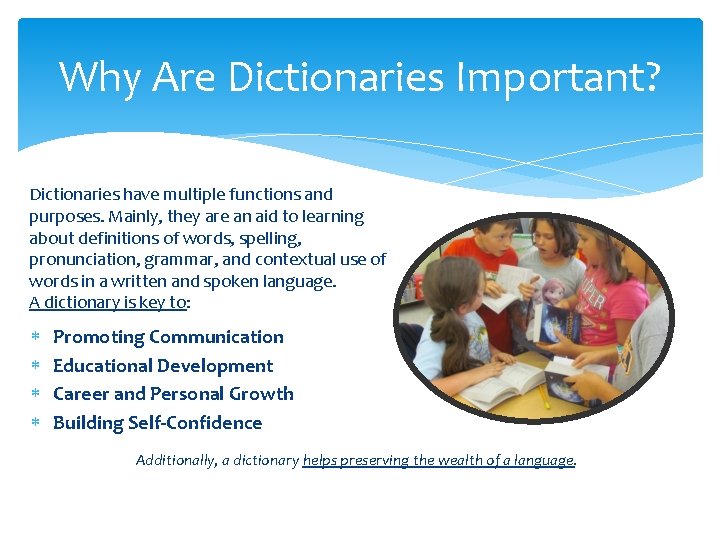
Why Are Dictionaries Important? Dictionaries have multiple functions and purposes. Mainly, they are an aid to learning about definitions of words, spelling, pronunciation, grammar, and contextual use of words in a written and spoken language. A dictionary is key to: Promoting Communication Educational Development Career and Personal Growth Building Self-Confidence Additionally, a dictionary helps preserving the wealth of a language.
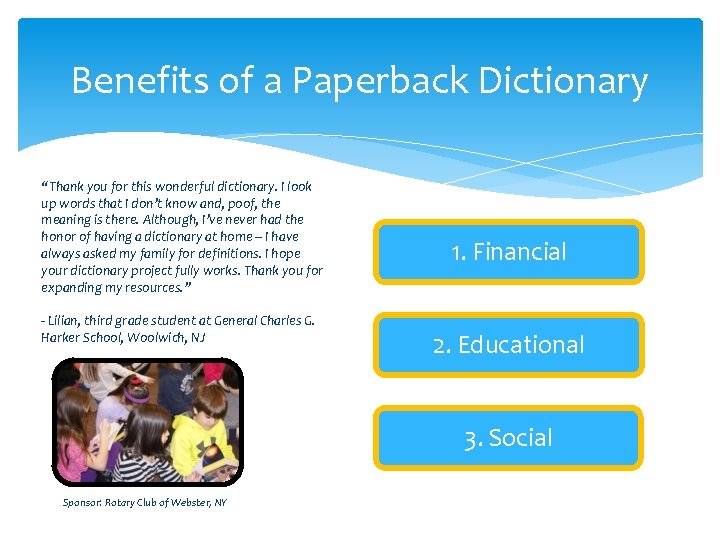
Benefits of a Paperback Dictionary “Thank you for this wonderful dictionary. I look up words that I don’t know and, poof, the meaning is there. Although, I’ve never had the honor of having a dictionary at home – I have always asked my family for definitions. I hope your dictionary project fully works. Thank you for expanding my resources. ” - Lilian, third grade student at General Charles G. Harker School, Woolwich, NJ 1. Financial 2. Educational 3. Social Sponsor: Rotary Club of Webster, NY
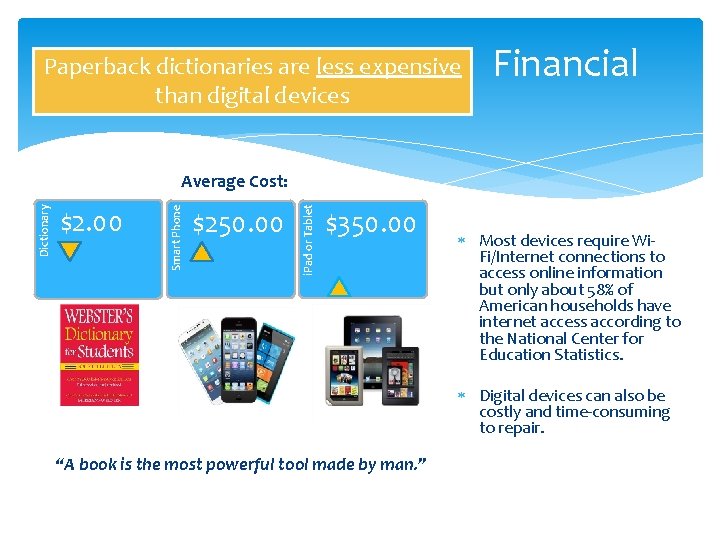
Paperback dictionaries are less expensive than digital devices Financial $250. 00 i. Pad or Tablet $2. 00 Smart Phone Dictionary Average Cost: $350. 00 Most devices require Wi. Fi/Internet connections to access online information but only about 58% of American households have internet access according to the National Center for Education Statistics. Digital devices can also be costly and time-consuming to repair. “A book is the most powerful tool made by man. ”
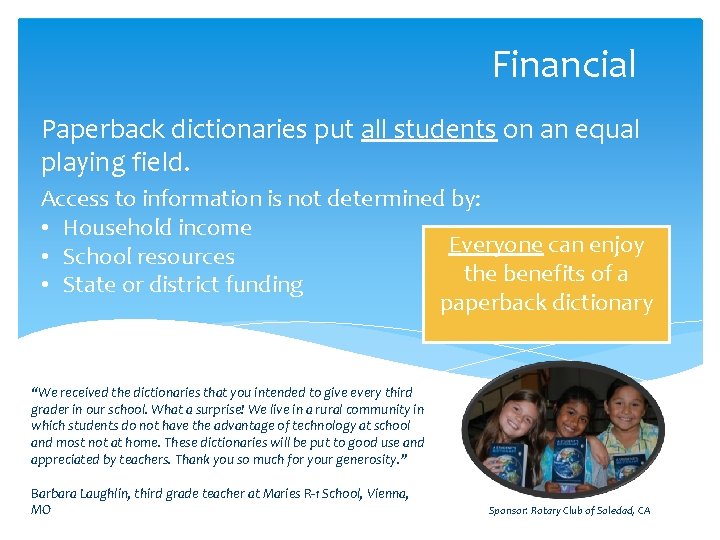
Financial Paperback dictionaries put all students on an equal playing field. Access to information is not determined by: • Household income Everyone can enjoy • School resources the benefits of a • State or district funding paperback dictionary “We received the dictionaries that you intended to give every third grader in our school. What a surprise! We live in a rural community in which students do not have the advantage of technology at school and most not at home. These dictionaries will be put to good use and appreciated by teachers. Thank you so much for your generosity. ” Barbara Laughlin, third grade teacher at Maries R-1 School, Vienna, MO Sponsor: Rotary Club of Soledad, CA
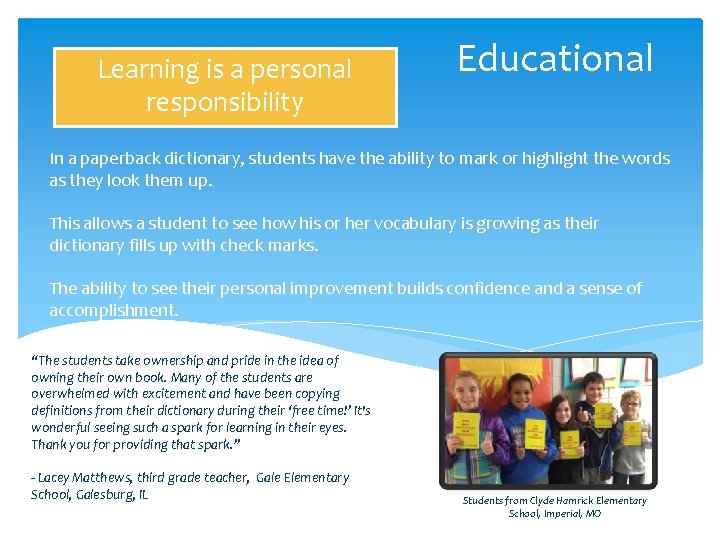
Learning is a personal responsibility Educational In a paperback dictionary, students have the ability to mark or highlight the words as they look them up. This allows a student to see how his or her vocabulary is growing as their dictionary fills up with check marks. The ability to see their personal improvement builds confidence and a sense of accomplishment. “The students take ownership and pride in the idea of owning their own book. Many of the students are overwhelmed with excitement and have been copying definitions from their dictionary during their ‘free time!’ It's wonderful seeing such a spark for learning in their eyes. Thank you for providing that spark. ” - Lacey Matthews, third grade teacher, Gale Elementary School, Galesburg, IL Students from Clyde Hamrick Elementary School, Imperial, MO
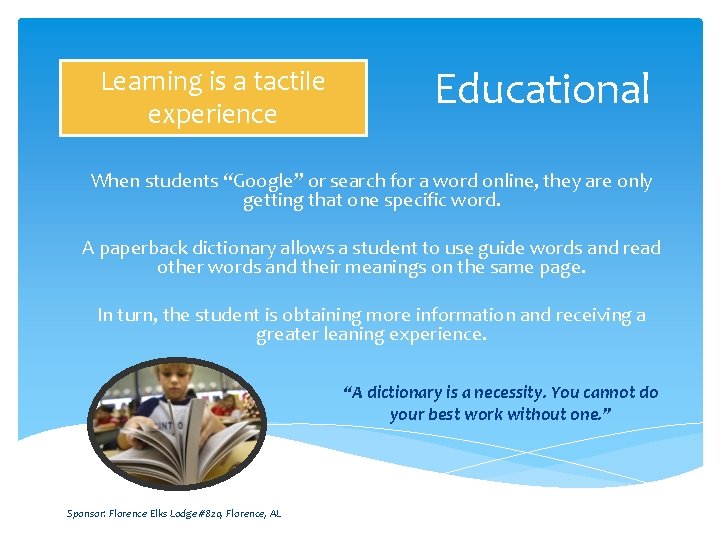
Learning is a tactile experience Educational When students “Google” or search for a word online, they are only getting that one specific word. A paperback dictionary allows a student to use guide words and read other words and their meanings on the same page. In turn, the student is obtaining more information and receiving a greater leaning experience. “A dictionary is a necessity. You cannot do your best work without one. ” Sponsor: Florence Elks Lodge #820, Florence, AL
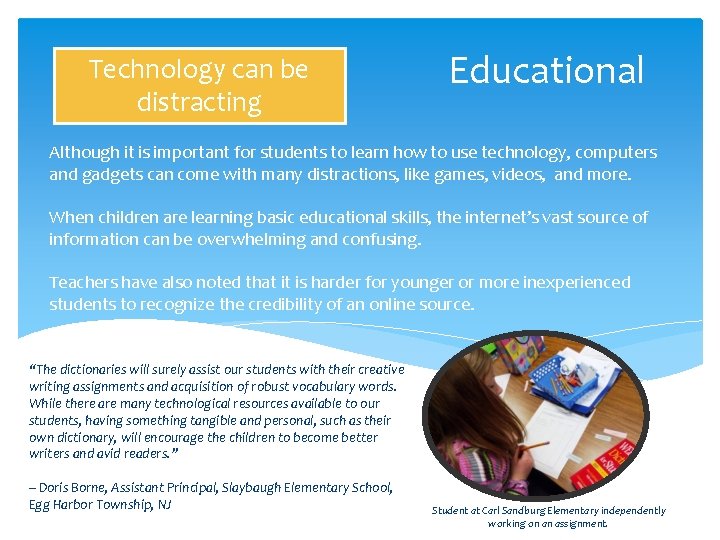
Technology can be distracting Educational Although it is important for students to learn how to use technology, computers and gadgets can come with many distractions, like games, videos, and more. When children are learning basic educational skills, the internet’s vast source of information can be overwhelming and confusing. Teachers have also noted that it is harder for younger or more inexperienced students to recognize the credibility of an online source. “The dictionaries will surely assist our students with their creative writing assignments and acquisition of robust vocabulary words. While there are many technological resources available to our students, having something tangible and personal, such as their own dictionary, will encourage the children to become better writers and avid readers. ” – Doris Borne, Assistant Principal, Slaybaugh Elementary School, Egg Harbor Township, NJ Student at Carl Sandburg Elementary independently working on an assignment.
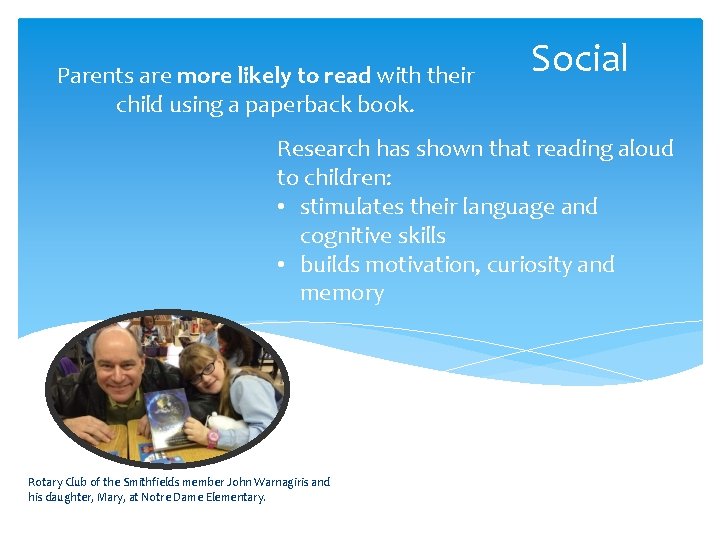
Parents are more likely to read with their child using a paperback book. Social Research has shown that reading aloud to children: • stimulates their language and cognitive skills • builds motivation, curiosity and memory Rotary Club of the Smithfields member John Warnagiris and his daughter, Mary, at Notre Dame Elementary.
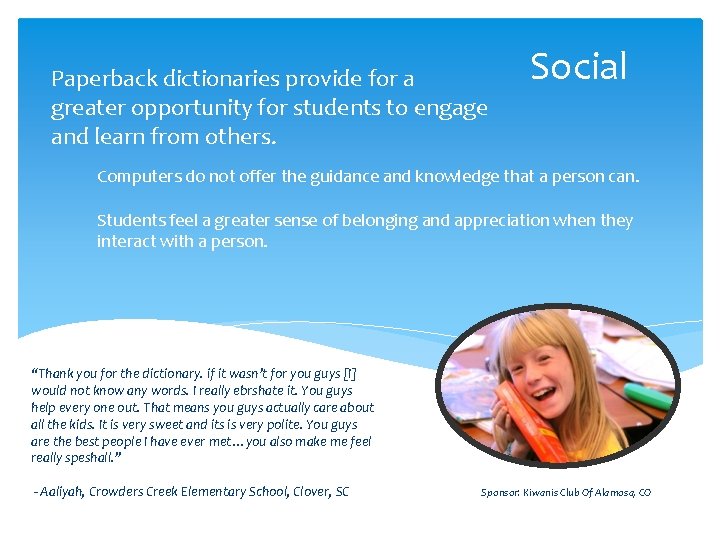
Paperback dictionaries provide for a greater opportunity for students to engage and learn from others. Social Computers do not offer the guidance and knowledge that a person can. Students feel a greater sense of belonging and appreciation when they interact with a person. “Thank you for the dictionary. if it wasn’t for you guys [I] would not know any words. I really ebrshate it. You guys help every one out. That means you guys actually care about all the kids. It is very sweet and its is very polite. You guys are the best people I have ever met…you also make me feel really speshall. ” - Aaliyah, Crowders Creek Elementary School, Clover, SC Sponsor: Kiwanis Club Of Alamosa, CO
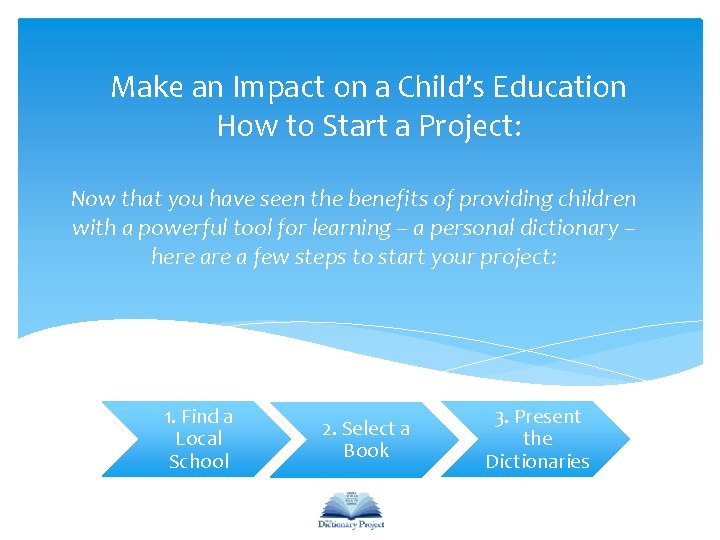
Make an Impact on a Child’s Education How to Start a Project: Now that you have seen the benefits of providing children with a powerful tool for learning – a personal dictionary – here a few steps to start your project: 1. Find a Local School 2. Select a Book 3. Present the Dictionaries
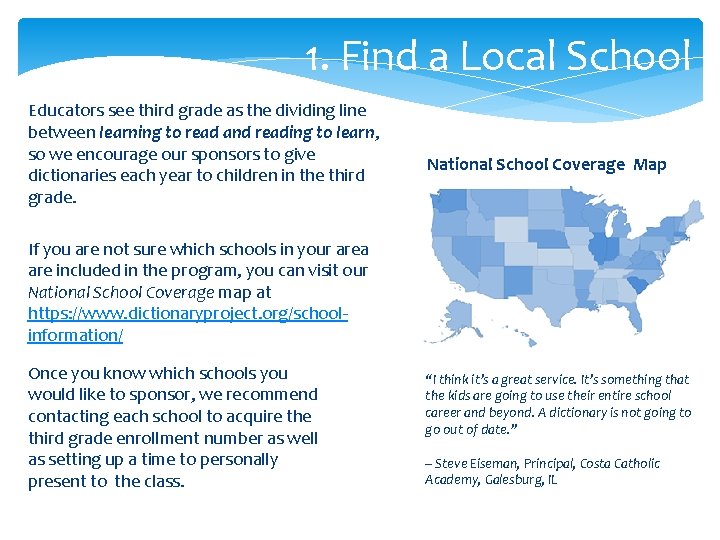
1. Find a Local School Educators see third grade as the dividing line between learning to read and reading to learn, so we encourage our sponsors to give dictionaries each year to children in the third grade. National School Coverage Map If you are not sure which schools in your area are included in the program, you can visit our National School Coverage map at https: //www. dictionaryproject. org/schoolinformation/ Once you know which schools you would like to sponsor, we recommend contacting each school to acquire third grade enrollment number as well as setting up a time to personally present to the class. “I think it’s a great service. It’s something that the kids are going to use their entire school career and beyond. A dictionary is not going to go out of date. ” – Steve Eiseman, Principal, Costa Catholic Academy, Galesburg, IL
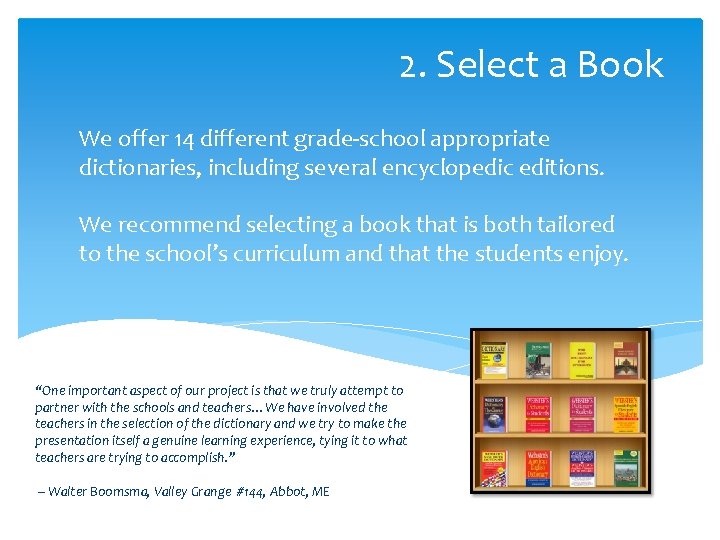
2. Select a Book We offer 14 different grade-school appropriate dictionaries, including several encyclopedic editions. We recommend selecting a book that is both tailored to the school’s curriculum and that the students enjoy. “One important aspect of our project is that we truly attempt to partner with the schools and teachers…We have involved the teachers in the selection of the dictionary and we try to make the presentation itself a genuine learning experience, tying it to what teachers are trying to accomplish. ” – Walter Boomsma, Valley Grange #144, Abbot, ME
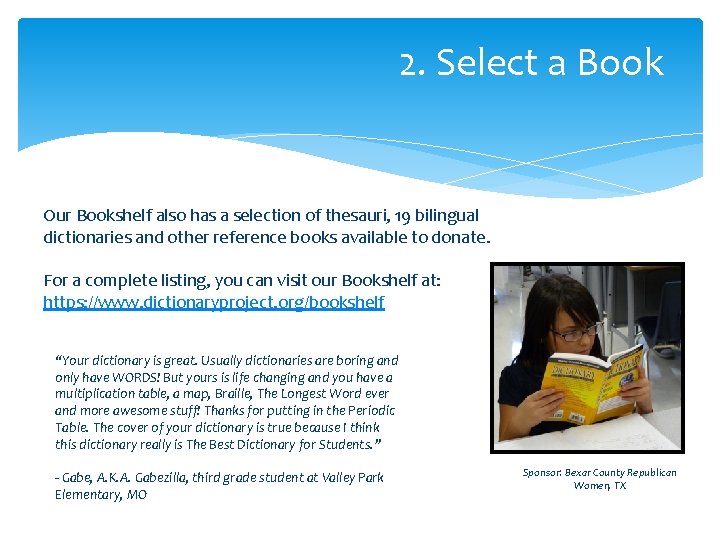
2. Select a Book Our Bookshelf also has a selection of thesauri, 19 bilingual dictionaries and other reference books available to donate. For a complete listing, you can visit our Bookshelf at: https: //www. dictionaryproject. org/bookshelf “Your dictionary is great. Usually dictionaries are boring and only have WORDS! But yours is life changing and you have a multiplication table, a map, Braille, The Longest Word ever and more awesome stuff! Thanks for putting in the Periodic Table. The cover of your dictionary is true because I think this dictionary really is The Best Dictionary for Students. ” - Gabe, A. K. A. Gabezilla, third grade student at Valley Park Elementary, MO Sponsor: Bexar County Republican Women, TX
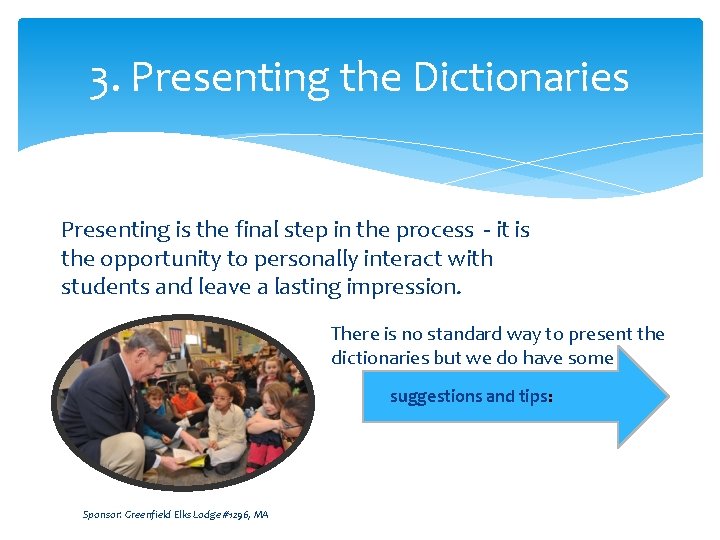
3. Presenting the Dictionaries Presenting is the final step in the process - it is the opportunity to personally interact with students and leave a lasting impression. There is no standard way to present the dictionaries but we do have some suggestions and tips: Sponsor: Greenfield Elks Lodge #1296, MA
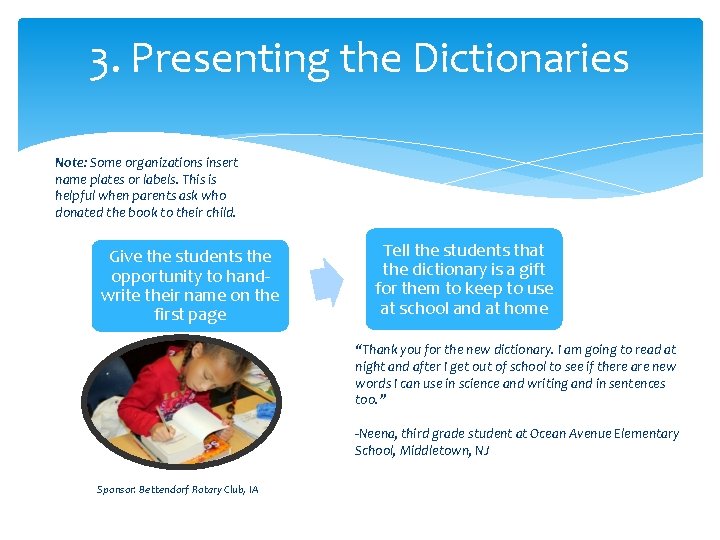
3. Presenting the Dictionaries Note: Some organizations insert name plates or labels. This is helpful when parents ask who donated the book to their child. Give the students the opportunity to handwrite their name on the first page Tell the students that the dictionary is a gift for them to keep to use at school and at home “Thank you for the new dictionary. I am going to read at night and after I get out of school to see if there are new words I can use in science and writing and in sentences too. ” -Neena, third grade student at Ocean Avenue Elementary School, Middletown, NJ Sponsor: Bettendorf Rotary Club, IA
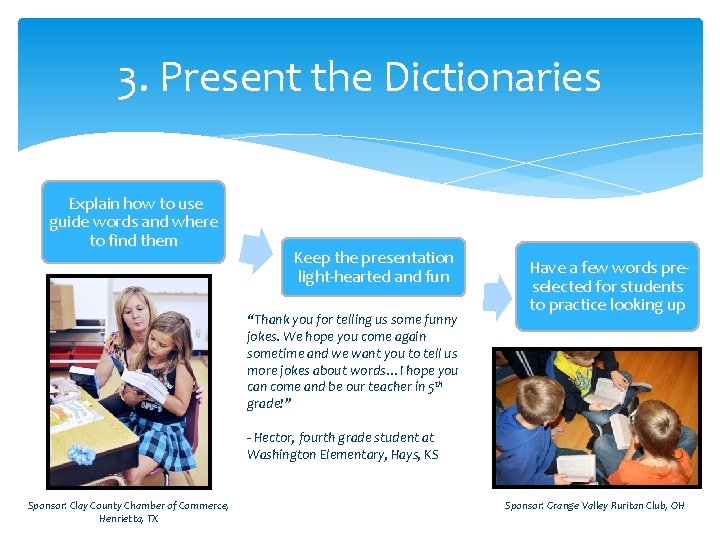
3. Present the Dictionaries Explain how to use guide words and where to find them Keep the presentation light-hearted and fun “Thank you for telling us some funny jokes. We hope you come again sometime and we want you to tell us more jokes about words…I hope you can come and be our teacher in 5 th grade!” Have a few words preselected for students to practice looking up - Hector, fourth grade student at Washington Elementary, Hays, KS Sponsor: Clay County Chamber of Commerce, Henrietta, TX Sponsor: Grange Valley Ruritan Club, OH
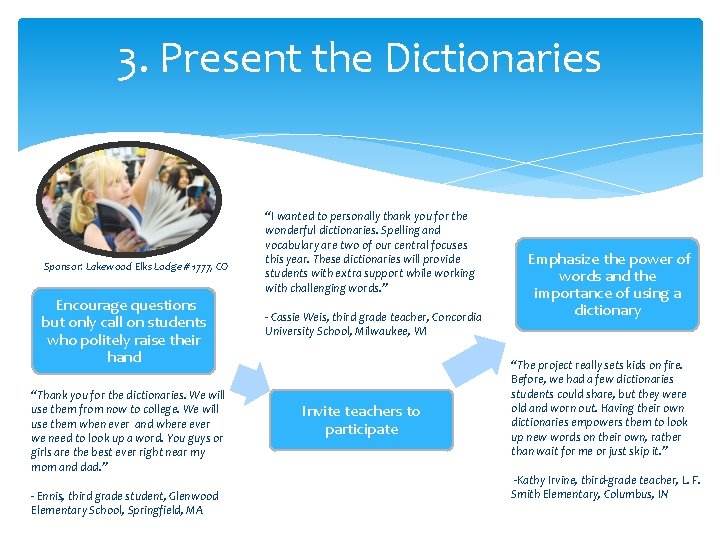
3. Present the Dictionaries Sponsor: Lakewood Elks Lodge # 1777, CO Encourage questions but only call on students who politely raise their hand “Thank you for the dictionaries. We will use them from now to college. We will use them when ever and where ever we need to look up a word. You guys or girls are the best ever right near my mom and dad. ” - Ennis, third grade student, Glenwood Elementary School, Springfield, MA “I wanted to personally thank you for the wonderful dictionaries. Spelling and vocabulary are two of our central focuses this year. These dictionaries will provide students with extra support while working with challenging words. ” - Cassie Weis, third grade teacher, Concordia University School, Milwaukee, WI Invite teachers to participate Emphasize the power of words and the importance of using a dictionary “The project really sets kids on fire. Before, we had a few dictionaries students could share, but they were old and worn out. Having their own dictionaries empowers them to look up new words on their own, rather than wait for me or just skip it. ” -Kathy Irvine, third-grade teacher, L. F. Smith Elementary, Columbus, IN
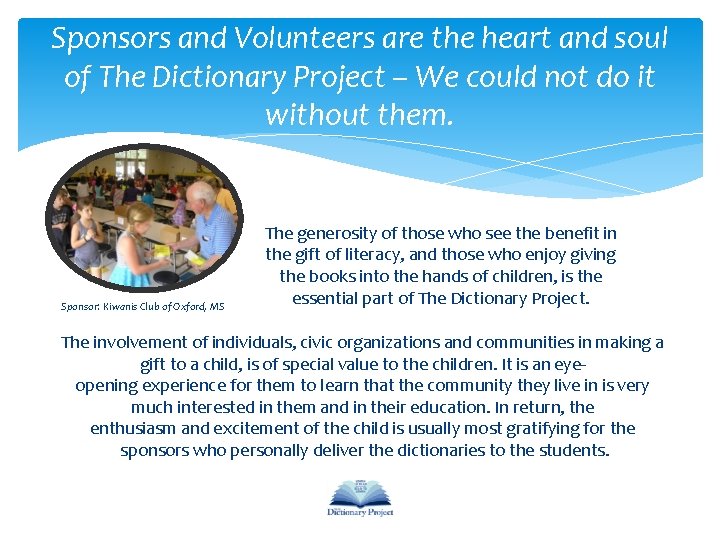
Sponsors and Volunteers are the heart and soul of The Dictionary Project – We could not do it without them. Sponsor: Kiwanis Club of Oxford, MS The generosity of those who see the benefit in the gift of literacy, and those who enjoy giving the books into the hands of children, is the essential part of The Dictionary Project. The involvement of individuals, civic organizations and communities in making a gift to a child, is of special value to the children. It is an eyeopening experience for them to learn that the community they live in is very much interested in them and in their education. In return, the enthusiasm and excitement of the child is usually most gratifying for the sponsors who personally deliver the dictionaries to the students.
The Dictionary Project appreciates your time and consideration. With your support, we can achieve our goal: Student by Student State by State Country by Country Post Office Box 1845 Charleston, South Carolina 29402 843 -856 -2706 843 -388 -8375 www. dictionaryproject. org