
A Deterministic Approach to Stochastic Computation Devon Jenson
![Generation • Randomizer unit [3]: binary to pseudorandom bit stream L-bit C < 010.](https://slidetodoc.com/presentation_image_h/318a448c810eb4793e386e5680774720/image-16.jpg "Generation • Randomizer unit [3]: binary to pseudorandom bit stream L-bit C < 010.")
![Taking a Look at the Average Independent: P[A|B] = P[A], P[B|A] = P[B] P[A]](https://slidetodoc.com/presentation_image_h/318a448c810eb4793e386e5680774720/image-22.jpg "Taking a Look at the Average Independent: P[A|B] = P[A], P[B|A] = P[B] P[A]")

- Slides: 42
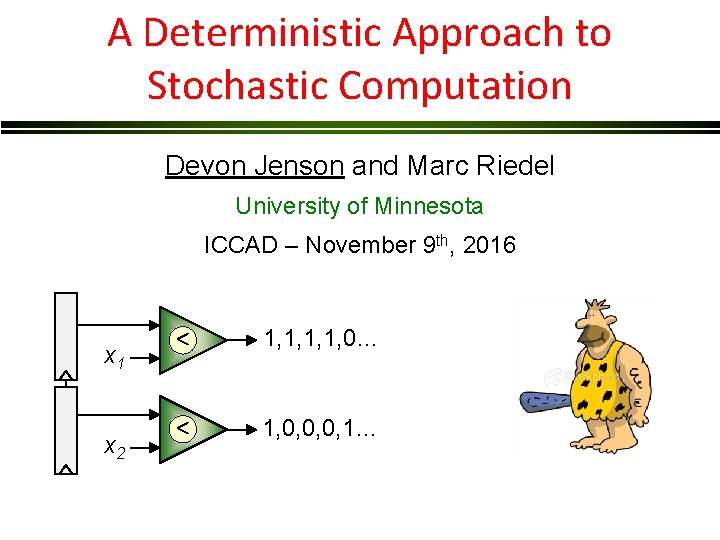
A Deterministic Approach to Stochastic Computation Devon Jenson and Marc Riedel University of Minnesota ICCAD – November 9 th, 2016 x 1 x 2 < 1, 1, 0… < 1, 0, 0, 0, 1…
Summary • Randomness is not a requirement for stochastic computing • Deterministic bit streams • • Same benefits Reduce latency by an exponential factor Compute with perfect precision Reduce gate count by at least 40% 2
Overview • • • Background: Stochastic Computation Average View of Stochastic Computation Deterministic Methods and Circuits Experimental Results Conclusion and Future Work 3
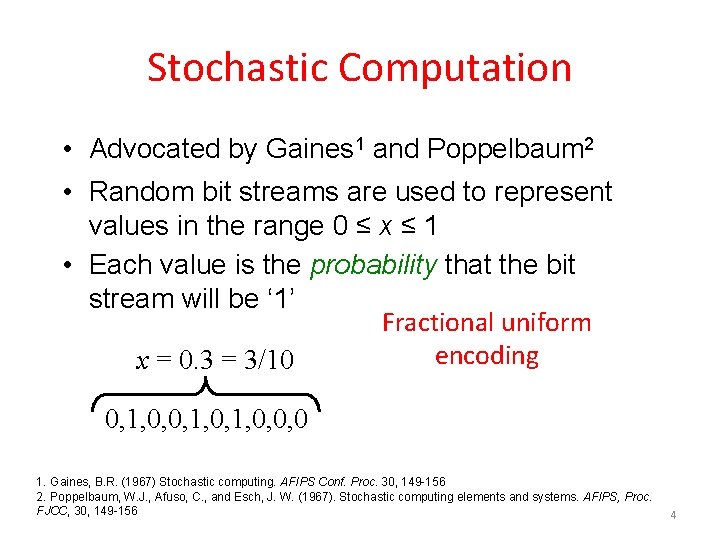
Stochastic Computation • Advocated by Gaines 1 and Poppelbaum 2 • Random bit streams are used to represent values in the range 0 ≤ x ≤ 1 • Each value is the probability that the bit stream will be ‘ 1’ Fractional uniform encoding x = 0. 3 = 3/10 0, 1, 0, 0, 0 1. Gaines, B. R. (1967) Stochastic computing. AFIPS Conf. Proc. 30, 149 -156 2. Poppelbaum, W. J. , Afuso, C. , and Esch, J. W. (1967). Stochastic computing elements and systems. AFIPS, Proc. FJCC, 30, 149 -156 4
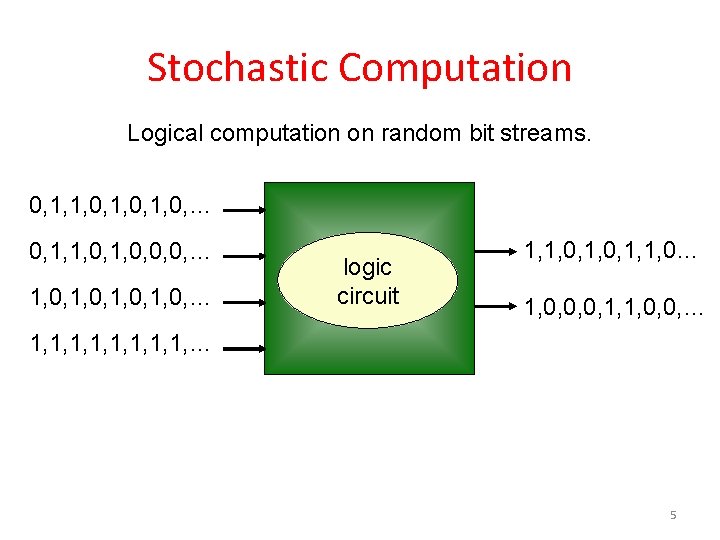
Stochastic Computation Logical computation on random bit streams. 0, 1, 1, 0, … 0, 1, 1, 0, 0, 0, … 1, 0, … logic circuit 1, 1, 0, 1, 1, 0… 1, 0, 0, 0, 1, 1, 0, 0, … 1, 1, … 5
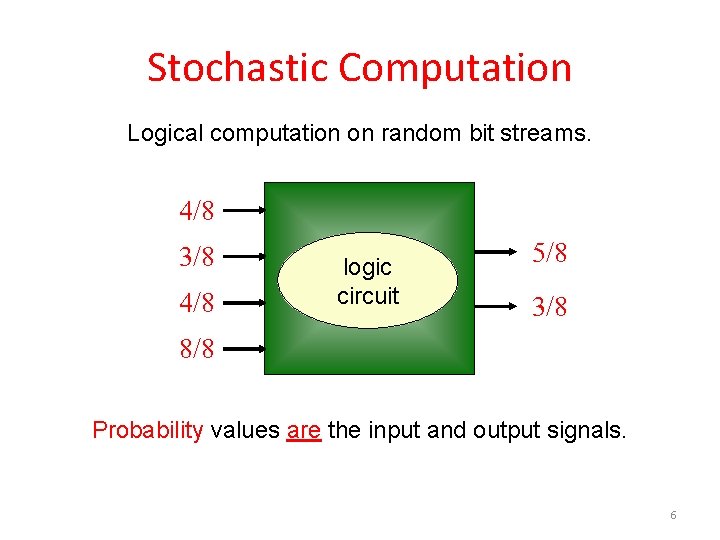
Stochastic Computation Logical computation on random bit streams. 4/8 3/8 4/8 logic combinational circuit 5/8 3/8 8/8 Probability values are the input and output signals. 6
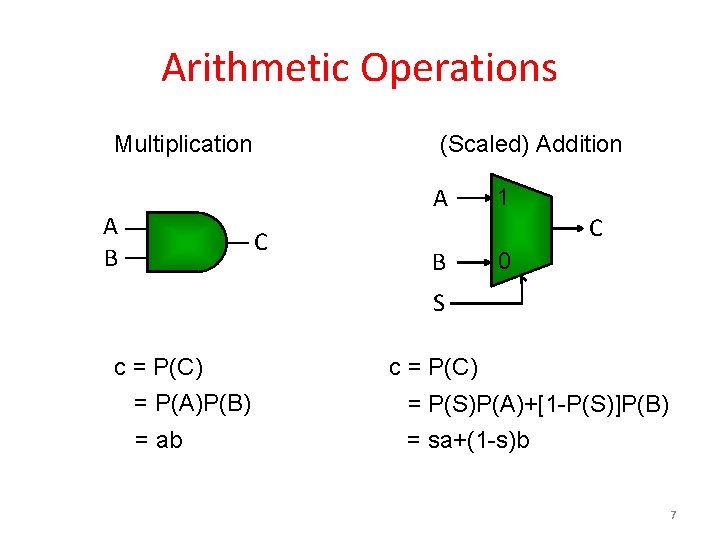
Arithmetic Operations Multiplication A B (Scaled) Addition C A 1 B 0 C S c = P(C) = P(A)P(B) = P(S)P(A)+[1 -P(S)]P(B) = ab = sa+(1 -s)b 7
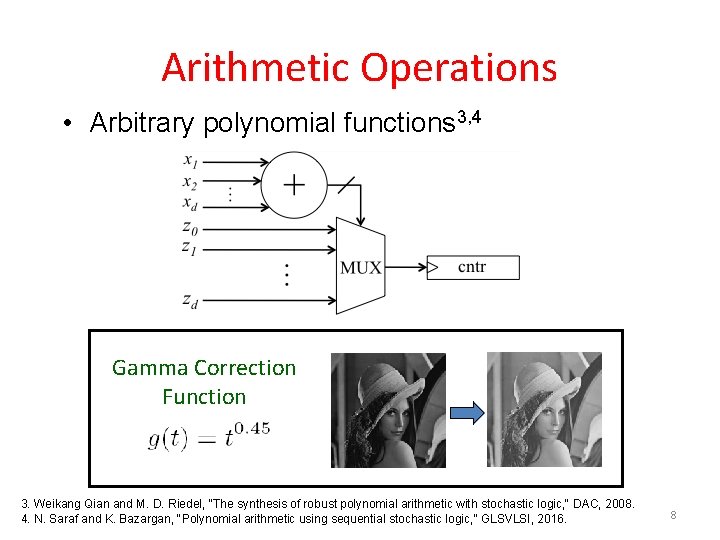
Arithmetic Operations • Arbitrary polynomial functions 3, 4 Gamma Correction Function 3. Weikang Qian and M. D. Riedel, "The synthesis of robust polynomial arithmetic with stochastic logic, " DAC, 2008. 4. N. Saraf and K. Bazargan, "Polynomial arithmetic using sequential stochastic logic, ” GLSVLSI, 2016. 8
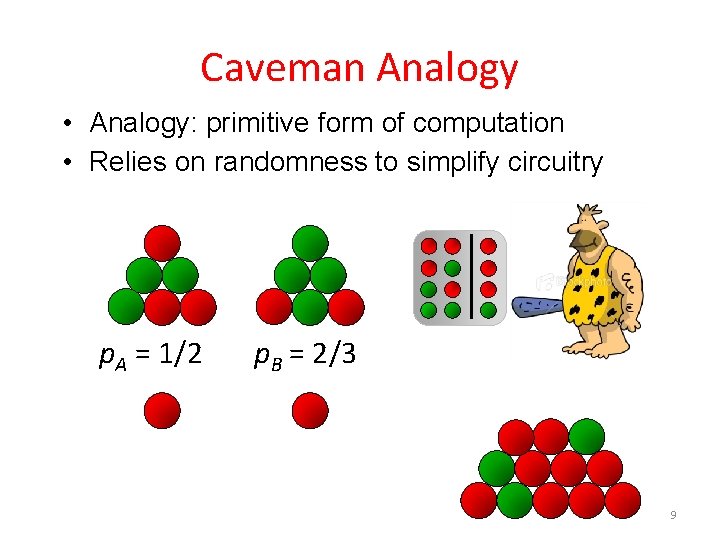
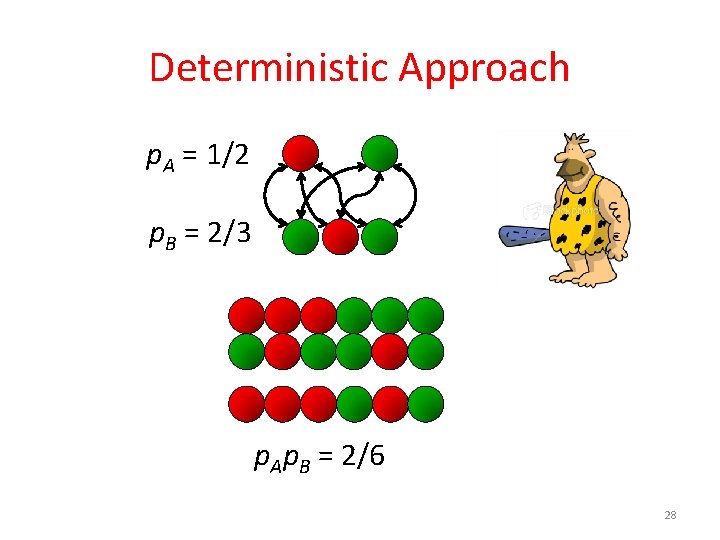
Caveman Analogy • Analogy: primitive form of computation • Relies on randomness to simplify circuitry p. A = 1/2 p. B = 2/3 9
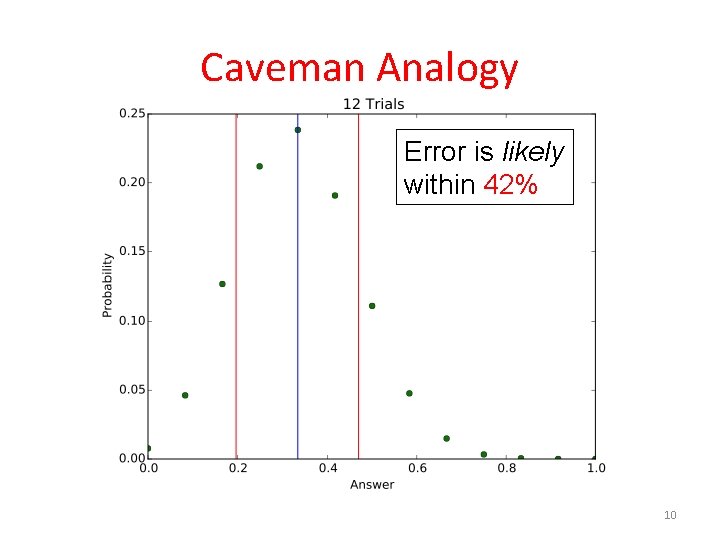
Caveman Analogy Error is likely within 42% 10
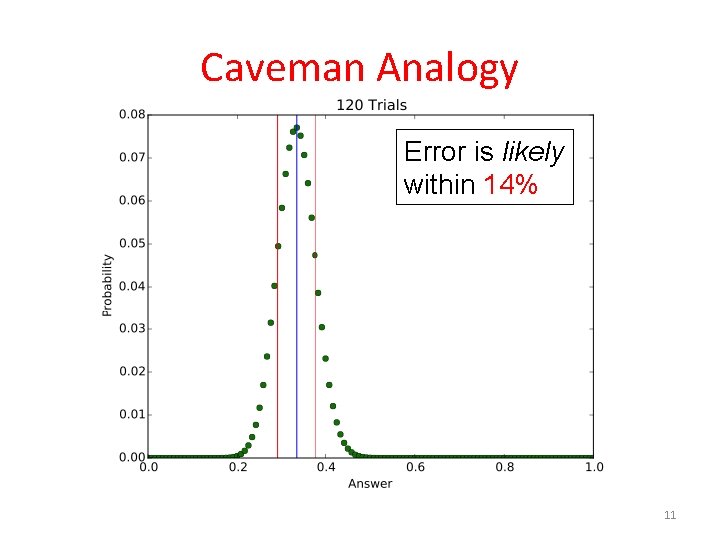
Caveman Analogy Error is likely within 14% 11
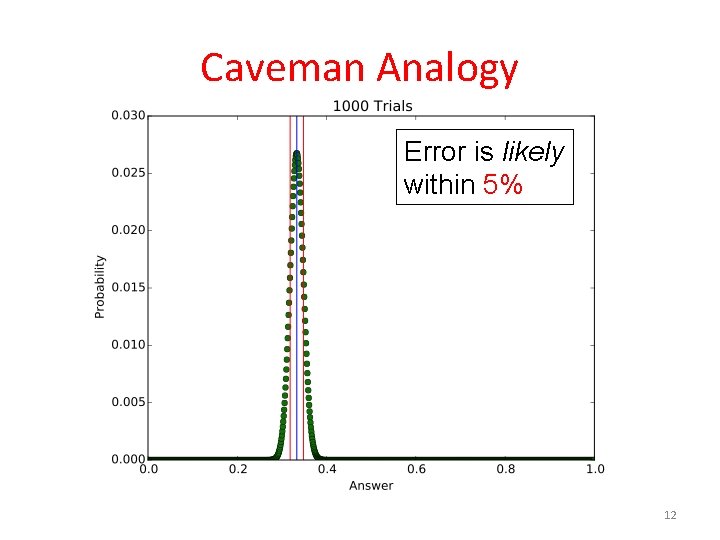
Caveman Analogy Error is likely within 5% 12
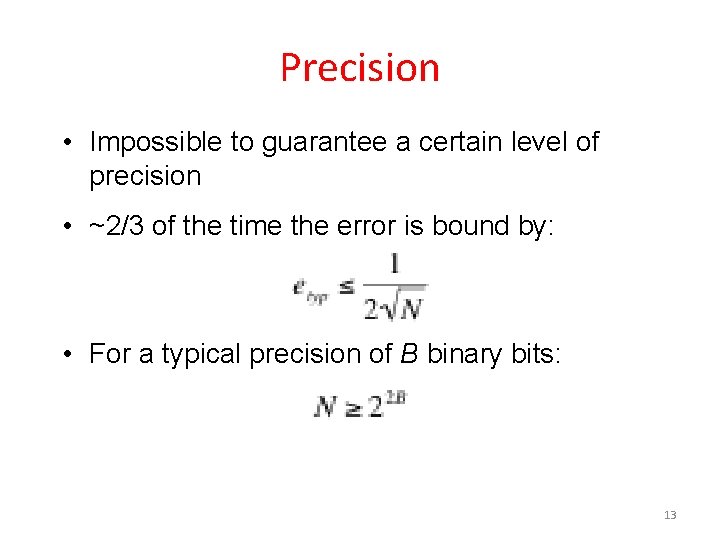
Precision • Impossible to guarantee a certain level of precision • ~2/3 of the time the error is bound by: • For a typical precision of B binary bits: 13
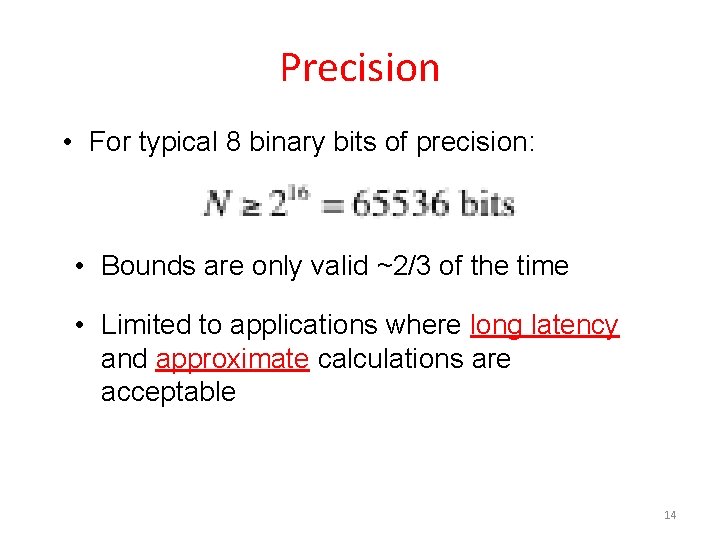
Precision • For typical 8 binary bits of precision: • Bounds are only valid ~2/3 of the time • Limited to applications where long latency and approximate calculations are acceptable 14
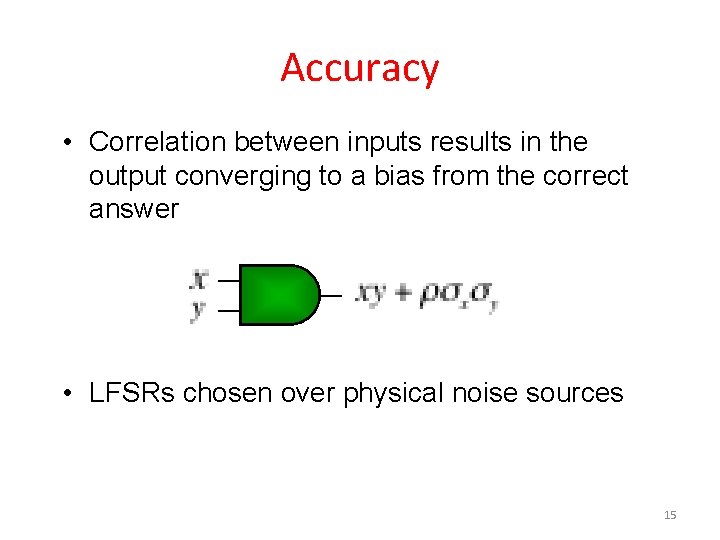
Accuracy • Correlation between inputs results in the output converging to a bias from the correct answer • LFSRs chosen over physical noise sources 15
Generation • Randomizer unit [3]: binary to pseudorandom bit stream L-bit C < 010. . 1101 • Length of bit stream depends on LFSR length 16
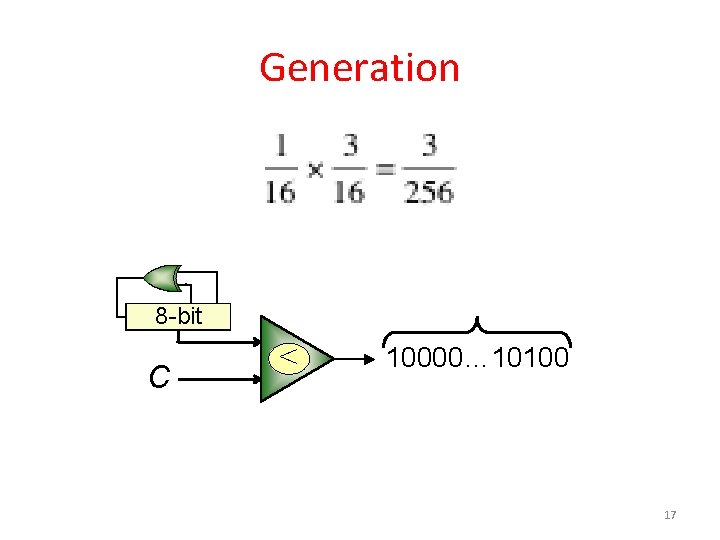
Generation 8 -bit C < 10000… 10100 17
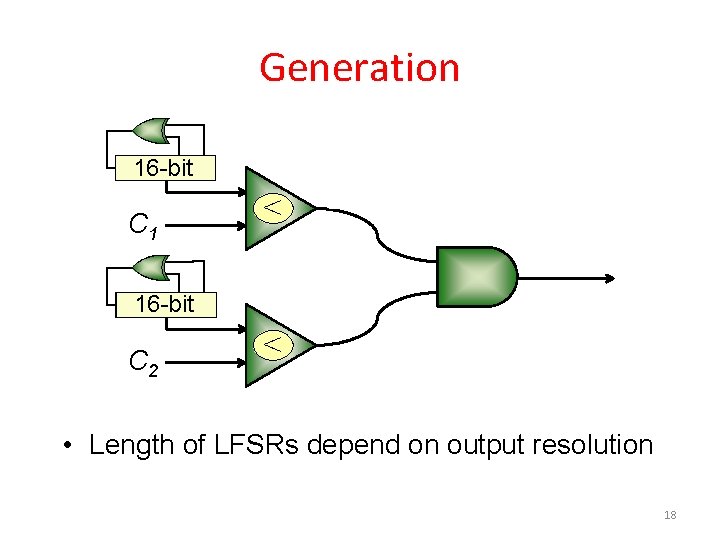
Generation 16 -bit 8 -bit C 1 < 16 -bit 8 -bit C 2 < • Length of LFSRs depend on output resolution 18
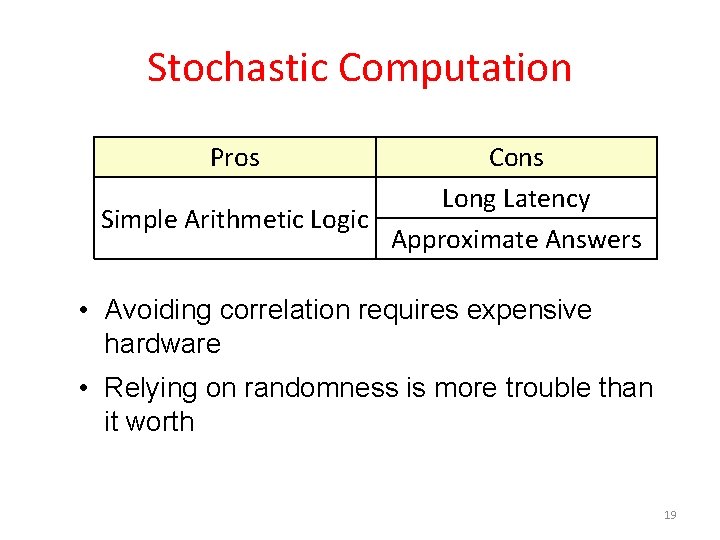
Stochastic Computation Pros Cons Long Latency Simple Arithmetic Logic Approximate Answers • Avoiding correlation requires expensive hardware • Relying on randomness is more trouble than it worth 19
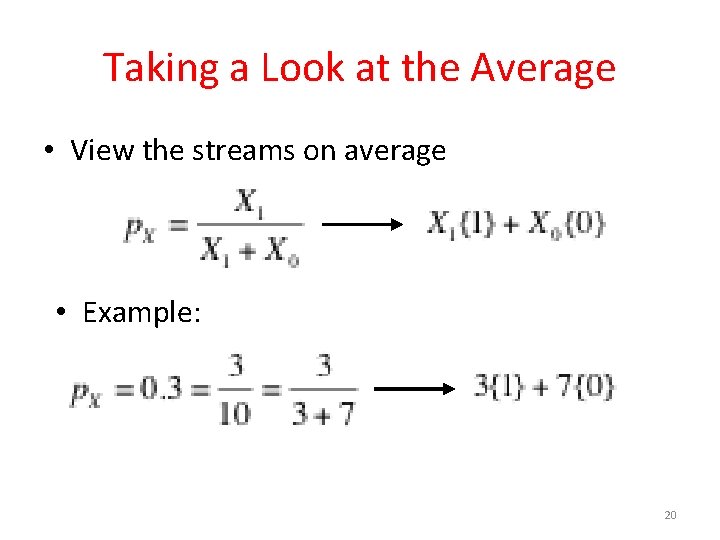
Taking a Look at the Average • View the streams on average • Example: 20
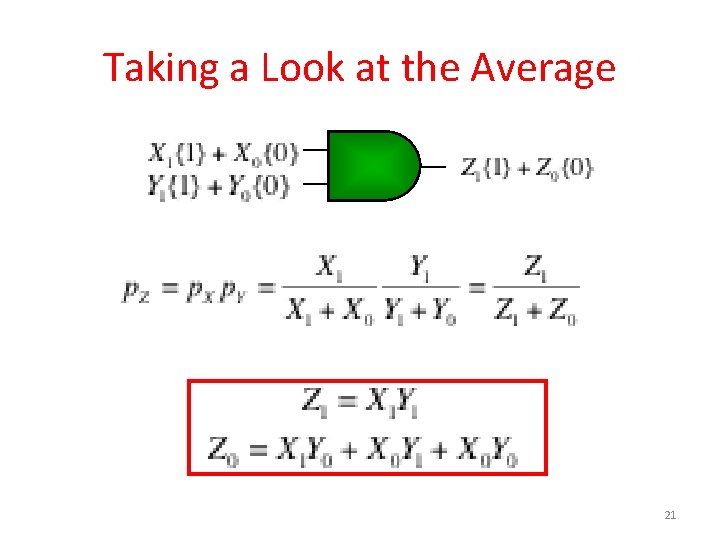
Taking a Look at the Average 21
Taking a Look at the Average Independent: P[A|B] = P[A], P[B|A] = P[B] P[A] = 1/3 1 0 0 1 0 P[B] = 2/3 1 1 0 1 01 0 0 • On average, each outcome of one bit stream will see the average value of the other bit stream 22
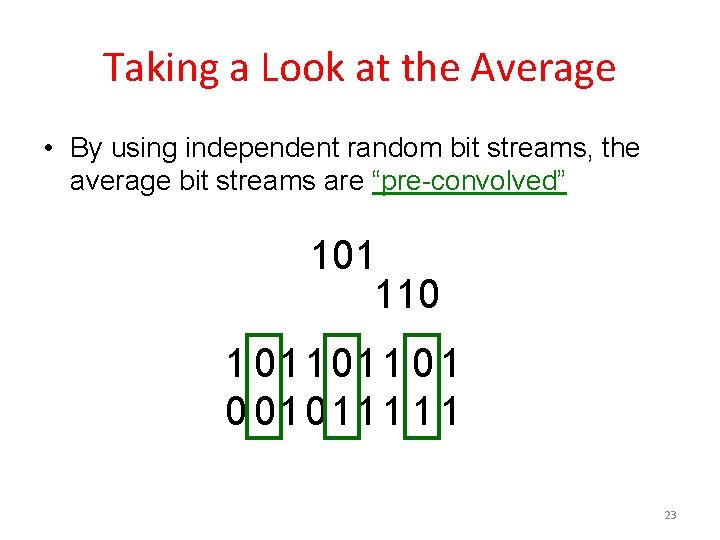
Taking a Look at the Average • By using independent random bit streams, the average bit streams are “pre-convolved” 101 110 110 1 01 1 0 010 11 1 23
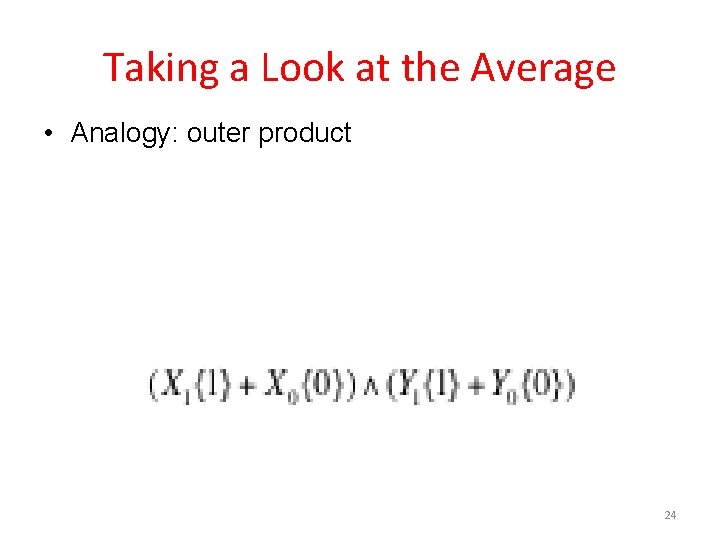
Taking a Look at the Average • Analogy: outer product 24
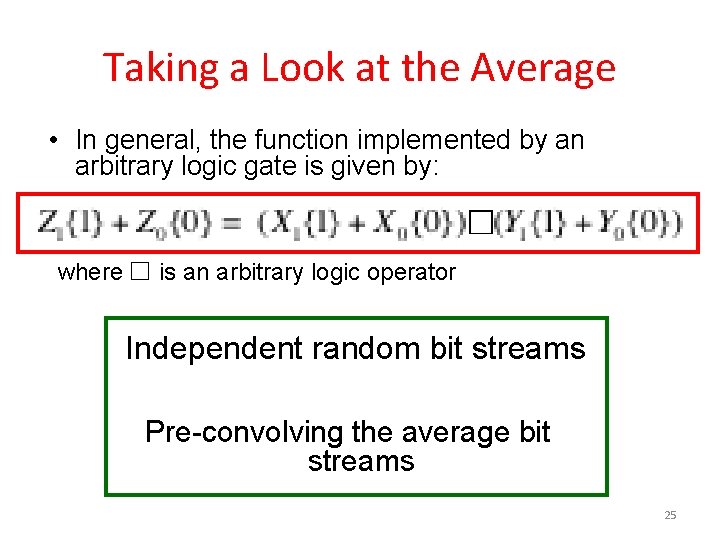
Taking a Look at the Average • In general, the function implemented by an arbitrary logic gate is given by: ☐ where ☐ is an arbitrary logic operator Independent random bit streams Pre-convolving the average bit streams 25
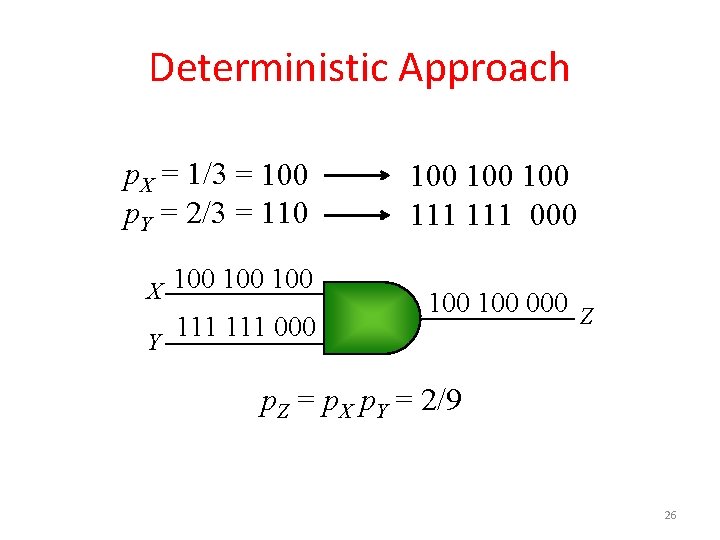
Deterministic Approach p. X = 1/3 = 100 p. Y = 2/3 = 110 X 100 100 Y 111 000 100 111 111 000 100 000 Z p. Z = p. X p. Y = 2/9 26
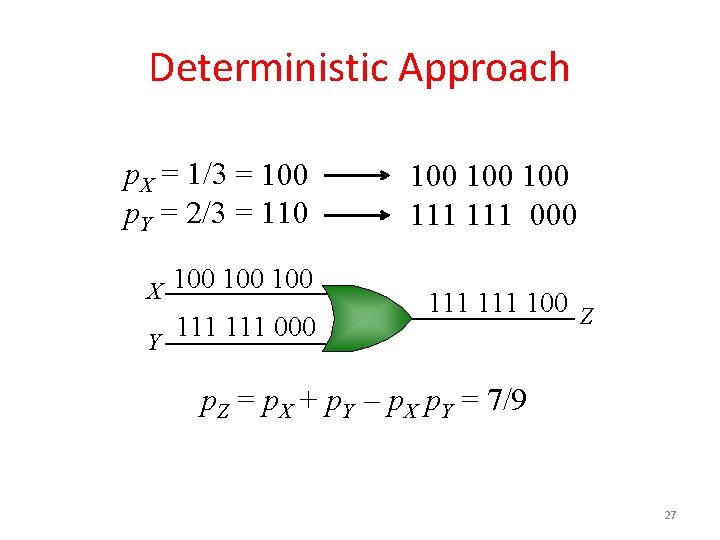
Deterministic Approach p. X = 1/3 = 100 p. Y = 2/3 = 110 X 100 100 Y 111 000 100 111 111 000 111 100 Z p. Z = p. X + p. Y – p. X p. Y = 7/9 27
Deterministic Approach p. A = 1/2 p. B = 2/3 p. Ap. B = 2/6 28
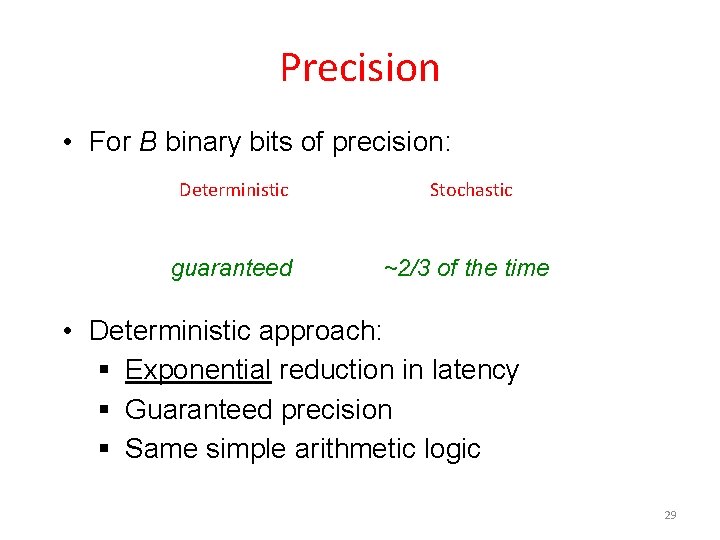
Precision • For B binary bits of precision: Deterministic Stochastic guaranteed ~2/3 of the time • Deterministic approach: § Exponential reduction in latency § Guaranteed precision § Same simple arithmetic logic 29
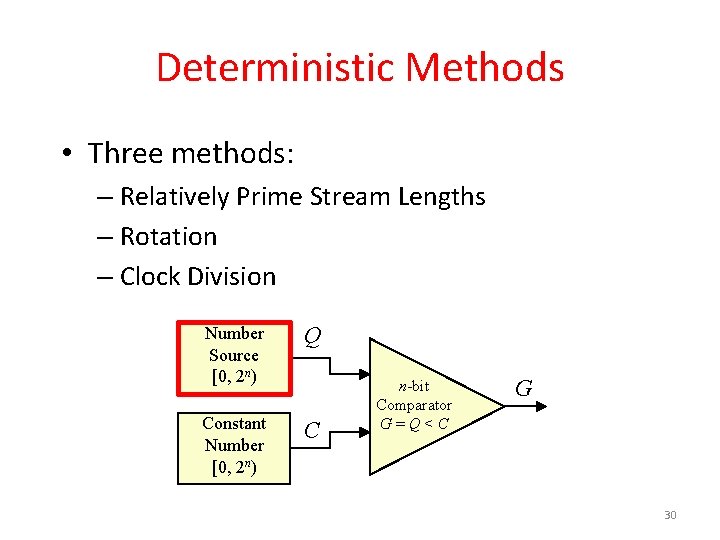
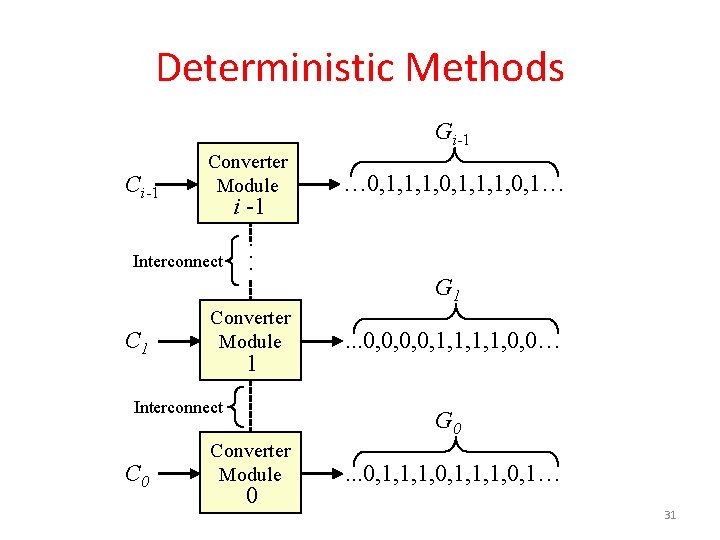
Deterministic Methods • Three methods: – Relatively Prime Stream Lengths – Rotation – Clock Division Number Source [0, 2 n) Q Constant Number [0, 2 n) C n-bit Comparator G=Q<C G 30
Deterministic Methods Gi-1 i -1 Interconnect … 0, 1, 1, 1, 0, 1… . . . Ci-1 Converter Module G 1 Converter Module 1 Interconnect C 0 . . . 0, 0, 1, 1, 0, 0… G 0 Converter Module 0 . . . 0, 1, 1, 1, 0, 1… 31
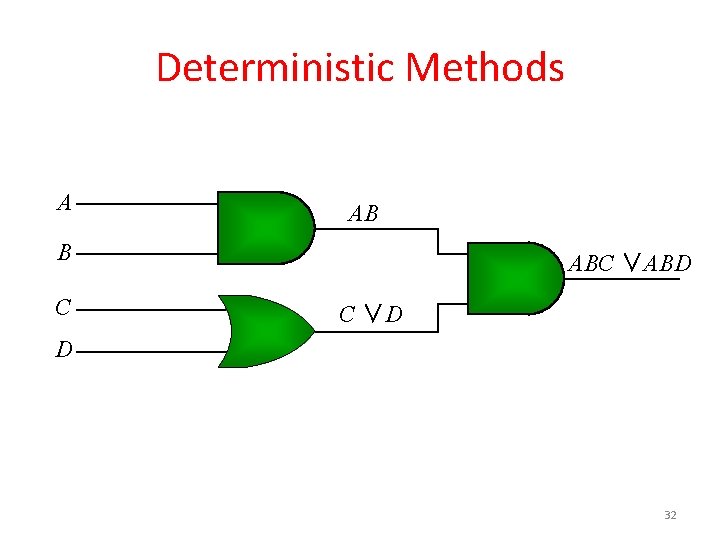
Deterministic Methods A AB B C ABC ∨ABD C ∨D D 32
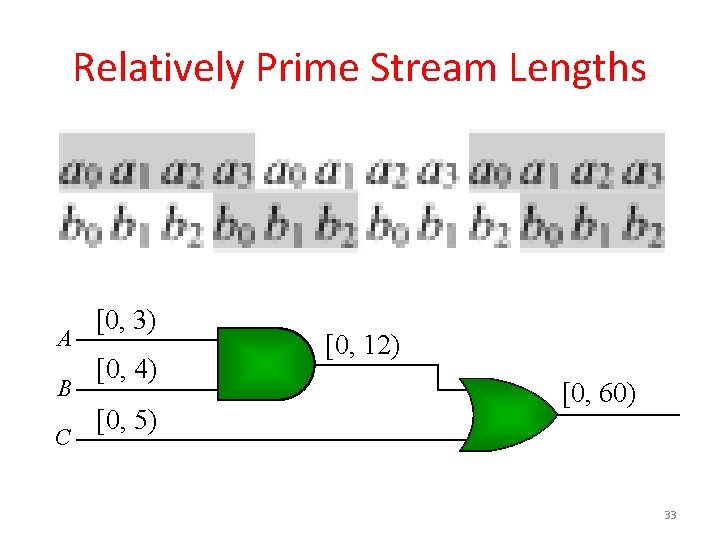
Relatively Prime Stream Lengths A B C [0, 3) [0, 4) [0, 5) [0, 12) [0, 60) 33
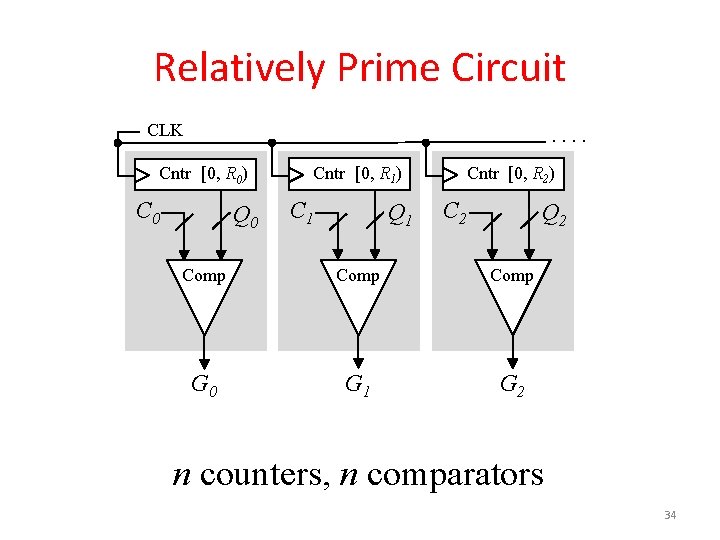
Relatively Prime Circuit CLK . . Cntr [0, R 0) C 0 Q 0 Cntr [0, R 1) C 1 Q 1 Cntr [0, R 2) C 2 Q 2 Comp G 0 G 1 G 2 n counters, n comparators 34
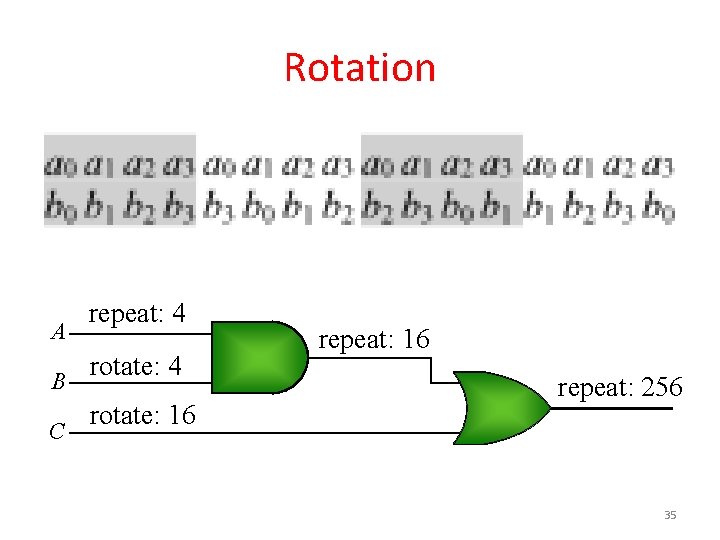
Rotation A B C repeat: 4 rotate: 16 repeat: 256 35
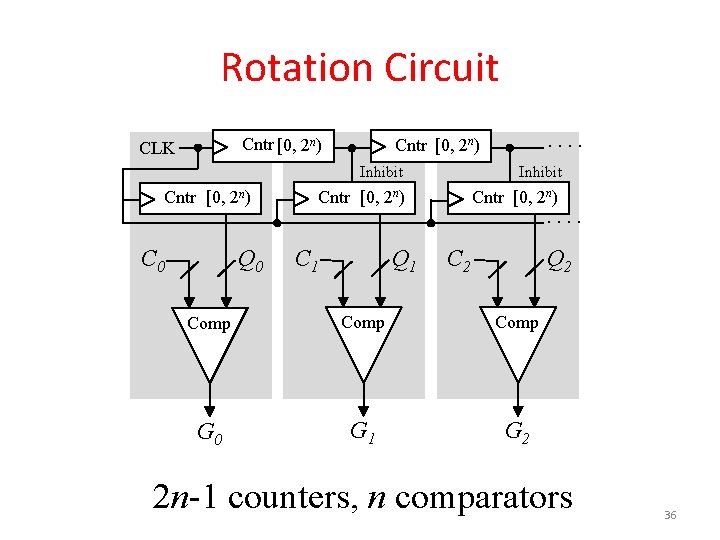
Rotation Circuit Cntr [0, 2 n) CLK Cntr [0, 2 n) C 0 Q 0 . . Cntr [0, 2 n) Inhibit Cntr [0, 2 n) C 1 Q 1 . . C 2 Q 2 Comp G 0 G 1 G 2 2 n-1 counters, n comparators 36
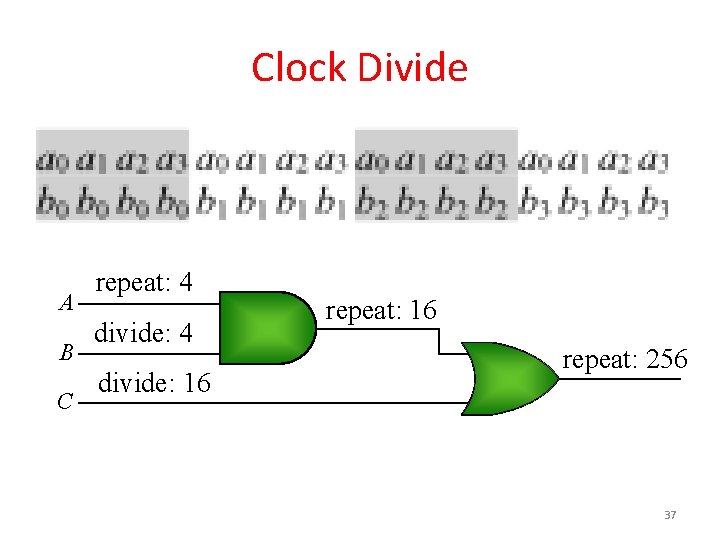
Clock Divide A B C repeat: 4 divide: 16 repeat: 256 37
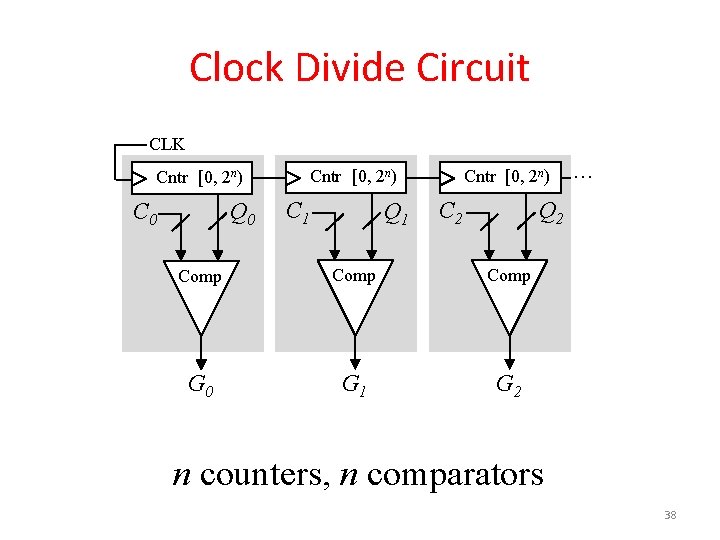
Clock Divide Circuit CLK Cntr [0, 2 n) C 0 Q 0 Cntr [0, 2 n) C 1 Q 1 Cntr [0, 2 n) C 2 … Q 2 Comp G 0 G 1 G 2 n counters, n comparators 38
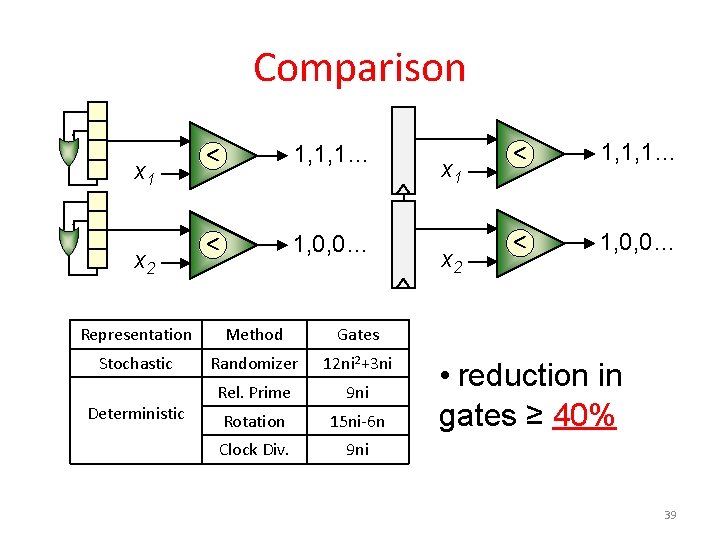
Comparison x 1 x 2 < 1, 1, 1… < 1, 0, 0… Representation Method Gates Stochastic Randomizer 12 ni 2+3 ni Rel. Prime 9 ni Rotation 15 ni-6 n Clock Div. 9 ni Deterministic x 1 x 2 < 1, 1, 1… < 1, 0, 0… • reduction in gates ≥ 40% 39
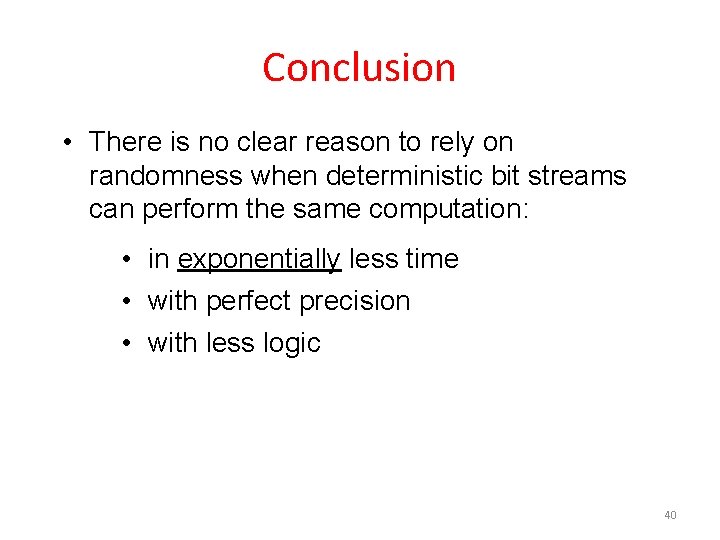
Conclusion • There is no clear reason to rely on randomness when deterministic bit streams can perform the same computation: • in exponentially less time • with perfect precision • with less logic 40
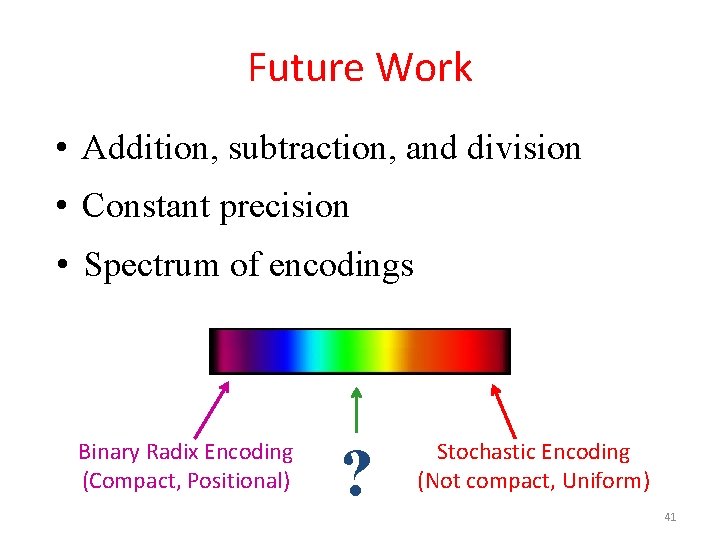
Future Work • Addition, subtraction, and division • Constant precision • Spectrum of encodings Binary Radix Encoding (Compact, Positional) ? Stochastic Encoding (Not compact, Uniform) 41
Thank you! 42