
A detailed look at the MOD 16 ET
- Slides: 18
A detailed look at the MOD 16 ET algorithm Natalie Schultz Heat budget group meeting 7/11/13
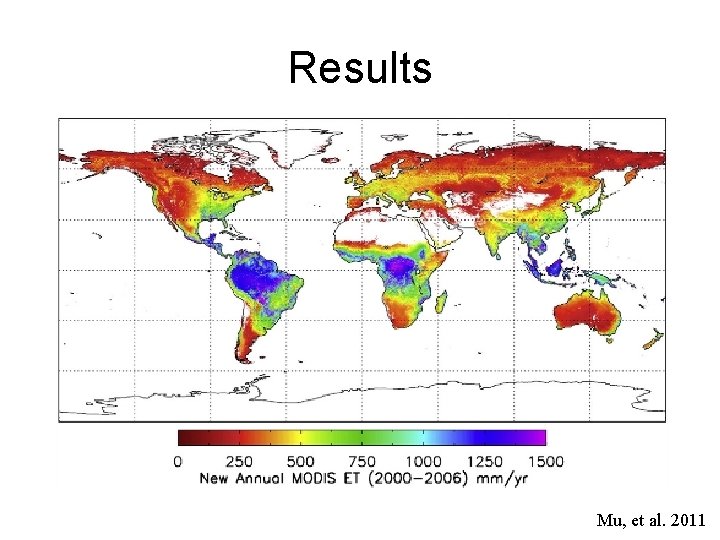
MOD 16 • Global 1 km 2 dataset of ET, LE, PET, PLE for 109. 03 million km 2 of global vegetated land • Computed daily • Produced at 8 -day, monthly, annual intervals • Available from 2000 -2012 • Currently available through group’s website: U Montana. • According to Mu 2011, this algorithm has been submitted to NASA for full review to be available through the MODIS Land product DAAC.
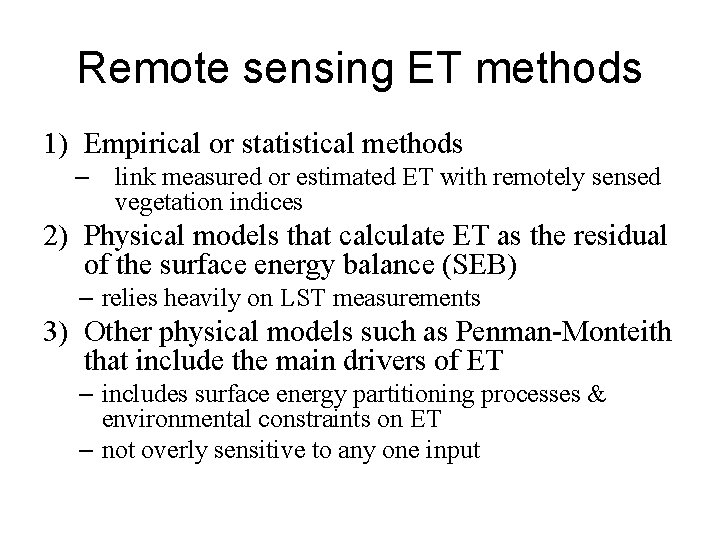
Remote sensing ET methods 1) Empirical or statistical methods – link measured or estimated ET with remotely sensed vegetation indices 2) Physical models that calculate ET as the residual of the surface energy balance (SEB) – relies heavily on LST measurements 3) Other physical models such as Penman-Monteith that include the main drivers of ET – includes surface energy partitioning processes & environmental constraints on ET – not overly sensitive to any one input
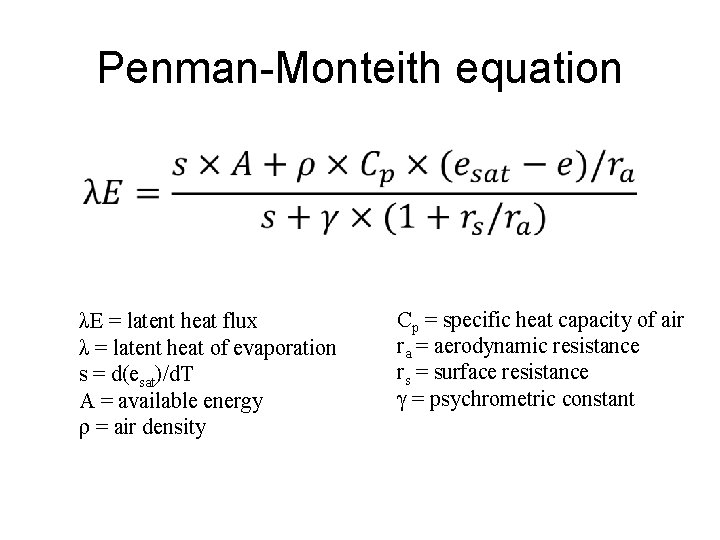
Penman-Monteith equation λE = latent heat flux λ = latent heat of evaporation s = d(esat)/d. T A = available energy ρ = air density Cp = specific heat capacity of air ra = aerodynamic resistance rs = surface resistance γ = psychrometric constant
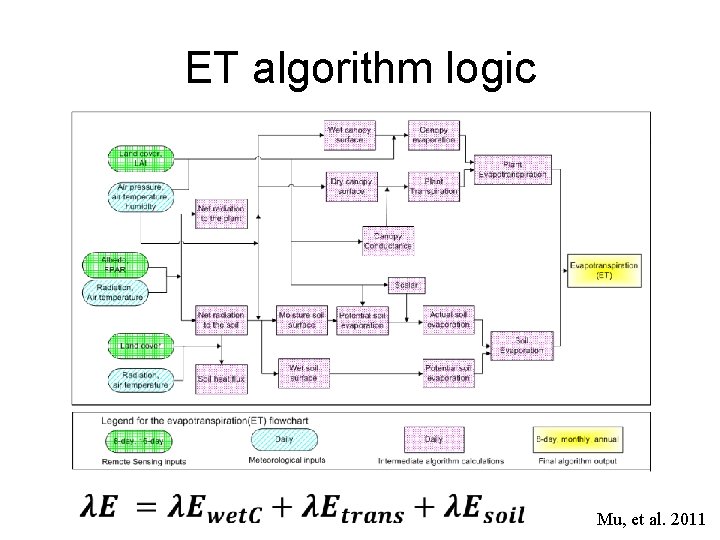
ET algorithm logic Mu, et al. 2011
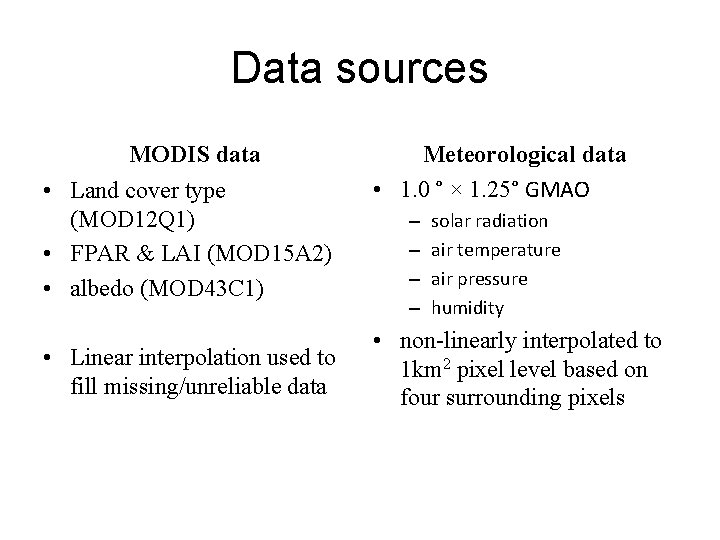
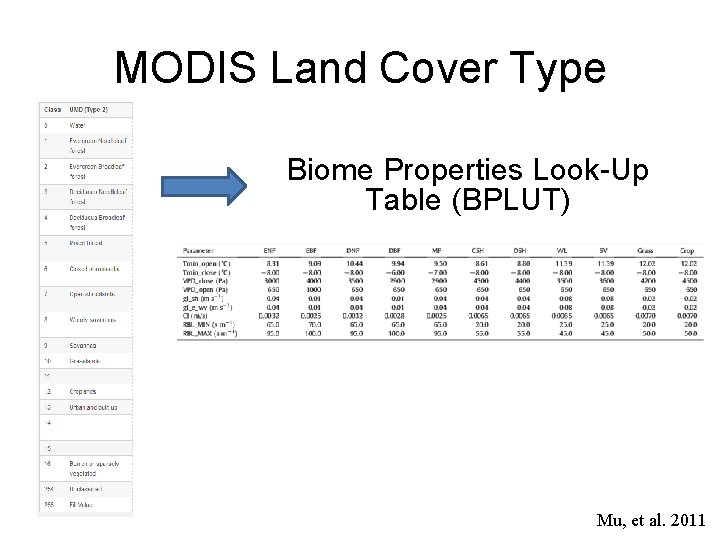
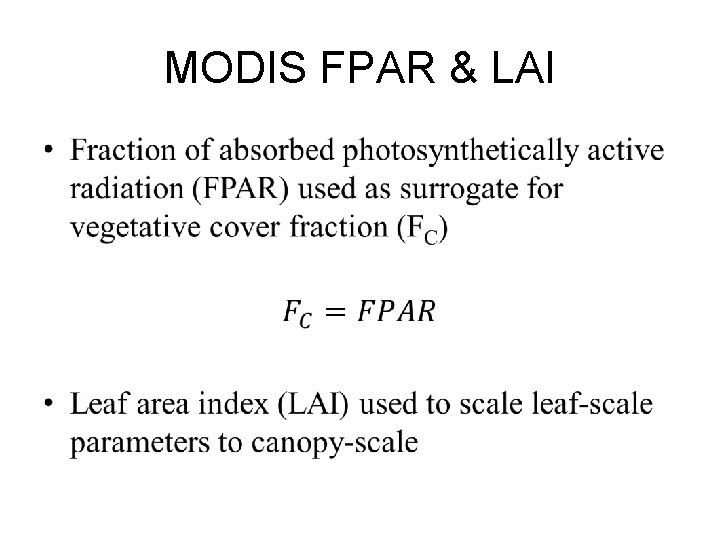
Data sources MODIS data • Land cover type (MOD 12 Q 1) • FPAR & LAI (MOD 15 A 2) • albedo (MOD 43 C 1) • Linear interpolation used to fill missing/unreliable data Meteorological data • 1. 0 ° × 1. 25° GMAO – – solar radiation air temperature air pressure humidity • non-linearly interpolated to 1 km 2 pixel level based on four surrounding pixels
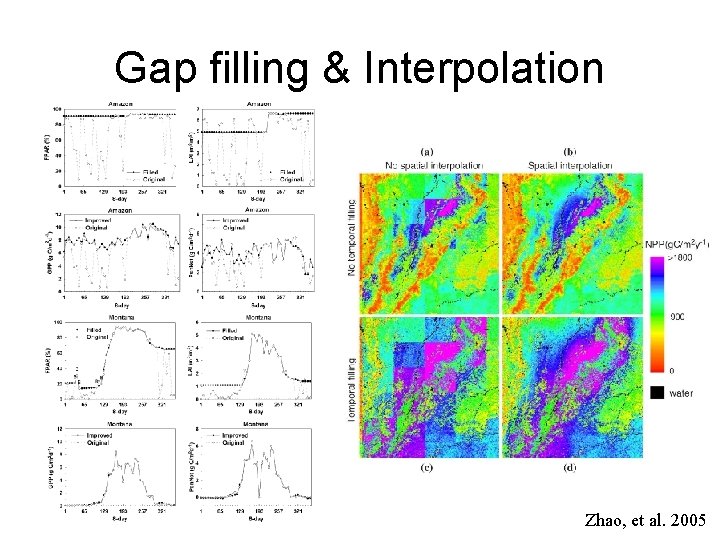
Gap filling & Interpolation Zhao, et al. 2005
MODIS Land Cover Type Biome Properties Look-Up Table (BPLUT) Mu, et al. 2011
MODIS FPAR & LAI •
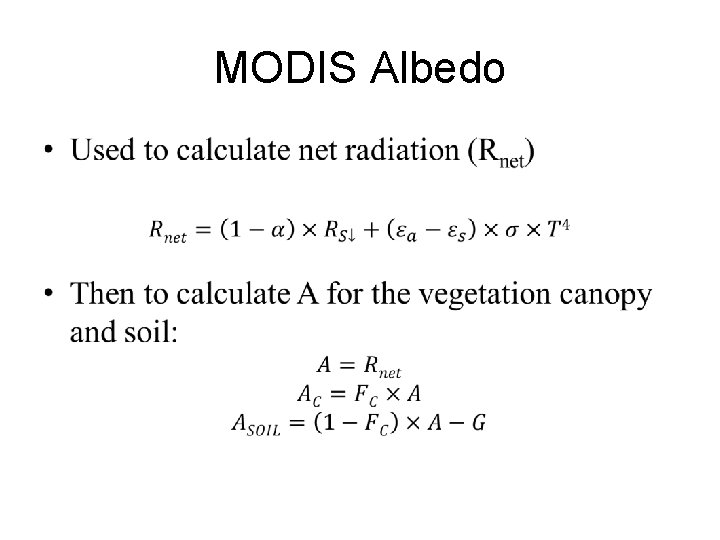
MODIS Albedo •
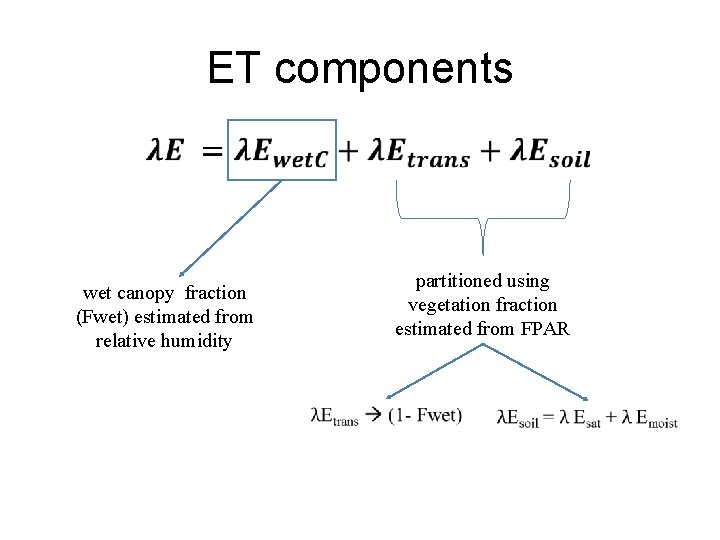
ET components wet canopy fraction (Fwet) estimated from relative humidity partitioned using vegetation fraction estimated from FPAR
Results Mu, et al. 2011
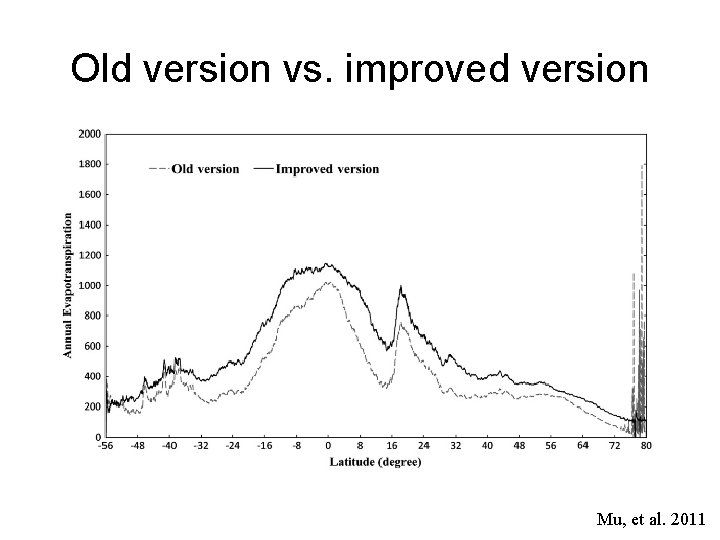
Old version vs. improved version Mu, et al. 2011
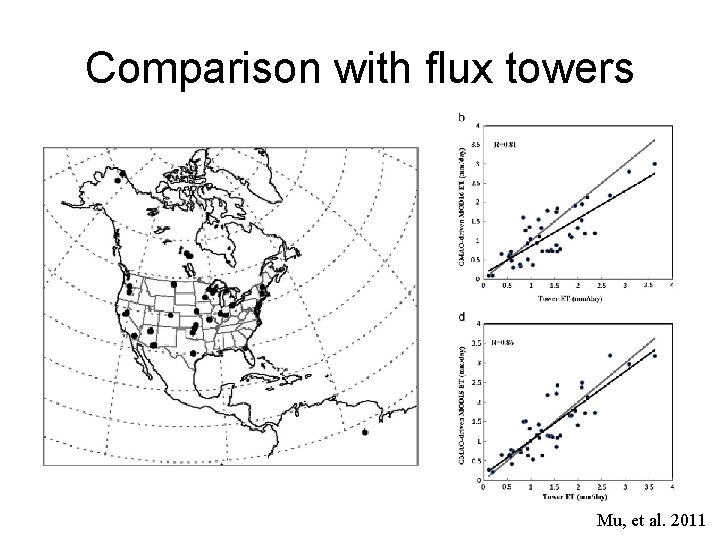
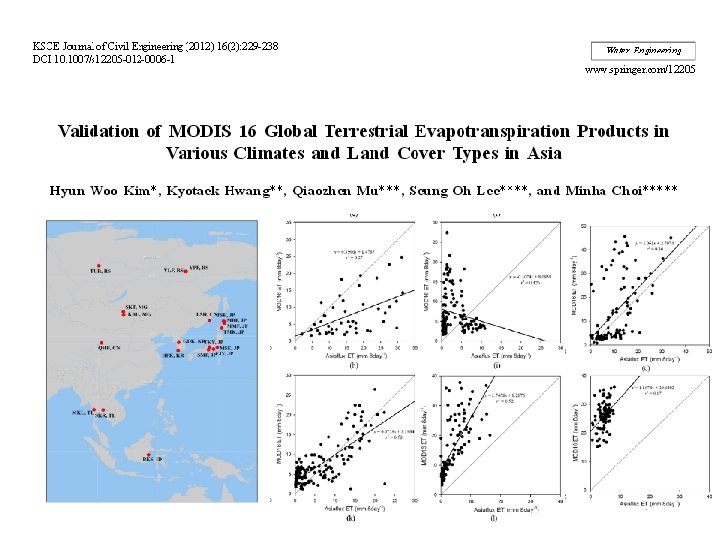
Comparison with flux towers Mu, et al. 2011
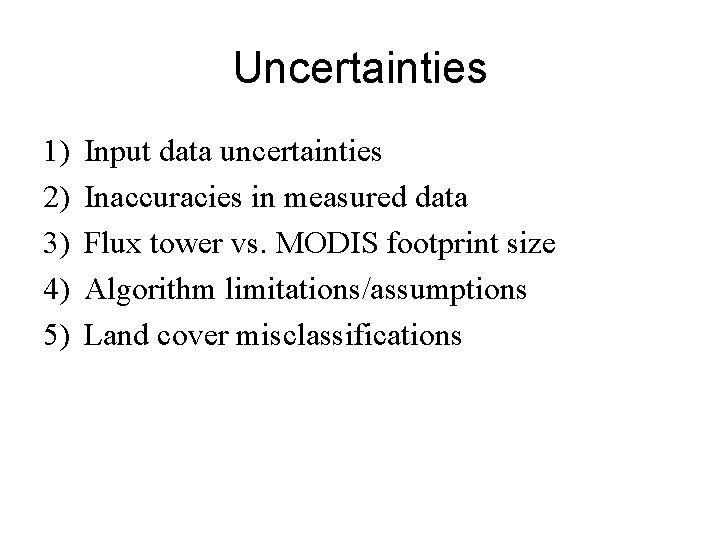
Uncertainties 1) 2) 3) 4) 5) Input data uncertainties Inaccuracies in measured data Flux tower vs. MODIS footprint size Algorithm limitations/assumptions Land cover misclassifications
Conclusions • MOD 16 useful tool for examining global terrestrial water and energy cycles, and environmental change. • At smaller spatial scales, there may be biases between MOD 16 and surface measurements. • Validation using surface measurements.