
A Detailed Lesson Plan in Mathematics IV Solving
- Slides: 16
A Detailed Lesson Plan in Mathematics IV “Solving Quadratic Inequalities”
I. Objectives • At the end of the lesson, the students should be able to: • demonstrate the ability to solve quadratic inequalities using the graphic and algebraic method. • internalize the concept of solving problems in different methods. • correctly solve quadratic inequalities.
II. Subject Matter • Topic: Solving Quadratic Inequlities • References: • Stewart, J. , Redlin L. , & Watson, S. (2007). Algebra and Trigonometry. Pasig City: Cengage Learning. pp. 122 -124 • http: //www. regentsprep. org/Regents/math/algtrig /ATE 6/Quadinequal. htm • Materials: graphing board
III. Learning Activities Teacher’s Activity A. Preparation • Daily Routine • “Let us pray first. ” • “Good morning class!” • “Before you take your seat, please pick up the pieces of paper under your chair. ” • “Thank you class. You may now take your seat. ” • “Let me have your attendance. Say present if you are here. ” Student’s Activity • Expected response from students: • (One student will lead the prayer) • “Good morning ma’am/sir!” • (Students will pick up the pieces of paper. ) • (Students will be sitting down. ) • (Students will say present as the teacher calls their name. )
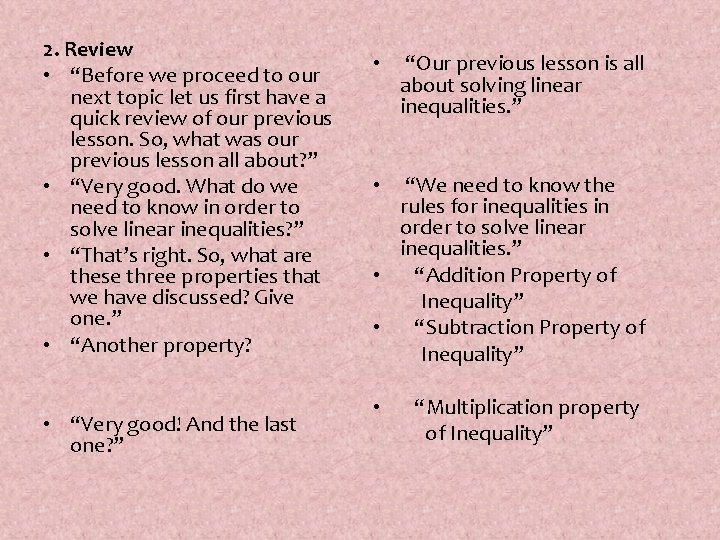
2. Review • “Before we proceed to our next topic let us first have a quick review of our previous lesson. So, what was our previous lesson all about? ” • “Very good. What do we need to know in order to solve linear inequalities? ” • “That’s right. So, what are these three properties that we have discussed? Give one. ” • “Another property? • “Very good! And the last one? ” • “Our previous lesson is all about solving linear inequalities. ” • “We need to know the rules for inequalities in order to solve linear inequalities. ” • “Addition Property of Inequality” • “Subtraction Property of Inequality” • “Multiplication property of Inequality”
3. Motivation Ø PRIMING ACTIVITY
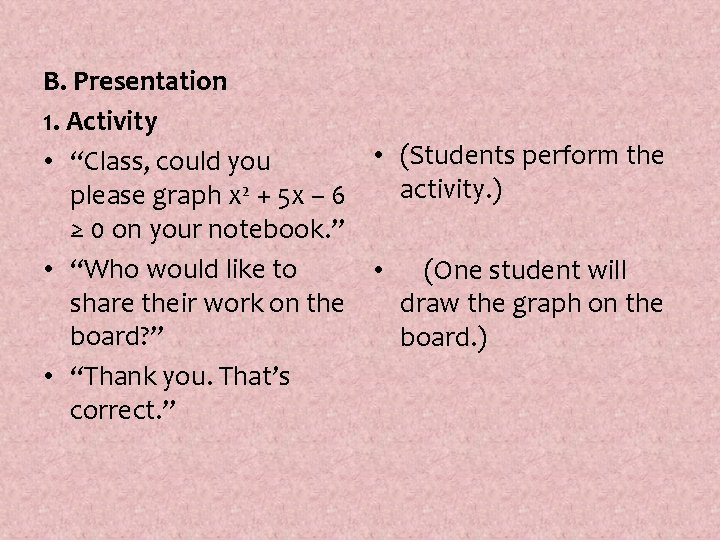
B. Presentation 1. Activity • (Students perform the • “Class, could you activity. ) please graph x 2 + 5 x – 6 ≥ 0 on your notebook. ” • “Who would like to • (One student will share their work on the draw the graph on the board? ” board. ) • “Thank you. That’s correct. ”
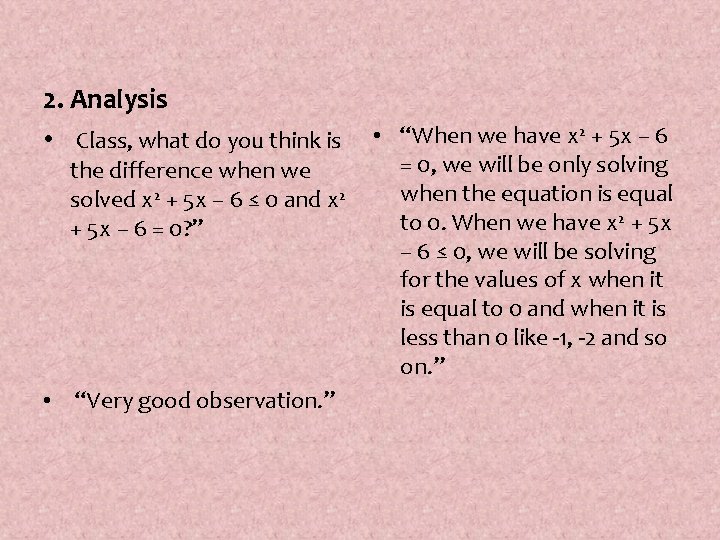
2. Analysis • Class, what do you think is • “When we have x 2 + 5 x – 6 the difference when we solved x 2 + 5 x – 6 ≤ 0 and x 2 + 5 x – 6 = 0? ” • “Very good observation. ” = 0, we will be only solving when the equation is equal to 0. When we have x 2 + 5 x – 6 ≤ 0, we will be solving for the values of x when it is equal to 0 and when it is less than 0 like -1, -2 and so on. ”
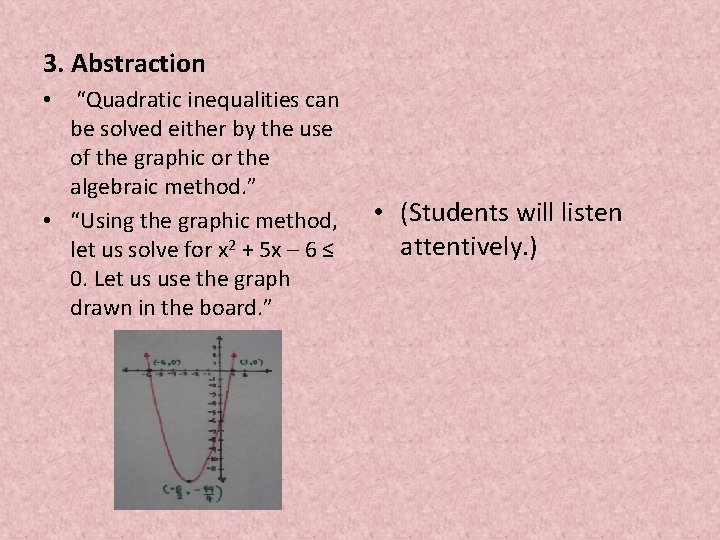
3. Abstraction • “Quadratic inequalities can be solved either by the use of the graphic or the algebraic method. ” • “Using the graphic method, let us solve for x 2 + 5 x – 6 ≤ 0. Let us use the graph drawn in the board. ” • (Students will listen attentively. )
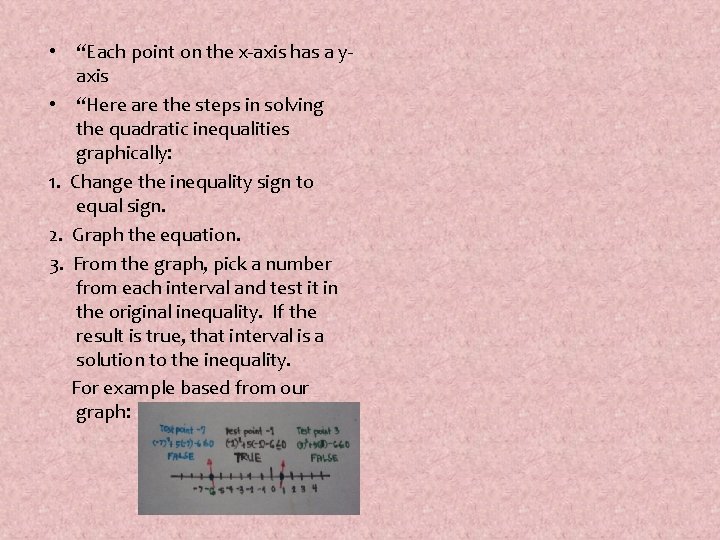
• “Each point on the x-axis has a yaxis • “Here are the steps in solving the quadratic inequalities graphically: 1. Change the inequality sign to equal sign. 2. Graph the equation. 3. From the graph, pick a number from each interval and test it in the original inequality. If the result is true, that interval is a solution to the inequality. For example based from our graph:
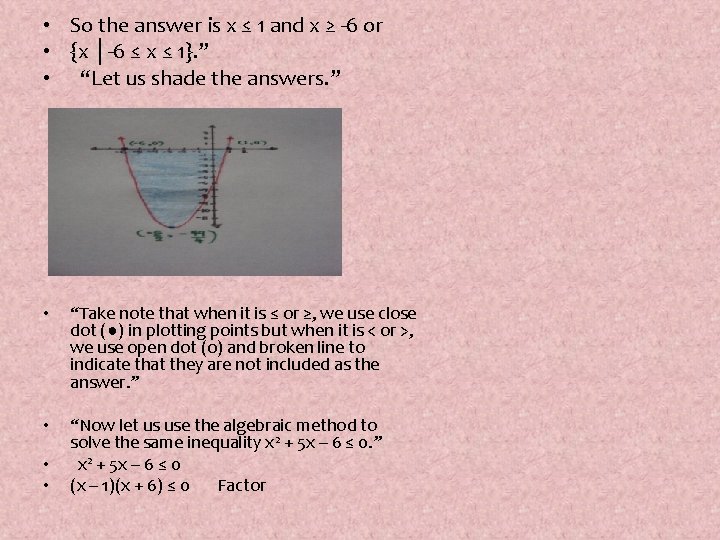
• So the answer is x ≤ 1 and x ≥ -6 or • {x │-6 ≤ x ≤ 1}. ” • “Let us shade the answers. ” • • • • “Take note that when it is ≤ or ≥, we use close dot (●) in plotting points but when it is < or >, we use open dot (○) and broken line to indicate that they are not included as the answer. ” “Now let us use the algebraic method to solve the same inequality x 2 + 5 x – 6 ≤ 0. ” x 2 + 5 x – 6 ≤ 0 (x – 1)(x + 6) ≤ 0 Factor
• “Now, there are two ways this product could be less than zero or equal to 0 • (x - 1) ≤ 0 and (x + 6) ≥ 0 or (x - 1) ≥ 0 and (x + 6) ≤ 0. First situation: 1. (x - 1) ≤ 0 and (x + 6) ≥ 0 x ≤ 1 and x ≥ -6 • This tells us that -6 ≤ x ≤ 1.
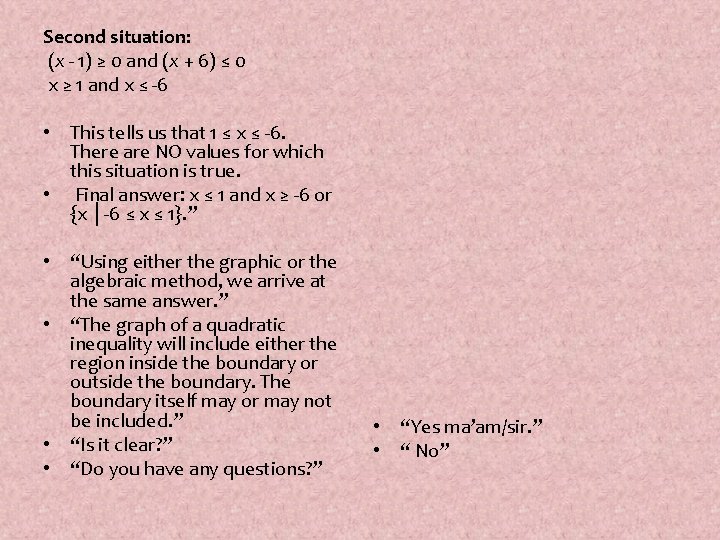
Second situation: (x - 1) ≥ 0 and (x + 6) ≤ 0 x ≥ 1 and x ≤ -6 • This tells us that 1 ≤ x ≤ -6. There are NO values for which this situation is true. • Final answer: x ≤ 1 and x ≥ -6 or {x │-6 ≤ x ≤ 1}. ” • “Using either the graphic or the algebraic method, we arrive at the same answer. ” • “The graph of a quadratic inequality will include either the region inside the boundary or outside the boundary. The boundary itself may or may not be included. ” • “Is it clear? ” • “Do you have any questions? ” • “Yes ma’am/sir. ” • “ No”
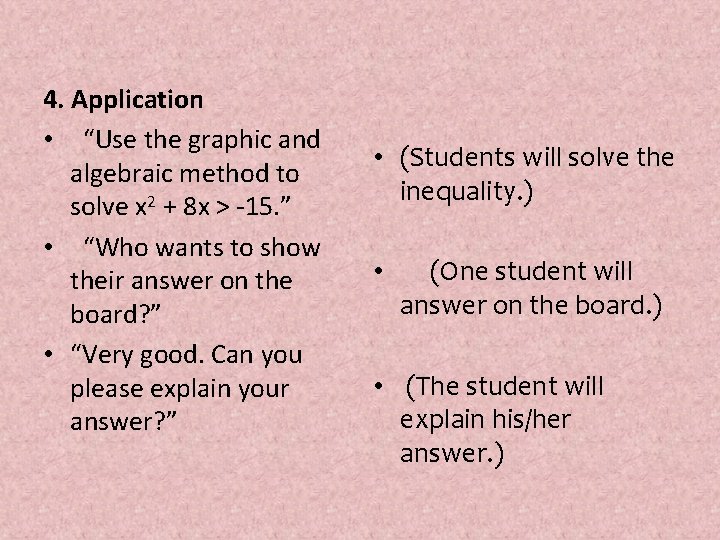
4. Application • “Use the graphic and algebraic method to solve x 2 + 8 x > -15. ” • “Who wants to show their answer on the board? ” • “Very good. Can you please explain your answer? ” • (Students will solve the inequality. ) • (One student will answer on the board. ) • (The student will explain his/her answer. )
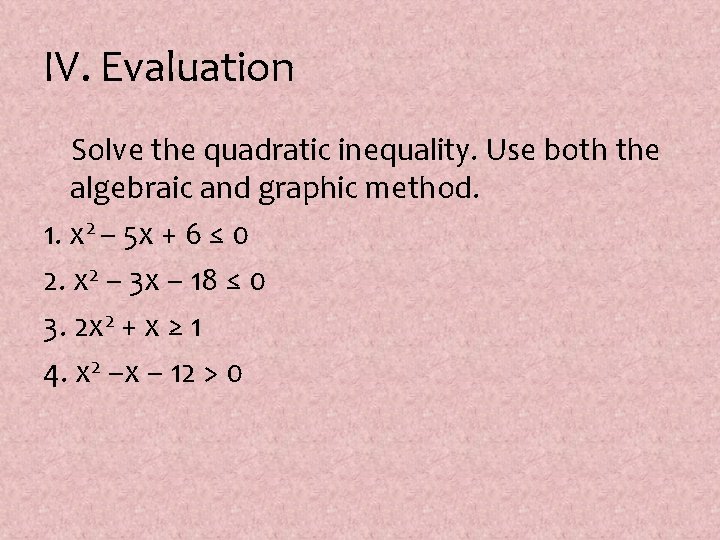
IV. Evaluation Solve the quadratic inequality. Use both the algebraic and graphic method. 1. x 2 – 5 x + 6 ≤ 0 2. x 2 – 3 x – 18 ≤ 0 3. 2 x 2 + x ≥ 1 4. x 2 –x – 12 > 0
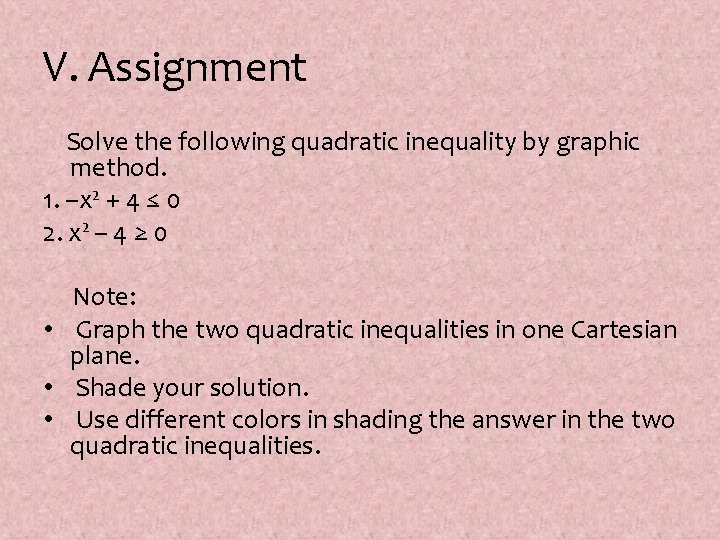
V. Assignment Solve the following quadratic inequality by graphic method. 1. –x 2 + 4 ≤ 0 2. x 2 – 4 ≥ 0 Note: • Graph the two quadratic inequalities in one Cartesian plane. • Shade your solution. • Use different colors in shading the answer in the two quadratic inequalities.