
A Detailed GPU Cache Model Based on Reuse

A Detailed GPU Cache Model Based on Reuse Distance Theory Cedric Nugteren, Gert-Jan van den Braak, Henk Corporaal Eindhoven University of Technology (Netherlands) Henri Bal Vrije Universiteit Amsterdam (Netherlands)
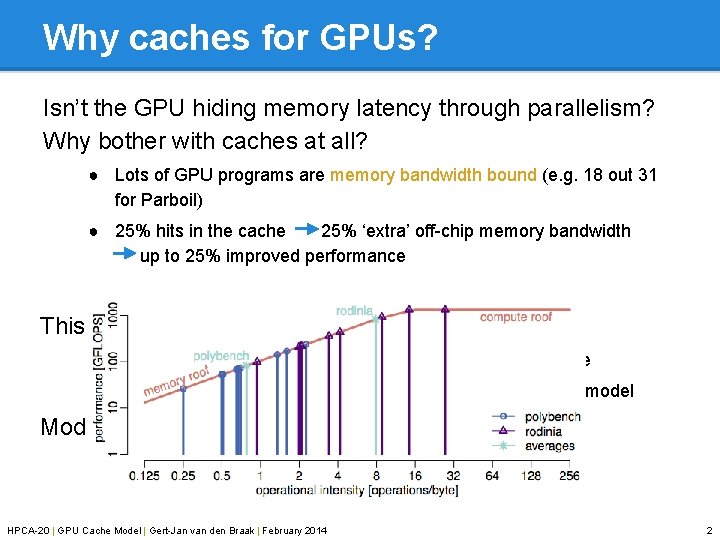
Why caches for GPUs? Isn’t the GPU hiding memory latency through parallelism? Why bother with caches at all? ● Lots of GPU programs are memory bandwidth bound (e. g. 18 out 31 for Parboil) ● 25% hits in the cache 25% ‘extra’ off-chip memory bandwidth up to 25% improved performance This work focuses on the L 1 data-caches only: • • Finding the order of requests to the L 1 is the main challenge Existing multi-core CPU models can be re-used to get a L 2 model Modelling NVIDIA GPUs: L 1 caches only reads HPCA-20 | GPU Cache Model | Gert-Jan van den Braak | February 2014 2
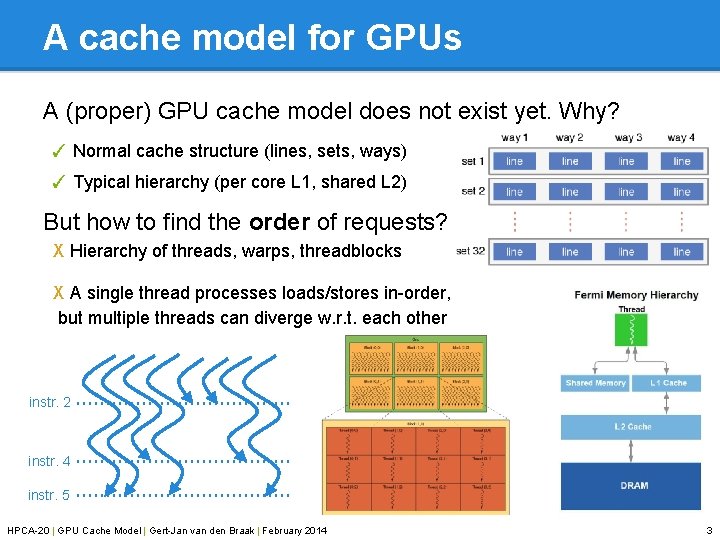
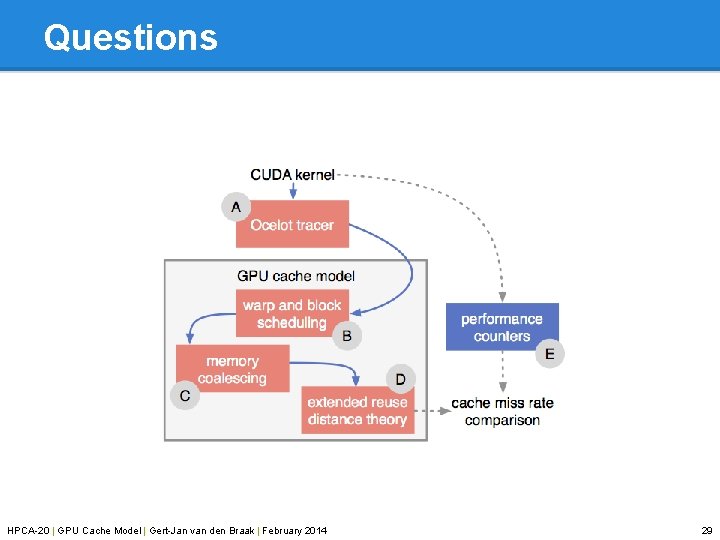
A cache model for GPUs A (proper) GPU cache model does not exist yet. Why? ✓ Normal cache structure (lines, sets, ways) ✓ Typical hierarchy (per core L 1, shared L 2) But how to find the order of requests? X Hierarchy of threads, warps, threadblocks X A single thread processes loads/stores in-order, but multiple threads can diverge w. r. t. each other instr. 2 instr. 4 instr. 5 HPCA-20 | GPU Cache Model | Gert-Jan van den Braak | February 2014 3
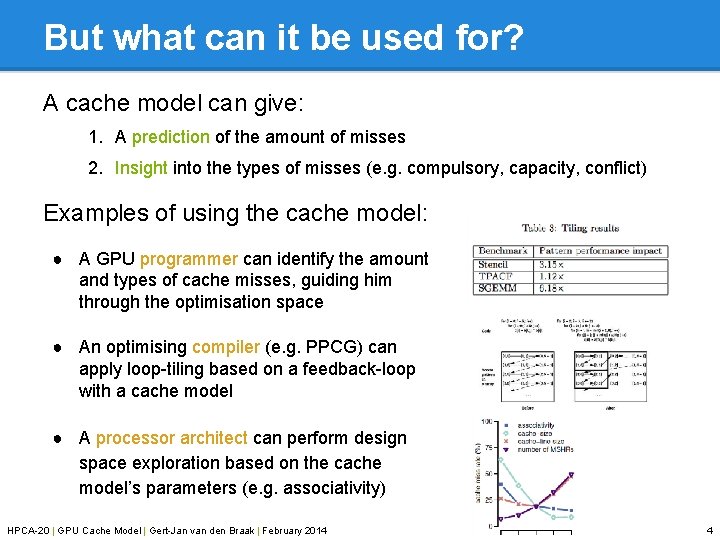
But what can it be used for? A cache model can give: 1. A prediction of the amount of misses 2. Insight into the types of misses (e. g. compulsory, capacity, conflict) Examples of using the cache model: ● A GPU programmer can identify the amount and types of cache misses, guiding him through the optimisation space ● An optimising compiler (e. g. PPCG) can apply loop-tiling based on a feedback-loop with a cache model ● A processor architect can perform design space exploration based on the cache model’s parameters (e. g. associativity) HPCA-20 | GPU Cache Model | Gert-Jan van den Braak | February 2014 4
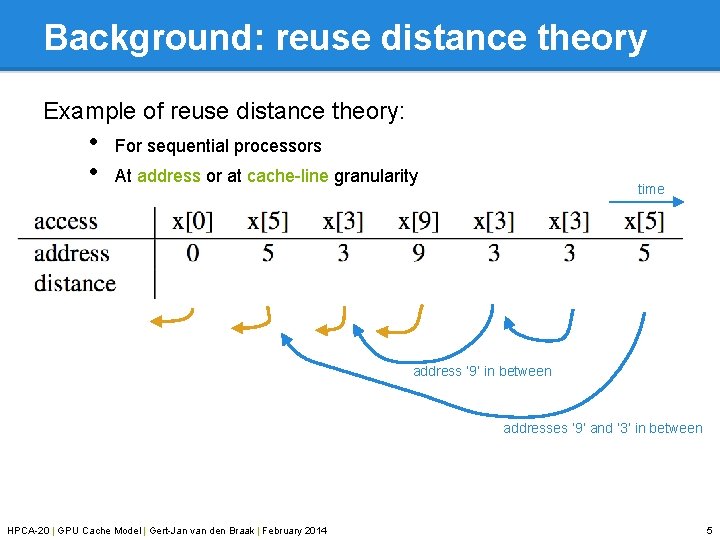
Background: reuse distance theory Example of reuse distance theory: • • For sequential processors At address or at cache-line granularity time address ‘ 9’ in between addresses ‘ 9’ and ‘ 3’ in between HPCA-20 | GPU Cache Model | Gert-Jan van den Braak | February 2014 5
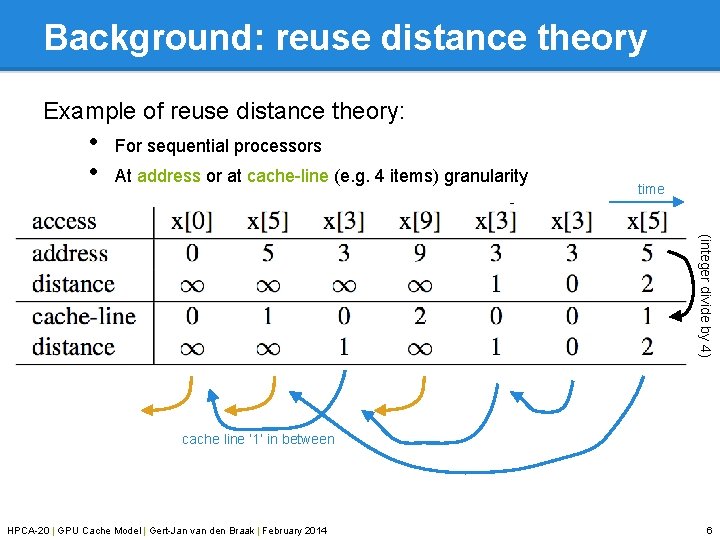
Background: reuse distance theory Example of reuse distance theory: • • For sequential processors At address or at cache-line (e. g. 4 items) granularity time (integer divide by 4) cache line ‘ 1’ in between HPCA-20 | GPU Cache Model | Gert-Jan van den Braak | February 2014 6
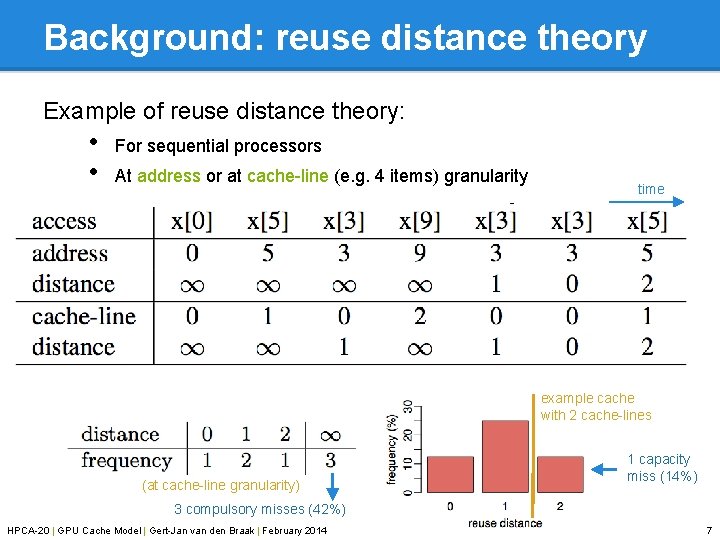
Background: reuse distance theory Example of reuse distance theory: • • For sequential processors At address or at cache-line (e. g. 4 items) granularity time example cache with 2 cache-lines (at cache-line granularity) 1 capacity miss (14%) 3 compulsory misses (42%) HPCA-20 | GPU Cache Model | Gert-Jan van den Braak | February 2014 7
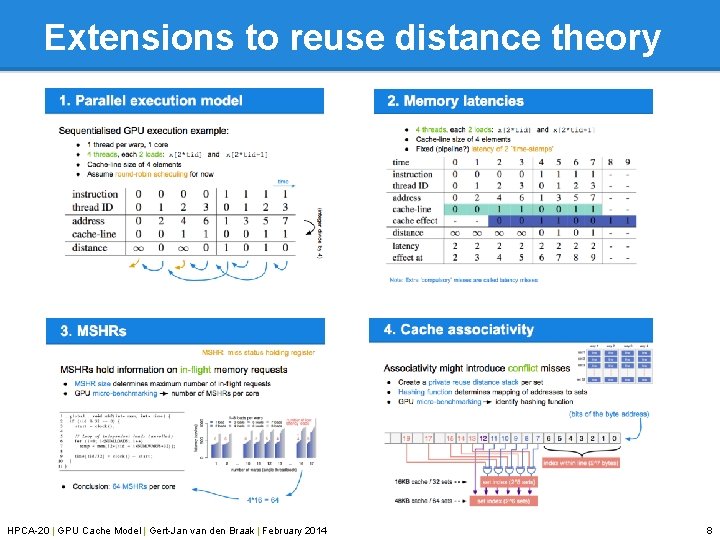
Extensions to reuse distance theory HPCA-20 | GPU Cache Model | Gert-Jan van den Braak | February 2014 8
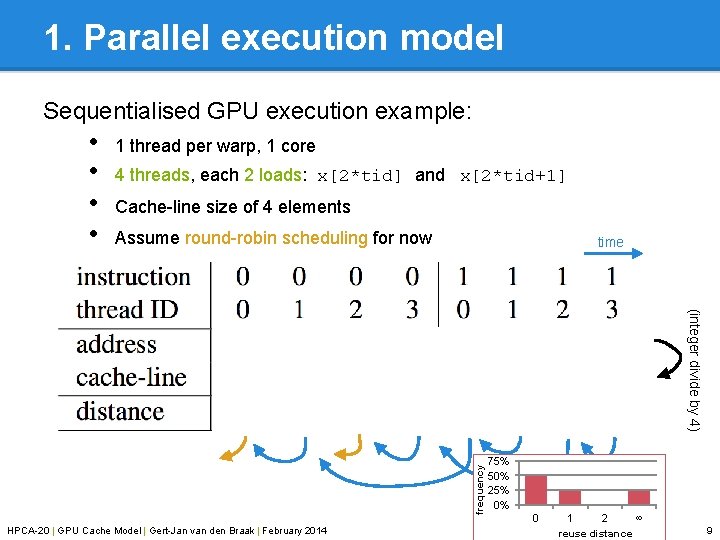
1. Parallel execution model Sequentialised GPU execution example: • • 1 thread per warp, 1 core 4 threads, each 2 loads: x[2*tid] and x[2*tid+1] Cache-line size of 4 elements Assume round-robin scheduling for now time frequency (integer divide by 4) HPCA-20 | GPU Cache Model | Gert-Jan van den Braak | February 2014 75% 50% 25% 0% 0 1 2 ∞ reuse distance 9
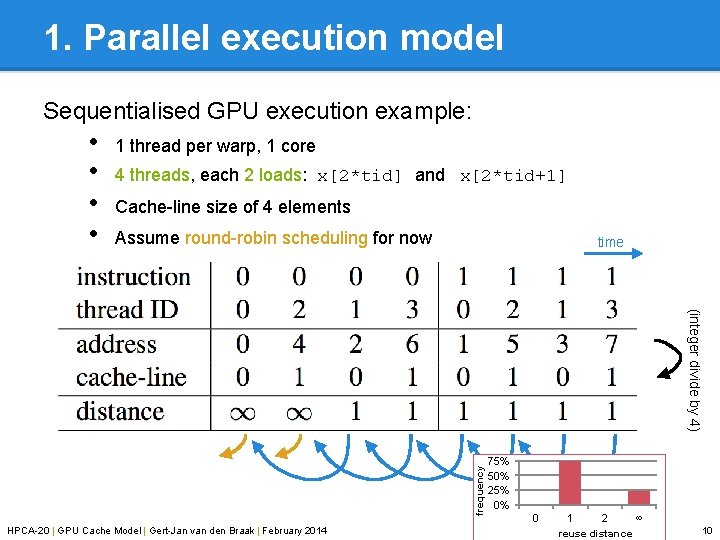
1. Parallel execution model Sequentialised GPU execution example: • • 1 thread per warp, 1 core 4 threads, each 2 loads: x[2*tid] and x[2*tid+1] Cache-line size of 4 elements Assume round-robin scheduling for now time frequency (integer divide by 4) HPCA-20 | GPU Cache Model | Gert-Jan van den Braak | February 2014 75% 50% 25% 0% 0 1 2 ∞ reuse distance 10
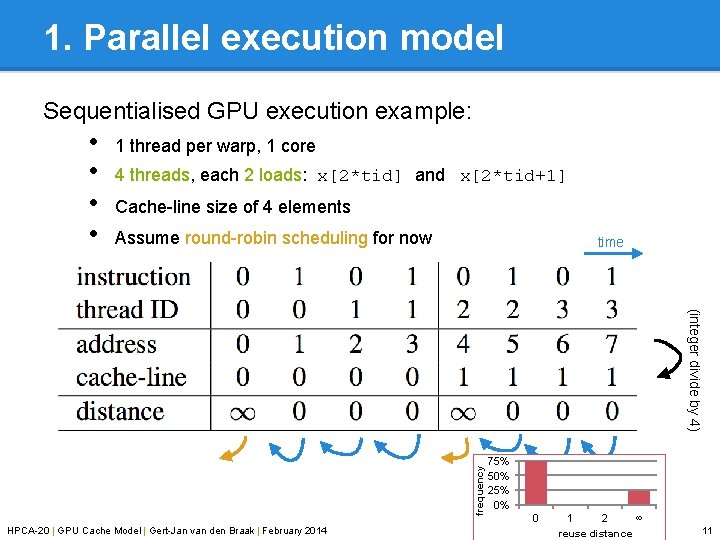
1. Parallel execution model Sequentialised GPU execution example: • • 1 thread per warp, 1 core 4 threads, each 2 loads: x[2*tid] and x[2*tid+1] Cache-line size of 4 elements Assume round-robin scheduling for now time frequency (integer divide by 4) HPCA-20 | GPU Cache Model | Gert-Jan van den Braak | February 2014 75% 50% 25% 0% 0 1 2 ∞ reuse distance 11
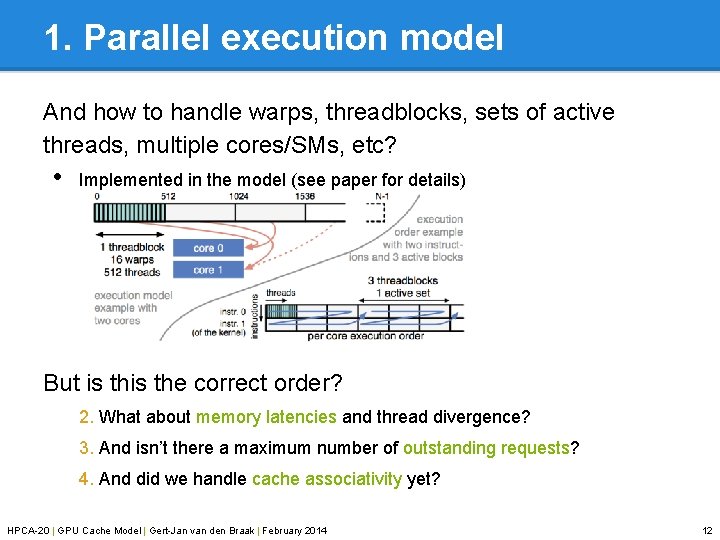
1. Parallel execution model And how to handle warps, threadblocks, sets of active threads, multiple cores/SMs, etc? • Implemented in the model (see paper for details) But is the correct order? 2. What about memory latencies and thread divergence? 3. And isn’t there a maximum number of outstanding requests? 4. And did we handle cache associativity yet? HPCA-20 | GPU Cache Model | Gert-Jan van den Braak | February 2014 12
![2. Memory latencies • • • 4 threads, each 2 loads: x[2*tid] and x[2*tid+1]](http://slidetodoc.com/presentation_image_h2/688590a3c4b7f4699b6fa1755f015815/image-13.jpg "2. Memory latencies • • • 4 threads, each 2 loads: x[2*tid] and x[2*tid+1]")
2. Memory latencies • • • 4 threads, each 2 loads: x[2*tid] and x[2*tid+1] Cache-line size of 4 elements Fixed latency of 2 `time-stamps’ Note: Extra ‘compulsory’ misses are called latency misses HPCA-20 | GPU Cache Model | Gert-Jan van den Braak | February 2014 frequency as before 75% 50% 25% 0% 0 1 2 ∞ reuse distance 13
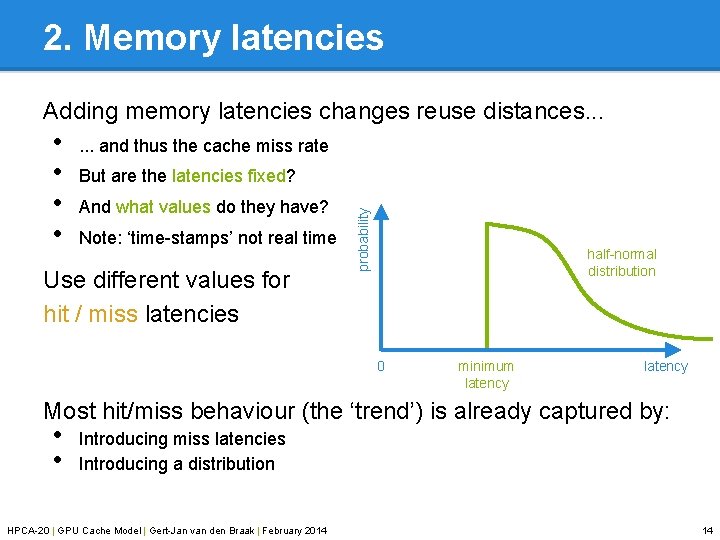
2. Memory latencies Adding memory latencies changes reuse distances. . . and thus the cache miss rate But are the latencies fixed? And what values do they have? Note: ‘time-stamps’ not real time Use different values for hit / miss latencies probability • • half-normal distribution 0 minimum latency Most hit/miss behaviour (the ‘trend’) is already captured by: • • Introducing miss latencies Introducing a distribution HPCA-20 | GPU Cache Model | Gert-Jan van den Braak | February 2014 14
![2. Memory latencies 4 threads, each 2 loads: x[2*tid] and x[2*tid+1] Cache-line size of](http://slidetodoc.com/presentation_image_h2/688590a3c4b7f4699b6fa1755f015815/image-15.jpg "2. Memory latencies 4 threads, each 2 loads: x[2*tid] and x[2*tid+1] Cache-line size of")
2. Memory latencies 4 threads, each 2 loads: x[2*tid] and x[2*tid+1] Cache-line size of 4 elements Variable latency of 2 (misses) and 0 (hits) frequency • • • HPCA-20 | GPU Cache Model | Gert-Jan van den Braak | February 2014 75% 50% 25% 0% 0 1 2 ∞ reuse distance 15
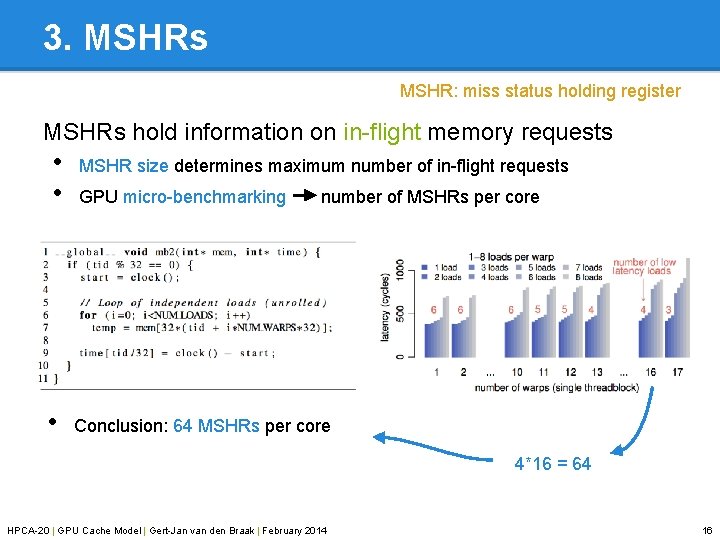
3. MSHRs MSHR: miss status holding register MSHRs hold information on in-flight memory requests • • • MSHR size determines maximum number of in-flight requests GPU micro-benchmarking number of MSHRs per core Conclusion: 64 MSHRs per core 4*16 = 64 HPCA-20 | GPU Cache Model | Gert-Jan van den Braak | February 2014 16
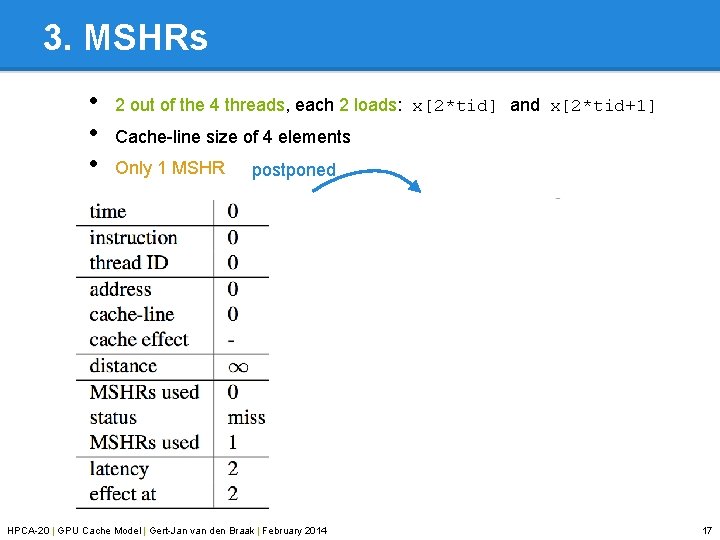
3. MSHRs • • • 2 out of the 4 threads, each 2 loads: x[2*tid] and x[2*tid+1] Cache-line size of 4 elements Only 1 MSHR postponed HPCA-20 | GPU Cache Model | Gert-Jan van den Braak | February 2014 17
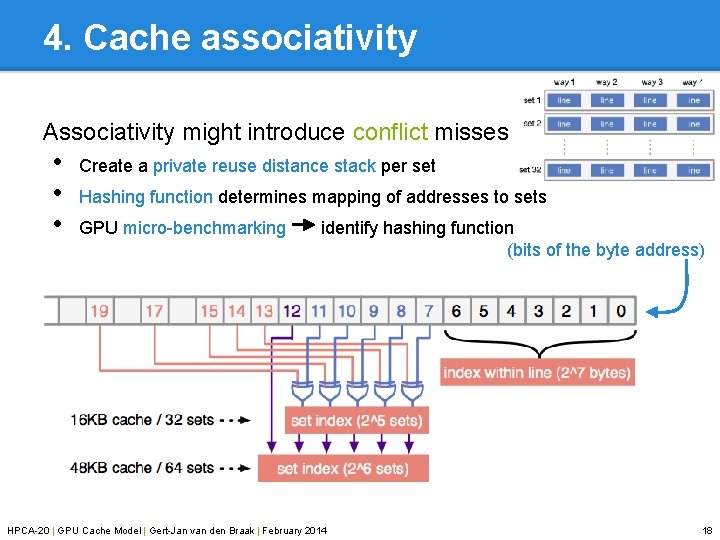
4. Cache associativity Associativity might introduce conflict misses • • • Create a private reuse distance stack per set Hashing function determines mapping of addresses to sets GPU micro-benchmarking identify hashing function (bits of the byte address) HPCA-20 | GPU Cache Model | Gert-Jan van den Braak | February 2014 18
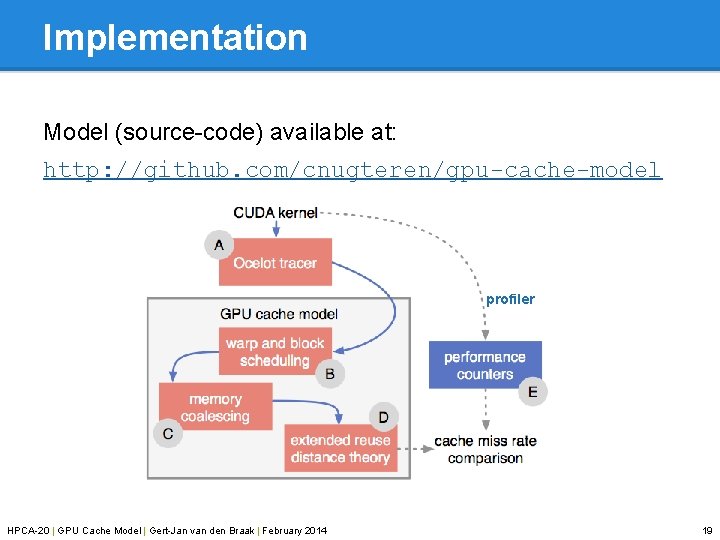
Implementation Model (source-code) available at: http: //github. com/cnugteren/gpu-cache-model profiler HPCA-20 | GPU Cache Model | Gert-Jan van den Braak | February 2014 19
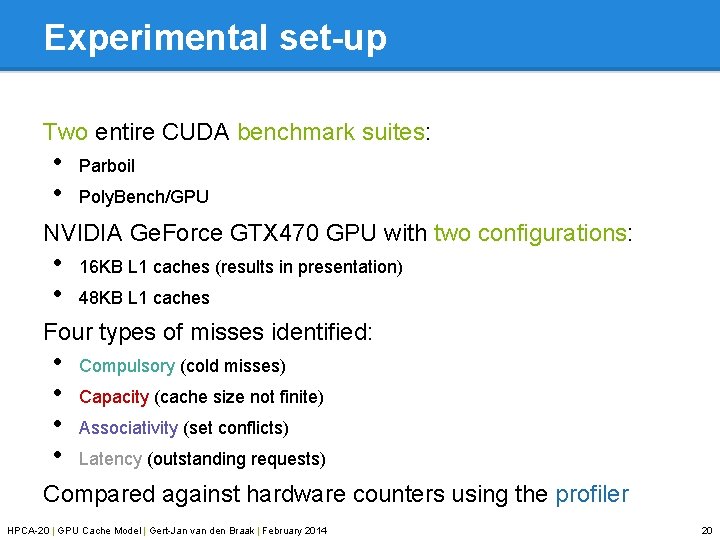
Experimental set-up Two entire CUDA benchmark suites: • • Parboil Poly. Bench/GPU NVIDIA Ge. Force GTX 470 GPU with two configurations: • • 16 KB L 1 caches (results in presentation) 48 KB L 1 caches Four types of misses identified: • • Compulsory (cold misses) Capacity (cache size not finite) Associativity (set conflicts) Latency (outstanding requests) Compared against hardware counters using the profiler HPCA-20 | GPU Cache Model | Gert-Jan van den Braak | February 2014 20
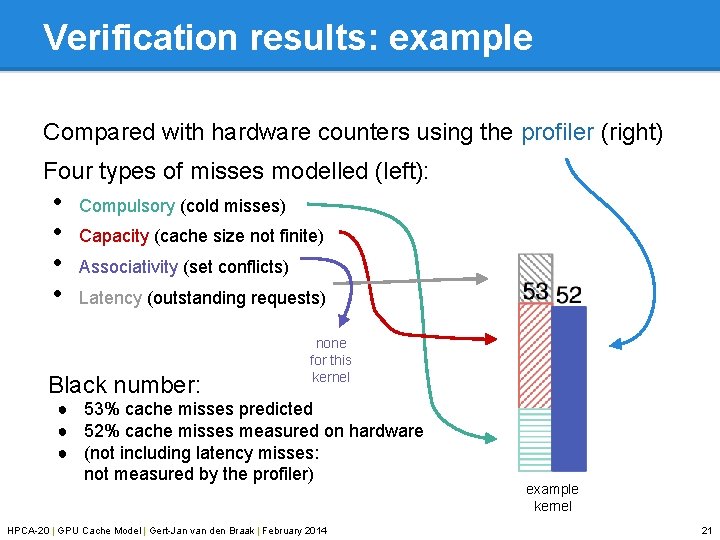
Verification results: example Compared with hardware counters using the profiler (right) Four types of misses modelled (left): • • Compulsory (cold misses) Capacity (cache size not finite) Associativity (set conflicts) Latency (outstanding requests) Black number: none for this kernel ● 53% cache misses predicted ● 52% cache misses measured on hardware ● (not including latency misses: not measured by the profiler) HPCA-20 | GPU Cache Model | Gert-Jan van den Braak | February 2014 example kernel 21
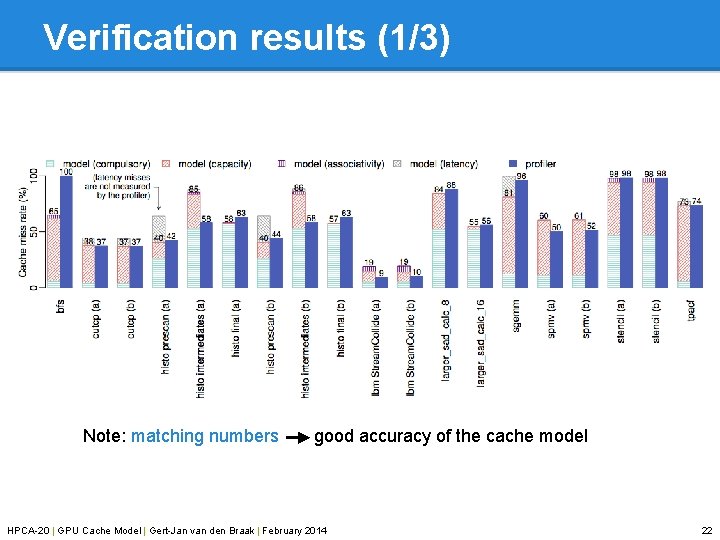
Verification results (1/3) Note: matching numbers good accuracy of the cache model HPCA-20 | GPU Cache Model | Gert-Jan van den Braak | February 2014 22
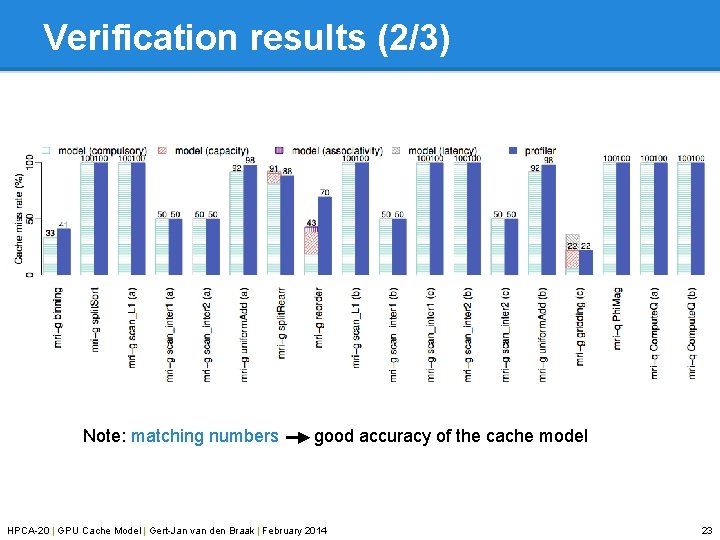
Verification results (2/3) Note: matching numbers good accuracy of the cache model HPCA-20 | GPU Cache Model | Gert-Jan van den Braak | February 2014 23
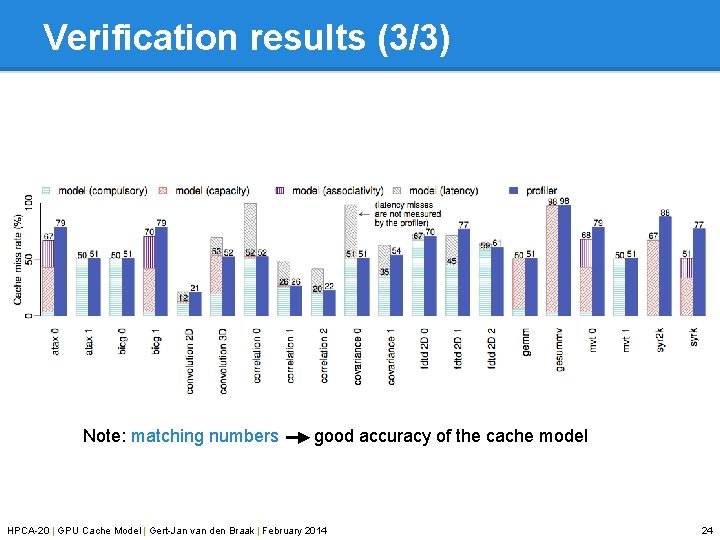
Verification results (3/3) Note: matching numbers good accuracy of the cache model HPCA-20 | GPU Cache Model | Gert-Jan van den Braak | February 2014 24
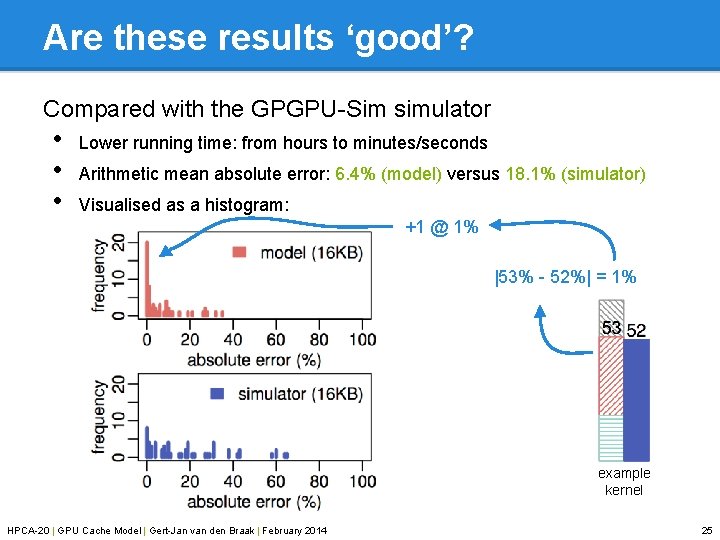
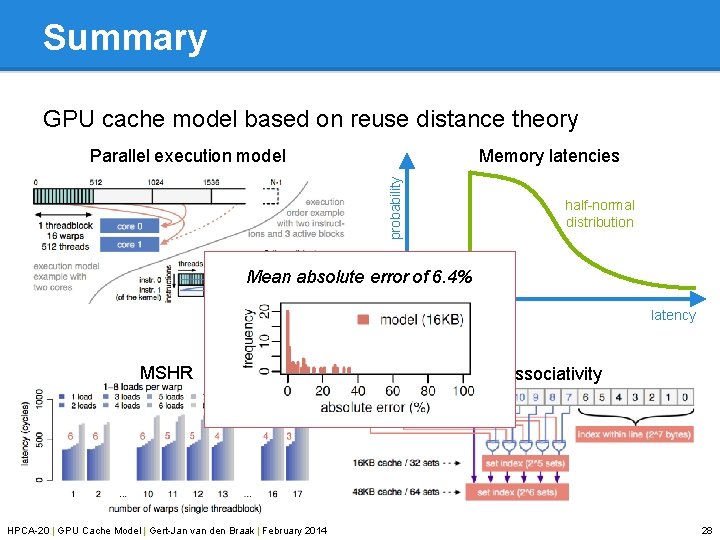
Are these results ‘good’? Compared with the GPGPU-Sim simulator • • • Lower running time: from hours to minutes/seconds Arithmetic mean absolute error: 6. 4% (model) versus 18. 1% (simulator) Visualised as a histogram: +1 @ 1% |53% - 52%| = 1% example kernel HPCA-20 | GPU Cache Model | Gert-Jan van den Braak | February 2014 25
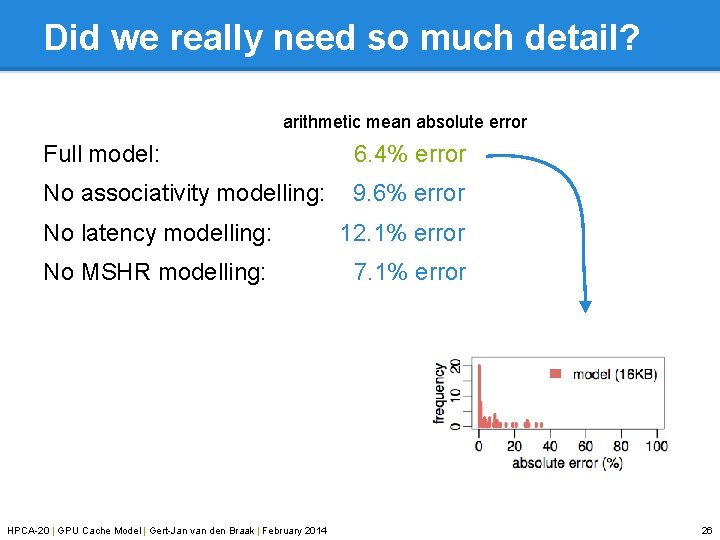
Did we really need so much detail? arithmetic mean absolute error Full model: 6. 4% error No associativity modelling: 9. 6% error No latency modelling: 12. 1% error No MSHR modelling: 7. 1% error HPCA-20 | GPU Cache Model | Gert-Jan van den Braak | February 2014 26
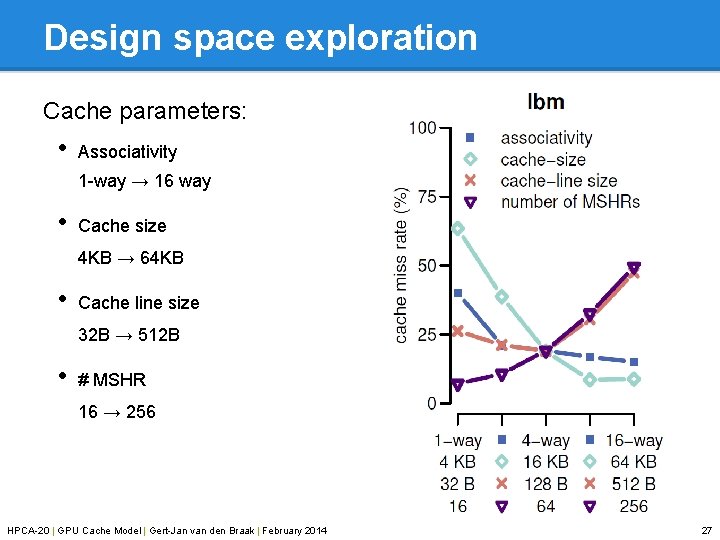
Design space exploration Cache parameters: • Associativity 1 -way → 16 way • Cache size 4 KB → 64 KB • Cache line size 32 B → 512 B • # MSHR 16 → 256 HPCA-20 | GPU Cache Model | Gert-Jan van den Braak | February 2014 27
Summary GPU cache model based on reuse distance theory Memory latencies probability Parallel execution model half-normal distribution Mean absolute error of 6. 4% 0 MSHR HPCA-20 | GPU Cache Model | Gert-Jan van den Braak | February 2014 minimum latency Cache associativity 28
Questions HPCA-20 | GPU Cache Model | Gert-Jan van den Braak | February 2014 29
- Slides: 29