
A Desktop Particle Accelerator Employing a Pyroelectric Crystal
- Slides: 1
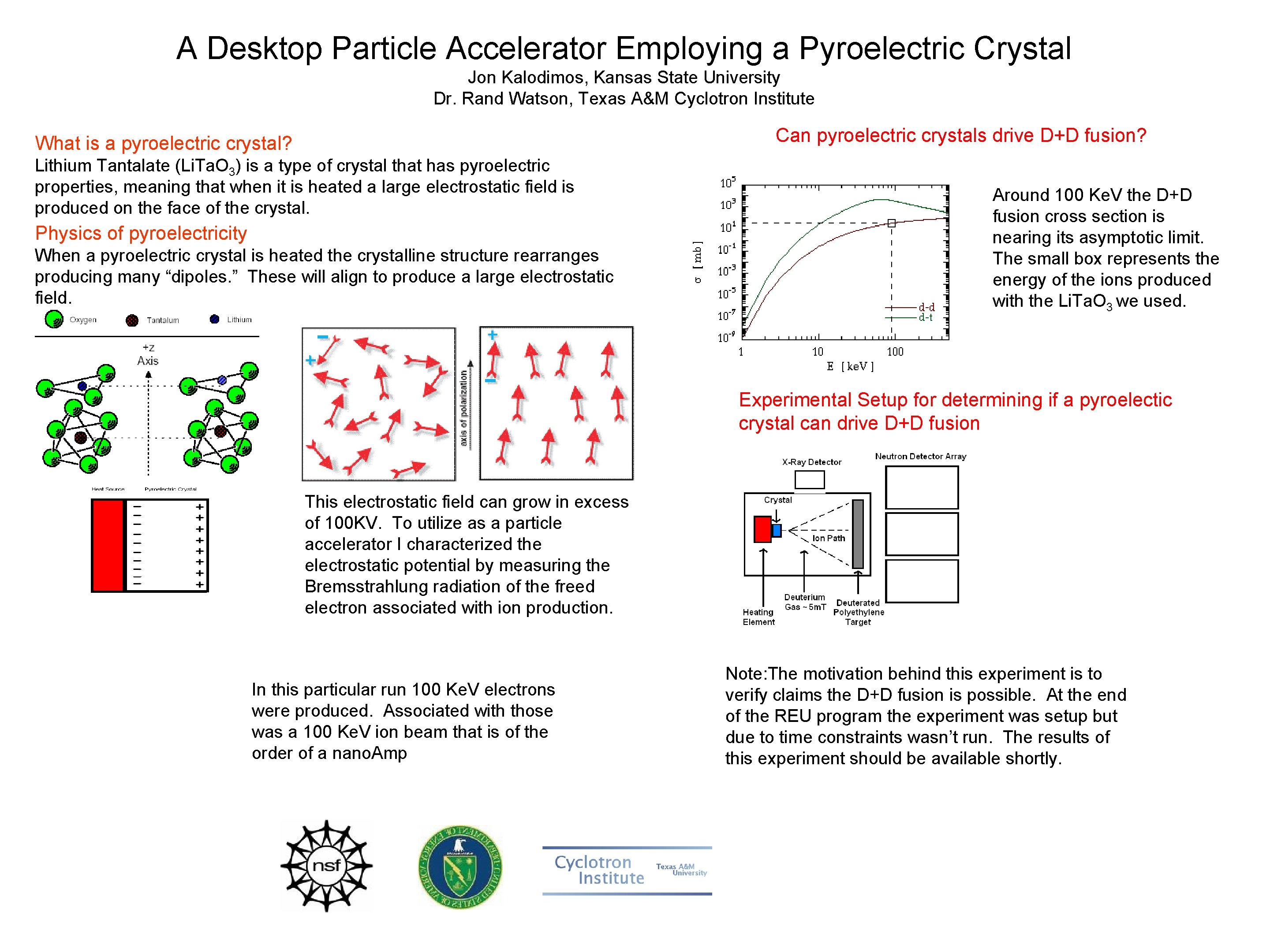
A Desktop Particle Accelerator Employing a Pyroelectric Crystal Jon Kalodimos, Kansas State University Dr. Rand Watson, Texas A&M Cyclotron Institute Can pyroelectric crystals drive D+D fusion? What is a pyroelectric crystal? Lithium Tantalate (Li. Ta. O 3) is a type of crystal that has pyroelectric properties, meaning that when it is heated a large electrostatic field is produced on the face of the crystal. Physics of pyroelectricity When a pyroelectric crystal is heated the crystalline structure rearranges producing many “dipoles. ” These will align to produce a large electrostatic field. Around 100 Ke. V the D+D fusion cross section is nearing its asymptotic limit. The small box represents the energy of the ions produced with the Li. Ta. O 3 we used. Experimental Setup for determining if a pyroelectic crystal can drive D+D fusion This electrostatic field can grow in excess of 100 KV. To utilize as a particle accelerator I characterized the electrostatic potential by measuring the Bremsstrahlung radiation of the freed electron associated with ion production. In this particular run 100 Ke. V electrons were produced. Associated with those was a 100 Ke. V ion beam that is of the order of a nano. Amp Note: The motivation behind this experiment is to verify claims the D+D fusion is possible. At the end of the REU program the experiment was setup but due to time constraints wasn’t run. The results of this experiment should be available shortly.