
A DelayTolerant Network Architecture for Challenged Internets SIGCOMM

- Slides: 17
A Delay-Tolerant Network Architecture for Challenged Internets SIGCOMM’ 03 Kevin Fall (kfall@intel-research. net) Intel Research, Berkeley Nov. 26, 2003 Presented by Sookhyun, Yang
Contents Ø Introduction Ø Background Ø Challenges for Internetworking Ø Delay Tolerant Networking (DTN) Ø Application Interface Ø Conclusion Computer Network Lab Seminar 2003 2
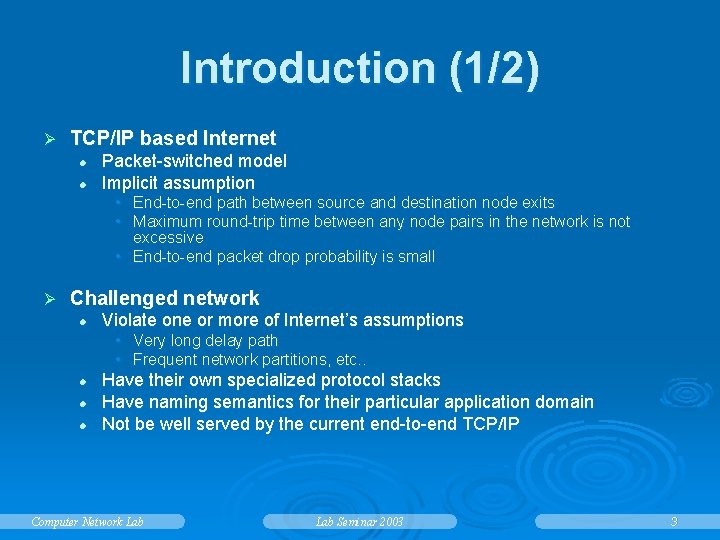
Introduction (1/2) Ø TCP/IP based Internet l l Packet-switched model Implicit assumption • End-to-end path between source and destination node exits • Maximum round-trip time between any node pairs in the network is not excessive • End-to-end packet drop probability is small Ø Challenged network l Violate one or more of Internet’s assumptions • Very long delay path • Frequent network partitions, etc. . l l l Have their own specialized protocol stacks Have naming semantics for their particular application domain Not be well served by the current end-to-end TCP/IP Computer Network Lab Seminar 2003 3
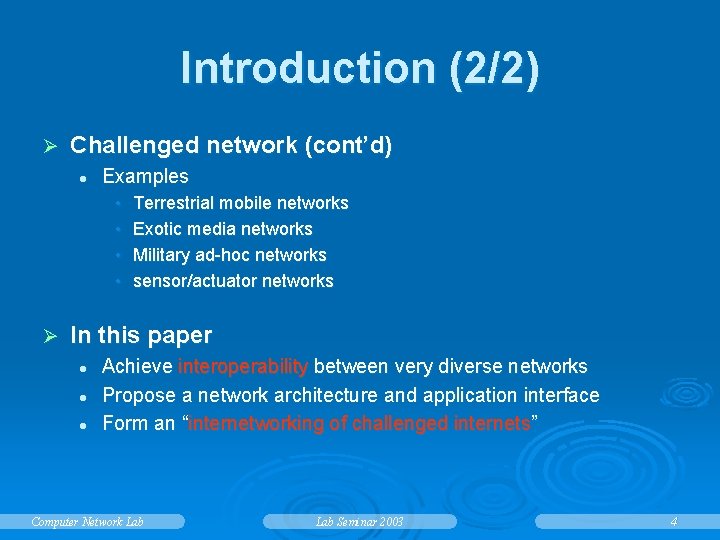
Introduction (2/2) Ø Challenged network (cont’d) l Examples • • Ø Terrestrial mobile networks Exotic media networks Military ad-hoc networks sensor/actuator networks In this paper l l l Achieve interoperability between very diverse networks Propose a network architecture and application interface Form an “internetworking of challenged internets” Computer Network Lab Seminar 2003 4
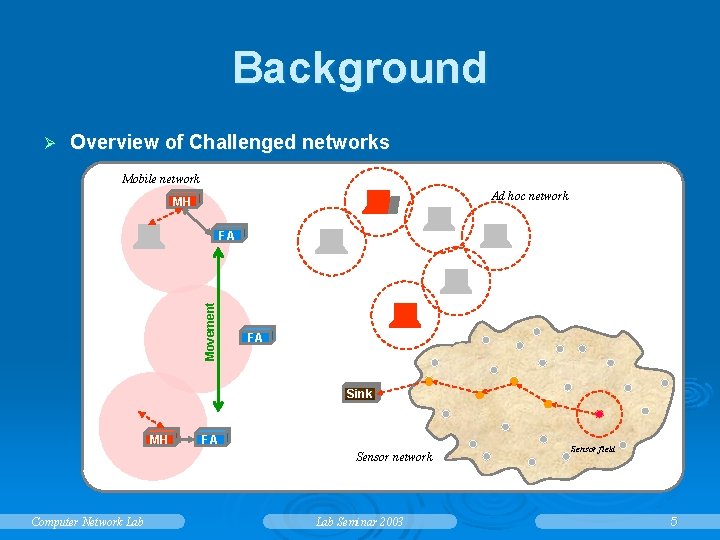
Background Ø Overview of Challenged networks Mobile network Ad hoc network MH Movement FA FA Sink MH FA Sensor network Computer Network Lab Seminar 2003 Sensor field 5
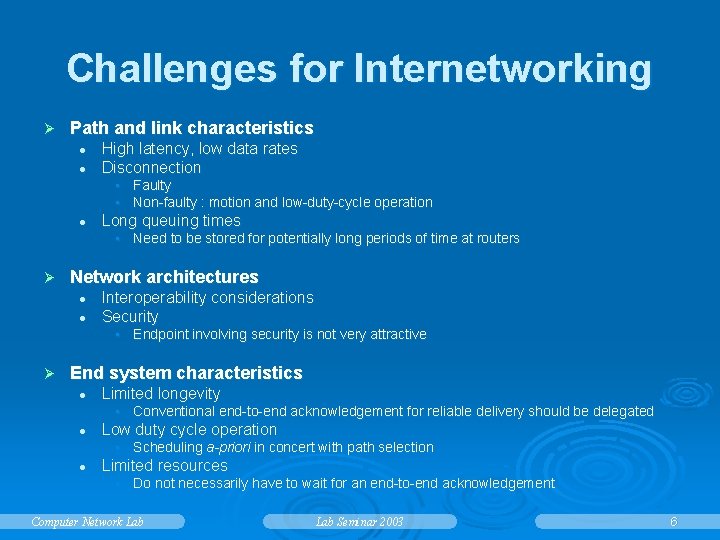
Challenges for Internetworking Ø Path and link characteristics l l High latency, low data rates Disconnection • Faulty • Non-faulty : motion and low-duty-cycle operation l Long queuing times • Need to be stored for potentially long periods of time at routers Ø Network architectures l l Interoperability considerations Security • Endpoint involving security is not very attractive Ø End system characteristics l Limited longevity • Conventional end-to-end acknowledgement for reliable delivery should be delegated l Low duty cycle operation • Scheduling a-priori in concert with path selection l Limited resources • Do not necessarily have to wait for an end-to-end acknowledgement Computer Network Lab Seminar 2003 6
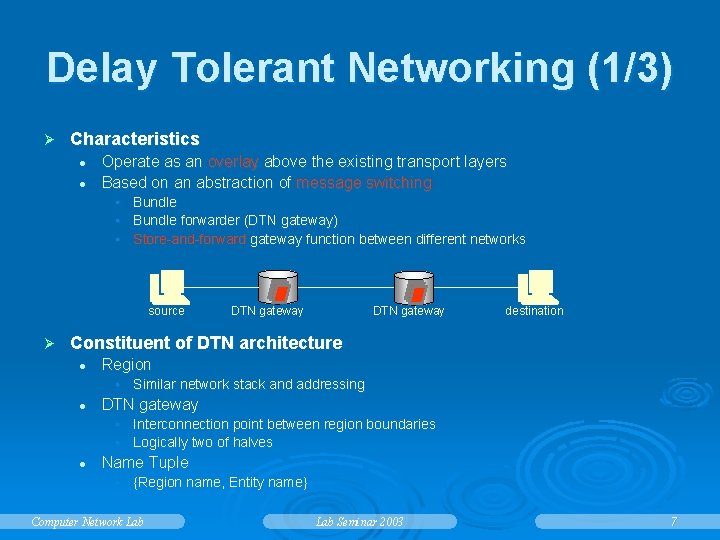
Delay Tolerant Networking (1/3) Ø Characteristics l l Operate as an overlay above the existing transport layers Based on an abstraction of message switching • • • Bundle forwarder (DTN gateway) Store-and-forward gateway function between different networks source Ø DTN gateway destination Constituent of DTN architecture l Region • Similar network stack and addressing l DTN gateway • Interconnection point between region boundaries • Logically two of halves l Name Tuple • {Region name, Entity name} Computer Network Lab Seminar 2003 7
Delay Tolerant Networking (2/3) Region A - Internet data {B, R 2} data {A, R 1} Region D {A, R 2} {D, R 4} Region B – Sensor network data {C, R 4} Region C - Intranet User. Host {A, User. Host} {C, R 3} {B, R 3} data Ø Architecture DTN gateway Computer Network Lab Seminar 2003 8
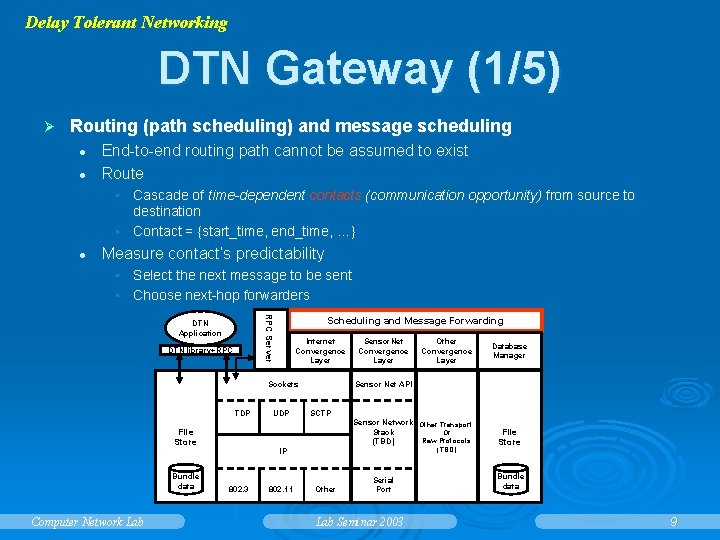
Delay Tolerant Networking DTN Gateway (1/5) Ø Routing (path scheduling) and message scheduling l l End-to-end routing path cannot be assumed to exist Route • Cascade of time-dependent contacts (communication opportunity) from source to destination • Contact = {start_time, end_time, …} l Measure contact’s predictability • • Select the next message to be sent Choose next-hop forwarders RPC Server DTN Application DTN library+RPC Scheduling and Message Forwarding Internet Convergence Layer Sockets TDP Computer Network Lab Other Convergence Layer SCTP (TBD) IP 802. 3 802. 11 Database Manager Sensor Net API Sensor Network Other Transport Stack Or Raw Protocols (TBD) File Store Bundle data UDP Sensor. Net Convergence Layer Other Serial Port Lab Seminar 2003 File Store Bundle data 9
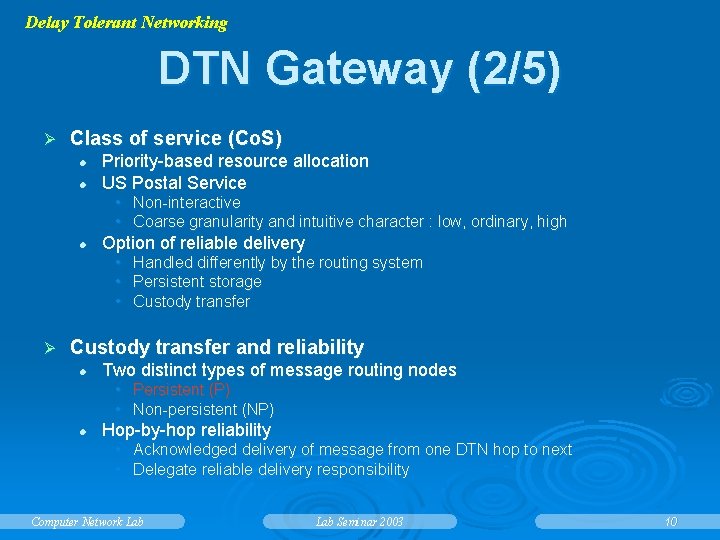
Delay Tolerant Networking DTN Gateway (2/5) Ø Class of service (Co. S) l l Priority-based resource allocation US Postal Service • Non-interactive • Coarse granularity and intuitive character : low, ordinary, high l Option of reliable delivery • • • Ø Handled differently by the routing system Persistent storage Custody transfer and reliability l Two distinct types of message routing nodes • Persistent (P) • Non-persistent (NP) l Hop-by-hop reliability • Acknowledged delivery of message from one DTN hop to next • Delegate reliable delivery responsibility Computer Network Lab Seminar 2003 10
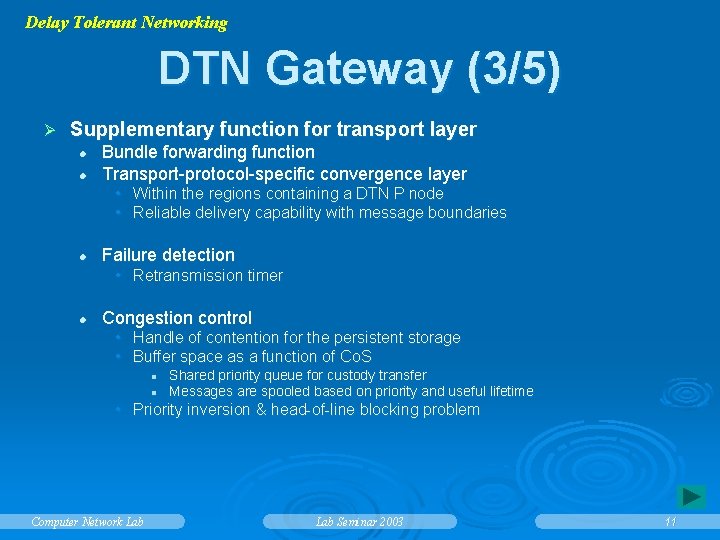
Delay Tolerant Networking DTN Gateway (3/5) Ø Supplementary function for transport layer l l Bundle forwarding function Transport-protocol-specific convergence layer • Within the regions containing a DTN P node • Reliable delivery capability with message boundaries l Failure detection • Retransmission timer l Congestion control • Handle of contention for the persistent storage • Buffer space as a function of Co. S l l Shared priority queue for custody transfer Messages are spooled based on priority and useful lifetime • Priority inversion & head-of-line blocking problem Computer Network Lab Seminar 2003 11
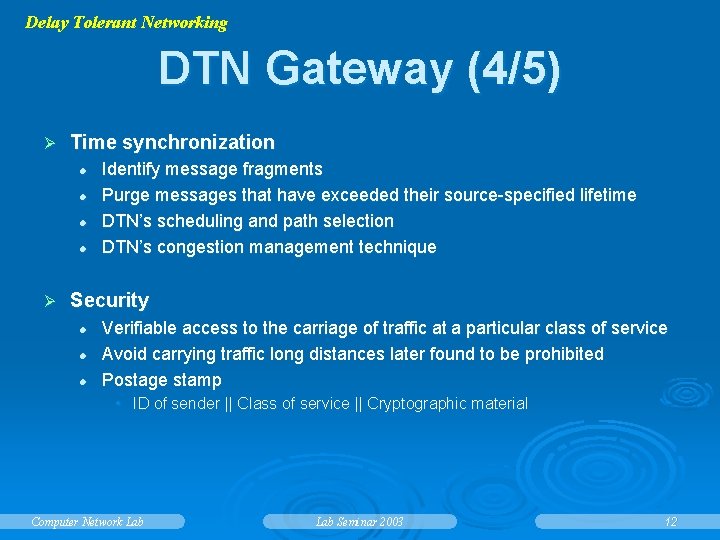
Delay Tolerant Networking DTN Gateway (4/5) Ø Time synchronization l l Ø Identify message fragments Purge messages that have exceeded their source-specified lifetime DTN’s scheduling and path selection DTN’s congestion management technique Security l l l Verifiable access to the carriage of traffic at a particular class of service Avoid carrying traffic long distances later found to be prohibited Postage stamp • ID of sender || Class of service || Cryptographic material Computer Network Lab Seminar 2003 12
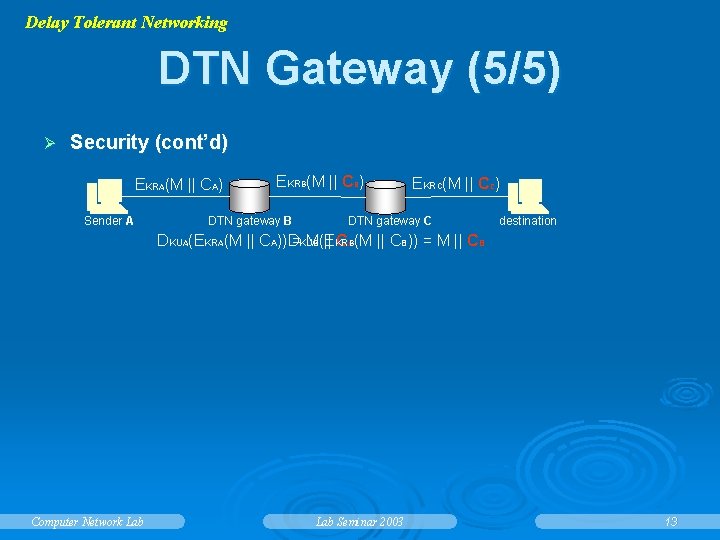
Delay Tolerant Networking DTN Gateway (5/5) Ø Security (cont’d) EKRA(M || CA) Sender A EKRB(M || CB) DTN gateway B EKRC(M || CC) DTN gateway C destination DKUA(EKRA(M || CA))D=KUMB(E || KR CAB(M || CB)) = M || CB Computer Network Lab Seminar 2003 13
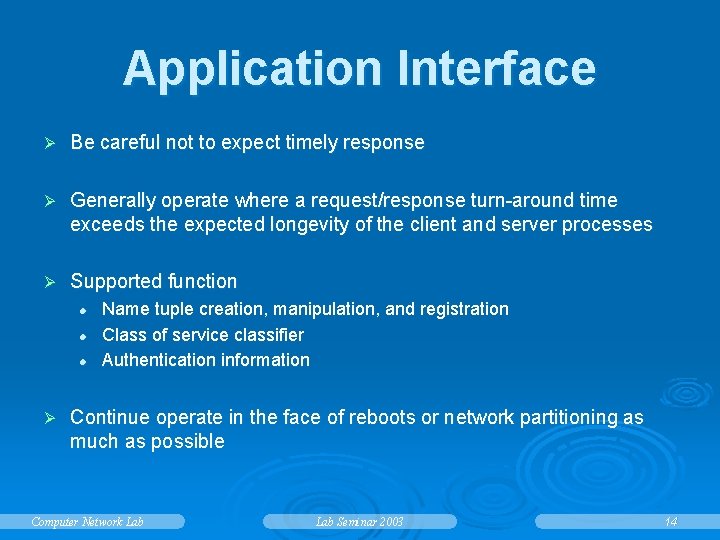
Application Interface Ø Be careful not to expect timely response Ø Generally operate where a request/response turn-around time exceeds the expected longevity of the client and server processes Ø Supported function l l l Ø Name tuple creation, manipulation, and registration Class of service classifier Authentication information Continue operate in the face of reboots or network partitioning as much as possible Computer Network Lab Seminar 2003 14
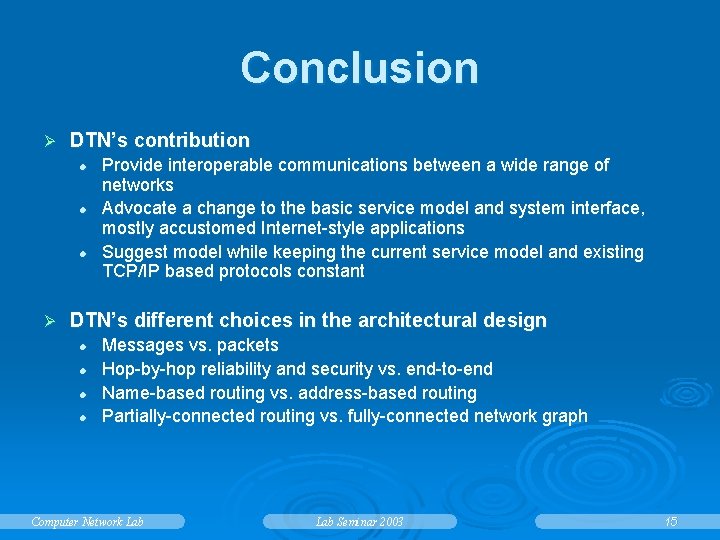
Conclusion Ø DTN’s contribution l l l Ø Provide interoperable communications between a wide range of networks Advocate a change to the basic service model and system interface, mostly accustomed Internet-style applications Suggest model while keeping the current service model and existing TCP/IP based protocols constant DTN’s different choices in the architectural design l l Messages vs. packets Hop-by-hop reliability and security vs. end-to-end Name-based routing vs. address-based routing Partially-connected routing vs. fully-connected network graph Computer Network Lab Seminar 2003 15
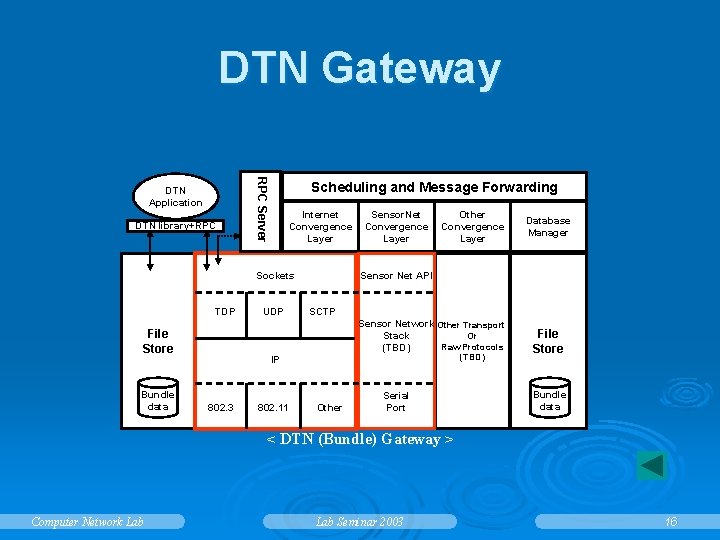
DTN Gateway DTN library+RPC Server DTN Application Scheduling and Message Forwarding Internet Convergence Layer Sockets TDP Other Convergence Layer SCTP (TBD) IP 802. 3 802. 11 Database Manager Sensor Net API Sensor Network Other Transport Stack Or Raw Protocols (TBD) File Store Bundle data UDP Sensor. Net Convergence Layer Other Serial Port File Store Bundle data < DTN (Bundle) Gateway > Computer Network Lab Seminar 2003 16
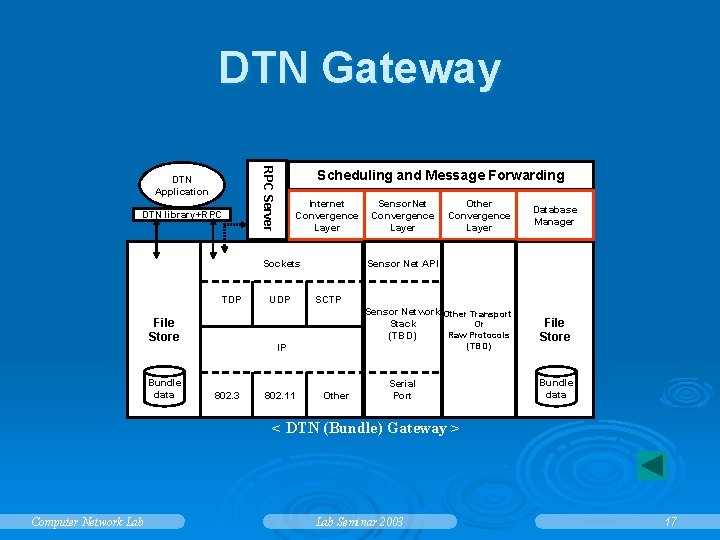
DTN Gateway DTN library+RPC Server DTN Application Scheduling and Message Forwarding Internet Convergence Layer Sockets TDP Other Convergence Layer SCTP (TBD) IP 802. 3 802. 11 Database Manager Sensor Net API Sensor Network Other Transport Stack Or Raw Protocols (TBD) File Store Bundle data UDP Sensor. Net Convergence Layer Other Serial Port File Store Bundle data < DTN (Bundle) Gateway > Computer Network Lab Seminar 2003 17