
A Decompositional Approach to Regular Expression Matching for
- Slides: 17
A De-compositional Approach to Regular Expression Matching for Network Security Applications Author: Eric Norige Alex Liu Presenter: Yi-Hsien Wu Conference : 2016 IEEE 36 th International Conference on Distributed Computing Systems Date: 2017/12/27 Department of Computer Science and Information Engineering National Cheng Kung University, Taiwan R. O. C.
Outline l Introduction l Proposed Scheme l Results and Analysis l Conclusion National Cheng Kung University CSIE Computer & Internet Architecture Lab 2
Introduction The category of DPI with the best cost-vs-accuracy tradeoff is regular expression (regex) matching, because it is simple enough for efficient implementation but complex enough to precisely specify attack patterns. A major benefit of regex matching for security applications is the availability of offline pre-processing that greatly speeds online matching of packets. National Cheng Kung University CSIE Computer & Internet Architecture Lab 3
Proposed Scheme We propose Stateful Match Filtering, a de-compositional approach to matching regular expressions. The core idea is that by decomposing a complex pattern into simpler patterns we can post-process the matches of the simpler pattern to get the match results of the complex pattern. National Cheng Kung University CSIE Computer & Internet Architecture Lab 4
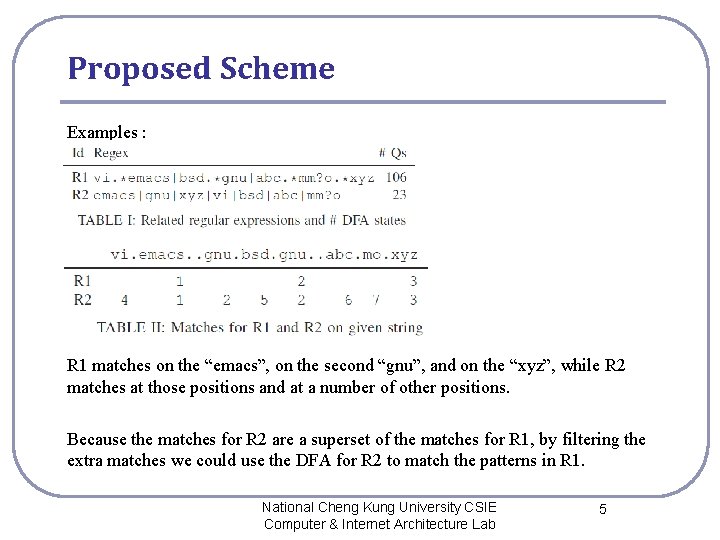
Proposed Scheme Examples : R 1 matches on the “emacs”, on the second “gnu”, and on the “xyz”, while R 2 matches at those positions and at a number of other positions. Because the matches for R 2 are a superset of the matches for R 1, by filtering the extra matches we could use the DFA for R 2 to match the patterns in R 1. National Cheng Kung University CSIE Computer & Internet Architecture Lab 5
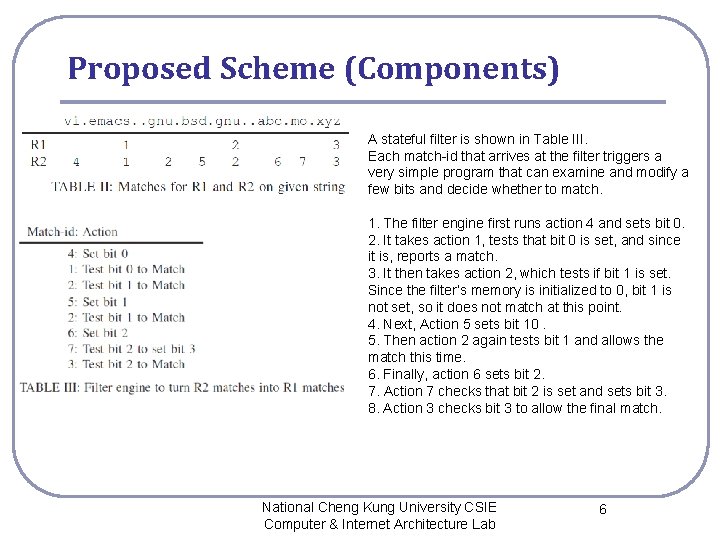
Proposed Scheme (Components) A stateful filter is shown in Table III. Each match-id that arrives at the filter triggers a very simple program that can examine and modify a few bits and decide whether to match. 1. The filter engine first runs action 4 and sets bit 0. 2. It takes action 1, tests that bit 0 is set, and since it is, reports a match. 3. It then takes action 2, which tests if bit 1 is set. Since the filter’s memory is initialized to 0, bit 1 is not set, so it does not match at this point. 4. Next, Action 5 sets bit 10. 5. Then action 2 again tests bit 1 and allows the match this time. 6. Finally, action 6 sets bit 2. 7. Action 7 checks that bit 2 is set and sets bit 3. 8. Action 3 checks bit 3 to allow the final match. National Cheng Kung University CSIE Computer & Internet Architecture Lab 6
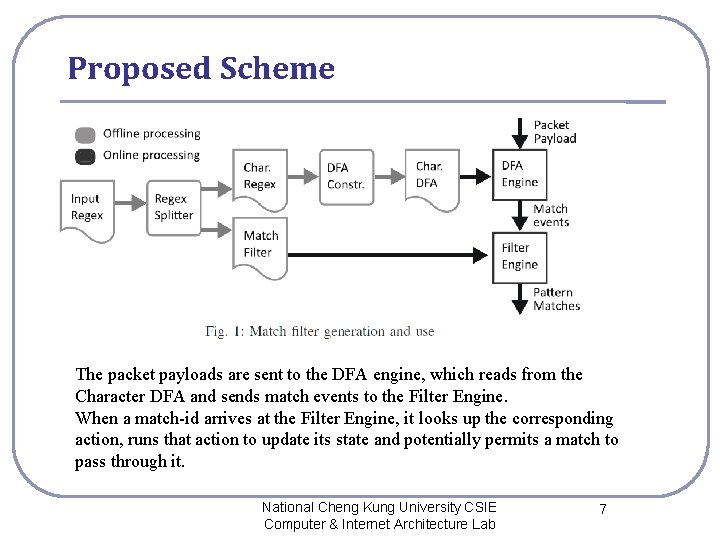
Proposed Scheme The packet payloads are sent to the DFA engine, which reads from the Character DFA and sends match events to the Filter Engine. When a match-id arrives at the Filter Engine, it looks up the corresponding action, runs that action to update its state and potentially permits a match to pass through it. National Cheng Kung University CSIE Computer & Internet Architecture Lab 7
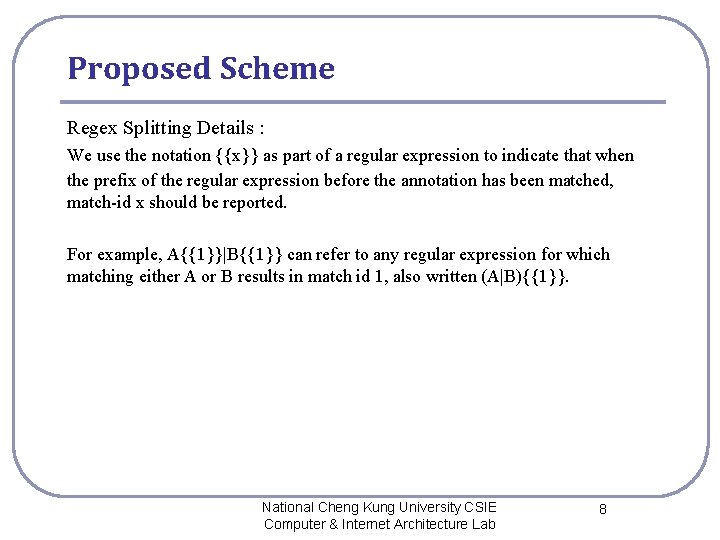
Proposed Scheme Regex Splitting Details : We use the notation {{x}} as part of a regular expression to indicate that when the prefix of the regular expression before the annotation has been matched, match-id x should be reported. For example, A{{1}}|B{{1}} can refer to any regular expression for which matching either A or B results in match id 1, also written (A|B){{1}}. National Cheng Kung University CSIE Computer & Internet Architecture Lab 8
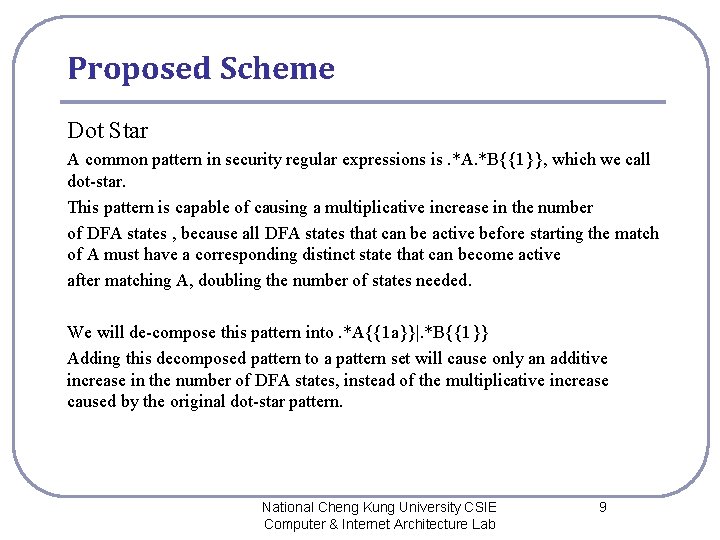
Proposed Scheme Dot Star A common pattern in security regular expressions is. *A. *B{{1}}, which we call dot-star. This pattern is capable of causing a multiplicative increase in the number of DFA states , because all DFA states that can be active before starting the match of A must have a corresponding distinct state that can become active after matching A, doubling the number of states needed. We will de-compose this pattern into. *A{{1 a}}|. *B{{1}} Adding this decomposed pattern to a pattern set will cause only an additive increase in the number of DFA states, instead of the multiplicative increase caused by the original dot-star pattern. National Cheng Kung University CSIE Computer & Internet Architecture Lab 9
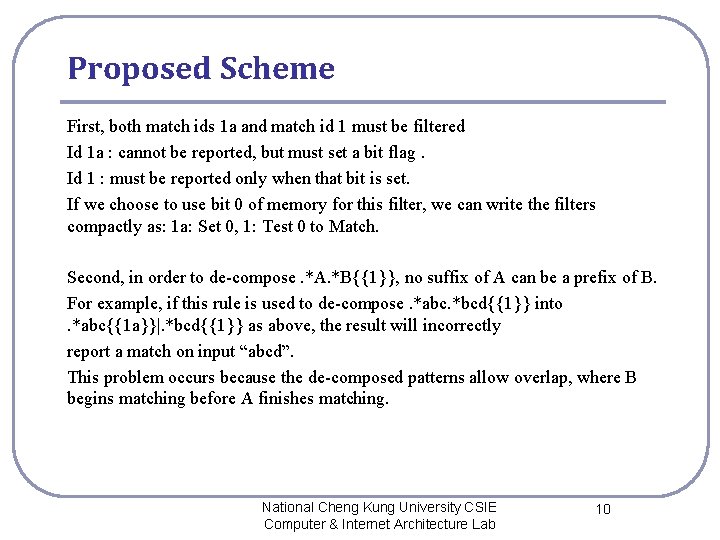
Proposed Scheme First, both match ids 1 a and match id 1 must be filtered Id 1 a : cannot be reported, but must set a bit flag. Id 1 : must be reported only when that bit is set. If we choose to use bit 0 of memory for this filter, we can write the filters compactly as: 1 a: Set 0, 1: Test 0 to Match. Second, in order to de-compose. *A. *B{{1}}, no suffix of A can be a prefix of B. For example, if this rule is used to de-compose. *abc. *bcd{{1}} into. *abc{{1 a}}|. *bcd{{1}} as above, the result will incorrectly report a match on input “abcd”. This problem occurs because the de-composed patterns allow overlap, where B begins matching before A finishes matching. National Cheng Kung University CSIE Computer & Internet Architecture Lab 10
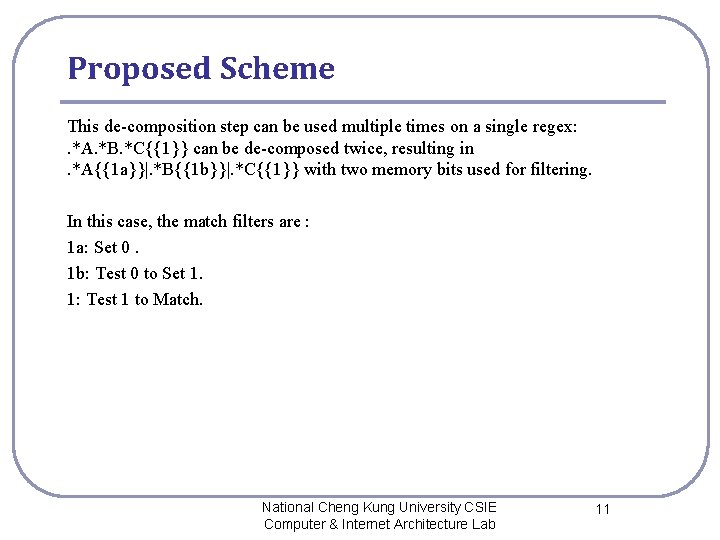
Proposed Scheme This de-composition step can be used multiple times on a single regex: . *A. *B. *C{{1}} can be de-composed twice, resulting in. *A{{1 a}}|. *B{{1 b}}|. *C{{1}} with two memory bits used for filtering. In this case, the match filters are : 1 a: Set 0. 1 b: Test 0 to Set 1. 1: Test 1 to Match. National Cheng Kung University CSIE Computer & Internet Architecture Lab 11
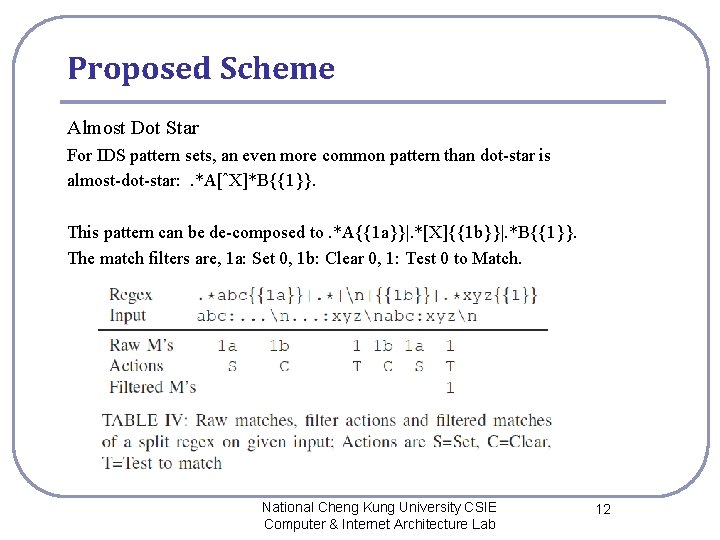
Proposed Scheme Almost Dot Star For IDS pattern sets, an even more common pattern than dot-star is almost-dot-star: . *A[ˆX]*B{{1}}. This pattern can be de-composed to. *A{{1 a}}|. *[X]{{1 b}}|. *B{{1}}. The match filters are, 1 a: Set 0, 1 b: Clear 0, 1: Test 0 to Match. National Cheng Kung University CSIE Computer & Internet Architecture Lab 12
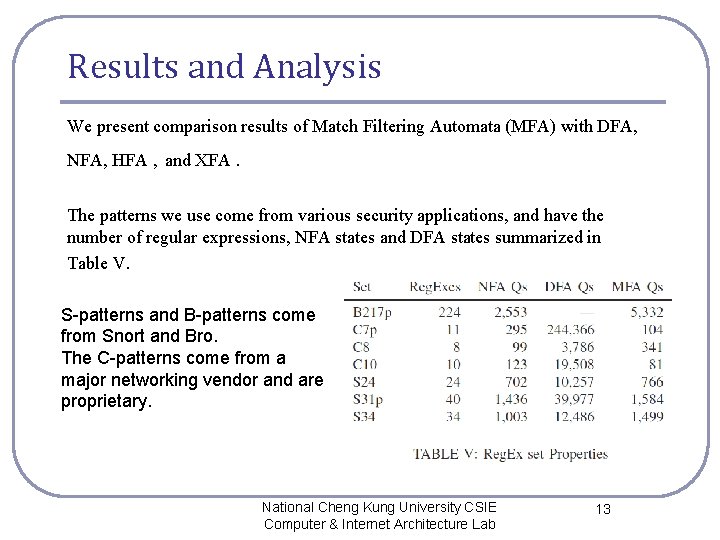
Results and Analysis We present comparison results of Match Filtering Automata (MFA) with DFA, NFA, HFA , and XFA. The patterns we use come from various security applications, and have the number of regular expressions, NFA states and DFA states summarized in Table V. S-patterns and B-patterns come from Snort and Bro. The C-patterns come from a major networking vendor and are proprietary. National Cheng Kung University CSIE Computer & Internet Architecture Lab 13
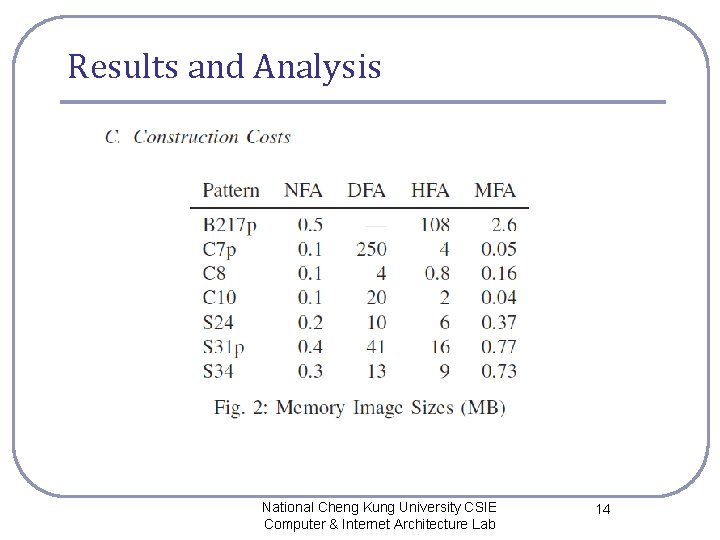
Results and Analysis National Cheng Kung University CSIE Computer & Internet Architecture Lab 14
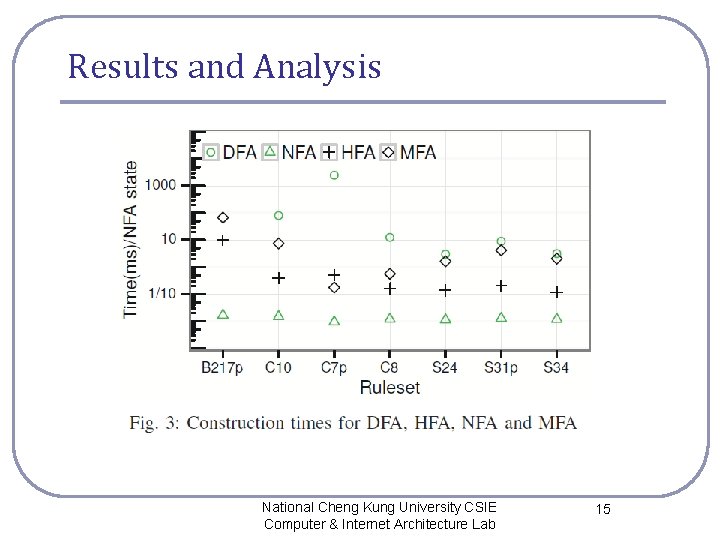
Results and Analysis National Cheng Kung University CSIE Computer & Internet Architecture Lab 15
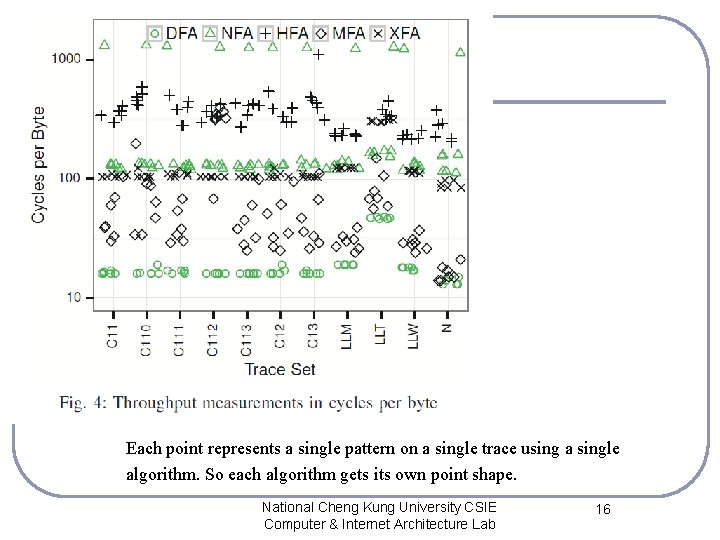
Results and Analysis Each point represents a single pattern on a single trace using a single algorithm. So each algorithm gets its own point shape. National Cheng Kung University CSIE Computer & Internet Architecture Lab 16
Conclusion The methods presented here are effective at dealing with state space explosion while still being automatically generable, and without producing an overly complex automaton that performs slowly. Further work can still be done to add more patterns that can be de-composed. While it is not a silver bullet for all possible regular expressions, this approach will only become more powerful as additional effort is put into implementing efficient de-compositions and filters to efficiently match commonly used patterns. National Cheng Kung University CSIE Computer & Internet Architecture Lab 17