
A Decade Later Are We Any Closer to



- Slides: 67
A Decade Later: Are We Any Closer to Resolving the LSND Puzzle? BNL Seminar September 23, 2010 Richard Van de Water, LANL, P-25 Subatomic Physics Group TRIUMF 2009
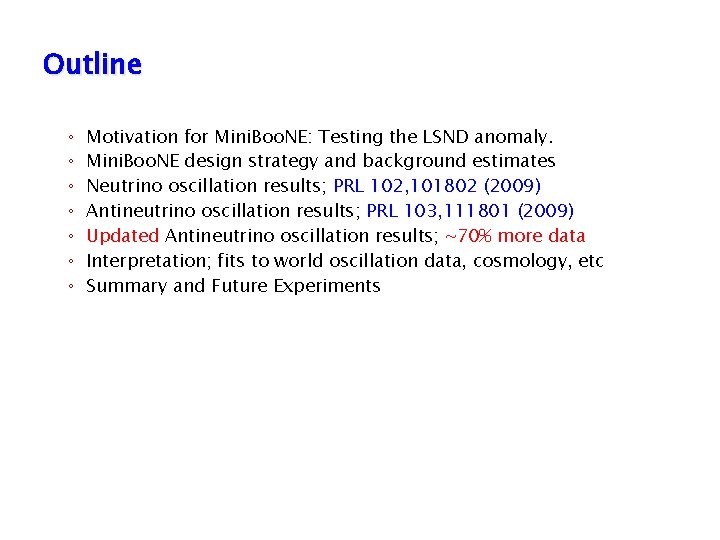
Outline ◦ ◦ ◦ ◦ Motivation for Mini. Boo. NE: Testing the LSND anomaly. Mini. Boo. NE design strategy and background estimates Neutrino oscillation results; PRL 102, 101802 (2009) Antineutrino oscillation results; PRL 103, 111801 (2009) Updated Antineutrino oscillation results; ~70% more data Interpretation; fits to world oscillation data, cosmology, etc Summary and Future Experiments
Motivation for Mini. Boo. NE
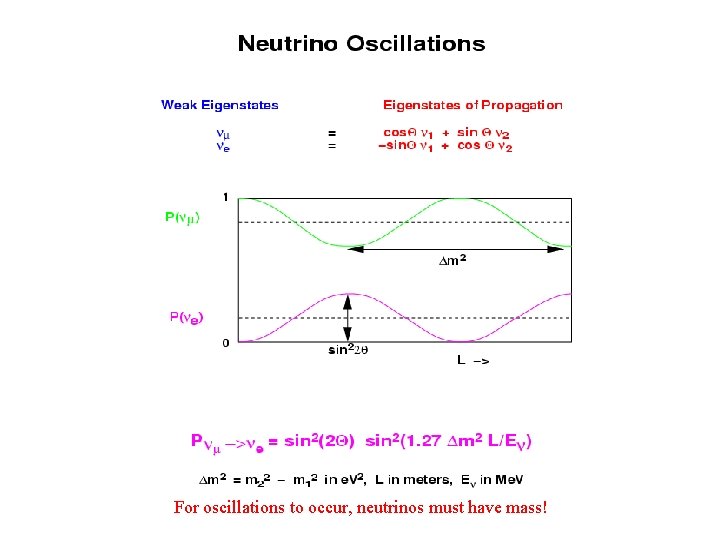
For oscillations to occur, neutrinos must have mass!
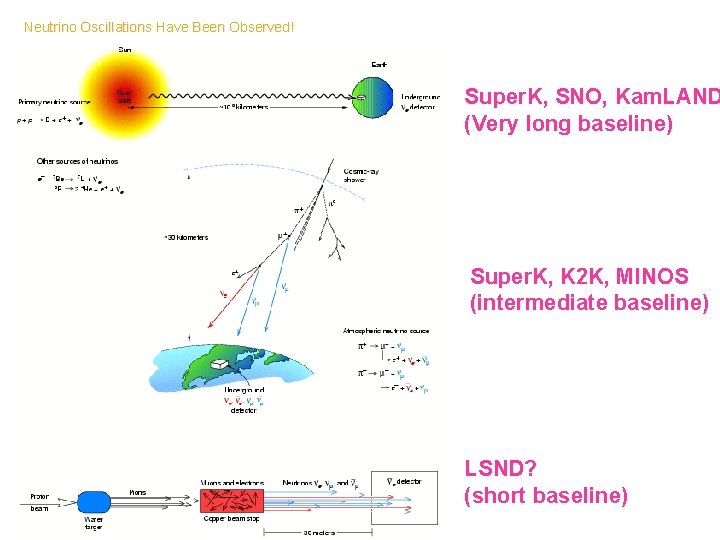
Neutrino Oscillations Have Been Observed! Super. K, SNO, Kam. LAND (Very long baseline) Super. K, K 2 K, MINOS (intermediate baseline) LSND? (short baseline)
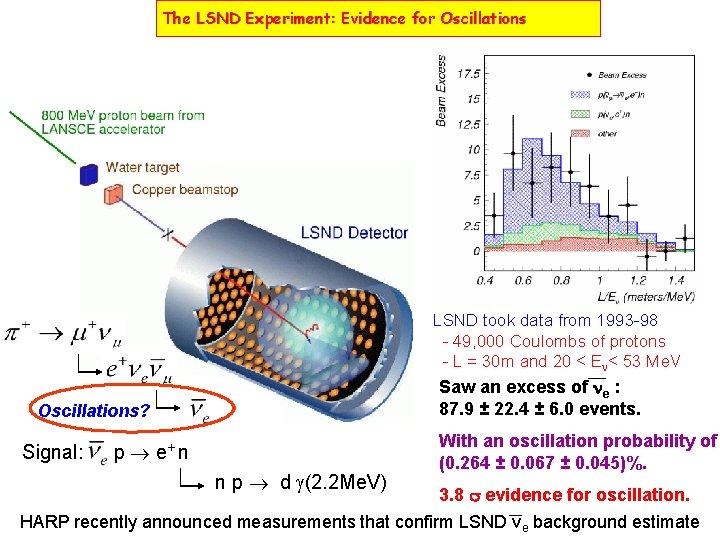
The LSND Experiment: Evidence for Oscillations LSND took data from 1993 -98 - 49, 000 Coulombs of protons - L = 30 m and 20 < En< 53 Me. V Saw an excess of e : 87. 9 ± 22. 4 ± 6. 0 events. Oscillations? Signal: p e+ n n p d (2. 2 Me. V) With an oscillation probability of (0. 264 ± 0. 067 ± 0. 045)%. 3. 8 s evidence for oscillation. HARP recently announced measurements that confirm LSND ve background estimate
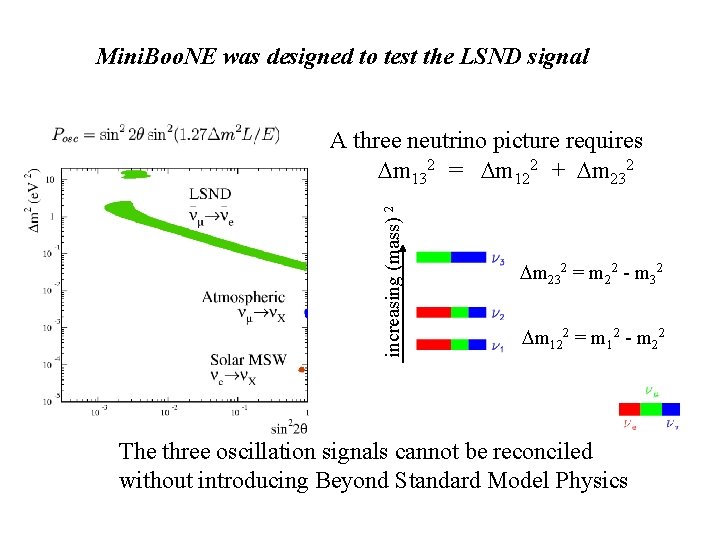
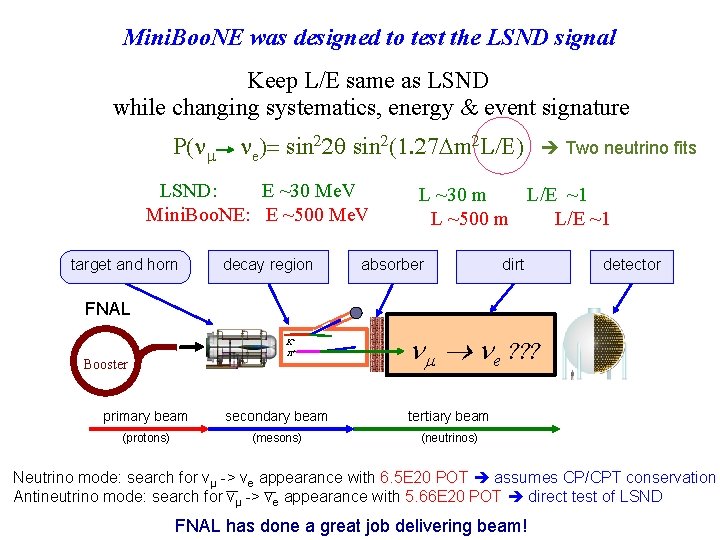
Mini. Boo. NE was designed to test the LSND signal increasing (mass) 2 A three neutrino picture requires m 132 = m 122 + m 232 = m 22 - m 32 m 122 = m 12 - m 22 The three oscillation signals cannot be reconciled without introducing Beyond Standard Model Physics
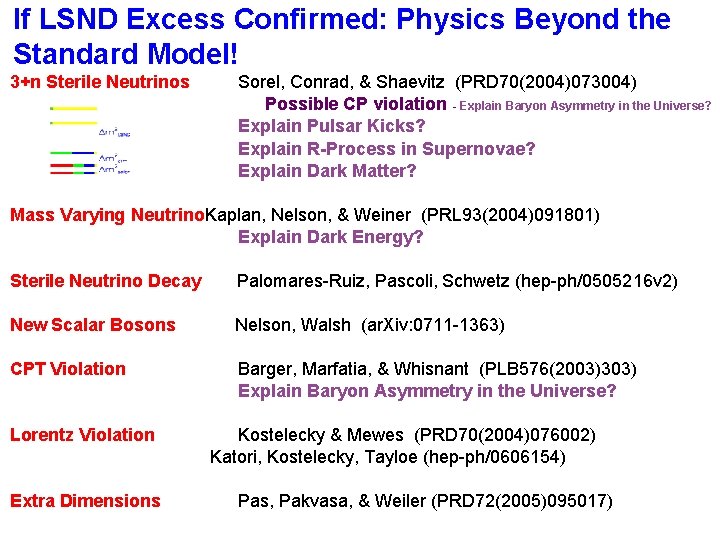
If LSND Excess Confirmed: Physics Beyond the Standard Model! 3+n Sterile Neutrinos Sorel, Conrad, & Shaevitz (PRD 70(2004)073004) Possible CP violation - Explain Baryon Asymmetry in the Universe? Explain Pulsar Kicks? Explain R-Process in Supernovae? Explain Dark Matter? Mass Varying Neutrino. Kaplan, Nelson, & Weiner (PRL 93(2004)091801) Explain Dark Energy? Sterile Neutrino Decay Palomares-Ruiz, Pascoli, Schwetz (hep-ph/0505216 v 2) New Scalar Bosons Nelson, Walsh (ar. Xiv: 0711 -1363) CPT Violation Barger, Marfatia, & Whisnant (PLB 576(2003)303) Explain Baryon Asymmetry in the Universe? Lorentz Violation Extra Dimensions Kostelecky & Mewes (PRD 70(2004)076002) Katori, Kostelecky, Tayloe (hep-ph/0606154) Pas, Pakvasa, & Weiler (PRD 72(2005)095017)
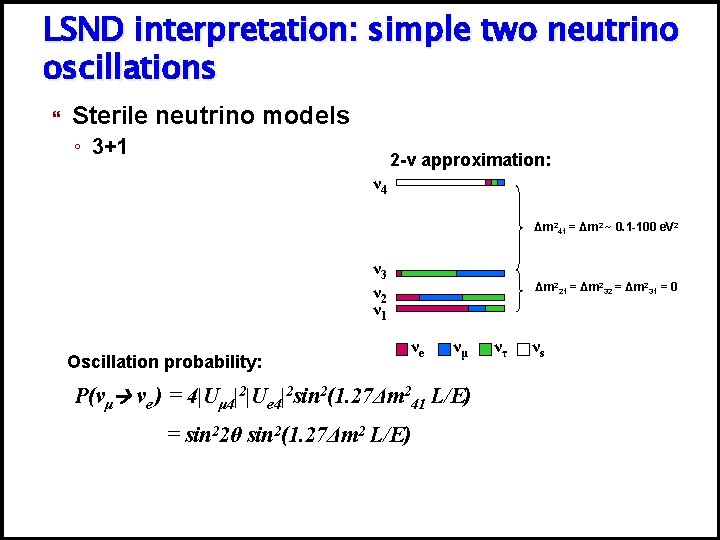
LSND interpretation: simple two neutrino oscillations Sterile neutrino models ◦ 3+1 2 -ν approximation: ν 4 Δm 241 = Δm 2 ~ 0. 1 -100 e. V 2 ν 3 ν 2 ν 1 Oscillation probability: Δm 221 = Δm 232 = Δm 231 = 0 νe νμ P(νμ νe ) = 4|Uμ 4|2|Ue 4|2 sin 2(1. 27Δm 241 L/E) = sin 22θ sin 2(1. 27Δm 2 L/E) ντ νs
The Mini. Boo. NE Experiment: How to measure neutrino oscillations at the ~1% level…. very difficult!
Mini. Boo. NE was designed to test the LSND signal Keep L/E same as LSND while changing systematics, energy & event signature P(nm ne)= sin 22 q sin 2(1. 27 m 2 L E) LSND: E ~30 Me. V Mini. Boo. NE: E ~500 Me. V target and horn decay region Two neutrino fits L ~30 m L/E ~1 L ~500 m L/E ~1 absorber dirt detector FNAL K+ p+ Booster nm ne ? ? ? primary beam secondary beam tertiary beam (protons) (mesons) (neutrinos) Neutrino mode: search for νμ -> νe appearance with 6. 5 E 20 POT assumes CP/CPT conservation Antineutrino mode: search for νμ -> νe appearance with 5. 66 E 20 POT direct test of LSND FNAL has done a great job delivering beam!
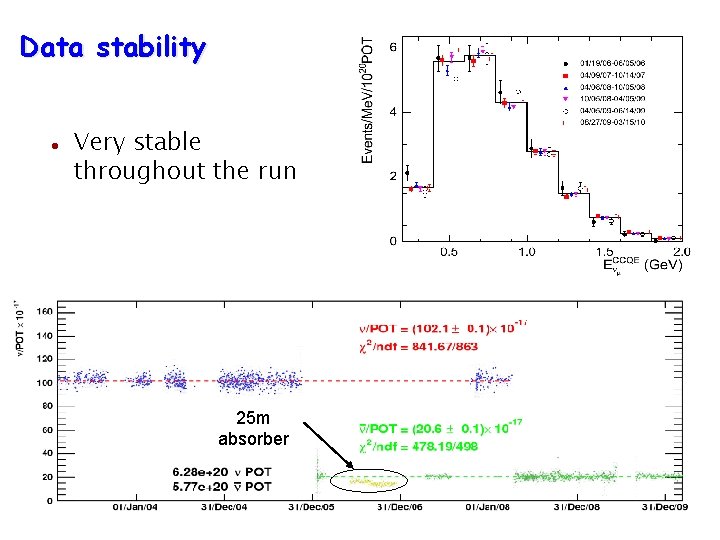
Data stability Very stable throughout the run 25 m absorber
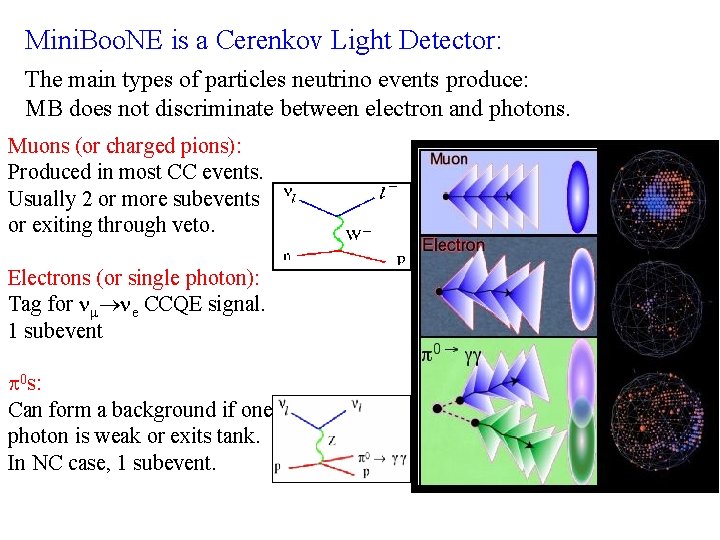
Mini. Boo. NE is a Cerenkov Light Detector: The main types of particles neutrino events produce: MB does not discriminate between electron and photons. Muons (or charged pions): Produced in most CC events. Usually 2 or more subevents or exiting through veto. Electrons (or single photon): Tag for nm ne CCQE signal. 1 subevent p 0 s: Can form a background if one photon is weak or exits tank. In NC case, 1 subevent.
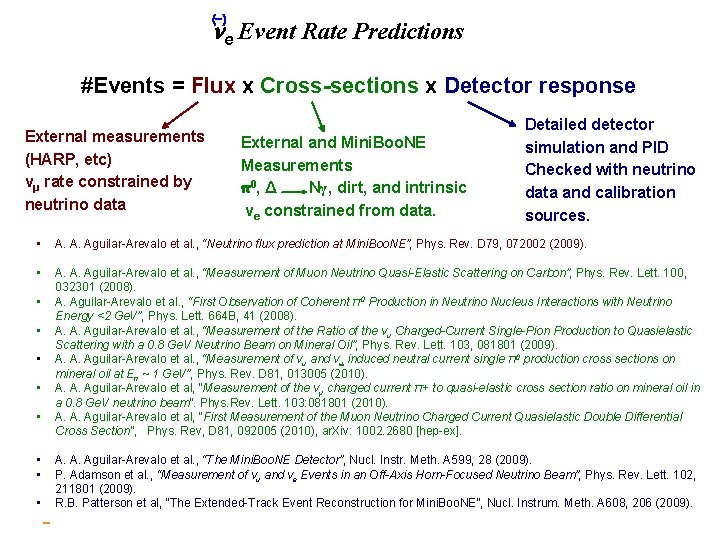
(−) e Event Rate Predictions #Events = Flux x Cross-sections x Detector response External measurements (HARP, etc) νμ rate constrained by neutrino data External and Mini. Boo. NE Measurements π 0, Δ Nγ, dirt, and intrinsic ve constrained from data. Detailed detector simulation and PID Checked with neutrino data and calibration sources. • A. A. Aguilar-Arevalo et al. , “Neutrino flux prediction at Mini. Boo. NE”, Phys. Rev. D 79, 072002 (2009). • A. A. Aguilar-Arevalo et al. , “Measurement of Muon Neutrino Quasi-Elastic Scattering on Carbon”, Phys. Rev. Lett. 100, 032301 (2008). A. Aguilar-Arevalo et al. , “First Observation of Coherent π0 Production in Neutrino Nucleus Interactions with Neutrino Energy <2 Ge. V”, Phys. Lett. 664 B, 41 (2008). A. A. Aguilar-Arevalo et al. , “Measurement of the Ratio of the vu Charged-Current Single-Pion Production to Quasielastic Scattering with a 0. 8 Ge. V Neutrino Beam on Mineral Oil”, Phys. Rev. Lett. 103, 081801 (2009). A. A. Aguilar-Arevalo et al. , “Measurement of vu and vu induced neutral current single π0 production cross sections on mineral oil at En ~ 1 Ge. V”, Phys. Rev. D 81, 013005 (2010). A. A. Aguilar-Arevalo et al, “Measurement of the νμ charged current π+ to quasi-elastic cross section ratio on mineral oil in a 0. 8 Ge. V neutrino beam”. Phys. Rev. Lett. 103: 081801 (2010). A. A. Aguilar-Arevalo et al, “First Measurement of the Muon Neutrino Charged Current Quasielastic Double Differential Cross Section”, Phys. Rev, D 81, 092005 (2010), ar. Xiv: 1002. 2680 [hep-ex]. • • A. A. Aguilar-Arevalo et al. , “The Mini. Boo. NE Detector”, Nucl. Instr. Meth. A 599, 28 (2009). P. Adamson et al. , “Measurement of vu and ve Events in an Off-Axis Horn-Focused Neutrino Beam”, Phys. Rev. Lett. 102, 211801 (2009). R. B. Patterson et al, “The Extended-Track Event Reconstruction for Mini. Boo. NE”, Nucl. Instrum. Meth. A 608, 206 (2009).
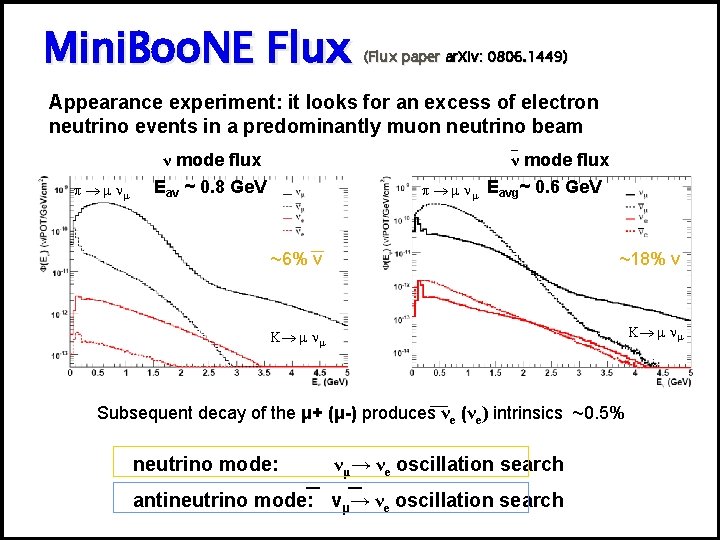
Mini. Boo. NE Flux (Flux paper ar. Xiv: 0806. 1449) Appearance experiment: it looks for an excess of electron neutrino events in a predominantly muon neutrino beam p m nm ν mode flux Eav ~ 0. 8 Ge. V ν mode flux p m nm Eavg~ 0. 6 Ge. V ~6% ν ~18% ν K m nm Subsequent decay of the μ+ (μ-) produces νe (νe) intrinsics ~0. 5% neutrino mode: _ νμ→ νe oscillation search _ antineutrino mode: νμ→ νe oscillation search
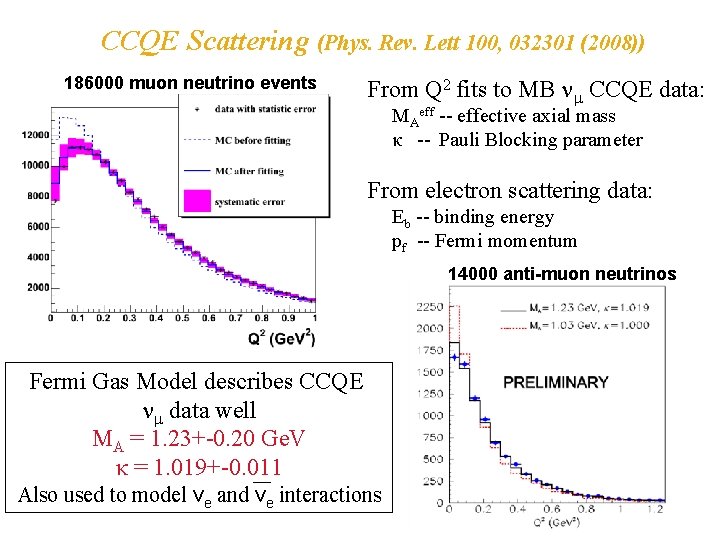
CCQE Scattering (Phys. Rev. Lett 100, 032301 (2008)) 186000 muon neutrino events From Q 2 fits to MB nm CCQE data: MAeff -- effective axial mass κ -- Pauli Blocking parameter From electron scattering data: Eb -- binding energy pf -- Fermi momentum 14000 anti-muon neutrinos Fermi Gas Model describes CCQE nm data well MA = 1. 23+-0. 20 Ge. V κ = 1. 019+-0. 011 Also used to model νe and νe interactions
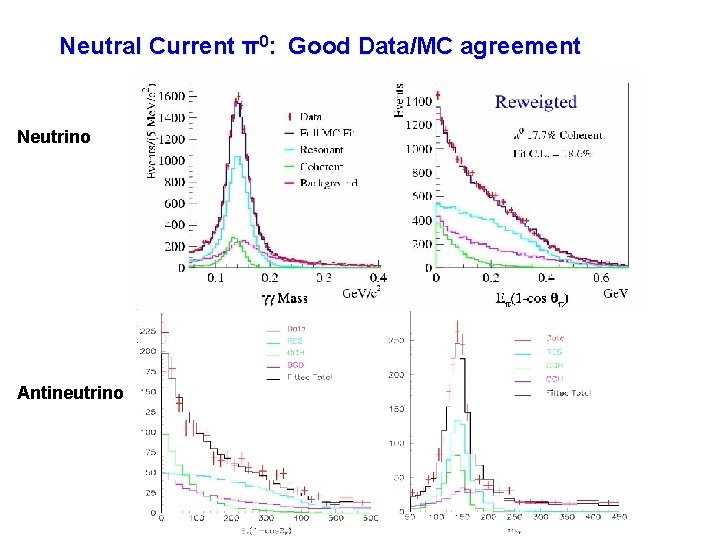
Neutral Current π0: Good Data/MC agreement Neutrino Antineutrino
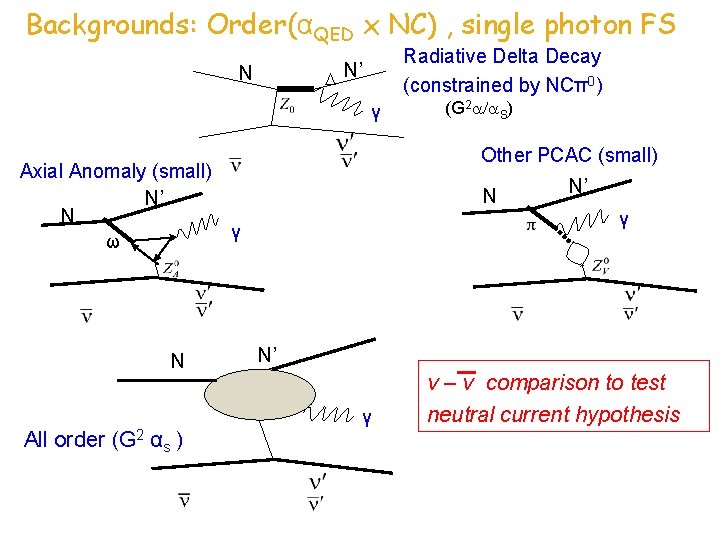
Backgrounds: Order(αQED x NC) , single photon FS Radiative Delta Decay (constrained by NCπ0) N’ N γ Axial Anomaly (small) N’ N ω N All order (G 2 αs ) (G 2 S) Other PCAC (small) N N’ γ γ N’ γ ν – ν comparison to test neutral current hypothesis
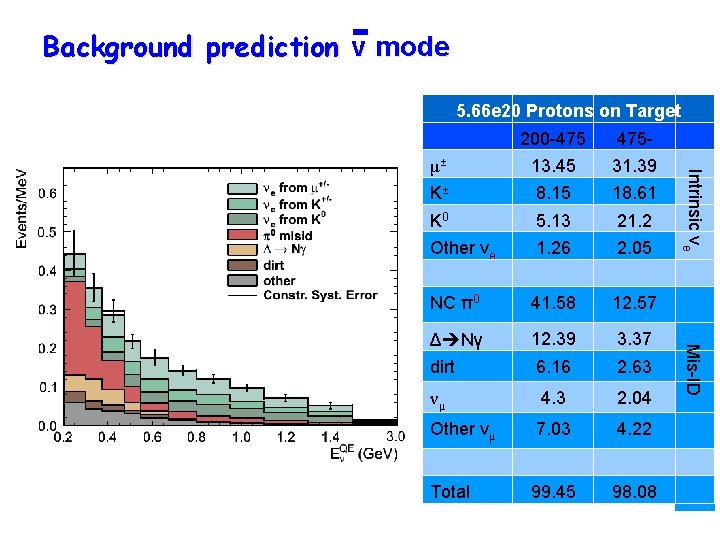
Background prediction ν mode 5. 66 e 20 Protons on Target 200 -475 K± 8. 15 18. 61 K 0 5. 13 21. 2 Other νe 1. 26 2. 05 NC π0 41. 58 12. 57 Δ Nγ 12. 39 3. 37 dirt 6. 16 2. 63 νμ CCQE Other ν 4. 3 2. 04 7. 03 4. 22 99. 45 98. 08 Total μ Mis-ID 13. 45 Intrinsic νe μ± 4751250 31. 39
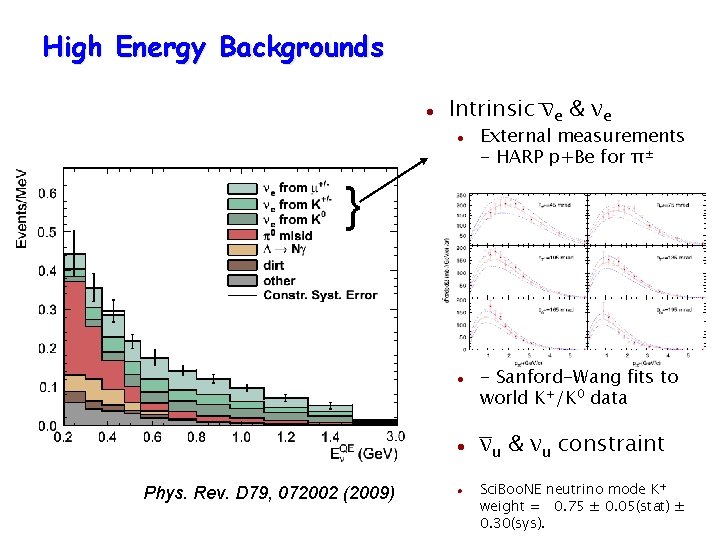
High Energy Backgrounds Intrinsic νe & νe External measurements - HARP p+Be for π± } Phys. Rev. D 79, 072002 (2009) - Sanford-Wang fits to world K+/K 0 data νu & νu constraint Sci. Boo. NE neutrino mode K+ weight = 0. 75 ± 0. 05(stat) ± 0. 30(sys).
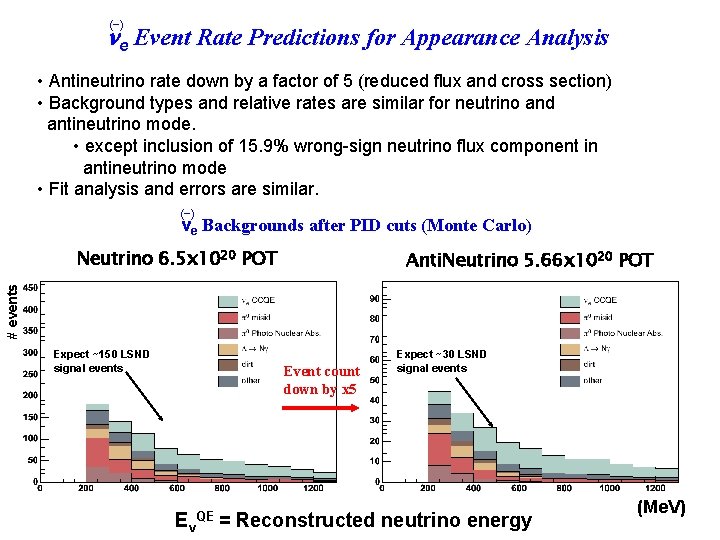
(−) e Event Rate Predictions for Appearance Analysis • Antineutrino rate down by a factor of 5 (reduced flux and cross section) • Background types and relative rates are similar for neutrino and antineutrino mode. • except inclusion of 15. 9% wrong-sign neutrino flux component in antineutrino mode • Fit analysis and errors are similar. (−) νe Backgrounds after PID cuts (Monte Carlo) Neutrino 6. 5 x 10²⁰ POT # events Anti. Neutrino 5. 66 x 1020 POT Expect ~150 LSND signal events Event count down by x 5 Expect ~30 LSND signal events EνQE = Reconstructed neutrino energy (Me. V)
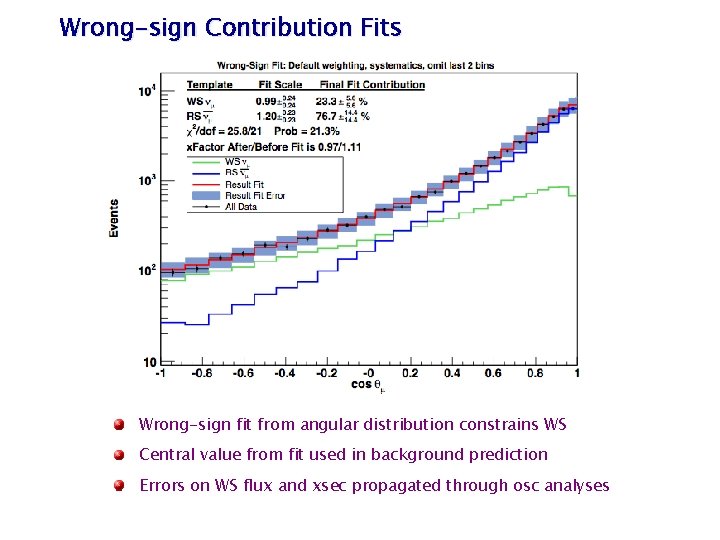
Wrong-sign Contribution Fits Wrong-sign fit from angular distribution constrains WS Central value from fit used in background prediction Errors on WS flux and xsec propagated through osc analyses
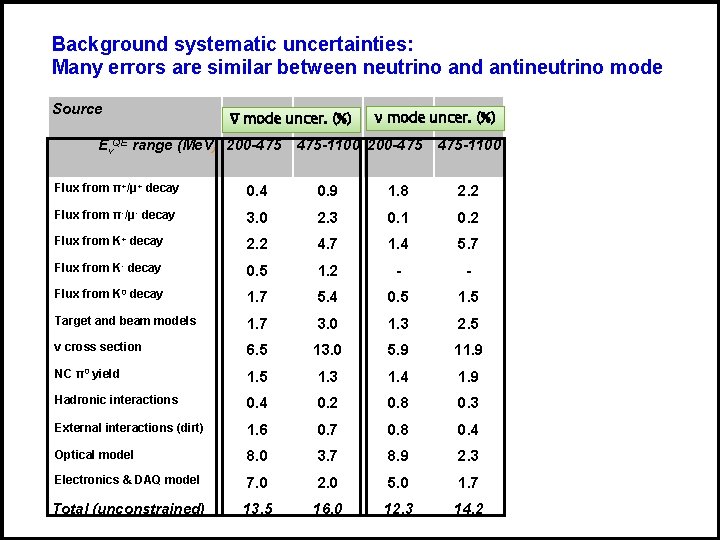
Background systematic uncertainties: Many errors are similar between neutrino and antineutrino mode Source _ ν mode uncer. (%) EνQE range (Me. V) 200 -475 ν mode uncer. (%) 475 -1100 200 -475 475 -1100 Flux from π+/μ+ decay 0. 4 0. 9 1. 8 2. 2 Flux from π-/μ- decay 3. 0 2. 3 0. 1 0. 2 Flux from K+ decay 2. 2 4. 7 1. 4 5. 7 Flux from K- decay 0. 5 1. 2 - - Flux from K 0 decay 1. 7 5. 4 0. 5 1. 5 Target and beam models 1. 7 3. 0 1. 3 2. 5 ν cross section 6. 5 13. 0 5. 9 11. 9 NC π0 yield 1. 5 1. 3 1. 4 1. 9 Hadronic interactions 0. 4 0. 2 0. 8 0. 3 External interactions (dirt) 1. 6 0. 7 0. 8 0. 4 Optical model 8. 0 3. 7 8. 9 2. 3 Electronics & DAQ model 7. 0 2. 0 5. 0 1. 7 Total (unconstrained) 13. 5 16. 0 12. 3 14. 2
Previous Oscillation Results
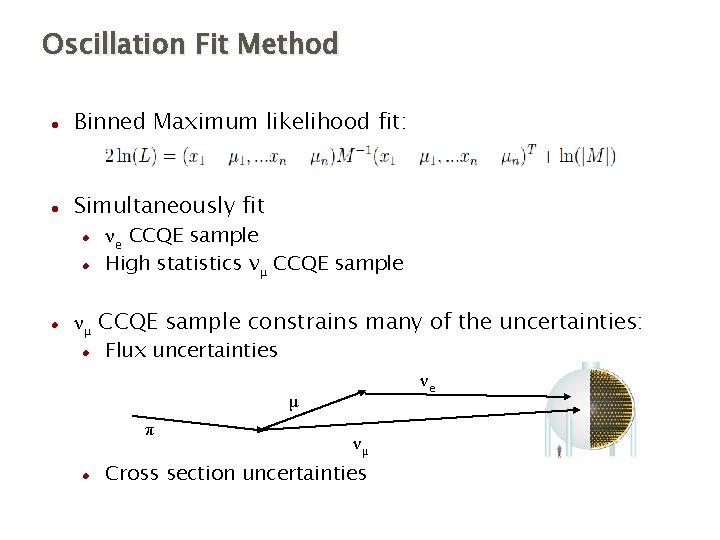
Oscillation Fit Method Binned Maximum likelihood fit: Simultaneously fit ν e CCQE sample High statistics νμ CCQE sample ν μ CCQE sample constrains many of the uncertainties: Flux uncertainties νe μ π νμ Cross section uncertainties
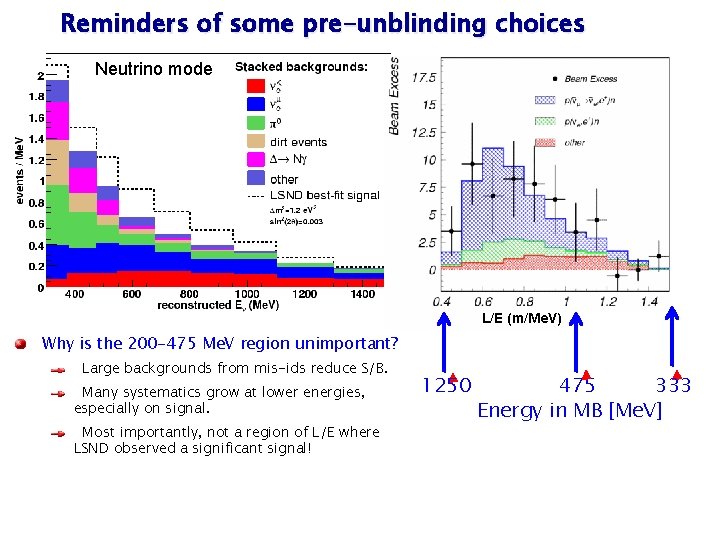
Reminders of some pre-unblinding choices Neutrino mode L/E (m/Me. V) Why is the 200 -475 Me. V region unimportant? Large backgrounds from mis-ids reduce S/B. Many systematics grow at lower energies, especially on signal. Most importantly, not a region of L/E where LSND observed a significant signal! 1250 475 333 Energy in MB [Me. V]
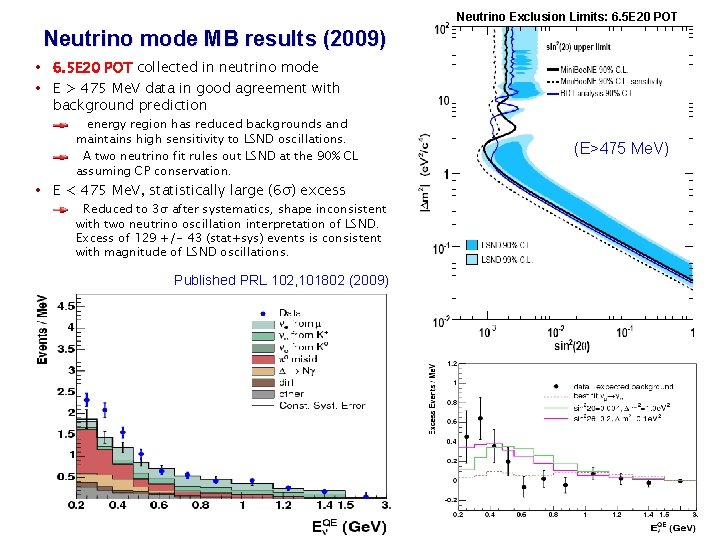
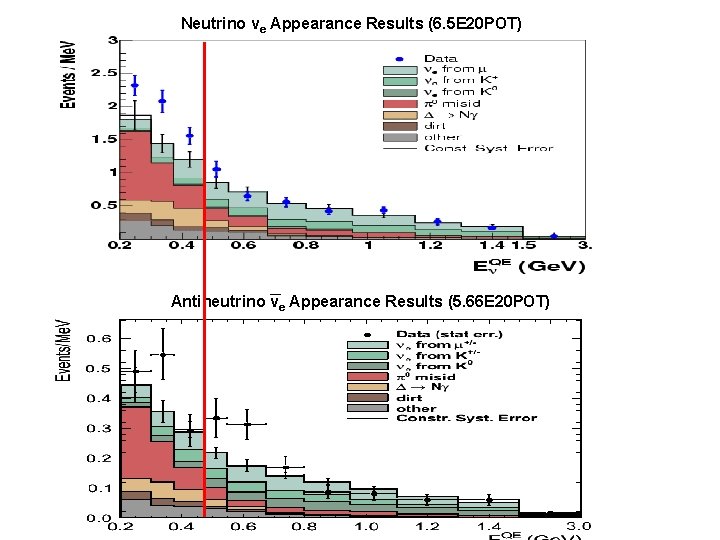
Neutrino Exclusion Limits: 6. 5 E 20 POT Neutrino mode MB results (2009) • 6. 5 E 20 POT collected in neutrino mode • E > 475 Me. V data in good agreement with background prediction energy region has reduced backgrounds and maintains high sensitivity to LSND oscillations. A two neutrino fit rules out LSND at the 90% CL assuming CP conservation. • E < 475 Me. V, statistically large (6σ) excess Reduced to 3σ after systematics, shape inconsistent with two neutrino oscillation interpretation of LSND. Excess of 129 +/- 43 (stat+sys) events is consistent with magnitude of LSND oscillations. Published PRL 102, 101802 (2009) (E>475 Me. V)
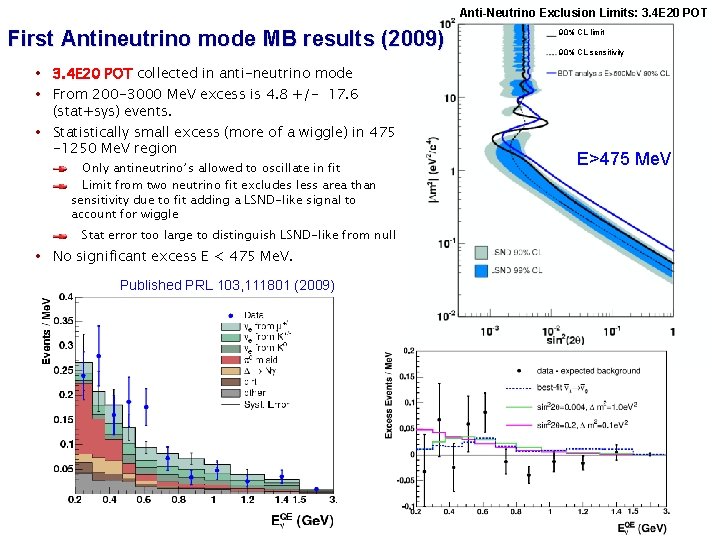
Anti-Neutrino Exclusion Limits: 3. 4 E 20 POT First Antineutrino mode MB results (2009) 90% CL limit 90% CL sensitivity • 3. 4 E 20 POT collected in anti-neutrino mode • From 200 -3000 Me. V excess is 4. 8 +/- 17. 6 (stat+sys) events. • Statistically small excess (more of a wiggle) in 475 -1250 Me. V region Only antineutrino’s allowed to oscillate in fit Limit from two neutrino fit excludes less area than sensitivity due to fit adding a LSND-like signal to account for wiggle Stat error too large to distinguish LSND-like from null • No significant excess E < 475 Me. V. Published PRL 103, 111801 (2009) E>475 Me. V
New Antineutrino Oscillation Results
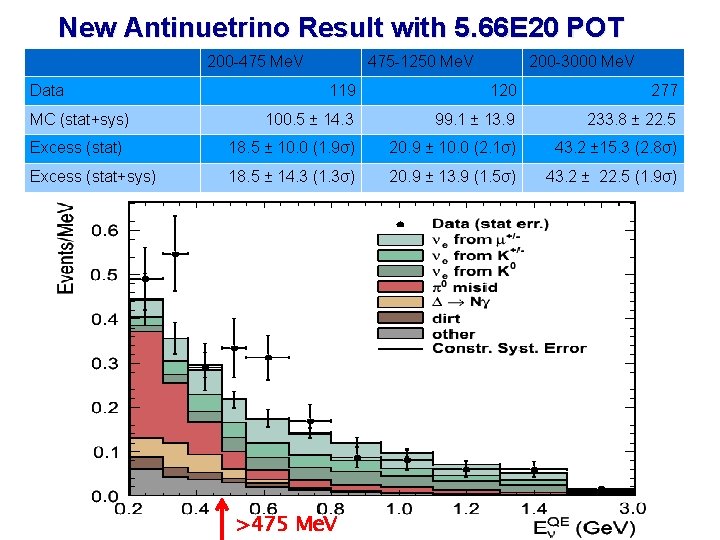
New Antinuetrino Result with 5. 66 E 20 POT 200 -475 Me. V Data 475 -1250 Me. V 200 -3000 Me. V 119 120 277 100. 5 ± 14. 3 99. 1 ± 13. 9 233. 8 ± 22. 5 Excess (stat) 18. 5 ± 10. 0 (1. 9σ) 20. 9 ± 10. 0 (2. 1σ) 43. 2 ± 15. 3 (2. 8σ) Excess (stat+sys) 18. 5 ± 14. 3 (1. 3σ) 20. 9 ± 13. 9 (1. 5σ) 43. 2 ± 22. 5 (1. 9σ) MC (stat+sys) >475 Me. V
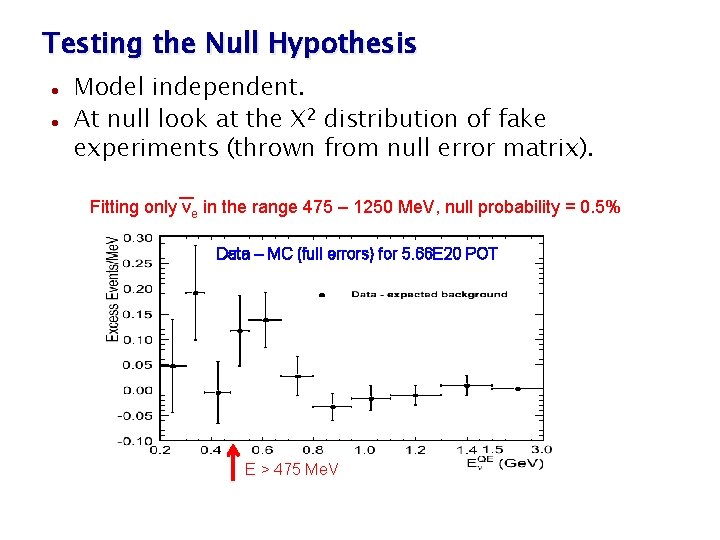
Testing the Null Hypothesis Model independent. At null look at the Χ 2 distribution of fake experiments (thrown from null error matrix). Fitting only ve in the range 475 – 1250 Me. V, null probability = 0. 5% Data – MC (full errors) for 5. 66 E 20 POT E > 475 Me. V
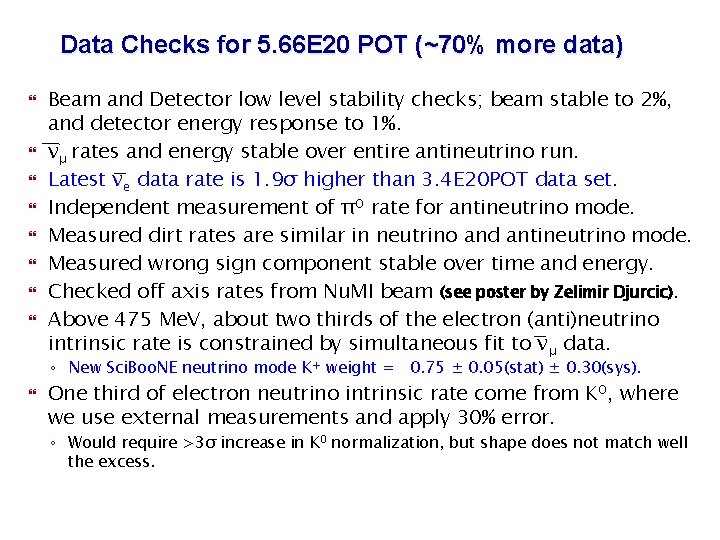
Data Checks for 5. 66 E 20 POT (~70% more data) Beam and Detector low level stability checks; beam stable to 2%, and detector energy response to 1%. νμ rates and energy stable over entire antineutrino run. Latest νe data rate is 1. 9σ higher than 3. 4 E 20 POT data set. Independent measurement of π0 rate for antineutrino mode. Measured dirt rates are similar in neutrino and antineutrino mode. Measured wrong sign component stable over time and energy. Checked off axis rates from Nu. MI beam (see poster by Zelimir Djurcic). Above 475 Me. V, about two thirds of the electron (anti)neutrino intrinsic rate is constrained by simultaneous fit to νμ data. ◦ New Sci. Boo. NE neutrino mode K+ weight = 0. 75 ± 0. 05(stat) ± 0. 30(sys). One third of electron neutrino intrinsic rate come from K 0, where we use external measurements and apply 30% error. ◦ Would require >3σ increase in K 0 normalization, but shape does not match well the excess.
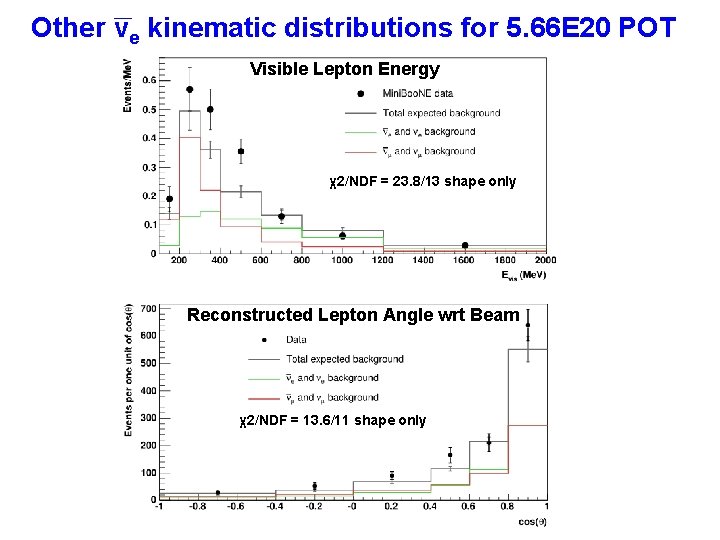
Other ve kinematic distributions for 5. 66 E 20 POT Visible Lepton Energy χ2/NDF = 23. 8/13 shape only Reconstructed Lepton Angle wrt Beam χ2/NDF = 13. 6/11 shape only
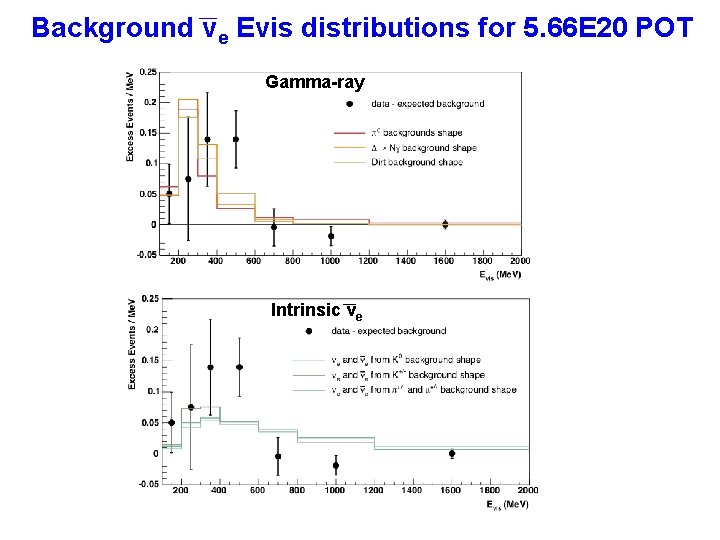
Background ve Evis distributions for 5. 66 E 20 POT Gamma-ray Intrinsic νe
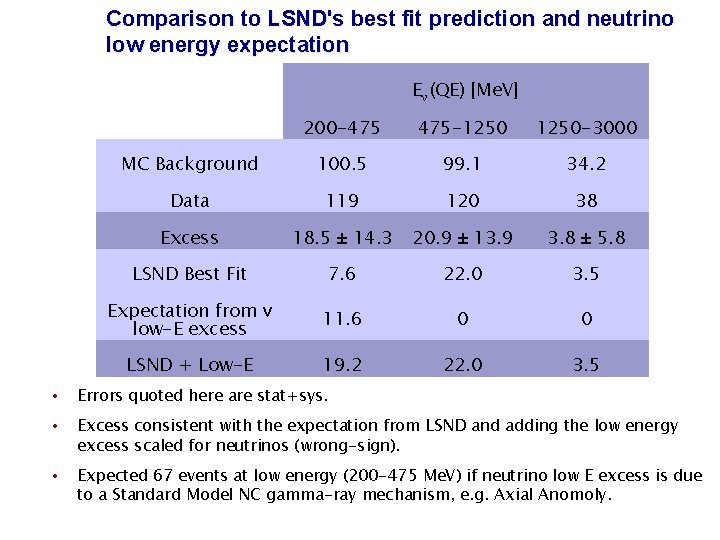
Comparison to LSND's best fit prediction and neutrino low energy expectation Eν (QE) [Me. V] 200 -475 475 -1250 -3000 MC Background 100. 5 99. 1 34. 2 Data 119 120 38 Excess 18. 5 ± 14. 3 20. 9 ± 13. 9 3. 8 ± 5. 8 LSND Best Fit 7. 6 22. 0 3. 5 Expectation from ν low-E excess 11. 6 0 0 LSND + Low-E 19. 2 22. 0 3. 5 • Errors quoted here are stat+sys. • Excess consistent with the expectation from LSND and adding the low energy excess scaled for neutrinos (wrong-sign). • Expected 67 events at low energy (200 -475 Me. V) if neutrino low E excess is due to a Standard Model NC gamma-ray mechanism, e. g. Axial Anomoly.
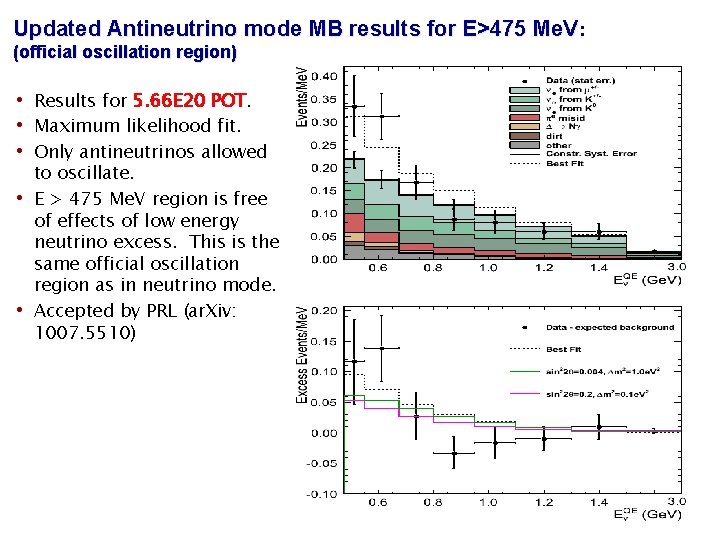
Updated Antineutrino mode MB results for E>475 Me. V: (official oscillation region) • Results for 5. 66 E 20 POT. • Maximum likelihood fit. • Only antineutrinos allowed to oscillate. • E > 475 Me. V region is free of effects of low energy neutrino excess. This is the same official oscillation region as in neutrino mode. • Accepted by PRL (ar. Xiv: 1007. 5510)
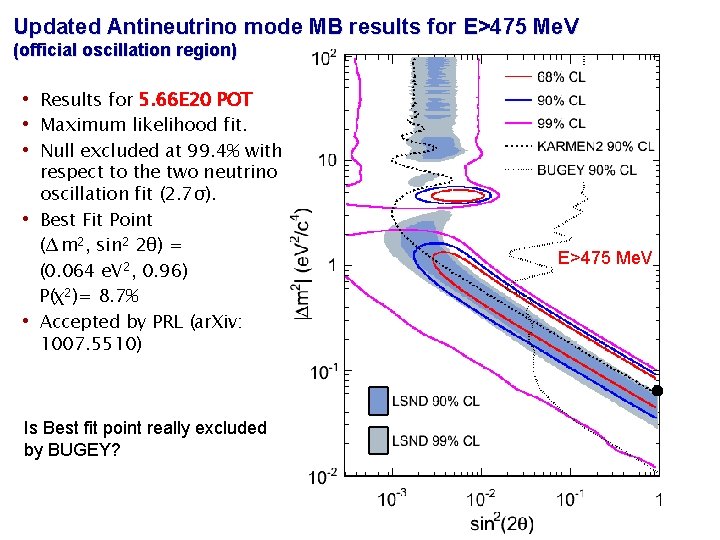
Updated Antineutrino mode MB results for E>475 Me. V (official oscillation region) • Results for 5. 66 E 20 POT • Maximum likelihood fit. • Null excluded at 99. 4% with respect to the two neutrino oscillation fit (2. 7σ). • Best Fit Point (∆m 2, sin 2 2θ) = (0. 064 e. V 2, 0. 96) P(χ2)= 8. 7% • Accepted by PRL (ar. Xiv: 1007. 5510) Is Best fit point really excluded by BUGEY? E>475 Me. V
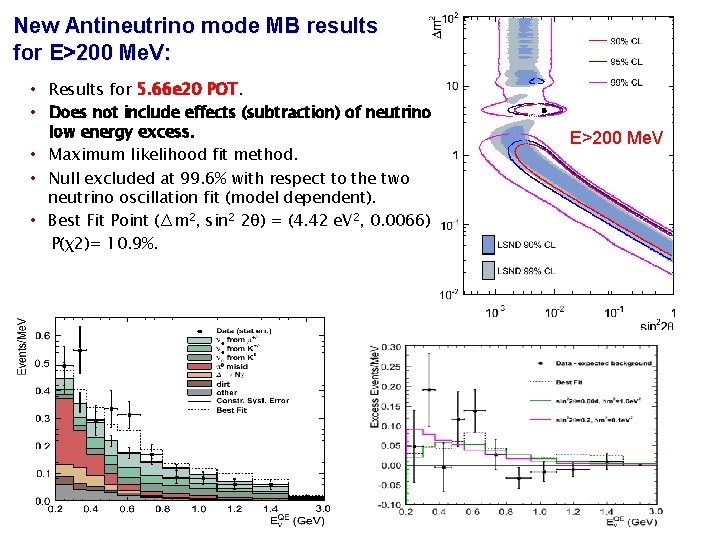
New Antineutrino mode MB results for E>200 Me. V: • Results for 5. 66 e 20 POT. • Does not include effects (subtraction) of neutrino low energy excess. • Maximum likelihood fit method. • Null excluded at 99. 6% with respect to the two neutrino oscillation fit (model dependent). • Best Fit Point (∆m 2, sin 2 2θ) = (4. 42 e. V 2, 0. 0066) P(χ2)= 10. 9%. E>200 Me. V
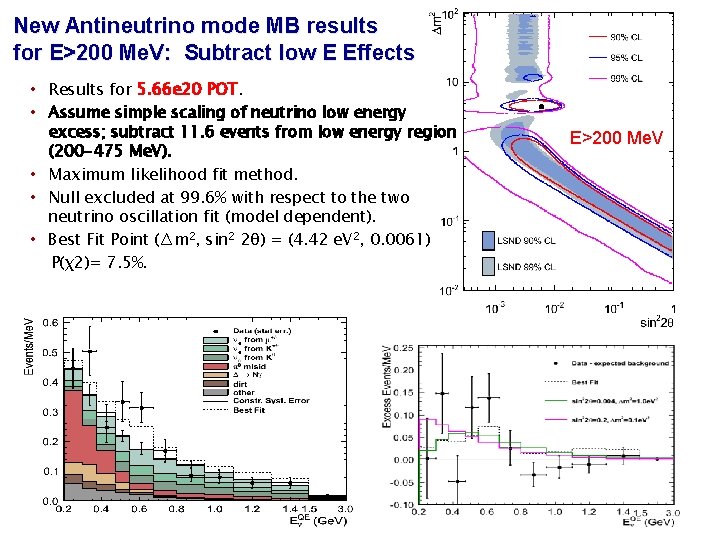
New Antineutrino mode MB results for E>200 Me. V: Subtract low E Effects • Results for 5. 66 e 20 POT. • Assume simple scaling of neutrino low energy excess; subtract 11. 6 events from low energy region (200 -475 Me. V). • Maximum likelihood fit method. • Null excluded at 99. 6% with respect to the two neutrino oscillation fit (model dependent). • Best Fit Point (∆m 2, sin 2 2θ) = (4. 42 e. V 2, 0. 0061) P(χ2)= 7. 5%. E>200 Me. V
Other Interpretations
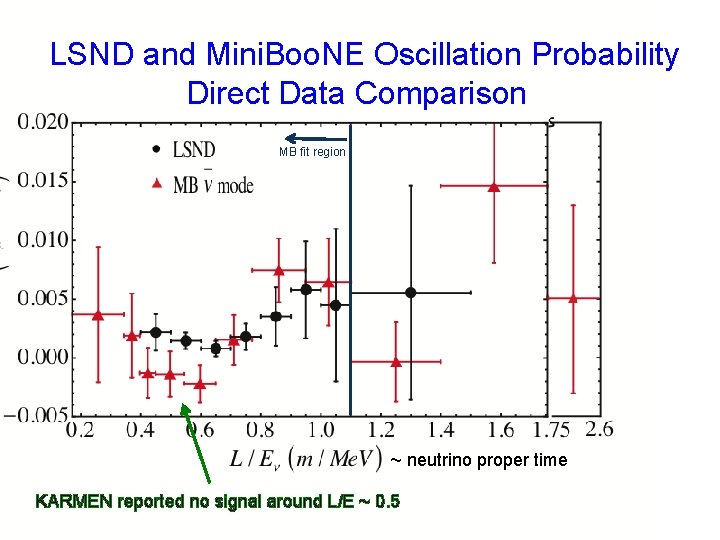
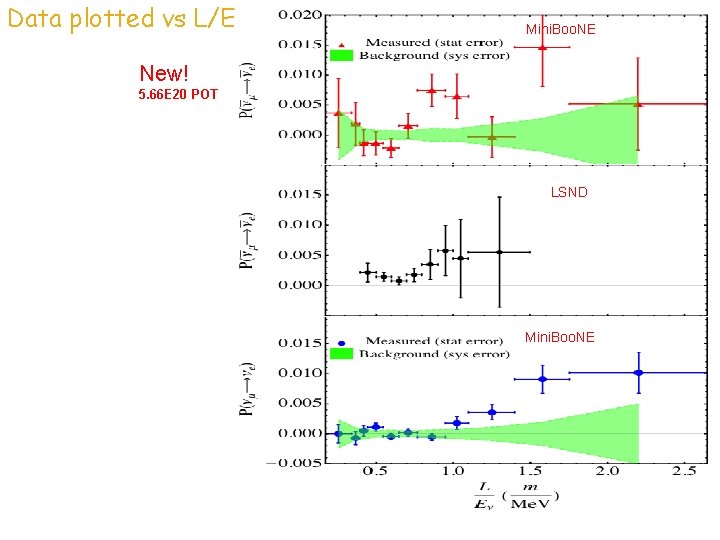
Model Independent Views of Oscillations • The next graph show P(osc) vs L/E:
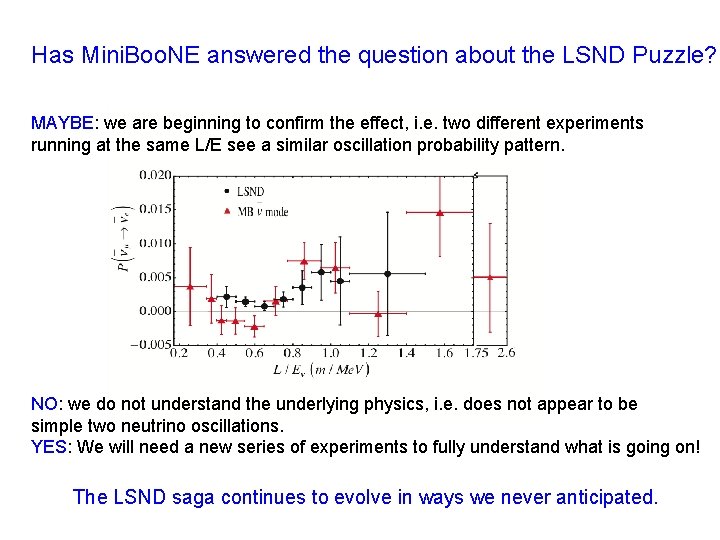
LSND and Mini. Boo. NE Oscillation Probability Direct Data Comparison MB fit region ~ neutrino proper time KARMEN reported no signal around L/E ~ 0. 5
Data plotted vs L/E Mini. Boo. NE New! 5. 66 E 20 POT LSND Mini. Boo. NE
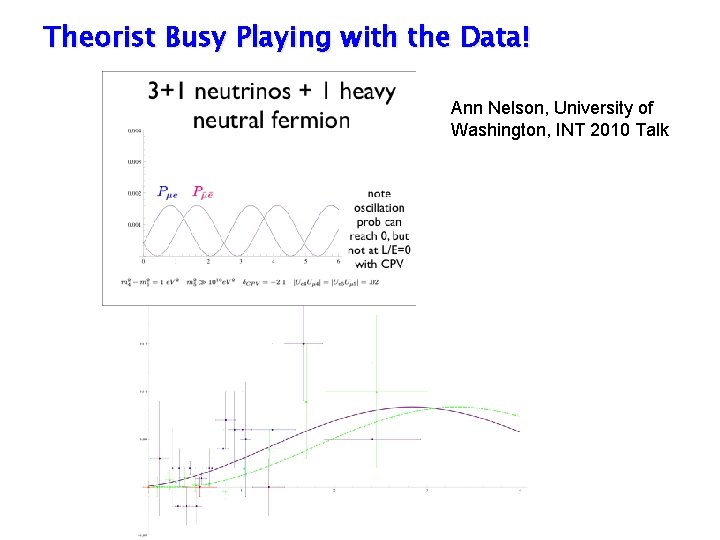
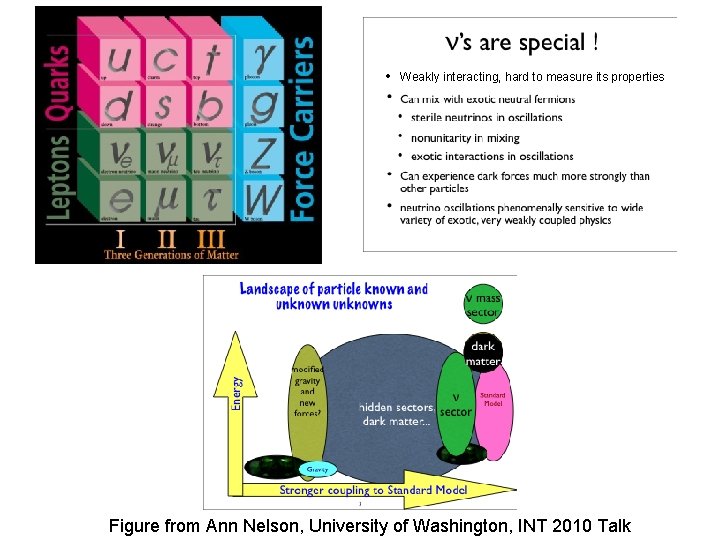
Theorist Busy Playing with the Data! Ann Nelson, University of Washington, INT 2010 Talk
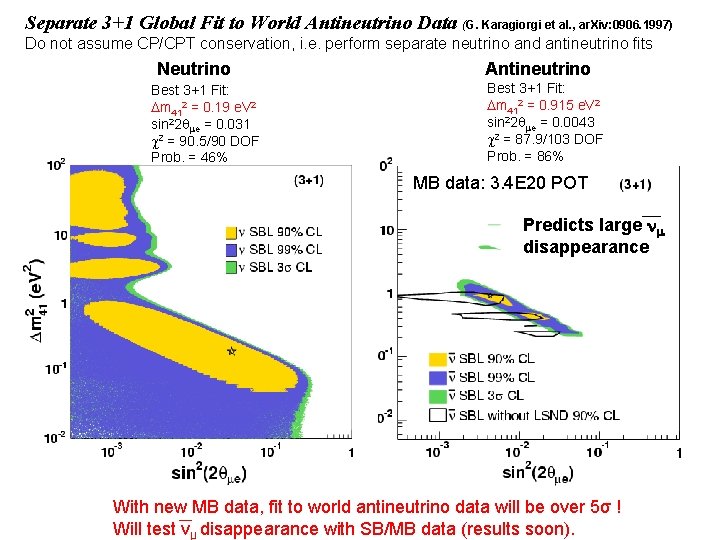
Separate 3+1 Global Fit to World Antineutrino Data (G. Karagiorgi et al. , ar. Xiv: 0906. 1997) Do not assume CP/CPT conservation, i. e. perform separate neutrino and antineutrino fits Neutrino Best 3+1 Fit: m 412 = 0. 19 e. V 2 sin 22 qme = 0. 031 c 2 = 90. 5/90 DOF Prob. = 46% Antineutrino Best 3+1 Fit: m 412 = 0. 915 e. V 2 sin 22 qme = 0. 0043 c 2 = 87. 9/103 DOF Prob. = 86% MB data: 3. 4 E 20 POT Predicts large m disappearance With new MB data, fit to world antineutrino data will be over 5σ ! Will test vμ disappearance with SB/MB data (results soon).
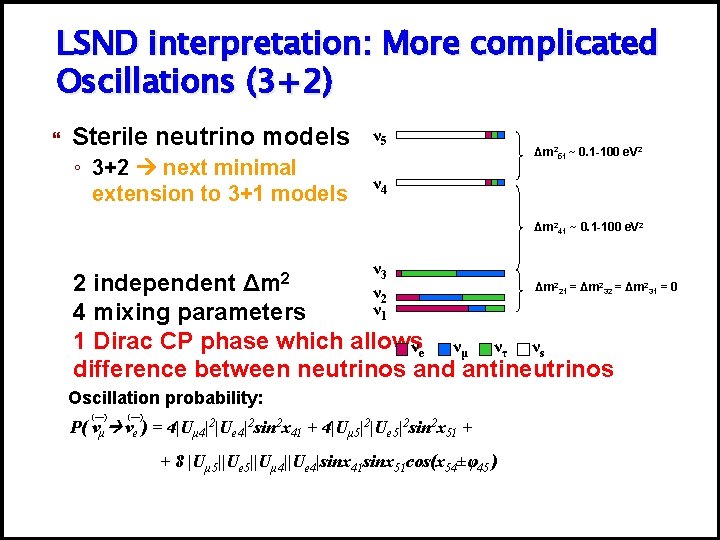
LSND interpretation: More complicated Oscillations (3+2) Sterile neutrino models ν 5 ◦ 3+2 next minimal extension to 3+1 models ν 4 Δm 251 ~ 0. 1 -100 e. V 2 Δm 241 ~ 0. 1 -100 e. V 2 Δm 2 ν 3 ν 2 ν 1 2 independent Δm = Δm 4 mixing parameters 1 Dirac CP phase which allows νe νμ ντ νs difference between neutrinos and antineutrinos Oscillation probability: (―) P( νμ νe ) = 4|Uμ 4|2|Ue 4|2 sin 2 x 41 + 4|Uμ 5|2|Ue 5|2 sin 2 x 51 + + 8 |Uμ 5||Ue 5||Uμ 4||Ue 4|sinx 41 sinx 51 cos(x 54±φ45 ) 2 21 2 32 2 31 =0
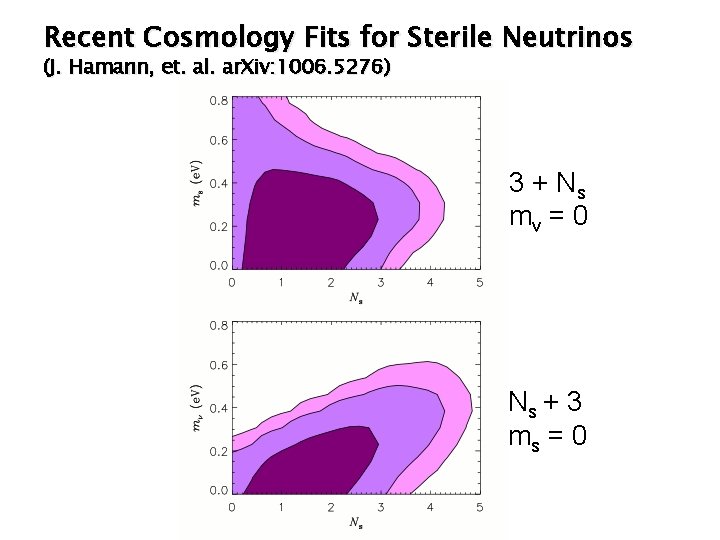
Recent Cosmology Fits for Sterile Neutrinos (J. Hamann, et. al. ar. Xiv: 1006. 5276) 3 + Ns mv = 0 Ns + 3 ms = 0
Summary and Future Experiments
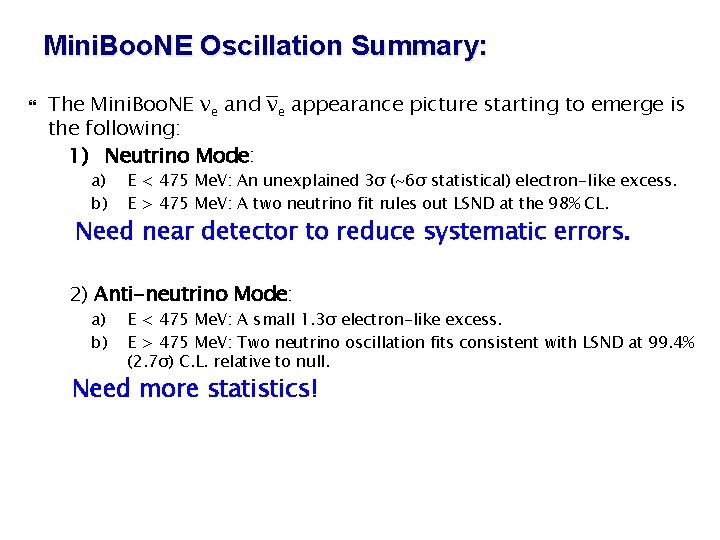
Mini. Boo. NE Oscillation Summary: The Mini. Boo. NE νe and νe appearance picture starting to emerge is the following: 1) Neutrino Mode: a) b) E < 475 Me. V: An unexplained 3σ (~6σ statistical) electron-like excess. E > 475 Me. V: A two neutrino fit rules out LSND at the 98% CL. Need near detector to reduce systematic errors. 2) Anti-neutrino Mode: a) b) E < 475 Me. V: A small 1. 3σ electron-like excess. E > 475 Me. V: Two neutrino oscillation fits consistent with LSND at 99. 4% (2. 7σ) C. L. relative to null. Need more statistics!
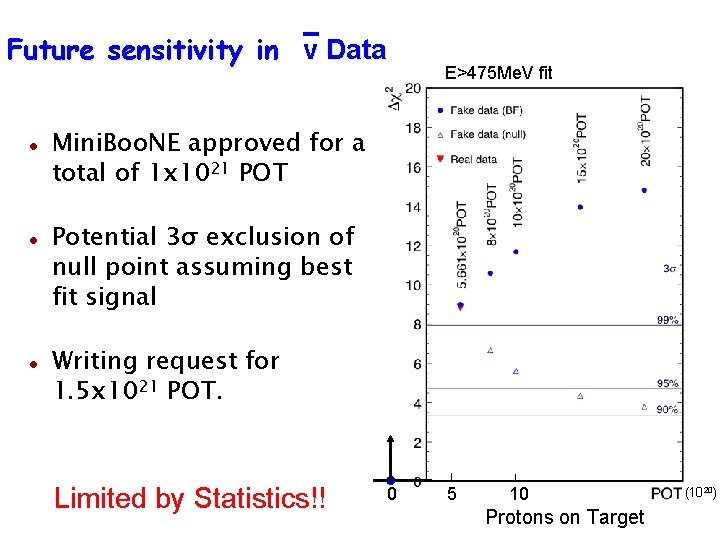
Future sensitivity in ν Data E>475 Me. V fit Mini. Boo. NE approved for a total of 1 x 10²¹ POT Potential 3σ exclusion of null point assuming best fit signal Writing request for 1. 5 x 10²¹ POT. Limited by Statistics!! 0 5 10 Protons on Target (1020)
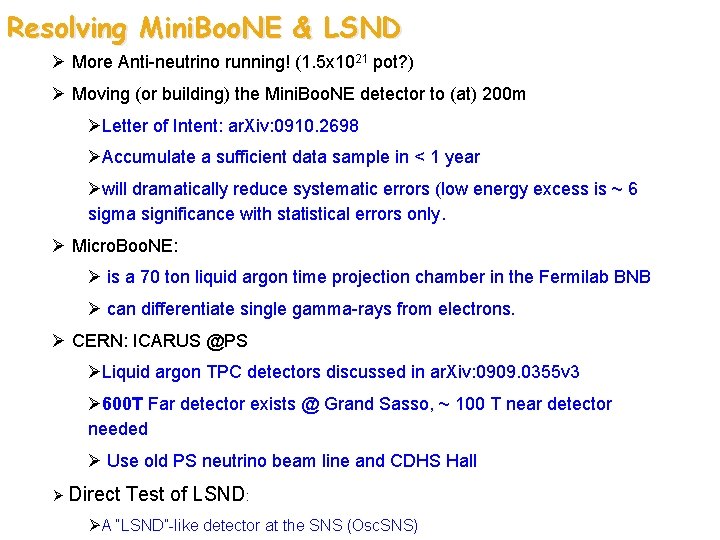
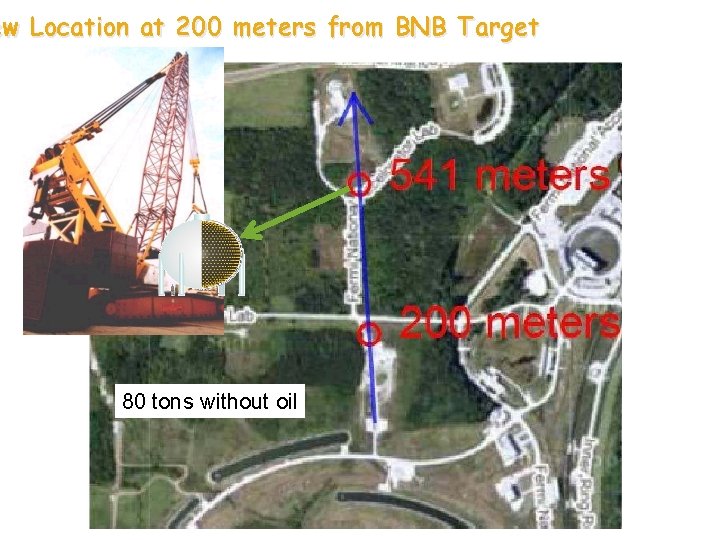
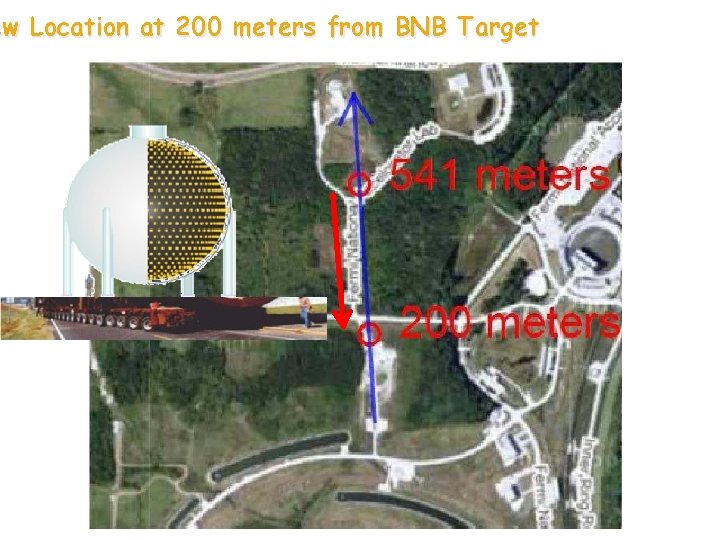
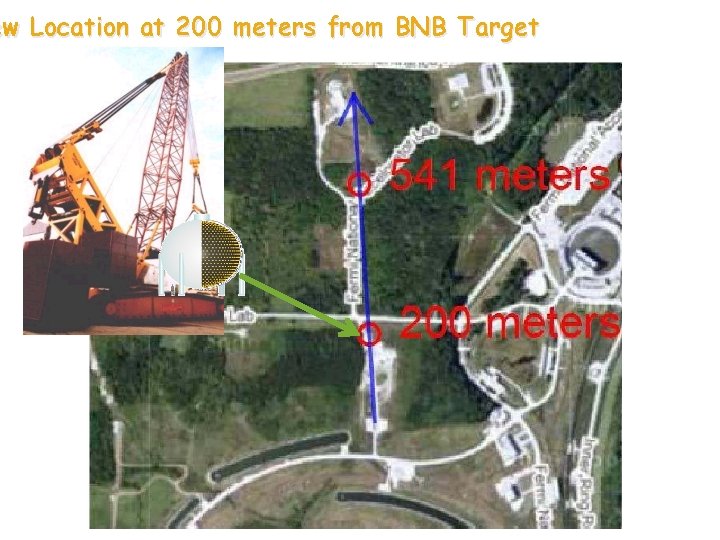
Resolving Mini. Boo. NE & LSND Ø More Anti-neutrino running! (1. 5 x 10²¹ pot? ) Ø Moving (or building) the Mini. Boo. NE detector to (at) 200 m ØLetter of Intent: ar. Xiv: 0910. 2698 ØAccumulate a sufficient data sample in < 1 year Øwill dramatically reduce systematic errors (low energy excess is ~ 6 sigma significance with statistical errors only. Ø Micro. Boo. NE: Ø is a 70 ton liquid argon time projection chamber in the Fermilab BNB Ø can differentiate single gamma-rays from electrons. Ø CERN: ICARUS @PS ØLiquid argon TPC detectors discussed in ar. Xiv: 0909. 0355 v 3 Ø 600 T Far detector exists @ Grand Sasso, ~ 100 T near detector needed Ø Use old PS neutrino beam line and CDHS Hall Ø Direct Test of LSND: ØA “LSND”-like detector at the SNS (Osc. SNS)
ew Location at 200 meters from BNB Target 80 tons without oil
ew Location at 200 meters from BNB Target
ew Location at 200 meters from BNB Target
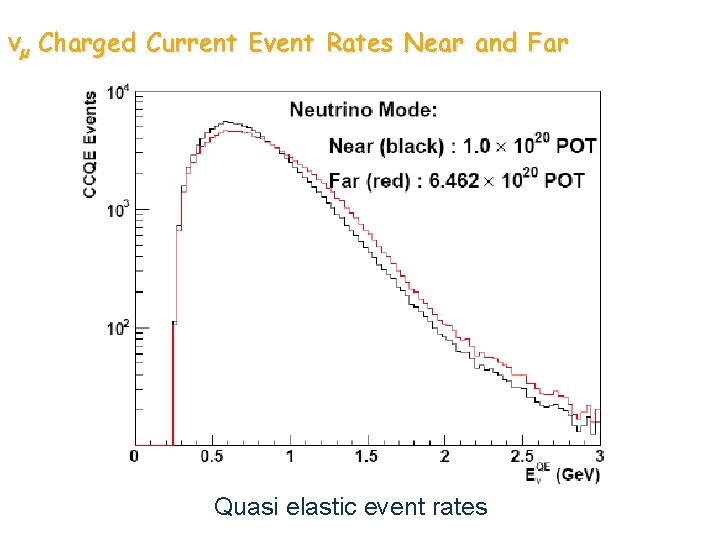
νµ Charged Current Event Rates Near and Far Quasi elastic event rates
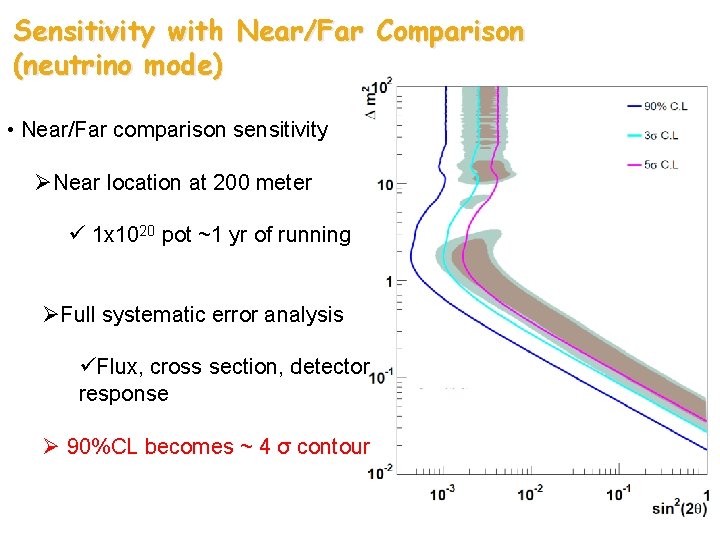
Sensitivity with Near/Far Comparison (neutrino mode) • Near/Far comparison sensitivity ØNear location at 200 meter ü 1 x 10²⁰ pot ~1 yr of running ØFull systematic error analysis üFlux, cross section, detector response Ø 90%CL becomes ~ 4 σ contour
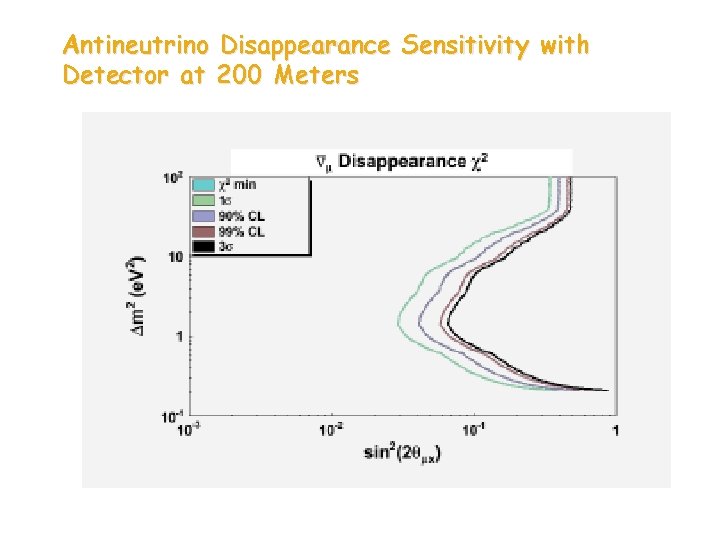
Antineutrino Disappearance Sensitivity with Detector at 200 Meters
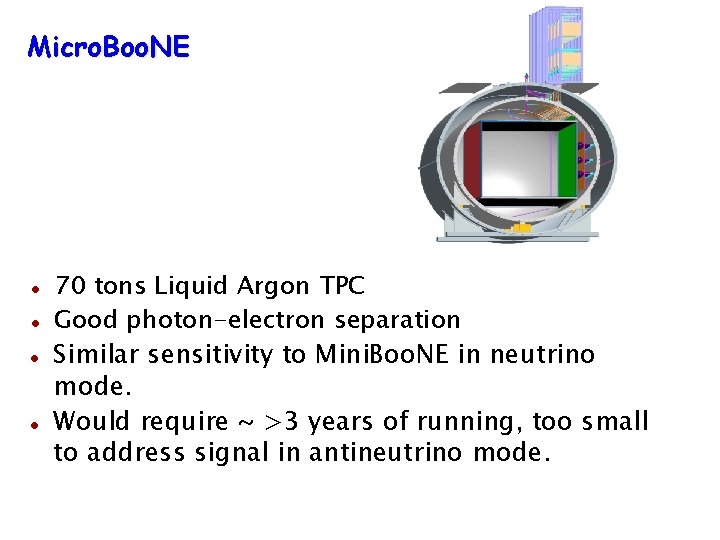
Micro. Boo. NE 70 tons Liquid Argon TPC Good photon-electron separation Similar sensitivity to Mini. Boo. NE in neutrino mode. Would require ~ >3 years of running, too small to address signal in antineutrino mode.
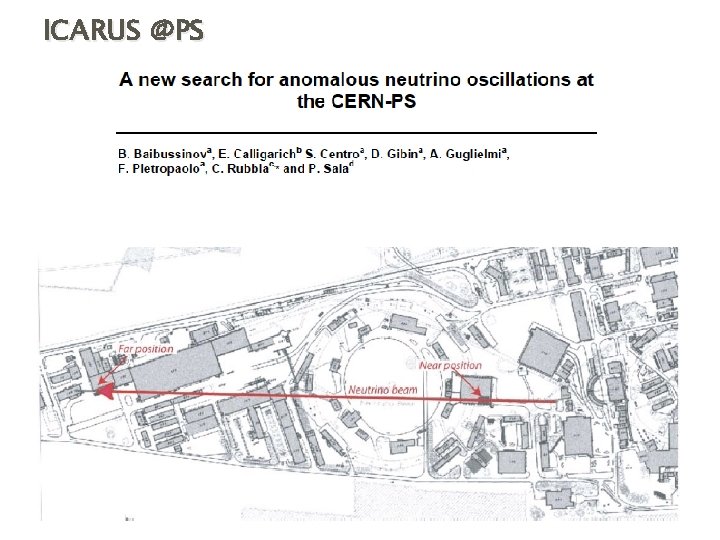
ICARUS @PS
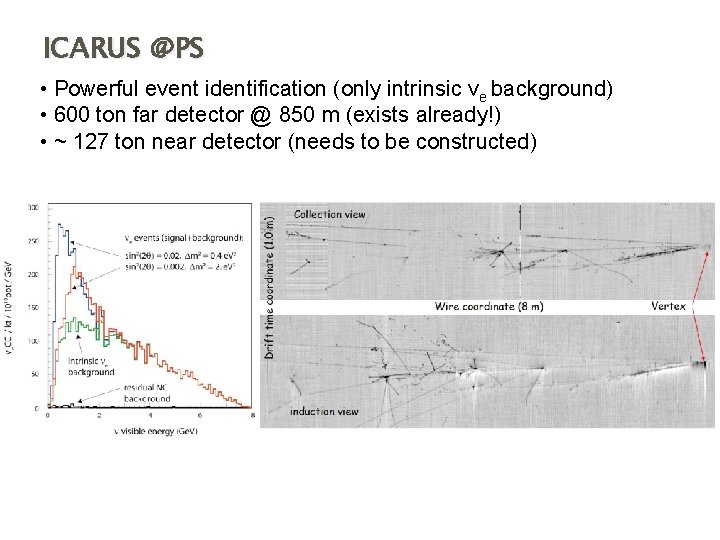
ICARUS @PS • Powerful event identification (only intrinsic νe background) • 600 ton far detector @ 850 m (exists already!) • ~ 127 ton near detector (needs to be constructed)
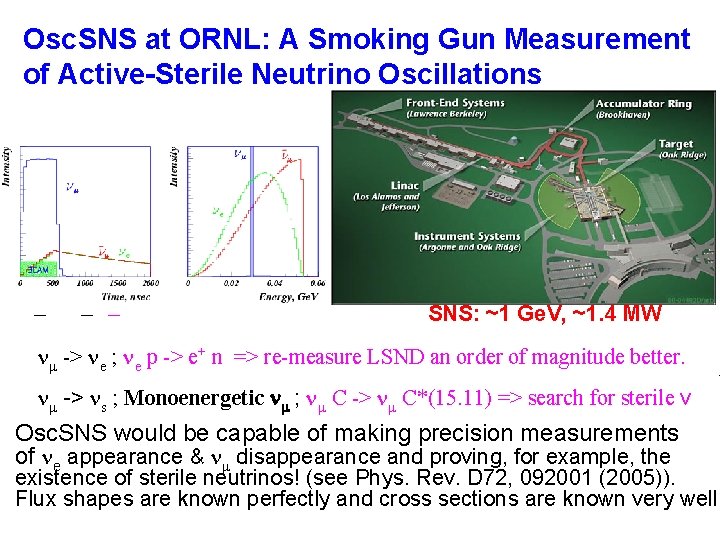
Osc. SNS at ORNL: A Smoking Gun Measurement of Active-Sterile Neutrino Oscillations SNS: ~1 Ge. V, ~1. 4 MW nm -> ne ; ne p -> e+ n => re-measure LSND an order of magnitude better. nm -> ns ; Monoenergetic m ; nm C -> nm C*(15. 11) => search for sterile ν Osc. SNS would be capable of making precision measurements of ne appearance & nm disappearance and proving, for example, the existence of sterile neutrinos! (see Phys. Rev. D 72, 092001 (2005)). Flux shapes are known perfectly and cross sections are known very well.
Final Conclusions
Has Mini. Boo. NE answered the question about the LSND Puzzle? MAYBE: we are beginning to confirm the effect, i. e. two different experiments running at the same L/E see a similar oscillation probability pattern. NO: we do not understand the underlying physics, i. e. does not appear to be simple two neutrino oscillations. YES: We will need a new series of experiments to fully understand what is going on! The LSND saga continues to evolve in ways we never anticipated.
Long-Baseline News, May 2010: “ *** LSND effect rises from the dead… ? “ Slide by Geoff Mills, LANL
Backup Slides
Neutrino ve Appearance Results (6. 5 E 20 POT) Antineutrino ve Appearance Results (5. 66 E 20 POT)
• Weakly interacting, hard to measure its properties Figure from Ann Nelson, University of Washington, INT 2010 Talk