
A DDS Clock Measurement Module W J Riley
- Slides: 24
A DDS Clock Measurement Module W. J. Riley 2016 Precise Time and Time Interval (PTTI) Meeting Monterey, CA USA January 27, 2016 12/28/15
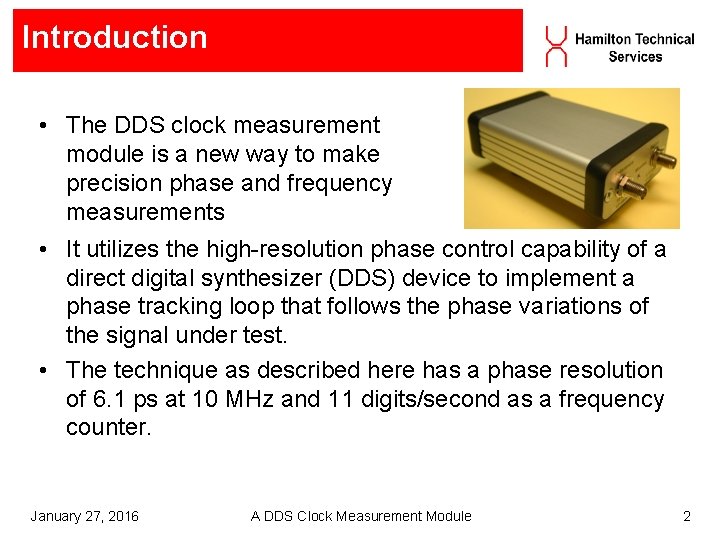
Introduction • The DDS clock measurement module is a new way to make precision phase and frequency measurements • It utilizes the high-resolution phase control capability of a direct digital synthesizer (DDS) device to implement a phase tracking loop that follows the phase variations of the signal under test. • The technique as described here has a phase resolution of 6. 1 ps at 10 MHz and 11 digits/second as a frequency counter. January 27, 2016 A DDS Clock Measurement Module 2
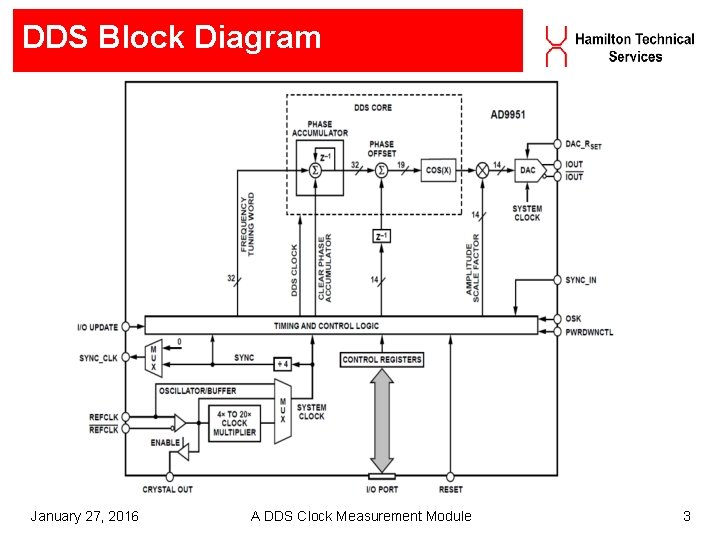
DDS Block Diagram January 27, 2016 A DDS Clock Measurement Module 3
Basic DDS Operation • A DDS works by incrementing its phase accumulator by the frequency word at each clock cycle. • The resulting phase value is transformed to a cosine function which is then converted into analog RF form by a DAC. • For our purposes here, the critical thing is that a 14 -bit offset can be added to the phase value, thereby adjusting the phase of the RF output. • At 10 MHz, this corresponds to a phase resolution of 100 ns/214 = 6. 10 ps. January 27, 2016 A DDS Clock Measurement Module 4
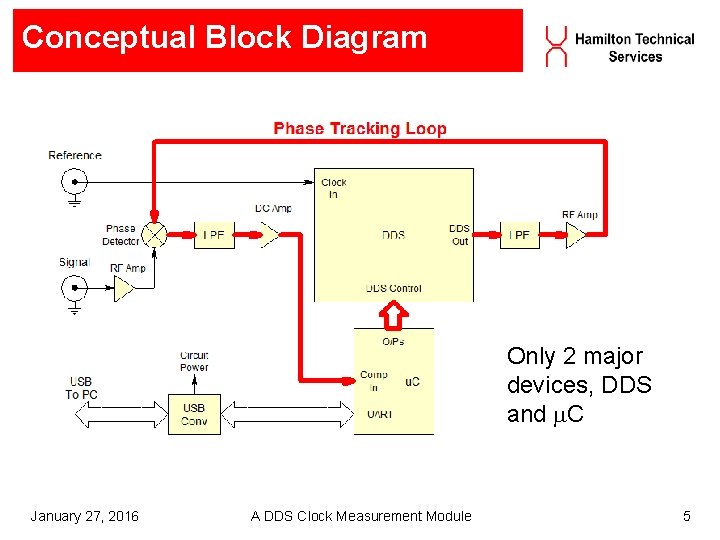
Conceptual Block Diagram Only 2 major devices, DDS and C January 27, 2016 A DDS Clock Measurement Module 5
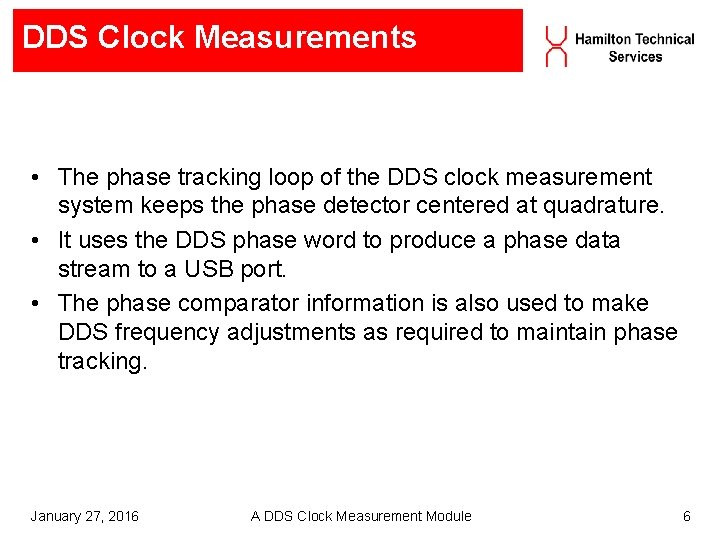
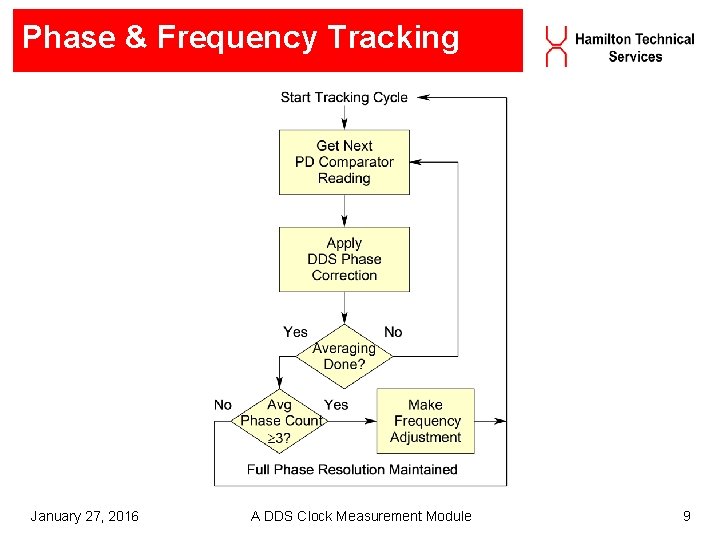
DDS Clock Measurements • The phase tracking loop of the DDS clock measurement system keeps the phase detector centered at quadrature. • It uses the DDS phase word to produce a phase data stream to a USB port. • The phase comparator information is also used to make DDS frequency adjustments as required to maintain phase tracking. January 27, 2016 A DDS Clock Measurement Module 6
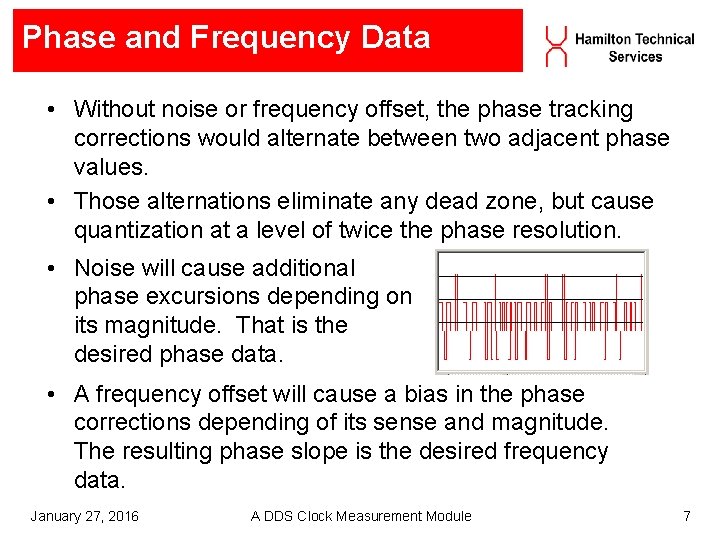
Phase and Frequency Data • Without noise or frequency offset, the phase tracking corrections would alternate between two adjacent phase values. • Those alternations eliminate any dead zone, but cause quantization at a level of twice the phase resolution. • Noise will cause additional phase excursions depending on its magnitude. That is the desired phase data. • A frequency offset will cause a bias in the phase corrections depending of its sense and magnitude. The resulting phase slope is the desired frequency data. January 27, 2016 A DDS Clock Measurement Module 7
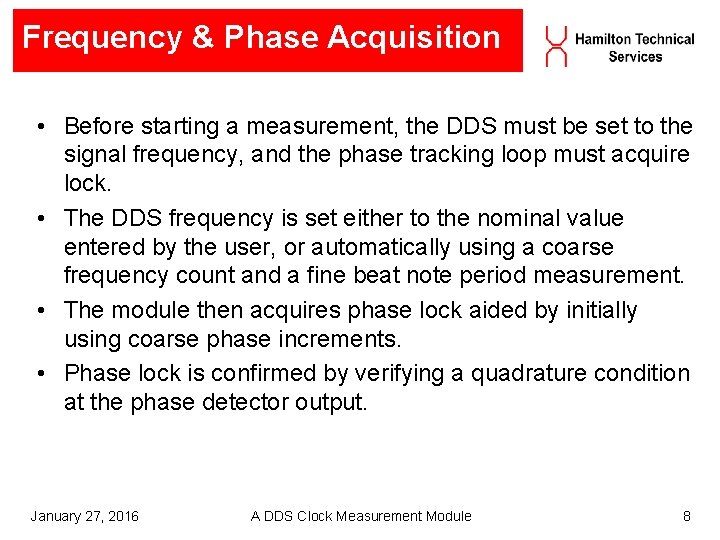
Frequency & Phase Acquisition • Before starting a measurement, the DDS must be set to the signal frequency, and the phase tracking loop must acquire lock. • The DDS frequency is set either to the nominal value entered by the user, or automatically using a coarse frequency count and a fine beat note period measurement. • The module then acquires phase lock aided by initially using coarse phase increments. • Phase lock is confirmed by verifying a quadrature condition at the phase detector output. January 27, 2016 A DDS Clock Measurement Module 8
Phase & Frequency Tracking January 27, 2016 A DDS Clock Measurement Module 9
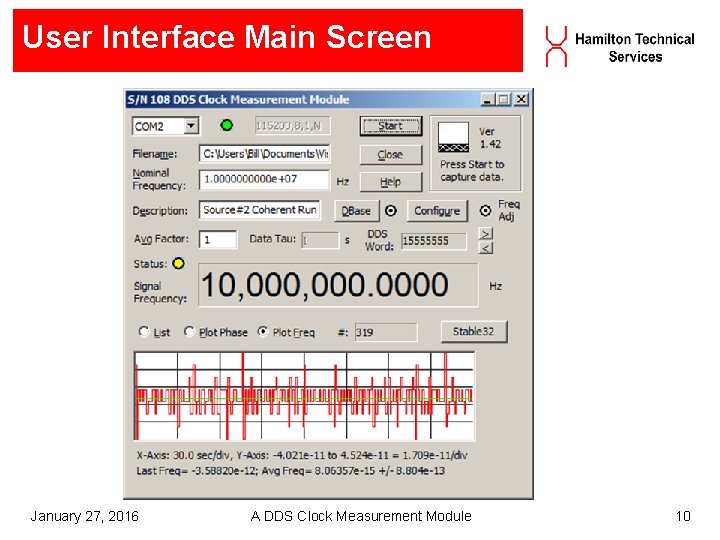
User Interface Main Screen January 27, 2016 A DDS Clock Measurement Module 10
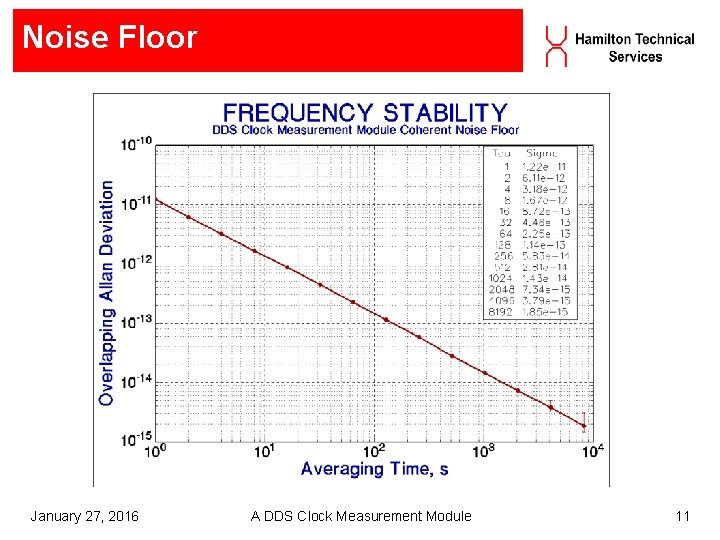
Noise Floor January 27, 2016 A DDS Clock Measurement Module 11
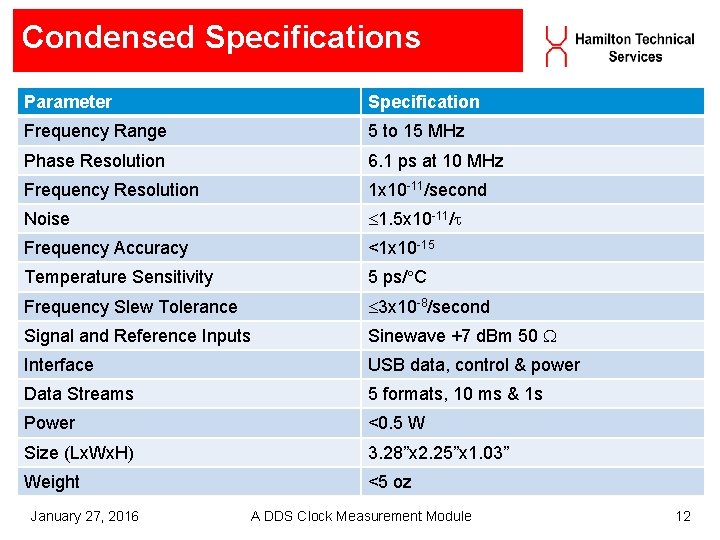
Condensed Specifications Parameter Specification Frequency Range 5 to 15 MHz Phase Resolution 6. 1 ps at 10 MHz Frequency Resolution 1 x 10 -11/second Noise 1. 5 x 10 -11/t Frequency Accuracy <1 x 10 -15 Temperature Sensitivity 5 ps/ C Frequency Slew Tolerance 3 x 10 -8/second Signal and Reference Inputs Sinewave +7 d. Bm 50 Interface USB data, control & power Data Streams 5 formats, 10 ms & 1 s Power <0. 5 W Size (Lx. Wx. H) 3. 28”x 2. 25”x 1. 03” Weight <5 oz January 27, 2016 A DDS Clock Measurement Module 12
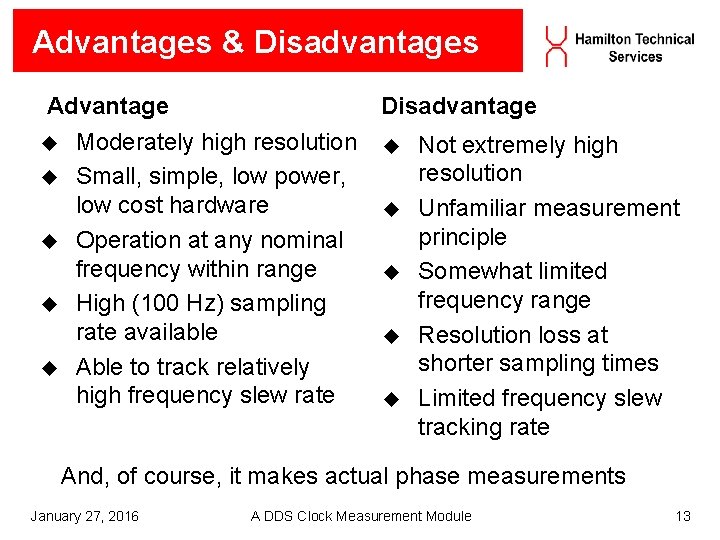
Advantages & Disadvantages Advantage u Moderately high resolution u Small, simple, low power, low cost hardware u Operation at any nominal frequency within range u High (100 Hz) sampling rate available u Able to track relatively high frequency slew rate Disadvantage u u u Not extremely high resolution Unfamiliar measurement principle Somewhat limited frequency range Resolution loss at shorter sampling times Limited frequency slew tracking rate And, of course, it makes actual phase measurements January 27, 2016 A DDS Clock Measurement Module 13
Applications • Phase and frequency measurements: o For just about any precise or semi-precise source at any frequency between 5 -15 MHz • Particularly well-suited for: o Measurements against a GPS timing receiver o Portable measurements with a laptop computer o A substitute for a high-resolution counter o Avoiding tying up an expensive system o Embedding into an instrument January 27, 2016 A DDS Clock Measurement Module 14
Conclusion The DDS clock measurement concept has been proven viable, and is an effective technique for making precise phase measurements. January 27, 2016 A DDS Clock Measurement Module 15
Backup Slides January 27, 2016 A DDS Clock Measurement Module 16
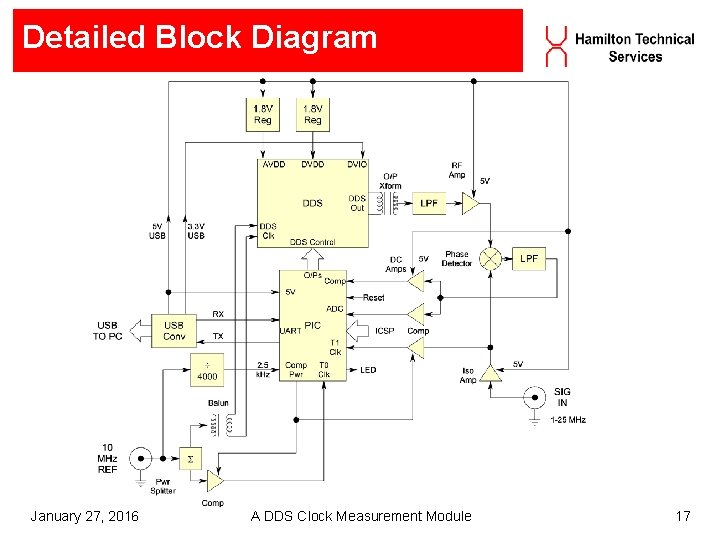
Detailed Block Diagram January 27, 2016 A DDS Clock Measurement Module 17
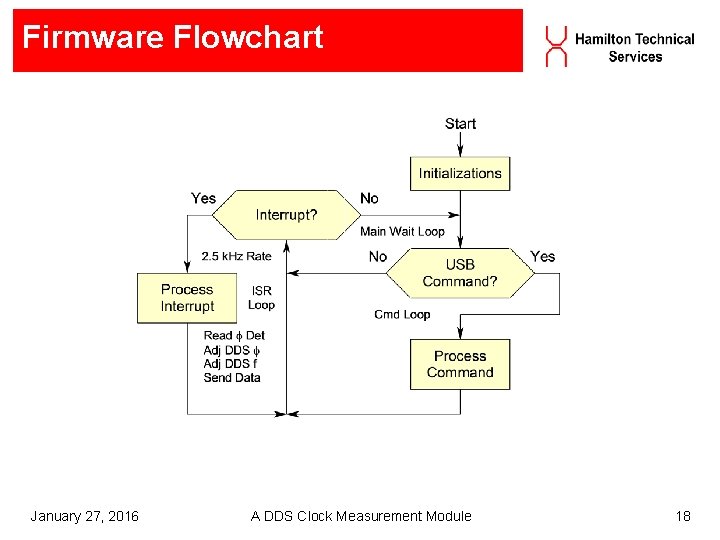
Firmware Flowchart January 27, 2016 A DDS Clock Measurement Module 18
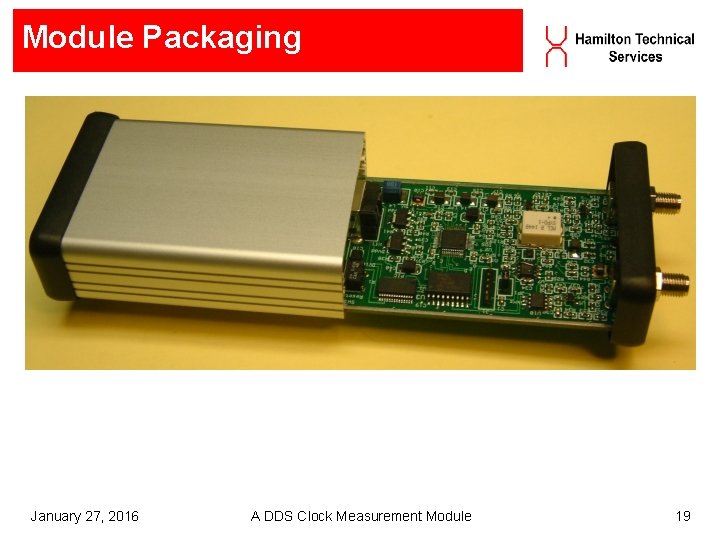
Module Packaging January 27, 2016 A DDS Clock Measurement Module 19
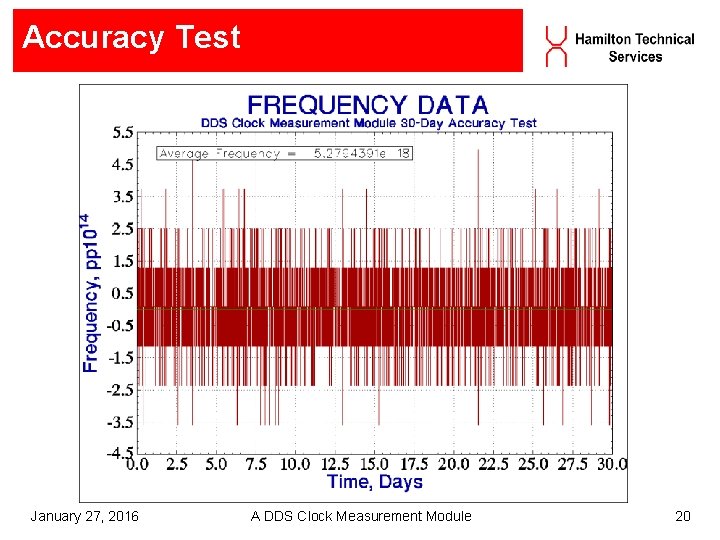
Accuracy Test January 27, 2016 A DDS Clock Measurement Module 20
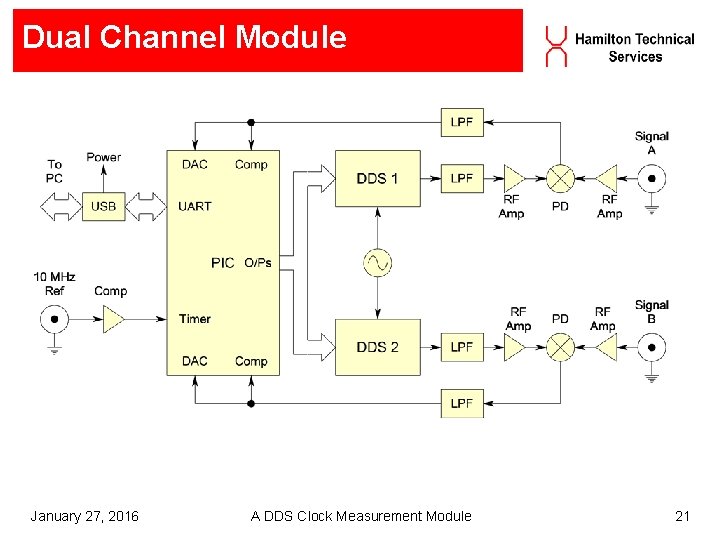
Dual Channel Module January 27, 2016 A DDS Clock Measurement Module 21
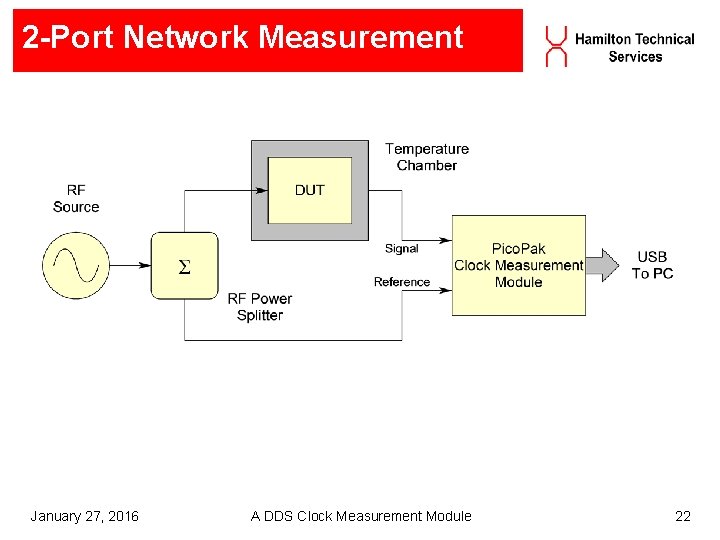
2 -Port Network Measurement January 27, 2016 A DDS Clock Measurement Module 22
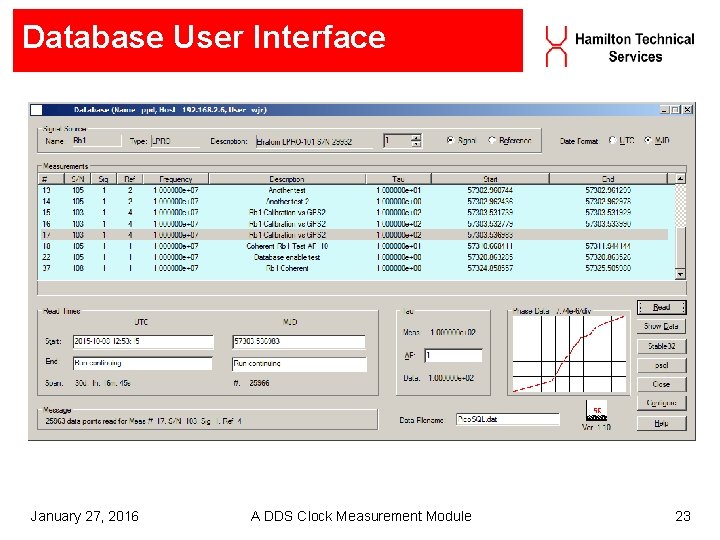
Database User Interface January 27, 2016 A DDS Clock Measurement Module 23
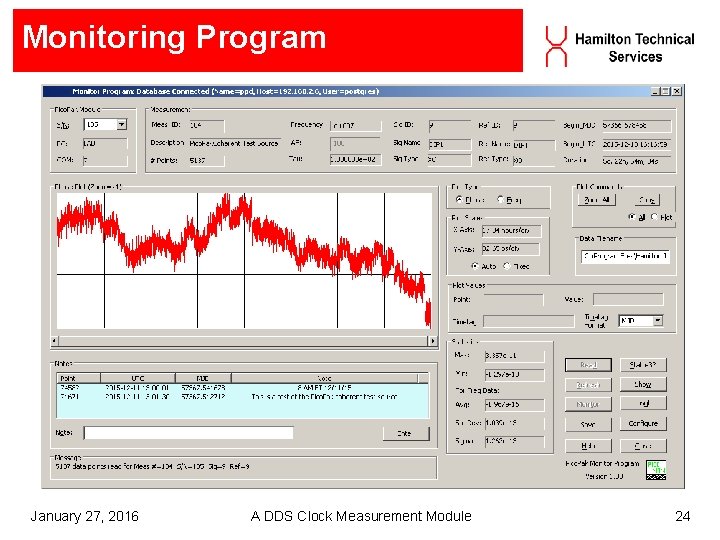
Monitoring Program January 27, 2016 A DDS Clock Measurement Module 24