
A Daydream a Nightmare and an Awakening How


- Slides: 18
A Daydream, a Nightmare and an Awakening: How Derek Walcott’s “The Star Apple Kingdom” teaches Postcolonial Theory (better than postcolonial theory!)
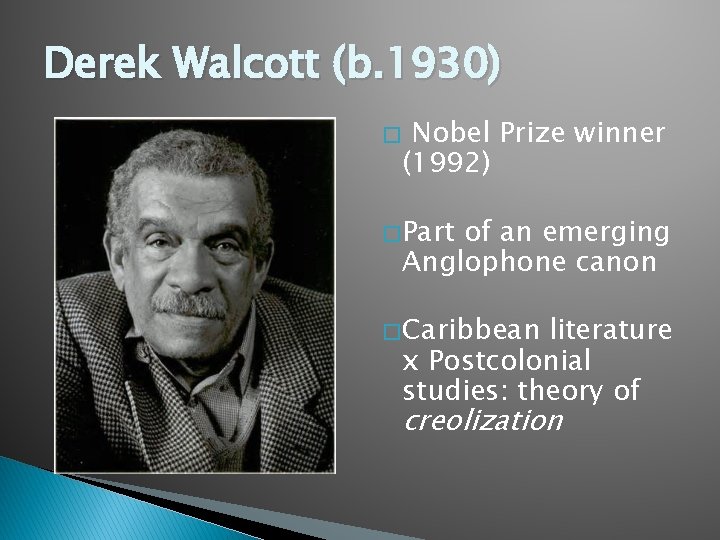
Derek Walcott (b. 1930) � Nobel Prize winner (1992) � Part of an emerging Anglophone canon � Caribbean literature x Postcolonial studies: theory of creolization
Divided to the vein? Both grandmothers, descendents of slaves Both grandfathers, British citizens Son of mixed race parents Middleclass, Protestant, English speaking boy in a Poor, Catholic, French Creole speaking community Relationship of self/place
“A Far Cry from Africa” [1962] I who am poisoned with blood of both, Where shall I turn, divided to the vein? I who have cursed The drunken officer of the British rule, how choose Between this Africa and the English tongue I love? Betray them both, or give back what they give? How can I face such slaughter and be cool? How can I turn from Africa and live?
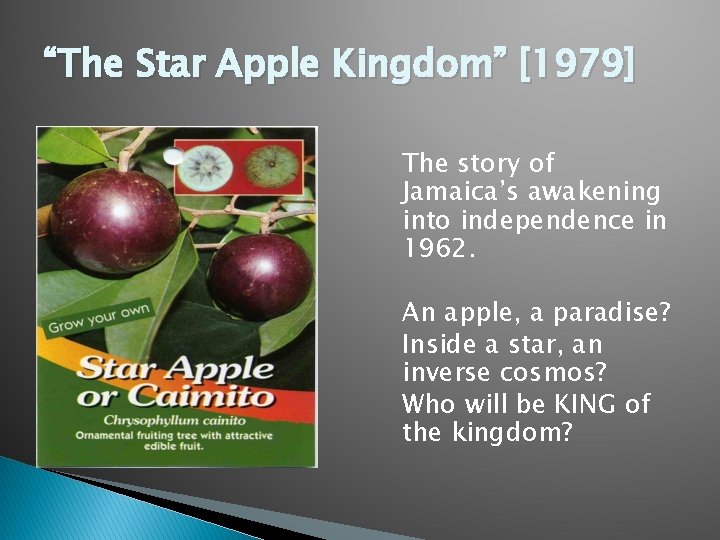
“The Star Apple Kingdom” [1979] The story of Jamaica’s awakening into independence in 1962. An apple, a paradise? Inside a star, an inverse cosmos? Who will be KING of the kingdom?
Three Themes Worth Our Time � Politics of representation – HOW to write the Caribbean, made to answer to the wrong names? � Hybrid identity: Creolization, literal and figurative – WHO can speak for Jamaica? � Postcolonial Temporality: daydream, nightmare, awakening – WHEN is a nation? 1834? 1962?
Resisting English Pastoral There are still shards of an ancient pastoral In those shires of the island where the cattle drank their pools of shadow from an older sky, surviving from when the landscape copied such subjects as “Herefords at Sunset in the Valley of Wye. ”
Language converted, A landscape mis-named The mountain water that fell white from the mill wheel …would repeat… in tongues of Mission school pickaninnies, like rivers remembering their source, Parish Trelawny, Parish St. David, Parish St. Andrew, the names afflicting the pastures…
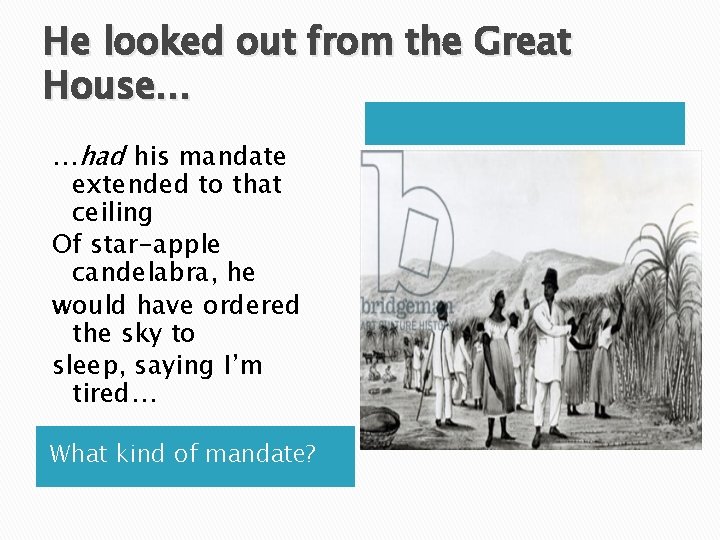
He looked out from the Great House… …had his mandate extended to that ceiling Of star-apple candelabra, he would have ordered the sky to sleep, saying I’m tired… What kind of mandate?
Why tired? A fatigued colonial daydream …the rancor of hatred hid in that dream Of slow rivers and lily-like parasols, in snaps of fine old colonial families, curled at the edge, not from age or from fire…not at all, But because, off at its edges, innocently excluded, Stood the groom, the cattle boy, the housemaid, the gardeners…their mouths in the locked jaw of a silent scream.
Daydream turns to Nightmare He swayed like a stone down fathoms into sleep, drawn by that magnet which pulls down half the world/between a star and a star… [he dreamed he heard] a hymn ascending to earth from a heaven inverted by water, a crab climbing the steeple… the scholars lamplit by in their own aquarium, he saw them mouthing like parrot fish… their history lessons, the bubbles like ideas which he could not break…
I’m the Revolution …until a black woman, shawled like a buzzard, Climbed up the stairs and knocked at the door of his dream, whispering in the ear of the keyhole: “Let me in, I’m finished with praying. I’m the Revolution. I am the darker, the older America. ”
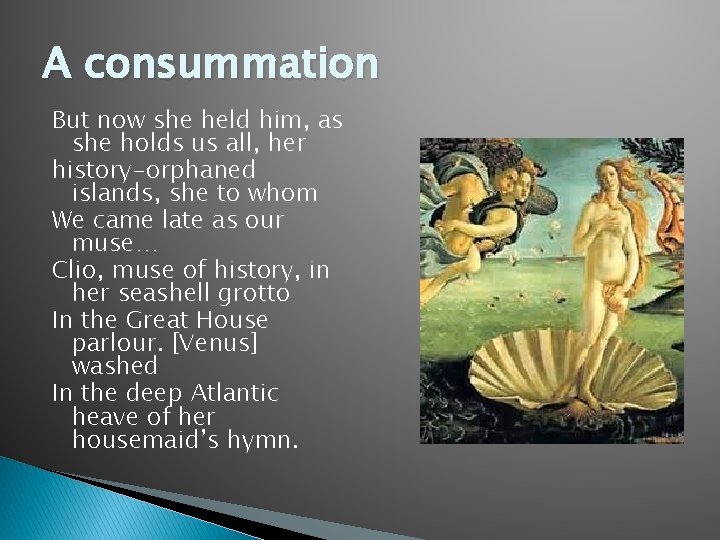
A consummation But now she held him, as she holds us all, her history-orphaned islands, she to whom We came late as our muse… Clio, muse of history, in her seashell grotto In the Great House parlour. [Venus] washed In the deep Atlantic heave of her housemaid’s hymn.
A re-marriage? He was a bride under lace, remarrying his country, a child drawn by the roars of the mill wheel’s electorate, those vows reaffirmed.
Imagery Revisited On the knee-hollowed steps of the crusted cathedral, there was a woman in black… She heard as the dog hears, what all the underdogs of the world hear, the pitched shriek of silence. Star-apples rained to the ground in that silence…
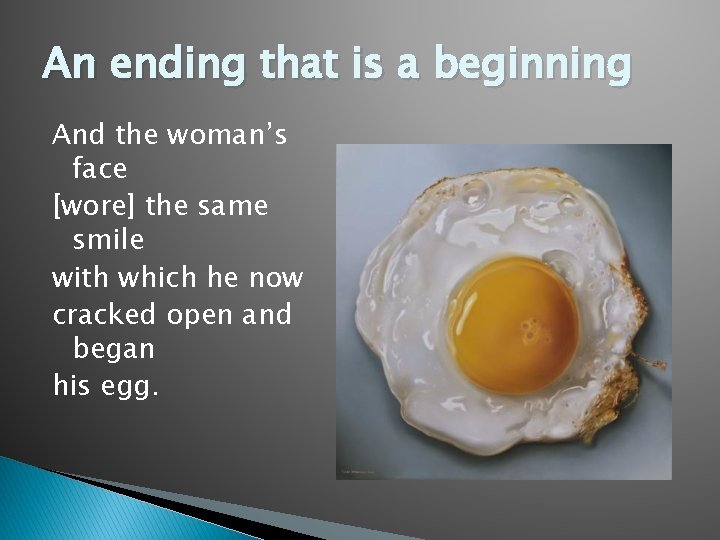
An ending that is a beginning And the woman’s face [wore] the same smile with which he now cracked open and began his egg.
Poco issues the Poem makes vivid � Politics of representation – Re-telling the history of the Caribbean (no longer able to sleep “the sleep that wipes out history” � Hybrid identity – told by a creolized speaker, with creolized imagery, allusions, and forms � Postcolonial Temporality: precolonial/postcolonial layered consciousness
Thank you!