
A Dashboard Framework for Community Resilience Assessments Resilient
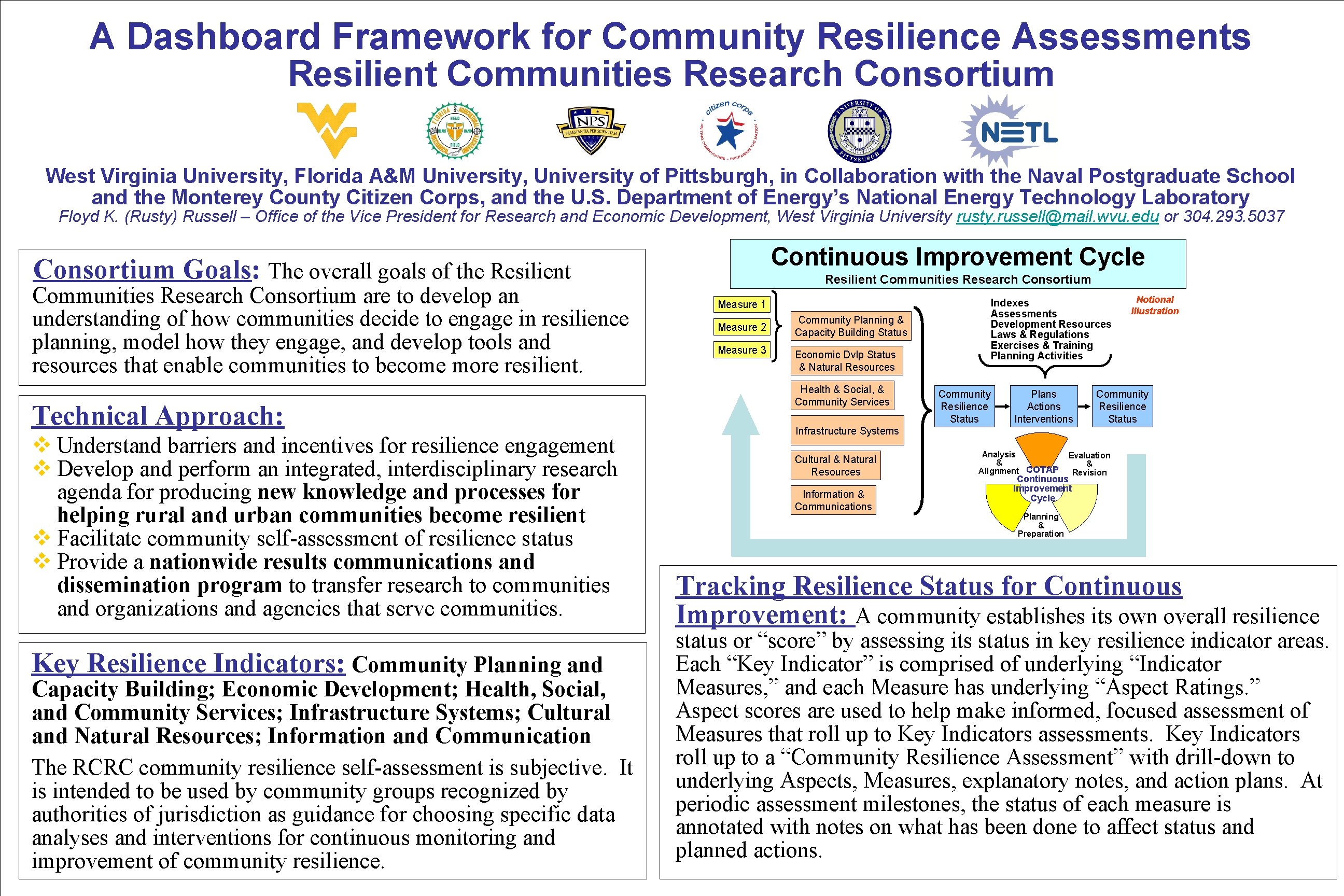
A Dashboard Framework for Community Resilience Assessments Resilient Communities Research Consortium West Virginia University, Florida A&M University, University of Pittsburgh, in Collaboration with the Naval Postgraduate School and the Monterey County Citizen Corps, and the U. S. Department of Energy’s National Energy Technology Laboratory Floyd K. (Rusty) Russell – Office of the Vice President for Research and Economic Development, West Virginia University rusty. russell@mail. wvu. edu or 304. 293. 5037 Continuous Improvement Cycle Consortium Goals: The overall goals of the Resilient Communities Research Consortium are to develop an understanding of how communities decide to engage in resilience planning, model how they engage, and develop tools and resources that enable communities to become more resilient. Technical Approach: v Understand barriers and incentives for resilience engagement v Develop and perform an integrated, interdisciplinary research agenda for producing new knowledge and processes for helping rural and urban communities become resilient v Facilitate community self-assessment of resilience status v Provide a nationwide results communications and dissemination program to transfer research to communities and organizations and agencies that serve communities. Key Resilience Indicators: Community Planning and Capacity Building; Economic Development; Health, Social, and Community Services; Infrastructure Systems; Cultural and Natural Resources; Information and Communication The RCRC community resilience self-assessment is subjective. It is intended to be used by community groups recognized by authorities of jurisdiction as guidance for choosing specific data analyses and interventions for continuous monitoring and improvement of community resilience. Resilient Communities Research Consortium Measure 1 Measure 2 Measure 3 Community Planning & Capacity Building Status Economic Dvlp Status & Natural Resources Health & Social, & Community Services Indexes Assessments Development Resources Laws & Regulations Exercises & Training Planning Activities Community Resilience Status Plans Actions Interventions Notional Illustration Community Resilience Status Infrastructure Systems Cultural & Natural Resources Information & Communications Analysis & Alignment COTAP Evaluation & Revision Continuous Improvement Cycle Planning & Preparation Tracking Resilience Status for Continuous Improvement: A community establishes its own overall resilience status or “score” by assessing its status in key resilience indicator areas. Each “Key Indicator” is comprised of underlying “Indicator Measures, ” and each Measure has underlying “Aspect Ratings. ” Aspect scores are used to help make informed, focused assessment of Measures that roll up to Key Indicators assessments. Key Indicators roll up to a “Community Resilience Assessment” with drill-down to underlying Aspects, Measures, explanatory notes, and action plans. At periodic assessment milestones, the status of each measure is annotated with notes on what has been done to affect status and planned actions.
- Slides: 1