
A Cylindrical Polarimetric Phased Array Radar System Design
![CPPAR Array Hardware Design • Operates in four sectors. [5] • Installed as a](https://slidetodoc.com/presentation_image_h2/fdb79f19059fa211c769e906ef577168/image-6.jpg "CPPAR Array Hardware Design • Operates in four sectors. [5] • Installed as a")
![Some Images of the System Figure taken from [7] Figure taken from [6]](https://slidetodoc.com/presentation_image_h2/fdb79f19059fa211c769e906ef577168/image-7.jpg "Some Images of the System Figure taken from [7] Figure taken from [6]")
![Beam-patterns Figure taken from [4] • Simulated Results on the left for various frequencies,](https://slidetodoc.com/presentation_image_h2/fdb79f19059fa211c769e906ef577168/image-8.jpg "Beam-patterns Figure taken from [4] • Simulated Results on the left for various frequencies,")
![Co-pol and Cross-pol patterns • • Figure taken from [5] W = cos(θ), V](https://slidetodoc.com/presentation_image_h2/fdb79f19059fa211c769e906ef577168/image-9.jpg "Co-pol and Cross-pol patterns • • Figure taken from [5] W = cos(θ), V")
![CPPAR in action Figure taken from [6] Left is CPPAR, Right is nearby KTLX](https://slidetodoc.com/presentation_image_h2/fdb79f19059fa211c769e906ef577168/image-10.jpg "CPPAR in action Figure taken from [6] Left is CPPAR, Right is nearby KTLX")
![CPPAR in action Figure taken from [6] Left is CPPAR, Right is nearby KTLX](https://slidetodoc.com/presentation_image_h2/fdb79f19059fa211c769e906ef577168/image-11.jpg "CPPAR in action Figure taken from [6] Left is CPPAR, Right is nearby KTLX")
![CPPAR in action Figure taken from [6] Left is CPPAR, Right is nearby KTLX](https://slidetodoc.com/presentation_image_h2/fdb79f19059fa211c769e906ef577168/image-12.jpg "CPPAR in action Figure taken from [6] Left is CPPAR, Right is nearby KTLX")
![References • [1] G. Zhang, R. J. Doviak, D. S. Zrni´c, et. al. ,](https://slidetodoc.com/presentation_image_h2/fdb79f19059fa211c769e906ef577168/image-14.jpg "References • [1] G. Zhang, R. J. Doviak, D. S. Zrni´c, et. al. ,")

- Slides: 15
A Cylindrical Polarimetric Phased Array Radar System Design • Thomas J Kramer • EECS 823
Introduction • In Microwave Radiometry, the use of polarization is important in many applications, including weather radar. • Performance of polarimetric operations modes is heavily dependent on the separation of the polarization channels. • In order to achieve improved polarization separation, researchers at the University of Oklahoma (OU) have proposed a cylindrical array radar system.
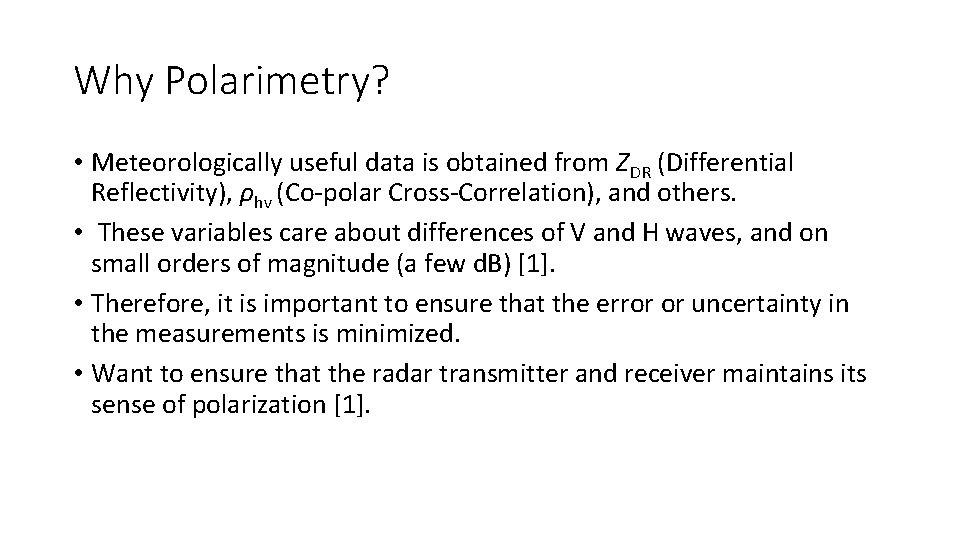
Why Polarimetry? • Meteorologically useful data is obtained from ZDR (Differential Reflectivity), ρhv (Co-polar Cross-Correlation), and others. • These variables care about differences of V and H waves, and on small orders of magnitude (a few d. B) [1]. • Therefore, it is important to ensure that the error or uncertainty in the measurements is minimized. • Want to ensure that the radar transmitter and receiver maintains its sense of polarization [1].
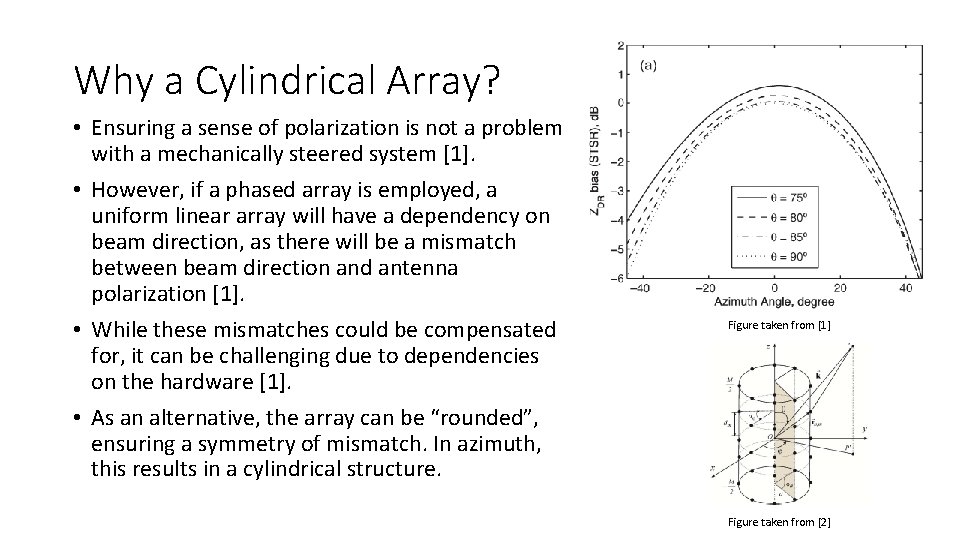
Why a Cylindrical Array? • Ensuring a sense of polarization is not a problem with a mechanically steered system [1]. • However, if a phased array is employed, a uniform linear array will have a dependency on beam direction, as there will be a mismatch between beam direction and antenna polarization [1]. • While these mismatches could be compensated for, it can be challenging due to dependencies on the hardware [1]. • As an alternative, the array can be “rounded”, ensuring a symmetry of mismatch. In azimuth, this results in a cylindrical structure. Figure taken from [1] Figure taken from [2]
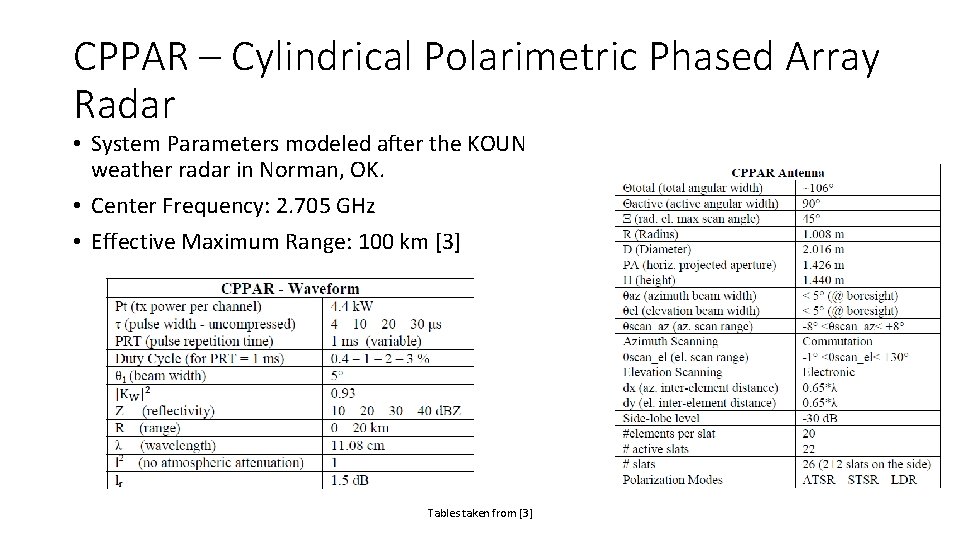
CPPAR – Cylindrical Polarimetric Phased Array Radar • System Parameters modeled after the KOUN weather radar in Norman, OK. • Center Frequency: 2. 705 GHz • Effective Maximum Range: 100 km [3] Tables taken from [3]
CPPAR Array Hardware Design • Operates in four sectors. [5] • Installed as a series of 19 element vertical strips. [4] • 96 columns of vertical subarrays. [6] • 1, 824 elements in total. Figure taken from [4] Figure taken from [5]
Some Images of the System Figure taken from [7] Figure taken from [6]
Beam-patterns Figure taken from [4] • Simulated Results on the left for various frequencies, measured on the right. • Beampattern calibrated and optimized for 2. 8 GHz. Similar, yet different for each polarization. Figure taken from [6]
Co-pol and Cross-pol patterns • • Figure taken from [5] W = cos(θ), V = sin(θ)cos(ɸ) Peak PPAR cross-pol: -11. 5 d. B Peak CPPAR cross-pol: -28 d. B Significant improvement with cylindrical structure due to the symmetry.
CPPAR in action Figure taken from [6] Left is CPPAR, Right is nearby KTLX Radar Figure taken from [6]
CPPAR in action Figure taken from [6] Left is CPPAR, Right is nearby KTLX Radar Figure taken from [6]
CPPAR in action Figure taken from [6] Left is CPPAR, Right is nearby KTLX Radar Figure taken from [6]
Conclusions • The CPPAR provides a solution to specific but important factor to weather radar. • The system is well-documented, and provides a great example of the work it takes to bring an idea from theory to reality. • For the report, still need to perform basic radar analysis, as well as attempt to generate theoretical beam patterns and co/cross-pol responses.
References • [1] G. Zhang, R. J. Doviak, D. S. Zrni´c, et. al. , “Phased Array Radar Polarimetry for Weather Sensing: A Theoretical Formulation for Bias Corrections, ” IEEE Transactions on Geoscience and Remote Sensing, Vol. 47, No. 11, Nov. 2009. • [2] A. Shevchenko, S. Piskunov, G. Levagin, et. al. , “Statistical Characteristics of Cyllindrical Antenna Array, ” 2020 IEEE Ukrainian Microwave Week, Kharklv, Ukraine, Sept 2020. • [3] M. Galletti, D. Zrnic, G. Zhang, D. Doviak, J. Crain, “CPPAR – Cylindrical Polarimetric Phased Array Radar System Design, ” 2011 IEEE Radar. Con (RADAR), Kansas City, MO, May 2011. • [4] H. Saeidi-Manesh, G. Zhang, “Optimized Dual-Linear Polarization Frequency Scanning Microstrip Array Antenna for Cylindrical Polarimetric Phased Array Radar (CPPAR), ” 2017 IEEE International Symposium on Antennas and Propagation & USNC/URSI National Radio Science Meeting, 2017. • [5] L. Lei, G. Zhang, R. J. Doviak, “Design and Simulations for a Cylindrical Polarimetric Phased Array Weather Radar, ” 2011 IEEE Radar. Con (RADAR), Kansas City, MO, May 2011. • [6] Z. Li, G. Zhang, M. Golbon-Haghighi, et. al. , “Initial Observations With Electronic and Mechanical Scans Using a Cylindrical Polarimetric Phased Array Radar, ” IEEE Geoscience and Remote Sensing Letters, 2020. • [7] https: //arrc. ou. edu/radar_cppar. html
Any Questions?