
A Cyclone Phase Space Derived from Thermal Wind
- Slides: 42
A Cyclone Phase Space Derived from Thermal Wind & Thermal Asymmetry
Robert Hart Department of Meteorology Penn State University hart@ems. psu. edu http: //eyewall. met. psu. edu/cyclonephase
Introduction: The Problem • Tropical and extratropical cyclones historically have been viewed as two discrete, mutual exclusive cyclone groups. • Warm SSTs, increased surface fluxes, enhanced convection, enhanced latent heat release & warm-seclusion within extratropical cyclones can blur that once-perceived fine line between tropical and extratropical cyclones. • Cyclones that have aspects of both tropical and extratropical cyclones are difficult to completely explain by individual development theories. • Yet, synthesizing tropical cyclone & extratropical cyclone development theories is difficult. • Cyclone predictability (both numerically and in reality) is likely related to cyclone phase. • Current diagnosis and forecast methods do not adequately address such a gray area of cyclone development & cyclone transition.
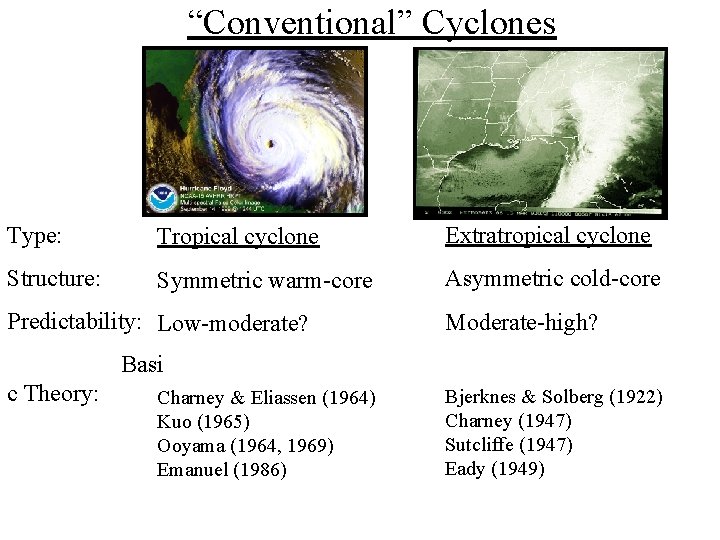
“Conventional” Cyclones Type: Tropical cyclone Extratropical cyclone Structure: Symmetric warm-core Asymmetric cold-core Predictability: Low-moderate? Moderate-high? Basi c Theory: Charney & Eliassen (1964) Kuo (1965) Ooyama (1964, 1969) Emanuel (1986) Bjerknes & Solberg (1922) Charney (1947) Sutcliffe (1947) Eady (1949)
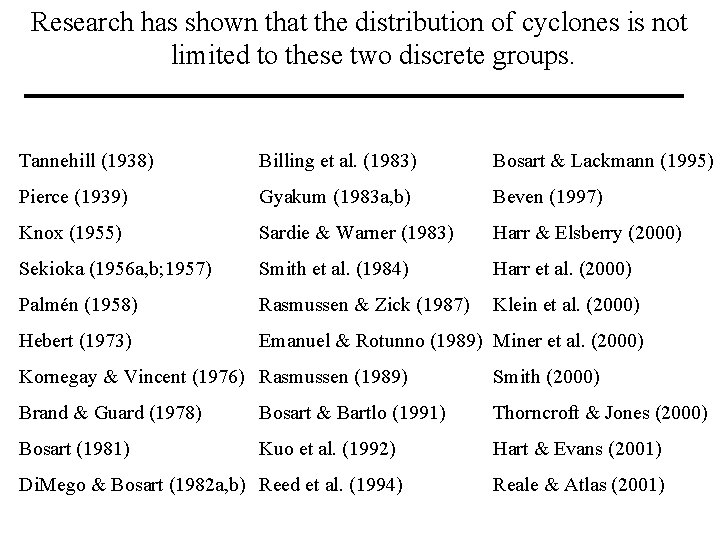
Research has shown that the distribution of cyclones is not limited to these two discrete groups. Tannehill (1938) Billing et al. (1983) Bosart & Lackmann (1995) Pierce (1939) Gyakum (1983 a, b) Beven (1997) Knox (1955) Sardie & Warner (1983) Harr & Elsberry (2000) Sekioka (1956 a, b; 1957) Smith et al. (1984) Harr et al. (2000) Palmén (1958) Rasmussen & Zick (1987) Klein et al. (2000) Hebert (1973) Emanuel & Rotunno (1989) Miner et al. (2000) Kornegay & Vincent (1976) Rasmussen (1989) Smith (2000) Brand & Guard (1978) Bosart & Bartlo (1991) Thorncroft & Jones (2000) Bosart (1981) Kuo et al. (1992) Hart & Evans (2001) Di. Mego & Bosart (1982 a, b) Reed et al. (1994) Reale & Atlas (2001)
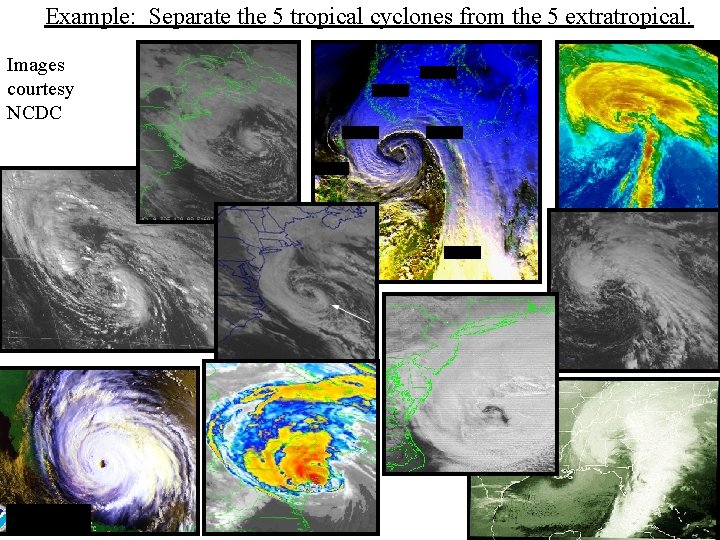
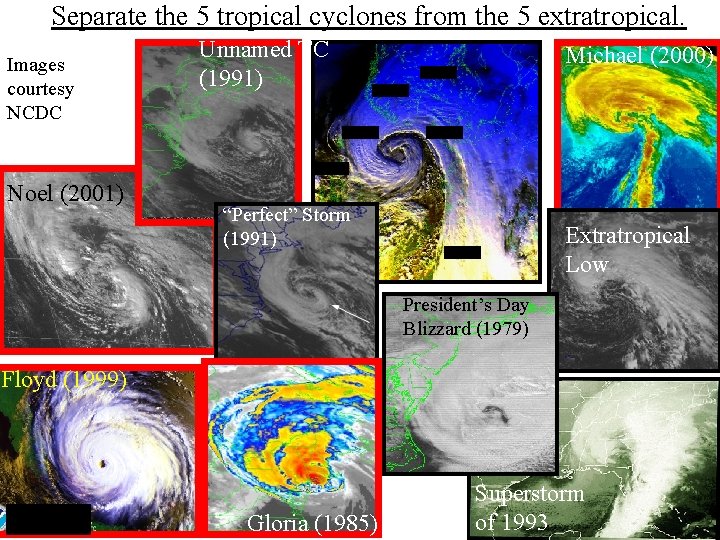
Example: Separate the 5 tropical cyclones from the 5 extratropical. Images courtesy NCDC
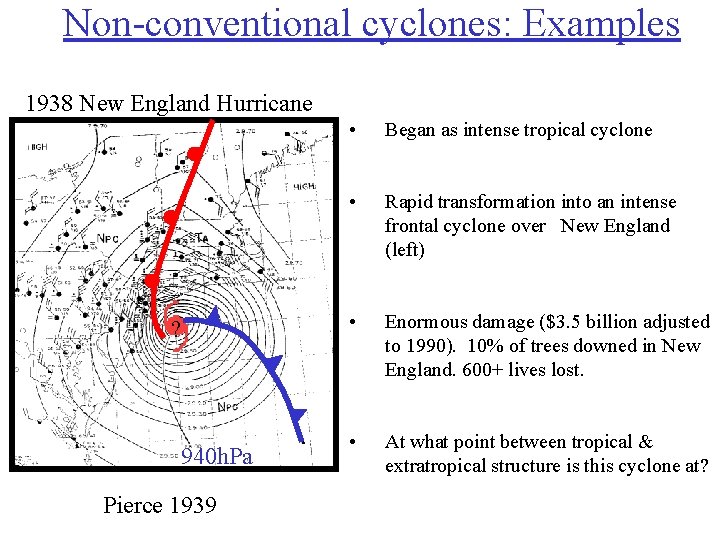
Non-conventional cyclones: Examples 1938 New England Hurricane ? 940 h. Pa Pierce 1939 • Began as intense tropical cyclone • Rapid transformation into an intense frontal cyclone over New England (left) • Enormous damage ($3. 5 billion adjusted to 1990). 10% of trees downed in New England. 600+ lives lost. • At what point between tropical & extratropical structure is this cyclone at?
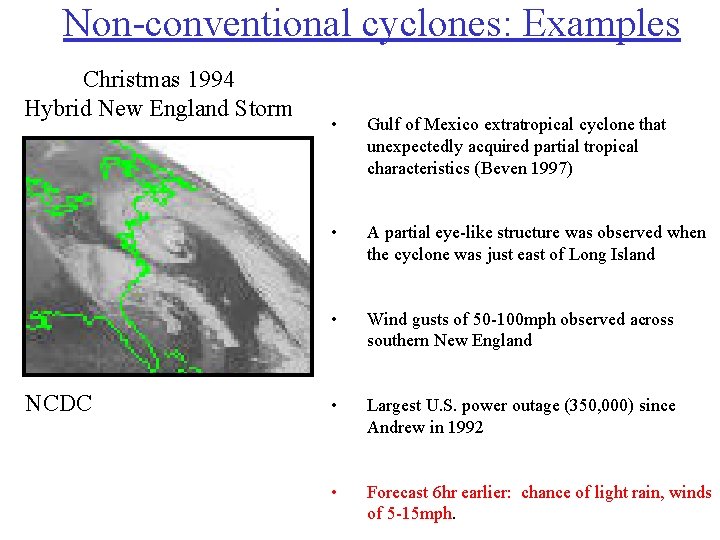
Non-conventional cyclones: Examples Christmas 1994 Hybrid New England Storm NCDC • Gulf of Mexico extratropical cyclone that unexpectedly acquired partial tropical characteristics (Beven 1997) • A partial eye-like structure was observed when the cyclone was just east of Long Island • Wind gusts of 50 -100 mph observed across southern New England • Largest U. S. power outage (350, 000) since Andrew in 1992 • Forecast 6 hr earlier: chance of light rain, winds of 5 -15 mph.
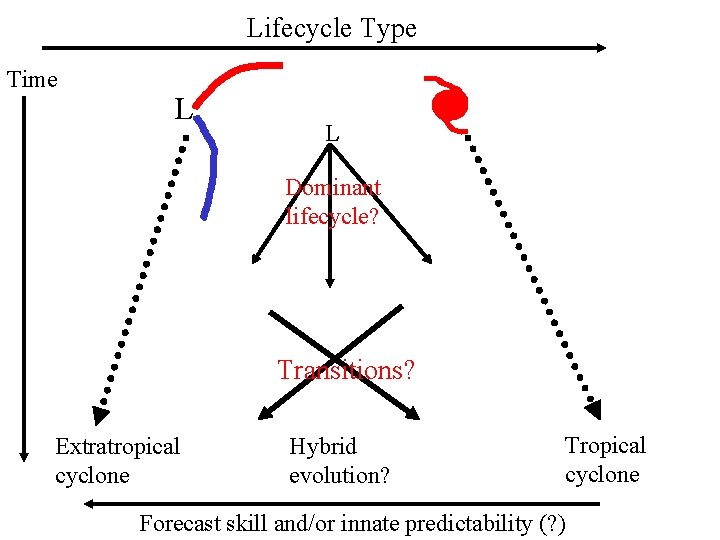
Lifecycle Type Time L L Dominant lifecycle? Transitions? Extratropical cyclone Hybrid evolution? Tropical cyclone Forecast skill and/or innate predictability (? )
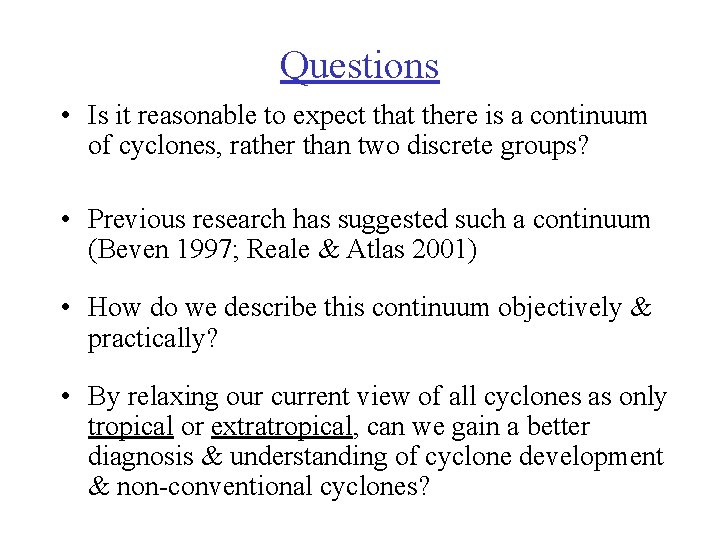
Questions • Is it reasonable to expect that there is a continuum of cyclones, rather than two discrete groups? • Previous research has suggested such a continuum (Beven 1997; Reale & Atlas 2001) • How do we describe this continuum objectively & practically? • By relaxing our current view of all cyclones as only tropical or extratropical, can we gain a better diagnosis & understanding of cyclone development & non-conventional cyclones?
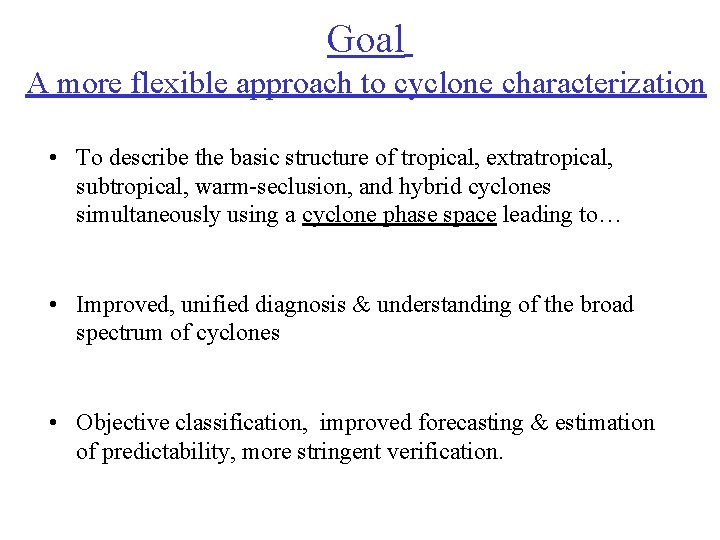
Goal A more flexible approach to cyclone characterization • To describe the basic structure of tropical, extratropical, subtropical, warm-seclusion, and hybrid cyclones simultaneously using a cyclone phase space leading to… • Improved, unified diagnosis & understanding of the broad spectrum of cyclones • Objective classification, improved forecasting & estimation of predictability, more stringent verification.
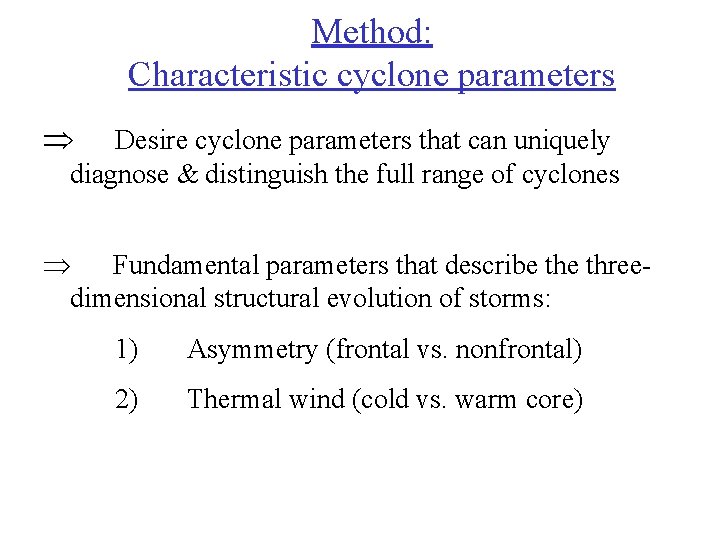
Method: Characteristic cyclone parameters Desire cyclone parameters that can uniquely diagnose & distinguish the full range of cyclones Fundamental parameters that describe threedimensional structural evolution of storms: 1) Asymmetry (frontal vs. nonfrontal) 2) Thermal wind (cold vs. warm core)
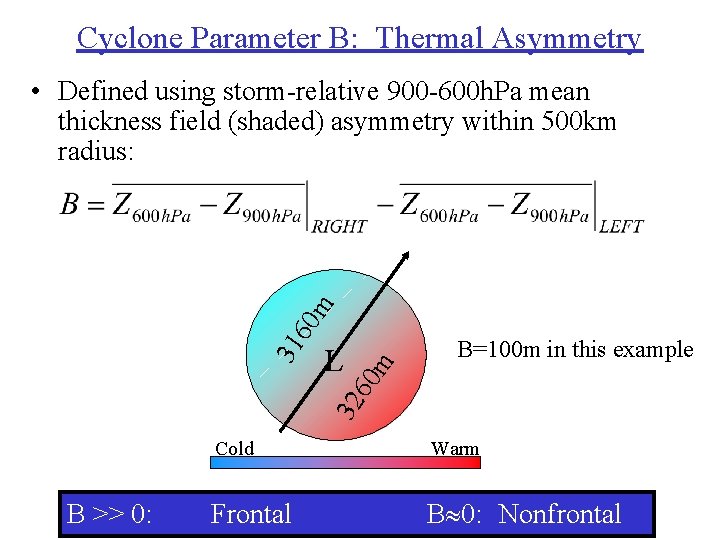
Cyclone Parameter B: Thermal Asymmetry m L B=100 m in this example 32 60 31 60 m • Defined using storm-relative 900 -600 h. Pa mean thickness field (shaded) asymmetry within 500 km radius: B >> 0: Cold Warm Frontal B 0: Nonfrontal
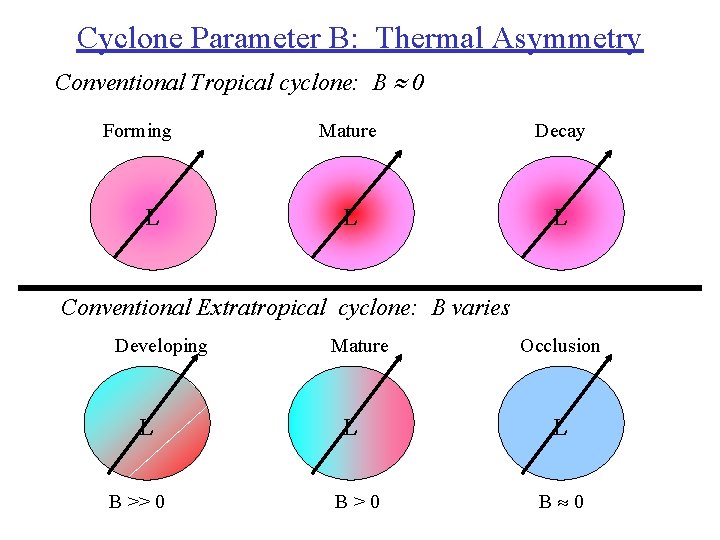
Cyclone Parameter B: Thermal Asymmetry Conventional Tropical cyclone: B 0 Forming L Mature Decay L L Conventional Extratropical cyclone: B varies Developing L B >> 0 Mature L B>0 Occlusion L B 0
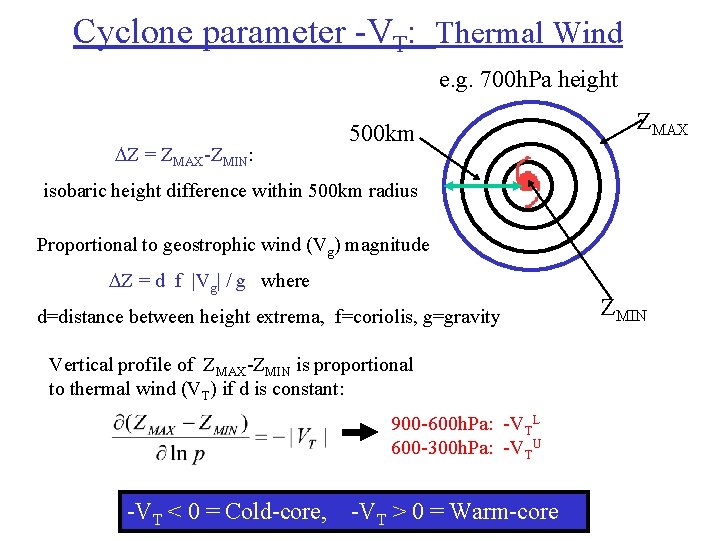
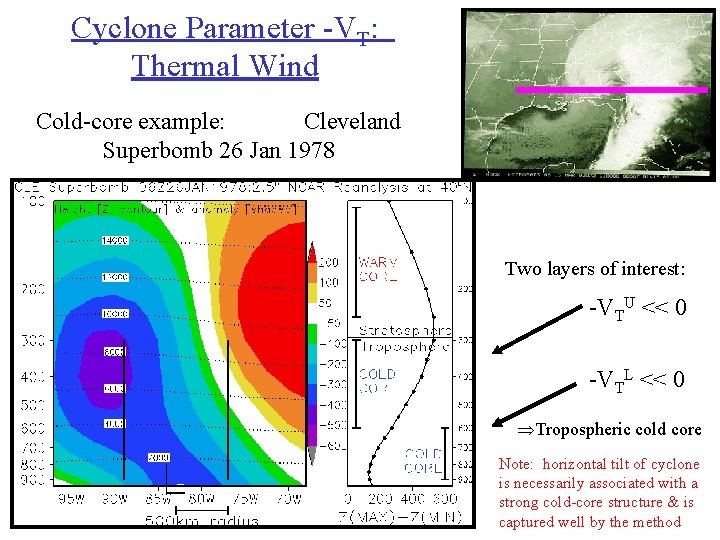
Cyclone parameter -VT: Thermal Wind e. g. 700 h. Pa height Z = ZMAX-ZMIN: 500 km ZMAX isobaric height difference within 500 km radius Proportional to geostrophic wind (Vg) magnitude Z = d f |Vg| / g where d=distance between height extrema, f=coriolis, g=gravity Vertical profile of ZMAX-ZMIN is proportional to thermal wind (VT) if d is constant: 900 -600 h. Pa: -VTL 600 -300 h. Pa: -VTU -VT < 0 = Cold-core, -VT > 0 = Warm-core ZMIN
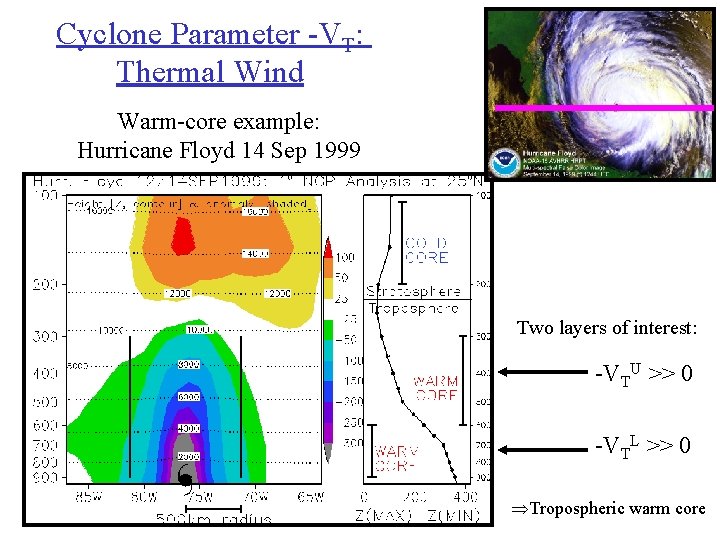
Cyclone Parameter -VT: Thermal Wind Warm-core example: Hurricane Floyd 14 Sep 1999 Two layers of interest: -VTU >> 0 -VTL >> 0 Tropospheric warm core
Cyclone Parameter -VT: Thermal Wind Cold-core example: Cleveland Superbomb 26 Jan 1978 Two layers of interest: -VTU << 0 -VTL << 0 Tropospheric cold core Note: horizontal tilt of cyclone is necessarily associated with a strong cold-core structure & is captured well by the method
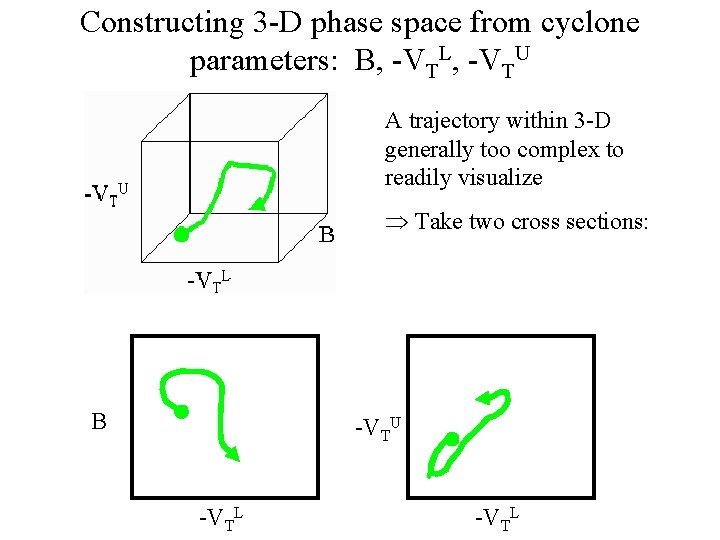
Constructing 3 -D phase space from cyclone parameters: B, -VTL, -VTU A trajectory within 3 -D generally too complex to readily visualize Take two cross sections: B -VTU -VTL
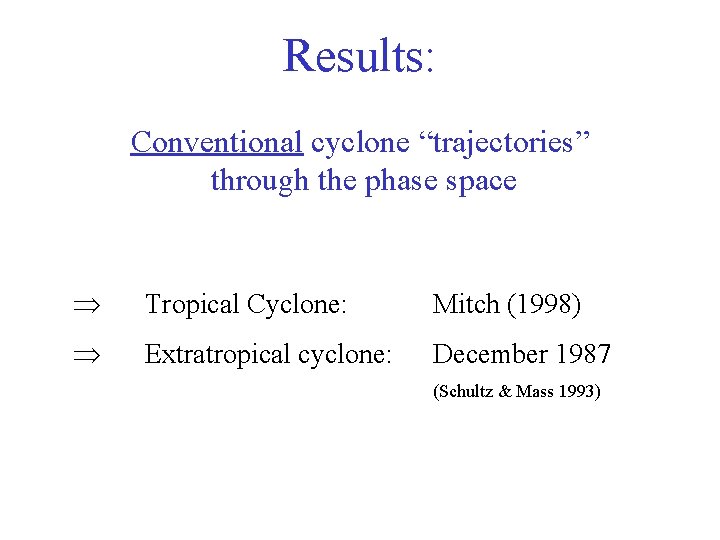
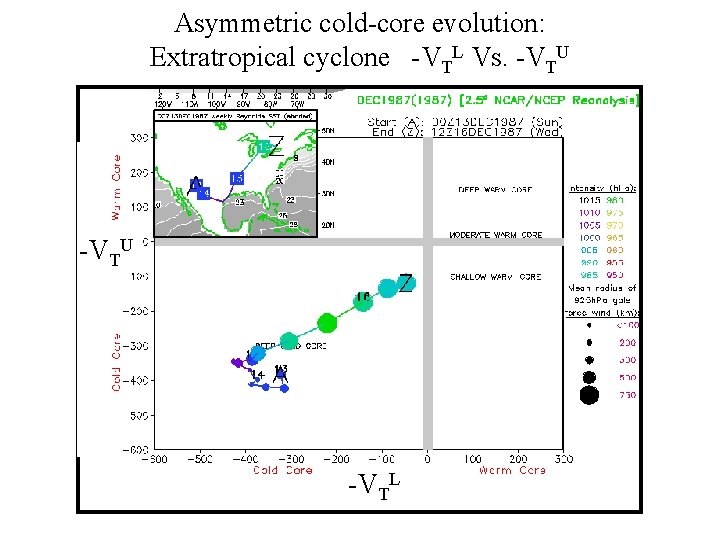
Results: Conventional cyclone “trajectories” through the phase space Tropical Cyclone: Mitch (1998) Extratropical cyclone: December 1987 (Schultz & Mass 1993)
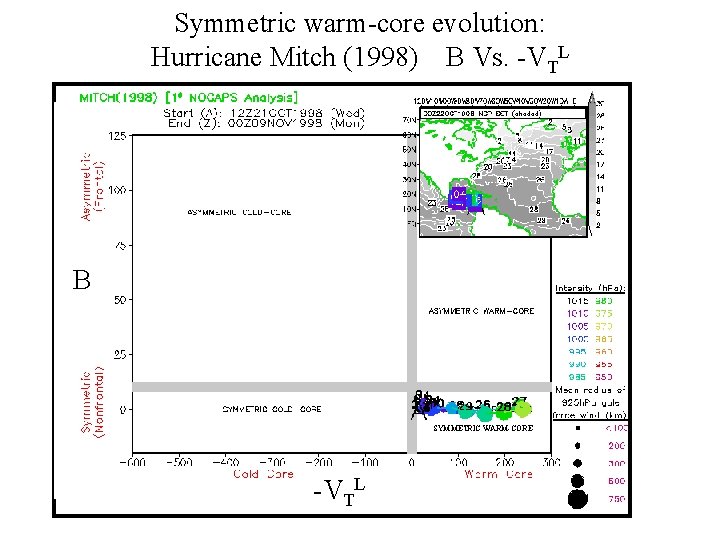
Symmetric warm-core evolution: Hurricane Mitch (1998) B Vs. -VTL B SYMMETRIC WARM-CORE -VTL
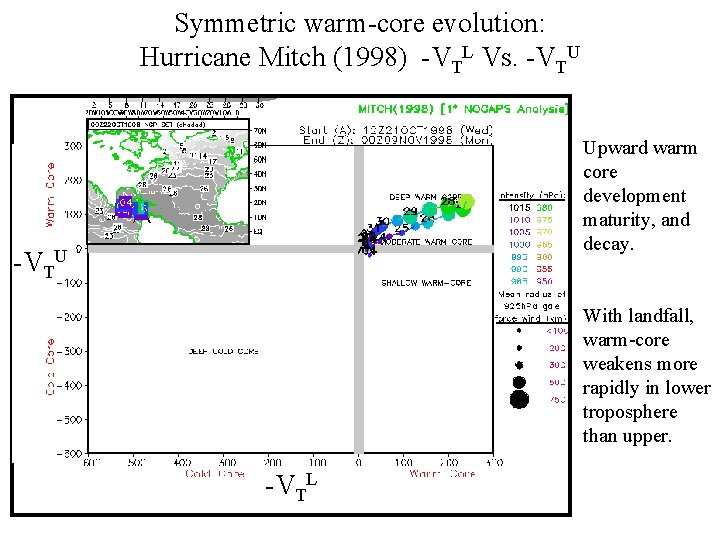
Symmetric warm-core evolution: Hurricane Mitch (1998) -VTL Vs. -VTU Upward warm core development maturity, and decay. -VTU With landfall, warm-core weakens more rapidly in lower troposphere than upper. -VTL
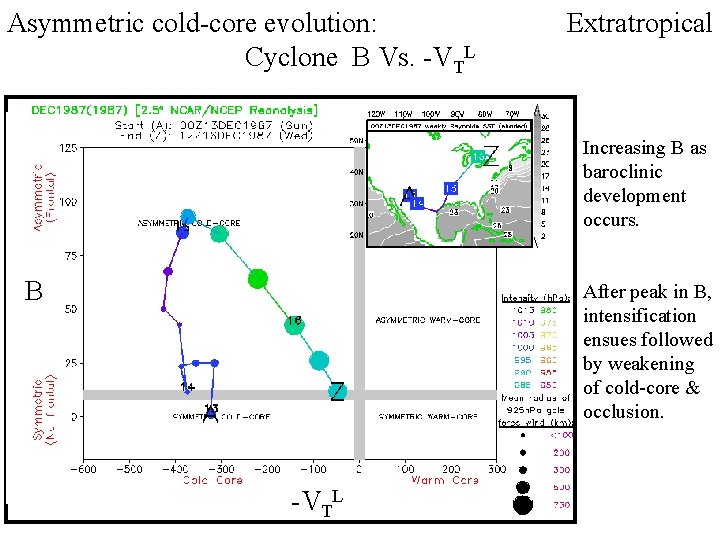
Asymmetric cold-core evolution: Cyclone B Vs. -VTL Extratropical Increasing B as baroclinic development occurs. B After peak in B, intensification ensues followed by weakening of cold-core & occlusion. -VTL
Asymmetric cold-core evolution: Extratropical cyclone -VTL Vs. -VTU -VTL
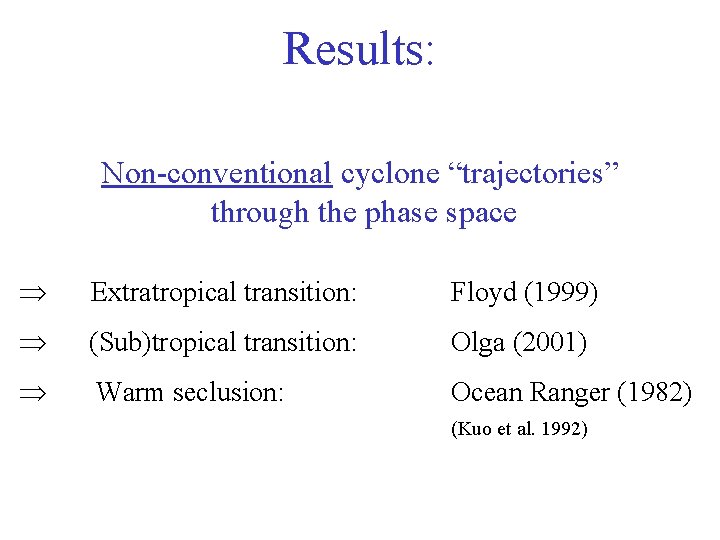
Results: Non-conventional cyclone “trajectories” through the phase space Extratropical transition: (Sub)tropical transition: Tropical transition: Floyd (1999) Olga (2001) Ocean Ranger (1982) Warm seclusion: (Kuo et al. 1992)
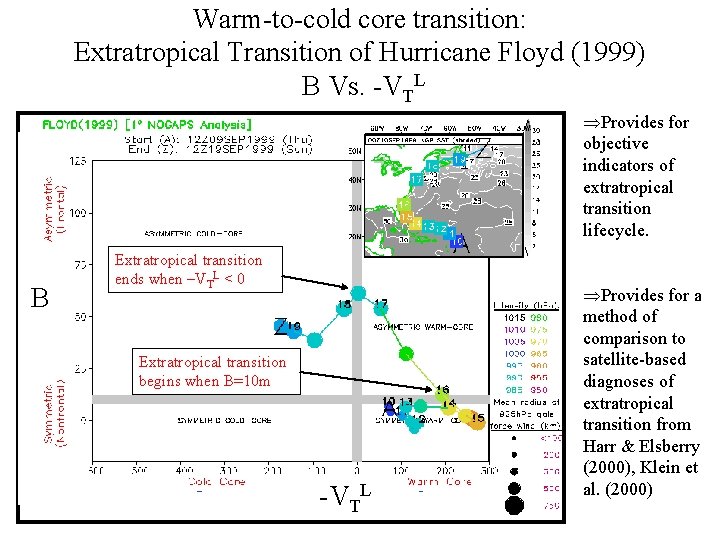
Warm-to-cold core transition: Extratropical Transition of Hurricane Floyd (1999) B Vs. -VTL Provides for objective indicators of extratropical transition lifecycle. B Extratropical transition ends when –VTL < 0 Extratropical transition begins when B=10 m -VTL Provides for a method of comparison to satellite-based diagnoses of extratropical transition from Harr & Elsberry (2000), Klein et al. (2000)
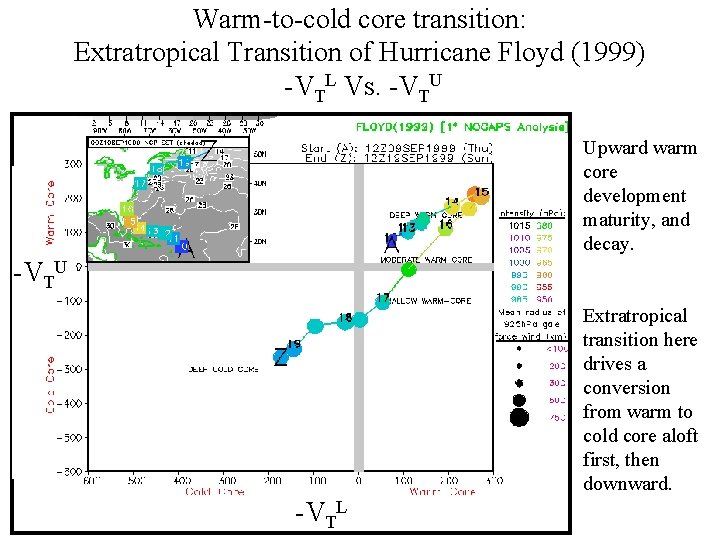
Warm-to-cold core transition: Extratropical Transition of Hurricane Floyd (1999) -VTL Vs. -VTU Upward warm core development maturity, and decay. -VTU Extratropical transition here drives a conversion from warm to cold core aloft first, then downward. -VTL
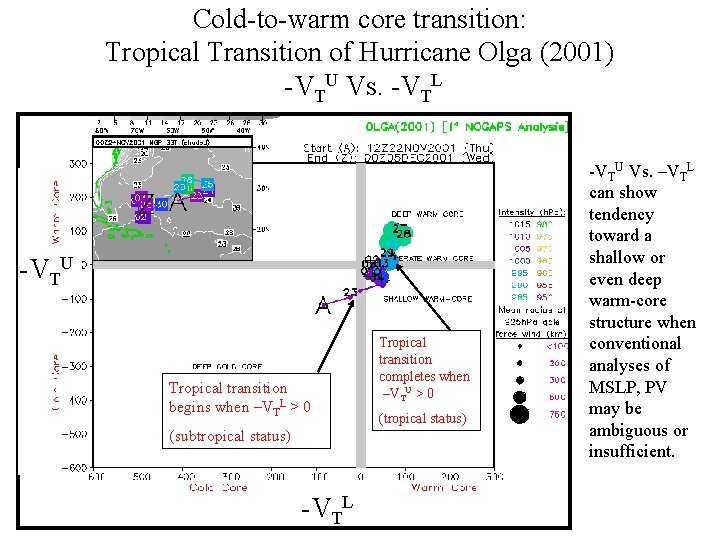
Cold-to-warm core transition: Tropical Transition of Hurricane Olga (2001) -VTU Vs. -VTL -VTU Tropical transition begins when –VTL > 0 (subtropical status) -VTL Tropical transition completes when –VTU > 0 (tropical status) -VTU Vs. –VTL can show tendency toward a shallow or even deep warm-core structure when conventional analyses of MSLP, PV may be ambiguous or insufficient.
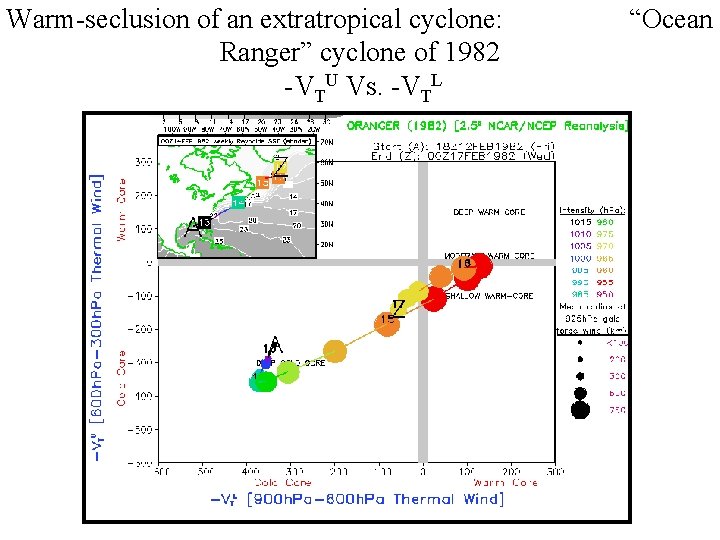
Warm-seclusion of an extratropical cyclone: Ranger” cyclone of 1982 -VTU Vs. -VTL “Ocean
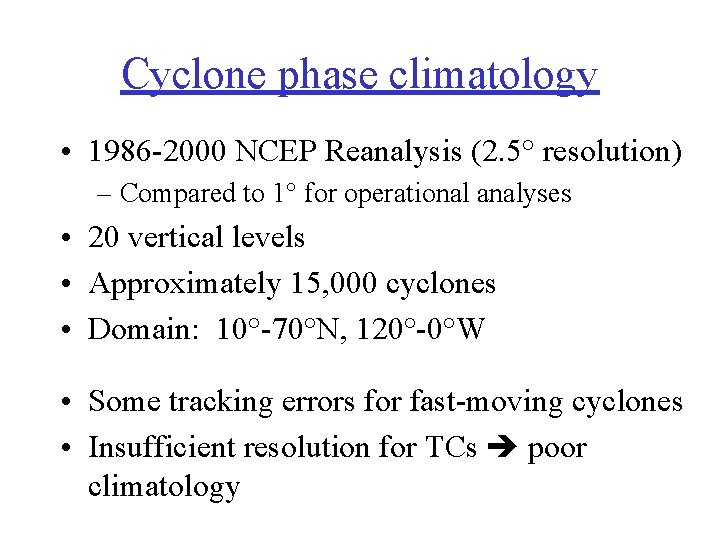
Cyclone phase climatology • 1986 -2000 NCEP Reanalysis (2. 5° resolution) – Compared to 1° for operational analyses • 20 vertical levels • Approximately 15, 000 cyclones • Domain: 10°-70°N, 120°-0°W • Some tracking errors for fast-moving cyclones • Insufficient resolution for TCs poor climatology
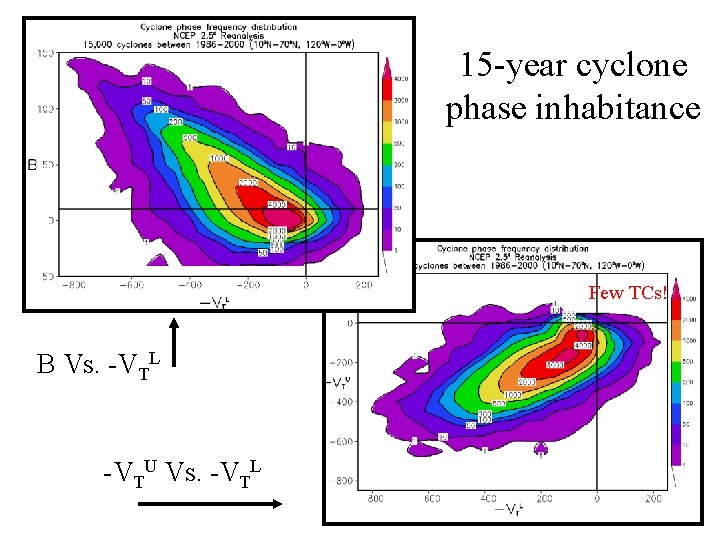
15 -year cyclone phase inhabitance Few TCs! B Vs. -VTL -VTU Vs. -VTL
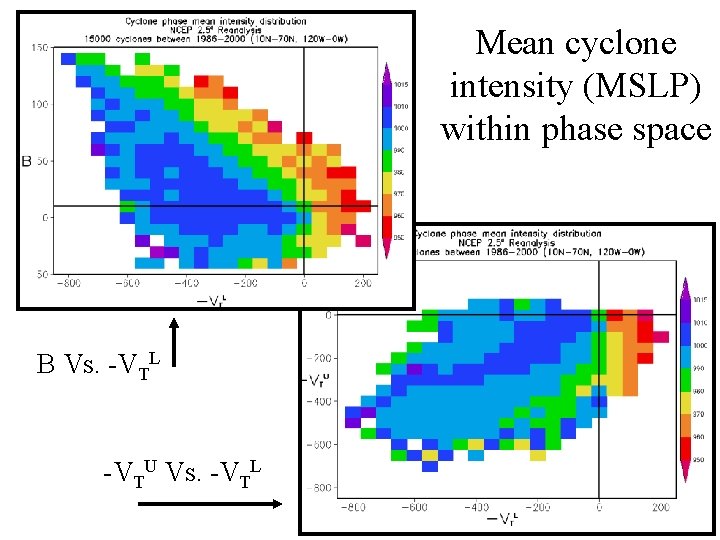
Mean cyclone intensity (MSLP) within phase space B Vs. -VTL -VTU Vs. -VTL
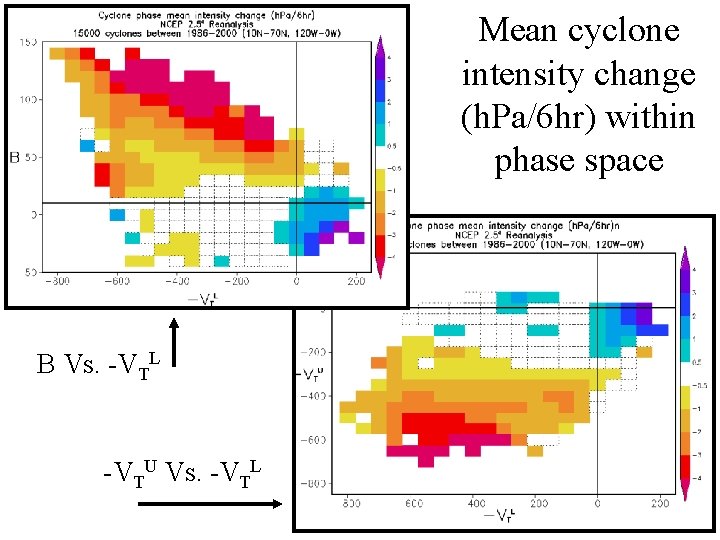
Mean cyclone intensity change (h. Pa/6 hr) within phase space B Vs. -VTL -VTU Vs. -VTL
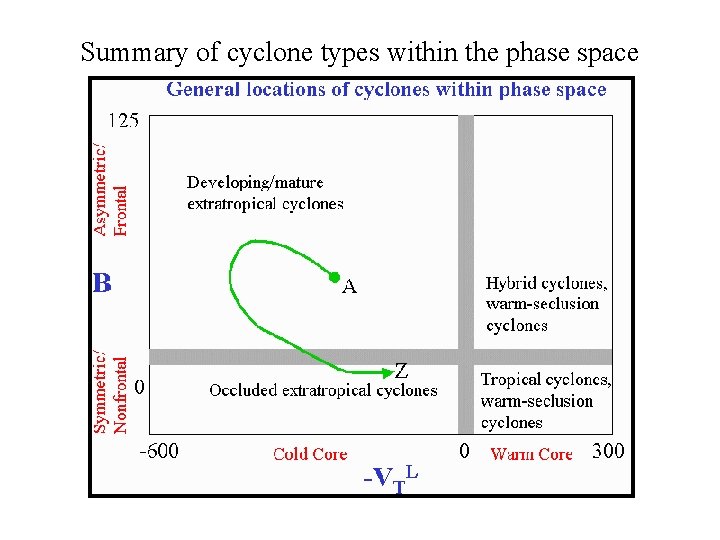
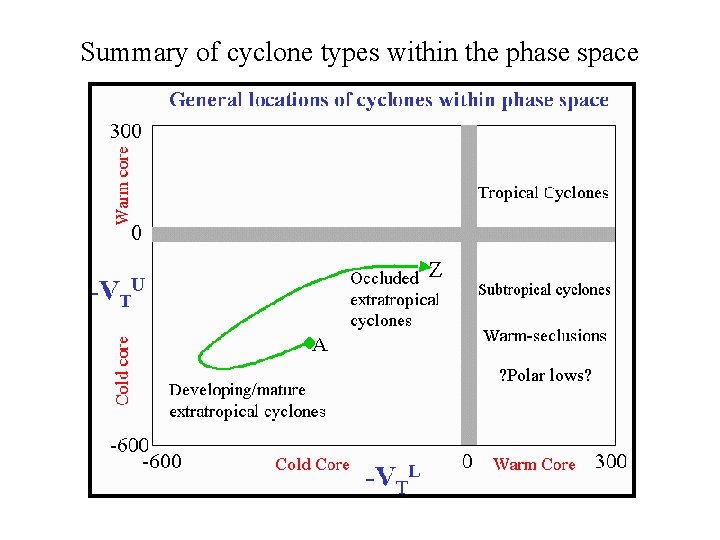
Summary of cyclone types within the phase space
Summary of cyclone types within the phase space ? Polar lows?
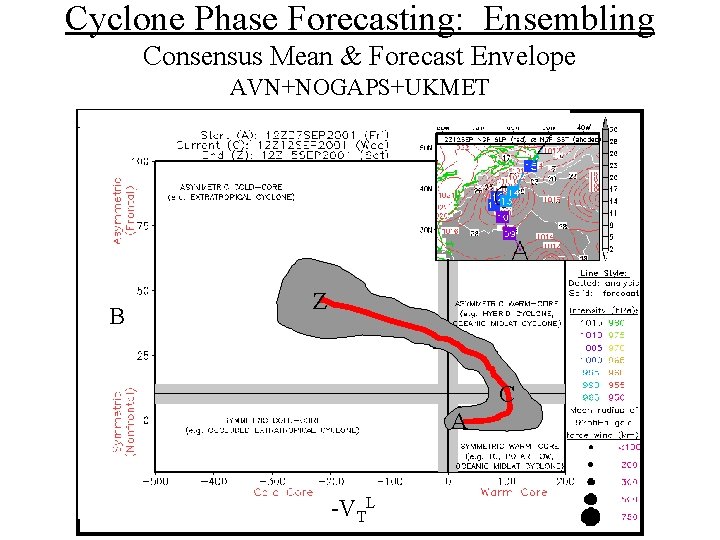
Real-time Cyclone Phase Analysis & Forecasting • Phase diagrams produced in real-time for various operational and research models. • Provides insight into cyclone evolution that may not be apparent from conventional analyses • Can be used to aid anticipation of phase changes, especially extratropical & (sub)tropical transition. • Were used experimentally during 2001 hurricane season. • Web site: http: //eyewall. met. psu. edu/cyclonephase
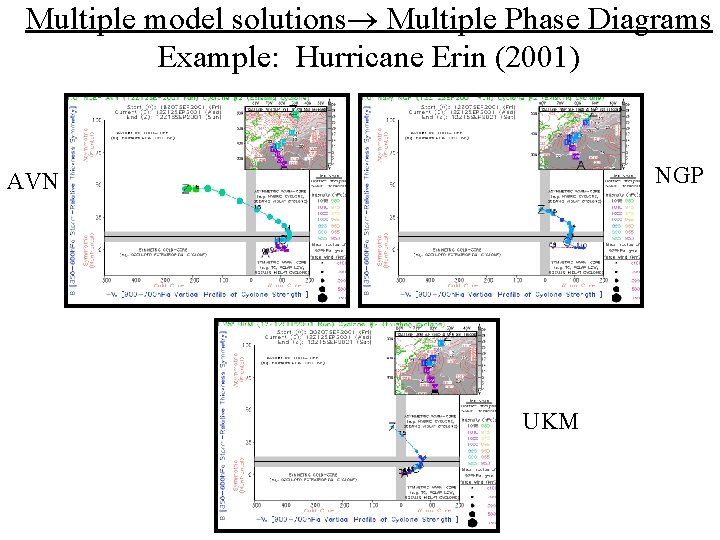
Multiple model solutions Multiple Phase Diagrams Example: Hurricane Erin (2001) NGP AVN UKM
Cyclone Phase Forecasting: Ensembling Consensus Mean & Forecast Envelope AVN+NOGAPS+UKMET B Z C A -VTL
Phase space limitations • Cyclone phase diagrams are dependent on the quality of the analyses upon which they are based. • Three dimensions (B, -VTL, -VTU) are not expected to explain all aspects of cyclone development • Other potential dimensions: static stability, long-wave pattern, jet streak configuration, binary cyclone interaction, tropopause height/folds, surface moisture availability, surface roughness. . . • However, the chosen three parameters represent a large percentage of the variance & explain the crucial structural changes.
Summary • A continuum of cyclone phase space is proposed, defined, & explored. • A unified diagnosis method for basic cyclone structure is possible. • Conventional tropical & extratropical cyclone lifecycles are well-defined within the phase space. • Unconventional lifecycles (extratropical transition, hybrid cyclones) are resolved within the phase space. • Describing and explaining cyclone evolution is not limited to the two textbook examples provided by historic cyclone development theory. • The phase diagram can be applied to forecast data to arrive at estimates forecast cyclones evolution, providing guidance for complex cyclones that was otherwise unavailable. • Objective estimates for the timing of extratropical and tropical transition of cyclones is now possible. (NHC, CHC)
Future Work • Continued use of the phase space to understand complex cyclone evolutions, including examination of dynamics as phase changes. • Evaluation of the phase space to diagnose phase transition: tropical and extratropical – Hart & Evans (2002 AMS Hurricanes; Thursday presentation) – Can it be used to anticipate (sub)tropical transition (e. g. Olga 2001) • Examine the impact of a synthetic (bogus) vortex on the phase evolution – Can phase evolution be used to diagnose when a bogus should be ceased? • Examine the predictability within phase space: what models are most skilled at forecasting extratropical transition, and phase in general? – Is predictability related to phase or phase change?
Acknowledgments & References • Penn State University: Jenni Evans, Bill Frank, Nelson Seaman, Mike Fritsch • SUNY Albany: Lance Bosart, John Molinari • University of Wisconsin/CIMSS: Chris Velden • National Hurricane Center (NHC): Jack Beven, Miles Lawrence • Canadian Hurricane Center (CHC): Pete Bowyer • NCDC for the online database of satellite imagery, NCEP for providing real-time analyses, NCAR/ NCEP for their online archive of reanalysis data through CDC, and Mike Fiorino for providing NOGAPS analyses Beven, J. L. II, 1997: A study of three “hybrid” storms. Proc. 22 nd Conf. On Hurricanes and Tropical Meteorology, Fort Collins, CO, Amer. Meteor. Soc. , 645 -6. Harr, P. and R. L. Elsberry, 2000: Extratropical transition of tropical cyclones over the western North Pacific. Part I. : Evolution of structural characteristics during the transition process. Mon. Wea. Rev. , 128, 2613 -2633. Klein, P. Harr, and R. Elsberry, 2000: Extratropical transition of western north Pacific tropical cyclones: An overview and conceptual model of the transformation stage. Wea. And Forecasting, 15, 373 -396. Kuo, Y. -H. , R. J. Reed, and S. Low-Nam, 1992: Thermal structure and airflow in a model simulation of an occluded marine cyclone. Mon. Wea. Rev. , 120, 2280 -2297. Pierce, C. H. , 1939: The meteorological history of the New England hurricane of Sept. 21, 1938. Mon. Wea. Rev. , 67, 237 -285. Reale, O. and R. Atlas, 2001: Tropical cyclone-like vortices in the extratropics: Observational evidence and synoptic analysis. Weather and Forecasting, 16, 7 -34. Schultz, D. M. and C. F. Mass, 1993: The occlusion process in a midlatitude cyclone over land. Mon. Wea. Rev. , 121, 918 -940.
Separate the 5 tropical cyclones from the 5 extratropical. Images courtesy NCDC Noel (2001) Unnamed TC (1991) Michael (2000) “Perfect” Storm (1991) Extratropical Low President’s Day Blizzard (1979) Floyd (1999) Gloria (1985) Superstorm of 1993