
A Culture of SafetyJust Culture Introduction The Past

- Slides: 17
A Culture of Safety/Just Culture
Introduction The Past The culture of health care in the past focuses on placing blame on healthcare providers whenever there was an error or bad outcomes occurred. With this kind of culture, health care providers were hesitant to report any errors due to fear of punishment. As a result such occurrences were never reported. The Present To improve reporting of errors, organizations moved to blameless culture, however, this type of culture did not succeed due to lack of accountability and the practice did not promote a learning environment that promoted patient safety. Today, the focus of health care is patient safety and “Just Culture” balances the assessment of systems, processes and human behavior when an error or event is reported.
What is “Just Culture” The term “Just Culture” refers to a safety-supportive system of shared accountability where health care organizations are accountable for the systems they have designed and for responding to the behaviors of their staffs in fair and just manners. Staff, in turn, is accountable for the quality of their choices and for reporting both their errors and system vulnerabilities.
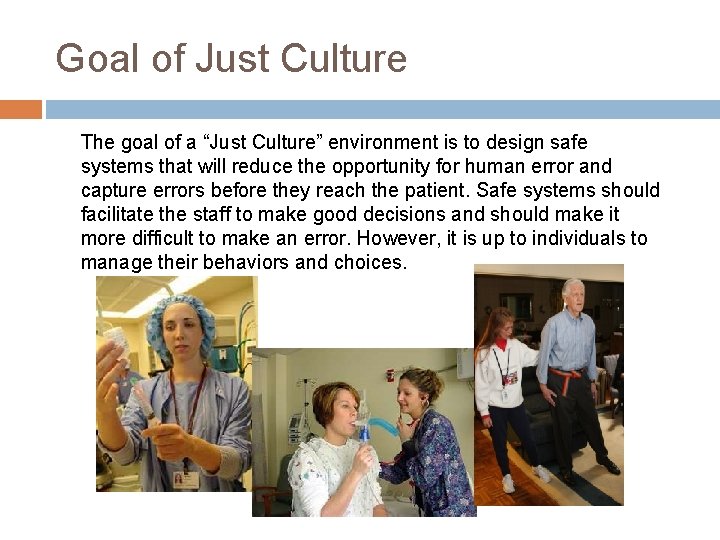
Goal of Just Culture The goal of a “Just Culture” environment is to design safe systems that will reduce the opportunity for human error and capture errors before they reach the patient. Safe systems should facilitate the staff to make good decisions and should make it more difficult to make an error. However, it is up to individuals to manage their behaviors and choices.
Just Culture Environment “Just Culture” is an environment where negligence is identified and discipline is applied appropriately after a systematic review of the error. To ensure a fair and just process, an established set of objective questions follow an algorithm to identify if the error occurred due to a system or process issue and/or due to human error. Staff is held accountable for their actions or behaviors. Staff is held blameless when there is a system or process that allowed the error to happen.
Just Culture Environment “Just Culture” environment recognizes that competent professionals make mistakes and acknowledges that even competent professionals will develop unhealthy norms (shortcuts, “routine rule violations”), but has zero tolerance for reckless behavior. “Just Culture” supports a learning culture and focuses on proactive management of system design and management of behavioral choices.
Just Culture An objective model for dealing with human errors and breeches Decision paths for allocating responsibility to either the system or the individual Based upon duty Not based upon severity of outcome 7
Just Culture Foundational Assumption About Risk: Humans will make errors and drift into at-risk behaviors as they become comfortable with processes Risk is managed by monitoring and measuring errors Judged using our values against what another reasonable person in a similar situation would do 8
Just Culture http: //www. youtube. com/watch? v=2 Uzd. Kk. LTph. E You can embed the movie, David Marx Introduces the Just Culture, on this slide. 9
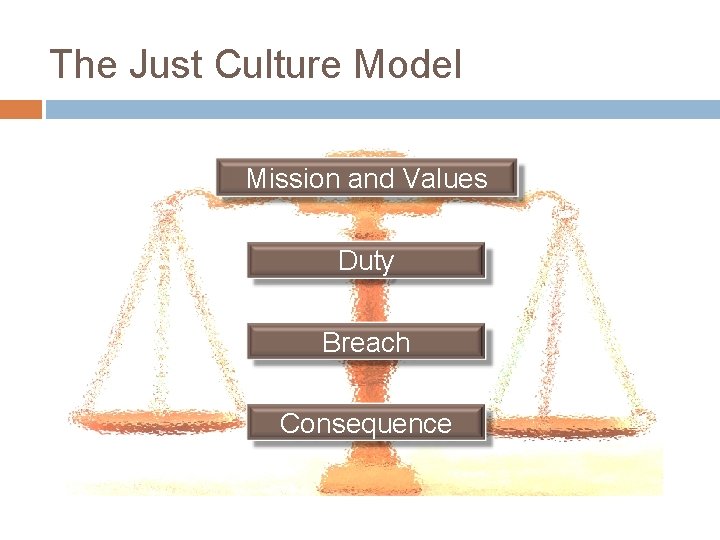
The Just Culture Model Mission and Values Duty Breach Consequence
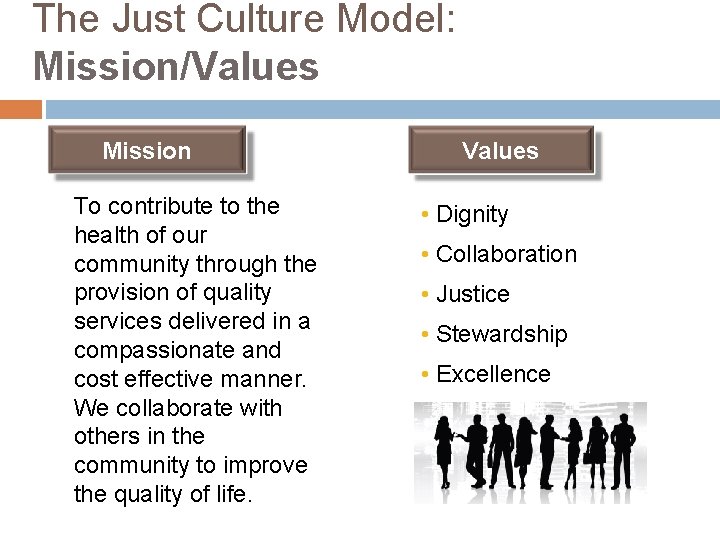
The Just Culture Model: Mission/Values Mission To contribute to the health of our community through the provision of quality services delivered in a compassionate and cost effective manner. We collaborate with others in the community to improve the quality of life. Values • Dignity • Collaboration • Justice • Stewardship • Excellence
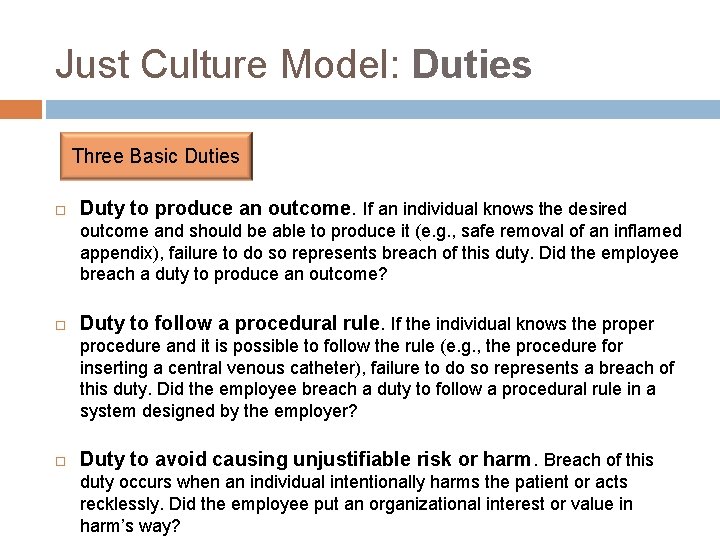
Just Culture Model: Duties Three Basic Duties Duty to produce an outcome. If an individual knows the desired outcome and should be able to produce it (e. g. , safe removal of an inflamed appendix), failure to do so represents breach of this duty. Did the employee breach a duty to produce an outcome? Duty to follow a procedural rule. If the individual knows the proper procedure and it is possible to follow the rule (e. g. , the procedure for inserting a central venous catheter), failure to do so represents a breach of this duty. Did the employee breach a duty to follow a procedural rule in a system designed by the employer? Duty to avoid causing unjustifiable risk or harm. Breach of this duty occurs when an individual intentionally harms the patient or acts recklessly. Did the employee put an organizational interest or value in harm’s way?
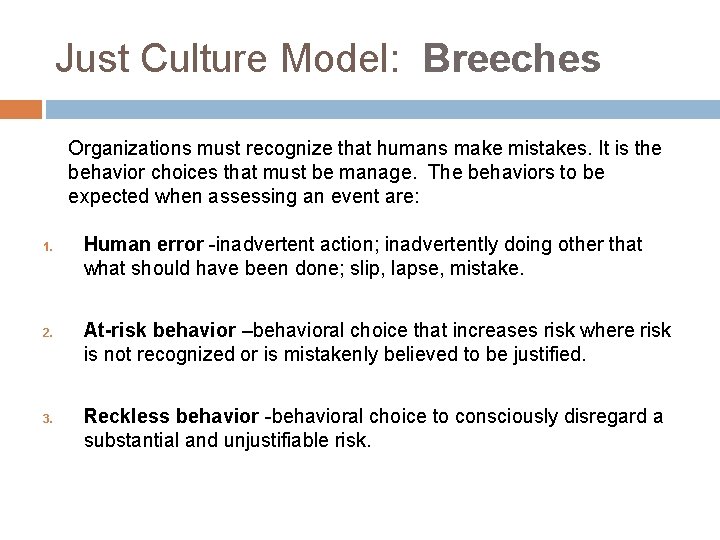
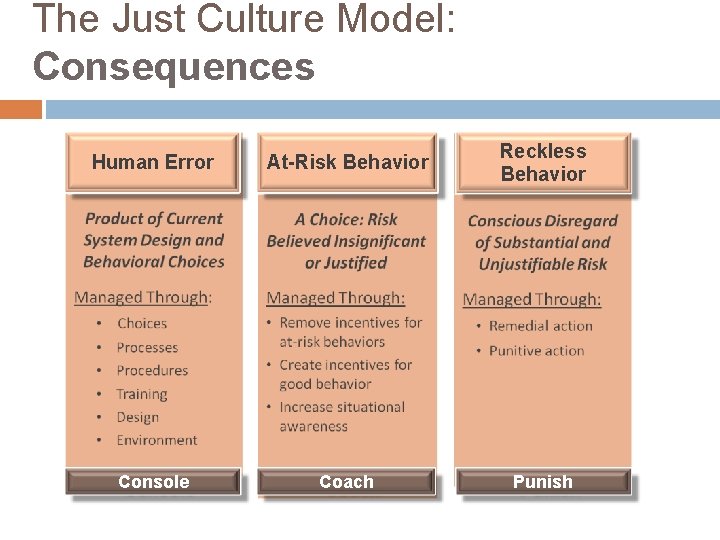
Just Culture Model: Breeches Organizations must recognize that humans make mistakes. It is the behavior choices that must be manage. The behaviors to be expected when assessing an event are: 1. 2. 3. Human error -inadvertent action; inadvertently doing other that what should have been done; slip, lapse, mistake. At-risk behavior –behavioral choice that increases risk where risk is not recognized or is mistakenly believed to be justified. Reckless behavior -behavioral choice to consciously disregard a substantial and unjustifiable risk.
The Just Culture Model: Consequences Human Error At-Risk Behavior Reckless Behavior Console Coach Punish
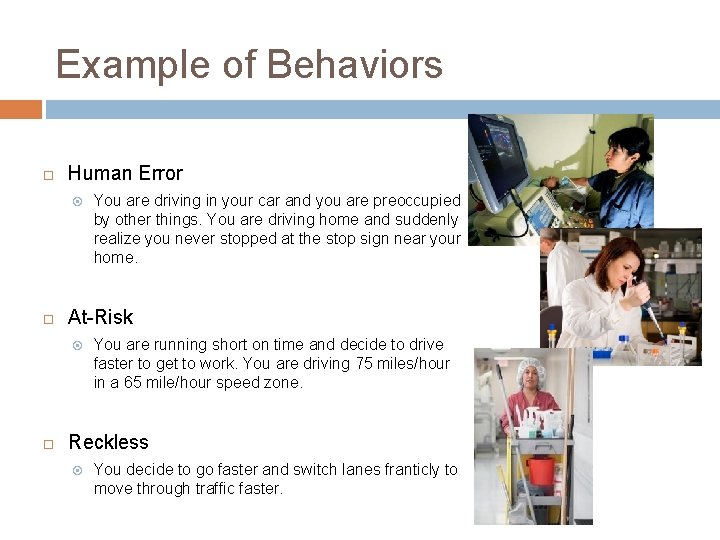
Example of Behaviors Human Error At-Risk You are driving in your car and you are preoccupied by other things. You are driving home and suddenly realize you never stopped at the stop sign near your home. You are running short on time and decide to drive faster to get to work. You are driving 75 miles/hour in a 65 mile/hour speed zone. Reckless You decide to go faster and switch lanes franticly to move through traffic faster.
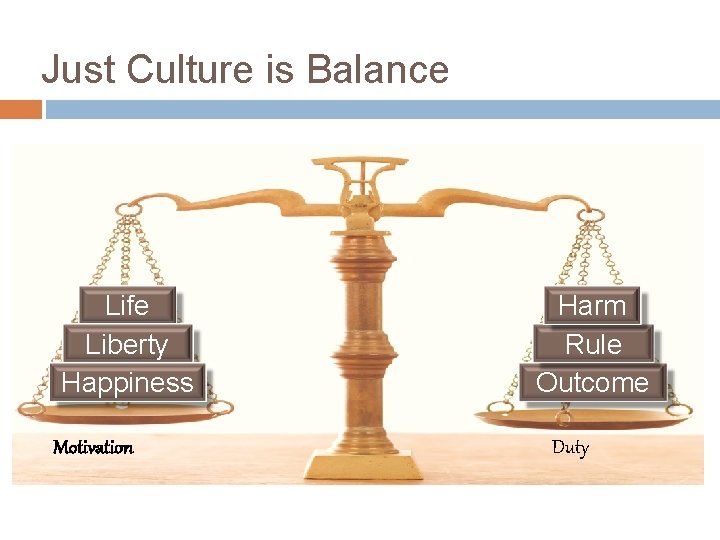
Just Culture is Balance Life Liberty Happiness Motivation Harm Rule Outcome Duty
It’s All About Patient Safety