
A CUDA IMPLEMENTATION OF THE HPCG BENCHMARK Everett

A CUDA IMPLEMENTATION OF THE HPCG BENCHMARK Everett Phillips Massimiliano Fatica
OUTLINE High Performance Conjugate Gradient Benchmark Introduction CUDA Implementation Optimization Performance Results Single GPU Supercomputers Conclusion
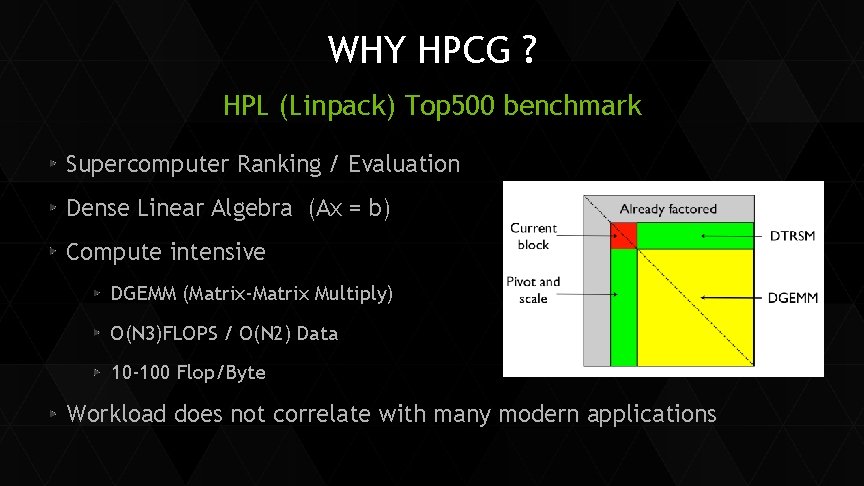
WHY HPCG ? HPL (Linpack) Top 500 benchmark Supercomputer Ranking / Evaluation Dense Linear Algebra (Ax = b) Compute intensive DGEMM (Matrix-Matrix Multiply) O(N 3)FLOPS / O(N 2) Data 10 -100 Flop/Byte Workload does not correlate with many modern applications
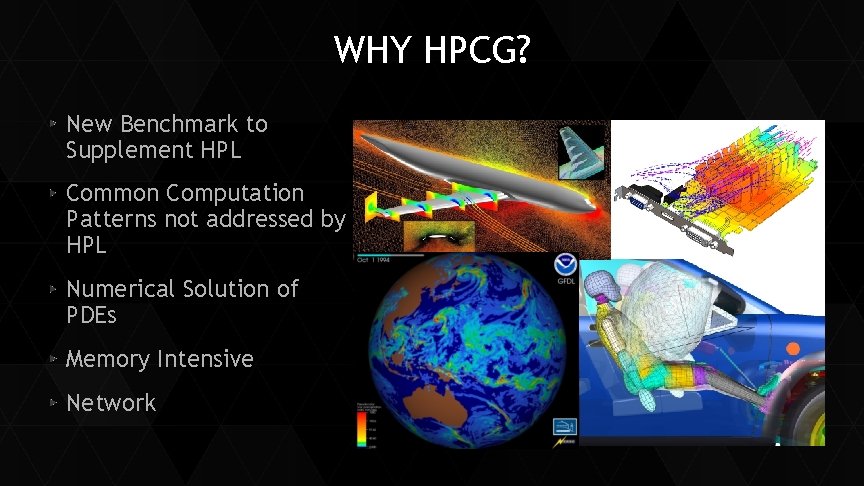
WHY HPCG? New Benchmark to Supplement HPL Common Computation Patterns not addressed by HPL Numerical Solution of PDEs Memory Intensive Network
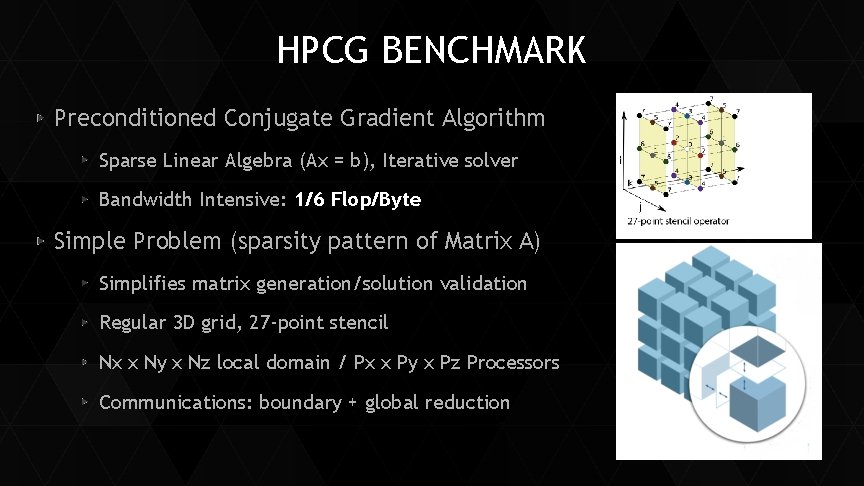
HPCG BENCHMARK Preconditioned Conjugate Gradient Algorithm Sparse Linear Algebra (Ax = b), Iterative solver Bandwidth Intensive: 1/6 Flop/Byte Simple Problem (sparsity pattern of Matrix A) Simplifies matrix generation/solution validation Regular 3 D grid, 27 -point stencil Nx x Ny x Nz local domain / Px x Py x Pz Processors Communications: boundary + global reduction
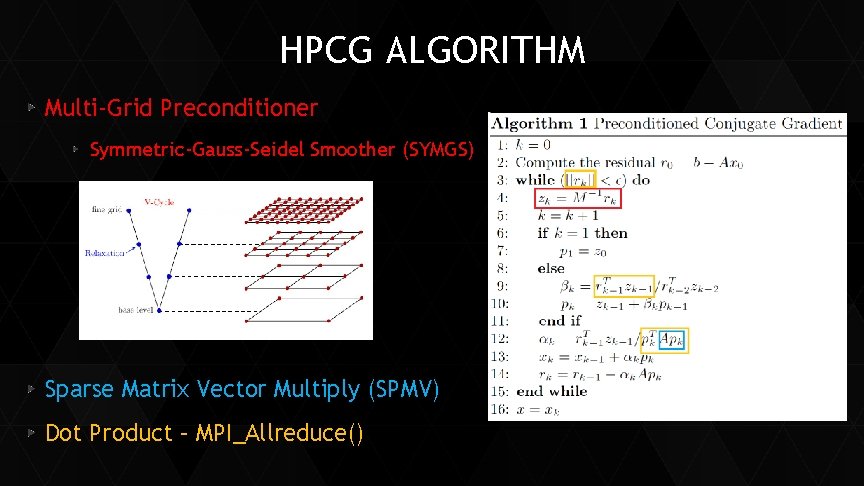
HPCG ALGORITHM Multi-Grid Preconditioner Symmetric-Gauss-Seidel Smoother (SYMGS) Sparse Matrix Vector Multiply (SPMV) Dot Product – MPI_Allreduce()
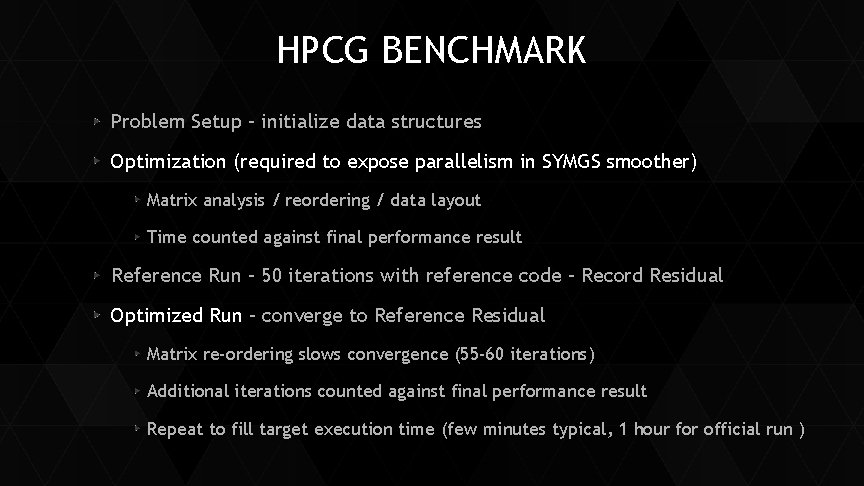
HPCG BENCHMARK Problem Setup – initialize data structures Optimization (required to expose parallelism in SYMGS smoother) Matrix analysis / reordering / data layout Time counted against final performance result Reference Run – 50 iterations with reference code – Record Residual Optimized Run – converge to Reference Residual Matrix re-ordering slows convergence (55 -60 iterations) Additional iterations counted against final performance result Repeat to fill target execution time (few minutes typical, 1 hour for official run )
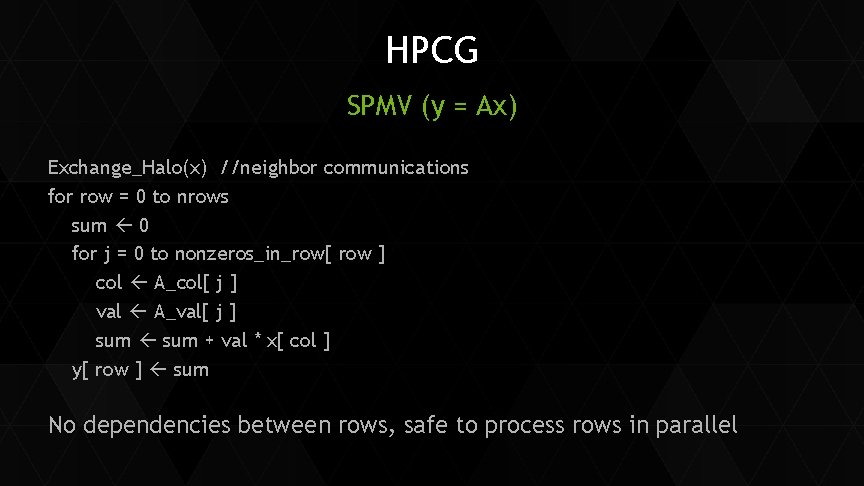
HPCG SPMV (y = Ax) Exchange_Halo(x) //neighbor communications for row = 0 to nrows sum 0 for j = 0 to nonzeros_in_row[ row ] col A_col[ j ] val A_val[ j ] sum + val * x[ col ] y[ row ] sum No dependencies between rows, safe to process rows in parallel
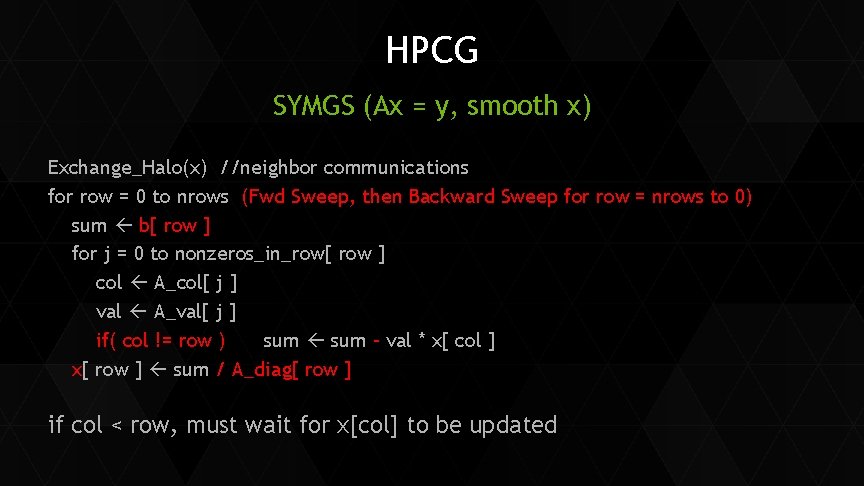
HPCG SYMGS (Ax = y, smooth x) Exchange_Halo(x) //neighbor communications for row = 0 to nrows (Fwd Sweep, then Backward Sweep for row = nrows to 0) sum b[ row ] for j = 0 to nonzeros_in_row[ row ] col A_col[ j ] val A_val[ j ] if( col != row ) sum – val * x[ col ] x[ row ] sum / A_diag[ row ] if col < row, must wait for x[col] to be updated
CUDA IMPLEMENTATIONS I. Cusparse CSR II. Cusparse CSR + Matrix Reordering III. Custom Kernels CSR + Matrix Reordering IV. Custom Kernels ELL + Matrix Reordering
BASELINE CUSPARSE Leverage existing Libraries CUSPARSE (TRSV + SPMV), CUBLAS (DOT, AXPY), THRUST (sort, count) Flexible, works with any matrix ordering (allows experimentation) Shortcomings Triangular solve perf (limited parallelism, memory access pattern) Expensive Analysis for Triangular Solves Extra steps to compute SYMGS ( SPMV + Vector Update) Columns must be sorted WRT diagonal
OPTIMIZED VERSIONS Reorder Matrix (Graph Coloring) triangular solve perf Custom Kernels Removes extra steps in SYMGS (same algorithm as reference) No cusparse analysis overhead Relaxed data format requirements (non square mtx and unsorted columns ok) ELLPACK Memory access efficiency
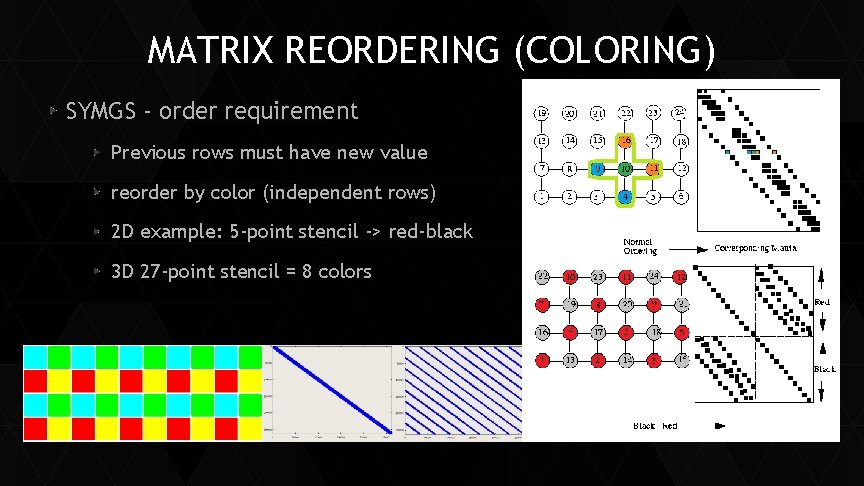
MATRIX REORDERING (COLORING) SYMGS - order requirement Previous rows must have new value reorder by color (independent rows) 2 D example: 5 -point stencil -> red-black 3 D 27 -point stencil = 8 colors
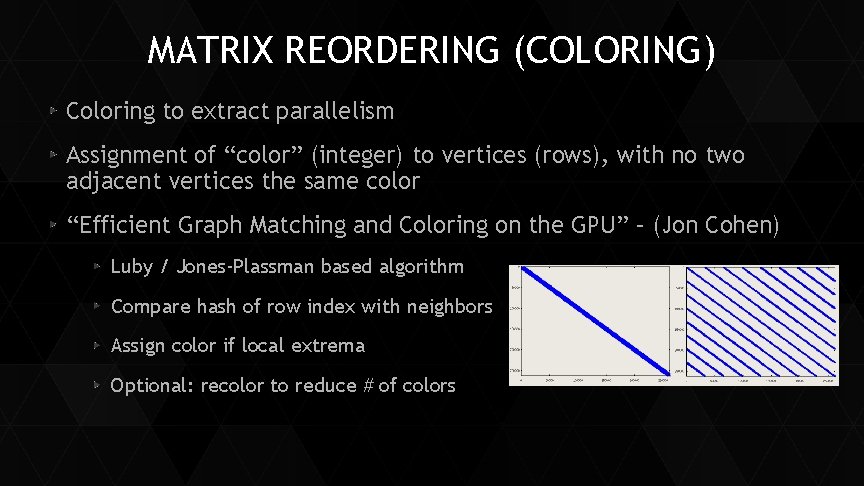
MATRIX REORDERING (COLORING) Coloring to extract parallelism Assignment of “color” (integer) to vertices (rows), with no two adjacent vertices the same color “Efficient Graph Matching and Coloring on the GPU” – (Jon Cohen) Luby / Jones-Plassman based algorithm Compare hash of row index with neighbors Assign color if local extrema Optional: recolor to reduce # of colors
MORE OPTIMIZATIONS Overlap Computation with neighbor communication Overlap 1/3 MPI_Allreduce with Computation __LDG loads for irregular access patterns (SPMV + SYMGS)
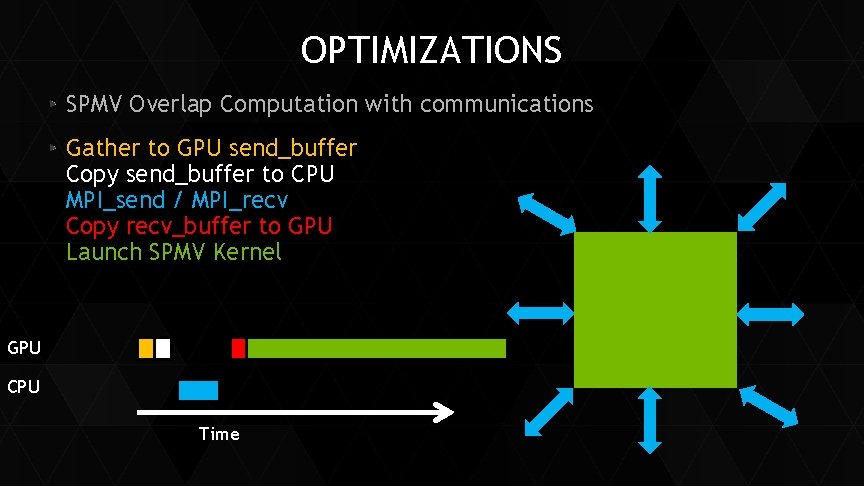
OPTIMIZATIONS SPMV Overlap Computation with communications Gather to GPU send_buffer Copy send_buffer to CPU MPI_send / MPI_recv Copy recv_buffer to GPU Launch SPMV Kernel GPU CPU Time
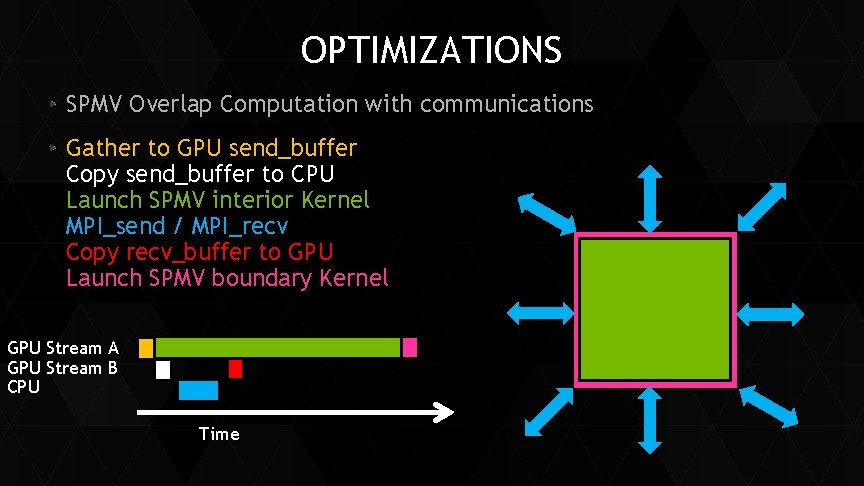
OPTIMIZATIONS SPMV Overlap Computation with communications Gather to GPU send_buffer Copy send_buffer to CPU Launch SPMV interior Kernel MPI_send / MPI_recv Copy recv_buffer to GPU Launch SPMV boundary Kernel GPU Stream A GPU Stream B CPU Time
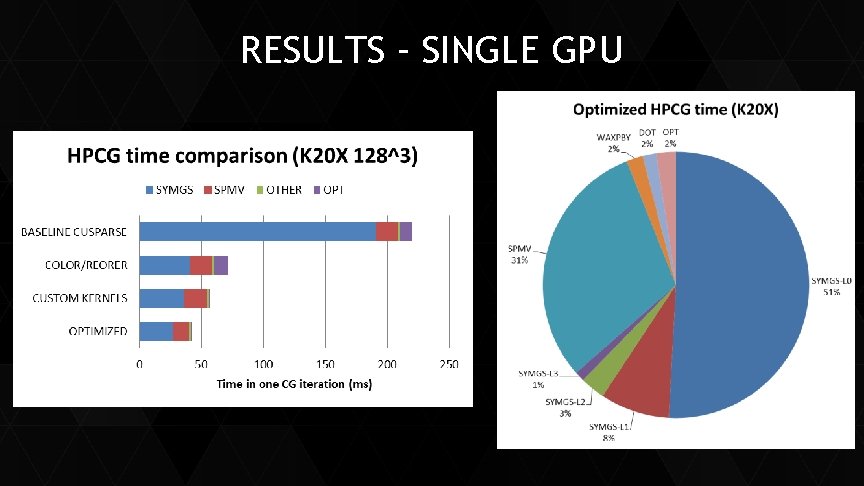
RESULTS – SINGLE GPU
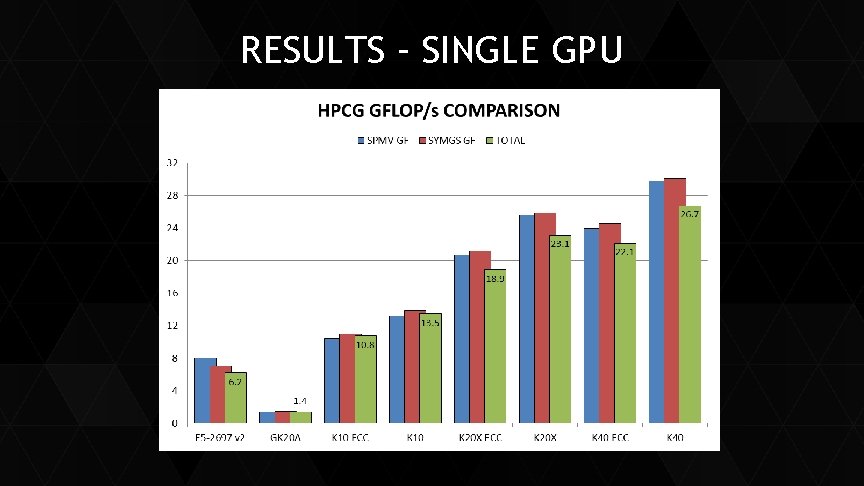
RESULTS – SINGLE GPU
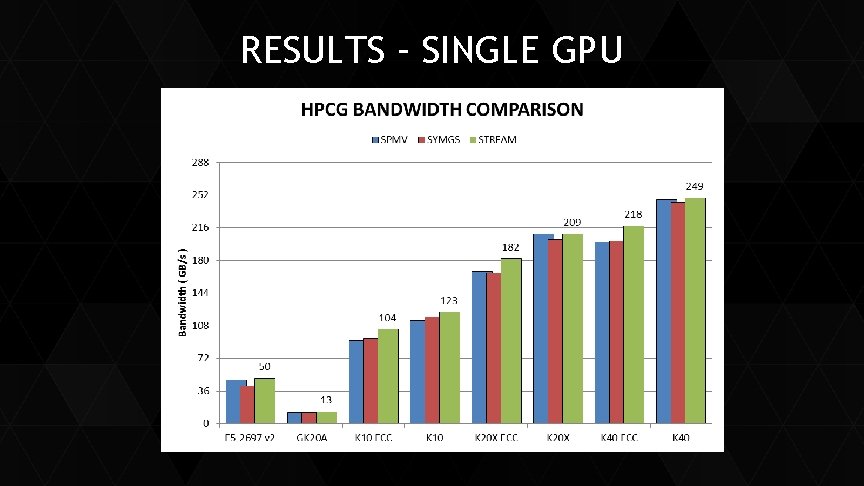
RESULTS – SINGLE GPU
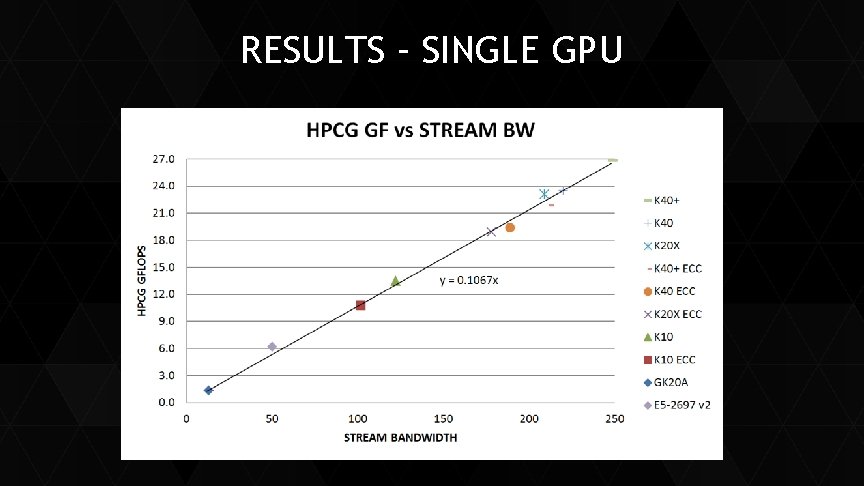
RESULTS – SINGLE GPU
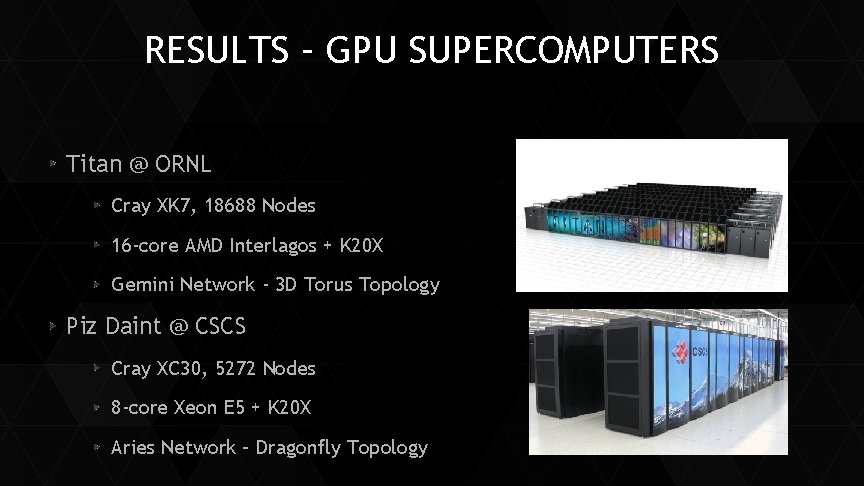
RESULTS – GPU SUPERCOMPUTERS Titan @ ORNL Cray XK 7, 18688 Nodes 16 -core AMD Interlagos + K 20 X Gemini Network - 3 D Torus Topology Piz Daint @ CSCS Cray XC 30, 5272 Nodes 8 -core Xeon E 5 + K 20 X Aries Network – Dragonfly Topology
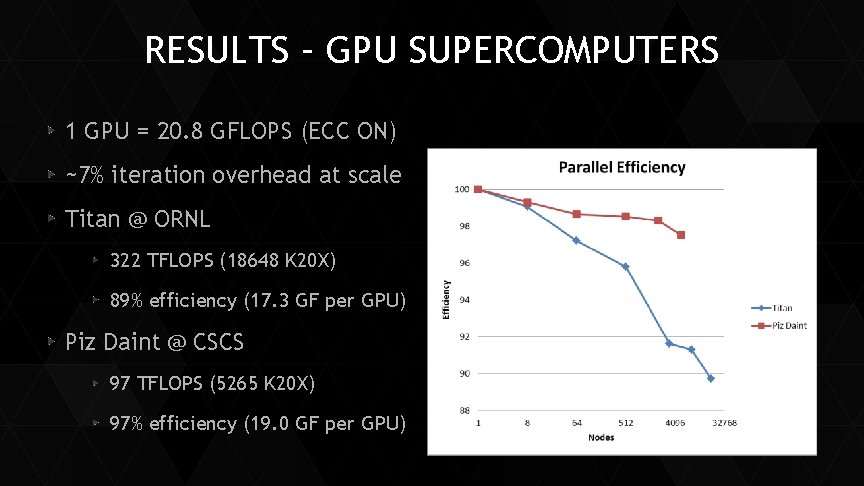
RESULTS – GPU SUPERCOMPUTERS 1 GPU = 20. 8 GFLOPS (ECC ON) ~7% iteration overhead at scale Titan @ ORNL 322 TFLOPS (18648 K 20 X) 89% efficiency (17. 3 GF per GPU) Piz Daint @ CSCS 97 TFLOPS (5265 K 20 X) 97% efficiency (19. 0 GF per GPU)
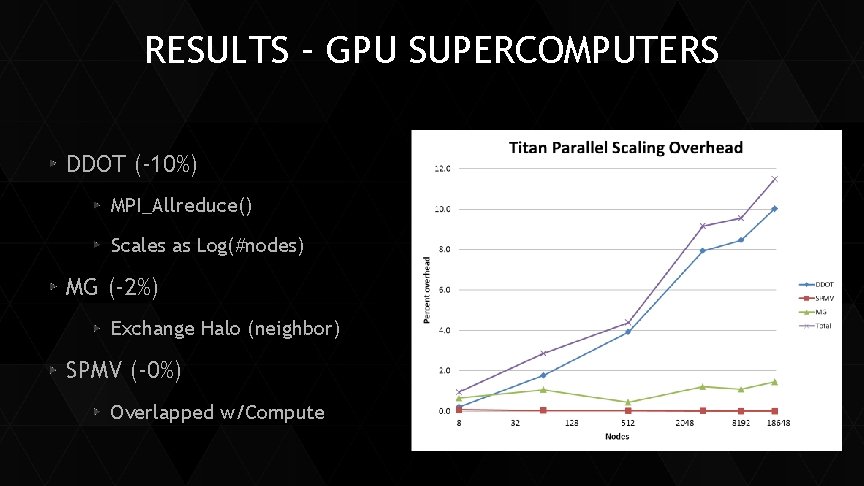
RESULTS – GPU SUPERCOMPUTERS DDOT (-10%) MPI_Allreduce() Scales as Log(#nodes) MG (-2%) Exchange Halo (neighbor) SPMV (-0%) Overlapped w/Compute
REPRODUCIBILITY Residual Variance (reported in output file) zero = deterministic order of floating point operations GPU Supercomputers bitwise reproducible up to full scale except with network hardware-acceleration enabled on Cray XC 30 Parallel Dot Product Local GPU routines bitwise reproducible MPI_Allreduce() reproducible with default MPI implementation Non-reproducible with network offload (hardware atomics)
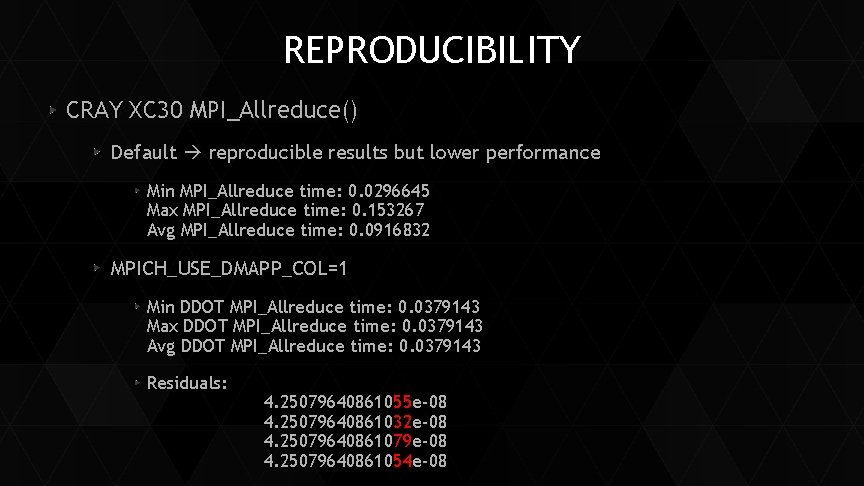
REPRODUCIBILITY CRAY XC 30 MPI_Allreduce() Default reproducible results but lower performance Min MPI_Allreduce time: 0. 0296645 Max MPI_Allreduce time: 0. 153267 Avg MPI_Allreduce time: 0. 0916832 MPICH_USE_DMAPP_COL=1 Min DDOT MPI_Allreduce time: 0. 0379143 Max DDOT MPI_Allreduce time: 0. 0379143 Avg DDOT MPI_Allreduce time: 0. 0379143 Residuals: 4. 25079640861055 e-08 4. 25079640861032 e-08 4. 25079640861079 e-08 4. 25079640861054 e-08
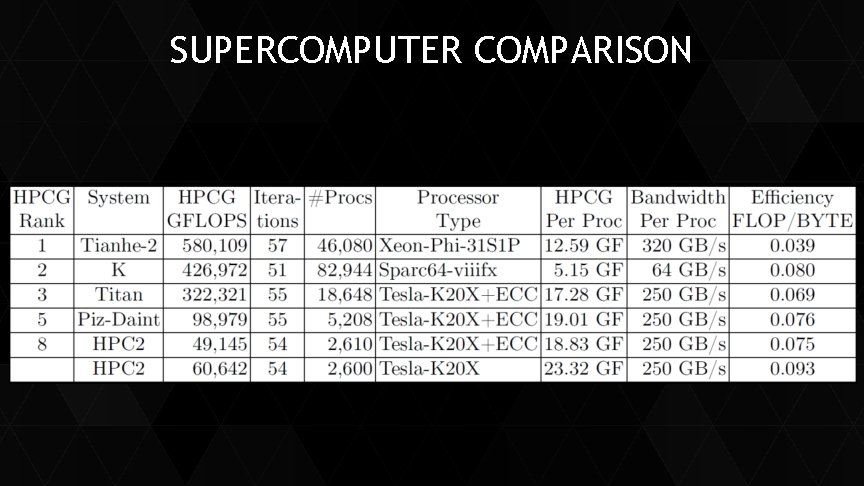
SUPERCOMPUTER COMPARISON
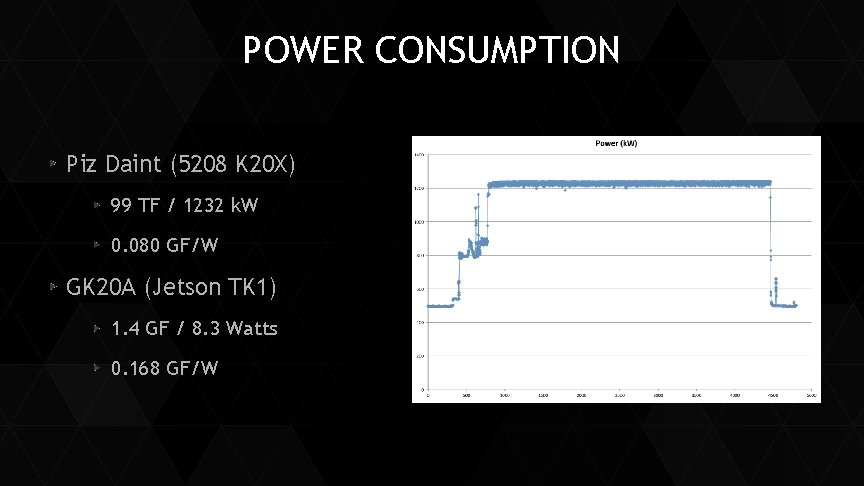
POWER CONSUMPTION Piz Daint (5208 K 20 X) 99 TF / 1232 k. W 0. 080 GF/W GK 20 A (Jetson TK 1) 1. 4 GF / 8. 3 Watts 0. 168 GF/W
CONCLUSIONS GPUs proven effective for HPL, especially for power efficiency High flop rate GPUs also very effective for HPCG High memory bandwidth Stacked memory will give a huge boost Future work will add CPU + GPU

ACKNOWLEDGMENTS Oak Ridge Leadership Computing Facility (ORNL) Buddy Bland, Jack Wells and Don Maxwell Swiss National Supercomputing Center (CSCS) Gilles Fourestey and Thomas Schulthess NVIDIA Lung Scheng Chien and Jonathan Cohen
- Slides: 30