
A CUB Model Strategy to Select Anchoring Vignettes

A CUB Model Strategy to Select Anchoring Vignettes Omar Paccagnella 1 and Maria Iannario 2 1 Department of Statistical Sciences – University of Padua 2 Department of Political Sciences – University of Naples Federico II
Introduction In socio-economic surveys, collecting subjective evaluations of individuals’ health, living conditions or thoughts on certain aspects of their own life is quite common Questions on individual’s attitudes, opinions or perceptions (i. e. job or customer satisfaction, life quality, health status, etc. ) try to measure an underlying continuous latent variable, but for practical reasons the answer is usually expressed through an ordered set of categories QDET 2 2016 Miami – November 12, 2016
Introduction There is a large literature on ordinal data modelling, particularly on the analysis AFTER data collection. What about the selection of questions to be included in a questionnaire, that is BEFORE data collection ? This work aims at introducing a mixture model strategy (i. e. a parametric model solution) to select questions requiring ordinal answers → Pretesting ? → Selection questions from a large set of questions? QDET 2 2016 Miami – November 12, 2016

CUB models • QDET 2 2016 Miami – November 12, 2016
Uncertainty In CUB uncertainty is the result of some related factors: - Amount of time devoted to the response - Tiredness or fatigue - Nature of the chosen scale - Willingness to joke and fake - Knowledge/ignorance - Partial understanding of the item … QDET 2 2016 Miami – November 12, 2016

CUB models • QDET 2 2016 Miami – November 12, 2016
Vignettes have a long history to investigate social phenomena “…short descriptions of a person or a social situation which contain precise references to what are thought to be the most important factors in the decision-making or judgement -making process of respondents” (Alexander & Becker, 1978) Statistical solutions exploiting the vignettes as an additional tool to identify and correct for the systematic differences in the use of response scales within countries or socioeconomic groups were introduced by King et al. (2004) QDET 2 2016 Miami – November 12, 2016
Vignettes The presence of individual heterogeneity leads respondents to interpret, understand, use the response categories for the same questions differently: DIF – Differential Item Functioning Anchoring vignettes aim at making comparable, across respondents, self-evaluations affected by individual unobserved heterogeneity Since the ratings of the vignette persons provide an anchor (a gold standard) for adjusting self-ratings, these instruments were called anchoring vignettes Two assumptions: response consistency & vignette equivalence QDET 2 2016 Miami – November 12, 2016

The application The proposed strategy is applied to a vignette dataset on work disability, collected in the SHARE (Survey of Health, Ageing and Retirement in Europe) project The self-reported question asks: Do you have any impairment or health problem that limits the amount or kind of work you can do? (1=None; 2=Mild; 3=Moderate; 4=Severe; 5=Extreme) In wave 1 (2004) 9 vignettes were proposed, while in wave 2 (2006) only 3 of them were collected ! QDET 2 2016 Miami – November 12, 2016

The application The final dataset is composed by 4007 observations (individuals who answered to all questions) coming from 8 countries: Sweden, Belgium, the Netherlands, Germany, France, Italy, Spain and Greece QDET 2 2016 Miami – November 12, 2016
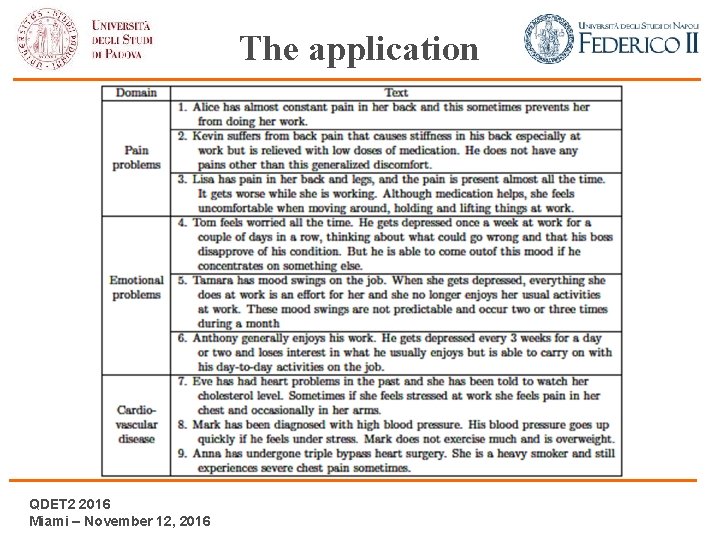
The application QDET 2 2016 Miami – November 12, 2016
The application Some analyses of reliability and construct validity show: Reliability: According to coefficient alpha (0. 82 – even if criticised…), Guttman lower bounds, split-half tests, inter-item correlations no vignette shows particular problems Validity: According to EFA, 3 factors appears – one for each domain! However, vignette 2 shows a large value of uniqueness (0. 52), the lowest factor loading (0. 47) in its factor (“pain problems”) and a loading of 0. 34 for factor “emotional problems” QDET 2 2016 Miami – November 12, 2016

The application Vignette 2: Kevin suffers from back pain that causes stiffness in his back especially at work but is relieved with low doses of medication. He does not have any pains other than this generalized discomfort QDET 2 2016 Miami – November 12, 2016
The application Wave 2 vignettes were chosen in order to provide the most accurate estimates of cross-country differences, according to wave 1 results. The different domains were also taking into account. The wave 2 selection was: vignette 2 – 6 – 7 Which is the result using a CUB model framework without taking into account the domains’ information ? QDET 2 2016 Miami – November 12, 2016
The application A CUB model where self-rating is the dependent variable and ratings of the 9 vignettes are the explanatory variables is estimated. The statistically significant coefficients are associated to: Feeling component: vignette 1 – 3 – 4 – 9 Uncertainty component: vignette 2 QDET 2 2016 Miami – November 12, 2016
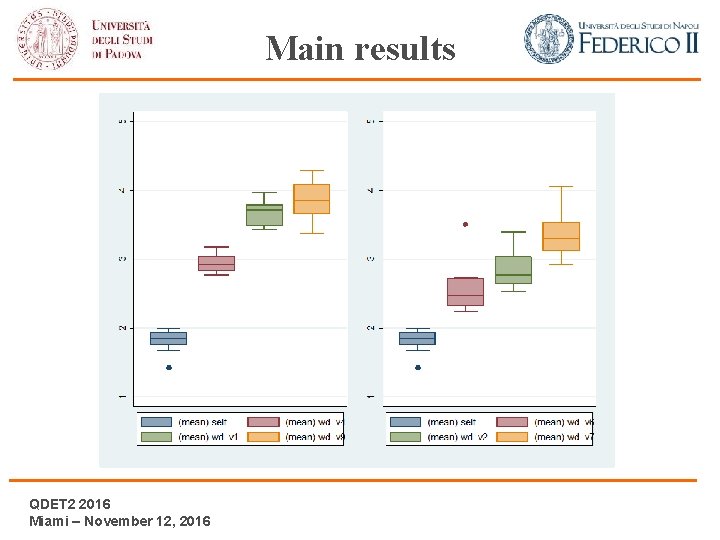
The application A further analysis that checks the best model fit for each of the statistically significant vignettes in the feeling component leads to propose the following selection: vignette 1 – 4 – 9 (The wave 2 selection was: vignette 2 – 6 – 7) QDET 2 2016 Miami – November 12, 2016
Main results - This approach is able to identify – in the uncertainty component – the vignette with potential problems of understanding. - Without imposing any constraints, a vignette for each domain has been selected QDET 2 2016 Miami – November 12, 2016
Main results Is our result the best set of vignettes? We do not, because we cannot have the “right” answer ! We could try to check which vignettes satisfy the assumptions (however, no formal testing are available in the literature so far…) We could compare the two sets of selected vignettes (i. e. number of countries having an answer category with a frequency smaller than 1%) or. . . QDET 2 2016 Miami – November 12, 2016
Main results QDET 2 2016 Miami – November 12, 2016
Concluding remarks CUB models may be an promising tool for selecting subsamples of questions asking for a rating It is based on a mixture model strategy Future research: - Experimental vignettes - Selecting the components of an overall satisfaction QDET 2 2016 Miami – November 12, 2016

THANK YOU ! QDET 2 2016 Miami – November 12, 2016
- Slides: 21